Next-to-next-to-leading-order QCD corrections to {}³S₁⁽⁸⁾ gluon fragmentation function for quarkonium
Pith reviewed 2026-06-26 08:05 UTC · model grok-4.3
The pith
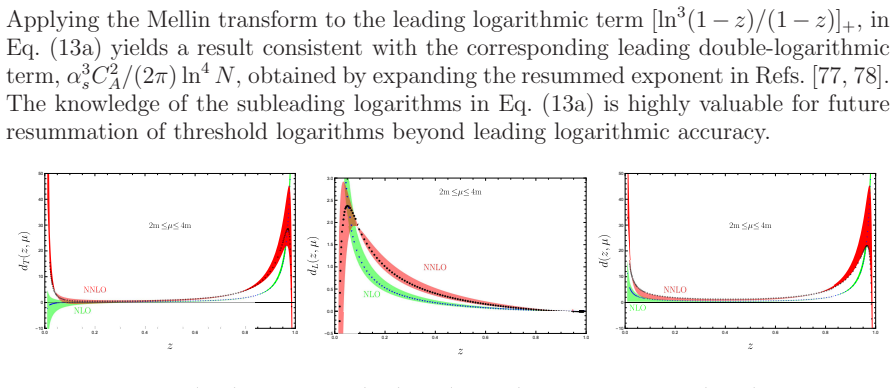
The first NNLO QCD calculation finds that corrections to the ³S₁⁽⁸⁾ gluon fragmentation function for quarkonium are positive and substantial over most of the momentum fraction range.
A machine-rendered reading of the paper's core claim, the machinery that carries it, and where it could break.
Core claim
We present the first computation of the next-to-next-to-leading-order (NNLO) QCD corrections to the ³S₁⁽⁸⁾ gluon fragmentation function for quarkonium within the nonrelativistic QCD (NRQCD) factorization framework, accurate to the lowest order in the velocity expansion. The calculation is performed with high numerical precision and encompasses both polarized and unpolarized cases. We find that the NNLO corrections are positive and substantial across most of the z region. Furthermore, the logarithmic singularities near the endpoint z→1 are fully reconstructed, providing essential inputs for future threshold resummation beyond leading-logarithmic accuracy.
What carries the argument
The ³S₁⁽⁸⁾ gluon fragmentation function in the NRQCD factorization framework at NNLO in the strong coupling constant.
Load-bearing premise
NRQCD factorization continues to hold for the gluon fragmentation function when going to NNLO in the coupling while staying at leading order in velocity.
What would settle it
A high-precision measurement of the J/ψ cross section or polarization at transverse momenta above several hundred GeV that deviates markedly from predictions incorporating this NNLO fragmentation function would indicate the calculation does not capture the physics.
Figures


read the original abstract
We present the first computation of the next-to-next-to-leading-order (NNLO) QCD corrections to the ${}^3S_1^{(8)}$ gluon fragmentation function for quarkonium within the nonrelativistic QCD (NRQCD) factorization framework, accurate to the lowest order in the velocity expansion. The calculation is performed with high numerical precision and encompasses both polarized and unpolarized cases. We find that the NNLO corrections are positive and substantial across most of the $z$ region. Furthermore, the logarithmic singularities near the endpoint $z\to 1$ are fully reconstructed, providing essential inputs for future threshold resummation beyond leading-logarithmic accuracy. Combined with threshold-resummed formulas in the large-$z$ region, our results yield phenomenologically viable inputs for the $^3S_1^{(8)}$ gluon fragmentation function. This enables a more reliable description of large-$p_T$ $J/\psi$ ($\psi'$) and $\chi_{cJ}$ production and polarization at hadron colliders, representing a crucial step toward a definitive test of the color-octet mechanism.
Editorial analysis
A structured set of objections, weighed in public.
Referee Report
Summary. The paper presents the first computation of the next-to-next-to-leading-order (NNLO) QCD corrections to the ^3S_1^(8) gluon fragmentation function for quarkonium within the NRQCD factorization framework at leading order in the velocity expansion. The calculation covers both polarized and unpolarized cases with high numerical precision, finds positive and substantial corrections across most of the z region, fully reconstructs the logarithmic singularities near the endpoint z→1, and combines the results with threshold resummation to yield phenomenological inputs for high-p_T J/ψ, ψ', and χ_cJ production and polarization.
Significance. If the central results hold, this constitutes a significant advance by supplying the first NNLO short-distance coefficients for the ^3S_1^(8) gluon fragmentation function. The explicit reconstruction of endpoint logarithms supplies essential inputs for threshold resummation beyond leading-log accuracy, and the high numerical precision is a clear strength that supports more reliable collider phenomenology for testing the color-octet mechanism.
minor comments (2)
- [Abstract] Abstract and §1: the claim of providing 'phenomenologically viable inputs' would benefit from a short quantitative comparison to NLO results to illustrate the size of the NNLO shift.
- [§2] Notation for the polarized versus unpolarized fragmentation functions should be introduced with an explicit definition in §2 before the NNLO calculation begins.
Simulated Author's Rebuttal
We thank the referee for the positive assessment of our work, the accurate summary of its contributions, and the recommendation for minor revision. No specific major comments were provided in the report.
Circularity Check
No significant circularity detected
full rationale
The paper reports an explicit perturbative computation of NNLO short-distance coefficients for the gluon fragmentation function in the NRQCD framework at leading order in velocity. The derivation proceeds via standard Feynman-diagram evaluation, ultraviolet and infrared renormalization, and numerical integration; none of these steps reduce by the paper's own equations to a fitted parameter, a self-citation chain, or a renamed input. The NRQCD factorization premise is the conventional external assumption used for such calculations and is not internally derived or self-referential within the work.
Axiom & Free-Parameter Ledger
axioms (2)
- domain assumption NRQCD factorization applies to the gluon fragmentation function at NNLO in alpha_s
- domain assumption Lowest order in the velocity expansion is sufficient for the fragmentation function
Reference graph
Works this paper leans on
-
[1]
(C2b) For the unpolarized case, the NNLO coefficient function associated with the ln µ 2 13 term is given by πC 1(z) = πC T 1 (z) +πC L 1 (z): πC 1(z) = nL { ( − 2z 3 − 2 3 ) Li2(1 − z) + 41z2 108 − [ 23z2 9 − 10z 3 + 3 z − 1 − 23 9z + 19 3 ] ln(1 − z) + [ 13z2 9 − 7z 6 + 1 z − 1 − 1 9z − (2z 3 + 2 3 ) ln(1 − z) − ( 4z 3 + 4 3 ) ln 2 + 5 2 ] lnz − [ 37z2 9 ...
-
[2]
N. Brambilla et al. [Quarkonium Working Group], Heavy Quarkonium Physics , [arXiv:hep-ph/0412158 [hep-ph]]. 15
-
[3]
N. Brambilla et al. , Eur. Phys. J. C 71, 1534 (2011) [arXiv:1010.5827 [hep-ph]]
Pith/arXiv arXiv 2011
-
[4]
G. T. Bodwin, E. Braaten and G. P. Lepage, Phys. Rev. D 51, 1125-1171 (1995) [erra- tum: Phys. Rev. D 55, 5853 (1997)] [arXiv:hep-ph/9407339 [hep-ph]]
Pith/arXiv arXiv 1995
-
[5]
E. Braaten and S. Fleming, Phys. Rev. Lett. 74, 3327-3330 (1995) [arXiv:hep- ph/9411365 [hep-ph]]
arXiv 1995
-
[6]
P. L. Cho and M. B. Wise, Phys. Lett. B 346, 129-136 (1995) [arXiv:hep-ph/9411303 [hep-ph]]
Pith/arXiv arXiv 1995
-
[7]
T. Affolder et al. [CDF], Phys. Rev. Lett. 85, 2886-2891 (2000) [arXiv:hep-ex/0004027 [hep-ex]]
Pith/arXiv arXiv 2000
-
[8]
A. Abulencia et al. [CDF], Phys. Rev. Lett. 99, 132001 (2007) [arXiv:0704.0638 [hep- ex]]
Pith/arXiv arXiv 2007
-
[9]
B. Abelev et al. [ALICE], Phys. Rev. Lett. 108, 082001 (2012) [arXiv:1111.1630 [hep- ex]]
Pith/arXiv arXiv 2012
-
[10]
S. Chatrchyan et al. [CMS], Phys. Lett. B 727, 381-402 (2013) [arXiv:1307.6070 [hep- ex]]
Pith/arXiv arXiv 2013
-
[11]
R. Aaij et al. [LHCb], Eur. Phys. J. C 73, no.11, 2631 (2013) [arXiv:1307.6379 [hep-ex]]
Pith/arXiv arXiv 2013
-
[12]
P. L. Cho and A. K. Leibovich, Phys. Rev. D 53, 150-162 (1996) [arXiv:hep-ph/9505329 [hep-ph]]
Pith/arXiv arXiv 1996
-
[13]
P. L. Cho and A. K. Leibovich, Phys. Rev. D 53, 6203-6217 (1996) [arXiv:hep- ph/9511315 [hep-ph]]
arXiv 1996
-
[14]
M. Beneke and M. Kr¨ amer, Phys. Rev. D 55, 5269-5272 (1997) [arXiv:hep-ph/9611218 [hep-ph]]
Pith/arXiv arXiv 1997
-
[15]
A. Petrelli, M. Cacciari, M. Greco, F. Maltoni and M. L. M angano, Nucl. Phys. B 514, 245-309 (1998) [arXiv:hep-ph/9707223 [hep-ph]]
Pith/arXiv arXiv 1998
-
[16]
E. Braaten, B. A. Kniehl and J. Lee, Phys. Rev. D 62, 094005 (2000) [arXiv:hep- ph/9911436 [hep-ph]]
arXiv 2000
-
[17]
M. Kr¨ amer, Prog. Part. Nucl. Phys. 47, 141-201 (2001) [arXiv:hep-ph/0106120 [hep- ph]]
Pith/arXiv arXiv 2001
-
[18]
J. P. Lansberg, Int. J. Mod. Phys. A 21, 3857-3916 (2006) [arXiv:hep-ph/0602091 [hep- ph]]
Pith/arXiv arXiv 2006
-
[19]
J. M. Campbell, F. Maltoni and F. Tramontano, Phys. Rev. Lett. 98, 252002 (2007) [arXiv:hep-ph/0703113 [hep-ph]]
Pith/arXiv arXiv 2007
-
[20]
J. P. Lansberg, Eur. Phys. J. C 61, 693-703 (2009) [arXiv:0811.4005 [hep-ph]]
Pith/arXiv arXiv 2009
-
[21]
P. Faccioli, C. Lourenco, J. Seixas and H. K. Wohri, Eur. Phys. J. C 69, 657-673 (2010) [arXiv:1006.2738 [hep-ph]]
Pith/arXiv arXiv 2010
-
[22]
S. P. Baranov, A. V. Lipatov and N. P. Zotov, Phys. Rev. D 85, 014034 (2012) [arXiv:1108.2856 [hep-ph]]
Pith/arXiv arXiv 2012
-
[23]
Z. B. Kang, J. W. Qiu and G. Sterman, Phys. Rev. Lett. 108, 102002 (2012) [arXiv:1109.1520 [hep-ph]]
Pith/arXiv arXiv 2012
-
[24]
B. Gong and J. X. Wang, Phys. Rev. Lett. 100, 232001 (2008) [arXiv:0802.3727 [hep- ph]]
Pith/arXiv arXiv 2008
-
[25]
B. Gong and J. X. Wang, Phys. Rev. D 78, 074011 (2008) [arXiv:0805.2469 [hep-ph]]
Pith/arXiv arXiv 2008
-
[26]
B. Gong, X. Q. Li and J. X. Wang, Phys. Lett. B 673, 197-200 (2009) [erratum: Phys. Lett. B 693, 612-613 (2010)] [arXiv:0805.4751 [hep-ph]]
Pith/arXiv arXiv 2009
-
[27]
B. Gong, L. P. Wan, J. X. Wang and H. F. Zhang, Phys. Rev. Le tt. 110, no.4, 042002 (2013) [arXiv:1205.6682 [hep-ph]]
Pith/arXiv arXiv 2013
-
[28]
H. F. Zhang, Z. Sun, W. L. Sang and R. Li, Phys. Rev. Lett. 114, no.9, 092006 (2015) 16 [arXiv:1412.0508 [hep-ph]]
Pith/arXiv arXiv 2015
-
[29]
M. Butenschoen and B. A. Kniehl, Phys. Rev. Lett. 104, 072001 (2010) [arXiv:0909.2798 [hep-ph]]
Pith/arXiv arXiv 2010
-
[30]
M. Butenschoen and B. A. Kniehl, Phys. Rev. Lett. 106, 022003 (2011) [arXiv:1009.5662 [hep-ph]]
Pith/arXiv arXiv 2011
-
[31]
M. Butenschoen and B. A. Kniehl, Phys. Rev. D 84, 051501 (2011) [arXiv:1105.0820 [hep-ph]]
Pith/arXiv arXiv 2011
-
[32]
M. Butenschoen and B. A. Kniehl, Phys. Rev. Lett. 108, 172002 (2012) [arXiv:1201.1872 [hep-ph]]
Pith/arXiv arXiv 2012
-
[33]
M. Butenschoen, Z. G. He and B. A. Kniehl, Phys. Rev. Lett . 114, no.9, 092004 (2015) [arXiv:1411.5287 [hep-ph]]
Pith/arXiv arXiv 2015
-
[34]
Y. Q. Ma, K. Wang and K. T. Chao, Phys. Rev. D 83, 111503 (2011) [arXiv:1002.3987 [hep-ph]]
Pith/arXiv arXiv 2011
-
[35]
Y. Q. Ma, K. Wang and K. T. Chao, Phys. Rev. Lett. 106, 042002 (2011) [arXiv:1009.3655 [hep-ph]]
Pith/arXiv arXiv 2011
-
[36]
Y. Q. Ma, K. Wang and K. T. Chao, Phys. Rev. D 84, 114001 (2011) [arXiv:1012.1030 [hep-ph]]
Pith/arXiv arXiv 2011
-
[37]
K. T. Chao, Y. Q. Ma, H. S. Shao, K. Wang and Y. J. Zhang, Phy s. Rev. Lett. 108, 242004 (2012) [arXiv:1201.2675 [hep-ph]]
Pith/arXiv arXiv 2012
-
[38]
H. S. Shao, Y. Q. Ma, K. Wang and K. T. Chao, Phys. Rev. Lett . 112, no.18, 182003 (2014) [arXiv:1402.2913 [hep-ph]]
Pith/arXiv arXiv 2014
-
[39]
H. S. Shao, H. Han, Y. Q. Ma, C. Meng, Y. J. Zhang and K. T. Ch ao, JHEP 05, 103 (2015) [arXiv:1411.3300 [hep-ph]]
Pith/arXiv arXiv 2015
-
[40]
H. Han, Y. Q. Ma, C. Meng, H. S. Shao and K. T. Chao, Phys. Re v. Lett. 114, no.9, 092005 (2015) [arXiv:1411.7350 [hep-ph]]
Pith/arXiv arXiv 2015
-
[41]
N. Brambilla, H. S. Chung, A. Vairo and X. P. Wang, JHEP 03, 242 (2023) [arXiv:2210.17345 [hep-ph]]
arXiv 2023
-
[42]
N. Brambilla, M. Butenschoen and X. P. Wang, Phys. Rev. D 112, no.1, L011902 (2025) [arXiv:2411.16384 [hep-ph]]
arXiv 2025
-
[43]
J. P. Lansberg, Phys. Rept. 889, 1-106 (2020) [arXiv:1903.09185 [hep-ph]]
arXiv 2020
-
[44]
A. P. Chen, Y. Q. Ma and H. Zhang, Adv. High Energy Phys. 2022, 7475923 (2022) [arXiv:2109.04028 [hep-ph]]
arXiv 2022
-
[45]
H. S. Chung, EPJ Web Conf. 274, 01011 (2022) [arXiv:2211.10201 [hep-ph]]
arXiv 2022
-
[46]
A. Andronic et al. , Eur. Phys. J. C 76, no.3, 107 (2016) [arXiv:1506.03981 [nucl-ex]]
Pith/arXiv arXiv 2016
-
[47]
J. C. Collins, D. E. Soper and G. F. Sterman, Adv. Ser. Dir ect. High Energy Phys. 5, 1-91 (1989) [arXiv:hep-ph/0409313 [hep-ph]]
Pith/arXiv arXiv 1989
-
[48]
E. Braaten and T. C. Yuan, Phys. Rev. Lett. 71, 1673-1676 (1993) [arXiv:hep- ph/9303205 [hep-ph]]
arXiv 1993
-
[49]
Z. B. Kang, J. W. Qiu and G. Sterman, Nucl. Phys. B Proc. Su ppl. 214, 39-43 (2011)
2011
-
[50]
Z. B. Kang, Y. Q. Ma, J. W. Qiu and G. Sterman, Phys. Rev. D 90, no.3, 034006 (2014) [arXiv:1401.0923 [hep-ph]]
Pith/arXiv arXiv 2014
-
[51]
Y. Q. Ma, J. W. Qiu, G. Sterman and H. Zhang, Phys. Rev. Let t. 113, no.14, 142002 (2014) [arXiv:1407.0383 [hep-ph]]
Pith/arXiv arXiv 2014
-
[52]
V. N. Gribov and L. N. Lipatov, Sov. J. Nucl. Phys. 15, 438-450 (1972) IPTI-381-71
1972
-
[53]
Altarelli and G
G. Altarelli and G. Parisi, Nucl. Phys. B 126, 298-318 (1977)
1977
-
[54]
Y. L. Dokshitzer, Sov. Phys. JETP 46, 641-653 (1977)
1977
-
[55]
G. T. Bodwin, H. S. Chung, U. R. Kim and J. Lee, Phys. Rev. L ett. 113, no.2, 022001 17 (2014) [arXiv:1403.3612 [hep-ph]]
Pith/arXiv arXiv 2014
-
[56]
G. T. Bodwin, K. T. Chao, H. S. Chung, U. R. Kim, J. Lee and Y . Q. Ma, Phys. Rev. D 93, no.3, 034041 (2016) [arXiv:1509.07904 [hep-ph]]
Pith/arXiv arXiv 2016
-
[57]
V. Bertone et al. [NNPDF], Eur. Phys. J. C 77, no.8, 516 (2017) [arXiv:1706.07049 [hep-ph]]
Pith/arXiv arXiv 2017
- [58]
-
[59]
R. Abdul Khalek et al. [MAP (Multi-dimensional Analyses of Partonic distributio ns)], Phys. Lett. B 834, 137456 (2022) [arXiv:2204.10331 [hep-ph]]
arXiv 2022
-
[60]
J. Gao, C. Liu, X. Shen, H. Xing and Y. Zhao, Phys. Rev. Let t. 132, no.26, 26 (2024) [arXiv:2401.02781 [hep-ph]]
arXiv 2024
-
[61]
J. Gao, X. Shen, H. Xing, Y. Zhao and B. Zhou, Phys. Rev. Le tt. 135, no.4, 041902 (2025) [arXiv:2502.17837 [hep-ph]]
arXiv 2025
-
[62]
E. Braaten and T. C. Yuan, Phys. Rev. D 50, 3176-3180 (1994) [arXiv:hep-ph/9403401 [hep-ph]]
Pith/arXiv arXiv 1994
-
[63]
J. P. Ma, Nucl. Phys. B 447, 405-424 (1995) [arXiv:hep-ph/9503346 [hep-ph]]
Pith/arXiv arXiv 1995
-
[64]
M. Beneke and I. Z. Rothstein, Phys. Lett. B 372, 157-164 (1996) [erratum: Phys. Lett. B 389, 769 (1996)] [arXiv:hep-ph/9509375 [hep-ph]]
Pith/arXiv arXiv 1996
-
[65]
E. Braaten and Y. Q. Chen, Phys. Rev. D 55, 2693-2707 (1997) [arXiv:hep-ph/9610401 [hep-ph]]
Pith/arXiv arXiv 1997
-
[66]
E. Braaten and J. Lee, Nucl. Phys. B 586, 427-439 (2000) [arXiv:hep-ph/0004228 [hep- ph]]
Pith/arXiv arXiv 2000
-
[67]
Y. Q. Ma, J. W. Qiu and H. Zhang, Phys. Rev. D 89 (2014) no.9, 094029 [arXiv:1311.7078 [hep-ph]]
Pith/arXiv arXiv 2014
-
[68]
Y. Q. Ma, J. W. Qiu and H. Zhang, JHEP 06, 021 (2015) [arXiv:1501.04556 [hep-ph]]
Pith/arXiv arXiv 2015
-
[69]
E. Braaten and T. C. Yuan, Phys. Rev. D 52, 6627-6629 (1995) [arXiv:hep-ph/9507398 [hep-ph]]
Pith/arXiv arXiv 1995
-
[70]
P. Zhang, Y. Q. Ma, Q. Chen and K. T. Chao, Phys. Rev. D 96 (2017) no.9, 094016 [arXiv:1708.01129 [hep-ph]]
Pith/arXiv arXiv 2017
-
[71]
P. Artoisenet and E. Braaten, JHEP 01 (2019), 227 [arXiv:1810.02448 [hep-ph]]
Pith/arXiv arXiv 2019
-
[72]
F. Feng and Y. Jia, Chin. Phys. C 47, no.3, 033103 (2023) [arXiv:1810.04138 [hep-ph]]
arXiv 2023
-
[73]
P. Zhang, C. Y. Wang, X. Liu, Y. Q. Ma, C. Meng and K. T. Chao , JHEP 04 (2019), 116 [arXiv:1810.07656 [hep-ph]]
Pith/arXiv arXiv 2019
- [74]
-
[75]
G. T. Bodwin and J. Lee, Phys. Rev. D 69, 054003 (2004) [arXiv:hep-ph/0308016 [hep- ph]]
Pith/arXiv arXiv 2004
-
[76]
G. T. Bodwin, U. R. Kim and J. Lee, JHEP 11, 020 (2012) [erratum: JHEP 07, 170 (2023)] [arXiv:1208.5301 [hep-ph]]
arXiv 2012
-
[77]
Z. G. He, B. A. Kniehl and P. Zhang, [arXiv:2602.16920 [h ep-ph]]
-
[78]
H. S. Chung, U. R. Kim and J. Lee, Phys. Rev. Lett. 134, no.7, 071902 (2025) [arXiv:2408.04255 [hep-ph]]
arXiv 2025
-
[79]
H. S. Chung, U. R. Kim and J. Lee, Phys. Rev. D 113, no.7, 074029 (2026) [arXiv:2602.12611 [hep-ph]]
Pith/arXiv arXiv 2026
-
[80]
J. C. Collins and D. E. Soper, Nucl. Phys. B 194, 445-492 (1982)
1982
discussion (0)
Sign in with ORCID, Apple, or X to comment. Anyone can read and Pith papers without signing in.