Node-Oriented Proactive Spectral Modulation: A Unified Fractional Framework for Graph Signal Denoising
Pith reviewed 2026-06-28 09:14 UTC · model grok-4.3
The pith
A low-rank constraint on node-specific fractional filters prevents noise memorization while enabling robust graph signal denoising.
A machine-rendered reading of the paper's core claim, the machinery that carries it, and where it could break.
Core claim
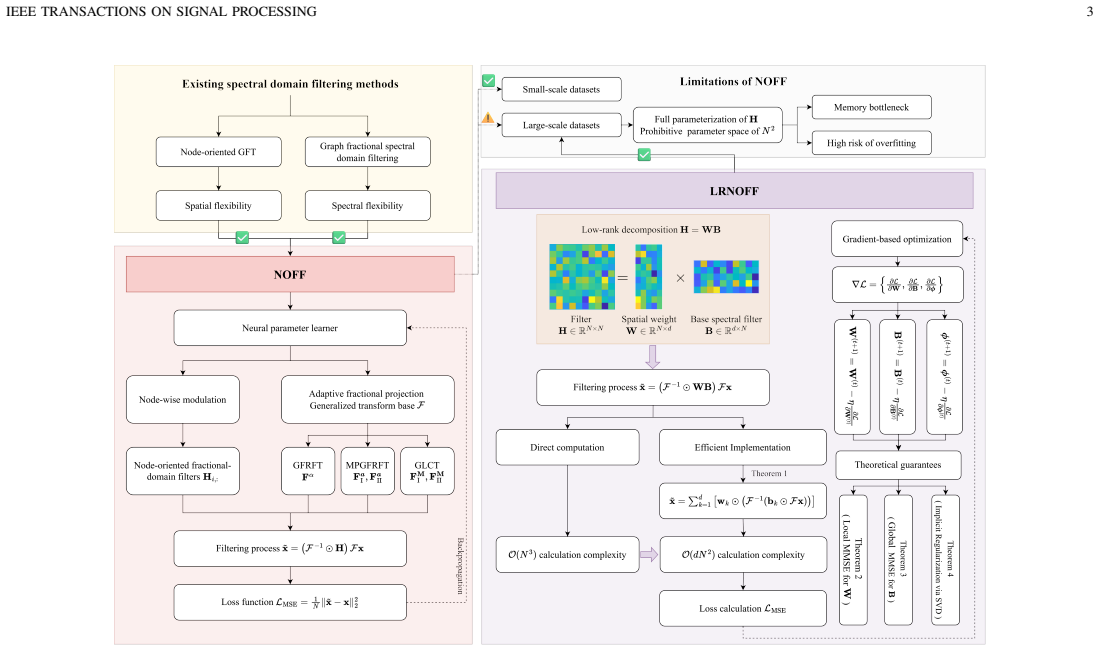
The low-rank NOFF (LRNOFF) architecture, obtained by constraining node-specific fractional filters to low rank, inherently regularizes against noise memorization and extracts robust spectral bases; its fast variant LRNOFF-Fast realizes the same optimality at far lower computational and memory cost.
What carries the argument
The low-rank node-oriented fractional filtering (LRNOFF) architecture, which applies a strict low-rank constraint to node-specific fractional filters to act as an implicit regularizer.
If this is right
- The same low-rank structure applies across multiple fractional transforms without redesign.
- LRNOFF-Fast delivers the identical theoretical optimum at drastically reduced runtime and memory.
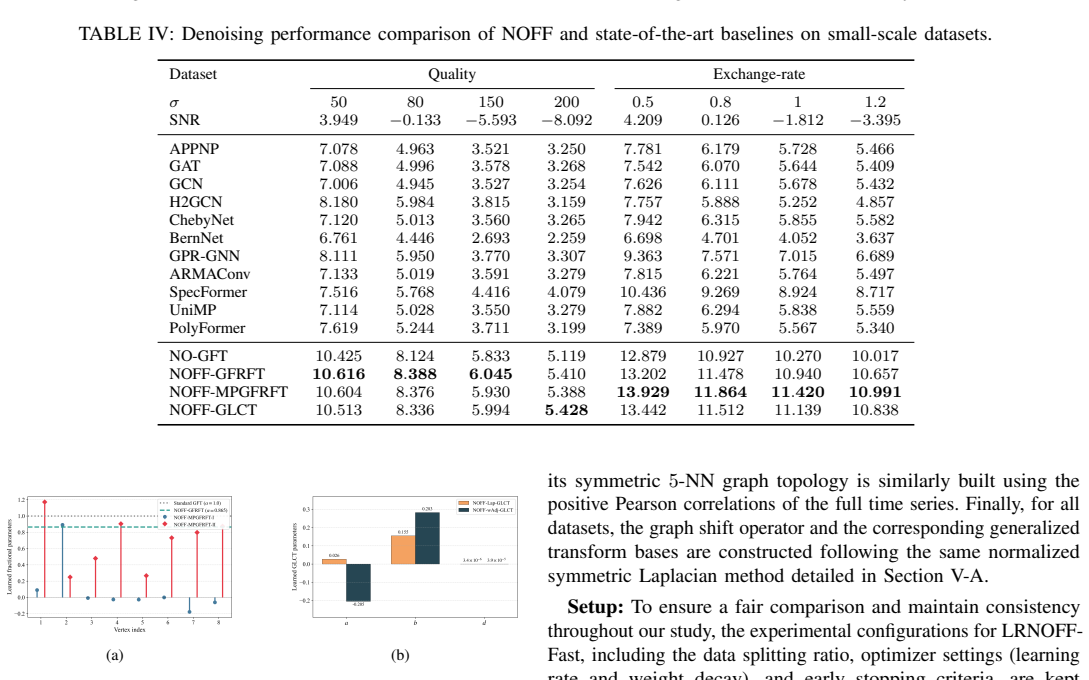
- The approach yields state-of-the-art denoising accuracy on real-world graph datasets.
- No post-hoc data selection or manual parameter tuning is needed to realize the reported gains.
Where Pith is reading between the lines
- The low-rank mechanism could be tested on dynamic or time-varying graphs to check whether the same regularization still holds when topology changes.
- If the low-rank bases prove stable, the method might transfer directly to related tasks such as graph-based semi-supervised learning.
- Scalability on very large graphs remains open; memory savings from the fast variant suggest it could be measured on networks with millions of nodes.
Load-bearing premise
That the low-rank constraint on the filters will separate signal from noise rather than indiscriminately smoothing both.
What would settle it
A controlled experiment in which full-rank per-node filters achieve equal or higher denoising accuracy on the same datasets without extra regularization or post-hoc selection would falsify the claim that the low-rank constraint is required to prevent noise memorization.
Figures

read the original abstract
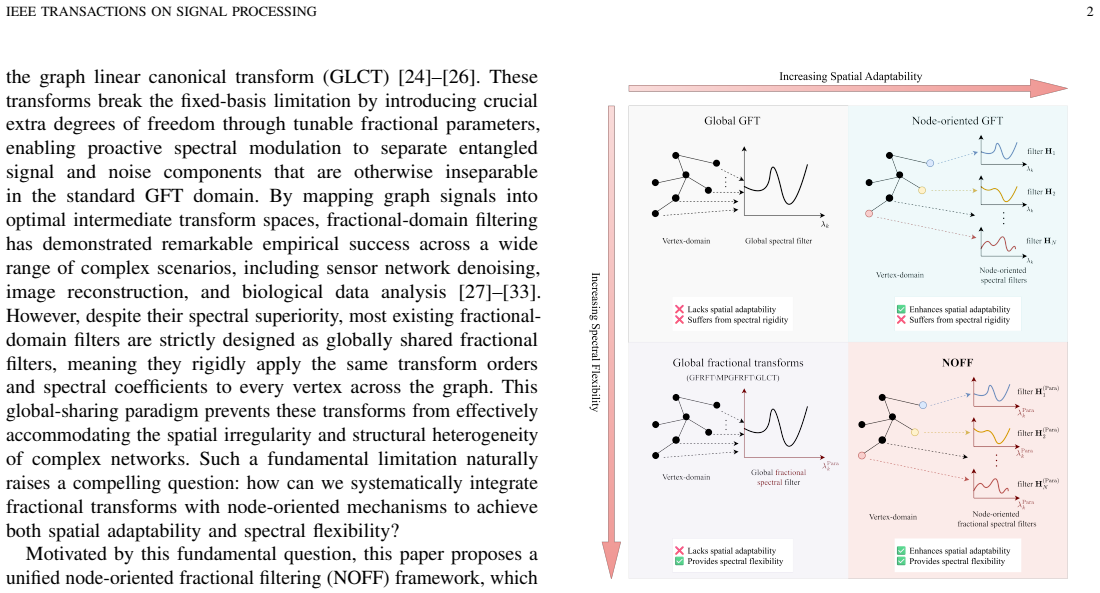
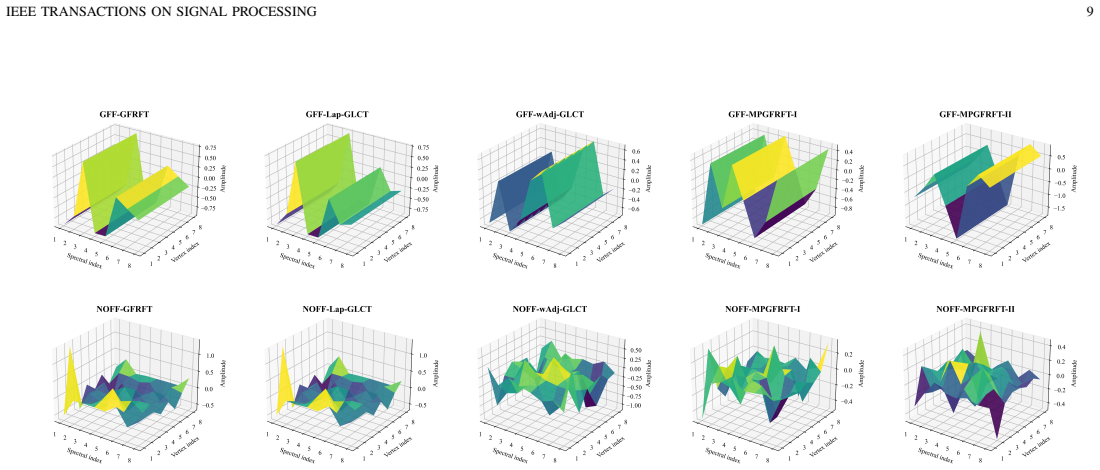
Graph signal denoising is a fundamental task in graph signal processing. While the node-oriented filtering approach enhances spatial adaptability, it suffers from spectral rigidity due to its reliance on the graph Fourier transform. Conversely, emerging fractional-domain transforms provide crucial spectral flexibility but are fundamentally limited by their globally shared filtering paradigm, failing to accommodate localized topological variations. To bridge this gap, this paper proposes a generalized node-oriented fractional filtering (NOFF) framework that seamlessly integrates localized spatial adaptability with proactive spectral modulation across various fractional transforms. However, straightforwardly assigning independent full-rank filters to all vertices incurs a prohibitive parameter space, leading to severe overfitting on random noise. To mitigate this, we introduce the low-rank NOFF (LRNOFF) architecture. By imposing a strict low-rank constraint, LRNOFF inherently acts as a powerful implicit regularizer, preventing noise memorization and ensuring the extraction of robust spectral bases. Furthermore, we develop an efficient computational implementation termed LRNOFF-Fast, which drastically reduces computational and memory overhead while preserving theoretical optimality. Experiments on real-world datasets demonstrate that the proposed framework achieves state-of-the-art performance.
Editorial analysis
A structured set of objections, weighed in public.
Referee Report
Summary. The manuscript proposes a node-oriented fractional filtering (NOFF) framework for graph signal denoising that combines per-node spatial adaptability with proactive spectral modulation via fractional transforms. To address the prohibitive parameter count and overfitting of full-rank per-node filters, it introduces low-rank NOFF (LRNOFF) whose strict low-rank constraint is asserted to act inherently as an implicit regularizer that prevents noise memorization while extracting robust spectral bases; an efficient LRNOFF-Fast implementation is also developed, with experiments claimed to show state-of-the-art results on real-world datasets.
Significance. If the low-rank constraint can be rigorously shown to provide the claimed regularization effect without hidden data-dependent tuning and if the SOTA claims are substantiated with proper controls, the work would offer a useful unification of node-oriented and fractional-domain methods in graph signal processing.
major comments (3)
- [Abstract] Abstract: the central claim that 'imposing a strict low-rank constraint, LRNOFF inherently acts as a powerful implicit regularizer, preventing noise memorization and ensuring the extraction of robust spectral bases' is presented without any derivation, theorem, or analysis showing why the low-rank constraint necessarily yields robust bases rather than simply reduced capacity; this mechanism is load-bearing for the paper's contribution.
- [Abstract] Abstract: the assertion of 'state-of-the-art performance' on 'real-world datasets' is made without any mention of the specific datasets used, evaluation metrics, baseline methods, number of trials, or error bars, rendering the empirical claim unverifiable from the provided text.
- [Abstract] Abstract: no ablation or control experiments are described that isolate the low-rank constraint from other design choices (e.g., fractional order selection, graph construction), which is required to substantiate that any observed gains arise specifically from the implicit regularization rather than other factors.
minor comments (1)
- The abstract refers to integration 'across various fractional transforms' but does not enumerate the specific transforms included in the unified NOFF framework.
Simulated Author's Rebuttal
We thank the referee for the constructive comments on our manuscript. We address each major comment below and commit to revisions that strengthen the substantiation of our claims without altering the core contributions.
read point-by-point responses
-
Referee: [Abstract] Abstract: the central claim that 'imposing a strict low-rank constraint, LRNOFF inherently acts as a powerful implicit regularizer, preventing noise memorization and ensuring the extraction of robust spectral bases' is presented without any derivation, theorem, or analysis showing why the low-rank constraint necessarily yields robust bases rather than simply reduced capacity; this mechanism is load-bearing for the paper's contribution.
Authors: We agree that the abstract states this claim without an accompanying derivation or theorem. The manuscript explains the capacity reduction via the low-rank factorization but does not include a formal proposition isolating the regularization mechanism from simple capacity limits. We will add a short theoretical analysis or proposition in the revised manuscript to derive why the strict low-rank constraint provides the claimed implicit regularization effect. revision: yes
-
Referee: [Abstract] Abstract: the assertion of 'state-of-the-art performance' on 'real-world datasets' is made without any mention of the specific datasets used, evaluation metrics, baseline methods, number of trials, or error bars, rendering the empirical claim unverifiable from the provided text.
Authors: The abstract is length-limited and therefore omits these details, but we acknowledge that this renders the SOTA claim difficult to verify from the abstract alone. We will revise the abstract to concisely reference the specific real-world datasets, metrics (e.g., MSE), baseline methods, and the use of multiple trials with error bars while preserving the overall length. revision: yes
-
Referee: [Abstract] Abstract: no ablation or control experiments are described that isolate the low-rank constraint from other design choices (e.g., fractional order selection, graph construction), which is required to substantiate that any observed gains arise specifically from the implicit regularization rather than other factors.
Authors: The abstract summarizes results but does not describe experimental controls. The manuscript contains comparative experiments against baselines, yet does not present dedicated ablations that isolate the low-rank constraint from fractional-order or graph-construction choices. We will add targeted ablation studies in the revised version to isolate the low-rank effect and confirm its role in the observed gains. revision: yes
Circularity Check
No circularity: low-rank constraint is presented as explicit design choice for parameter reduction, not derived from or equivalent to target result
full rationale
The abstract states the low-rank constraint is introduced to address the prohibitive parameter space of full-rank filters that leads to overfitting, and asserts it 'inherently acts as a powerful implicit regularizer'. This is a standard capacity-control argument rather than a self-definitional loop, fitted parameter renamed as prediction, or load-bearing self-citation. No equations, uniqueness theorems, or prior-author citations are shown that would reduce the regularization claim to the input data or to a tautology. The SOTA performance claim rests on separate experiments, which are independent of the architectural motivation. Per the rules, absence of quoted reduction by construction yields score 0.
Axiom & Free-Parameter Ledger
Reference graph
Works this paper leans on
-
[1]
Graph signal processing: Overview, challenges, and applications,
A. Ortega, P. Frossard, J. Kovacevic, J. M. F. Moura, and P. Vandergheynst, “Graph signal processing: Overview, challenges, and applications,”Proc. IEEE, vol. 106, no. 5, pp. 808–828, Apr. 2018
2018
-
[2]
Ortega,Introduction to Graph Signal Processing
A. Ortega,Introduction to Graph Signal Processing. Cambridge University Press, 2022
2022
-
[3]
SSGCNet: A sparse spectra graph convolutional network for epileptic EEG signal classification,
J. L. Wang, R. Gao, H. T. Zheng, H. Zhu, and C.-J. R. Shi, “SSGCNet: A sparse spectra graph convolutional network for epileptic EEG signal classification,”IEEE Trans. Neural Netw. Learn. Syst., vol. 35, no. 9, pp. 12 157–12 171, Mar. 2024
2024
-
[4]
Graph signal processing, graph neural network and graph learning on biological data: A systematic review,
R. Li, X. Yuan, M. Radfar, P. Marendy, W. Ni, T. J. O’Brien, and P. M. Casillas-Espinosa, “Graph signal processing, graph neural network and graph learning on biological data: A systematic review,”IEEE Rev. Biomed. Eng., vol. 16, pp. 109–135, Doc. 2023
2023
-
[5]
Brain network analysis of schizophrenia patients based on hypergraph signal processing,
X. Y . Song, K. Wu, and L. Chai, “Brain network analysis of schizophrenia patients based on hypergraph signal processing,”IEEE Trans. Image Process., vol. 32, pp. 4964–4976, Aug. 2023
2023
-
[6]
Attention-driven graph neural network for deep face super-resolution,
Q. Bao, B. Gang, W. Yang, J. Zhou, and Q. Liao, “Attention-driven graph neural network for deep face super-resolution,”IEEE Trans. Image Process., vol. 31, pp. 6455–6470, Oct. 2022
2022
-
[7]
Target recognition in SAR images via sparse representation in the frequency domain,
G. G. Dong, H. W. Liu, G. Y . Kuang, and J. Chanussot, “Target recognition in SAR images via sparse representation in the frequency domain,”Pattern Recognit., vol. 96, p. 106972, Dec. 2019
2019
-
[8]
EEG-based emotion classification using graph signal processing,
S. S. Saboksayr, G. Mateos, and M. Cetin, “EEG-based emotion classification using graph signal processing,” inProc. IEEE International Conference on Acoustics, Speech and Signal Processing (ICASSP), Jun. 2021, pp. 1065–1069
2021
-
[9]
A unified view on graph neural networks as graph signal denoising,
Y . Ma, X. R. Liu, T. Zhao, Y . Z. Liu, J. L. Tang, and N. Shah, “A unified view on graph neural networks as graph signal denoising,” inProc. ACM International Conference on Information and Knowledge Management (CIKM), Oct. 2021, pp. 1202–1211
2021
-
[10]
Graph signal denoising via trilateral filter on graph spectral domain,
M. Onuki, S. Ono, M. Yamagishi, and Y . Tanaka, “Graph signal denoising via trilateral filter on graph spectral domain,”IEEE Trans. Signal Inf. Process. Netw., vol. 2, no. 2, pp. 137–148, Feb. 2016
2016
-
[11]
Graph unrolling networks: Interpretable neural networks for graph signal denoising,
S. H. Chen, Y . C. Eldar, and L. X. Zhao, “Graph unrolling networks: Interpretable neural networks for graph signal denoising,”IEEE Trans. Signal Process., vol. 69, pp. 3699–3713, Jun. 2021
2021
-
[12]
Spectral graph based vertex-frequency wiener filtering for image and graph signal denoising,
A. C. Yagan and M. T. Ozgen, “Spectral graph based vertex-frequency wiener filtering for image and graph signal denoising,”IEEE Trans. Signal Inf. Process. Netw., vol. 6, pp. 226–240, Feb. 2020
2020
-
[13]
Discrete signal processing on graphs,
A. Sandryhaila and J. M. F. Moura, “Discrete signal processing on graphs,” IEEE Trans. Signal Process., vol. 61, no. 7, pp. 1644–1656, Jan. 2013
2013
-
[14]
Graph Fourier transform: A stable approximation,
J. Domingos and J. M. F. Moura, “Graph Fourier transform: A stable approximation,”IEEE Trans. Signal Process., vol. 68, pp. 4422–4437, Jul. 2020
2020
-
[15]
Generic reversible visible watermarking via regularized graph Fourier transform coding,
W. F. Qi, S. R. Guo, and W. Hu, “Generic reversible visible watermarking via regularized graph Fourier transform coding,”IEEE Trans. Image Process., vol. 31, pp. 691–705, Dec. 2022
2022
-
[16]
A spectral graph wiener filter in graph Fourier domain for improved image denoising,
A. C. Yagan and M. T. Ozgen, “A spectral graph wiener filter in graph Fourier domain for improved image denoising,” inProc. IEEE Global Conference on Signal and Information Processing (GlobalSIP), Apr. 2016, pp. 450–454
2016
-
[17]
Node-oriented spectral filtering for graph neural networks,
S. Zheng, Z. F. Zhu, Z. Z. Liu, Y . R. Li, and Y . Zhao, “Node-oriented spectral filtering for graph neural networks,”IEEE Trans. Pattern Anal. Mach. Intell., vol. 46, no. 1, pp. 388–402, Oct. 2024
2024
-
[18]
Hyper-differential operator-based graph fractional Fourier transform: Novel approaches and applications,
J. Y . Chen, B. Z. Li, and L. Peng, “Hyper-differential operator-based graph fractional Fourier transform: Novel approaches and applications,”IEEE Trans. Signal Inf. Process. Netw., vol. 12, pp. 411–423, Mar. 2026
2026
-
[19]
The fractional Fourier transform on graphs: Sampling and recovery,
Y . Q. Wang and B. Z. Li, “The fractional Fourier transform on graphs: Sampling and recovery,” inProc. 14th IEEE International Conference on Signal Processing (ICSP), Aug. 2018, pp. 1103–1108
2018
-
[20]
Optimal fractional Fourier filtering for graph signals,
C. Ozturk, H. M. Ozaktas, S. Gezici, and A. Ko c ¸, “Optimal fractional Fourier filtering for graph signals,”IEEE Trans. Signal Process., vol. 69, pp. 2902– 2912, May 2021
2021
-
[21]
The windowed two-dimensional graph fractional Fourier transform,
Y . C. Gan, J. Y . Chen, and B. Z. Li, “The windowed two-dimensional graph fractional Fourier transform,”Digit. Signal Process., vol. 162, p. 105191, Jul 2025
2025
-
[22]
Wiener filtering in joint time-vertex fractional Fourier domains,
T. Alikasifoglu, B. Kartal, and A. Koc, “Wiener filtering in joint time-vertex fractional Fourier domains,”IEEE Signal Process. Lett., vol. 31, pp. 1319– 1323, May 2024
2024
-
[23]
M. J. Cui, Z. C. Zhang, and W. Yao, “Multiple-parameter graph fractional Fourier transform: Theory and applications,”arXiv preprint arXiv:2507.23570, 2025
work page internal anchor Pith review Pith/arXiv arXiv 2025
-
[24]
Multi-dimensional graph linear canonical transform,
N. Li and Z. C. Zhang, “Multi-dimensional graph linear canonical transform,” Digit. Signal Process., vol. 165, p. 105334, Oct 2025
2025
-
[25]
Graph linear canonical transform: Definition, vertex-frequency analysis and filter design,
J. Y . Chen, Y . Zhang, and B. Z. Li, “Graph linear canonical transform: Definition, vertex-frequency analysis and filter design,”IEEE Trans. Signal Process., vol. 72, pp. 5691–5707, Dec. 2024
2024
-
[26]
Discrete linear canonical transform on graphs,
Y . Zhang and B. Z. Li, “Discrete linear canonical transform on graphs,”Digit. Signal Process., vol. 135, p. 103934, Apr. 2023
2023
-
[27]
Multi–dimensional graph fractional Fourier transform and its application to data compression,
F. J. Yan and B. Z. Li, “Multi–dimensional graph fractional Fourier transform and its application to data compression,”Digit. Signal Process., vol. 129, p. 103683, Sep. 2022
2022
-
[28]
Windowed fractional Fourier transform on graphs: Properties and fast algorithm,
——, “Windowed fractional Fourier transform on graphs: Properties and fast algorithm,”Digit. Signal Process., vol. 118, p. 103210, Nov. 2021
2021
-
[29]
Joint time-vertex fractional Fourier transform,
T. Alikasifoglu, B. Kartal, E. Ozgunay, and A. Koc, “Joint time-vertex fractional Fourier transform,”Signal Process., vol. 233, p. 109944, Aug. 2025
2025
-
[30]
Graph fractional Fourier transform: A unified theory,
T. Alikasifoglu, B. Kartal, and A. Koc, “Graph fractional Fourier transform: A unified theory,”IEEE Trans. Signal Process., vol. 72, pp. 3834–3850, Aug. 2024
2024
-
[31]
A graph signal denoising method using total variation regularization and fractional graph Fourier transform,
C. C. Tseng and S. L. Lee, “A graph signal denoising method using total variation regularization and fractional graph Fourier transform,” inProc. International Symposium on Intelligent Signal Processing and Communication Systems (ISPACS), Dec. 2024, pp. 1–5
2024
-
[32]
A fractional graph Fourier transform method for missing data recovery of sensor network,
——, “A fractional graph Fourier transform method for missing data recovery of sensor network,” inProc. Global Conference on Consumer Electronics (GCCE), Oct. 2024, pp. 154–155
2024
-
[33]
Graph signal processing, graph neural network and graph learning on biological data: A systematic review,
R. Li, X. Yuan, M. Radfar, P. Marendy, W. Ni, T. J. O’Brien, and P. M. Casillas-Espinosa, “Graph signal processing, graph neural network and graph learning on biological data: A systematic review,”IEEE Rev. Biomed. Eng., vol. 16, pp. 109–135, Oct. 2023
2023
-
[34]
The fractional Fourier transform on graphs,
Y . Q. Wang, B. Z. Li, and Q. Y . Cheng, “The fractional Fourier transform on graphs,” inProc. Asia-Pacific Signal and Information Processing Association Annual Summit and Conference (APSIPA ASC), Dec. 2017, pp. 105–110
2017
-
[35]
Frequency-domain MLPs are more effective learners in time series forecasting,
K. Yi, Q. Zhang, W. Fan, S. J. Wang, P. Y . Wang, H. He, N. An, D. F. Lian, L. B. Cao, and Z. D. Niu, “Frequency-domain MLPs are more effective learners in time series forecasting,” inProc. Advances in Neural Information Processing Systems (NeurIPS), vol. 36, Dec. 2023, pp. 76 656–76 679
2023
-
[36]
Modeling long- and short- term temporal patterns with deep neural networks,
G. K. Lai, W. C. Chang, Y . M. Yang, and H. X. Liu, “Modeling long- and short- term temporal patterns with deep neural networks,” inProc. International ACM SIGIR Conference on Research and Development in Information Retrieval (SIGIR), Jun. 2018, pp. 95–104
2018
-
[37]
JFRFFNet: A data-model co-driven graph signal denoising model with partial prior information,
Z. Q. Yan and Z. C. Zhang, “JFRFFNet: A data-model co-driven graph signal denoising model with partial prior information,”IEEE Signal Process. Lett., vol. 33, pp. 1038–1042, Feb. 2026
2026
-
[38]
Diffusion convolutional recurrent neural network: Data-driven traffic forecasting,
Y . G. Li, R. Yu, C. Shahabi, and Y . Liu, “Diffusion convolutional recurrent neural network: Data-driven traffic forecasting,” inProc. International Conference on Learning Representations (ICLR), Feb. 2018
2018
-
[39]
Learning dynamics and heterogeneity of spatial-temporal graph data for traffic forecasting,
S. N. Guo, Y . F. Lin, H. Y . Wan, X. C. Li, and G. Cong, “Learning dynamics and heterogeneity of spatial-temporal graph data for traffic forecasting,”IEEE Trans. Knowl. Data Eng., vol. 34, no. 11, pp. 5415–5428, Feb. 2022
2022
-
[40]
Solar power data for integration studies,
National Laboratoryof the Rockies, “Solar power data for integration studies,” https://www.nrel.gov/grid/solar-power-data.html
-
[41]
Modeling long- and short-term temporal patterns with deep neural networks,
G. K. Lai, W. C. Chang, Y . M. Yang, and H. X. Liu, “Modeling long- and short-term temporal patterns with deep neural networks,” inProc. International ACM SIGIR Conference on Research & Development in Information Retrieval (SIGIR), Jun. 2018, pp. 95–104
2018
discussion (0)
Sign in with ORCID, Apple, or X to comment. Anyone can read and Pith papers without signing in.