REVIEW 5 major objections 5 minor 1 cited by
Galaxy-cluster-stacked Fermi-LAT, part IV: $\sim70$ GeV WIMP annihilation lines
T0 review · 5 major / 5 minor · reviewed 2026-08-04 · deepseek-v4-flash
Pith's one-line read Analyzing 16 years of Fermi-LAT gamma-ray data enhanced by X-ray cross-correlations and cluster stacking, this paper claims to detect a tightly kinematically locked set of narrow emission lines — six resolved lines plus a broad feature — ma
desk verdict A genuinely new, high-stakes line-search claim whose central significance rests on a null test that has not actually been done; the kinematic nonad is the most interesting part and deserves scrutiny. read the letter →
The pith
A machine-rendered reading of the paper's core claim, the machinery that carries it, and where it could break.
The reading
What carries the argument
The load-bearing tool is a matched spectral filter: a sliding aperture built from Fermi's measured energy-response function, applied to cross-correlated or cluster-frame-stacked spectra after aggressive background subtraction. For the multi-line claims, the filter is a rigid kinematic template that locks three line energies (triad) or nine line energies (nonad) to the masses of one or two WIMPs using the conservation relation for a boson-plus-photon final state. This kinematic rigidity is what turns a handful of marginal lines into a structured prediction: the triad spans a wide energy range, so any localized instrumental or background artifact would have to accidentally reproduce the same s
What would settle it
Re-run the eastern-hemisphere analysis using a high-resolution eROSITA map with raw-pixel access, rather than the low-resolution Hammer-Aitoff projection that produced the unexplained ~80 GeV line. If the ~80 GeV feature disappears while the ~70, ~40, and ~13 GeV triad remains significant, the core signal is exonerated; if instead the family of lines shifts or vanishes when the detrending scale or masking is varied, that is direct evidence for pipeline-created artifacts.
Extended reading notes
Core claim
The paper's central claim is that the dark matter in galaxy clusters (and by extension in the Milky Way) contains two weakly interacting species with rest masses 67.3 and 71.4 GeV/c² that annihilate both with themselves and with each other. In the cluster-frame stacked spectrum and in the X-ray-correlated sky, the gamma-ray emissivity shows narrow lines at exactly the energies dictated by energy-momentum conservation for chi-chi → gamma-gamma, gamma-Z, and gamma-h, with cross-annihilation channels appearing at the arithmetic mean of the two masses. The strongest single triad is found in the high-resolution western-sky cross-correlation at a local significance of about 5.5 sigma, correspondin
Load-bearing premise
The claim rests on the assumption that the narrow emission features emerging only after cross-correlation, detrending, and redshift alignment are genuine gamma-ray lines from dark matter; if any of these processing steps can manufacture narrow lines, the WIMP interpretation loses its foundation.
Editorial extensions
If this is right
- If the signal is real, WIMP dark matter must annihilate primarily through velocity-dependent p-wave processes, with intrinsic cross-sections near 1e-20–1e-19 cm³/s, far above the canonical s-wave thermal-relic value but consistent with existing p-wave cluster limits.
- The two inferred masses imply a dark sector with two species that both self-annihilate and cross-annihilate, producing three triads of gamma, Z, and Higgs lines; a confirmed nonad would be a smoking-gun signature of that structure.
- The Galactic-center GeV excess can be understood as the broad b-bbar continuum from the same two WIMPs, which may explain why the excess tracks the stellar bulge rather than a simple cusped dark-matter profile.
- Because the nine-line pattern is rigidly fixed by kinematics, a verified detection could serve as an in-situ energy calibration for gamma-ray telescopes, complementing laboratory-based calibrations.
- The same cross-correlation and rest-frame-stacking pipeline should be applied to new cluster catalogs and additional large-scale-structure tracers, since the paper predicts the same triad and nonad energies should reappear wherever such tracers are available.
Reading between the lines
- Editorial inference: The paper's own weakest link is the unresolved ~80 GeV line in the eastern hemisphere, which comes from a low-resolution map and is explicitly flagged as unverifiable at present. If a future high-resolution eastern-sky map makes that line disappear while preserving the ~70, ~40, and ~13 GeV triad, the core claim is strengthened; if the remaining lines also shift or vanish with
- Editorial inference: A decisive control experiment would be to regenerate the western and eastern spectra with the Gaussian-process detrending either turned off or run with substantially different correlation lengths. Genuine astrophysical lines should survive such changes; lines that appear, disappear, or move with the smoothing length are pipeline products.
- Editorial inference: The same rigid nonad template could be searched in the Galactic-center region itself, where the signal-to-noise per solid angle is far higher. Resolving all nine lines individually there would be a much stronger test than the blended ~70 GeV feature reported here.
- Editorial inference: If the channel hierarchy gamma-gamma < gamma-Z < gamma-h is confirmed, it points toward a charge-conjugation-odd annihilation current in the dark sector, a testable property for collider searches for invisible dark-sector states.
Signed reviews
Editorial analysis
A structured set of objections, weighed in public.
Referee Report
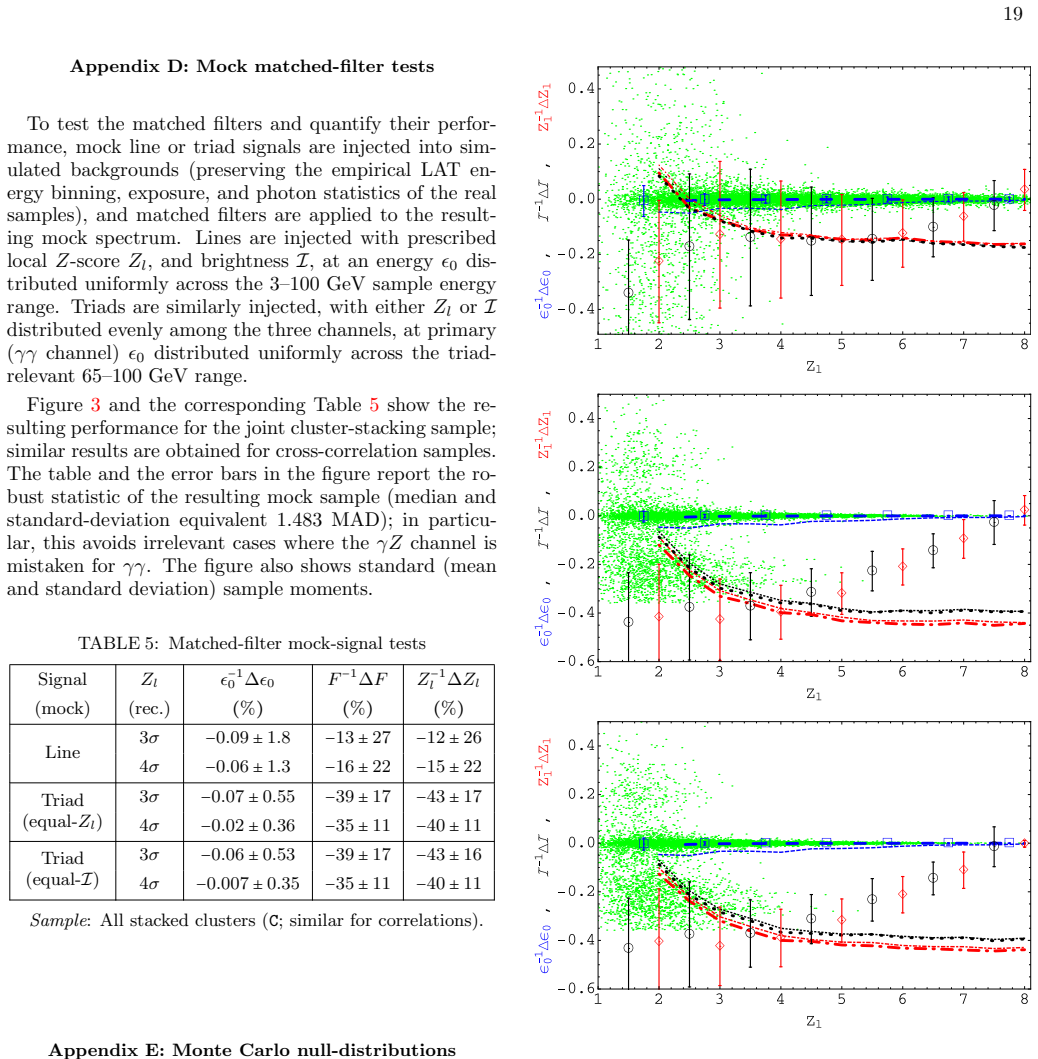
Summary. The paper reports a matched-filter search for narrow γ-ray lines in 3–100 GeV Fermi-LAT data, using three cluster-based analyses: cross-correlation with eROSITA maps in the western (W) and eastern (E) Galactic hemispheres, and rest-frame stacking over MCXC/eROSITA/DESI clusters (C). It claims a ~70 GeV-oriented triad of lines (γγ, γZ, γh), a second/third triad, and a nine-line nonad from two cross-annihilating WIMPs of masses 67.3 and 71.4 GeV, with local significances up to Zl≈5.5 and cross-sections ~10^-20 D cm^3/s. The kinematic template is fixed by energy-momentum conservation and the known Z and Higgs masses, so the pattern is not circular. The detection claim, however, rests on the assumption that the matched-filter/GPR pipeline applied to real LAT data and fixed LSS tracers does not itself produce narrow features; this assumption is not adequately tested by the Monte Carlo nulls presented.
Significance. If the lines were real, this would be a major discovery in indirect dark-matter searches. The paper has genuine strengths: the kinematic rigidity of the triad/nonad templates, the use of several cluster catalogs and independent sky regions, the IRF-based matched filters, the mock-injection tests in Appendix D, and the large Monte Carlo survival distributions in Appendix E. These show care in calibrating energy biases and trial corrections within a single analysis configuration. However, the evidence is not yet at discovery level. The strongest single cross-correlation feature (80 GeV in E) is self-admittedly unverifiable, the null simulations do not randomize the tracer, W/E/C are not statistically independent, and the trial correction for the many analysis variants is not transparent. With additional validation—tracer scrambling, a full trials audit, and removal of E—the methodology could be compelling. In its present form, the central detection claim is not sufficiently supported.
major comments (5)
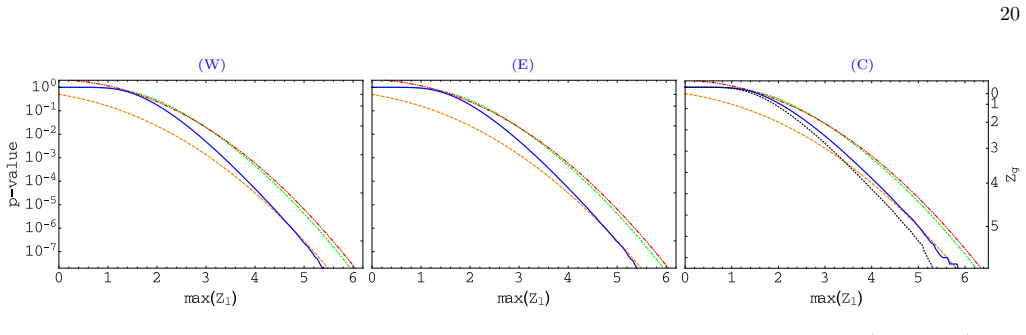
- [Appendix E; Sec. IV.C] The null Monte Carlo simulations preserve the empirical LAT energy binning, exposure, and photon statistics and add uncorrelated noise before detrending, but they keep the eROSITA tracer maps and cluster catalog fixed. This tests Poisson fluctuations around the actual pipeline, not whether the pipeline produces narrow features when applied to a different tracer with the same statistical properties. The concern is concrete: Sec. IV.C states that the strongest single line (80 GeV in E) cannot be verified and is attributed to the low-resolution Hammer-Aitoff map. The same GPR/matched-filter machinery is used for W. A surrogate-tracer scrambling test (randomizing the tracer map or cluster positions) is needed before a 5.5σ detection claim can be accepted.
- [§II.D; Table 3] The global Zg correction accounts for the logarithmic energy scan only. The paper presents many analysis variants (W/E/C, f=0.1/0.03, native resolutions, masks, synthetic filters, GPR/ALS) as robustness, but the quoted significances are not corrected for choosing the most favorable among these variants. If the same data are scanned over many configurations, the best Zl is subject to a further trials factor; otherwise the global Zg overstates the evidence. Please provide either a pre-defined analysis tree with an explicit number of independent trials, or a Monte Carlo that includes the full configuration selection.
- [§III.B; Table 3 columns 15–16] The joint analysis treats W, E, and C as statistically independent and sums their line significances via Eq. (9). These analyses use the same Fermi-LAT photons; C largely overlaps the sky regions of W and E. The resulting joint Zl=5.6 for the triad is therefore not a combination of independent experiments. A joint likelihood with covariances, or at least a version excluding C and E, is needed to assess the actual combined significance.
- [§III.A–B; Table 3] The triad significance is the unweighted average of three line significances, so Zl=5.5 in W is built from 3.8 (γγ), 1.6 (γZ), and 4.1 (γh); in E the γγ term is 0.0 and in C the γZ term is 0.0. The 'triad' is therefore not a coherent set of three significant lines in any one analysis. Please report the likelihood ratio of the kinematic triad hypothesis against a model with three independent lines at arbitrary energies, and give the corresponding p-value for the pattern, not just the composite Zl.
- [Sec. IV.C] The paper itself flags two persistent features as unverified: the 5.2σ 80 GeV line in E and the ~20 GeV line. Since E is included in the joint triad and nonad, these unverified features propagate into the central results. The paper should show all joint significances with E removed (and with the 80 GeV energy window excluded), and state whether the W-alone nonad/triad survive the same trial corrections. Without this, the impact of the admitted artifact risk is not quantified.
minor comments (5)
- [§II.A heading] The section heading contains a typo: 'F ermi-LA T data reduction' should be 'Fermi-LAT data reduction'.
- [Abstract and §II.E–F] The abstract and summary quote 'intrinsic' cross-sections ~10^-20–10^-19 cm^3/s, but the tables report σvp/D, with D an order-unity factor that is unity only under the assumptions that DM traces baryons and the single-Majorana model. The abstract should qualify these as D=1 estimates.
- [Appendix B] The GPR correlation length l and the ALS parameters (λ,p) are not quoted. Since detrending is central to the spectral analysis, the actual values used should be stated and included in the sensitivity scans.
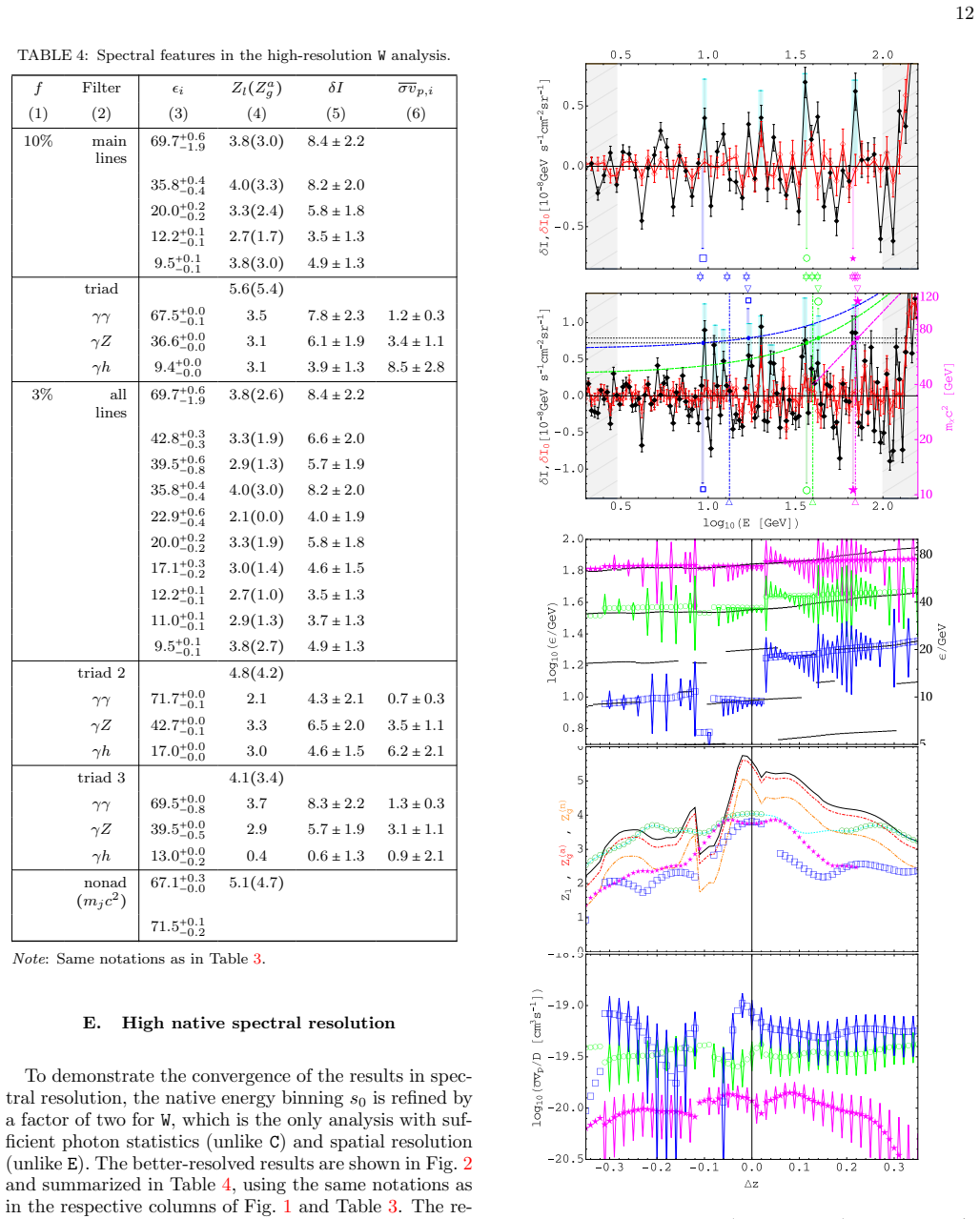
- [Figs. 1–2] The figures are extremely dense; the many colors, symbols, and multi-panel rows are very difficult to parse. A zoomed version of the 3–100 GeV region around the main triad, and a clearer legend separating the matched-filter channels from the trial-corrected scores, would improve readability.
- [General] No code or detailed software provenance is released. Given that the trial corrections and Monte Carlo nulls cannot be independently audited, a code release or a step-by-step reproducible pipeline description would substantially strengthen the paper.
Circularity Check
No significant circularity: the triad/nonad kinematics and Monte Carlo nulls are external constraints; assumptions (D, baryon-tracing) are transparent and not fitted predictions.
full rationale
The derivation chain is not circular. The line-search templates (Eqs. 18–19) are fixed by energy–momentum conservation and PDG Z/H masses, not by the LAT spectra; the composite triad/nonad filters are therefore external constraints. The spectral lines are found by sliding matched filters over detrended spectra; the reported Z-scores are corrected for trials using analytic Šidák/Euler estimates and >10^8.5 Monte Carlo null samples that preserve binning, exposure, and photon statistics, i.e., a genuine null hypothesis rather than the fitted signal. The inferred cross sections are explicitly conditional (Eqs. 14–15), with the ignorance factor D absorbing unknown dark-sector and baryon-tracing assumptions; D is not fitted to the line brightnesses and then renamed a prediction. The only passages flagged as limitations—the unverifiable ~80 GeV east-map feature and the persistent ~20 GeV line—are data-quality/systematics concerns, not inputs that define the result by construction. Self-citations to Papers I–III describe the stacking methodology, but this paper restates the equations (Sec. II C) and does not import a uniqueness or existence theorem; thus the self-citation is not load-bearing. Consequently no circular step is exhibited.
Assumptions & free parameters
free parameters (5)
- WIMP masses m1, m2 =
67.3 GeV, 71.4 GeV
- Individual line energies =
Multiple, e.g., 69.7, 35.8, 20.0, 12.2, 9.5 GeV in W (Table 4)
- Ignorance factor D =
Set to 1 for normalization
- GPR correlation scale l =
Not specified numerically
- Exclusion window factor f =
0.1 nominal, 0.03 alternative
assumptions (4)
- standard math Two-body annihilation kinematics (Eq. 18) determines line energies from WIMP mass and final-state boson mass.
- domain assumption Dark matter density traces the X-ray emitting baryonic gas (b=1) in clusters.
- ad hoc to paper The background after masking and detrending is smooth and correctly modeled by GPR/ALS.
- ad hoc to paper Monte Carlo null distributions correctly capture the search trials.
invented entities (1)
-
Two WIMP species (χ1, χ2) of masses ~67.3 and ~71.4 GeV
Cite this review
Pith. "Pith review of Galaxy-cluster-stacked Fermi-LAT, part IV: $\sim70$ GeV WIMP annihilation lines." pith.science (2026). https://pith.science/paper/Y6BVHATQ
@misc{pith2026260617044,
  author       = {Pith},
  title        = {Pith review of: Galaxy-cluster-stacked Fermi-LAT, part IV: $\sim70$ GeV WIMP annihilation lines},
  year         = {2026},
  howpublished = {\url{https://pith.science/paper/Y6BVHATQ}},
  note         = {Machine review of arXiv:2606.17044}
}
abstract
The strongest constraints on the velocity-dependent ($p$-wave) annihilation of weakly interacting massive particle (WIMP) dark matter were derived from the deep potential wells of galaxy clusters. Even weaker signals can be extracted from sufficient aggregated clusters, by cross-correlating $\gamma$-rays with large-scale structure tracers or stacking over extensive cluster catalogs. Three independent such analyses show a similar triad of emission lines in Fermi-LAT data, around 70, 40, and 13 GeV, emerging from featureless spectra in each hemisphere upon cross-correlation with eROSITA maps, and in stacked MCXC, eROSITA, and DESI catalog clusters only once boosted to the cluster frame. These lines fit the anticipated $\chi\chi\to\gamma\gamma$, $\gamma Z$, and $\gamma h$ annihilation channels of a $\sim70$ GeV WIMP $\chi$, detected by composite matched filters at trial-corrected global $Z$-scores reaching $5.6\sigma$ (cross-correlations) and $2.3\sigma$ (stacking), with intrinsic $\sim10^{[-20,-19]}$ cm$^3$ s$^{-1}$ channel cross-sections. High-resolution spectra establish six lines and an unresolved ($2$--$3$ line) feature in total, naturally aligned with the anticipated nine channels of two cross-annihilating WIMPs of masses $67.3_{-0.1}^{+0.1}$ and $71.4_{-0.1}^{+0.2}$ GeV (profile-likelihood bounds; $_{-5\%}^{+3\%}$ systematic; $5.3\sigma$). The Galactic-center GeV excess is broadly consistent with the corresponding broad annihilation continuum.
Figures

Figures from the paper (2 more)
Forward citations
Cited by 1 Pith paper
-
A Tentative Double Excess in the Gamma-Ray Spectrum of the Fermi Blazar 4FGL J0604.9-0000
Tentative double Gaussian excess at 1.59 GeV (2.6σ) and 11.15 GeV (3.7σ) in Fermi-LAT spectrum of blazar 4FGL J0604.9-0000, combined TS ≃ 27 (~4.3σ local).
Reference graph
Works this paper leans on
-
[1]
Are highly significant (some > 4σ lines), especially (> 5σ triads and nonads) when incorporating multiple kinematically constrained channels
-
[2]
Emerge from apparent noise only when LSS-amplified (cross-correlations) or rest-frame boosted (stacking): ar- tifacts don’t do that
-
[3]
stacking) methods
Are quantitatively consistent across three independent (W, E, and C) analyses, based on two very different (cross- correlation vs. stacking) methods
-
[4]
Present the highly-restrictive kinematic sub-structure (lines combined into triads) and structure (triads com- bined into a nonad) expected from annihilating WIMPs
-
[5]
Are seen across the sky, on large scales, found sepa- rately east and west, north and south, with various cuts
-
[6]
Are consistent with narrow WIMP annihilation lines: no detected redshift or other broadening, better isolated by the LAT IRF than by tested synthetic apertures
-
[7]
Are detected by triad and nonad apertures that span a wide range of energies, which acts as a natural veto against localized instrumental and other artifacts
-
[8]
Scale as LSS: gradually strengthen with tracer quality (solid angle and resolution of eROSITA map, size of valid sample of cluster catalog), spectral resolution, and obser- vation time (similar contributions in different epochs)
Show all 146 references
-
[9]
correlations), tracers (different X-ray maps, different cat- alog origins), and brightness levels (see Fig.1)
Imply channel cross sections, consistent with previous limits, that agree across different methods (stacking vs. correlations), tracers (different X-ray maps, different cat- alog origins), and brightness levels (see Fig.1)
-
[10]
Are plausibly consistent with the Galactic-center GeV excess, which can be modelled as the b¯b continuum of the same WIMPs (next). B. GeV Galactic-center excess The GeV excess attributed 33,51 to the GC was argued to originate from unresolved astrophysical sources, such as mil...
-
[11]
J. C. Kapteyn, ApJ 55, 302 (1922). [2] J. H. Oort, Bull. Astron. Inst. Netherlands 6, 249 (1932). 16
1922
-
[12]
H. W. Babcock, Lick Observatory Bulletin 498, 41 (1939)
1939
-
[13]
V. C. Rubin and W. K. Ford, Jr., ApJ 159, 379 (1970)
1970
-
[14]
Zwicky, Helvetica Physica Acta 6, 110 (1933)
F. Zwicky, Helvetica Physica Acta 6, 110 (1933)
1933
-
[15]
Walsh, R
D. Walsh, R. F. Carswell, and R. J. Weymann, Nature 279, 381 (1979)
1979
-
[16]
Clowe, M
D. Clowe, M. Bradaˇ c, A. H. Gonzalez,et al., ApJ 648, L109 (2006)
2006
-
[17]
Fabricant, M
D. Fabricant, M. Lecar, and P. Gorenstein, ApJ 241, 552 (1980)
1980
-
[18]
G. R. Blumenthal, S. M. Faber, J. R. Primack, and M. J. Rees, Nature 311, 517 (1984)
1984
-
[19]
P. J. E. Peebles, ApJ 263, L1 (1982)
1982
-
[20]
G. F. Smoot, C. L. Bennett, A. Kogut, et al., ApJ 396, L1 (1992)
1992
-
[21]
J. R. Gott, III, J. E. Gunn, D. N. Schramm, and B. M. Tinsley, ApJ 194, 543 (1974)
1974
-
[22]
Keshet, I
U. Keshet, I. Raveh, and Y. Naor, MNRAS 508, 3455 (2021)
2021
-
[23]
Bertone and D
G. Bertone and D. Hooper, Reviews of Modern Physics 90, 045002 (2018)
2018
-
[24]
Arbey and F
A. Arbey and F. Mahmoudi, Progress in Particle and Nuclear Physics 119, 103865 (2021)
2021
-
[25]
B. W. Lee and S. Weinberg, Phys. Rev. Lett. 39, 165 (1977)
1977
-
[26]
B. Carr, K. Kohri, Y. Sendouda, and J. Yokoyama, Re- ports on Progress in Physics 84, 116902 (2021)
2021
-
[27]
Preskill, M
J. Preskill, M. B. Wise, and F. Wilczek, Physics Letters B 120, 127 (1983)
1983
-
[28]
G. F. Chapline, Nature 253, 251 (1975)
1975
-
[29]
Dodelson and L
S. Dodelson and L. M. Widrow, Phys. Rev. Lett. 72, 17 (1994)
1994
-
[30]
W. Hu, R. Barkana, and A. Gruzinov, Phys. Rev. Lett. 85, 1158 (2000)
2000
-
[31]
Aalbers, D
J. Aalbers, D. S. Akerib, C. W. Akerlof, et al. , Phys. Rev. Lett. 131, 041002 (2023)
2023
-
[32]
Aprile, K
E. Aprile, K. Abe, F. Agostini, et al., Phys. Rev. Lett. 131, 041003 (2023)
2023
-
[33]
Agnes, I
P. Agnes, I. F. M. Albuquerque, T. Alexander, et al., Phys. Rev. Lett. 121, 081307 (2018)
2018
-
[34]
Agnese, A
R. Agnese, A. J. Anderson, T. Aralis, et al. , Phys. Rev. D 97, 022002 (2018)
2018
-
[35]
G. Aad, B. Abbott, D. C. Abbott, et al., Phys. Rev. D 103, 112006 (2021)
2021
-
[36]
A. M. Sirunyan, CMS Collaboration, A. Tumasyan, et al., European Physical Journal C 81, 13 (2021)
2021
-
[37]
J. P. Lees, V. Poireau, V. Tisserand, et al. , Phys. Rev. Lett. 119, 131804 (2017)
2017
-
[38]
Banerjee, V
D. Banerjee, V. E. Burtsev, A. G. Chumakov, et al., Phys. Rev. Lett. 123, 121801 (2019)
2019
-
[39]
A. A. Aguilar-Arevalo, M. Backfish, A. Bashyal, et al., Phys. Rev. Lett. 118, 221803 (2017)
2017
-
[41]
Albert, B
A. Albert, B. Anderson, K. Bechtol, et al., ApJ 834, 110 (2017)
2017
-
[42]
Ajello, A
M. Ajello, A. Albert, W. B. Atwood, et al., ApJ 819, 44 (2016)
2016
-
[43]
Ackermann, A
M. Ackermann, A. Albert, B. Anderson, et al. , Phys. Rev. Lett. 115, 231301 (2015)
2015
-
[44]
Cosmology Astropart
Fermi LAT Collaboration, J. Cosmology Astropart. Phys. 2015, 008 (2015)
2015
-
[45]
Abdalla, F
H. Abdalla, F. Aharonian, F. A. Benkhali, et al. , Phys. Rev. Lett. 129, 111101 (2022)
2022
-
[46]
Cosmology Astropart
MAGIC Collaboration, J. Cosmology Astropart. Phys. 2016, 039 (2016)
2016
-
[47]
Archambault, A
S. Archambault, A. Archer, W. Benbow, et al. , Phys. Rev. D 95, 082001 (2017)
2017
-
[48]
Abramowski, F
A. Abramowski, F. Acero, F. Aharonian, et al., ApJ 750, 123 (2012)
2012
-
[49]
M. G. Aartsen, M. Ackermann, J. Adams, et al., Euro- pean Physical Journal C 77, 146 (2017)
2017
-
[50]
Albert, M
A. Albert, M. Andr´ e, M. Anghinolfi,et al., Physics Let- ters B 769, 249 (2017)
2017
-
[51]
K. Choi, K. Abe, Y. Haga, et al., Phys. Rev. Lett. 114, 141301 (2015)
2015
-
[52]
Chang, J
J. Chang, J. H. Adams, H. S. Ahn, et al., Nature 456, 362 (2008)
2008
-
[53]
Adriani, G
O. Adriani, G. C. Barbarino, G. A. Bazilevskaya, et al., Nature 458, 607 (2009)
2009
-
[54]
Aguilar, L
M. Aguilar, L. Ali Cavasonza, B. Alpat, et al. , Phys. Rev. Lett. 117, 091103 (2016)
2016
-
[55]
Griest and M
K. Griest and M. Kamionkowski, Phys. Rev. Lett. 64, 615 (1990)
1990
-
[56]
Pagels and J
H. Pagels and J. R. Primack, Phys. Rev. Lett. 48, 223 (1982)
1982
-
[57]
Irˇ siˇ c, M
V. Irˇ siˇ c, M. Viel, M. G. Haehnelt,et al., Phys. Rev. D 96, 023522 (2017)
2017
-
[58]
Aghanim, Y
Planck Collaboration, N. Aghanim, Y. Akrami, et al., A&A 641, A6 (2020)
2020
-
[59]
S. Hoof, A. Geringer-Sameth, and R. Trotta, J. Cosmol- ogy Astropart. Phys. 2020, 012 (2020)
2020
-
[60]
Alemanno, Q
F. Alemanno, Q. An, P. Azzarello, et al., ApJS 284, 22 (2026)
2026
-
[61]
Griest and D
K. Griest and D. Seckel, Phys. Rev. D 43, 3191 (1991)
1991
-
[62]
Kumar and D
J. Kumar and D. Marfatia, Phys. Rev. D 88, 014035 (2013)
2013
-
[63]
Berlin, D
A. Berlin, D. Hooper, and S. D. McDermott, Phys. Rev. D 89, 115022 (2014)
2014
-
[64]
R. T. D’Agnolo and J. T. Ruderman, Phys. Rev. Lett. 115, 061301 (2015)
2015
-
[65]
B. E. Robertson and A. R. Zentner, Phys. Rev. D 79, 083525 (2009)
2009
-
[66]
Diamanti, L
R. Diamanti, L. Lopez-Honorez, O. Mena, et al., J. Cos- mology Astropart. Phys. 2014, 017 (2014)
2014
-
[67]
Abdullah, A
M. Abdullah, A. DiFranzo, A. Rajaraman, et al. , Phys. Rev. D 90, 035004 (2014)
2014
-
[68]
Zhao, X.-J
Y. Zhao, X.-J. Bi, P.-F. Yin, and X. Zhang, Phys. Rev. D 97, 063013 (2018)
2018
-
[69]
Johnson, R
C. Johnson, R. Caputo, C. Karwin, et al., Phys. Rev. D 99, 103007 (2019)
2019
-
[70]
Aleksi´ c, L
J. Aleksi´ c, L. A. Antonelli, P. Antoranz,et al., ApJ 710, 634 (2010)
2010
-
[71]
Arlen, T
T. Arlen, T. Aune, M. Beilicke, et al., ApJ 757, 123 (2012)
2012
-
[72]
Keshet, E
U. Keshet, E. Waxman, and A. Loeb, J. Cosmology As- tropart. Phys. 4, 6 (2004)
2004
-
[73]
Calore, I
F. Calore, I. Cholis, and C. Weniger, J. Cosmology As- tropart. Phys. 2015, 038 (2015)
2015
-
[74]
R. J. Scherrer and M. S. Turner, Phys. Rev. D 33, 1585 (1986)
1986
-
[75]
Hisano, S
J. Hisano, S. Matsumoto, and M. M. Nojiri, Phys. Rev. Lett. 92, 031303 (2004)
2004
-
[76]
Arkani-Hamed, D
N. Arkani-Hamed, D. P. Finkbeiner, T. R. Slatyer, and N. Weiner, Phys. Rev. D 79, 015014 (2009)
2009
-
[77]
M. Ibe, H. Murayama, and T. T. Yanagida, Phys. Rev. D 79, 095009 (2009). 17
2009
-
[78]
Pospelov and A
M. Pospelov and A. Ritz, Physics Letters B 671, 391 (2009)
2009
-
[79]
Lake, Nature 346, 39 (1990)
G. Lake, Nature 346, 39 (1990)
1990
-
[80]
Silk and A
J. Silk and A. Stebbins, ApJ 411, 439 (1993)
1993
-
[81]
Balberg, S
S. Balberg, S. L. Shapiro, and S. Inagaki, ApJ 568, 475 (2002)
2002
-
[82]
Kamionkowski and M
M. Kamionkowski and M. S. Turner, Phys. Rev. D 42, 3310 (1990)
1990
-
[83]
Gelmini and P
G. Gelmini and P. Gondolo, Phys. Rev. D 74, 023510 (2006)
2006
-
[84]
Moroi and L
T. Moroi and L. Randall, Nuclear Physics B 570, 455 (2000)
2000
-
[85]
Nussinov, Physics Letters B 165, 55 (1985)
S. Nussinov, Physics Letters B 165, 55 (1985)
1985
-
[86]
D. E. Kaplan, M. A. Luty, and K. M. Zurek, Phys. Rev. D 79, 115016 (2009)
2009
-
[87]
Reiss and U
I. Reiss and U. Keshet, J. Cosmology Astropart. Phys. 2018, 010 (2018)
2018
-
[88]
K.-C. Hou, G. Hallinan, and U. Keshet, MNRAS 521, 5786 (2023)
2023
-
[89]
Keshet, Phys
U. Keshet, Phys. Rev. D 111, 123008 (2025)
2025
-
[90]
Ilani, K.-C
G. Ilani, K.-C. Hou, and U. Keshet, J. Cosmology As- tropart. Phys. 2024, 008 (2024)
2024
-
[91]
Ilani, K.-C
G. Ilani, K.-C. Hou, G. Nadler, and U. Keshet, A&A 686, L16 (2024)
2024
-
[92]
Keshet, D
U. Keshet, D. Kushnir, A. Loeb, and E. Waxman, ApJ 845, 24 (2017)
2017
-
[93]
Keshet and I
U. Keshet and I. Reiss, ApJ 869, 53 (2018)
2018
-
[94]
Hurier, R
G. Hurier, R. Adam, and U. Keshet, A&A 622, A136 (2019)
2019
-
[95]
Keshet, I
U. Keshet, I. Reiss, and G. Hurier, ApJ 895, 72 (2020)
2020
-
[96]
Keshet, J
U. Keshet, J. Cosmology Astropart. Phys. 2025, 016 (2025)
2025
- [97]
- [98]
-
[99]
Keshet, MNRAS 527, 1194 (2024)
U. Keshet, MNRAS 527, 1194 (2024)
2024
-
[100]
Keshet, arXiv e-prints, arXiv:2503.09687 (2025)
U. Keshet, arXiv e-prints, arXiv:2503.09687 (2025)
2025 arXiv
-
[101]
Piffaretti, M
R. Piffaretti, M. Arnaud, G. W. Pratt, et al., A&A 534, A109 (2011)
2011
-
[102]
Bulbul, A
E. Bulbul, A. Liu, M. Kluge, et al., A&A 685, A106 (2024)
2024
-
[103]
Z. L. Wen and J. L. Han, ApJS 272, 39 (2024)
2024
-
[104]
Abdollahi, F
S. Abdollahi, F. Acero, L. Baldini, et al., ApJS 260, 53 (2022)
2022
- [105]
-
[106]
Ajello, W
M. Ajello, W. B. Atwood, M. Axelsson, et al., ApJS 256, 12 (2021)
2021
-
[107]
Franceschini, G
A. Franceschini, G. Rodighiero, and M. Vaccari, A&A 487, 837 (2008)
2008
-
[108]
Dom ´ ınguez, J
A. Dom ´ ınguez, J. R. Primack, D. J. Rosario,et al., MN- RAS 410, 2556 (2011)
2011
-
[109]
A. A. Abdo, M. Ackermann, M. Ajello, et al. , Phys. Rev. D 80, 122004 (2009)
2009
-
[110]
K. M. G´ orski, E. Hivon, A. J. Banday,et al., ApJ 622, 759 (2005)
2005
-
[111]
Merloni, G
A. Merloni, G. Lamer, T. Liu, et al., A&A 682, A34 (2024)
2024
-
[112]
Predehl, R
P. Predehl, R. A. Sunyaev, W. Becker, et al., Nature 588, 227 (2020)
2020
-
[113]
Alamaniotis, C
M. Alamaniotis, C. K. Choi, and L. H. Tsoukalas, in 2015 IEEE Nuclear Science Symposium and Medical Imaging Conference (NSS/MIC)(IEEE, 2015) p. 217
2015
-
[114]
Karamanavis, L
V. Karamanavis, L. Fuhrmann, E. Angelakis, et al., A&A 590, A48 (2016)
2016
-
[115]
Agarwal, A
S. Agarwal, A. Shukla, and P. Sharma, MNRAS 537, 332 (2025)
2025
-
[116]
C. E. Rasmussen and C. K. I. Williams, Gaussian Pro- cesses for Machine Learning (MIT Press, Cambridge, MA, 2006)
2006
-
[117]
Ackermann, M
M. Ackermann, M. Ajello, A. Albert, et al. , Phys. Rev. D 88, 082002 (2013)
2013
-
[118]
Ajello, A
M. Ajello, A. Albert, B. Anderson, et al. , Phys. Rev. Lett. 116, 161101 (2016)
2016
-
[119]
Liang, Z.-Q
Y.-F. Liang, Z.-Q. Shen, X. Li, et al., Phys. Rev. D 93, 103525 (2016)
2016
-
[120]
Donath, R
A. Donath, R. Terrier, Q. Remy, et al., A&A 678, A157 (2023)
2023
-
[121]
ˇSid´ ak, Journal of the American Statistical Associa- tion 62, 626 (1967)
Z. ˇSid´ ak, Journal of the American Statistical Associa- tion 62, 626 (1967)
1967
-
[122]
Gross and O
E. Gross and O. Vitells, European Physical Journal C 70, 525 (2010)
2010
-
[123]
Shen, Z.-Q
Z.-Q. Shen, Z.-Q. Xia, and Y.-Z. Fan, ApJ 920, 1 (2021)
2021
-
[124]
M. J. Oreglia, A Study of the Reactionsψ′ → γγψ , Ph.D. thesis, Stanford University (1980), sLAC Report No. SLAC-R-236
1980
-
[125]
R. S. Sutherland and M. A. Dopita, ApJS 88, 253 (1993)
1993
-
[126]
R. K. Smith, N. S. Brickhouse, D. A. Liedahl, and J. C. Raymond, ApJ 556, L91 (2001)
2001
-
[127]
Richard, G
J. Richard, G. P. Smith, J.-P. Kneib, et al., MNRAS 404, 325 (2010)
2010
-
[128]
A. B. Newman, T. Treu, R. S. Ellis, et al., ApJ 765, 24 (2013)
2013
-
[129]
J. F. Navarro, C. S. Frenk, and S. D. M. White, ApJ 490, 493 (1997)
1997
-
[130]
Navas, C
S. Navas, C. Amsler, T. Gutsche, et al., Phys. Rev. D 110, 030001 (2024)
2024
-
[131]
Ackermann, M
M. Ackermann, M. Ajello, A. Albert, et al., ApJS 203, 4 (2012)
2012
-
[132]
Bartels, S
R. Bartels, S. Krishnamurthy, and C. Weniger, Phys. Rev. Lett. 116, 051102 (2016)
2016
-
[133]
S. K. Lee, M. Lisanti, B. R. Safdi,et al., Phys. Rev. Lett. 116, 051103 (2016)
2016
-
[134]
Macias, C
O. Macias, C. Gordon, R. M. Crocker, et al., Nature Astronomy 2, 387 (2018)
2018
-
[135]
Ackermann, M
M. Ackermann, M. Ajello, A. Albert, et al., ApJ 840, 43 (2017)
2017
-
[136]
Pontzen and F
A. Pontzen and F. Governato, MNRAS 421, 3464 (2012)
2012
-
[137]
Nesti and P
F. Nesti and P. Salucci, J. Cosmology Astropart. Phys. 2013, 016 (2013)
2013
-
[138]
Di Cintio, C
A. Di Cintio, C. B. Brook, A. V. Macci` o,et al., MNRAS 437, 415 (2014)
2014
-
[139]
Gustafsson, E
M. Gustafsson, E. Lundstr¨ om, L. Bergstr¨ om, and J. Edsj¨ o, Phys. Rev. Lett.99, 041301 (2007)
2007
-
[140]
Weiner and I
N. Weiner and I. Yavin, Phys. Rev. D86, 075021 (2012)
2012
-
[141]
P. J. Fox and E. Poppitz, Phys. Rev. D 79, 083528 (2009)
2009
-
[142]
Pospelov, A
M. Pospelov, A. Ritz, and M. Voloshin, Physics Letters B 662, 53 (2008)
2008
-
[143]
P. H. Eilers and H. F. Boelens, Baseline correction with asymmetric least squares smoothing, Tech. Rep. 1 (2005)
2005
-
[144]
R. K. Sheth and G. Tormen, MNRAS 308, 119 (1999). 18
1999
-
[145]
J. M. Bardeen, J. R. Bond, N. Kaiser, and A. S. Szalay, ApJ 304, 15 (1986)
1986
-
[146]
Pauly, G
J. Pauly, G. Guzzi, F. Girardi, and A. Borella, Nuclear Instruments and Methods 42, 15 (1966)
1966
-
[147]
Garcia and J
E. Garcia and J. Puimed´ on, Journal of Analytical Atomic Spectrometry 19, 1391 (2004). Appendix A: eROSIT A data reduction To construct western-hemisphere X-ray maps, eRASS1 data are projected onto an order 10 HEALPix grid. Two data reduction streams are used: merging the 48 ...
2004
Reviewed August 4, 2026 · model on record in the stance chip above.
Discussion (0). Continue with ORCID to comment.