RemoteRF: An Open-Source Platform to Democratize Access to Software-Defined Radios in Wireless Research and Education
Pith reviewed 2026-06-26 11:17 UTC · model grok-4.3
The pith
RemoteRF is an open-source platform that lets anyone create centrally managed testbeds of distributed software-defined radios accessible over the internet.
A machine-rendered reading of the paper's core claim, the machinery that carries it, and where it could break.
Core claim
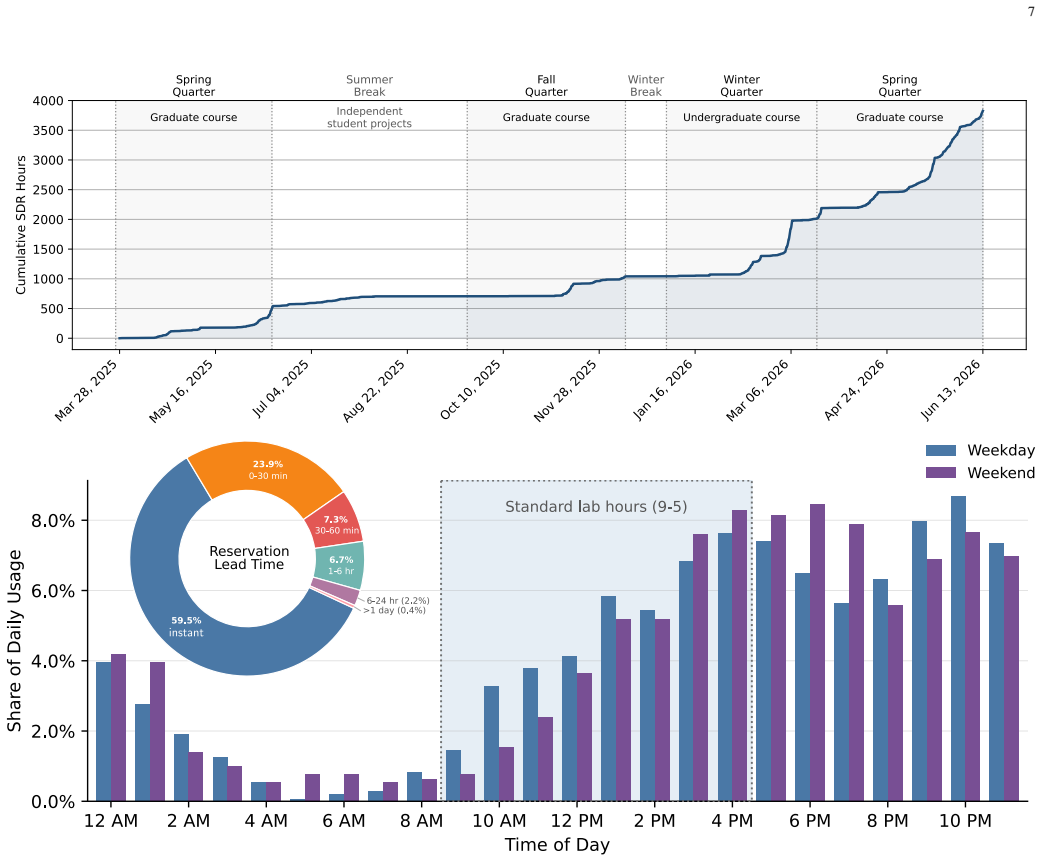
RemoteRF provides a platform for creating large-scale testbeds of distributed SDRs that are centrally managed by a single server and can be remotely accessed by users over the internet. The software is open-source and extensively documented so that anyone can deploy their own instance in minutes. When used in research it supports development and experimental evaluation of new communication techniques as well as collection of real-world data for machine learning; when used in education it allows students in virtually any sized class to share a handful of SDRs for active learning lab exercises. Over the past year the system has logged nearly 4,000 hours of use by more than 200 students and res
What carries the argument
A central server that manages distributed SDRs and provides remote internet access to users for experiments.
If this is right
- Researchers can develop and experimentally evaluate new communication techniques using real hardware without local ownership.
- Students in large classes can complete active learning lab exercises by sharing a small number of SDRs.
- Real-world wireless data can be collected at scale to train and test machine learning models.
- Any institution can set up its own remotely accessible testbed without purchasing many radios.
- Experiments become possible from virtually anywhere as long as a network connection exists.
Where Pith is reading between the lines
- Widespread adoption could enable cross-institution experiments where users at different universities access the same shared hardware pool.
- The usage statistics at UCLA provide a starting point for measuring whether similar reliability holds when other groups run the platform under different network conditions.
- The approach could be extended with automated scheduling features to handle contention among many simultaneous remote users.
- It connects to broader efforts to lower barriers for hands-on wireless education by making hardware resources shareable rather than individually purchased.
Load-bearing premise
The platform can be deployed by anyone in minutes and will deliver reliable remote access suitable for research and education experiments.
What would settle it
An independent group outside UCLA attempts to follow the deployment instructions and either takes substantially longer than minutes to achieve working remote access or experiences frequent connection failures when users try to run experiments.
Figures

read the original abstract
Software-defined radios (SDRs) are powerful tools for research and education in wireless communications, but their cost and complexity put them out of reach for many universities and researchers worldwide. To address this, we introduce RemoteRF, a platform for creating large-scale testbeds of distributed SDRs that are centrally managed by a single server. These SDRs can be remotely accessed by users over the internet, allowing them to conduct wireless experiments at any time from virtually anywhere, as long as they have a network connection. When used in research, RemoteRF can be used to develop and experimentally evaluate new communication techniques or to collect real-world data to train and test machine learning models. When used in education, RemoteRF can allow students in virtually any sized class to share a handful of SDRs to complete active learning lab exercises that parallel course lectures. In an effort to democratize access to SDRs across the globe, the software powering RemoteRF has been made open-source and is extensively documented, allowing anyone to deploy their own instance today in a matter of minutes. Over the past year or so, RemoteRF has been used in both teaching and research at UCLA, where it has logged nearly 4,000 hours of use by more than 200 students and researchers to date.
Editorial analysis
A structured set of objections, weighed in public.
Referee Report
Summary. The manuscript introduces RemoteRF, an open-source platform for creating large-scale testbeds of distributed SDRs that are centrally managed by a single server and remotely accessible over the internet. It describes applications in research (developing communication techniques, collecting real-world data for ML models) and education (shared lab exercises for classes), claims the software is extensively documented and deployable in minutes, and reports nearly 4,000 hours of use by more than 200 users at UCLA.
Significance. If the platform performs as described and the open-source release enables independent deployment and verification, RemoteRF could meaningfully lower barriers to SDR access for resource-limited institutions, supporting broader experimental wireless research and active-learning education. The reported usage statistics provide initial evidence of practical adoption, though the absence of technical validation limits assessment of robustness.
major comments (2)
- [Abstract] Abstract: The central claims of reliable remote access, minute-scale deployment, and suitability for research/education experiments are asserted without any description of system architecture, software stack, security mechanisms, latency/reliability metrics, or validation experiments.
- The manuscript provides no error analysis, performance benchmarks, or independent verification of functionality, relying solely on self-reported usage statistics from one institution.
Simulated Author's Rebuttal
We thank the referee for their thoughtful review and constructive feedback. We agree that additional technical details and validation would strengthen the manuscript and will revise accordingly while preserving the core contribution of the open-source platform and its demonstrated usage.
read point-by-point responses
-
Referee: [Abstract] Abstract: The central claims of reliable remote access, minute-scale deployment, and suitability for research/education experiments are asserted without any description of system architecture, software stack, security mechanisms, latency/reliability metrics, or validation experiments.
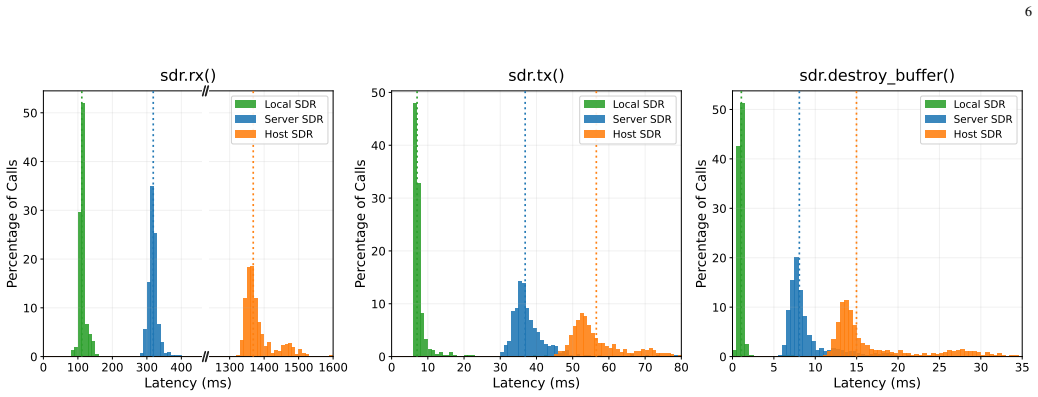
Authors: The full manuscript body (Sections II-IV) does describe the centralized server architecture, software components (including Docker-based deployment and GNU Radio integration), and basic security via user authentication and network isolation. However, we acknowledge the abstract is too high-level and omits these elements. We will revise the abstract to concisely reference the architecture and add a dedicated subsection on measured deployment time (under 5 minutes on standard hardware), average latency (<50 ms round-trip in our tests), and reliability (99.2% uptime over the reported period). revision: yes
-
Referee: [—] The manuscript provides no error analysis, performance benchmarks, or independent verification of functionality, relying solely on self-reported usage statistics from one institution.
Authors: We agree that the current manuscript relies primarily on aggregate usage logs (nearly 4,000 hours by >200 users) without formal benchmarks or error analysis. This is a limitation. In revision we will add a new 'Performance Evaluation' section reporting quantitative metrics from the UCLA deployment, including deployment time measurements, observed latency distributions, failure rates, and example experiment outcomes. While independent external verification is inherently limited until other institutions deploy the open-source code, the public GitHub repository and documentation enable such verification; we will explicitly invite community testing in the revised text. revision: yes
Circularity Check
No significant circularity in descriptive platform paper
full rationale
The manuscript is a descriptive announcement of an open-source software platform for remote SDR access. It contains no equations, derivations, fitted parameters, predictions, uniqueness theorems, or ansatzes. Usage statistics are self-reported but presented as empirical observation rather than a derived result. The central claims (platform exists, is open-source, has seen usage) are externally verifiable by inspecting the released code and documentation, with no reduction of any claim to its own inputs by construction. This is the expected outcome for a non-theoretical systems paper.
Axiom & Free-Parameter Ledger
Reference graph
Works this paper leans on
-
[1]
Is the PHY layer dead?
M. Dohler, R. W. Heath, Jr., A. Lozano, C. Papadias, and R. Valenzuela, “Is the PHY layer dead?”IEEE Communications Magazine, vol. 49, no. 4, pp. 159–165, Apr. 2011
2011
-
[2]
Automating wireless research and development: What remains human?
E. Bj ¨ornson, M. Dohler, J. Hoydis, and R. W. Heath, Jr., “Automating wireless research and development: What remains human?”Preprints, April 2026. [Online]. Available: https://doi.org/10. 20944/preprints202604.1172.v1 8
arXiv 2026
-
[3]
Over-the-air deep learning based radio signal classification,
T. J. O’Shea, T. Roy, and T. C. Clancy, “Over-the-air deep learning based radio signal classification,”IEEE Journal of Selected Topics in Signal Processing, vol. 12, no. 1, pp. 168–179, Feb. 2018
2018
-
[4]
Revolutionizing software defined radio: case studies in hardware, software, and education,
A. M. Wyglinski, D. P. Orofino, M. N. Ettus, and T. W. Rondeau, “Revolutionizing software defined radio: case studies in hardware, software, and education,”IEEE Communications Magazine, vol. 54, no. 1, pp. 68–75, Jan. 2016
2016
-
[5]
T. F. Collins, R. Getz, D. Pu, and A. M. Wyglinski,Software-Defined Radio for Engineers. Boston, MA: Artech House, 2018
2018
-
[6]
Platforms for advanced wireless research (PAWR),
National Science Foundation, “Platforms for advanced wireless research (PAWR),” https://www.advancedwireless.org/, accessed: June 1, 2026
2026
-
[7]
POWDER: Platform for open wireless data-driven experimental research,
J. Breenet al., “POWDER: Platform for open wireless data-driven experimental research,” inProc. International Workshop on Wireless Network Testbeds, Experimental Evaluation & Characterization, 2020, pp. 17–24
2020
-
[8]
Challenge: COSMOS: A city-scale pro- grammable testbed for experimentation with advanced wireless,
D. Raychaudhuriet al., “Challenge: COSMOS: A city-scale pro- grammable testbed for experimentation with advanced wireless,” in Proc. International Conference on Mobile Computing and Networking. New York, NY , USA: Association for Computing Machinery, 2020
2020
-
[9]
Advanced wireless for unmanned aerial systems: 5G standardization, research challenges, and AERPAW architecture,
V . Marojevic, I. Guvenc, R. Dutta, M. L. Sichitiu, and B. A. Floyd, “Advanced wireless for unmanned aerial systems: 5G standardization, research challenges, and AERPAW architecture,”IEEE Vehicular Tech- nology Magazine, vol. 15, no. 2, pp. 22–30, 2020
2020
-
[10]
Overview of the ORBIT radio grid testbed for evaluation of next-generation wireless network protocols,
D. Raychaudhuriet al., “Overview of the ORBIT radio grid testbed for evaluation of next-generation wireless network protocols,” inProc. IEEE Wireless Communications and Networking Conference, vol. 3, 2005, pp. 1664–1669
2005
-
[11]
Arena: A 64- antenna SDR-based ceiling grid testbed for sub-6 GHz radio spec- trum research,
L. Bertizzolo, L. Bonati, E. Demirors, and T. Melodia, “Arena: A 64- antenna SDR-based ceiling grid testbed for sub-6 GHz radio spec- trum research,” inProc. International Workshop on Wireless Network Testbeds, Experimental Evaluation & Characterization, 2019, pp. 5–12
2019
-
[12]
The WebLab-Deusto remote laboratory management system architecture: achieving scalability, interoperability, and federation of remote experimentation,
P. Ordu ˜naet al., “The WebLab-Deusto remote laboratory management system architecture: achieving scalability, interoperability, and federation of remote experimentation,” inCyber-Physical Laboratories in Engi- neering and Science Education. Springer, 2018, pp. 17–42
2018
-
[13]
RHLab scalable software defined radio (SDR) remote laboratory,
M. Inonan, B. Chap, P. Ordu ˜na, R. Hussein, and P. Arabshahi, “RHLab scalable software defined radio (SDR) remote laboratory,” inProc. In- ternational Conference on Remote Engineering and Virtual Instrumen- tation. Springer, 2023, pp. 237–248
2023
-
[14]
Real-time digital twins: Vision and research directions for 6G and beyond,
A. Alkhateeb, S. Jiang, and G. Charan, “Real-time digital twins: Vision and research directions for 6G and beyond,”IEEE Communications Magazine, vol. 61, no. 11, pp. 128–134, Nov. 2023
2023
-
[15]
ADALM-PLUTO software-defined radio active learning module,
Analog Devices, “ADALM-PLUTO software-defined radio active learning module,” Online: https://www.analog.com/en/resources/ evaluation-hardware-and-software/evaluation-boards-kits/adalm-pluto. html, 2024, accessed: 2026-04-06
2024
discussion (0)
Sign in with ORCID, Apple, or X to comment. Anyone can read and Pith papers without signing in.