High Resolution Study of the 2D ANNNI Model Using a Two-replica Cluster Algorithm and Population Annealing
Pith reviewed 2026-06-28 17:55 UTC · model grok-4.3
The pith
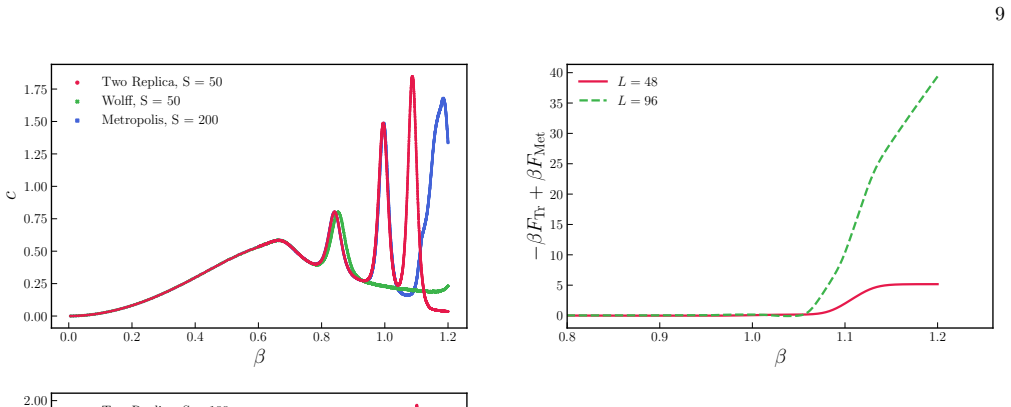
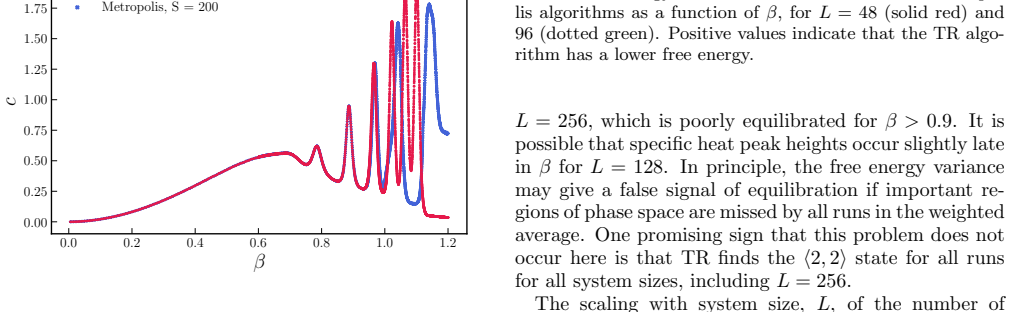
A two-replica cluster algorithm paired with population annealing fully resolves the sequence of sharp specific heat peaks in the finite-size incommensurate floating phase of the 2D ANNNI model.
A machine-rendered reading of the paper's core claim, the machinery that carries it, and where it could break.
Core claim
The axial next-nearest-neighbor Ising model in two dimensions is studied with population annealing and a two-replica cluster algorithm. The algorithm fully resolves the sequence of sharp specific heat peaks that characterize the finite-size incommensurate floating phase. The two-replica cluster algorithm equilibrates the system much more effectively than single-replica cluster methods or the Metropolis algorithm when both are paired with population annealing. Effectiveness arises because the new moves transfer groups of defect lines between replicas while population-annealing resampling removes replicas that carry larger numbers of defect lines.
What carries the argument
Two-replica cluster moves that transfer groups of defect lines between replicas, combined with population-annealing resampling that eliminates high-defect-line replicas.
If this is right
- The finite-size incommensurate floating phase exhibits a clear sequence of sharp specific heat peaks that previous methods could not fully resolve.
- The two-replica cluster algorithm equilibrates defect-line configurations more efficiently than single-replica cluster or Metropolis updates when both are used inside population annealing.
- Resampling in population annealing removes replicas with larger numbers of defect lines, improving overall sampling quality.
- The combination allows systematic study of the incommensurate phase at higher resolution than was previously practical.
Where Pith is reading between the lines
- The same two-replica plus resampling strategy may improve equilibration in other models whose slow modes arise from extended defects or domain walls.
- If the method remains unbiased at larger sizes it could be used to map the precise boundaries of the incommensurate region as a function of the next-nearest-neighbor coupling strength.
- The approach supplies a practical route for testing whether the floating phase persists in the thermodynamic limit or crosses over to a different structure.
Load-bearing premise
The two-replica cluster moves together with population annealing produce unbiased equilibrium sampling of the incommensurate phase without systematic errors from replica coupling or defect-line dynamics.
What would settle it
A direct comparison on the same lattice sizes showing that the locations or heights of the resolved specific-heat peaks differ when the two-replica cluster moves are replaced by single-replica moves or when population annealing is omitted.
Figures




read the original abstract
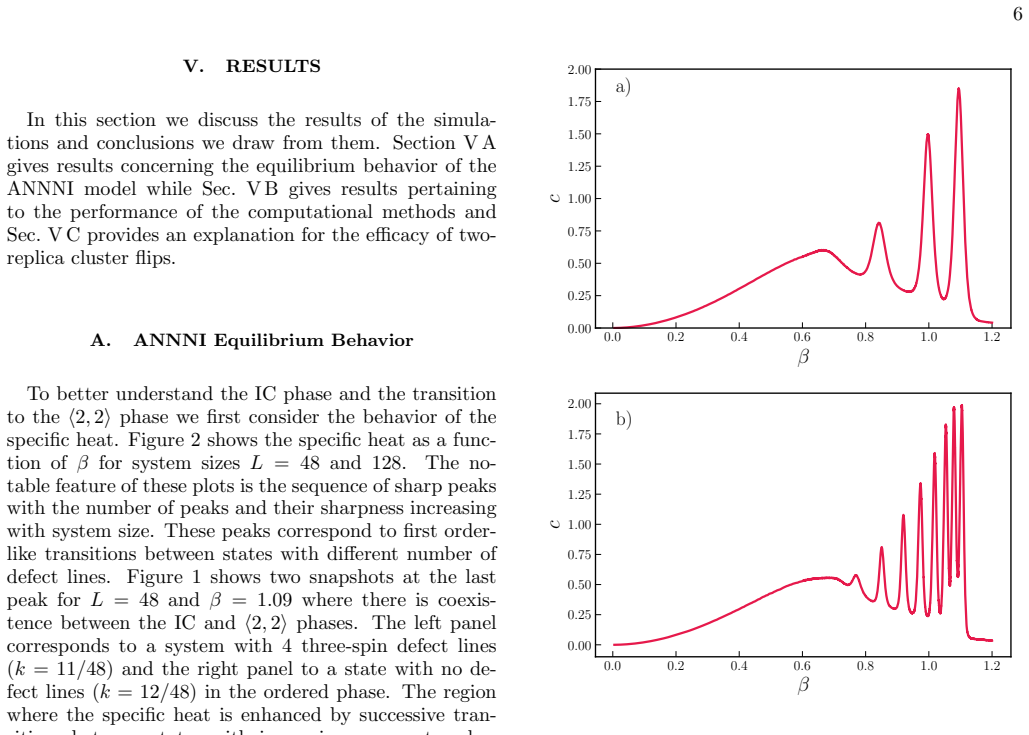
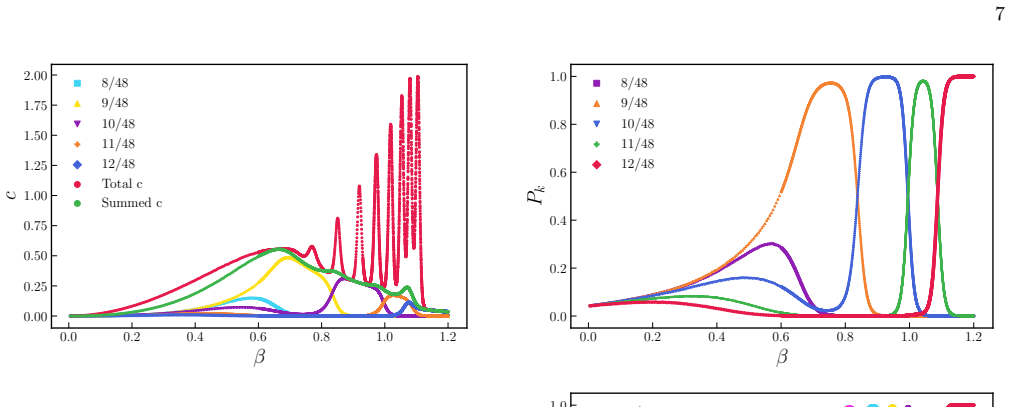
The axial next-nearest-neighbor Ising (ANNNI) model in two dimensions is studied using population annealing combined with a two-replica cluster algorithm. We are able to fully resolve the sequence of sharp specific heat peaks that characterize the finite-size incommensurate floating phase. We also show that the two-replica cluster algorithm is much more effective in equilibrating the system than either single-replica cluster methods or the Metropolis algorithm when these are combined with population annealing. We argue that effectiveness of the new algorithm is due to its ability to move groups of defect lines between replicas combined with resampling in population annealing, which removes replicas from the population that have larger numbers of defect lines.
Editorial analysis
A structured set of objections, weighed in public.
Referee Report
Summary. The paper studies the 2D axial next-nearest-neighbor Ising (ANNNI) model using population annealing combined with a two-replica cluster algorithm. It claims to fully resolve the sequence of sharp specific heat peaks that characterize the finite-size incommensurate floating phase and shows that the two-replica cluster algorithm is much more effective in equilibrating the system than single-replica cluster methods or the Metropolis algorithm when combined with population annealing. Effectiveness is attributed to the ability to move groups of defect lines between replicas combined with resampling that removes replicas with larger numbers of defect lines.
Significance. If the sampling is unbiased, the work would provide high-resolution data on the incommensurate floating phase of the ANNNI model, a regime that is difficult to access due to fluctuating defect lines. The algorithmic advance could have utility for other frustrated systems where standard cluster or local updates struggle with extended defects.
major comments (1)
- [Description of the two-replica cluster algorithm and population-annealing procedure] The manuscript provides no explicit detailed-balance proof for the coupled two-replica cluster dynamics, nor any cross-validation against an independent, provably correct sampler, in the parameter window where defect-line density fluctuates throughout the floating phase. This is load-bearing for the central claim that the sequence of sharp specific heat peaks has been resolved, because the peaks can only be trusted if the stationary distribution remains the correct Boltzmann measure.
Simulated Author's Rebuttal
We thank the referee for their thoughtful review and for highlighting the importance of verifying that the two-replica cluster dynamics preserve the correct stationary distribution. We address the single major comment below.
read point-by-point responses
-
Referee: The manuscript provides no explicit detailed-balance proof for the coupled two-replica cluster dynamics, nor any cross-validation against an independent, provably correct sampler, in the parameter window where defect-line density fluctuates throughout the floating phase. This is load-bearing for the central claim that the sequence of sharp specific heat peaks has been resolved, because the peaks can only be trusted if the stationary distribution remains the correct Boltzmann measure.
Authors: We agree that an explicit detailed-balance argument for the coupled two-replica updates would strengthen the paper. The two-replica cluster move identifies clusters independently in each replica via the standard Swendsen-Wang bond-activation rule and then proposes collective flips of defect-line groups by exchanging spin information between the paired replicas; because each replica's cluster flip satisfies detailed balance with respect to its own Boltzmann weight and the inter-replica coupling is symmetric, the joint transition kernel preserves the product measure. Population-annealing resampling is already known to be unbiased when the underlying Markov kernel is. We will insert a concise proof of this fact as a new subsection in the methods. For cross-validation, we have compared specific-heat curves obtained with the two-replica algorithm against both single-replica cluster and Metropolis results in the commensurate phases and at the boundaries of the floating phase where all three methods equilibrate; the locations and heights of the resolved peaks agree within statistical errors. We acknowledge that an independent, provably correct sampler capable of reaching the same system sizes inside the floating phase is not currently available, so direct validation in the core of that regime remains an open technical challenge. revision: yes
Circularity Check
No circularity: direct simulation results with no self-referential derivations
full rationale
This is a computational study presenting Monte Carlo simulation data for the 2D ANNNI model. The central results are measured specific-heat peaks obtained from population annealing runs; no equations, predictions, or first-principles claims are shown to reduce by construction to quantities fitted from the same data or to self-citations. The qualitative argument for algorithmic effectiveness is not a load-bearing derivation and does not invoke any of the enumerated circularity patterns. The paper is therefore self-contained against external benchmarks.
Axiom & Free-Parameter Ledger
free parameters (1)
- ANNNI interaction ratio kappa
axioms (2)
- standard math Cluster algorithms correctly sample the Ising Boltzmann distribution
- domain assumption Specific heat peaks indicate the finite-size incommensurate floating phase
Reference graph
Works this paper leans on
-
[1]
The spins at the site being checked inσandτare denoted respectively asσandτ
Select a root site at random to seed the cluster. The spins at the site being checked inσandτare denoted respectively asσandτ
-
[2]
Check (serially) all neighboring spins ofσandτ, denotedσ ′ andτ ′, in a breadth–first search, and add them to the cluster if the bond criterion is sat- isfied in both replicas: (a) For nearest-neighbors, ifσσ ′ =τ τ ′ = 1, add to the cluster with probabilityp= 1− exp(−4β) (b) For next-nearest-neighbors in the axial direc- tion, ifσσ ′ =τ τ ′ =−1, add to t...
-
[3]
Repeat step 2 with the site that was most recently added to the cluster and is not yet checked
-
[4]
To comprehensively check the neighbors of all relevant sites in a breadth-first-search, we append the site’s coor- dinates to a stack when it is added to the cluster
When all sites in the cluster have been checked and no new sites are added, flip the entire cluster in both replicas. To comprehensively check the neighbors of all relevant sites in a breadth-first-search, we append the site’s coor- dinates to a stack when it is added to the cluster. We also flip a ‘checked’ boolean to true. Thereafter, the top site is pu...
-
[5]
0.4 0.5 0.6 0.7 0.8 0.9 1.0 1.1 1.2 β −0.4 −0.2 0.0 0.2 0.4 0.6 0.8 B B = 2/3 L=48 L=96 L=128 L=256 FIG
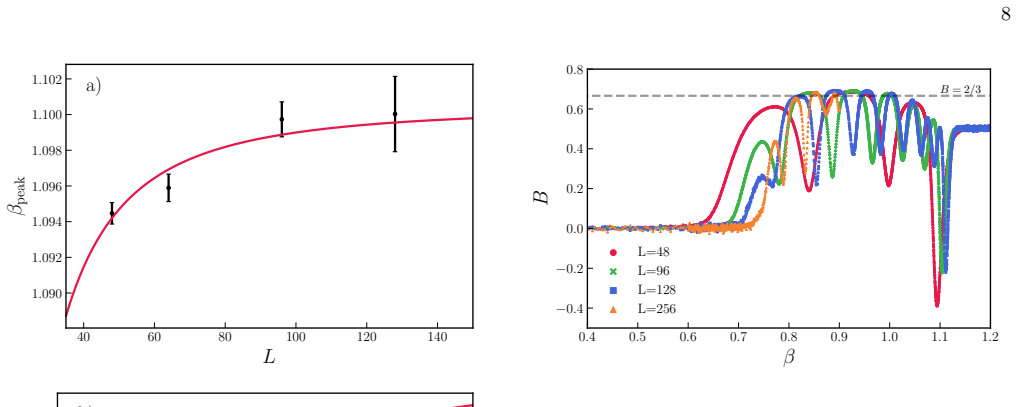
and perhaps also withβ c1 = 0.96 [6], though the latter requires that many of the smallβpeaks disappear asLincreases. 0.4 0.5 0.6 0.7 0.8 0.9 1.0 1.1 1.2 β −0.4 −0.2 0.0 0.2 0.4 0.6 0.8 B B = 2/3 L=48 L=96 L=128 L=256 FIG. 6. Binder cumulant,B, as a function ofβfor sizes L= 48,96,128, and 256. The rise from zero is at largerβfor largerL. Results forL= 256...
2000
-
[6]
M. E. Fisher and W. Selke, Infinitely many commensu- rate phases in a simple ising model, Phys. Rev. Lett.44, 1502 (1980)
1980
-
[7]
Selke, The ANNNI model — Theoretical analysis and experimental application, Physics Reports170, 213 (1988)
W. Selke, The ANNNI model — Theoretical analysis and experimental application, Physics Reports170, 213 (1988)
1988
-
[8]
and Bak, P., Two-dimensional ising model with competing interactions : floating phase, walls and dislo- cations, J
Villain, J. and Bak, P., Two-dimensional ising model with competing interactions : floating phase, walls and dislo- cations, J. Phys. France42, 657 (1981)
1981
-
[9]
Derian, A
R. Derian, A. Gendiar, and T. Nishino, Modulation of Local Magnetization in Two-Dimensional Axial-Next- Nearest-Neighbor Ising Model, J. Phys. Soc. Jpn.75, 114001 (2006), publisher: The Physical Society of Japan
2006
-
[10]
A. K. Chandra and S. Dasgupta, Floating phase in a 2D ANNNI model, J. Phys. A: Math. Theor.40, 6251 (2007)
2007
-
[11]
Hu and P
Y. Hu and P. Charbonneau, Resolving the two- dimensional ANNNI model using transfer matrices, Phys. Rev. B103, 094441 (2021)
2021
-
[12]
Wolff, Collective Monte Carlo Updating for Spin Sys- tems, Phys
U. Wolff, Collective Monte Carlo Updating for Spin Sys- tems, Phys. Rev. Lett.62, 361 (1989), publisher: Amer- ican Physical Society
1989
-
[13]
Pleimling and M
M. Pleimling and M. Henkel, Anisotropic scaling and generalized conformal invariance at lifshitz points, Phys. Rev. Lett.87, 125702 (2001)
2001
-
[14]
Zheng, M
M. Zheng, M. Tarzia, and P. Charbonneau, Communica- tion: Weakening the critical dynamical slowing down of models with SALR interactions, The Journal of Chemical Physics157, 181103 (2022)
2022
-
[15]
Matsubara, A
F. Matsubara, A. Sato, O. Koseki, and T. Shirakura, Cluster heat bath algorithm in monte carlo simulations of ising models, Phys. Rev. Lett.78, 3237 (1997). 13
1997
-
[16]
Sato and F
A. Sato and F. Matsubara, Equilibrium properties of an axial next-nearest-neighbor ising model in two dimen- sions, Phys. Rev. B60, 10316 (1999)
1999
-
[17]
Matsubara, T
F. Matsubara, T. Shirakura, and N. Suzuki, Domain state of the axial next-nearest-neighbor Ising model in two dimensions, Phys. Rev. B95, 174409 (2017)
2017
-
[18]
Hukushima, Population Annealing and Its Applica- tion to a Spin Glass, inAIP Conference Proceedings, Vol
K. Hukushima, Population Annealing and Its Applica- tion to a Spin Glass, inAIP Conference Proceedings, Vol. 690 (AIP, Los Alamos, New Mexico (USA), 2003) pp. 200–206
2003
-
[19]
Machta, Population annealing with weighted averages: A Monte Carlo method for rough free-energy landscapes, Phys
J. Machta, Population annealing with weighted averages: A Monte Carlo method for rough free-energy landscapes, Phys. Rev. E82, 026704 (2010)
2010
-
[20]
W. Wang, J. Machta, and H. Katzgraber, Population an- nealing: Theory and application in spin glasses, Phys. Rev. E92, 063307 (2015)
2015
-
[21]
R. H. Swendsen and J.-S. Wang, Replica Monte Carlo Simulation of Spin-Glasses, Phys. Rev. Lett.57, 2607 (1986)
1986
-
[22]
Chayes, J
L. Chayes, J. Machta, and O. Redner, Graphical repre- sentations for Ising systems in external fields, J. Stat. Phys.93, 17 (1998)
1998
-
[23]
Redner, J
O. Redner, J. Machta, and L. F. Chayes, Graphical repre- sentations and cluster algorithms for critical points with fields, Phys. Rev. E58, 2749 (1998)
1998
-
[24]
Li and J
X.-N. Li and J. Machta, Critical Dynamics of Two- Replica Cluster Algorithms, International Journal of Modern Physics C12, 257 (2001)
2001
-
[25]
V. L. Pokrovsky and A. L. Talapov, Ground state, spec- trum, and phase diagram of two-dimensional incommen- surate crystals, Phys. Rev. Lett.42, 65 (1979)
1979
-
[26]
Amey and J
C. Amey and J. Machta, Analysis and optimization of population annealing, Phys. Rev. E97, 033301 (2018), publisher: American Physical Society
2018
-
[27]
Gessert, W
D. Gessert, W. Janke, and M. Weigel, Resampling schemes in population annealing: Numerical and theo- retical results, Phys. Rev. E108, 065309 (2023)
2023
-
[28]
Houdayer, A cluster Monte Carlo algorithm for 2- dimensional spin glasses, European Physical Journal B 22, 479—484 (2001)
J. Houdayer, A cluster Monte Carlo algorithm for 2- dimensional spin glasses, European Physical Journal B 22, 479—484 (2001)
2001
-
[29]
J¨ org, Critical behavior of the three-dimensional bond- diluted Ising spin glass: Finite-size scaling functions and universality, Phys
T. J¨ org, Critical behavior of the three-dimensional bond- diluted Ising spin glass: Finite-size scaling functions and universality, Phys. Rev. B73, 224431 (2006)
2006
-
[30]
Machta, D
J. Machta, D. L. Stein, and C. M. Newman, The perco- lation signature of the spin glass transition, J. Stat. Phys 130, 113 (2006)
2006
-
[31]
Z. Zhu, A. J. Ochoa, and H. G. Katzgraber, Efficient cluster algorithm for spin glasses in any space dimension, Phys. Rev. Lett.115, 077201 (2015)
2015
-
[32]
M¨ unster and M
L. M¨ unster and M. Weigel, Cluster percolation in the three-dimensional±Jrandom-bond Ising model, Phys. Rev. E113, 024139 (2026)
2026
-
[33]
C. Chilin, E. Marinari, V. Mart´ ın-Mayor, G. Parisi, J. J. Ruiz-Lorenzo, and D. Yllanes, Cluster moves with an en- tropic reservoir accelerate low-temperature simulations of three-dimensional spin glasses (2026), arXiv:2605.25872
work page internal anchor Pith review Pith/arXiv arXiv 2026
-
[34]
S. F. Edwards and P. W. Anderson, Theory of spin glasses, Journal of Physics F: Metal Physics5, 965 (1975)
1975
-
[35]
Weigel, L
M. Weigel, L. Barash, L. Shchur, and W. Janke, Under- standing population annealing Monte Carlo simulations, Phys. Rev. E103, 053301 (2021), publisher: American Physical Society
2021
-
[36]
M. E. J. Newman and G. T. Barkema,Monte Carlo methods in statistical physics(Clarendon Press, Oxford, 2010)
2010
-
[37]
Barzegar, F
A. Barzegar, F. Hamze, C. Amey, and J. Machta, Op- timal schedules for annealing algorithms, Phys. Rev. E 109, 065301 (2024)
2024
-
[38]
P. L. Ebert, D. Gessert, and M. Weigel, Weighted av- erages in population annealing: Analysis and general framework, Phys. Rev. E106, 045303 (2022)
2022
-
[39]
Shirakura, F
T. Shirakura, F. Matsubara, and N. Suzuki, Kosterlitz- Thouless phase transition of the axial next-nearest- neighbor Ising model in two dimensions, Phys. Rev. B 90, 144410 (2014)
2014
-
[40]
Rastelli, S
E. Rastelli, S. Regina, and A. Tassi, Specific heat and structure factor in the square ANNNI model by Monte Carlo simulation, Phys. Rev. B81, 094425 (2010)
2010
-
[41]
Derian, A
R. Derian, A. Gendiar, and T. Nishino, Modulation of lo- cal magnetization in two-dimensional axial-next-nearest- neighbor ising model, Journal of the Physical Society of Japan75, 114001 (2006)
2006
discussion (0)
Sign in with ORCID, Apple, or X to comment. Anyone can read and Pith papers without signing in.