Probing Two Dark Dimensions through Primordial Black Holes, Gravitational Waves, and Colliders
Pith reviewed 2026-06-29 03:36 UTC · model grok-4.3
The pith
In the two-dark-dimensions framework the memory-burden effect with p=2 suppresses evaporation enough for primordial black holes as light as 10^{-3} g to survive to the present and comprise all dark matter.
A machine-rendered reading of the paper's core claim, the machinery that carries it, and where it could break.
Core claim
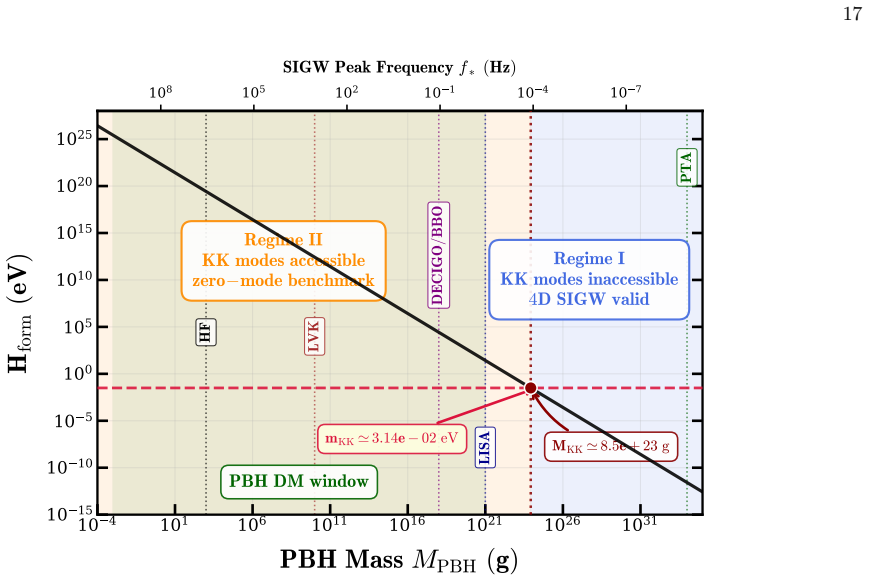
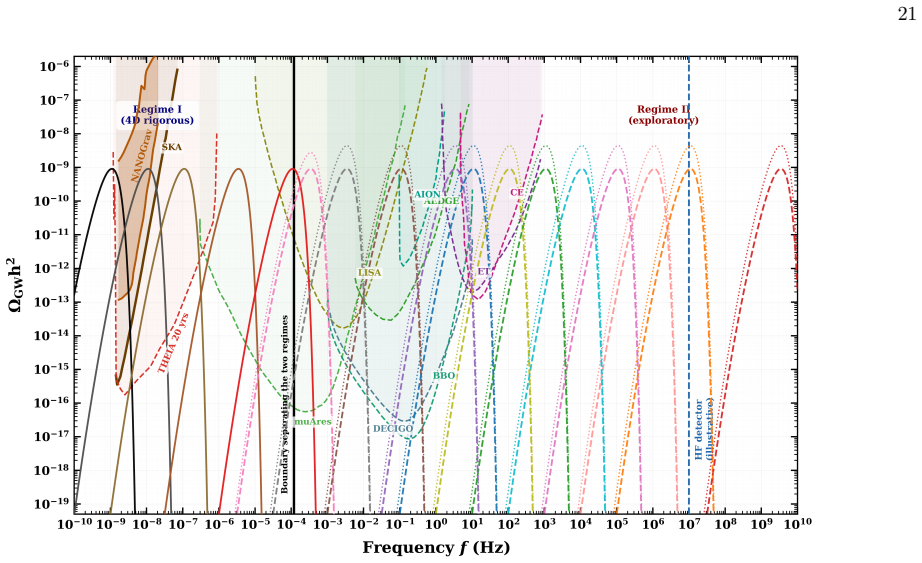
In the two-dark-dimensions scenario, applying the memory-burden effect with p=2 to higher-dimensional primordial black holes strongly suppresses their evaporation, permitting initial masses as small as ∼10^{-3} g to survive to the present epoch and thereby account for the observed dark matter over the mass range 10^{-3} g to 10^{21} g. The stochastic gravitational-wave background induced by the required curvature perturbations can be computed with the conventional four-dimensional formalism and lies within reach of LISA, DECIGO and pulsar timing arrays, while the TeV-scale gravity also allows microscopic black hole production at colliders.
What carries the argument
The memory-burden effect with exponent p=2, which modifies the evaporation rate of higher-dimensional black holes in the two-dark-dimensions brane-world model.
If this is right
- PBHs with initial masses from 10^{-3} g to 10^{21} g can constitute the entire dark matter density.
- The scalar-induced gravitational wave background from PBH formation is accessible to LISA, DECIGO, and pulsar timing arrays.
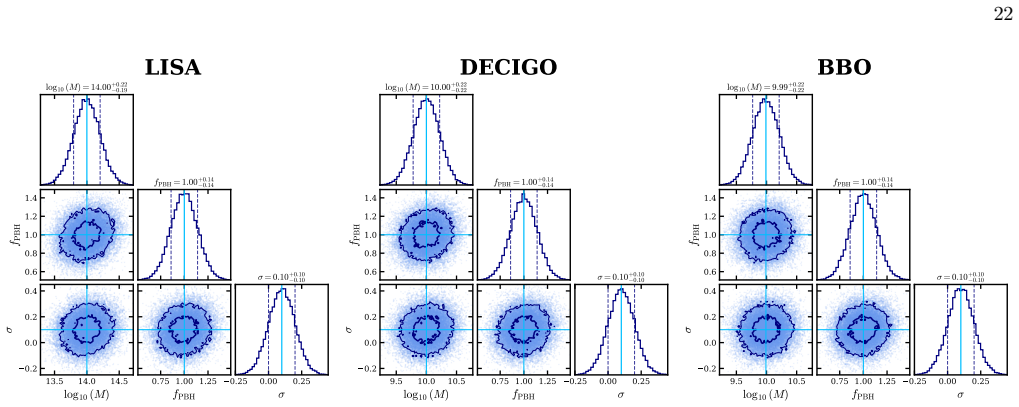
- Fisher forecasts indicate that gravitational-wave data can tightly constrain PBH mass, dark-matter fraction, and the width of the primordial curvature spectrum.
- Microscopic black holes can be produced at future high-energy colliders owing to the low fundamental gravity scale.
Where Pith is reading between the lines
- Similar evaporation suppression could operate in other extra-dimension models and thereby enlarge the viable PBH mass window beyond the specific two-dark-dimensions case.
- Independent astrophysical searches for long-lived small black holes could test the memory-burden mechanism without relying on early-universe cosmology.
- Joint analysis of collider events and gravitational-wave spectra might distinguish different values of the memory exponent p.
Load-bearing premise
The quantum-gravitational memory-burden effect with memory exponent p=2 holds for primordial black holes evolving in the two-dark-dimensions framework.
What would settle it
An observation that black holes with initial mass near 10^{-3} g have fully evaporated by the present epoch, or a null result for the predicted scalar-induced gravitational-wave background in the LISA frequency band under the assumption that these black holes make up the dark matter.
Figures


read the original abstract
We study primordial-black-hole (PBH) dark matter in the two-dark-dimensions (2DD) framework, a six-dimensional brane-world scenario with two compact extra dimensions and a fundamental gravity scale of order $10\,\mathrm{TeV}$. We calculate the evolution of higher-dimensional PBHs including the recently proposed quantum-gravitational memory-burden effect. For a memory exponent $p=2$, the evaporation rate is strongly suppressed, allowing PBHs with initial masses as small as $\sim10^{-3}\,\mathrm{g}$ to survive until the present epoch. Consequently, PBHs can account for the observed dark matter over a mass range extending from $10^{-3}\,\mathrm{g}$ to $10^{21}\,\mathrm{g}$. We further compute the stochastic gravitational-wave background generated at second order by the primordial curvature perturbations responsible for PBH formation. We show that the conventional four-dimensional formalism for scalar-induced gravitational waves remains applicable throughout the mass range accessible to current and future gravitational wave experiments. The resulting signals can be probed by LISA, DECIGO, and pulsar timing arrays. Using Fisher forecasts, we find that these observations can constrain the PBH mass, dark-matter fraction, and width of the primordial curvature spectrum with high precision. The low fundamental gravity scale of the 2DD framework also permits the production of microscopic black holes at future high-energy colliders. Their decay signatures, together with gravitational-wave measurements, provide complementary tests of higher-dimensional gravity, the memory-burden mechanism, and primordial-black-hole dark matter.
Editorial analysis
A structured set of objections, weighed in public.
Referee Report
Summary. The manuscript claims that in the two-dark-dimensions (2DD) framework—a six-dimensional brane-world model with two compact extra dimensions and a fundamental gravity scale of order 10 TeV—incorporation of the memory-burden effect with exponent p=2 strongly suppresses primordial black hole (PBH) evaporation. This allows PBHs with initial masses as small as ∼10^{-3} g to survive to the present epoch and account for all dark matter over the range 10^{-3} g to 10^{21} g. The paper further states that the standard four-dimensional formalism for scalar-induced gravitational waves remains valid across the relevant mass window, computes the resulting stochastic background, and uses Fisher forecasts to show that LISA, DECIGO, and pulsar timing arrays can tightly constrain PBH mass, dark-matter fraction, and the width of the primordial curvature spectrum. Collider production of microscopic black holes is noted as a complementary probe.
Significance. If the central assumptions on the memory-burden effect and the applicability of the four-dimensional gravitational-wave formalism hold after explicit derivation, the work would link higher-dimensional gravity, quantum-gravitational evaporation suppression, and multi-messenger observations in a single framework. The quantitative Fisher forecasts for gravitational-wave constraints on PBH parameters constitute a concrete strength that enables direct comparison with future data.
major comments (2)
- [Abstract and PBH evolution section] Abstract and the section on PBH evolution: the claim that the evaporation rate is strongly suppressed for p=2, allowing initial masses ∼10^{-3} g to survive until today, is asserted without a derivation of the modified evaporation law that incorporates the six-dimensional metric, bulk effects, or the ∼10 TeV fundamental scale; this step is load-bearing for the entire dark-matter mass-range conclusion.
- [Gravitational waves section] Section on gravitational waves: the statement that the conventional four-dimensional formalism for scalar-induced gravitational waves remains applicable is presented without an explicit check or equation demonstrating that curvature-perturbation sourcing and tensor propagation receive no corrections from the extra dimensions at the wavenumbers corresponding to the quoted PBH mass window.
minor comments (1)
- [Abstract] The abstract would benefit from a short statement of the numerical value adopted for the fundamental scale and the motivation for fixing the memory exponent at p=2 rather than treating it as a free parameter.
Simulated Author's Rebuttal
We thank the referee for the careful reading and constructive comments. We address each major comment below.
read point-by-point responses
-
Referee: [Abstract and PBH evolution section] Abstract and the section on PBH evolution: the claim that the evaporation rate is strongly suppressed for p=2, allowing initial masses ∼10^{-3} g to survive until today, is asserted without a derivation of the modified evaporation law that incorporates the six-dimensional metric, bulk effects, or the ∼10 TeV fundamental scale; this step is load-bearing for the entire dark-matter mass-range conclusion.
Authors: We agree that an explicit derivation of the modified evaporation law is required. In the revised manuscript we will add a dedicated subsection deriving the memory-burden-suppressed evaporation rate from the six-dimensional brane-world metric, incorporating bulk graviton emission and the ∼10 TeV fundamental scale for p=2. This derivation will directly support the survival of PBHs with initial masses down to ∼10^{-3} g and the resulting dark-matter mass window. revision: yes
-
Referee: [Gravitational waves section] Section on gravitational waves: the statement that the conventional four-dimensional formalism for scalar-induced gravitational waves remains applicable is presented without an explicit check or equation demonstrating that curvature-perturbation sourcing and tensor propagation receive no corrections from the extra dimensions at the wavenumbers corresponding to the quoted PBH mass window.
Authors: We acknowledge that an explicit verification is needed. The revised version will include a new subsection (or appendix) that supplies the required check: we will derive the conditions under which the six-dimensional corrections to curvature-perturbation sourcing and tensor-mode propagation remain negligible at the wavenumbers set by the PBH mass window, confirming the validity of the four-dimensional scalar-induced gravitational-wave formalism throughout the relevant range. revision: yes
Circularity Check
No circularity; central results rest on external input assumptions
full rationale
The paper presents the memory-burden exponent p=2 as an input taken from recent external proposals and applies it to calculate PBH evolution in the 2DD framework. The resulting mass range for dark matter follows directly from this suppression combined with higher-dimensional evaporation formulas. The assertion that 4D scalar-induced GW formalism remains applicable is stated as a check without reducing to a self-derived quantity. No quoted step shows a prediction equivalent to a fitted parameter by construction, a self-citation load-bearing the central claim, or any of the enumerated circular patterns. The derivation chain is therefore self-contained against external benchmarks.
Axiom & Free-Parameter Ledger
free parameters (2)
- memory exponent p =
2
- fundamental gravity scale =
10 TeV
axioms (2)
- domain assumption The conventional four-dimensional formalism for scalar-induced gravitational waves remains applicable throughout the mass range accessible to current and future gravitational wave experiments.
- domain assumption The quantum-gravitational memory-burden effect with exponent p=2 applies to higher-dimensional primordial black holes in the two-dark-dimensions framework.
Reference graph
Works this paper leans on
-
[1]
The Nariai limit corresponds to the degeneracy of the black-hole and cosmological horizons [63, 64]
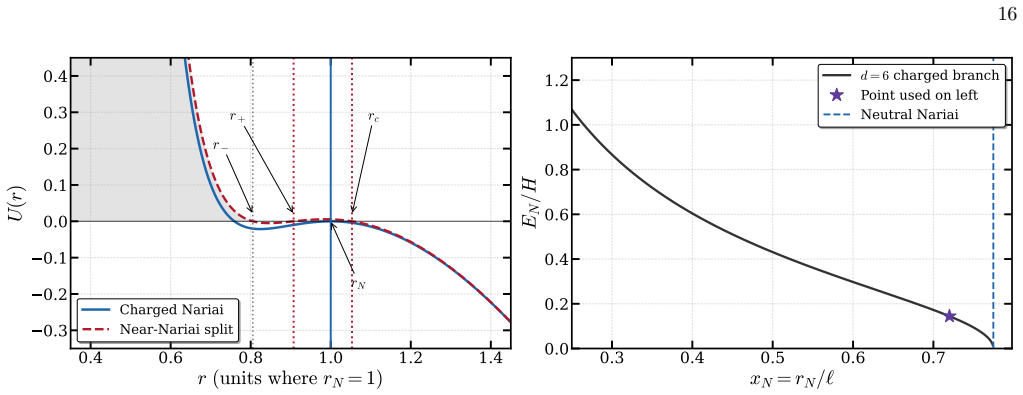
The Nariai limit inddimensions Consider thed-dimensional Reissner–Nordstr¨ om–de Sitter (RNdS) geometry [62, 63], ds2 =−U(r)dt 2 + dr2 U(r) +r 2dΩ2 d−2,(63) with U(r) = 1− µ rd−3 + Q2 d r2d−6 − r2 ℓ2 ,(64) where µ≡ 2M M d−2 P , Q 2 d ≡ g2q2 4πM d−2 P .(65) HereMis the black-hole mass,qis the charge quantum number,gis the gauge coupling,M P is thed-dimensi...
-
[2]
With the same normalization used in Eq
Electric field on the Nariai horizon The discharge of a charged near-Nariai black hole proceeds through Schwinger pair production in the background electric field [60, 65, 66]. With the same normalization used in Eq. (64), we define Q2 d ≡ g2q2 4πM d−2 P ,(79) so that the electric field may be written as E(r) = Qd 2√π rd−2 .(80) At the Nariai horizon, EN ...
-
[3]
(88) Thus, avoiding rapid Schwinger discharge of charged Nariai black holes requires parametricallym 2 ≳e physEN /π, up to order-one corrections
Schwinger pair production and the Festina–Lente bound In a locally constant electric fieldE, the Schwinger pair-production rate for a particle of massmand physical chargee phys has the schematic form [65] ΓSchw ∼ (ephysE)d/2 (2π)d−1 exp − πm2 ephysE ,(87) up to spin-dependent, curvature-dependent, and geometry-dependent prefactors, the Schwinger exponent ...
-
[4]
6: Benchmark production cross sections for microscopic six-dimensional black holes
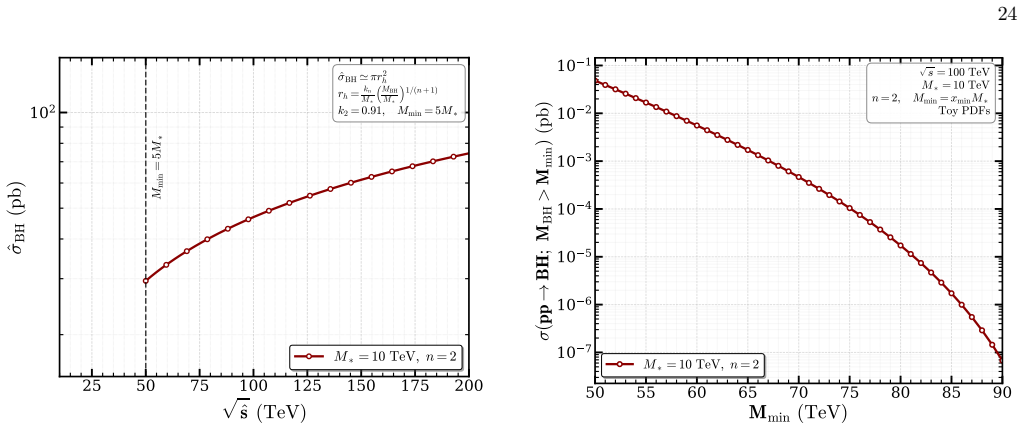
Proton–proton production rate The proton–proton cross section is obtained by convoluting the partonic result with the parton luminosities, σpp→BH(s) = X i,j Z 1 τmin dτ dLij dτ ˆσij→BH(τ s),(141) where τmin = M2 min s , dLij dτ = Z 1 τ dx x fi(x, Q)fj τ x , Q ,(142) 24 25 50 75 100 125 150 175 200 √ ˆs (TeV) 102 ˆσBH (pb) Mmin = 5M ∗ ˆσBH ≃ πr2 h rh = kn ...
-
[5]
The black hole therefore resolves the higher-dimensional bulk, and bulk graviton emission is not kinematically suppressed by the small KK mass gap
Bulk emission and missing transverse momentum The compactification scale is much larger than the microscopic horizon,r h ≪R, while the Hawking temperature is much greater than the KK mass spacing. The black hole therefore resolves the higher-dimensional bulk, and bulk graviton emission is not kinematically suppressed by the small KK mass gap. The power em...
-
[6]
Their relative emission rates are determined by the corresponding couplings and polarization-dependent greybody factors
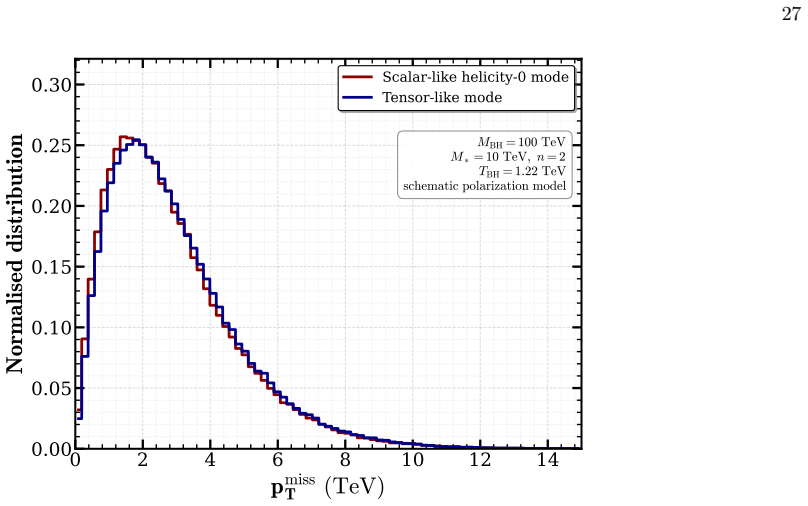
Illustrative polarization dependence of bulk emission From a four-dimensional viewpoint, a massive KK spin-2 excitation contains helicity-±2, helicity-±1, and helicity-0 components. Their relative emission rates are determined by the corresponding couplings and polarization-dependent greybody factors. In principle, their different angular distributions ca...
-
[7]
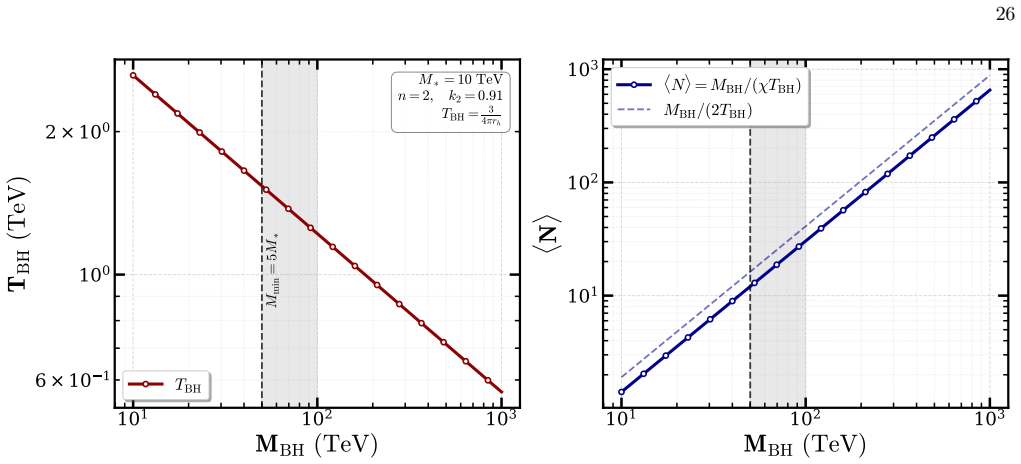
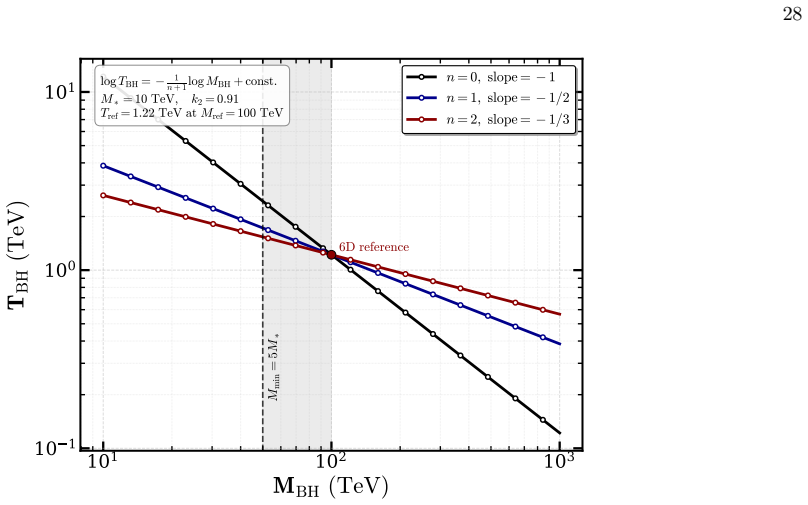
Sensitivity to the number of extra dimensions Fornextra dimensions, the temperature–mass relation has the logarithmic slope dlogT BH dlogM BH =− 1 n+ 1 .(152) A slope near−1/3 would therefore be consistent with two extra dimensions. In practice, the reconstructed mass is affected by invisible energy, while the inferred temperature is distorted by greybody...
-
[8]
KK decomposition of the tensor perturbation We consider a six-dimensional spacetime compactified on a square two-torus, M4 ×T 2,(A1) with compactification length L≡2πR.(A2) 31 The tensor perturbation of the higher-dimensional metric can be decomposed into eigenmodes of the compact space. Schematically, hij(x, y) =h (0) ij (x) + X ⃗ n̸=0 h(⃗ n) ij (x)Y ⃗ n...
-
[9]
Energy density of a massive tensor mode The energy density carried by a tensor perturbation follows from the quadratic action. For a massive KK tensor mode, the kinetic, gradient, and mass terms give schematically ρ(⃗ n) GW ≃ M2 Pl 8a2 X λ h hλ′ ⃗ n 2 + k2 +a 2m2 ⃗ n hλ ⃗ n 2i .(A17) For an oscillating mode, one may average over several oscillations. The ...
-
[10]
The functionI ⃗ nis the massive Green- function kernel and differs from the standard massless kernelI 0
F ull six-dimensional spectrum The full six-dimensional gravitational-wave spectrum is obtained by summing over the massless zero mode and all massive KK modes: Ω6d GW(k, η) = Ω(0) GW(k, η) + X ⃗ n̸=0 Ω(⃗ n) GW(k, η).(A26) The zero-mode contribution is the standard four-dimensional scalar-induced gravitational-wave spectrum: Ω(0) GW,0(k) = Ω(4d) GW,0(k).(...
-
[11]
Nima Arkani-Hamed, Savas Dimopoulos, and G. R. Dvali. The Hierarchy problem and new dimensions at a millimeter. Phys. Lett. B, 429:263–272, 1998
1998
-
[12]
Ignatios Antoniadis, Nima Arkani-Hamed, Savas Dimopoulos, and G. R. Dvali. New dimensions at a millimeter to a Fermi and superstrings at a TeV.Phys. Lett. B, 436:257–263, 1998
1998
-
[13]
Nima Arkani-Hamed, Savas Dimopoulos, and G. R. Dvali. Phenomenology, astrophysics and cosmology of theories with submillimeter dimensions and TeV scale quantum gravity.Phys. Rev. D, 59:086004, 1999
1999
-
[14]
The string landscape and the swampland
Cumrun Vafa. The string landscape and the swampland. 2005. arXiv:hep-th/0509212
Pith/arXiv arXiv 2005
-
[15]
On the Geometry of the String Landscape and the Swampland.Nucl
Hirosi Ooguri and Cumrun Vafa. On the Geometry of the String Landscape and the Swampland.Nucl. Phys. B, 766:21–33, 2007
2007
-
[16]
The Swampland: Introduction and Review.Fortsch
Eran Palti. The Swampland: Introduction and Review.Fortsch. Phys., 67(6):1900037, 2019
2019
-
[17]
Lectures on the Swampland Program in String Compactifications.Phys
Marieke van Beest, Jos´ e Calder´ on-Infante, Delaram Mirfendereski, and Irene Valenzuela. Lectures on the Swampland Program in String Compactifications.Phys. Rept., 989:1–50, 2022
2022
-
[18]
Lectures on the String Landscape and the Swampland
Nathan Benjamin Agmon, Alek Bedroya, Monica Jinwoo Kang, and Cumrun Vafa. Lectures on the String Landscape and the Swampland. , 12 2022. arXiv:2212.06187 [hep-th]
arXiv 2022
-
[19]
Luis A. Anchordoqui and Dieter Lust. Breaking Free from the Swampland of Impossible Universes through the DESI Portal. , 5 2026. arXiv:2605.10476 [astro-ph.CO]
Pith/arXiv arXiv 2026
-
[20]
The dark dimension and the Swampland.JHEP, 02:022, 2023
Miguel Montero, Cumrun Vafa, and Irene Valenzuela. The dark dimension and the Swampland.JHEP, 02:022, 2023
2023
-
[21]
Anchordoqui, Ignatios Antoniadis, and Dieter Lust
Luis A. Anchordoqui, Ignatios Antoniadis, and Dieter Lust. Dark dimension, the swampland, and the dark matter fraction composed of primordial near-extremal black holes.Phys. Rev. D, 109(9):095008, 2024
2024
-
[22]
Leontaris and George Prampromis
George K. Leontaris and George Prampromis. 5D rotating black holes as dark matter in dark dimension scenario: Hawking radiation versus the memory burden effect.JCAP, 05:014, 2026. 34
2026
-
[23]
Waqas Ahmed and George K. Leontaris. Secondary Gravitational Wave Signatures from 5D Rotating Primordial Black Holes in the Dark Dimension. 5 2026. arXiv:2605.12948 [hep-ph]
Pith/arXiv arXiv 2026
-
[24]
Anchordoqui, Ignatios Antoniadis, and Dieter Lust
Luis A. Anchordoqui, Ignatios Antoniadis, and Dieter Lust. Two Micron-Size Dark Dimensions.Fortsch. Phys., 73(8):e70015, 2025
2025
-
[25]
Leontaris and George Prampromis
George K. Leontaris and George Prampromis. Micron-sized Extra Dimensions and Primordial Black Holes: Charged, Rotating, and Memory Burdened. 4 2026. arXiv:2605.00252 [hep-ph]
Pith/arXiv arXiv 2026
-
[26]
Benedikt et al
M. Benedikt et al. Future Circular Collider Feasibility Study Report: Volume 1, Physics, Experiments, Detectors.Eur. Phys. J. C, 85(12):1468, 2025
2025
-
[27]
Abada et al
A. Abada et al. FCC-hh: The Hadron Collider: Future Circular Collider Conceptual Design Report Volume 3.Eur. Phys. J. ST, 228(4):755–1107, 2019
2019
-
[28]
M. Benedikt et al. Future Circular Hadron Collider FCC-hh: Overview and Status. 3 2022. arXiv:2203.07804 [physics.acc- ph]
arXiv 2022
-
[29]
King, Alexander Merle, Stefano Morisi, Yusuke Shimizu, and Morimitsu Tanimoto
Stephen F. King, Alexander Merle, Stefano Morisi, Yusuke Shimizu, and Morimitsu Tanimoto. Neutrino Mass and Mixing: from Theory to Experiment.New J. Phys., 16:045018, 2014
2014
-
[30]
Carr and S
Bernard J. Carr and S. W. Hawking. Black holes in the early Universe.Mon. Not. Roy. Astron. Soc., 168:399–415, 1974
1974
-
[31]
Gravitationally collapsed objects of very low mass.Mon
Stephen Hawking. Gravitationally collapsed objects of very low mass.Mon. Not. Roy. Astron. Soc., 152:75, 1971
1971
-
[32]
Constraints on primordial black holes.Rept
Bernard Carr, Kazunori Kohri, Yuuiti Sendouda, and Jun’ichi Yokoyama. Constraints on primordial black holes.Rept. Prog. Phys., 84(11):116902, 2021
2021
-
[33]
Black Hole’s Quantum N-Portrait.Fortsch
Gia Dvali and Cesar Gomez. Black Hole’s Quantum N-Portrait.Fortsch. Phys., 61:742–767, 2013
2013
-
[34]
Black hole metamorphosis and stabilization by memory burden.Phys
Gia Dvali, Lukas Eisemann, Marco Michel, and Sebastian Zell. Black hole metamorphosis and stabilization by memory burden.Phys. Rev. D, 102(10):103523, 2020
2020
-
[35]
Ananda, Chris Clarkson, and David Wands
Kishore N. Ananda, Chris Clarkson, and David Wands. The Cosmological gravitational wave background from primordial density perturbations.Phys. Rev. D, 75:123518, 2007
2007
-
[36]
Steinhardt, Keitaro Takahashi, and Kiyotomo Ichiki
Daniel Baumann, Paul J. Steinhardt, Keitaro Takahashi, and Kiyotomo Ichiki. Gravitational Wave Spectrum Induced by Primordial Scalar Perturbations.Phys. Rev. D, 76:084019, 2007
2007
-
[37]
Yanagida
Kazunori Kohri, Takahiro Terada, and Tsutomu T. Yanagida. Induced gravitational waves probing primordial black hole dark matter with the memory burden effect.Phys. Rev. D, 111(6):063543, 2025
2025
-
[38]
Gravitational waves induced by scalar perturbations as probes of the small-scale primordial spectrum.Phys
Keisuke Inomata and Tomohiro Nakama. Gravitational waves induced by scalar perturbations as probes of the small-scale primordial spectrum.Phys. Rev. D, 99(4):043511, 2019
2019
-
[39]
Giudice, Riccardo Rattazzi, and James D
Gian F. Giudice, Riccardo Rattazzi, and James D. Wells. Quantum gravity and extra dimensions at high-energy colliders. Nucl. Phys. B, 544:3–38, 1999
1999
-
[40]
Anchordoqui, Jonathan L
Luis A. Anchordoqui, Jonathan L. Feng, Haim Goldberg, and Alfred D. Shapere. Inelastic black hole production and large extra dimensions.Phys. Lett. B, 594:363–367, 2004
2004
-
[41]
Landsberg
Savas Dimopoulos and Greg L. Landsberg. Black holes at the LHC.Phys. Rev. Lett., 87:161602, 2001
2001
-
[42]
Giddings and Scott D
Steven B. Giddings and Scott D. Thomas. High-energy colliders as black hole factories: The End of short distance physics. Phys. Rev. D, 65:056010, 2002
2002
-
[43]
Black holes in theories with large extra dimensions: A Review.Int
Panagiota Kanti. Black holes in theories with large extra dimensions: A Review.Int. J. Mod. Phys. A, 19:4899–4951, 2004
2004
-
[44]
New mass window for primordial black holes as dark matter from the memory burden effect.Phys
Ana Alexandre, Gia Dvali, and Emmanouil Koutsangelas. New mass window for primordial black holes as dark matter from the memory burden effect.Phys. Rev. D, 110(3):036004, 2024
2024
-
[45]
Memory burden effect in black holes and solitons: Implications for PBH.Phys
Gia Dvali, Juan Sebasti´ an Valbuena-Berm´ udez, and Michael Zantedeschi. Memory burden effect in black holes and solitons: Implications for PBH.Phys. Rev. D, 110(5):056029, 2024
2024
-
[46]
Gravitational wave background as a probe of the primordial black hole abundance
Ryo Saito and Jun’ichi Yokoyama. Gravitational wave background as a probe of the primordial black hole abundance. Phys. Rev. Lett., 102:161101, 2009. [Erratum: Phys.Rev.Lett. 107, 069901 (2011)]
2009
-
[47]
Scalar Induced Gravitational Waves Review.Universe, 7(11):398, 2021
Guillem Dom` enech. Scalar Induced Gravitational Waves Review.Universe, 7(11):398, 2021
2021
-
[48]
Flanagan
Curt Cutler and Eanna E. Flanagan. Gravitational waves from merging compact binaries: How accurately can one extract the binary’s parameters from the inspiral wave form?Phys. Rev. D, 49:2658–2697, 1994
1994
-
[49]
Karhunen-Loeve eigenvalue problems in cosmology: How should we tackle large data sets?Astrophys
Max Tegmark, Andy Taylor, and Alan Heavens. Karhunen-Loeve eigenvalue problems in cosmology: How should we tackle large data sets?Astrophys. J., 480:22, 1997
1997
-
[50]
Laser Interferometer Space Antenna.arXiv, 2 2017
Pau Amaro-Seoane et al. Laser Interferometer Space Antenna.arXiv, 2 2017. arXiv:1702.00786 [astro-ph.IM]
Pith/arXiv arXiv 2017
-
[51]
Possibility of direct measurement of the acceleration of the universe using 0.1-Hz band laser interferometer gravitational wave antenna in space.Phys
Naoki Seto, Seiji Kawamura, and Takashi Nakamura. Possibility of direct measurement of the acceleration of the universe using 0.1-Hz band laser interferometer gravitational wave antenna in space.Phys. Rev. Lett., 87:221103, 2001
2001
-
[52]
Torsion-Bar Antenna for Low-Frequency Gravitational-Wave Observations.Phys
Masaki Ando, Koji Ishidoshiro, Kazuhiro Yamamoto, Kent Yagi, Wataru Kokuyama, Kimio Tsubono, and Akiteru Takamori. Torsion-Bar Antenna for Low-Frequency Gravitational-Wave Observations.Phys. Rev. Lett., 105:161101, 2010
2010
-
[53]
Vincent Corbin and Neil J. Cornish. Detecting the cosmic gravitational wave background with the big bang observer. Class. Quant. Grav., 23:2435–2446, 2006
2006
-
[54]
Giudice, Riccardo Rattazzi, and James D
Gian F. Giudice, Riccardo Rattazzi, and James D. Wells. Transplanckian collisions at the LHC and beyond.Nucl. Phys. B, 630:293–325, 2002
2002
-
[55]
Black hole formation in the grazing collision of high-energy particles.Phys
Hirotaka Yoshino and Yasusada Nambu. Black hole formation in the grazing collision of high-energy particles.Phys. Rev. D, 67:024009, 2003
2003
-
[56]
Hirotaka Yoshino and Vyacheslav S. Rychkov. Improved analysis of black hole formation in high-energy particle collisions. Phys. Rev. D, 71:104028, 2005. [Erratum: Phys.Rev.D 77, 089905 (2008)]
2005
-
[57]
Greybody factors for scalar fields emitted by a higher-dimensional Schwarzschild–de Sitter black hole.Phys
Panagiota Kanti, Thomas Pappas, and Nikolaos Pappas. Greybody factors for scalar fields emitted by a higher-dimensional Schwarzschild–de Sitter black hole.Phys. Rev. D, 90(12):124077, 2014. 35
2014
-
[58]
Th. Kaluza. Zum Unit¨ atsproblem der Physik.Sitzungsber. Preuss. Akad. Wiss. Berlin (Math. Phys. ), 1921:966–972, 1921
1921
-
[59]
Quantum Theory and Five-Dimensional Theory of Relativity
Oskar Klein. Quantum Theory and Five-Dimensional Theory of Relativity. (In German and English).Z. Phys., 37:895–906, 1926
1926
-
[60]
Appelquist, A
T. Appelquist, A. Chodos, and P. G. O. Freund, editors.Modern Kaluza–Klein Theories. Addison-Wesley, Reading, MA, 1987
1987
-
[61]
F. R. Tangherlini. Schwarzschild field in n dimensions and the dimensionality of space problem.Nuovo Cim., 27:636–651, 1963
1963
-
[62]
Roberto Emparan and Harvey S. Reall. Black Holes in Higher Dimensions.Living Rev. Rel., 11:6, 2008
2008
-
[63]
S. W. Hawking. Particle Creation by Black Holes.Commun. Math. Phys., 43:199–220, 1975. [Erratum: Com- mun.Math.Phys. 46, 206 (1976)]
1975
-
[64]
Bekenstein
Jacob D. Bekenstein. Black holes and entropy.Phys. Rev. D, 7:2333–2346, 1973
1973
-
[65]
Black Hole Particle Emission in Higher-Dimensional Spacetimes
Vitor Cardoso, Marco Cavaglia, and Leonardo Gualtieri. Black Hole Particle Emission in Higher-Dimensional Spacetimes. Phys. Rev. Lett., 96:071301, 2006. [Erratum: Phys.Rev.Lett. 96, 219902 (2006)]
2006
-
[66]
Myers and M
Robert C. Myers and M. J. Perry. Black Holes in Higher Dimensional Space-Times.Annals Phys., 172:304, 1986
1986
-
[67]
Rotating black holes at future colliders: Greybody factors for brane fields.Phys
Daisuke Ida, Kin-ya Oda, and Seong Chan Park. Rotating black holes at future colliders: Greybody factors for brane fields.Phys. Rev. D, 67:064025, 2003. [Erratum: Phys.Rev.D 69, 049901 (2004)]
2003
-
[68]
Rotating black holes at future colliders
Daisuke Ida, Kin-ya Oda, and Seong Chan Park. Rotating black holes at future colliders. II. Anisotropic scalar field emission.Phys. Rev. D, 71:124039, 2005
2005
-
[69]
Marc Casals, S. R. Dolan, P. Kanti, and E. Winstanley. Brane Decay of a (4+n)-Dimensional Rotating Black Hole. III. Spin-1/2 particles.JHEP, 03:019, 2007
2007
-
[70]
Festina Lente: EFT Constraints from Charged Black Hole Evaporation in de Sitter.JHEP, 01:039, 2020
Miguel Montero, Thomas Van Riet, and Victoria Venken. Festina Lente: EFT Constraints from Charged Black Hole Evaporation in de Sitter.JHEP, 01:039, 2020
2020
-
[71]
The FL bound and its phenomenological impli- cations.JHEP, 10:009, 2021
Miguel Montero, Cumrun Vafa, Thomas Van Riet, and Victoria Venken. The FL bound and its phenomenological impli- cations.JHEP, 10:009, 2021
2021
-
[72]
G. W. Gibbons and S. W. Hawking. Cosmological Event Horizons, Thermodynamics, and Particle Creation.Phys. Rev. D, 15:2738–2751, 1977
1977
-
[73]
Raphael Bousso and Stephen W. Hawking. Pair creation of black holes during inflation.Phys. Rev. D, 54:6312–6322, 1996
1996
-
[74]
On a New Cosmological Solution of Einstein’s Field Equations of Gravitation.Gen
Hidekazu Nariai. On a New Cosmological Solution of Einstein’s Field Equations of Gravitation.Gen. Rel. Grav., 31(6):963– 971, 1999
1999
-
[75]
Schwinger
Julian S. Schwinger. On gauge invariance and vacuum polarization.Phys. Rev., 82:664–679, 1951
1951
-
[76]
J. Garriga. Pair production by an electric field in (1+1)-dimensional de Sitter space.Phys. Rev. D, 49:6343–6346, 1994
1994
-
[77]
Enhancement of Gravitational Waves Induced by Scalar Perturbations due to a Sudden Transition from an Early Matter Era to the Radiation Era.Phys
Keisuke Inomata, Kazunori Kohri, Tomohiro Nakama, and Takahiro Terada. Enhancement of Gravitational Waves Induced by Scalar Perturbations due to a Sudden Transition from an Early Matter Era to the Radiation Era.Phys. Rev. D, 100:043532, 2019. [Erratum: Phys.Rev.D 108, 049901 (2023)]
2019
-
[78]
Gravitational Waves Induced by Scalar Perturbations with a Lognormal Peak.JCAP, 09:037, 2020
Shi Pi and Misao Sasaki. Gravitational Waves Induced by Scalar Perturbations with a Lognormal Peak.JCAP, 09:037, 2020
2020
-
[79]
Fierz and W
M. Fierz and W. Pauli. On relativistic wave equations for particles of arbitrary spin in an electromagnetic field.Proc. Roy. Soc. Lond. A, 173:211–232, 1939
1939
-
[80]
Theoretical Aspects of Massive Gravity.Rev
Kurt Hinterbichler. Theoretical Aspects of Massive Gravity.Rev. Mod. Phys., 84:671–710, 2012
2012
discussion (0)
Sign in with ORCID, Apple, or X to comment. Anyone can read and Pith papers without signing in.