REVIEW 3 major objections 3 minor 1 cited by
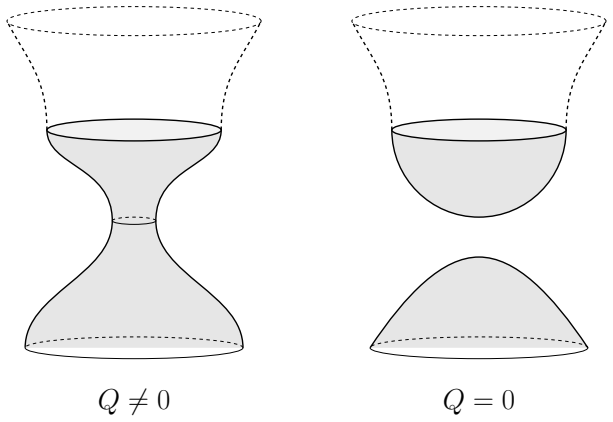
The paper argues that wormhole-mediated and no-boundary creation of inflationary universes are one continuous family: as the supporting axionic or magnetic charge goes to zero, the wineglass wormhole's stem pinches off and the geometry spli
Reviewed by Pith at T0; open to challenge. T0 means a machine referee read the full paper against a public rubric. the ladder, T0–T4 →
T0 review · deepseek-v4-flash
2026-08-02 14:19 UTC pith:YCPM75IM
load-bearing objection Solid, careful numerical work that convincingly demonstrates the wormhole/no-boundary family within the symmetric ansatz; the physical relevance hinges on the unproven dominance of that ansatz. the 3 major comments →
Birth of Inflationary Universes via Wineglass Wormholes and their No-Boundary Relatives
The pith
A machine-rendered reading of the paper's core claim, the machinery that carries it, and where it could break.
Core claim
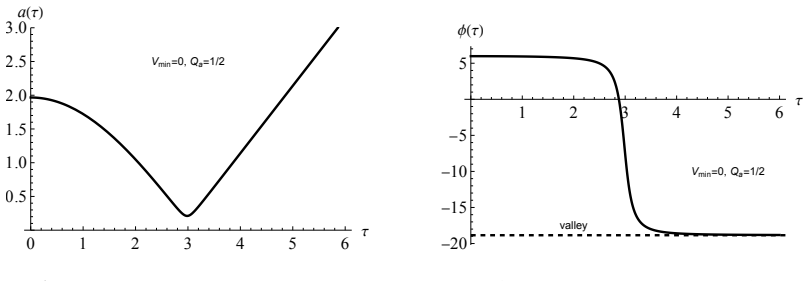
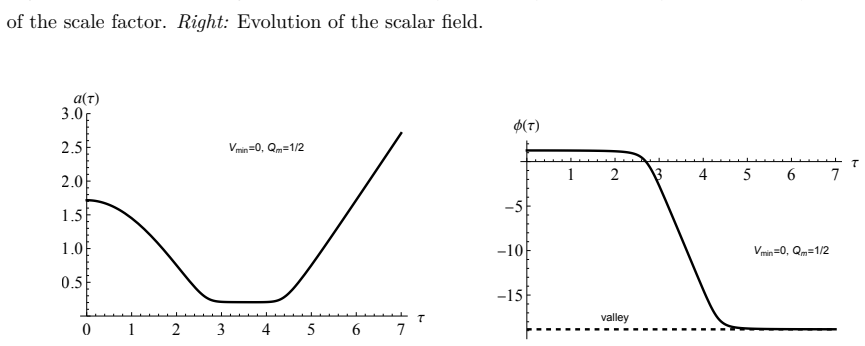
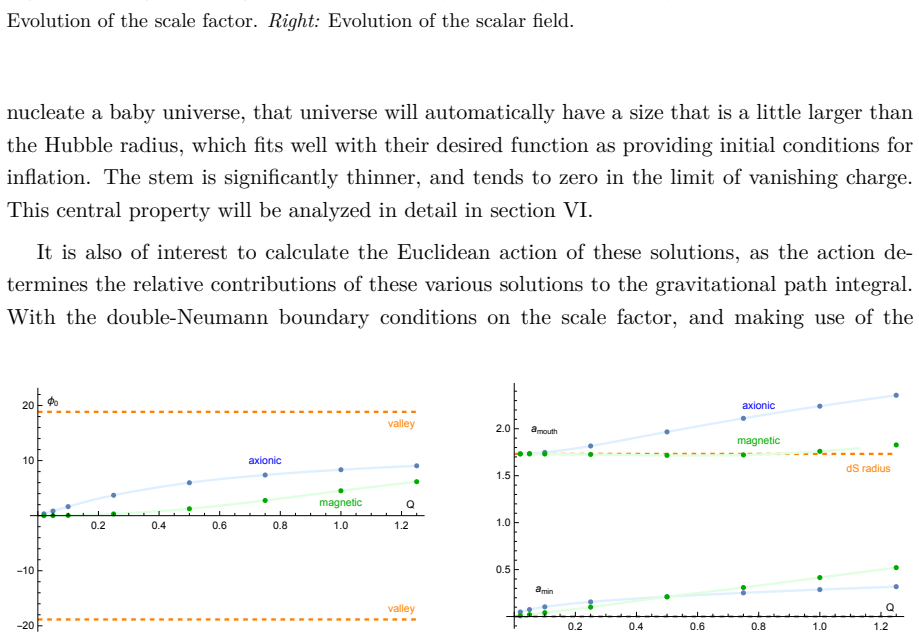
The central discovery is that wineglass wormholes and no-boundary instantons are not independent tunneling channels but limiting members of one family parameterized by charge Q (axionic Q_a or magnetic Q_m). Explicit numerical solutions with asymptotically flat and asymptotically AdS boundary conditions, supported by axionic or magnetic matter plus a self-interacting scalar with a sinusoidal potential, show that the scale factor starts at a local maximum (rim), contracts to a minimum (stem), and then grows to the asymptotic background. As Q decreases, the stem radius amin scales like sqrt(Q_a) or Q_m, the wall through which the scalar interpolates becomes thinner, and in the Q→0 limit the ge
What carries the argument
The carrying object is the O(4)-symmetric Euclidean metric ds² = dτ² + a²(τ)dΩ³ with a scalar field in a sinusoidal potential and a spherically symmetric axionic or magnetic charge. The wineglass profile—a local maximum of a(τ) (the rim) followed by a local minimum (the stem) before the asymptotic region—is what makes the Lorentzian continuation expand. The quantitative mechanism is the thin-wall scaling at small charge: amin ~ Q_a^{1/2} (axion) or Q_m (magnetic), with wall width of order amin, which makes the wall contributions to the Euclidean action vanish at zero charge and forces the action to split into a no-boundary piece 12π²/V_top plus the background flat/EAdS action.
Load-bearing premise
The argument depends on the unproven assumption that highly symmetric wormhole saddles dominate the gravitational path integral, and on the separate assumption that an inflaton with the required barrier potential exists.
What would settle it
Numerically evaluate the on-shell action of the zero-charge family and check whether the difference from the no-boundary value 12π²/V_top vanishes as the stem radius goes to zero; a nonzero residual would break the claim that the topology change is smooth.
If this is right
- Small charges are preferred: the weighting grows as Q decreases, so the family automatically favors baby universes with the longest inflationary phases.
- For small Q, the scalar starts very close to the top of the barrier, providing the homogeneous, slow-roll initial conditions that inflation needs.
- In the dominant limit, the original background becomes irrelevant: flat and AdS-tunneling weightings all converge to the same no-boundary value at Q=0.
- Topology change is smooth in the action: the zero-charge limit leaves a disconnected no-boundary instanton plus the original spacetime, with no discontinuity in the weighting.
- Multi-stem and multi-barrier wormhole solutions also exist in the family, but their weightings do not beat the no-boundary limit.
Where Pith is reading between the lines
- Inference: If a less-symmetric analogue exists—for example, wormholes supported by ordinary electromagnetic fields—the same Q→0 pinching could imply that generic electromagnetic vacuum fluctuations can seed no-boundary-like creation, making the mechanism less dependent on axions.
- Inference: The convergence of all weightings to a value fixed only by the barrier height V_top suggests that, in the dominant limit, the pre-existing vacuum's depth drops out entirely; a testable extension would be to vary the barrier shape and check whether the limit remains 12π²/V_top.
- Inference: The disconnected de Sitter sphere left behind at zero charge may provide a concrete bulk realization of the factorization puzzle in AdS/CFT, but the paper only notes this connection as worth exploring.
- Inference: The preference for small Q and long inflation suggests a possible selection mechanism for observed cosmological initial conditions, but making contact with observation would require integrating over the continuous family with a proper measure, which the paper does not do.
Editorial analysis
A structured set of objections, weighed in public.
Referee Report
Summary. The paper constructs and analyzes Euclidean 'wineglass' wormholes that can nucleate expanding inflationary universes from asymptotically flat or AdS backgrounds. The solutions are supported by an axionic or magnetic charge together with a scalar field having a potential barrier. The authors provide high-precision numerical shooting solutions, analytic approximations near the stem, and explicit action evaluations. Their central claim is that as the charge Q goes to zero, the wormhole stem pinches off and the geometry splits into a disconnected no-boundary instanton plus the flat/AdS background, with the Euclidean weighting tending to 12π²/V_top. They also describe multi-stem and multi-barrier exotic solutions and discuss conceptual puzzles associated with these saddles.
Significance. If the central claim is correct, the paper establishes a surprising and conceptually important unification: wormhole-mediated tunneling and no-boundary nucleation are not distinct mechanisms but belong to a single one-parameter family of Euclidean saddles. This is a genuinely interesting result for quantum cosmology and for the interpretation of topology change in gravitational path integrals. The paper is strong in its concrete numerics: the shooting parameters are given to 8–12 significant digits, the analytic expansions (18)–(25) are checked against numerics in Fig. 16, and the action formulas are derived from standard holographic counterterms where needed. The authors are also unusually candid about open issues, such as the absence of a negative-mode analysis and the unresolved status of less-symmetric wormholes. The main concerns are the unproven O(4)-symmetric truncation, an apparent infrared divergence in the flat magnetic action, and the lack of a stability analysis before drawing probabilistic conclusions.
major comments (3)
- [§III, Eq. (11), Fig. 7] For asymptotically flat magnetic wormholes, the on-shell action (11) contains the term ∫ 2Q_m²/a dτ. From the constraint (5), the large-τ behavior is a(τ)=τ−C+Q_m²/(6τ)+..., so this integral diverges logarithmically. With the double-Neumann boundary term in (2) the quadratic divergence cancels, but a logarithmic divergence remains. The finite magnetic weightings plotted in Fig. 7 are therefore cutoff-dependent. The text says that no counterterms are needed for flat asymptotics, but no regularization is specified. Please specify the IR subtraction, or restrict the quantitative weighting claims to the axionic case and state that the magnetic case requires a separate treatment.
- [§II, Eq. (1)] The restriction to O(4)-symmetric minisuperspace metrics is justified only by the statement that 'one expects these to dominate over less symmetric configurations in the gravitational path integral.' No calculation or perturbative argument is given. Since the physical interpretation—wormholes as nucleation channels and the preference for long inflation—depends on these saddles surviving in the full path integral, the central claim should be framed as conditional on this truncation, or supported by at least a perturbative test around the presented solutions. The paper's own Section VII acknowledges that less-symmetric wormholes and integration contours remain unresolved, which underscores the load-bearing nature of this assumption.
- [§VII, Eq. (12)] The probabilistic hierarchy derived from Ψ∼∑e^{−S} assumes that the saddles are relevant local minima of the Euclidean action. No negative-mode analysis is provided for the wineglass family; the paper only cites Ref. [47] for the different axion-dilaton wormholes. If the new saddles possess negative modes, the relative probabilities—in particular the preference for small charge and hence long inflation—could be altered or reversed. Please either compute the perturbation spectrum in the O(4)-symmetric sector or state explicitly that the probability statements are provisional pending stability analysis.
minor comments (3)
- [Table I caption] The caption states 'with Vmin = 0, f=√6', but the text in §III and Eq. (8) give f=6 for Vmin=0. This is inconsistent and should be corrected.
- [§V, Figs. 10–12] The existence of the multi-stem solutions is interesting, but the statement that solutions with more than six bounces were not found is presented without a systematic search or an argument for their absence. A brief comment on the numerical strategy and possible obstructions would be helpful.
- [§VI, Eq. (28)] The zero-charge limit is described as a topological transition in which the action splits smoothly. The paper notes that the scalar field becomes a step function; it would be useful to state explicitly at that point that the limit is therefore not smooth in field space, even though the action limit is well defined.
Circularity Check
No significant circularity: the wormhole-to-no-boundary limit is derived from the action and equations of motion, then compared with an independent analytic value; self-citations are for priority and technical details, not load-bearing.
full rationale
The central derivation chain is self-contained. Starting from the action (2) and equations of motion (3)-(5), the paper constructs wineglass wormhole solutions by shooting and computes their Euclidean actions via the on-shell reductions (11) and (14). The Q→0 limit is analyzed from the constraint and the expansions (18)-(25), which show that the stem size and wall width vanish, so the wall contribution to the action disappears (26)-(27). The remaining Euclidean de Sitter bowl has the standard no-boundary weighting 12π²/V_top (28); this value is an independent analytic input and is not used to fit the numerical wormhole actions. The background subtraction in the AdS case (17), (29) is a definition of excess action that cancels the EAdS piece; the limit is not forced by fitting. The paper does cite the authors' earlier work [22] for priority and for the initial interpretation ('As we discovered recently [22]...', 'As first argued in our earlier paper [22]...'), but the present numerical evidence and scaling analysis are independent of those citations. The genuine weaknesses are assumptions, not circularity: the O(4)-symmetric minisuperspace ansatz is justified only by the expectation that symmetric metrics dominate, and Section VII itself flags unresolved questions about less-symmetric wormholes, integration contours, and probability definitions. Those are external validity risks, not reductions to inputs.
Axiom & Free-Parameter Ledger
free parameters (3)
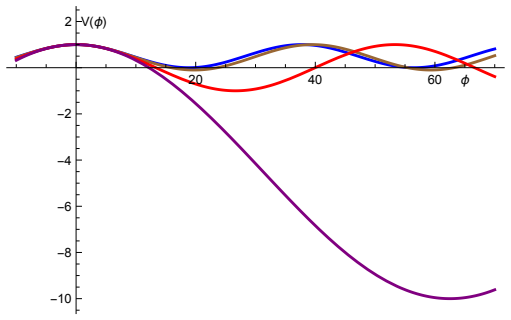
- Scalar decay constant f =
f = 6√(1−V_min)
- Potential minimum V_min =
0, −0.1, −1, −10
- Charge Q_a or Q_m =
Values in Tables I–II (e.g., 1.25 to 0.02)
axioms (5)
- domain assumption O(4)-symmetric minisuperspace ansatz dominates the path integral
- domain assumption An inflaton field with a suitable barrier potential exists
- domain assumption Euclidean path integral and saddle-point approximation apply to quantum gravity
- domain assumption Choice of Neumann/Dirichlet boundary conditions as in (2) with c0=cf=1 or cf=0 gives the correct transition amplitudes
- standard math Counterterm subtraction (15)–(16) is the correct renormalization for AdS asymptotics
read the original abstract
We study Euclidean wineglass wormholes, which mediate the nucleation of inflationary spacetimes from an existing spacetime with asymptotically flat or Anti-de Sitter regions. These wormholes are distinguished by the presence of a local maximum of the scale factor, which allows the analytically continued Lorentzian spacetime to expand after materialization. We present explicit numerical wormhole solutions supported either by an axionic field or a magnetic gauge field, in both cases in conjunction with a self-interacting scalar field. More exotic solutions, with multiple extrema of the scale factor, are also described. As we discovered recently, in the limit of small axionic or magnetic charge, wineglass wormhole solutions split into two separate geometries, one being the background spacetime and the other a disconnected no-boundary instanton. We study the associated topology changing transition in detail and provide an extensive discussion of both the properties and puzzles exhibited by this common family of wineglass/no-boundary instantons.
Figures



Forward citations
Cited by 1 Pith paper
-
A Small-Throat Boundary Condition for the Tunneling Wave Function of the Universe
Tunneling wave function of a closed universe is recovered as the ε o0 limit of a Neumann-plus-small-domain path integral with radiation-induced throat, excluding the unsuppressed outer saddle.
Reference graph
Works this paper leans on
-
[1]
The Inflationary Universe: A Possible Solution to the Horizon and Flatness Problems,
A. H. Guth, “The Inflationary Universe: A Possible Solution to the Horizon and Flatness Problems,”Phys. Rev. D23(1981) 347–356
1981
-
[2]
A New Inflationary Universe Scenario: A Possible Solution of the Horizon, Flatness, Homogeneity, Isotropy and Primordial Monopole Problems,
A. D. Linde, “A New Inflationary Universe Scenario: A Possible Solution of the Horizon, Flatness, Homogeneity, Isotropy and Primordial Monopole Problems,”Phys. Lett. B108(1982) 389–393
1982
-
[3]
Cosmology for Grand Unified Theories with Radiatively Induced Symmetry Breaking,
A. Albrecht and P. J. Steinhardt, “Cosmology for Grand Unified Theories with Radiatively Induced Symmetry Breaking,”Phys. Rev. Lett.48(1982) 1220–1223
1982
-
[4]
Inflationary paradigm in trouble after Planck2013,
A. Ijjas, P. J. Steinhardt, and A. Loeb, “Inflationary paradigm in trouble after Planck2013,”Phys. 24 Lett. B723(2013) 261–266,arXiv:1304.2785 [astro-ph.CO]
Pith/arXiv arXiv 2013
-
[5]
An Obstacle to Creating a Universe in the Laboratory,
E. Farhi and A. H. Guth, “An Obstacle to Creating a Universe in the Laboratory,”Phys. Lett. B 183(1987) 149–155
1987
-
[6]
Inflationary spacetimes are not past-complete,
A. Borde, A. H. Guth, and A. Vilenkin, “Inflationary spacetimes are not past-complete,”Phys. Rev. Lett.90(2003) 151301,arXiv:gr-qc/0110012 [gr-qc]
Pith/arXiv arXiv 2003
-
[7]
Kerr-NUT-de Sitter as an Inhomogeneous Non-Singular Bouncing Cosmology,
A. Anabalón, S. F. Bramberger, and J.-L. Lehners, “Kerr-NUT-de Sitter as an Inhomogeneous Non-Singular Bouncing Cosmology,”JHEP09(2019) 096,arXiv:1904.07285 [hep-th]
Pith/arXiv arXiv 2019
-
[8]
Is It Possible to Create a Universe in the Laboratory by Quantum Tunneling?,
E. Farhi, A. H. Guth, and J. Guven, “Is It Possible to Create a Universe in the Laboratory by Quantum Tunneling?,”Nucl. Phys. B339(1990) 417–490
1990
-
[9]
Gravitational Effects on and of Vacuum Decay,
S. R. Coleman and F. De Luccia, “Gravitational Effects on and of Vacuum Decay,”Phys. Rev. D 21(1980) 3305
1980
-
[10]
decay constant
or radiation for which the magnetic component is larger than the electric one [27, 28]. For consistency, the axionic chargesQa or magnetic chargesQ m must also be distributed in a spherically symmetric manner. In a previous paper [24] we reviewed in detail how this can be done in the axionic case. In appendix A we review an example of how this can be done...
-
[11]
Loss of Quantum Coherence Due to Topological Changes: A Toy Model,
G. Lavrelashvili, V. A. Rubakov, and P. G. Tinyakov, “Loss of Quantum Coherence Due to Topological Changes: A Toy Model,”Mod. Phys. Lett. A3(1988) 1231–1242
1988
-
[12]
Axion-induced topology change in quantum gravity and string theory,
S. B. Giddings and A. Strominger, “Axion-induced topology change in quantum gravity and string theory,”Nuclear Physics B306no. 4, (1988) 890–907
1988
-
[13]
Wave Function of the Universe,
J. B. Hartle and S. W. Hawking, “Wave Function of the Universe,”Phys. Rev. D28(1983) 2960–2975
1983
-
[14]
The Boundary Conditions of the Universe,
S. W. Hawking, “The Boundary Conditions of the Universe,”Pontif. Acad. Sci. Scr. Varia48 (1982) 563–574
1982
-
[15]
Conditions for (No) Eternal Inflation,
T. Rudelius, “Conditions for (No) Eternal Inflation,”JCAP08(2019) 009,arXiv:1905.05198 [hep-th]
Pith/arXiv arXiv 2019
-
[16]
Hurdles for recent measures in eternal inflation,
A. Aguirre, S. Gratton, and M. C. Johnson, “Hurdles for recent measures in eternal inflation,” Phys. Rev. D75(2007) 123501,arXiv:hep-th/0611221
Pith/arXiv arXiv 2007
-
[17]
The LargeNlimit of superconformal field theories and supergravity,
J. M. Maldacena, “The LargeNlimit of superconformal field theories and supergravity,”Adv. Theor. Math. Phys.2(1998) 231–252,arXiv:hep-th/9711200
Pith/arXiv arXiv 1998
-
[18]
Cosmological consequences of a principle of finite amplitudes,
C. Jonas, J.-L. Lehners, and J. Quintin, “Cosmological consequences of a principle of finite amplitudes,”Phys. Rev. D103no. 10, (2021) 103525,arXiv:2102.05550 [hep-th]
Pith/arXiv arXiv 2021
-
[19]
Prepare inflationary universe via the Euclidean charged wormhole,
Q.-Y. Lan and Y.-S. Piao, “Prepare inflationary universe via the Euclidean charged wormhole,” arXiv:2411.13844 [gr-qc]
-
[20]
Inflationary Cosmology from Anti-de Sitter Wormholes,
P. Betzios and O. Papadoulaki, “Inflationary Cosmology from Anti-de Sitter Wormholes,”Phys. Rev. Lett.133no. 2, (2024) 021501,arXiv:2403.17046 [hep-th]
Pith/arXiv arXiv 2024
-
[21]
A Menagerie of Wormholes and Cosmologies in the Gravitational Path Integral,
P. Betzios, P. Ghiringhelli, I. D. Gialamas, and O. Papadoulaki, “A Menagerie of Wormholes and Cosmologies in the Gravitational Path Integral,”arXiv:2602.23432 [hep-th]
-
[22]
Magnetic anti–de Sitter wormholes as seeds for Higgs inflation,
P. Betzios, I. D. Gialamas, and O. Papadoulaki, “Magnetic anti–de Sitter wormholes as seeds for Higgs inflation,”Phys. Rev. D111no. 12, (2025) 123542,arXiv:2412.03639 [hep-th]
Pith/arXiv arXiv 2025
-
[23]
Gravitational Instantons and Creation of Expanding Universes,
V. A. Rubakov and P. G. Tinyakov, “Gravitational Instantons and Creation of Expanding Universes,”Phys. Lett. B214(1988) 334–338
1988
-
[24]
Nucleating an Inflationary Universe: Euclidean Wormholes and their No-Boundary Limit,
G. Lavrelashvili and J.-L. Lehners, “Nucleating an Inflationary Universe: Euclidean Wormholes and their No-Boundary Limit,”arXiv:2603.11003 [hep-th]
-
[25]
for a review. No-boundary solutions require a positive vacuum energy (otherwise the geo- metry cannot be smoothly rounded off), so that they quite naturally provide initial conditions that are suitable for a subsequent inflationary period. A priori, the processes of creation of an inflating universe from nothing or creation via wormholes appear to be enti...
-
[26]
Zoo of axionic wormholes,
C. Jonas, G. Lavrelashvili, and J.-L. Lehners, “Zoo of axionic wormholes,”Phys. Rev. D108no. 6, (2023) 066012
2023
-
[27]
Review of the no-boundary wave function,
J.-L. Lehners, “Review of the no-boundary wave function,”Phys. Rept.1022(2023) 1–82, arXiv:2303.08802 [hep-th]. [26]PlanckCollaboration, Y. Akramiet al., “Planck 2018 results. X. Constraints on inflation,” Astron. Astrophys.641(2020) A10,arXiv:1807.06211 [astro-ph.CO]
Pith/arXiv arXiv 2023
-
[28]
Wormhole Instanton Solution in the Einstein Yang-Mills System,
A. Hosoya and W. Ogura, “Wormhole Instanton Solution in the Einstein Yang-Mills System,” Phys. Lett. B225(1989) 117–120
1989
-
[29]
Magnetic Wormholes and Topological Symmetry,
A. K. Gupta, J. Hughes, J. Preskill, and M. B. Wise, “Magnetic Wormholes and Topological Symmetry,”Nucl. Phys. B333(1990) 195–220. 25
1990
-
[30]
Consistent Evaluation of the No-Boundary Proposal,
A. I. Abdalla, S. Antonini, R. Bousso, L. V. Iliesiu, A. Levine, and A. Shahbazi-Moghaddam, “Consistent Evaluation of the No-Boundary Proposal,”arXiv:2602.02682 [hep-th]
-
[31]
O. Y. Shvedov, “On the exponentially large probability of transition through the Lavrelashvili-Rubakov-Tinyakov wormhole,”Phys. Lett. B381(1996) 45–48, arXiv:gr-qc/9602049
Pith/arXiv arXiv 1996
-
[32]
Why does inflation start at the top of the hill?,
S. W. Hawking and T. Hertog, “Why does inflation start at the top of the hill?,”Phys. Rev. D66 (2002) 123509,arXiv:hep-th/0204212
Pith/arXiv arXiv 2002
-
[33]
Bulk versus boundary dynamics in anti-de Sitter space-time,
V. Balasubramanian, P. Kraus, and A. E. Lawrence, “Bulk versus boundary dynamics in anti-de Sitter space-time,”Phys. Rev. D59(1999) 046003,arXiv:hep-th/9805171
Pith/arXiv arXiv 1999
-
[34]
On the holographic renormalization group,
J. de Boer, E. P. Verlinde, and H. L. Verlinde, “On the holographic renormalization group,”JHEP 08(2000) 003,arXiv:hep-th/9912012
Pith/arXiv arXiv 2000
-
[35]
A Practical Approach to the Hamilton-Jacobi Formulation of Holographic Renormalization,
H. Elvang and M. Hadjiantonis, “A Practical Approach to the Hamilton-Jacobi Formulation of Holographic Renormalization,”JHEP06(2016) 046,arXiv:1603.04485 [hep-th]
Pith/arXiv arXiv 2016
-
[36]
D. Marolf and J. E. Santos, “AdS Euclidean wormholes,”Class. Quant. Grav.38no. 22, (2021) 224002,arXiv:2101.08875 [hep-th]
Pith/arXiv arXiv 2021
-
[37]
Complex solutions for the scalar field model of the universe,
G. W. Lyons, “Complex solutions for the scalar field model of the universe,”Phys. Rev. D46 (1992) 1546–1550
1992
-
[38]
Wick Rotation and the Positivity of Energy in Quantum Field Theory,
M. Kontsevich and G. Segal, “Wick Rotation and the Positivity of Energy in Quantum Field Theory,”Quart. J. Math. Oxford Ser.72no. 1-2, (2021) 673–699,arXiv:2105.10161 [hep-th]
Pith/arXiv arXiv 2021
-
[39]
A Note On Complex Spacetime Metrics,
E. Witten, “A Note On Complex Spacetime Metrics,”arXiv:2111.06514 [hep-th]
-
[40]
Allowable complex scalars from Kaluza-Klein compactifications and metric rescalings,
J.-L. Lehners, “Allowable complex scalars from Kaluza-Klein compactifications and metric rescalings,”Phys. Rev. D107no. 4, (2023) 046004,arXiv:2209.14669 [hep-th]
Pith/arXiv arXiv 2023
-
[41]
Kontsevich-Segal Criterion in the No-Boundary State Constrains Inflation,
T. Hertog, O. Janssen, and J. Karlsson, “Kontsevich-Segal Criterion in the No-Boundary State Constrains Inflation,”Phys. Rev. Lett.131no. 19, (2023) 191501,arXiv:2305.15440 [hep-th]
Pith/arXiv arXiv 2023
-
[42]
J.-L. Lehners and J. Quintin, “A small Universe,”Phys. Lett. B850(2024) 138488, arXiv:2309.03272 [hep-th]
Pith/arXiv arXiv 2024
-
[43]
Note on KSW-allowability of Wine-Glass Geometry,
M. Ailiga and G. Narain, “Note on KSW-allowability of Wine-Glass Geometry,” arXiv:2603.23457 [hep-th]
-
[44]
Norm of the no-boundary state,
J. Cotler and K. Jensen, “Norm of the no-boundary state,”JHEP03(2026) 180, arXiv:2506.20547 [hep-th]
Pith/arXiv arXiv 2026
-
[45]
An algebra of observables for de Sitter space,
V. Chandrasekaran, R. Longo, G. Penington, and E. Witten, “An algebra of observables for de Sitter space,”JHEP02(2023) 082,arXiv:2206.10780 [hep-th]
Pith/arXiv arXiv 2023
-
[46]
The Hilbert space of de Sitter quantum gravity,
T. Chakraborty, J. Chakravarty, V. Godet, P. Paul, and S. Raju, “The Hilbert space of de Sitter quantum gravity,”JHEP01(2024) 132,arXiv:2303.16315 [hep-th]
Pith/arXiv arXiv 2024
-
[47]
Black holes as red herrings: Topological fluctuations and the loss of quantum coherence,
S. Coleman, “Black holes as red herrings: Topological fluctuations and the loss of quantum coherence,”Nuclear Physics B307no. 4, (1988) 867–882
1988
-
[48]
Stability of axion-dilaton wormholes,
C. Jonas, G. Lavrelashvili, and J.-L. Lehners, “Stability of axion-dilaton wormholes,”Phys. Rev. D 109no. 8, (2024) 086022,arXiv:2312.08971 [hep-th]
Pith/arXiv arXiv 2024
-
[49]
J. Feldbrugge, J.-L. Lehners, and N. Turok, “Lorentzian Quantum Cosmology,”Phys. Rev. D95 no. 10, (2017) 103508,arXiv:1703.02076 [hep-th]. 26
Pith/arXiv arXiv 2017
discussion (0)
Sign in with ORCID, Apple, or X to comment. Anyone can read and Pith papers without signing in.