Towards exascale fully relativistic pseudopotential density functional theory calculations enabled by mixed-precision computation and compressed-communication using residual based subspace iteration
Pith reviewed 2026-06-29 06:29 UTC · model grok-4.3
The pith
A residual-based subspace iteration method combined with mixed-precision arithmetic and compressed communication enables fully relativistic DFT simulations of up to 100,000 electrons on exascale systems.
A machine-rendered reading of the paper's core claim, the machinery that carries it, and where it could break.
Core claim
The residual-based Chebyshev filtered subspace iteration (R-ChFSI) remains stable under inexact matrix-vector products, which in turn permits a combination of mixed-precision arithmetic and block floating-point compressed communication that preserves double-precision accuracy for noncollinear SOC eigenproblems while cutting compute and communication costs enough to reach exascale performance.
What carries the argument
Residual-based Chebyshev filtered subspace iteration (R-ChFSI), which solves the sparse generalized eigenproblem arising from finite-element discretization of the NC-SOC Kohn-Sham equations while tolerating reduced-precision operations.
If this is right
- Fully relativistic pseudopotential DFT becomes feasible for systems an order of magnitude larger than current practical limits.
- Time-to-solution for noncollinear SOC calculations decreases because both arithmetic and MPI communication volumes are reduced.
- The same R-ChFSI tolerance to inexact products can be reused with other sparse eigensolvers that appear in finite-element DFT.
- Band-partitioning combined with compressed communication improves weak and strong scaling on GPU-based exascale machines.
Where Pith is reading between the lines
- The same tolerance property could be tested in other quantum-chemistry packages that solve generalized eigenproblems with iterative subspace methods.
- If the compression scheme generalizes, similar mixed-precision strategies might apply to time-dependent DFT or response calculations that also involve large sparse operators.
- The approach suggests that future hardware supporting even lower-precision formats could further accelerate relativistic DFT without new algorithmic changes.
Load-bearing premise
The residual-based Chebyshev filtered subspace iteration stays accurate and convergent even when matrix-vector products are performed in lower precision or with compressed data.
What would settle it
A direct comparison on a benchmark NC-SOC system showing that the mixed-precision compressed run produces eigenvalues or total energies that differ from a full double-precision reference by more than the accepted DFT tolerance.
Figures
read the original abstract
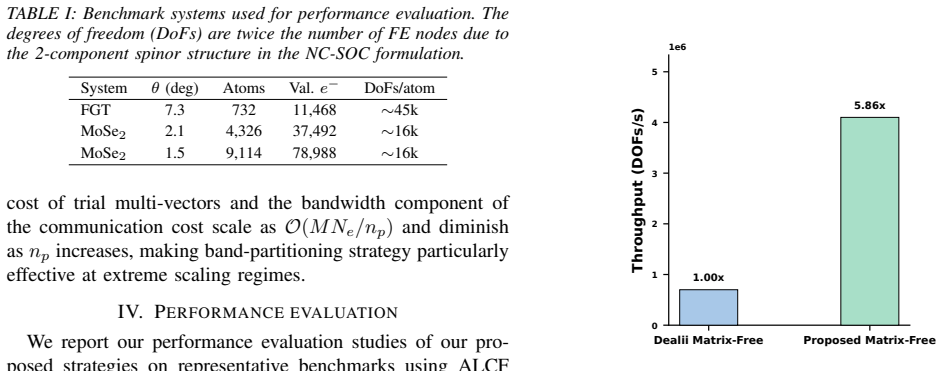
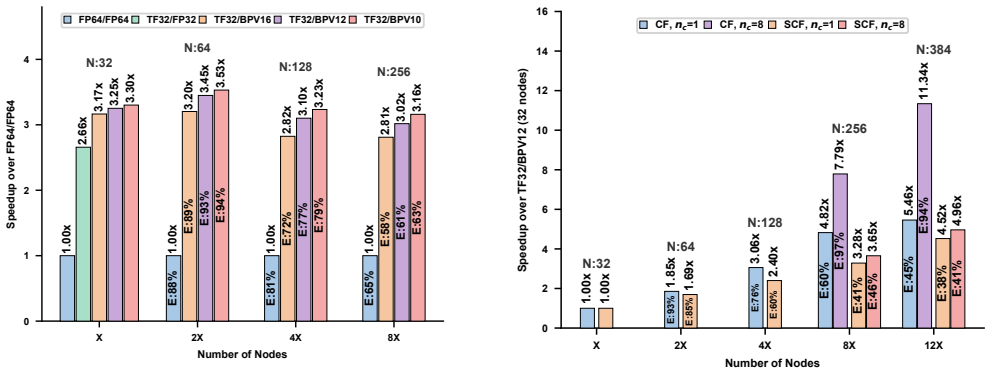
Noncollinear (NC) magnetism and spin-orbit coupling (SOC) are indispensable for predictive ab initio materials simulations with pronounced relativistic effects and magnetic frustration, yet they significantly increase the cost of cubic-scaling density functional theory (DFT) by introducing complex 2-component wavefunctions per electron and consequently much larger eigenproblems. We present a GPU-centric high-performance framework for NC-SOC DFT that combines: (i) algorithmic advances for solving finite-element (FE) discretized DFT equations; (ii) residual-based Chebyshev filtered subspace iteration (R-ChFSI), tolerant to inexact matrix-vector products, for the resulting sparse generalized eigenproblem; (iii) a matrix-free strategy for accelerating FE Poisson solver; (iv) R-ChFSI-enabled mixed-precision computation with block floating-point compressed MPI communication at compression ratios over 4x, preserving double-precision robustness while reducing compute and data movement costs; and (v) a communication efficient band-partitioning algorithm to improve scalability. Numerical results demonstrate improved time-to-solution and excellent scaling on exascale architectures, enabling fully relativistic pseudopotential DFT simulations of up to 100,000 electrons.
Editorial analysis
A structured set of objections, weighed in public.
Referee Report
Summary. The manuscript presents a GPU-centric high-performance framework for noncollinear spin-orbit coupled (NC-SOC) pseudopotential DFT based on finite-element discretization. It introduces residual-based Chebyshev filtered subspace iteration (R-ChFSI) claimed to tolerate inexact matrix-vector products, combined with mixed-precision arithmetic, block floating-point compressed MPI communication (>4x ratio), a matrix-free Poisson solver, and band-partitioning. The central claim is that these enable fully relativistic DFT simulations of up to 100,000 electrons on exascale machines with improved time-to-solution, excellent scaling, and preserved double-precision robustness for the complex 2-component eigenproblems.
Significance. If the tolerance of R-ChFSI to the mixed-precision and compressed-communication approximations is shown to hold without degrading physical accuracy for NC-SOC systems, the work would enable previously inaccessible large-scale relativistic materials simulations. The algorithmic focus on inexact operations and communication reduction directly targets exascale bottlenecks in cubic-scaling DFT. Credit is due for targeting preservation of robustness rather than raw speed alone.
major comments (2)
- [Numerical Results] Numerical Results section: The claim that the mixed-precision plus >4x compressed-communication scheme 'preserves double-precision robustness' for NC-SOC eigenproblems is not supported by any reported quantitative metrics (eigenvalue residuals, total-energy drift, or direct comparison to full double-precision reference calculations) at the largest system sizes (~100,000 electrons). This evidence gap is load-bearing for the headline claim of accurate exascale simulations.
- [R-ChFSI description] R-ChFSI description (likely §3): While tolerance to inexact matvecs is asserted for the residual-based Chebyshev filter, no analysis, error bound, or numerical test is provided demonstrating stability specifically for the larger, complex-valued generalized eigenproblems that arise from 2-component spinors under noncollinear SOC (as opposed to collinear or scalar-relativistic cases).
minor comments (1)
- [Abstract] Abstract: The statement 'Numerical results demonstrate...' does not cite the specific figures or tables that contain the scaling and accuracy data.
Simulated Author's Rebuttal
We thank the referee for the constructive comments and for recognizing the potential impact of our framework on exascale NC-SOC DFT simulations. We address each major comment below.
read point-by-point responses
-
Referee: [Numerical Results] Numerical Results section: The claim that the mixed-precision plus >4x compressed-communication scheme 'preserves double-precision robustness' for NC-SOC eigenproblems is not supported by any reported quantitative metrics (eigenvalue residuals, total-energy drift, or direct comparison to full double-precision reference calculations) at the largest system sizes (~100,000 electrons). This evidence gap is load-bearing for the headline claim of accurate exascale simulations.
Authors: We agree that direct quantitative metrics at the absolute largest scales would strengthen the robustness claim. The current manuscript validates accuracy on representative smaller systems and reports scaling/time-to-solution up to 100k electrons, but does not include side-by-side double-precision references at the largest sizes (which are memory-prohibitive). In the revised version we will add an expanded table in the Numerical Results section with eigenvalue residuals, total-energy drift, and available higher-precision comparisons for the largest feasible systems, together with a brief discussion of why full double-precision runs become impractical. revision: yes
-
Referee: [R-ChFSI description] R-ChFSI description (likely §3): While tolerance to inexact matvecs is asserted for the residual-based Chebyshev filter, no analysis, error bound, or numerical test is provided demonstrating stability specifically for the larger, complex-valued generalized eigenproblems that arise from 2-component spinors under noncollinear SOC (as opposed to collinear or scalar-relativistic cases).
Authors: The residual-based formulation of R-ChFSI is designed to adapt to the spectrum of the generalized eigenproblem regardless of whether the matrices are real or complex. Nevertheless, we acknowledge that the manuscript does not contain an explicit stability discussion or dedicated test isolating the NC-SOC (complex 2-component) case. In the revision we will expand the R-ChFSI description in §3 with a short error-bound sketch applicable to complex Hermitian generalized eigenproblems and add a numerical test comparing filter convergence for NC-SOC versus scalar-relativistic discretizations. revision: yes
Circularity Check
No circularity detected in performance and scaling claims
full rationale
The paper describes algorithmic and implementation choices (R-ChFSI, mixed-precision, compressed communication, band-partitioning) whose consequences are measured as empirical time-to-solution and scaling results on exascale hardware. No derivation chain reduces a claimed prediction to a fitted parameter or self-citation by construction; the numerical demonstrations are presented as outcomes of the listed techniques rather than being defined in terms of themselves. The work is self-contained against external benchmarks of wall-clock performance.
Axiom & Free-Parameter Ledger
Reference graph
Works this paper leans on
-
[1]
Large-scale electronic structure calculations of high-Z metals on the BlueGene/L platform,
F. Gygi, E. W. Draeger, M. Schulz, B. R. De Supinski, J. A. Gunnels, V . Austel, J. C. Sexton, F. Franchetti, S. Kral, C. W. Ueberhuber et al., “Large-scale electronic structure calculations of high-Z metals on the BlueGene/L platform,” inProceedings of the 2006 ACM/IEEE conference on Supercomputing, 2006, pp. 45–es. [Online]. Available: https://doi.org/1...
-
[2]
G. Alvarez, M. S. Summers, D. E. Maxwell, M. Eisenbach, J. S. Meredith, J. M. Larkin, J. Levesque, T. A. Maier, P. R. Kent, E. F. D’Azevedoet al., “New algorithm to enable 400+ TFlop/s sustained performance in simulations of disorder effects in high-T c superconductors,” inSC’08: Proceedings of the 2008 ACM/IEEE Conference on Supercomputing. IEEE, 2008, p...
-
[3]
Y . Hasegawa, J.-I. Iwata, M. Tsuji, D. Takahashi, A. Oshiyama, K. Minami, T. Boku, F. Shoji, A. Uno, M. Kurokawaet al., “First-principles calculations of electron states of a silicon nanowire with 100,000 atoms on the K computer,” inProceedings of 2011 International Conference for High Performance Computing, Networking, Storage and Analysis, 2011, pp. 1–...
-
[4]
A data-centric approach to extreme-scale ab initio dissipative quantum transport simulations,
A. N. Ziogas, T. Ben-Nun, G. I. Fern ´andez, T. Schneider, M. Luisier, and T. Hoefler, “A data-centric approach to extreme-scale ab initio dissipative quantum transport simulations,” inProceedings of the International Conference for High Performance Computing, Networking, Storage and Analysis, 2019, pp. 1–13. [Online]. Available: https://doi.org/10.1145/3...
-
[5]
S. Das, B. Kanungo, V . Subramanian, G. Panigrahi, P. Motamarri, D. Rogers, P. Zimmerman, and V . Gavini, “Large-scale materials modeling at quantum accuracy: Ab initio simulations of quasicrystals and interacting extended defects in metallic alloys,” inProceedings of the International Conference for High Performance Computing, Networking, Storage and Ana...
-
[6]
J.-L. Fattebert, D. Osei-Kuffuor, E. W. Draeger, T. Ogitsu, and W. D. Krauss, “Modeling dilute solutions using first-principles molecular dynamics: computing more than a million atoms with over a million cores,” inSC’16: Proceedings of the International Conference for High Performance Computing, Networking, Storage and Analysis. IEEE, 2016, pp. 12–22. [On...
-
[7]
S. Das, P. Motamarri, V . Gavini, B. Turcksin, Y . W. Li, and B. Leback, “Fast, scalable and accurate finite-element based ab initio calculations using mixed precision computing: 46 PFLOPS simulation of a metallic dislocation system,” inProceedings of the International Conference for High Performance Computing, Networking, Storage and Analysis, 2019, pp. ...
-
[8]
P. Hohenberg and W. Kohn, “Inhomogeneous electron gas,” Phys. Rev., vol. 136, pp. B864–B871, 1964. [Online]. Available: https://doi.org/10.1103/PhysRev.136.B864
-
[9]
W. Kohn and L. J. Sham, “Self-consistent equations including exchange and correlation effects,”Phys. Rev., vol. 140, pp. 1133–1138, 1965. [Online]. Available: https://doi.org/10.1103/PhysRev.140.A1133
-
[10]
[Online]
https://www.nobelprize.org/prizes/chemistry/1998/summary. [Online]. Available: https://www.nobelprize.org/prizes/chemistry/1998/summary
1998
-
[11]
Linear scaling electronic structure methods,
S. Goedecker, “Linear scaling electronic structure methods,”Rev. Mod. Phys., vol. 71, pp. 1085–1123, Jul 1999. [Online]. Available: https://link.aps.org/doi/10.1103/RevModPhys.71.1085
-
[12]
Introducing ONETEP: Linear-scaling density functional simulations on parallel computers,
C.-K. Skylaris, P. D. Haynes, A. A. Mostofi, and M. C. Payne, “Introducing ONETEP: Linear-scaling density functional simulations on parallel computers,”J. Chem. Phys., vol. 122, no. 8, p. 084119,
-
[13]
Available: https://doi.org/10.1063/1.1839852
[Online]. Available: https://doi.org/10.1063/1.1839852
-
[14]
Methods in electronic structure calculations,
D. Bowler and T. Miyazaki, “Methods in electronic structure calculations,”Rep. Prog. Phys., vol. 75, no. 3, p. 036503, 2012. [Online]. Available: https://doi.org/10.1088/0034-4885/75/3/036503
-
[15]
Linear-scaling three-dimensional fragment method for large-scale electronic structure calculations,
L.-W. Wang, Z. Zhao, and J. Meza, “Linear-scaling three-dimensional fragment method for large-scale electronic structure calculations,” Phys. Rev. B, vol. 77, no. 16, p. 165113, 2008. [Online]. Available: https://doi.org/10.1103/PhysRevB.77.165113
-
[16]
A scalable method for ab initio computation of free energies in nanoscale systems,
M. Eisenbach, C.-G. Zhou, D. M. Nicholson, G. Brown, J. Larkin, and T. C. Schulthess, “A scalable method for ab initio computation of free energies in nanoscale systems,” inProceedings of the Conference on High Performance Computing Networking, Storage and Analysis, 2009, pp. 1–8. [Online]. Available: https://doi.org/10.1145/1654059.1654062
-
[17]
Self-averaging stochastic Kohn-Sham density-functional theory,
R. Baer, D. Neuhauser, and E. Rabani, “Self-averaging stochastic Kohn-Sham density-functional theory,”Phys. Rev. Lett., vol. 111, p. 106402, 2013. [Online]. Available: https://doi.org/10.1103/PhysRevLett.111.106402
-
[18]
Stochastic density functional theory,
M. D. Fabian, B. Shpiro, E. Rabani, D. Neuhauser, and R. Baer, “Stochastic density functional theory,”WIREs Comput. Mol. Sci., vol. 9, no. 6, p. e1412, 2019. [Online]. Available: https://doi.org/10.1002/wcms.1412
-
[19]
S. Das, P. Motamarri, V . Subramanian, D. M. Rogers, and V . Gavini, “DFT-FE 1.0: A massively parallel hybrid CPU-GPU density functional theory code using finite-element discretization,”Comput. Phys. Commun., vol. 280, p. 108473, 2022. [Online]. Available: https://doi.org/10.1016/j.cpc.2022.108473
-
[20]
Three unfinished works on the optimal storage capacity of networks
J. K ¨ubler, K. H. Hock, J. Sticht, and A. R. Williams, “Density functional theory of non-collinear magnetism,”J. Phys. F: Met. Phys., vol. 18, pp. 469–483, 1988. [Online]. Available: https://doi.org/10.1088/0305- 4608/18/3/018
-
[21]
Exact results and critical properties of the Ising model with competing interactions
U. von Barth and L. Hedin, “A local exchange-correlation potential for the spin polarized case. I,”J. Phys. C: Solid State Phys., vol. 5, pp. 1629–1642, 1972. [Online]. Available: https://doi.org/10.1088/0022- 3719/5/13/012
-
[22]
P. Motamarri, S. Das, S. Rudraraju, K. Ghosh, D. Davydov, and V . Gavini, “DFT-FE–a massively parallel adaptive finite-element code for large-scale density functional theory calculations,”Comput. Phys. Commun., vol. 246, p. 106853, 2020. [Online]. Available: https://doi.org/10.1016/j.cpc.2019.07.016
-
[23]
Optimized norm-conserving Vanderbilt pseudopoten- tials,
D. R. Hamann, “Optimized norm-conserving Vanderbilt pseudopoten- tials,”Phys. Rev. B, vol. 88, p. 085117, Aug 2013. [Online]. Available: https://doi.org/10.1103/PhysRevB.88.085117
-
[24]
Spin-orbit coupling with ultrasoft pseudopotentials: Application to Au and Pt,
A. Dal Corso and A. M. Conte, “Spin-orbit coupling with ultrasoft pseudopotentials: Application to Au and Pt,”Phys. Rev. B, vol. 71, p. 115106, 2005. [Online]. Available: https://doi.org/10.1103/PhysRevB.71.115106
-
[25]
G. Kresse and J. Furthm ¨uller, “Efficient iterative schemes for ab initio total-energy calculations using a plane-wave basis set,”Phys. Rev. B, vol. 54, no. 16, p. 11169, 1996. [Online]. Available: https://doi.org/10.1103/PhysRevB.54.11169
-
[26]
Advanced capabilities for materials modelling with Quantum ESPRESSO,
P. Giannozzi, O. Andreussi, T. Brumme, O. Bunau, M. B. Nardelli, M. Calandra, R. Car, C. Cavazzoni, D. Ceresoli, M. Cococcioni et al., “Advanced capabilities for materials modelling with Quantum ESPRESSO,”J. Phys.: Condens. Matter, vol. 29, no. 46, p. 465901,
-
[27]
Available: https://doi.org/10.1088/1361-648X/aa8f79
[Online]. Available: https://doi.org/10.1088/1361-648X/aa8f79
-
[28]
Finite-difference- pseudopotential method: electronic structure calculations without a basis,
J. R. Chelikowsky, N. Troullier, and Y . Saad, “Finite-difference- pseudopotential method: electronic structure calculations without a basis,”Phys. Rev. Lett., vol. 72, no. 8, p. 1240, 1994. [Online]. Available: https://doi.org/10.1103/PhysRevLett.72.1240
-
[29]
L. Kronik, A. Makmal, M. L. Tiago, M. Alemany, M. Jain, X. Huang, Y . Saad, and J. R. Chelikowsky, “PARSEC–the pseudopotential algorithm for real-space electronic structure calculations: recent advances and novel applications to nano-structures,”Phys. Status Solidi B, vol. 243, no. 5, pp. 1063–1079, 2006. [Online]. Available: https://doi.org/10.1002/pssb....
-
[30]
Daubechies wavelets as a basis set for density functional pseudopotential calculations,
L. Genovese, A. Neelov, S. Goedecker, T. Deutsch, S. A. Ghasemi, A. Willand, D. Caliste, O. Zilberberg, M. Rayson, A. Bergman, and R. Schneider, “Daubechies wavelets as a basis set for density functional pseudopotential calculations,”J. Chem. Phys., vol. 129, p. 014109,
-
[31]
Available: https://doi.org/10.1063/1.2949547
[Online]. Available: https://doi.org/10.1063/1.2949547
-
[32]
Adaptive finite-element method for electronic-structure calculations,
E. Tsuchida and M. Tsukada, “Adaptive finite-element method for electronic-structure calculations,”Phys. Rev. B, vol. 54, no. 11, pp. 7602–7605, 1996. [Online]. Available: https://doi.org/10.1103/PhysRevB.54.7602
-
[33]
Finite element methods in ab initio electronic structure calculations,
J. Pask and P. Sterne, “Finite element methods in ab initio electronic structure calculations,”Modell. Simul. Mater. Sci. Eng., vol. 13, no. 3, p. R71, 2005. [Online]. Available: https://doi.org/10.1088/0965- 0393/13/3/R01
-
[34]
Higher-order adaptive finite-element methods for Kohn–Sham density functional theory,
P. Motamarri, M. R. Nowak, K. Leiter, J. Knap, and V . Gavini, “Higher-order adaptive finite-element methods for Kohn–Sham density functional theory,”J. Comput. Phys., vol. 253, pp. 308–343, 2013. [Online]. Available: https://doi.org/10.1016/j.jcp.2013.06.042
-
[35]
A matrix-free approach for finite-strain hyperelastic problems using geometric multigrid,
D. Davydov, J.-P. Pelteret, D. Arndt, M. Kronbichler, and P. Steinmann, “A matrix-free approach for finite-strain hyperelastic problems using geometric multigrid,”Int. J. Numer. Methods Eng., vol. 121, no. 13, pp. 2874–2895, 2020. [Online]. Available: https://doi.org/10.1002/nme.6336
-
[36]
Scalability of high-performance PDE solvers,
P. Fischer, M. Min, T. Rathnayake, S. Dutta, T. Kolev, V . Dobrev, J.-S. Camier, M. Kronbichler, T. Warburton, K. ´Swirydowicz, and J. Brown, “Scalability of high-performance PDE solvers,”Int. J. High Perform. Comput. Appl., vol. 34, no. 5, pp. 562–586, 2020. [Online]. Available: https://doi.org/10.1177/1094342020915762
-
[37]
G. Panigrahi, N. Kodali, D. Panda, and P. Motamarri, “Fast hardware- aware matrix-free algorithms for higher-order finite-element discretized matrix multivector products on distributed systems,”J. Parallel Distrib. Comput., vol. 192, p. 104925, 2024. [Online]. Available: https://doi.org/10.1016/j.jpdc.2024.104925
-
[38]
Giant nonlinear Hall effect in twisted bilayer WTe2,
Z. He and H. Weng, “Giant nonlinear Hall effect in twisted bilayer WTe2,”npj Quantum Mater., vol. 6, p. 101, 2021. [Online]. Available: https://doi.org/10.1038/s41535-021-00403-9
-
[39]
N. Kodali and P. Motamarri, “Finite-element methods for noncollinear magnetism and spin-orbit coupling in real- space pseudopotential density functional theory,”Phys. Rev. B, vol. 111, p. 195129, May 2025. [Online]. Available: https://link.aps.org/doi/10.1103/PhysRevB.111.195129
-
[40]
J. Kim and M. M. May, “Resta-like preconditioning for self-consistent field iterations in the linearized augmented planewave method,” Electronic Structure, vol. 4, no. 4, p. 047003, nov 2022. [Online]. Available: https://doi.org/10.1088/2516-1075/aca24a
-
[41]
Self-consistent- field calculations using Chebyshev-filtered subspace iteration,
Y . Zhou, Y . Saad, M. L. Tiago, and J. R. Chelikowsky, “Self-consistent- field calculations using Chebyshev-filtered subspace iteration,”J. Comput. Phys., vol. 219, no. 1, pp. 172 – 184, 2006. [Online]. Available: https://doi.org/10.1016/j.jcp.2006.03.017
-
[42]
N. Kodali, K. Ramakrishnan, and P. Motamarri, “Residual- based Chebyshev filtered subspace iteration for sparse Hermitian eigenvalue problems tolerant to inexact matrix-vector products,” arXiv preprint arXiv:2503.22652, 2025. [Online]. Available: https://arxiv.org/abs/2503.22652
-
[43]
P. Lindstrom, “Fixed-rate compressed floating-point arrays,” IEEE Transactions on Visualization and Computer Graphics, vol. 20, no. 12, pp. 2674–2683, 2014. [Online]. Available: https://doi.org/10.1109/TVCG.2014.2346458
-
[44]
Aurora: Architecting argonne’s first exascale supercomputer for accelerated scientific discovery,
W. E. Allcock, B. S. Allen, J. Anchell, V . Anisimov, T. Applencourt, A. Bagusetty, R. Balakrishnan, R. Balin, S. Bekele, C. Bertoni, C. Blackworth, R. Bustamante, K. Canada, J. Carrier, C. Chan-nui, L. C. Cheney, T. Childers, P. Coffman, S. Coghlan, T. Dey, M. D’Mello, A. Emani, M. Emani, K. G. Felker, S. Foreman, O. Franza, L. Gao, M. Garc´ıa, M. Garzar...
-
[45]
Two-dimensional itinerant ferromagnetism in atomically thin Fe 3GeTe2,
Z. Fei, B. Huang, P. Malinowski, W. Wang, T. Song, J. Sanchez, W. Yao, D. Xiao, X. Zhu, A. F. May, W. Wu, D. H. Cobden, J. H. Chu, and X. Xu, “Two-dimensional itinerant ferromagnetism in atomically thin Fe 3GeTe2,”Nat. Mater., vol. 17, no. 9, pp. 778–782, 2018. [Online]. Available: https://doi.org/10.1038/s41563-018-0149-7
-
[46]
Gate-tunable room-temperature ferromagnetism in two-dimensional Fe3GeTe2,
Y . Deng, Y . Yu, Y . Song, J. Zhang, N. Z. Wang, Z. Sun, Y . Yi, Y . Z. Wu, S. Wu, J. Zhu, J. Wang, X. H. Chen, and Y . Zhang, “Gate-tunable room-temperature ferromagnetism in two-dimensional Fe3GeTe2,”Nature, vol. 563, no. 7729, pp. 94–99, 2018. [Online]. Available: https://doi.org/10.1038/s41586-018-0626-9
-
[47]
Topological exciton bands in moir ´e heterojunctions,
F. Wu, T. Lovorn, and A. H. MacDonald, “Topological exciton bands in moir ´e heterojunctions,”Phys. Rev. Lett., vol. 118, p. 147401, 2017. [Online]. Available: https://doi.org/10.1103/PhysRevLett.118.147401
-
[48]
Signatures of moir ´e-trapped valley excitons in MoSe 2/WSe2 heterobilayers,
K. L. Seyler, P. Rivera, H. Yu, N. P. Wilson, E. L. Ray, D. G. Mandrus, J. Yan, W. Yao, and X. Xu, “Signatures of moir ´e-trapped valley excitons in MoSe 2/WSe2 heterobilayers,”Nature, vol. 567, pp. 66–70,
-
[49]
Available: https://doi.org/10.1038/s41586-019-0957-1
[Online]. Available: https://doi.org/10.1038/s41586-019-0957-1
-
[50]
Twister: Construction and structural relaxation of commensurate moir ´e superlattices,
M. H. Naik and M. Jain, “Twister: Construction and structural relaxation of commensurate moir ´e superlattices,”Comput. Phys. Commun., vol. 271, p. 108184, 2022. [Online]. Available: https://doi.org/10.1016/j.cpc.2021.108184
-
[51]
Optimization algorithm for the generation of ONCV pseudopotentials,
M. Schlipf and F. Gygi, “Optimization algorithm for the generation of ONCV pseudopotentials,”Comput. Phys. Commun., vol. 196, pp. 36–44,
-
[52]
Available: https://doi.org/10.1016/j.cpc.2015.05.011
[Online]. Available: https://doi.org/10.1016/j.cpc.2015.05.011
-
[53]
Generalized gradient ap- proximation made simple,
J. P. Perdew, K. Burke, and M. Ernzerhof, “Generalized gradient ap- proximation made simple,”Phys. Rev. Lett., vol. 77, pp. 3865–3868, Oct
-
[54]
Generalized Gradient Approximation Made Simple,
[Online]. Available: https://doi.org/10.1103/PhysRevLett.77.3865
-
[55]
The deal. II library, version 9.7
D. Arndt, W. Bangerth, M. Bergbauer, B. Blais, M. Fehling, R. Gassm ¨oller, T. Heister, L. Heltai, M. Kronbichler, M. Maier, P. Munch, S. Scheuerman, B. Turcksin, S. Uzunbajakau, D. Wells, and M. Wichrowski, “The deal.ii library, version 9.7,”Journal of Numerical Mathematics, vol. 33, no. 4, pp. 403–415, 2025. [Online]. Available: https://doi.org/10.1515/...
-
[56]
The kokkos ecosystem: Comprehensive performance portability for high performance computing,
C. Trott, L. Berger-Vergiat, D. Poliakoff, S. Rajamanickam, D. Lebrun- Grandie, J. Madsen, N. Al Awar, M. Gligoric, G. Shipman, and G. Womeldorff, “The kokkos ecosystem: Comprehensive performance portability for high performance computing,”Computing in Science Engineering, vol. 23, no. 5, pp. 10–18, 2021. [Online]. Available: https://doi.org/10.1109/MCSE....
discussion (0)
Sign in with ORCID, Apple, or X to comment. Anyone can read and Pith papers without signing in.