Twist-3 contributions to γγtoπ⁰π⁰,\,K_S⁰K_S⁰ in k_T factorization
Pith reviewed 2026-06-26 23:47 UTC · model grok-4.3
The pith
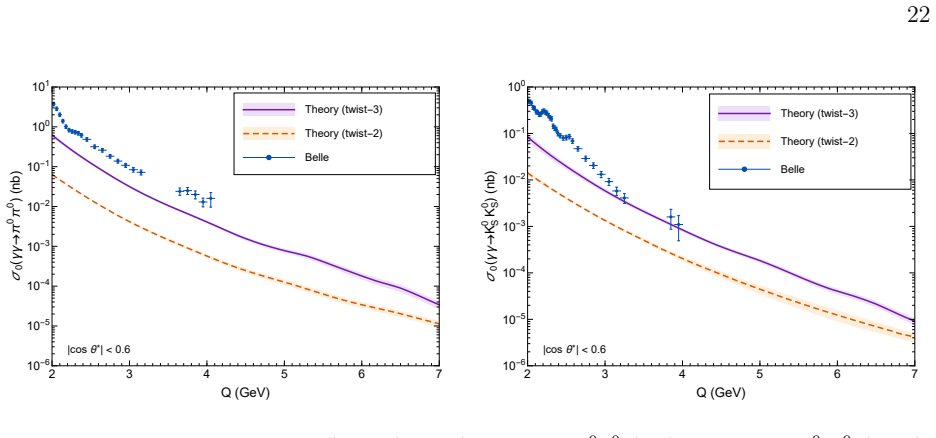
Twist-3 terms raise cross sections for neutral pion and kaon pair production from two photons by nearly an order of magnitude at intermediate energies.
A machine-rendered reading of the paper's core claim, the machinery that carries it, and where it could break.
Core claim
In the k_T factorization framework the twist-3 contributions to the cross sections of γγ→π⁰π⁰ and γγ→K_S⁰K_S⁰ exceed the twist-2 contributions by close to an order of magnitude in the intermediate-energy region, bringing the theoretical results much closer to the Belle data for these charge-suppressed neutral channels.
What carries the argument
Chirally enhanced two-parton twist-3 light-cone distribution amplitudes inserted into the k_T factorization hard-scattering kernels for neutral meson-pair production.
If this is right
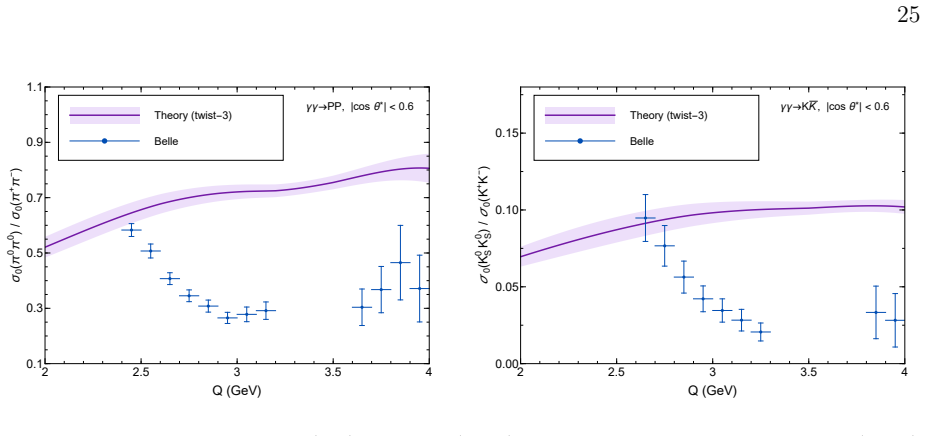
- The neutral-to-charged ratios remain nearly constant with energy in the calculation while the data show strong energy dependence.
- Higher-order QCD corrections are expected to close the remaining gap between theory and Belle data for the neutral channels.
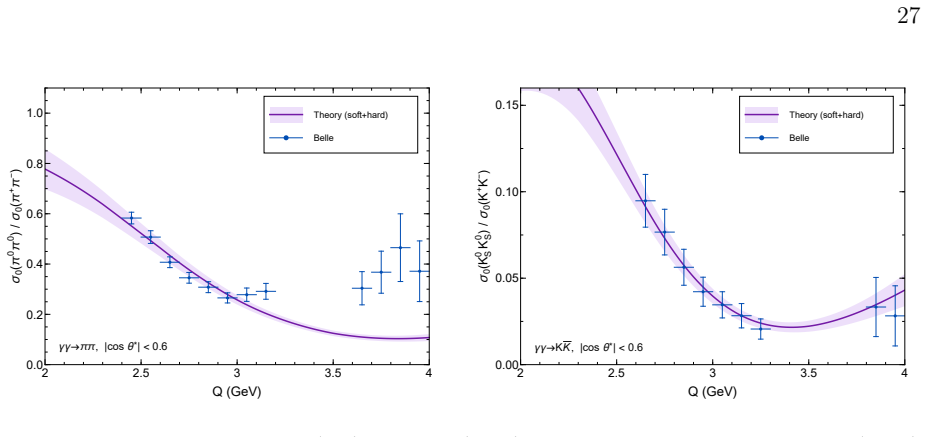
- The hard twist-3 contribution and the soft handbag contribution are of comparable size in the few-GeV region.
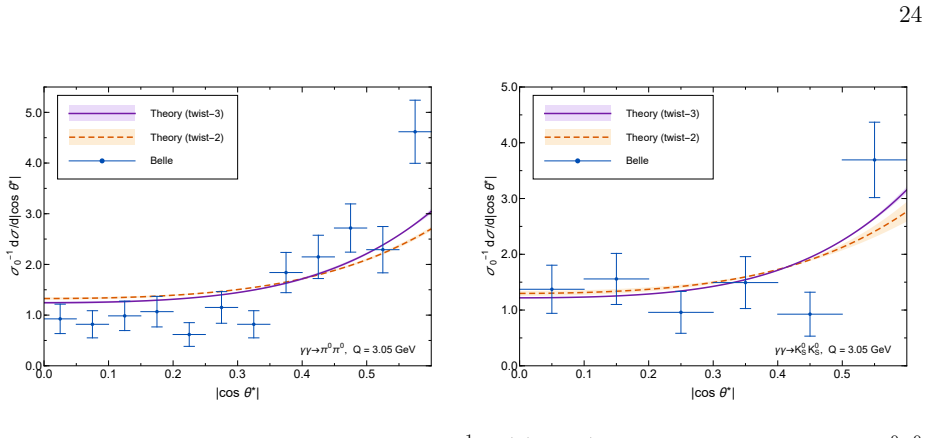
- The calculation matches the measured angular distributions for both charged and neutral-pion channels.
Where Pith is reading between the lines
- The persistent mismatch in the energy slope of the neutral-kaon channel suggests that additional mechanisms beyond the current twist-3 set may be required for kaons specifically.
- If the flat theoretical ratio persists at higher energies, future collider data on the ratio could distinguish between hard-scattering models and soft-overlap pictures.
- The same twist-3 enhancement pattern could be tested in related neutral channels such as γγ → ηη or γγ → ηπ⁰ once sufficient luminosity is available.
Load-bearing premise
The specific models chosen for the twist-3 light-cone distribution amplitudes are accurate and k_T factorization remains valid and dominant without large non-factorizable contributions in the few-GeV region.
What would settle it
A measurement showing that the neutral-to-charged cross-section ratio continues to fall steeply with energy beyond 4 GeV, rather than flattening as the calculation predicts, would contradict the dominance of the included twist-3 terms.
Figures

read the original abstract
We compute the cross sections for the two-photon processes $\gamma\gamma\to\pi^0\pi^0$ and $\gamma\gamma\to K_S^0K_S^0$ in $k_T$ factorization, including the chirally enhanced two-parton twist-3 light-cone distribution amplitudes. For these charge-suppressed neutral channels the twist-3 cross sections exceed the twist-2 ones by close to an order of magnitude in the intermediate-energy region, bringing the predictions much closer to the Belle data, the residual underestimate being plausibly attributable to higher-order QCD corrections. The calculation reproduces the measured angular distributions and the energy dependence of the charged channels and the neutral pion, though not the steeper fall of the neutral kaon. The neutral-to-charged ratios are the most discriminating observables. They depend strongly on energy in the data, whereas our calculation, like other approaches in the literature, yields a nearly flat ratio. Finally, in a phenomenological discussion, we combine our contribution with the soft handbag contribution and largely reproduce the observed energy dependence, suggesting that the hard and soft contributions are comparably important in the few-GeV region.
Editorial analysis
A structured set of objections, weighed in public.
Referee Report
Summary. The paper computes cross sections for γγ→π⁰π⁰ and γγ→K_S⁰K_S⁰ in k_T factorization, incorporating chirally enhanced two-parton twist-3 light-cone distribution amplitudes. It reports that for these neutral channels the twist-3 contributions exceed twist-2 by nearly an order of magnitude at intermediate energies, improving agreement with Belle data (with residuals ascribed to higher-order QCD). The calculation reproduces angular distributions and energy dependence for charged channels and neutral pions but not the steeper fall-off for neutral kaons; neutral-to-charged ratios remain nearly flat in the theory while data show strong energy dependence. A phenomenological combination with soft handbag contributions is shown to largely reproduce the observed energy dependence.
Significance. If the central numerical result holds, the work establishes that twist-3 effects can dominate over twist-2 in charge-suppressed neutral two-photon channels at few-GeV scales, providing a concrete illustration of the importance of higher-twist contributions within k_T factorization and of the interplay between hard and soft mechanisms in the transition region.
major comments (3)
- [§2, §4] §4 (numerical results) and the LCDA parametrization in §2: the reported order-of-magnitude enhancement of twist-3 over twist-2 is obtained with specific functional forms and parameters for the two-parton twist-3 LCDAs; no variation or uncertainty band is shown, so it is unclear whether the dominance survives reasonable changes in those models.
- [§3] §3 (factorization framework): the validity of k_T factorization at the few-GeV scales of the Belle data is assumed without quantitative assessment of higher-order corrections or power-suppressed non-factorizable terms; the residual data-theory discrepancy is attributed to higher-order QCD but no estimate of its size is provided.
- [final section] Phenomenological discussion (final section): the soft handbag term is added by hand to restore the observed energy dependence; the paper does not demonstrate that this term is independent of the hard-scattering calculation or that double-counting is avoided.
minor comments (2)
- [abstract] The abstract states that the neutral-to-charged ratios are the most discriminating observables, yet the calculation yields a flat ratio; a brief remark on the kinematic range where this flatness is expected would help.
- [§2, §4] Notation for the twist-3 LCDAs (e.g., the precise definition of the chirally enhanced terms) should be cross-referenced to the equations in §2 when first used in the numerical discussion.
Simulated Author's Rebuttal
We thank the referee for the thorough review and valuable comments on our manuscript. We address each major comment below in a point-by-point manner.
read point-by-point responses
-
Referee: [§2, §4] §4 (numerical results) and the LCDA parametrization in §2: the reported order-of-magnitude enhancement of twist-3 over twist-2 is obtained with specific functional forms and parameters for the two-parton twist-3 LCDAs; no variation or uncertainty band is shown, so it is unclear whether the dominance survives reasonable changes in those models.
Authors: We agree that the robustness of the twist-3 dominance would be better demonstrated by including parameter variations. In the revised manuscript we will vary the key parameters of the two-parton twist-3 LCDAs within their accepted ranges, recompute the cross sections, and display uncertainty bands in the relevant figures of §4. revision: yes
-
Referee: [§3] §3 (factorization framework): the validity of k_T factorization at the few-GeV scales of the Belle data is assumed without quantitative assessment of higher-order corrections or power-suppressed non-factorizable terms; the residual data-theory discrepancy is attributed to higher-order QCD but no estimate of its size is provided.
Authors: We acknowledge that a more quantitative discussion of the applicability of k_T factorization is warranted. We will expand §3 to include an estimate of higher-order corrections based on the observed renormalization-scale dependence of our leading-order results and comparisons with existing NLO studies in the literature, while noting that a complete NLO calculation lies beyond the scope of the present work. revision: yes
-
Referee: [final section] Phenomenological discussion (final section): the soft handbag term is added by hand to restore the observed energy dependence; the paper does not demonstrate that this term is independent of the hard-scattering calculation or that double-counting is avoided.
Authors: The soft handbag contribution is introduced purely phenomenologically to illustrate the possible importance of soft mechanisms. We will revise the final section to state explicitly that this term is added by hand as a model-dependent supplement and is not derived from the same k_T factorization framework, thereby clarifying that it is not intended as a combined theoretical prediction. A rigorous demonstration of independence is not possible within the present approach, as the handbag term parametrizes non-perturbative effects outside the hard-scattering regime. revision: partial
Circularity Check
No significant circularity; derivation is a standard perturbative calculation
full rationale
The paper computes cross sections via kT factorization using chosen models for twist-3 LCDAs; the reported order-of-magnitude enhancement and comparison to Belle data follow directly from that computation and the stated assumptions about factorization validity. The final phenomenological combination with a soft handbag term is explicitly labeled as a separate discussion to illustrate energy dependence and is not presented as a derived prediction. No self-definitional equations, fitted parameters renamed as predictions, or load-bearing self-citations that reduce the central result to its inputs are present in the provided text. The derivation remains self-contained against external benchmarks once the LCDA models and factorization assumptions are granted.
Axiom & Free-Parameter Ledger
Reference graph
Works this paper leans on
-
[1]
The two-parton twist-3 LCDAs of the pion, including the meson-mass corrections of Refs. [39, 40], are ϕp π(x, µ) = 1 + 30η 3π(µ)− 5 2 ρ2 π(µ) C1/2 2 (2x−1) (9) − 3η 3π(µ)ω3π(µ) + 27 20 ρ2 π(µ) + 81 10 ρ2 π(µ)aπ 2(µ) C1/2 4 (2x−1), ϕσ π(x, µ) = 6x¯x n 1 + 5η3π(µ)− 1 2 η3π(µ)ω3π(µ)− 7 20 ρ2 π(µ)− 3 5 ρ2 π(µ)aπ 2(µ) C3/2 2 (2x−1) o , (10) where the Legendre ...
-
[2]
The factorκ 2/κ1 =µ 2 π/ω2 = 4µ2 π/Q2 is the chiral-enhancement parameter discussed in Sec. I. In the Belle windowQ∼2–4 GeV this ratio is of order 0.4–1.8, so the twist-3 corrections are not parametrically suppressed. In particular, the chiral masses µπ andµ K are of order the hard scale in this window, which is the physical reason why the two-parton twis...
-
[3]
Two features distinguish the kaon prefactor from the pion one. First,f K is here the physical neutral-kaon decay constant (and not fK/ √ 2), sinceK 0 =d¯sis a flavor eigenstate rather than a flavor superposition, so that no (1/ √ 2)2 projection weight appears. Second, becausee d =e s =− 1 3, the photon couples with equal strength to the two valence flavor...
2024
-
[4]
S. J. Brodsky and G. P. Lepage, Large-angle two-photon exclusive channels in quantum chro- modynamics, Phys. Rev. D24, 1808 (1981)
1981
-
[5]
G. P. Lepage and S. J. Brodsky, Exclusive processes in perturbative quantum chromodynamics, Phys. Rev. D22, 2157 (1980)
1980
-
[6]
V. L. Chernyak,γγ→ππ, KK: leading term QCD versus handbag model, Phys. Lett. B 640, 246 (2006), arXiv:hep-ph/0605072
Pith/arXiv arXiv 2006
-
[7]
Chenet al.(Belle), A study ofγγ→K 0 SK0 S production at energies of 2.4–4.0 GeV at Belle, Phys
W.-T. Chenet al.(Belle), A study ofγγ→K 0 SK0 S production at energies of 2.4–4.0 GeV at Belle, Phys. Lett. B651, 15 (2007), arXiv:hep-ex/0609042
arXiv 2007
-
[8]
V. L. Chernyak and S. I. Eidelman, Hard exclusive two-photon processes in QCD, Prog. Part. Nucl. Phys.80, 1 (2015), arXiv:1409.3348
Pith/arXiv arXiv 2015
-
[9]
S. Ueharaet al.(Belle), High-statistics study of neutral-pion pair production in two-photon collisions, Phys. Rev. D79, 052009 (2009), arXiv:0903.3697
Pith/arXiv arXiv 2009
-
[10]
Aiharaet al.(TPC/Two Gamma), Pion and kaon pair production in photon-photon colli- sions, Phys
H. Aiharaet al.(TPC/Two Gamma), Pion and kaon pair production in photon-photon colli- sions, Phys. Rev. Lett.57, 404 (1986)
1986
-
[11]
Heisteret al.(ALEPH), Exclusive production of pion and kaon meson pairs in two photon collisions at LEP, Phys
A. Heisteret al.(ALEPH), Exclusive production of pion and kaon meson pairs in two photon collisions at LEP, Phys. Lett. B569, 140 (2003)
2003
-
[12]
H. Nakazawaet al.(Belle), Measurement of theγγ→π +π− andγγ→K +K− processes at energies of 2.4–4.1 GeV, Phys. Lett. B615, 39 (2005), arXiv:hep-ex/0412058
arXiv 2005
-
[13]
Moriet al.(Belle), High statistics measurement of the cross sections ofγγ→π +π− production, J
T. Moriet al.(Belle), High statistics measurement of the cross sections ofγγ→π +π− production, J. Phys. Soc. Jpn.76, 074102 (2007), arXiv:0704.3538. 30
arXiv 2007
-
[14]
S. Ueharaet al.(Belle), High-statistics measurement of neutral-pion pair production in two- photon collisions, Phys. Rev. D78, 052004 (2008), arXiv:0805.3387
Pith/arXiv arXiv 2008
-
[15]
Ueharaet al.(Belle), High-statistics study ofηπ 0 production in two-photon collisions, Phys
S. Ueharaet al.(Belle), High-statistics study ofηπ 0 production in two-photon collisions, Phys. Rev. D80, 032001 (2009), arXiv:0906.1464
arXiv 2009
-
[16]
Ueharaet al.(Belle), Measurement ofηηproduction in two-photon collisions, Phys
S. Ueharaet al.(Belle), Measurement ofηηproduction in two-photon collisions, Phys. Rev. D82, 114031 (2010), arXiv:1007.3779
Pith/arXiv arXiv 2010
-
[17]
S. Ueharaet al.(Belle), High-statistics study ofK 0 S pair production in two-photon collisions, PTEP2013, 123C01 (2013), arXiv:1307.7457
Pith/arXiv arXiv 2013
-
[18]
Masudaet al.(Belle), Study ofπ 0 pair production in single-tag two-photon collisions, Phys
M. Masudaet al.(Belle), Study ofπ 0 pair production in single-tag two-photon collisions, Phys. Rev. D93, 032003 (2016), arXiv:1508.06757
Pith/arXiv arXiv 2016
-
[19]
Masudaet al.(Belle), Study ofK 0 S pair production in single-tag two-photon collisions, Phys
M. Masudaet al.(Belle), Study ofK 0 S pair production in single-tag two-photon collisions, Phys. Rev. D97, 052003 (2018), arXiv:1712.02145
Pith/arXiv arXiv 2018
-
[20]
C. Corian` o, H.-n. Li, and C. Savkli, Exclusive processes at intermediate energy, quark–hadron duality and the transition to perturbative QCD, JHEP07, 008, arXiv:hep-ph/9805406
-
[21]
R.-C. Hsieh and H.-n. Li, Transition to perturbative QCD in two photon collisions, Phys. Rev. D70, 056002 (2004), arXiv:hep-ph/0404109
Pith/arXiv arXiv 2004
-
[22]
C. Wang, M.-Z. Zhou, and H. Chen,γγ→M +M − (M=π, K) processes with twist-3 correc- tions in QCD, Eur. Phys. J. C77, 219 (2017), arXiv:1512.04381
Pith/arXiv arXiv 2017
-
[23]
G. Duplanˇ ci´ c and B. Niˇ zi´ c, NLO perturbative QCD predictions forγγ→M+M − (M=π, K), Phys. Rev. Lett.97, 142003 (2006), arXiv:hep-ph/0607069
Pith/arXiv arXiv 2006
-
[24]
M. Diehl, P. Kroll, and C. Vogt, The handbag contribution toγγ→ππandKK, Phys. Lett. B532, 99 (2002), arXiv:hep-ph/0112274
Pith/arXiv arXiv 2002
-
[25]
M. Diehl and P. Kroll, Two-photon annihilation into octet meson pairs: symmetry relations in the handbag approach, Phys. Lett. B683, 165 (2010), arXiv:0911.3317
arXiv 2010
-
[26]
Kroll, Hard exclusive wide-angle processes, EPJ Web Conf.37, 01019 (2012), arXiv:1209.1230
P. Kroll, Hard exclusive wide-angle processes, EPJ Web Conf.37, 01019 (2012), arXiv:1209.1230
Pith/arXiv arXiv 2012
-
[27]
M. Hoferichter, D. R. Phillips, and C. Schat, Roy–Steiner equations forγγ→ππ, Eur. Phys. J. C71, 1743 (2011), arXiv:1106.4147
Pith/arXiv arXiv 2011
-
[28]
R. Garc´ ıa-Mart´ ın and B. Moussallam, MO analysis of the high statistics Belle results on γγ→π +π−, π0π0 with chiral constraints, Eur. Phys. J. C70, 155 (2010), arXiv:1006.5373
Pith/arXiv arXiv 2010
-
[29]
L.-Y. Dai and M. R. Pennington, Comprehensive amplitude analysis ofγγ→π +π−, π0π0 and ¯KKbelow 1.5 GeV, Phys. Rev. D90, 036004 (2014), arXiv:1404.7524
Pith/arXiv arXiv 2014
-
[30]
I. Danilkin and M. Vanderhaeghen, Dispersive analysis of theγγ ∗ →ππprocess, Phys. Lett. B789, 366 (2019), arXiv:1810.03669
Pith/arXiv arXiv 2019
-
[31]
Y. S. Surovtsev, P. Bydˇ zovsk´ y, T. Gutsche, R. Kami´ nski, V. E. Lyubovitskij, and M. Nagy, Coupled-channel analysis of the processγγ→π 0π0, Particles5, 210 (2022), arXiv:2112.15435
arXiv 2022
-
[32]
S. P. Klevansky, R. H. Lemmer, and A. Beygi, Amplitude determination forM M→ 31 M M, M=π, Kand cross-sections forγγ→π +π−, π0π0, π0ηin a chiral model, Eur. Phys. J. A61, 49 (2025), arXiv:1607.08349
arXiv 2025
-
[33]
Botts and G
J. Botts and G. F. Sterman, Hard elastic scattering in QCD: leading behavior, Nucl. Phys. B 325, 62 (1989)
1989
-
[34]
Li and G
H.-n. Li and G. F. Sterman, The perturbative pion form factor with Sudakov suppression, Nucl. Phys. B381, 129 (1992)
1992
-
[35]
R. Jakob and P. Kroll, The pion form factor: Sudakov suppressions and intrinsic transverse momentum, Phys. Lett. B315, 463 (1993), arXiv:hep-ph/9306259
Pith/arXiv arXiv 1993
-
[36]
C. Wang, J.-K. He, and M.-Z. Zhou, Twist-3 contributions toγγ→π +π−, K +K− processes in perturbative QCD approach, Eur. Phys. J. C79, 765 (2019), arXiv:1905.07008
arXiv 2019
-
[37]
Li, Unification of thek T and threshold resummations, Phys
H.-n. Li, Unification of thek T and threshold resummations, Phys. Lett. B454, 328 (1999), arXiv:hep-ph/9812363
Pith/arXiv arXiv 1999
-
[38]
T. Kurimoto, H.-n. Li, and A. I. Sanda, Leading-power contributions toB→π, ρtransition form factors, Phys. Rev. D65, 014007 (2002), arXiv:hep-ph/0105003
Pith/arXiv arXiv 2002
-
[39]
Li, Threshold resummation for exclusiveBmeson decays, Phys
H.-n. Li, Threshold resummation for exclusiveBmeson decays, Phys. Rev. D66, 094010 (2002), arXiv:hep-ph/0102013
Pith/arXiv arXiv 2002
-
[40]
Gell-Mann, R
M. Gell-Mann, R. J. Oakes, and B. Renner, Behavior of current divergences under SU(3) x SU(3), Phys. Rev.175, 2195 (1968)
1968
-
[41]
Leutwyler, The ratios of the light quark masses, Phys
H. Leutwyler, The ratios of the light quark masses, Phys. Lett. B378, 313 (1996), arXiv:hep- ph/9602366
arXiv 1996
-
[42]
P. Ball, Theoretical update of pseudoscalar meson distribution amplitudes of higher twist: the nonsinglet case, JHEP01, 010, arXiv:hep-ph/9812375
-
[43]
P. Ball, V. M. Braun, and A. Lenz, Higher-twist distribution amplitudes of the K meson in QCD, JHEP05, 004, arXiv:hep-ph/0603063
-
[44]
M. Beneke and T. Feldmann, Symmetry-breaking corrections to heavy-to-light B meson form factors at large recoil, Nucl. Phys. B592, 3 (2001), arXiv:hep-ph/0008255
Pith/arXiv arXiv 2001
-
[45]
Aokiet al.(Flavour Lattice Averaging Group (FLAG)), FLAG review 2024, Phys
Y. Aokiet al.(Flavour Lattice Averaging Group (FLAG)), FLAG review 2024, Phys. Rev. D 113, 014508 (2026), arXiv:2411.04268 [hep-lat]
Pith/arXiv arXiv 2024
-
[46]
J. Bolz, P. Kroll, and G. A. Schuler, Color octet contributions to exclusive charmonium decays, Phys. Lett. B392, 198 (1997), arXiv:hep-ph/9610265
Pith/arXiv arXiv 1997
-
[47]
V. M. Braun and I. E. Filyanov, QCD sum rules in exclusive kinematics and pion wave function, Z. Phys. C44, 157 (1989)
1989
-
[48]
V. M. Braun and I. E. Filyanov, Conformal invariance and pion wave functions of nonleading twist, Z. Phys. C48, 239 (1990)
1990
-
[49]
Z.-T. Wei and M.-Z. Yang, Systematic study ofB→πform factors in the pQCD approach and its reliability, Nucl. Phys. B642, 263 (2002), arXiv:hep-ph/0202018
Pith/arXiv arXiv 2002
-
[50]
Navaset al.(Particle Data Group), Review of Particle Physics, Phys
S. Navaset al.(Particle Data Group), Review of Particle Physics, Phys. Rev. D110, 030001 32 (2024)
2024
-
[51]
A. V. Efremov and A. V. Radyushkin, Factorization and asymptotic behaviour of pion form factor in QCD, Phys. Lett. B94, 245 (1980)
1980
-
[52]
V. M. Braun, A. N. Manashov, and J. Rohrwild, Baryon operators of higher twist in QCD and nucleon distribution amplitudes, Nucl. Phys. B807, 89 (2009), arXiv:0806.2531
Pith/arXiv arXiv 2009
-
[53]
P. Kroll and K. Passek-Kumeriˇ cki, Twist-3 contributions to wide-angle photoproduction of pions, Phys. Rev. D97, 074023 (2018), arXiv:1802.06597
arXiv 2018
-
[54]
S. J. Brodsky, T. Huang, and G. P. Lepage, The intrinsic transverse momentum and the in- trinsic heavy quark probability distributions in QCD, inParticles and Fields 2, Banff Summer Institute(1981) p. 143
1981
-
[55]
G. P. Lepage, S. J. Brodsky, T. Huang, and P. B. Mackenzie, Hadronic wave functions in QCD, inParticles and Fields 2, Proc. Banff Summer Institute(1982) p. 83
1982
-
[56]
M. Nagashima and H.-n. Li,k T factorization of exclusive processes, Phys. Rev. D67, 034001 (2003), arXiv:hep-ph/0210173
Pith/arXiv arXiv 2003
-
[57]
H.-n. Li and S. Mishima, Pion transition form factor ink T factorization, Phys. Rev. D80, 074024 (2009), arXiv:0907.0166
Pith/arXiv arXiv 2009
-
[58]
H.-n. Li, Y.-L. Shen, Y.-M. Wang, and H. Zou, Next-to-leading-order correction to pion form factor ink T factorization, Phys. Rev. D83, 054029 (2011), arXiv:1012.4098
Pith/arXiv arXiv 2011
-
[59]
H.-C. Hu and H.-n. Li, Next-to-leading-order time-like pion form factors ink T factorization, Phys. Lett. B718, 1351 (2013), arXiv:1204.6708
Pith/arXiv arXiv 2013
-
[60]
A. S. Gorsky, The power correction to the asymptotics of the cross section for the process γγ→π +π− in QCD, Sov. J. Nucl. Phys.50, 708 (1989)
1989
-
[61]
Faiman, H
D. Faiman, H. J. Lipkin, and H. R. Rubinstein, Resonance physics withγγevents, Phys. Lett. B59, 269 (1975)
1975
-
[62]
N. N. Achasov and G. N. Shestakov, Lightest scalar and tensor resonances inγγ→ππafter the Belle experiment, Phys. Rev. D77, 074020 (2008), arXiv:0712.0885
Pith/arXiv arXiv 2008
-
[63]
C. N. Yang, Selection rules for the dematerialization of a particle into two photons, Phys. Rev. 77, 242 (1950)
1950
-
[64]
G. S. Baliet al.(RQCD), Light-cone distribution amplitudes of pseudoscalar mesons from lattice QCD, JHEP08, 065, addendum: JHEP 11 (2020) 037, arXiv:1903.08038
arXiv 2020
-
[65]
A. Khodjamirian, T. Mannel, A. A. Pivovarov, and Y.-M. Wang, Charm-loop effect inB→ K(∗)ℓ+ℓ− andB→K ∗γ, JHEP09, 089, arXiv:1006.4945
-
[66]
A. Khodjamirian and A. V. Rusov,B s →Kℓν ℓ andB (s) →π(K)ℓ +ℓ− decays at large recoil and CKM matrix elements, JHEP08, 112, arXiv:1703.04765
- [67]
-
[68]
J. Chai and S. Cheng, Shedding light on the intrinsic transversal momentum distributions of 33 pions and kaons, Phys. Rev. D111, L071902 (2025), arXiv:2412.05941 [hep-ph]
arXiv 2025
-
[69]
J. Chai and S. Cheng, Form factors of light pseudoscalar mesons from the perturbative QCD approach, JHEP06, 229, arXiv:2501.08783 [hep-ph]
discussion (0)
Sign in with ORCID, Apple, or X to comment. Anyone can read and Pith papers without signing in.