REVIEW 4 major objections 5 minor 53 references
Evidences for local non-centrosymmetricity and strong phonon anomaly in EuCu2As2: A Raman spectroscopy and lattice dynamics study
T0 review · 4 major / 5 minor · reviewed 2026-08-10 · deepseek-v4-flash
Pith's one-line read This paper argues that EuCu2As2 realizes the locally non-centrosymmetric P4/nmm structure instead of the accepted I4/mmm structure, and that anomalous hardening of the strongest phonon mode below 165 K signals a subtle electronic density…
desk verdict First Raman study of EuCu2As2 makes a plausible but not airtight case for P4/nmm over I4/mmm, and reports a real 165 K phonon anomaly whose density-wave origin is speculative. read the letter →
The pith
A machine-rendered reading of the paper's core claim, the machinery that carries it, and where it could break.
The reading
What carries the argument
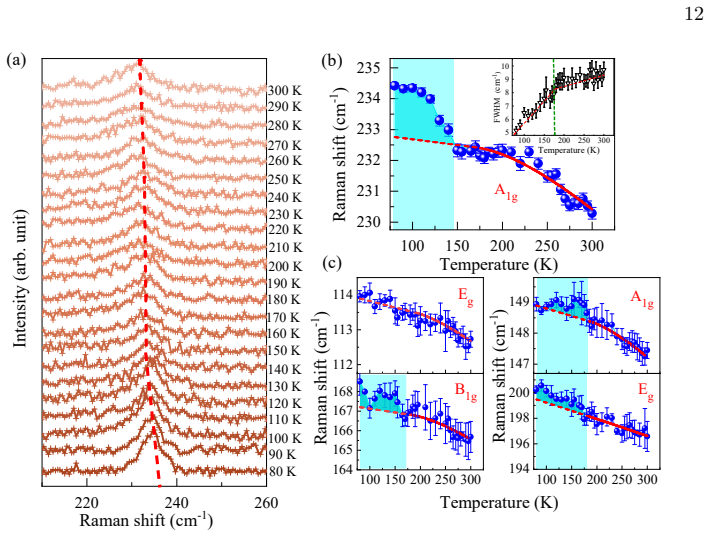
The argument is carried by three coupled tools. Mode counting: for I4/mmm the Γ-point optical modes decompose into A1g + 2A2u + B1g + 2Eu + 2Eg, giving four Raman-active bands (A1g, B1g, and two Eg doublets), whereas P4/nmm gives ten Raman-active bands (3A1g + 2B1g + 5Eg); observing seven distinct peaks is therefore a symmetry-level contradiction of the accepted structure. Lattice dynamics: DFT+U (PBEsol, U = 7 eV on the Eu 4f states) phonon dispersions computed by the supercell force-constant method yield imaginary soft modes for I4/mmm — the hallmark of a dynamically unstable structure — and a purely real, stable spectrum for P4/nmm whose frequencies near the Γ point track the measured modes. Anharmonic model: the temperature dependence of each mode is fit to the Balkanski–Wallis–Haro three- and four-phonon decay formula between 165 K and 300 K and extrapolated down; the area between the extrapolated curve and the data below 165 K quantifies the anomaly, which is largest for the out-of-plane A1g mode and decreases monotonically from P7 to P1, tying the instability to the interlayer Cu(2)–As(1) vibrations of the A1g mode.
What would settle it
Refining single-crystal X-ray or neutron diffraction of EuCu2As2 and hunting specifically for weak reflections with odd (hkl) index sums — forbidden by I4/mmm but allowed by P4/nmm — would decide the structure question directly, as would repeating the phonon calculation over a range of U values and functionals to see whether the I4/mmm imaginary modes survive the choice of method. For the 165 K anomaly, resolving the CDW fingerprints the paper could not see — an amplitude mode, zone-folded modes, or two-phonon features appearing below 165 K — would confirm the density wave, while a bulk probe (specific heat, resistivity, thermal expansion) showing no feature at 165 K would weigh against the electronic-instability interpretation.
Extended reading notes
Core claim
Stated on the paper's own terms, the discovery is that the accepted I4/mmm picture of EuCu2As2 is wrong and that the consequences are observable: seven first-order Raman bands — at approximately 115, 126, 150, 170, 201, 224, and 235 $cm^{-1}$ — exceed what I4/mmm symmetry permits and match, in count, symmetry labels (Eg, B1g, A1g, B1g, Eg, Eg, A1g), and frequency, the Γ-point phonons of the locally non-centrosymmetric P4/nmm structure computed with DFT+U. The same calculation shows I4/mmm to be dynamically unstable, with imaginary soft modes from in-plane Cu and As vibrations, and P4/nmm to be stable, with a phonon spectrum whose highest modes are dominated by Cu and As motion while Eu vibrations sit below about 150 $cm^{-1}$. On cooling, the A1g mode at ~232 $cm^{-1}$ departs from the anharmonic (three- and four-phonon decay) curve below 165 K, abruptly hardening while narrowing faster than the anharmonic fit; four other modes show smaller versions of the same deviation. The authors propose that an electronic density wave instability, analogous to the CDW states seen in Raman studies of transition-metal dichalcogenides and kagome metals and in the P4/nmm 122 compound SrPt2As2, gaps part of the Fermi surface and stiffens the phonons, particularly the out-of-plane A1g vibration of the interlayer Cu(2) and As(1) atoms. They explicitly stop short of claiming conclusive proof: no amplitude modes, zone-folded modes, or two-phonon features were observed, and more detailed studies are called for.
Load-bearing premise
The structural conclusion rests on the assumption that the DFT+U phonon calculation (PBEsol with U = 7 eV on the Eu 4f states) correctly predicts I4/mmm to be dynamically unstable, and that the seven Raman bands are intrinsic first-order modes of bulk EuCu2As2 rather than a near-surface artifact; the authors themselves note that Raman probes only the surface and that a P4/nmm surface sitting on an I4/mmm bulk cannot be excluded from experiment alone, and they report no test of how the result depends on the chosen U value or exchange-correlation functional.
Editorial extensions
If this is right
- EuCu2As2 would join SrPt2As2 and CeRh2As2 as a 122 pnictide realizing the locally non-centrosymmetric CaBe2Ge2-type P4/nmm structure, breaking the rule that copper-arsenide 122 compounds take the ThCr2Si2-type I4/mmm form.
- The seven-peak Raman pattern, anchored by the intense ~232 cm^-1 A1g mode, becomes a quick experimental fingerprint for P4/nmm order in other copper-based 122 compounds.
- Below 165 K, the hardening of the A1g mode and its accelerated linewidth narrowing imply a partial gap on the Fermi surface and a reduced electron–phonon coupling — the behavior expected of a subtle charge density wave whose amplitude mode has so far escaped detection.
- The near-degeneracy of the computed magnetic ground states and the small non-compensated moments induced on Cu(2) and As(1) near the Eu layer suggest that pressure or magnetic field could tune between density-wave and magnetic orders, as already seen for the Eu spin arrangement.
Reading between the lines
- If the P4/nmm assignment survives bulk-sensitive probes, then the 'collapsed tetragonal' picture of Cu-based 122 pnictides may have been describing a dynamical average: with I4/mmm phonons carrying imaginary soft modes, the accepted structure could be an unstable parent from which a locally non-centrosymmetric ground state emerges.
- A targeted bulk probe — specific heat, resistivity, or thermal expansion across 165 K — is the cheapest test of the density-wave reading: a small anomaly located at 165 K would strengthen it, while a clean null result would push the hardening toward a magnetic-fluctuation origin tied to the Eu sublattice.
- Because the experiment used a polycrystalline sample and a single 532 nm laser line, repeating the measurements on single crystals with polarization analysis and with different laser wavelengths (varying penetration depth) could confirm that all seven modes are bulk first-order Raman phonons and fix their symmetries unambiguously.
Editorial analysis
A structured set of objections, weighed in public.
Referee Report
Summary. The paper reports Raman spectra, powder XRD, magnetic susceptibility, and DFT-based lattice dynamics for EuCu2As2. The central claim is that the compound does not adopt the accepted ThCr2Si2-type I4/mmm structure but instead realizes the CaBe2Ge2-type P4/nmm structure: seven Raman peaks are observed above 100 cm−1, which is more than the four Raman-active modes expected for I4/mmm, and DFT phonon calculations find an imaginary mode for I4/mmm while P4/nmm is dynamically stable. Temperature-dependent Raman measurements show a deviation of the A1g mode frequency from an anharmonic model below about 165 K, which the authors interpret as a possible signature of a subtle electronic density-wave instability.
Significance. If the structural reassignment is correct, the paper is significant because it challenges the accepted I4/mmm classification of ACu2As2 compounds and adds EuCu2As2 to the small family of locally non-centrosymmetric 122 systems that host density-wave-like instabilities. The work has clear strengths: the DFT phonon calculations are independent first-principles results rather than fits to the Raman peaks, the XRD ambiguity between the two space groups is explicitly acknowledged, the Raman spectra are carefully analyzed, and the authors openly state the limits of their evidence, including the surface-sensitivity of Raman and the absence of CDW signatures. These strengths make the central claim plausible, but the bulk structural conclusion currently rests on a narrow set of computational parameters and the density-wave interpretation is speculative.
major comments (4)
- [§2, §3.2, Table 3] The bulk structural claim rests on the DFT prediction that I4/mmm is dynamically unstable, but this is shown for a single computational setup: PBEsol+U with U = 7 eV and an AFM-ordered state. The imaginary Eg mode at -50.07i in Table 3 could depend on the Hubbard U applied to the Eu 4f states or on the magnetic constraint, yet no U-dependence, exchange-correlation functional dependence, or magnetic-order dependence is reported for the phonon instability. Because the authors state, correctly, that Raman cannot distinguish a P4/nmm surface from a P4/nmm bulk, this DFT calculation is the only bulk-sensitive support for the structural reassignment. Without a robustness check of the soft mode, the conclusion that 'the whole structure belongs to the P4/nmm phase' is not fully supported.
- [§3.2, Fig. 4, Fig. 6] The seven observed peaks are assigned to specific irreducible representations (Eg, B1g, A1g) solely by comparing measured frequencies with the calculated P4/nmm spectrum; no polarization-resolved Raman measurements are reported. As a result, the symmetry labels attached to the modes, which are later used to discuss the displacement pattern of the anomalous A1g mode, are not independently verified. In particular, the assignments of P1 (calculated 106.7 cm−1, observed 115 cm−1) and P2 (calculated 137.4 cm−1, observed 126 cm−1) show discrepancies of 8–11 cm−1, and possible contributions from two-phonon or defect-related scattering are not discussed. Polarization-resolved measurements on an oriented single crystal would substantially strengthen the mode assignment and the structural conclusion.
- [§3.3, Eq. (1), Fig. 7] The phonon anomaly is quantified as the deviation from an anharmonic model fitted to Eq. (1) over a range that is chosen after inspecting the data: the fits are performed between 300 K and 165 K (or 160 K, according to the Fig. 7 caption) and then extrapolated to 80 K. The authors do not report the fitted values of ω0, A, and B, nor any goodness-of-fit measure or residual analysis, so it is difficult to judge whether the extrapolated baseline is reliable. A reproducible assessment would require reporting the fit parameters and uncertainties and testing how the inferred anomaly temperature changes when the fitting window is varied.
- [§3.3, §4] The interpretation of the 165 K phonon hardening as a 'subtle electronic density wave instability' is presented without the characteristic signatures that would distinguish a density wave from other electronic or magnetic couplings; the authors themselves note that amplitude modes, zone-folded modes, and two-phonon modes were not observed. The susceptibility deviation in Fig. 3(b) is small, and its fit range is also defined relative to 165 K. The phonon anomaly itself is well documented, but the density-wave conclusion remains one of several possibilities. The abstract and summary should be tempered unless additional evidence, such as superlattice reflections, transport anomalies, or heat-capacity features, is provided.
minor comments (5)
- [Throughout] There is an inconsistency in the author list header ('V aitheeswaran' should be 'Vaitheeswaran') and the text contains typos such as 'N'eel', 'focussing', and 'contrary to that what is expected'. The manuscript would benefit from a careful proofreading pass.
- [§2] The description of the supercell used for the force-constant calculation, '2√2×2√2×1 conventional cells', is difficult to parse; the authors should clarify the exact supercell geometry and the number of atoms used.
- [§3.3, Eq. (1)] Equation (1) uses 'K_B' and later 'KBT' in the exponentials; the Boltzmann constant should be denoted consistently (typically k_B), and the temperature dependence should be written unambiguously.
- [§3.1, Fig. 3(b)] The contour plot overlaid in Fig. 3(b) is not clearly described in the caption; the reader cannot tell which color scale corresponds to the Raman shift evolution. A separate panel or a clearer caption would help.
- [§3.2, Table 2] The notation 'Theo. (NM)' and 'Theo. (AFM)' is defined in the table, but the differences between non-magnetic and antiferromagnetic results are not discussed in the text; a brief comment on why the AFM frequencies were used for comparison would be useful.
Circularity Check
No significant circularity: the Raman frequencies are compared with independent DFT phonon predictions, and the 165 K anomaly is measured against an anharmonic fit extrapolated outside its fitted range.
full rationale
The central derivations are self-contained. The structural reassignment rests on counting more Raman peaks than the four Raman-active modes allowed by I4/mmm, and on DFT phonon calculations for both I4/mmm and P4/nmm that were performed with fixed PBEsol+U parameters and no adjustment to the measured peak positions. The calculated P4/nmm frequencies are presented alongside the observed P1-P7 peaks as a comparison, not as fit outputs; the I4/mmm soft mode at -50.07i is an independent first-principles result. The temperature analysis likewise fits the standard anharmonic expression Eq. (1) only to the 300-165 K window and extrapolates to 80 K; the low-temperature hardening is therefore an observed deviation from an independent baseline, not a parameter renamed as a prediction. The paper explicitly acknowledges that Raman is a surface probe and that surface P4/nmm with bulk I4/mmm cannot be excluded purely experimentally; it relies on bulk DFT to settle this, which is an honest limitation rather than a circular step. The only co-author citations (e.g., Refs. [18], [19], [44]) are background context or illustrative displacement patterns and are not load-bearing for the main claim. Correctness concerns about the untested U=7 eV choice and the absence of bulk-sensitive confirmation are real but belong to risk assessment, not circularity.
Assumptions & free parameters
free parameters (4)
- U (DFT+U on Eu f electrons) =
7 eV
- Anharmonic baseline parameters (omega_0, A, B) per tracked mode =
not reported in text
- Lorentzian peak parameters (position, width, intensity) =
peak positions at 80 K: 115,126,150,170,201,224,235 cm^-1
- Curie-Weiss parameters C, theta =
mu_eff = 7.74 mu_B (theta not stated)
assumptions (4)
- domain assumption GGA-PBEsol + DFT+U (U=7 eV) provides phonon frequencies and dynamical stability accurate enough to discriminate I4/mmm from P4/nmm.
- domain assumption The seven bands observed between 115 and 235 cm^-1 are intrinsic first-order Raman modes of EuCu2As2.
- domain assumption The anharmonic decay model of Balkanski et al. (Eq. 1) with no explicit thermal-expansion or spin/electronic coupling terms describes the baseline phonon shift down to 80 K.
- domain assumption The Curie-Weiss law holds above 180 K and extrapolates to 100 K for the Eu^2+ magnetic contribution.
invented entities (1)
-
Subtle electronic density wave instability below 165 K
Cite this review
Pith. "Pith review of Evidences for local non-centrosymmetricity and strong phonon anomaly in EuCu2As2: A Raman spectroscopy and lattice dynamics study." pith.science (2026). https://pith.science/paper/YDJQ7MIB
@misc{pith2026250105296,
  author       = {Pith},
  title        = {Pith review of: Evidences for local non-centrosymmetricity and strong phonon anomaly in EuCu2As2: A Raman spectroscopy and lattice dynamics study},
  year         = {2026},
  howpublished = {\url{https://pith.science/paper/YDJQ7MIB}},
  note         = {Machine review of arXiv:2501.05296}
}
abstract
Phonon modes and their association with the electronic states have been investigated for the metallic EuCu$_{2}$As$_{2}$ system. In this work, we present the Raman spectra of this pnictide system which clearly shows the presence of seven well defined peaks above $100$~cm$^{-1}$ that is consistent with the locally non-centrosymmetric {\it P4/nmm} crystal structure, contrary to that what is expected from the accepted symmorphic {\it I4/mmm} structure. Lattice dynamics calculations using the {\it P4/nmm} symmetry attest that there is a commendable agreement between the calculated phonon spectra at the $\Gamma$ point and the observed Raman mode frequencies, with the most intense peak at $\sim 232$~cm$^{-1}$ being ascribed to the A$_{1g}$ mode. Temperature dependent Raman measurements show that there is a significant deviation from the expected anharmonic behaviour around $165$~K for the A$_{1g}$ mode, with anomalies being observed for several other modes as well, although to a lesser extent. Attempts are made to rationalize the observed anomalous behavior related to the hardening of the phonon modes, with parallels being drawn from metal dichalcogenide and allied systems. Similarities in the evolution of the Raman peak frequencies with temperature seem to suggest a strong signature of a subtle electronic density wave instability below $165$~K in this compound.
Figures


Figures from the paper (4 more)


Reference graph
Works this paper leans on
-
[1]
Steglich F, Aarts J, Bredl C D, Lieke W, Meschede D, Franz W and Sch¨ afer H 1979 Phys. Rev. Lett. 43 1892 URL https://doi.org/10.1103/PhysRevLett.43.1892
-
[2]
Stockert O, Arndt J, Faulhaber E, Geibel C, Jeevan H S, Kirchner S, Loewenhaupt M, Schmalzl K, Schmidt W, Si Q and Steglich F 2011 Nat. Phys. 7 119 URL https://doi.org/10.1038/ nphys1852
work page 2011
-
[3]
Ni N, Nandi S, Kreyssig A, Goldman A, Mun E, Bud’ko S and Canfield P 2008 Physical Review B 78 014523
work page 2008
-
[4]
Li L, Parker D S, Gai Z, Cao H B and Sefat A S 2020 J. Phys.: Condens. Matter 32 295602 URL https://doi.org/10.1088/1361-648X/ab7e60
-
[5]
Kudo K, Nishikubo Y and Nohara M 2010 J. Phys. Soc. Jpn. 79 123710 URL https: //doi.org/10.1143/JPSJ.79.123710
-
[6]
Nagano Y, Araoka N, Mitsuda A, Yayama H, Wada H, Ichihara M, Isobe M and Ueda Y 2013 J. Phys. Soc. Jpn. 82 064715 URL https://doi.org/10.7566/JPSJ.82.064715
-
[7]
Mu Q, Pan B, Ruan B, Liu T, Zhao K, Shan L, Chen G and Ren Z 2018 Sci. China Phys. Mech. Astron. 61 127409 URL https://doi.org/10.1007/s11433-018-9285-5
-
[8]
Khim S, Landaeta J F, Banda J, Bannor N, Brando M, Brydon P M R, Hafner D, K¨ uchler R, Cardoso-Gil R, Stockert U, Mackenzie A P, Agterberg D F, Geibel C and Hassinger E 2021 Science 373 1012 URL https://doi.org/10.1126/science.abe7518
Show all 53 references
-
[9]
Rotter M, Tegel M and Johrendt D 2008 Phys. Rev. Lett. 101 107006 URL https://doi.org/ 10.1103/PhysRevLett.101.107006
2008 doi
-
[10]
Sasmal K, Lv B, Lorenz B, Guloy A M, Chen F, Xue Y Y and Chu C W 2008 Phys. Rev. Lett. 101 107007 URL https://doi.org/10.1103/PhysRevLett.101.107007
2008 doi
-
[11]
Torikachvili M S, Bud’ko S L, Ni N and Canfield P C 2008 Phys. Rev. Lett. 101 057006 URL https://doi.org/10.1103/PhysRevLett.101.057006
2008 doi
-
[12]
Zocco D A, Grube K, Eilers F, Wolf T and L¨ ohneysen H v 2013 Phys. Rev. Lett. 111 057007 URL https://doi.org/10.1103/PhysRevLett.111.057007
2013 doi
-
[13]
Cho C W, Yang J H, Yuan N F Q, Shen J, Wolf T and Lortz R 2017 Phys. Rev. Lett. 119 217002 URL https://doi.org/10.1103/PhysRevLett.119.217002
2017 doi
-
[14]
Lin Q, Miller G J and Corbett J D 2014 Inorg. Chem. 53 5875 URL https://doi.org/10.1021/ ic402991d
2014
-
[15]
Wang H C, Botti S and Marques M A L 2021 npj Comput. Mater. 7 12 URL https: //doi.org/10.1038/s41524-020-00481-6
2021 doi
-
[16]
Singh D J 2009 Phys. Rev. B 79 153102 URL https://doi.org/10.1103/PhysRevB.79.153102
2009 doi
-
[17]
Wu S F, Richard P, van Roekeghem A, Nie S M, Miao H, Xu N, Qian T, Saparov B, Fang Z, Biermann S, Sefat A S and Ding H 2015 Phys. Rev. B 91 235109 URL https: //doi.org/10.1103/PhysRevB.91.235109
2015 doi
-
[18]
Das S D, Laad M S, Craco L, Gillett J, Tripathi V and Sebastian S E 2015 Phys. Rev. B 92 155112 URL https://doi.org/10.1103/PhysRevB.92.155112 16
2015 doi
-
[19]
Ptok A, Kapcia K J, Jochym P T, /suppress La˙ zewski J, Ole´ s A M and Piekarz P 2021Phys. Rev. B 104 L041109 URL https://doi.org/10.1103/PhysRevB.104.L041109
-
[20]
Hafner D, Khanenko P, Eljaouhari E O, K¨ uchler R, Banda J, Bannor N, L¨ uhmann T, Landaeta J F, Mishra S, Sheikin I, Hassinger E, Khim S, Geibel C, Zwicknagl G and Brando M 2022 Phys. Rev. X 12 011023 URL https://doi.org/10.1103/PhysRevX.12.011023
2022 doi
-
[21]
Sengupta K, Paulose P L, Sampathkumaran E V, Doert T and Jemetio J P F 2005 Phys. Rev. B 72 184424 URL https://doi.org/10.1103/PhysRevB.72.184424
2005 doi
-
[22]
Phys.: Condens
Sengupta K, Alzamora M, Fontes M B, Sampathkumaran E V, Ramos S M, Hering E N, Saitovitch E M B, Paulose P L, Ranganathan R, Doert T and Jemetio J P F 2012 J. Phys.: Condens. Matter 24 096004 URL https://doi.org/10.1088/0953-8984/24/9/096004
2012 doi
-
[23]
Anand V K and Johnston D C 2015 Phys. Rev. B 91 184403 URL https://doi.org/10.1103/ PhysRevB.91.184403
2015
-
[25]
Phys.: Condens
Adhikary G, Sahadev N, Biswas D, Bindu R, Kumar N, Thamizhavel A, Dhar S K and Maiti K 2013 J. Phys.: Condens. Matter 25 225701 URL https://doi.org/10.1088/0953-8984/25/ 22/225701
2013 doi
-
[26]
Bl¨ ochl P E 1994Phys. Rev. B 50 17953 URL https://doi.org/10.1103/PhysRevB.50.17953
-
[28]
Perdew J P, Ruzsinszky A, Csonka G I, Vydrov O A, Scuseria G E, Constantin L A, Zhou X and Burke K 2008 Phys. Rev. Lett. 100 136406 URL https://doi.org/10.1103/PhysRevLett. 100.136406
2008 doi
-
[29]
Dudarev S L, Botton G A, Savrasov S Y, Humphreys C J and Sutton A P 1998 Phys. Rev. B 57 1505 URL https://doi.org/10.1103/PhysRevB.57.1505
1998 doi
-
[30]
Monkhorst H J and Pack J D 1976 Phys. Rev. B 13 5188 URL https://doi.org/10.1103/ PhysRevB.13.5188
1976
-
[31]
Stokes H T and Hatch D M 2005 J. Appl. Cryst. 38 237 URL https://doi.org/10.1107/ S0021889804031528
2005
-
[32]
Togo A and Tanaka I 2018 Spglib: a software library for crystal symmetry search ( Preprint arXiv:1808.01590)
2018 arXiv
-
[33]
Hinuma Y, Pizzi G, Kumagai Y, Oba F and Tanaka I 2017 Comput. Mater. Sci. 128 140 URL https://doi.org/10.1016/j.commatsci.2016.10.015
2017 doi
-
[34]
Parlinski K, Li Z Q and Kawazoe Y 1997 Phys. Rev. Lett. 78 4063 URL https://doi.org/10. 1103/PhysRevLett.78.4063
1997
-
[35]
Phys.: Condens
Tadano T, Gohda Y and Tsuneyuki S 2014 J. Phys.: Condens. Matter 26 225402 URL https://doi.org/10.1088/0953-8984/26/22/225402
2014 doi
-
[36]
Togo A, Chaput L, Tadano T and Tanaka I 2023 J. Phys. Condens. Matter 35 353001
2023
-
[37]
D¨ unner J, Mewis A, Roepke M and Michels G 1995 Z. anorg. allg. Chem. 621 1523 URL https://doi.org/10.1002/zaac.19956210915
1995 doi
-
[38]
Das S, McFadden K, Singh Y, Nath R, Ellern A and Johnston D C 2010 Phys. Rev. B 81 054425 URL https://ldoi.org/10.1103/PhysRevB.81.054425
2010 doi
-
[39]
Rotter M, Tegel M, Johrendt D, Schellenberg I, Hermes W and P¨ ottgen R 2008 Phys. Rev. B 78 020503(R) URL https://doi.org/10.1103/PhysRevB.78.020503
2008 doi
-
[40]
Krellner C, Caroca-Canales N, Jesche A, Rosner H, Ormeci A and Geibel C 2008 Phys. Rev. B 78 100504(R) URL https://doi.org/10.1103/PhysRevB.78.100504
2008 doi
-
[41]
Litvinchuk A P, Hadjiev V G, Iliev M N, Lv B, Guloy A M and Chu C W 2008 Phys. Rev. B 78 060503(R) URL https://doi.org/10.1103/PhysRevB.78.060503
2008 doi
-
[42]
Phys.: Condens
Wdowik U D, Jag/suppress lo G and Piekarz P 2015J. Phys.: Condens. Matter 27 415403 URL https://doi.org/10.1088/0953-8984/27/41/415403
-
[43]
Baum A, Li Y, Tomi´ c M, Lazarevi´ c N, Jost D, L¨ offler F, Muschler B, B¨ ohm T, Chu J H, Fisher I R, Valent ´ ı R, Mazin I I and Hackl R 2018 Phys. Rev. B 98 075113 URL https: //doi.org/10.1103/PhysRevB.98.075113
2018 doi
-
[44]
Ptok A, Sternik M, Kapcia K J and Piekarz P 2019 Phys. Rev. B 99 134103 URL https: //doi.org/10.1103/PhysRevB.99.134103
2019 doi
-
[45]
Balkanski M, Wallis R F and Haro E 1983 Phys. Rev. B 28 1928 URL https://doi.org/10. 1103/PhysRevB.28.1928
1983
-
[46]
13 443 URL https://doi.org/10.1038/s41467-021-27267-8 17
Weber M C, Guennou M, Evans D M, Toulouse C, Simonov A, Kholina Y, Ma X, Ren W, Cao S, Carpenter M A, Dkhil B, Fiebig M and Kreisel J 2022 Nature Commun. 13 443 URL https://doi.org/10.1038/s41467-021-27267-8 17
2022 doi
-
[47]
Hill H M, Chowdhury S, Simpson J R, Rigosi A F, Newell D B, Berger H, Tavazza F and Hight Walker A R 2019 Phys. Rev. B 99 174110 URL https://doi.org/10.1103/PhysRevB. 99.174110
2019 doi
-
[48]
Sharafeev A, Gnezdilov V, Sankar R, Chou F C and Lemmens P 2017 Phys. Rev. B 95 235148 URL https://doi.org/10.1103/PhysRevB.95.235148
2017 doi
-
[49]
Lin D, Li S, Wen J, Berger H, Forr´ o L, Zhou H, Jia S, Taniguchi T, Watanabe K, Xi X and Bahramy M S 2020 Nat. Commun. 11 2406 URL https://doi.org/10.1038/ s41467-020-15715-w
2020
-
[50]
Joshi J, Hill H M, Chowdhury S, Malliakas C D, Tavazza F, Chatterjee U, Hight Walker A R and Vora P M 2019Phys. Rev. B 99 245144 URL https://doi.org/10.1103/PhysRevB.99.245144
-
[51]
13 3461 URL https: //doi.org/10.1038/s41467-022-31162-1
Liu G, Ma X, He K, Li Q, Tan H, Liu Y, Xu J, Tang W, Watanabe K, Taniguchi T, Gao L, Dai Y, Wen H H, Yan B and Xi X 2022 Nature Commun. 13 3461 URL https: //doi.org/10.1038/s41467-022-31162-1
2022 doi
-
[52]
Kawasaki S, Tani Y, Mabuchi T, Kudo K, Nishikubo Y, Mitsuoka D, Nohara M and Zheng G q 2015 Phys. Rev. B 91 060510(R) URL https://doi.org/10.1103/PhysRevB.91.060510
2015 doi
-
[53]
Xiao Y, Su Y, Meven M, Mittal R, Kumar C M N, Chatterji T, Price S, Persson J, Kumar N, Dhar S K, Thamizhavel A and Brueckel T 2009 Phys. Rev. B 80 174424 URL https: //doi.org/10.1103/PhysRevB.80.174424
2009 doi
-
[54]
Overhauser A W 1968 Phys. Rev. 167 691 URL https://doi.org/10.1103/PhysRev.167.691
1968 doi
-
[55]
Momma K and Izumi F 2011 J. Appl. Crystallogr. 44 1272 URL http://doi.org/10.1107/ S0021889811038970 1 Supplemental Material Evidences for local non-centrosymmetricity and strong phonon anomaly in EuCu 2As2: A Raman spectroscopy and lattice dynamics study D. Swain et al. (Date...
2011 arXiv
Reviewed August 10, 2026 · model on record in the stance chip above.
Discussion (0). Continue with ORCID to comment.