Non-Abelian Dirac oscillator in a uniform Yang--Mills background: spin--isospin mixing and singlet--triplet splitting
Pith reviewed 2026-06-29 06:23 UTC · model grok-4.3
The pith
A uniform non-Abelian Yang-Mills background splits the Dirac oscillator spectrum into one branch quadratic in the spatial amplitude and two mixed branches linear in the product of amplitudes.
A machine-rendered reading of the paper's core claim, the machinery that carries it, and where it could break.
Core claim
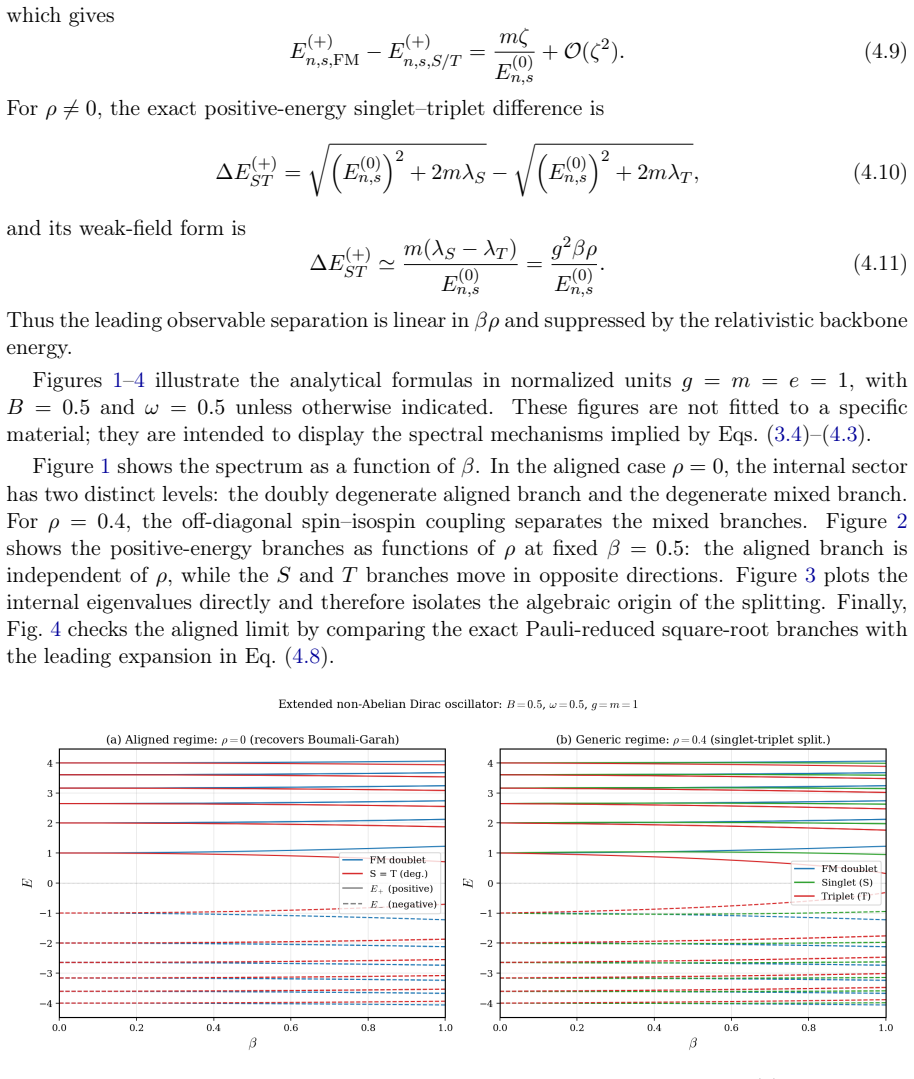
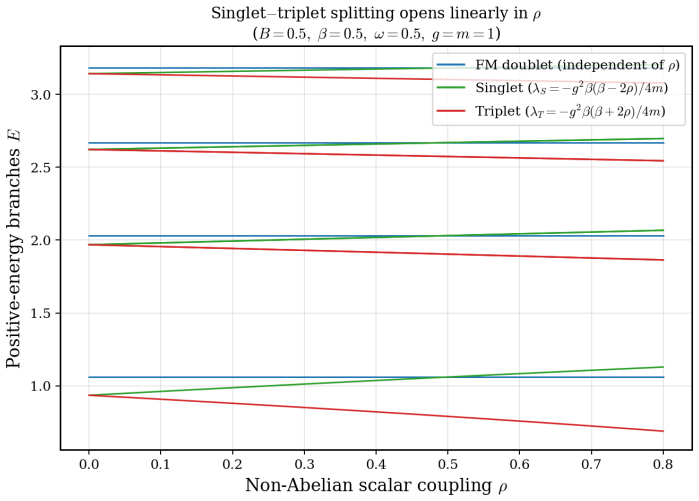
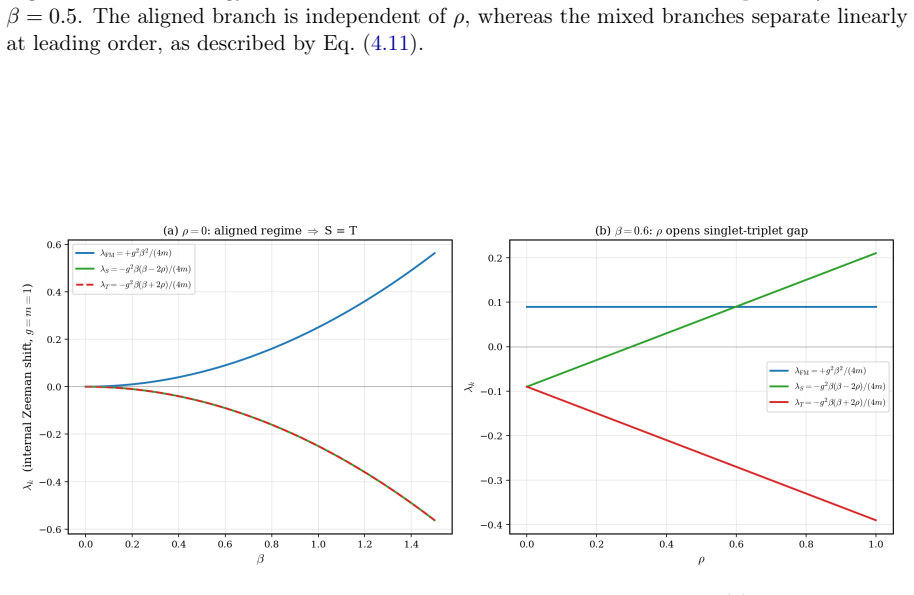
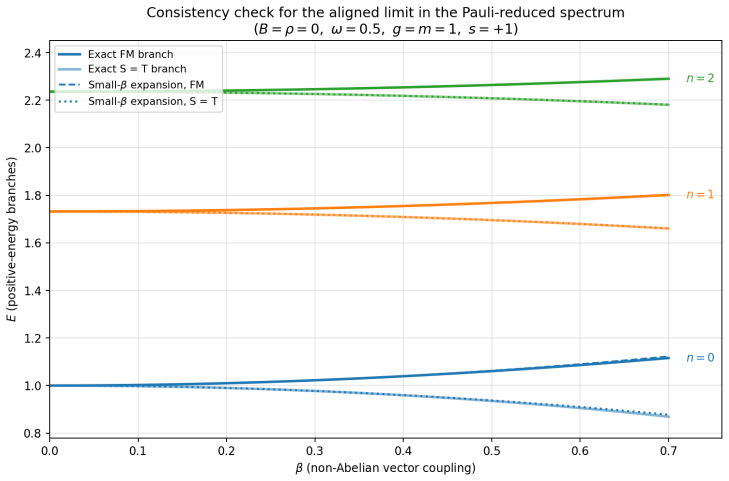
The non-Abelian field strength produces a constant operator on C²_spin ⊗ C²_iso containing a diagonal internal-Zeeman contribution proportional to σ³T³ and an off-diagonal spin-isospin term proportional to σ¹T¹ + σ²T². Its diagonalization yields a doubly degenerate aligned branch with eigenvalue λ_FM = g²β²/4m together with two mixed branches λ_S = -g²β(β-2ρ)/4m and λ_T = -g²β(β+2ρ)/4m. Consequently the aligned internal-Zeeman scale is quadratic in β while the singlet-triplet separation is linear in βρ.
What carries the argument
The constant operator on the combined spin-isospin Hilbert space generated by the non-Abelian field strength, whose diagonalization supplies the three eigenvalue branches and their distinct scaling with β and ρ.
If this is right
- The aligned branch energy shift grows quadratically with the non-Abelian spatial amplitude β.
- The singlet and triplet branches exhibit an energy separation linear in the product βρ.
- The spectrum obtained in the Pauli reduction is explicitly distinguished from what a full first-order Dirac treatment would give.
- The Abelian limit is recovered when the non-Abelian amplitudes β or ρ are set to zero.
Where Pith is reading between the lines
- The linear splitting term could dominate the quadratic term in regimes where the scalar amplitude ρ is comparable to β, suggesting a tunable crossover between mixing regimes.
- Analogous spin-isospin mixing operators might appear in condensed-matter realizations of Dirac oscillators coupled to synthetic non-Abelian gauge fields.
- Time-dependent versions of the same background would couple the linear splitting to oscillatory driving, potentially producing new resonance conditions.
Load-bearing premise
The Pauli-reduced formulation accurately captures the spectrum without needing the full first-order Dirac diagonalization.
What would settle it
A numerical diagonalization of the complete first-order Dirac Hamiltonian in the same uniform background that produces eigenvalues or β,ρ scalings different from the reported λ_FM, λ_S, and λ_T.
Figures
read the original abstract
We investigate a planar Dirac oscillator coupled to a spatially uniform \(\utwo=\uone\times\su\) Yang--Mills background. The gauge configuration, adapted from the Dossa--Avossevou construction, contains an Abelian magnetic field \(B\), a non-Abelian spatial amplitude \(\beta\), and a non-Abelian scalar amplitude \(\rho\). Within the Pauli-reduced formulation, the non-Abelian field strength produces a constant operator on \(\mathbb{C}^{2}_{\mathrm{spin}}\otimes\mathbb{C}^{2}_{\mathrm{iso}}\). This operator contains a diagonal internal-Zeeman contribution proportional to \(\sigma^{3}T^{3}\) and an off-diagonal spin--isospin term proportional to \(\sigma^{1}T^{1}+\sigma^{2}T^{2}\). Its diagonalization gives a doubly degenerate aligned branch and two mixed branches with eigenvalues \[ \lambda_{\mathrm{FM}}=\frac{g^{2}\beta^{2}}{4m},\qquad \lambda_{S}=-\frac{g^{2}\beta(\beta-2\rho)}{4m},\qquad \lambda_{T}=-\frac{g^{2}\beta(\beta+2\rho)}{4m}. \] Consequently, the aligned internal-Zeeman scale is quadratic in \(\beta\), whereas the singlet--triplet separation is linear in \(\beta\rho\). The revised formulation makes the sign conventions explicit, verifies the main limiting cases, distinguishes the Pauli-reduced spectrum from a full first-order Dirac diagonalization, and clarifies the physical meaning of the numerical illustrations.
Editorial analysis
A structured set of objections, weighed in public.
Referee Report
Summary. The manuscript investigates a planar Dirac oscillator coupled to a uniform U(2) Yang-Mills background containing an Abelian magnetic field B together with non-Abelian amplitudes β and ρ. Within the Pauli-reduced formulation the non-Abelian field strength yields a constant operator on the combined spin-isospin space that contains a diagonal internal-Zeeman term proportional to σ³T³ and an off-diagonal mixing term proportional to σ¹T¹ + σ²T². Diagonalization of this operator produces the eigenvalues λ_FM = g²β²/4m (doubly degenerate aligned branch), λ_S = -g²β(β-2ρ)/4m and λ_T = -g²β(β+2ρ)/4m, from which the authors conclude that the aligned Zeeman scale is quadratic in β while the singlet-triplet splitting is linear in the product βρ. The work explicitly distinguishes the Pauli-reduced spectrum from a full first-order Dirac treatment and verifies selected limiting cases.
Significance. If the reported eigenvalues and scaling relations survive scrutiny, the paper supplies a concrete, analytically tractable illustration of spin-isospin mixing generated by a uniform non-Abelian gauge background, together with falsifiable predictions for the relative magnitudes of quadratic versus linear corrections in the background amplitudes. Such results could serve as a benchmark for analogous calculations in non-Abelian condensed-matter or analog-gravity models.
major comments (2)
- [Abstract] Abstract: The eigenvalues λ_FM, λ_S and λ_T are stated to follow from diagonalization of the indicated operator, yet the manuscript supplies neither the explicit 4×4 matrix representation of that operator nor the algebraic steps that produce the three distinct eigenvalues. Because these expressions constitute the central quantitative claim, the absence of the derivation prevents independent verification of the quadratic-versus-linear scaling distinction.
- [Abstract] Abstract: The text distinguishes the Pauli-reduced spectrum from a full first-order Dirac diagonalization but provides no argument or explicit check demonstrating that the reduction preserves the non-commuting non-Abelian contributions of the uniform Yang-Mills background. If the unreduced Dirac operator generates additional terms that are discarded by the Pauli reduction, the reported eigenvalues and the claimed scaling behaviors would not hold; this assumption is load-bearing for every subsequent statement.
Simulated Author's Rebuttal
We thank the referee for the careful reading and for identifying points that will improve the clarity and verifiability of the central results. We address each major comment below and will revise the manuscript to incorporate the requested material.
read point-by-point responses
-
Referee: [Abstract] Abstract: The eigenvalues λ_FM, λ_S and λ_T are stated to follow from diagonalization of the indicated operator, yet the manuscript supplies neither the explicit 4×4 matrix representation of that operator nor the algebraic steps that produce the three distinct eigenvalues. Because these expressions constitute the central quantitative claim, the absence of the derivation prevents independent verification of the quadratic-versus-linear scaling distinction.
Authors: We agree that the explicit 4×4 matrix representation of the non-Abelian operator on the combined spin-isospin space and the algebraic steps leading to λ_FM, λ_S and λ_T are not shown in the current text. In the revised manuscript we will add both the matrix and the step-by-step diagonalization, thereby making the quadratic scaling of the aligned branch and the linear βρ dependence of the singlet-triplet splitting directly verifiable. revision: yes
-
Referee: [Abstract] Abstract: The text distinguishes the Pauli-reduced spectrum from a full first-order Dirac diagonalization but provides no argument or explicit check demonstrating that the reduction preserves the non-commuting non-Abelian contributions of the uniform Yang-Mills background. If the unreduced Dirac operator generates additional terms that are discarded by the Pauli reduction, the reported eigenvalues and the claimed scaling behaviors would not hold; this assumption is load-bearing for every subsequent statement.
Authors: The manuscript already states the distinction between the Pauli-reduced and full Dirac treatments. To address the concern that an explicit justification is missing, the revision will include a dedicated paragraph (or short appendix) that compares the relevant non-commuting terms in both formulations and verifies that the Pauli reduction retains the essential non-Abelian contributions, with checks in the Abelian and vanishing-background limits. revision: yes
Circularity Check
No circularity; eigenvalues obtained by explicit diagonalization of constant operator
full rationale
The reported eigenvalues follow directly from diagonalizing the constant operator (diagonal σ³T³ plus off-diagonal σ¹T¹+σ²T²) constructed from the uniform Yang-Mills background amplitudes β and ρ inside the Pauli-reduced formulation. This is a standard linear-algebra step with no fitted parameters renamed as predictions, no self-definitional loops, and no load-bearing self-citations. The paper explicitly distinguishes the Pauli-reduced spectrum from a full Dirac treatment but performs no reduction that equates the output to the input by construction. The derivation is therefore self-contained.
Axiom & Free-Parameter Ledger
free parameters (4)
- β
- ρ
- g
- m
axioms (2)
- domain assumption The gauge configuration is taken from the Dossa-Avossevou construction
- domain assumption The Pauli-reduced formulation is sufficient and equivalent for the spectrum analysis
Reference graph
Works this paper leans on
-
[1]
M. Moshinsky and A. Szczepaniak, “The Dirac oscillator,”Journal of Physics A: Mathe- matical and General22, L817–L819 (1989), doi:10.1088/0305-4470/22/17/002
-
[2]
Solution and hidden supersymmetry of a Dirac oscillator,
J. Benítez, R. P. Martínez-y-Romero, H. N. Núñez-Yépez, and A. L. Salas-Brito, “Solution and hidden supersymmetry of a Dirac oscillator,”Physical Review Letters64, 1643–1645 (1990), doi:10.1103/PhysRevLett.64.1643
-
[3]
A two-component Dirac oscillator with anomalous magnetic interaction,
R. Jagannathan, “A two-component Dirac oscillator with anomalous magnetic interaction,” Physical Review A42, 6674–6676 (1990), doi:10.1103/PhysRevA.42.6674
-
[4]
Exact solution of the (2+1)-dimensional Dirac oscillator,
A. Bermúdez, M. A. Martín-Delgado, and A. Luis, “Exact solution of the (2+1)-dimensional Dirac oscillator,”Physical Review A77, 063815 (2008), doi:10.1103/PhysRevA.77.063815
-
[5]
Quantum simulation of the Dirac equation,
R. Gerritsma, G. Kirchmair, F. Zähringer, E. Solano, R. Blatt, and C. F. Roos, “Quantum simulation of the Dirac equation,”Nature463, 68–71 (2010), doi:10.1038/nature08688
-
[6]
First experimental realization of the Dirac oscillator,
J. A. Franco-Villafañe, E. Sadurní, S. Barkhofen, U. Kuhl, F. Mortessagne, and T. H. Seligman, “First experimental realization of the Dirac oscillator,”Physical Review Letters 111, 170405 (2013), doi:10.1103/PhysRevLett.111.170405
-
[7]
The relativistic Dirac oscillator in a magnetic field,
A. Boumali, “The relativistic Dirac oscillator in a magnetic field,”Physica Scripta90, 045702 (2015), doi:10.1088/0031-8949/90/4/045702. 8
-
[8]
Gate-tunable graphene quantum dot and Dirac oscillator,
A. Belouad, A. Jellal, and Y. Zahidi, “Gate-tunable graphene quantum dot and Dirac oscillator,”Physics Letters A380, 773–778 (2016), doi:10.1016/j.physleta.2015.11.025
-
[9]
Non-Abelian extensions of the Dirac oscillator: A theoretical approach,
A. Boumali and S. Garah, “Non-Abelian extensions of the Dirac oscillator: A theoretical approach,”Modern Physics Letters A(2026); arXiv:2504.08978
Pith/arXiv arXiv 2026
-
[10]
F. A. Dossa and G. Y. H. Avossevou, “Relativistic dynamics for a particle carrying a non- Abelian charge in a non-Abelian background electromagnetic field,”Journal of Mathemat- ical Physics61, 022302 (2020), doi:10.1063/1.5123595
-
[11]
Conservation of isotopic spin and isotopic gauge invariance,
C. N. Yang and R. L. Mills, “Conservation of isotopic spin and isotopic gauge invariance,” Physical Review96, 191–195 (1954), doi:10.1103/PhysRev.96.191
-
[12]
Field and particle equations for the classical Yang-Mills field and particles with isotopic spin,
S. K. Wong, “Field and particle equations for the classical Yang-Mills field and particles with isotopic spin,”Il Nuovo Cimento A65, 689–694 (1970), doi:10.1007/BF02892134
-
[13]
L. H. Ryder,Quantum Field Theory, 2nd ed. (Cambridge University Press, Cambridge, 1996)
1996
-
[14]
Gauge invariance and current algebra in non- relativistic many-body theory,
J. Fröhlich and U. M. Studer, “Gauge invariance and current algebra in non- relativistic many-body theory,”Reviews of Modern Physics65, 733–802 (1993), doi:10.1103/RevModPhys.65.733
-
[15]
The electronic properties of graphene,
A. H. Castro Neto, F. Guinea, N. M. R. Peres, K. S. Novoselov, and A. K. Geim, “The electronic properties of graphene,”Reviews of Modern Physics81, 109–162 (2009), doi:10.1103/RevModPhys.81.109
-
[16]
M. A. H. Vozmediano, M. I. Katsnelson, and F. Guinea, “Gauge fields in graphene,”Physics Reports496, 109–148 (2010), doi:10.1016/j.physrep.2010.07.003
-
[17]
Non-Abelian gauge potentials in graphene bilay- ers,
P. San-Jose, J. González, and F. Guinea, “Non-Abelian gauge potentials in graphene bilay- ers,”Physical Review Letters108, 216802 (2012), doi:10.1103/PhysRevLett.108.216802
-
[18]
Electrically tunable gauge fields in tiny- angle twisted bilayer graphene,
A. Ramires and J. L. Lado, “Electrically tunable gauge fields in tiny- angle twisted bilayer graphene,”Physical Review Letters121, 146801 (2018), doi:10.1103/PhysRevLett.121.146801
-
[19]
Colloquium: Artificial gauge potentials for neutral atoms,
J. Dalibard, F. Gerbier, G. Juzeli¯ unas, and P. Öhberg, “Colloquium: Artificial gauge potentials for neutral atoms,”Reviews of Modern Physics83, 1523–1543 (2011), doi:10.1103/RevModPhys.83.1523
-
[20]
Light-induced gauge fields for ultracold atoms,
N. Goldman, G. Juzeli¯ unas, P. Öhberg, and I. B. Spielman, “Light-induced gauge fields for ultracold atoms,”Reports on Progress in Physics77, 126401 (2014), doi:10.1088/0034- 4885/77/12/126401. 9
discussion (0)
Sign in with ORCID, Apple, or X to comment. Anyone can read and Pith papers without signing in.