Toward Practical Two-Way Covert Communication
Pith reviewed 2026-06-29 07:10 UTC · model grok-4.3
The pith
A narrowband laser source and correlator receiver make two-way covert optical communication practical against quantum adversaries.
A machine-rendered reading of the paper's core claim, the machinery that carries it, and where it could break.
Core claim
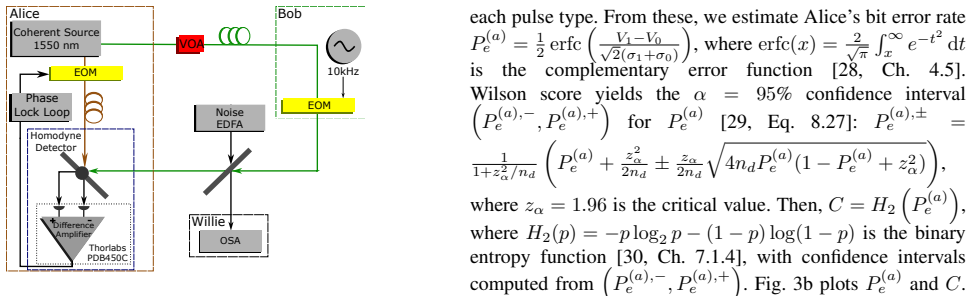
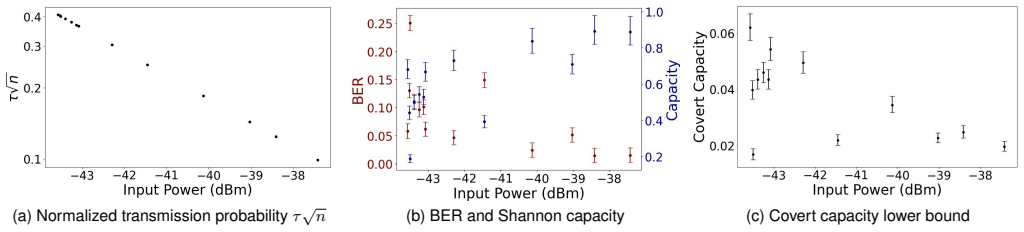
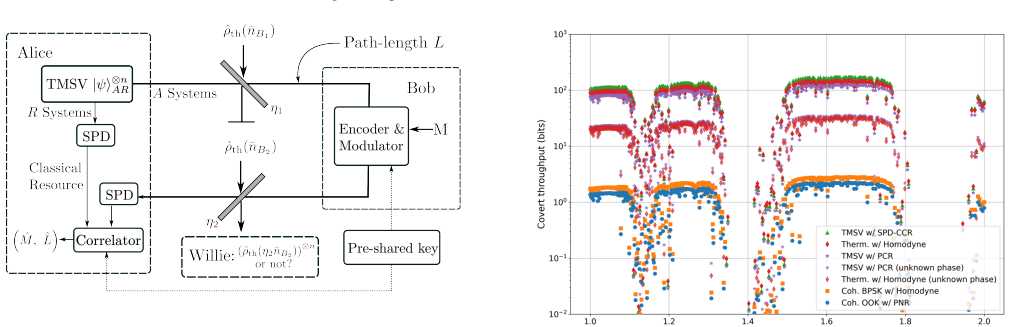
We employ a narrowband laser source to experimentally demonstrate a proof-of-concept two-way covert communication system, where the adversary is assumed to be quantum-capable. Furthermore, we propose a correlator-based receiver that attains the broadband gain offered by a quantum light source without the need for precise mode matching.
What carries the argument
The correlator-based receiver, which extracts information from the reflected modulated signal to capture broadband performance advantages without mode matching.
If this is right
- Two-way covert links become realizable with ordinary narrowband lasers in optical channels.
- Mode-matching and phase-synchronization hardware can be omitted while retaining quantum-light performance.
- Covert communication remains viable even when the eavesdropper has quantum detection capabilities.
- Experimental validation on real optical hardware confirms the scheme works at proof-of-concept level.
Where Pith is reading between the lines
- The same receiver architecture might simplify other covert or low-probability-of-intercept optical protocols.
- Deployment in fiber networks could reduce alignment overhead compared with broadband quantum sources.
- Further tests under varying loss and noise would clarify the practical throughput limits.
Load-bearing premise
A correlator-based receiver can deliver the broadband performance gain of a quantum light source without precise mode matching, an assumption stated without derivation or supporting measurements.
What would settle it
A side-by-side measurement of covert rate or detection probability using the proposed correlator receiver versus a standard receiver on the same narrowband source, checking whether the claimed gain appears without mode matching.
Figures

read the original abstract
We study two-way covert communication schemes, where information is transmitted by passively modulating a reflected signal back to the source. We consider optical systems, described by quantum bosonic channels. While broadband classical and quantum light sources offer high covert throughput in theory, the associated mode-matching and phase-synchronization requirements make them impractical. Therefore, we employ a narrowband laser source to experimentally demonstrate a proof-of-concept two-way covert communication system, where the adversary is assumed to be quantum-capable. Furthermore, we propose a correlator-based receiver that attains the broadband gain offered by a quantum light source without the need for precise mode matching.
Editorial analysis
A structured set of objections, weighed in public.
Referee Report
Summary. The paper studies two-way covert communication over quantum bosonic channels via passive modulation of reflected signals. It reports an experimental proof-of-concept demonstration using a narrowband laser source against a quantum-capable adversary and proposes a correlator-based receiver intended to deliver the broadband gain of a quantum light source without requiring precise mode matching.
Significance. A validated correlator-based receiver that achieves broadband covert rates without mode-matching overhead would address a central engineering barrier to practical covert optical links, potentially enabling higher-throughput secure communication in adversarial settings. The experimental component, if substantiated, would provide initial evidence of feasibility under quantum-adversary assumptions.
major comments (2)
- [Abstract, §4] Abstract and §4 (proposal of correlator receiver): the central claim that the correlator-based receiver attains the broadband gain of a quantum light source without precise mode matching is stated without any derivation, performance analysis, comparison to quantum-source baselines, simulation, or experimental data. This equivalence is load-bearing for the practicality argument but remains unsupported.
- [Abstract, experimental section] Abstract and experimental section: the proof-of-concept demonstration with a narrowband laser is asserted, yet no methods, raw data, error bars, covert-rate measurements, or adversary-channel characterization are provided, preventing evaluation of whether the results support the two-way covert claims.
minor comments (2)
- Notation for bosonic channels and covert capacity expressions should be defined explicitly on first use rather than assumed from prior literature.
- Figure captions for any experimental setups or rate plots should include all relevant parameters (e.g., power levels, integration times) to allow reproducibility.
Simulated Author's Rebuttal
We thank the referee for the detailed review and constructive criticism. We agree that the current manuscript requires substantial additions to substantiate the central claims regarding the correlator receiver and the experimental demonstration. We will revise the paper to include the requested derivations, analyses, data, and characterizations.
read point-by-point responses
-
Referee: [Abstract, §4] Abstract and §4 (proposal of correlator receiver): the central claim that the correlator-based receiver attains the broadband gain of a quantum light source without precise mode matching is stated without any derivation, performance analysis, comparison to quantum-source baselines, simulation, or experimental data. This equivalence is load-bearing for the practicality argument but remains unsupported.
Authors: We acknowledge that the proposal for the correlator-based receiver is presented without supporting derivation or quantitative analysis in the current version. In the revised manuscript, we will add a detailed derivation of the receiver's performance, comparisons against quantum-source baselines, simulations of the broadband gain, and analysis showing the absence of mode-matching requirements. This will directly address the load-bearing claim for practicality. revision: yes
-
Referee: [Abstract, experimental section] Abstract and experimental section: the proof-of-concept demonstration with a narrowband laser is asserted, yet no methods, raw data, error bars, covert-rate measurements, or adversary-channel characterization are provided, preventing evaluation of whether the results support the two-way covert claims.
Authors: The experimental section currently provides only a high-level description of the proof-of-concept. We will expand it in the revision to include full methods, raw data, error bars, measured covert rates, and characterization of the adversary channel under quantum-capable assumptions, enabling proper evaluation of the two-way covert communication results. revision: yes
Circularity Check
No circularity: paper contains no equations, derivations, or self-referential reductions
full rationale
The provided abstract and description contain no equations, no claimed derivations, and no mathematical steps that could reduce to inputs by construction. The central claims are an experimental demonstration using a narrowband laser and a proposal for a correlator-based receiver; neither is supported by any derivation chain in the visible text. No self-citations, fitted parameters presented as predictions, or ansatzes are present. This is the expected honest non-finding when a paper offers no formal derivation to inspect.
Axiom & Free-Parameter Ledger
Reference graph
Works this paper leans on
-
[1]
Square root law for communication with low probability of detection on AWGN channels,
B. A. Bash, D. Goeckel, and D. Towsley, “Square root law for communication with low probability of detection on AWGN channels,” inProc. IEEE Int. Symp. Inform. Theory (ISIT), Cambridge, MA, Jul. 2012
2012
-
[2]
Limits of reliable communication with low probability of detection on AWGN channels,
——, “Limits of reliable communication with low probability of detection on AWGN channels,”IEEE J. Select. Areas Commun., vol. 31, no. 9, pp. 1921–1930, 2013
1921
-
[3]
Covert communication over noisy channels: A resolvabil- ity perspective,
M. R. Bloch, “Covert communication over noisy channels: A resolvabil- ity perspective,”IEEE Trans. Inf. Theory, vol. 62, no. 5, pp. 2334–2354, May 2016
2016
-
[4]
Fundamental limits of communication with low probability of detection,
L. Wang, G. W. Wornell, and L. Zheng, “Fundamental limits of communication with low probability of detection,”IEEE Trans. Inf. Theory, vol. 62, no. 6, pp. 3493–3503, Jun. 2016
2016
-
[5]
Hiding information in noise: Fundamental limits of covert wireless communication,
B. A. Bash, D. Goeckel, S. Guha, and D. Towsley, “Hiding information in noise: Fundamental limits of covert wireless communication,”IEEE Commun. Mag., vol. 53, no. 12, 2015
2015
-
[6]
Covert communications: A comprehensive survey,
X. Chen, J. An, Z. Xiong, C. Xing, N. Zhao, F. R. Yu, and A. Nal- lanathan, “Covert communications: A comprehensive survey,”IEEE Commun. Surv. Tutor., vol. 25, no. 2, pp. 1173–1198, 2023
2023
-
[7]
A. J. Menezes, S. A. Vanstone, and P. C. V . Oorschot,Handbook of Applied Cryptography. Boca Raton, FL, USA: CRC Press, Inc., 1996
1996
-
[8]
Wilde,Quantum Information Theory, 2nd ed
M. Wilde,Quantum Information Theory, 2nd ed. Cambridge Univer- sity Press, 2016
2016
-
[9]
Quantum-secure covert communication on bosonic channels,
B. A. Bash, A. H. Gheorghe, M. Patel, J. L. Habif, D. Goeckel, D. Towsley, and S. Guha, “Quantum-secure covert communication on bosonic channels,”Nat. Commun., vol. 6, Oct. 2015
2015
-
[10]
Fundamental limits of quantum-secure covert communication over bosonic channels,
M. S. Bullock, C. N. Gagatsos, S. Guha, and B. A. Bash, “Fundamental limits of quantum-secure covert communication over bosonic channels,” IEEE J. Sel. Areas Commun., vol. 38, no. 3, pp. 471–482, Mar. 2020
2020
-
[11]
Covert capacity of bosonic channels,
C. N. Gagatsos, M. S. Bullock, and B. A. Bash, “Covert capacity of bosonic channels,”IEEE J. Sel. Areas Inf. Theory, vol. 1, pp. 555–567, 2020
2020
-
[12]
Experimental covert communication over metropolitan fibre optical links,
Y . Liu, J. M. Arrazola, W.-Z. Liu, W. Zhang, I. W. Primaatmaja, H. Li, L. You, Z. Wang, Q. Zhang, and J.-W. Pan, “Experimental covert communication over metropolitan fibre optical links,”IEEE Wireless Commun., vol. 31, no. 4, pp. 76–80, 2024
2024
-
[13]
Entanglement assisted LPI and covert communications with SLM-based beam steering over turbulent optical channels,
I. B. Djordjevic and I. A. Rojas, “Entanglement assisted LPI and covert communications with SLM-based beam steering over turbulent optical channels,”IEEE Access, vol. 13, pp. 174 658–174 663, 2025
2025
-
[14]
SLM steering-based covert communication over strong atmo- spheric turbulence channels,
——, “SLM steering-based covert communication over strong atmo- spheric turbulence channels,”Opt. Express, vol. 33, no. 21, pp. 44 622– 44 630, Oct. 2025
2025
-
[15]
Experimental covert communication using software-defined radio,
R. Bali, T. Bailey, M. S. Bullock, and B. A. Bash, “Experimental covert communication using software-defined radio,” inProc. IEEE Mil. Commun. Conf. (MILCOM), 2025, pp. 935–941
2025
-
[16]
Experimental validation of provably covert communication using software-defined radio,
R. Bali, T. E. Bailey, M. S. Bullock, and B. A. Bash, “Experimental validation of provably covert communication using software-defined radio,”IEEE J. Sel. Areas Commun. (JSAC), vol. 44, pp. 4382–4396, 2026
2026
-
[17]
Covert sensor,
B. A. Bash and S. Guha, “Covert sensor,” U.S. App. 10/274,587, Apr. 30, 2019
2019
-
[18]
Covert sensing using floodlight illumination,
C. N. Gagatsos, B. A. Bash, A. Datta, Z. Zhang, and S. Guha, “Covert sensing using floodlight illumination,” inProc. Conf. Lasers Electro- Opt. (CLEO). Opt. Soc. Amer., May 2019, p. FF1F.7
2019
-
[19]
Covert sensing using floodlight illumination,
——, “Covert sensing using floodlight illumination,”Phys. Rev. A, vol. 99, p. 062321, Jun. 2019
2019
-
[20]
Demonstration of entanglement- enhanced covert sensing,
S. Hao, H. Shi, C. N. Gagatsos, M. Mishra, B. Bash, I. Djordjevic, S. Guha, Q. Zhuang, and Z. Zhang, “Demonstration of entanglement- enhanced covert sensing,”Phys. Rev. Lett., vol. 129, no. 1, Jun. 2022
2022
-
[21]
Fundamental limits of quantum-secure covert optical sensing,
B. A. Bash, C. N. Gagatsos, A. Datta, and S. Guha, “Fundamental limits of quantum-secure covert optical sensing,” inProc. IEEE Int. Symp. In- form. Theory (ISIT), Aachen, Germany, Jun. 2017
2017
-
[22]
Absolute clock synchronization with a single time-correlated photon pair source over a 10 km optical fibre,
J. Lee, L. Shen, A. N. Utama, and C. Kurtsiefer, “Absolute clock synchronization with a single time-correlated photon pair source over a 10 km optical fibre,”Opt. Express, vol. 30, no. 11, p. 18530, May
-
[23]
Available: http://dx.doi.org/10.1364/OE.455542
[Online]. Available: http://dx.doi.org/10.1364/OE.455542
-
[24]
Signaling for covert quantum sensing,
M. Tahmasbi, B. A. Bash, S. Guha, and M. Bloch, “Signaling for covert quantum sensing,” inProc. IEEE Int. Symp. Inform. Theory (ISIT), 2021, pp. 1041–1045
2021
-
[25]
Covert Signaling for Communication and Sensing over the Bosonic Channels
T. Tan, E. J. Anderson, M. S. Bullock, and B. A. Bash, “Covert signaling for communication and sensing over the bosonic channels,” arXiv:2605.08066 [quant-ph], May 2026
work page internal anchor Pith review Pith/arXiv arXiv 2026
-
[26]
Gaussian-state quantum-illumination re- ceivers for target detection,
S. Guha and B. I. Erkmen, “Gaussian-state quantum-illumination re- ceivers for target detection,”Phys. Rev. A, vol. 80, p. 052310, Nov. 2009
2009
-
[27]
Optimum mixed-state discrimination for noisy entanglement-enhanced sensing,
Q. Zhuang, Z. Zhang, and J. H. Shapiro, “Optimum mixed-state discrimination for noisy entanglement-enhanced sensing,”Phys. Rev. Lett., vol. 118, p. 040801, Jan. 2017
2017
-
[28]
Covert entanglement gen- eration over bosonic channels,
E. J. D. Anderson, M. S. Bullock, O. Kimelfeld, C. K. Eyre, F. Rozp˛ edek, U. Pereg, and B. A. Bash, “Covert entanglement gen- eration over bosonic channels,”IEEE J. Sel. Areas Commun., 2025
2025
-
[29]
Agarwal,Fiber-Optic Communication Systems, 3rd ed.Wiley, 2010
2010
-
[30]
Douglas and G
M. Douglas and G. Runger,Applied Statistics and Probabilities for Engineers, 7th Edition. Wiley, 2018
2018
-
[31]
T. M. Cover and J. A. Thomas,Elements of Information Theory, 2nd ed. John Wiley & Sons, Hoboken, NJ, 2002
2002
-
[32]
MODTRAN5: 2006 update,
A. Berk, G. P. Anderson, P. K. Acharya, L. S. Bernstein, L. Muratov, J. Lee, M. Fox, S. M. Adler-Golden, J. H. Chetwynd, Jr., M. L. Hoke, R. B. Lockwood, J. A. Gardner, T. W. Cooley, C. C. Borel, P. E. Lewis, and E. P. Shettle, “MODTRAN5: 2006 update,” vol. 6233, 2006, pp. 62 331F–62 331F–8
2006
-
[33]
Fundamental limits of covert communication and entanglement generation over quantum channels,
M. S. Bullock, “Fundamental limits of covert communication and entanglement generation over quantum channels,” Ph.D. dissertation, University of Arizona, Tucson, AZ, USA, Nov. 2025
2025
-
[34]
Notes on the matrix exponential and logarithm,
H. E. Haber, “Notes on the matrix exponential and logarithm,” http: //scipp.ucsc.edu/~haber/webpage/MatrixExpLog.pdf, accessed Dec. 14, 2019, May 2019. APPENDIXA PROOF OFTHEOREM1 Here, we derive the bound given in Theorem 1. To use Pinsker’s inequality as discussed in Section II-C, we must evaluate the QRE between theM-length block mixed state received by...
2019
-
[35]
(27) Therefore, the trace of the first term of (25) is2M τ¯n −1 0 c1x
Thus, the trace ofˆρ ⊗M ¯n0 R 1 0 ds ˆσ−1 0 ˆam ˆρ⊗M ¯n0 ˆa† m ˆσ−1 0 is equal to ∞X k1,...,kM=0 ¯n0 ¯n0 + 1 MY i=1 tki(km + 1) = ∞X km=0 ¯n0 ¯n0 + 1tkm(km + 1) = ¯n0. (27) Therefore, the trace of the first term of (25) is2M τ¯n −1 0 c1x. For the second term of (25), the integral oversevaluates to identity such that the trace over the second term is simpl...
discussion (0)
Sign in with ORCID, Apple, or X to comment. Anyone can read and Pith papers without signing in.