Observing Cosmic Reheating with the expanded Simons Observatory
Pith reviewed 2026-06-27 08:30 UTC · model grok-4.3
The pith
If primordial gravitational waves are detected, the expanded Simons Observatory could measure the reheating temperature and inflaton coupling to a few percent in QCD-driven warm inflation.
A machine-rendered reading of the paper's core claim, the machinery that carries it, and where it could break.
Core claim
A detection of primordial gravitational waves at benchmark tensor-to-scalar ratios with the expanded Simons Observatory would fix the scale of inflation and thereby enable determination of the reheating temperature and inflaton coupling strength. In QCD-driven warm inflation, optimistic assumptions allow these quantities to be measured at a few percent precision, which in turn supplies clear targets for complementary inflaton searches in axion experiments.
What carries the argument
The mapping from an observed tensor-to-scalar ratio to the post-inflationary reheating temperature and inflaton-gluon coupling in QCD-driven warm inflation models.
If this is right
- In plateau models of inflation an observed tensor-to-scalar ratio would fix the order of magnitude of the reheating temperature and the inflaton interaction strength.
- In QCD-driven warm inflation the reheating temperature and inflaton-gluon coupling could both be determined to a few percent.
- The resulting values would generate specific predictions for inflaton searches in axion experiments.
- Successful measurements would link cosmic microwave background data directly to laboratory probes of the mechanism that sets the initial conditions of the hot Big Bang.
Where Pith is reading between the lines
- The same data combination could be applied to other variants of warm inflation to test whether the few-percent precision remains achievable.
- A confirmed measurement would narrow the viable parameter space for axion-like particles that could serve as the inflaton.
- Complementary constraints from direct axion searches could be combined with the cosmological data to over-constrain the model and test its consistency.
Load-bearing premise
Primordial gravitational waves will be discovered at the benchmark tensor-to-scalar ratios of 0.0036 or 0.01, the QCD-driven warm inflation model correctly describes the post-inflationary dynamics, and the optimistic experimental assumptions hold.
What would settle it
A non-detection of primordial gravitational waves at tensor-to-scalar ratios around 0.0036 or 0.01, or a measured reheating temperature and coupling that fall outside the few-percent precision window predicted by the QCD-driven warm inflation model.
Figures






read the original abstract
The Simons Observatory will be extended by three Small Aperture Telescopes by 2027, increasing the total number of these instruments to six. We study the prospects for probing the reheating temperature and the inflaton coupling with this configuration, assuming a discovery of primordial gravitational waves in benchmark scenarios with a tensor-to-scalar ratio r=0.0036 or r=0.01. In popular plateau models of inflation, such an observation would fix the scale of inflation and enable determination of the order of magnitude of the reheating temperature and the inflaton interactions. For QCD-driven Warm Inflation the reheating temperature and inflaton coupling to gluons could, under optimistic assumptions, be measured with a precision of a few percent. Such a measurement would imply a clear prediction for complementary inflaton searches in axion experiments, paving the way toward probing the mechanism responsible for the initial conditions of the hot Big Bang in the laboratory.
Editorial analysis
A structured set of objections, weighed in public.
Referee Report
Summary. The manuscript investigates the prospects for constraining the reheating temperature and the inflaton-gluon coupling in QCD-driven warm inflation using the expanded Simons Observatory (six Small Aperture Telescopes). It assumes a future detection of primordial gravitational waves at benchmark tensor-to-scalar ratios r=0.0036 or r=0.01, which would fix the inflationary scale, and claims that under optimistic assumptions the reheating parameters could be measured to a few percent precision, yielding testable predictions for axion experiments.
Significance. If the stated assumptions on experimental performance and model validity hold, the work would provide a concrete pathway to link CMB tensor measurements to post-inflationary dynamics and laboratory searches, strengthening the connection between early-universe cosmology and particle physics.
major comments (2)
- [Abstract] Abstract: the headline claim of few-percent precision on reheating temperature and inflaton coupling is explicitly conditional on (i) a tensor detection at the quoted benchmark r values, (ii) the QCD warm-inflation dynamics correctly governing post-inflationary evolution, and (iii) unspecified 'optimistic assumptions' on noise and foreground performance; the manuscript does not appear to quantify how the constraints degrade when any of these fail.
- [Abstract] Abstract: no robustness test against variations in warm-inflation parameters or against non-detection of tensors is indicated, which is load-bearing because the quoted precisions are presented as achievable only under the benchmark assumptions.
minor comments (1)
- [Abstract] The abstract should briefly state the key optimistic assumptions (e.g., achieved noise levels or foreground residuals) so that the precision claims can be evaluated without the full text.
Simulated Author's Rebuttal
We thank the referee for the constructive comments on our manuscript. The two major comments both concern the abstract and correctly note that our headline claims are conditional on specific assumptions. We will revise the abstract to make these conditions more explicit and to clarify the scope of the quoted precisions.
read point-by-point responses
-
Referee: [Abstract] Abstract: the headline claim of few-percent precision on reheating temperature and inflaton coupling is explicitly conditional on (i) a tensor detection at the quoted benchmark r values, (ii) the QCD warm-inflation dynamics correctly governing post-inflationary evolution, and (iii) unspecified 'optimistic assumptions' on noise and foreground performance; the manuscript does not appear to quantify how the constraints degrade when any of these fail.
Authors: We agree that the abstract does not quantify degradation under relaxed assumptions. In the revised version we will update the abstract to list the three conditions explicitly and to state that the few-percent precision applies only under the optimistic assumptions, with the expectation that constraints would weaken otherwise. A full quantitative degradation study lies outside the scope of the present work. revision: yes
-
Referee: [Abstract] Abstract: no robustness test against variations in warm-inflation parameters or against non-detection of tensors is indicated, which is load-bearing because the quoted precisions are presented as achievable only under the benchmark assumptions.
Authors: The manuscript is scoped to the case of a future tensor detection at the stated benchmark r values within QCD-driven warm inflation. We do not claim or perform robustness tests for non-detection or for wide variations away from the benchmarks. We will revise the abstract to reinforce that the reported precisions are specific to these benchmark scenarios, thereby addressing the load-bearing conditional presentation. revision: yes
Circularity Check
No significant circularity; forecasts are model-based projections conditional on external assumptions
full rationale
The paper presents forecasting calculations for reheating parameters under the assumption of a primordial GW detection at fixed benchmark r values (0.0036 or 0.01) together with the QCD warm inflation model and optimistic experimental performance. These are standard parameter-estimation projections that map input assumptions (inflation scale fixed by r, model dynamics, noise levels) through explicit transfer functions and likelihoods to output precisions; the outputs are not equivalent to the inputs by definition, nor are any fitted parameters renamed as predictions. No load-bearing step reduces to a self-citation chain, ansatz smuggling, or uniqueness theorem imported from the authors' prior work. The derivation chain remains self-contained against external benchmarks once the stated assumptions are granted.
Axiom & Free-Parameter Ledger
axioms (2)
- domain assumption Plateau models of inflation and QCD-driven warm inflation correctly describe the dynamics from inflation through reheating.
- domain assumption A detection of primordial gravitational waves at r=0.0036 or r=0.01 will occur.
Reference graph
Works this paper leans on
-
[1]
has been halted, the two most sensitive experiments that can achieve this goal are the Japanese LiteBIRD satellite [34] and the Simons Observatory (SO) [35]. The Chinese AliCPT array [36, 37] will provide data comple- mentary to the SO due to its geographic location in the Northern Hemisphere. We have previously assessed the sensitivity of LiteBIRD [38, 3...
Pith/arXiv arXiv 2026
-
[2]
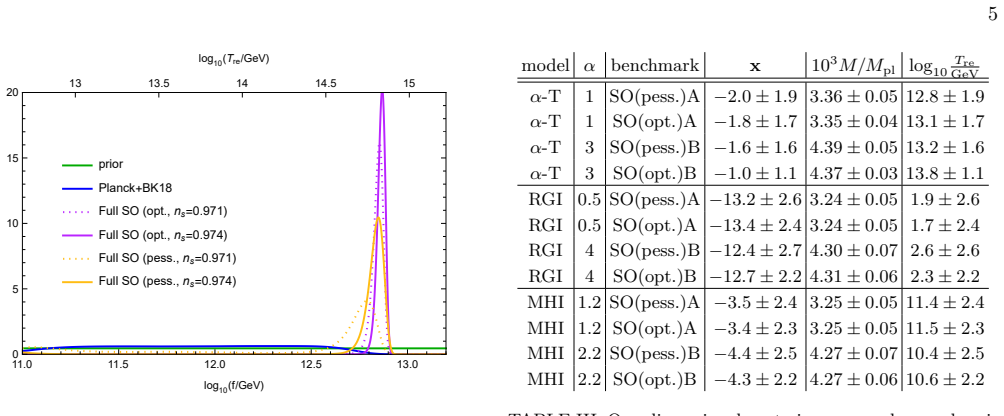
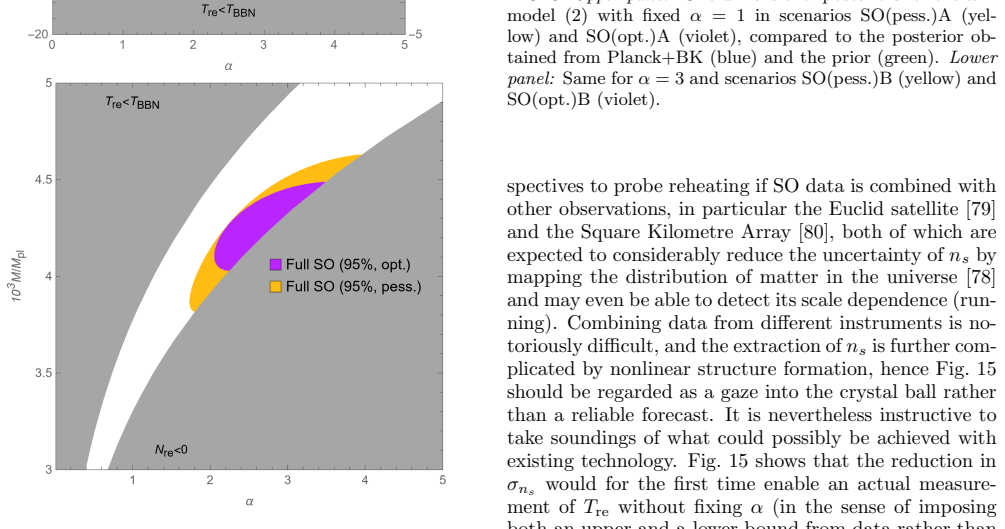
this directly translates a given value ofxinto a reheating temperatureT re. The results show that SO Planck+BK18(68%) Planck+BK18(95%) Full SO(95%, opt.) Full SO(95%, pess.) 0.955 0.960 0.965 0.970 0.975 0.980 0.00 0.01 0.02 0.03 0.04 0.05 ns r α=0.5 in RGI model Nre<0 Nk =50 Tre<10MeV Nk =60 Planck+BK18(68%) Planck+BK18(95%) Full SO(95%, opt.) Full SO(95...
-
[3]
Friedman, On the Curvature of space, Z
A. Friedman, On the Curvature of space, Z. Phys.10, 377 (1922)
1922
-
[4]
Lemaitre, A Homogeneous Universe of Constant Mass and Growing Radius Accounting for the Radial Velocity of Extragalactic Nebulae, Annales Soc
G. Lemaitre, A Homogeneous Universe of Constant Mass and Growing Radius Accounting for the Radial Velocity of Extragalactic Nebulae, Annales Soc. Sci. Bruxelles A 47, 49 (1927)
1927
-
[5]
R. A. Alpher, H. Bethe, and G. Gamow, The origin of chemical elements, Phys. Rev.73, 803 (1948)
1948
-
[6]
M. Cortˆ es, O. Lahav, and A. R. Liddle, The Cosmolog- ical Parameters (2025) (2026), arXiv:2602.13523 [astro- ph.CO]
arXiv 2025
-
[7]
See [89] for an overview of hints for deviations from the ΛCDM model
-
[8]
Navaset al.(Particle Data Group), Review of particle physics, Phys
S. Navaset al.(Particle Data Group), Review of particle physics, Phys. Rev. D110, 030001 (2024)
2024
-
[9]
Established observational facts that cannot be described in this framework include the microphysical composition of the Dark Matter [90] and the origin of the matter- antimatter asymmetry of the Universe [91]; it is not clear whether the explanations for other tensions or anomalies [89, 92] require the existence of New Physics
-
[10]
A. A. Starobinsky, A New Type of Isotropic Cosmological Models Without Singularity, Phys. Lett. B91, 99 (1980)
1980
-
[11]
A. H. Guth, The Inflationary Universe: A Possible Solu- tion to the Horizon and Flatness Problems, Phys. Rev. D23, 347 (1981)
1981
-
[12]
A. D. Linde, A New Inflationary Universe Scenario: A Possible Solution of the Horizon, Flatness, Homogeneity, Isotropy and Primordial Monopole Problems, Phys. Lett. B108, 389 (1982)
1982
- [13]
- [14]
-
[15]
Albrecht, P
A. Albrecht, P. J. Steinhardt, M. S. Turner, and F. Wilczek, Reheating an Inflationary Universe, Phys. Rev. Lett.48, 1437 (1982)
1982
-
[16]
A. D. Dolgov and D. P. Kirilova, ON PARTICLE CRE- ATION BY A TIME DEPENDENT SCALAR FIELD, Sov. J. Nucl. Phys.51, 172 (1990)
1990
-
[17]
J. H. Traschen and R. H. Brandenberger, Particle Pro- duction During Out-of-equilibrium Phase Transitions, Phys. Rev. D42, 2491 (1990)
1990
-
[18]
Y. Shtanov, J. H. Traschen, and R. H. Brandenberger, Universe reheating after inflation, Phys. Rev. D51, 5438 (1995), arXiv:hep-ph/9407247
Pith/arXiv arXiv 1995
-
[19]
L. Kofman, A. D. Linde, and A. A. Starobinsky, Re- heating after inflation, Phys. Rev. Lett.73, 3195 (1994), arXiv:hep-th/9405187
Pith/arXiv arXiv 1994
-
[20]
D. Boyanovsky, H. J. de Vega, R. Holman, and J. F. J. Salgado, Analytic and numerical study of preheating dynamics, Phys. Rev. D54, 7570 (1996), arXiv:hep- ph/9608205
arXiv 1996
-
[21]
L. Kofman, A. D. Linde, and A. A. Starobinsky, Towards the theory of reheating after inflation, Phys. Rev. D56, 3258 (1997), arXiv:hep-ph/9704452
Pith/arXiv arXiv 1997
-
[22]
J. E. Lidsey, A. R. Liddle, E. W. Kolb, E. J. Copeland, T. Barreiro, and M. Abney, Reconstructing the inflation potential : An overview, Rev. Mod. Phys.69, 373 (1997), arXiv:astro-ph/9508078
Pith/arXiv arXiv 1997
-
[23]
J. Martin and C. Ringeval, First CMB Constraints on the Inflationary Reheating Temperature, Phys. Rev. D 82, 023511 (2010), arXiv:1004.5525 [astro-ph.CO]
Pith/arXiv arXiv 2010
-
[24]
P. Adshead, R. Easther, J. Pritchard, and A. Loeb, Infla- tion and the Scale Dependent Spectral Index: Prospects and Strategies, JCAP02, 021, arXiv:1007.3748 [astro- ph.CO]
-
[25]
Mielczarek, Reheating temperature from the CMB, Phys
J. Mielczarek, Reheating temperature from the CMB, Phys. Rev. D83, 023502 (2011), arXiv:1009.2359 [astro- ph.CO]. 13
Pith/arXiv arXiv 2011
-
[26]
R. Easther and H. V. Peiris, Bayesian Analysis of Infla- tion II: Model Selection and Constraints on Reheating, Phys. Rev. D85, 103533 (2012), arXiv:1112.0326 [astro- ph.CO]
Pith/arXiv arXiv 2012
-
[27]
L. Dai, M. Kamionkowski, and J. Wang, Reheating con- straints to inflationary models, Phys. Rev. Lett.113, 041302 (2014), arXiv:1404.6704 [astro-ph.CO]
Pith/arXiv arXiv 2014
-
[28]
M. Drewes, What can the CMB tell about the microphysics of cosmic reheating?, JCAP03, 013, arXiv:1511.03280 [astro-ph.CO]
-
[29]
J. Martin, C. Ringeval, and V. Vennin, Shortcomings of New Parametrizations of Inflation, Phys. Rev. D94, 123521 (2016), arXiv:1609.04739 [astro-ph.CO]
Pith/arXiv arXiv 2016
-
[30]
J. Martin, C. Ringeval, and V. Vennin, Observing Infla- tionary Reheating, Phys. Rev. Lett.114, 081303 (2015), arXiv:1410.7958 [astro-ph.CO]
Pith/arXiv arXiv 2015
-
[31]
J. Martin, C. Ringeval, and V. Vennin, Information Gain on Reheating: the One Bit Milestone, Phys. Rev. D93, 103532 (2016), arXiv:1603.02606 [astro-ph.CO]
Pith/arXiv arXiv 2016
-
[32]
By this we mean the ability to impose both an upper and a lower bound on a quantity from data
-
[33]
J. Martin, C. Ringeval, and V. Vennin, How Well Can Fu- ture CMB Missions Constrain Cosmic Inflation?, JCAP 10, 038, arXiv:1407.4034 [astro-ph.CO]
-
[34]
Drewes, Measuring the inflaton coupling in the CMB, JCAP09, 069, arXiv:1903.09599 [astro-ph.CO]
M. Drewes, Measuring the inflaton coupling in the CMB, JCAP09, 069, arXiv:1903.09599 [astro-ph.CO]
arXiv 1903
-
[35]
K. Abazajianet al.(CMB-S4), CMB-S4: Forecasting Constraints on Primordial Gravitational Waves, Astro- phys. J.926, 54 (2022), arXiv:2008.12619 [astro-ph.CO]
arXiv 2022
-
[36]
Sugaiet al., Updated Design of the CMB Polariza- tion Experiment Satellite LiteBIRD, J
H. Sugaiet al., Updated Design of the CMB Polariza- tion Experiment Satellite LiteBIRD, J. Low. Temp. Phys. 199, 1107 (2020), arXiv:2001.01724 [astro-ph.IM]
arXiv 2020
-
[37]
P. Adeet al.(Simons Observatory), The Simons Ob- servatory: Science goals and forecasts, JCAP02, 056, arXiv:1808.07445 [astro-ph.CO]
-
[38]
Liet al., Probing Primordial Gravitational Waves: Ali CMB Polarization Telescope, Natl
H. Liet al., Probing Primordial Gravitational Waves: Ali CMB Polarization Telescope, Natl. Sci. Rev.6, 145 (2019), arXiv:1710.03047 [astro-ph.CO]
Pith/arXiv arXiv 2019
-
[39]
H. Li, S.-Y. Li, Y. Liu, Y.-P. Li, and X. Zhang, Tibet’s window on primordial gravitational waves, Nature As- tron.2, 104 (2018), arXiv:1802.08455 [astro-ph.IM]
Pith/arXiv arXiv 2018
-
[40]
M. Drewes and L. Ming, Connecting Cosmic Infla- tion to Particle Physics with LiteBIRD, CMB-S4, EU- CLID, and SKA, Phys. Rev. Lett.133, 031001 (2024), arXiv:2208.07609 [hep-ph]
arXiv 2024
- [41]
-
[42]
Y. Liu, L. Ming, M. Drewes, and H. Li, AliCPT sen- sitivity to cosmic reheating, Phys. Rev. D113, 103507 (2026), arXiv:2503.21207 [astro-ph.CO]
Pith/arXiv arXiv 2026
-
[43]
M. Abitbolet al.(Simons Observatory), The Simons Observatory: science goals and forecasts for the en- hanced Large Aperture Telescope, JCAP08, 034, arXiv:2503.00636 [astro-ph.IM]
-
[44]
I. Abril-Cabezaset al.(Simons Observatory), The Si- mons Observatory: forecasted constraints on primordial gravitational waves with the expanded array of Small Aperture Telescopes, JCAP04, 051, arXiv:2512.15833 [astro-ph.CO]
-
[45]
R. Kallosh and A. Linde, Non-minimal Inflationary At- tractors, JCAP10, 033, arXiv:1307.7938 [hep-th]
-
[46]
R. Kallosh and A. Linde, Universality Class in Conformal Inflation, JCAP07, 002, arXiv:1306.5220 [hep-th]
-
[47]
J. J. M. Carrasco, R. Kallosh, and A. Linde,α- Attractors: Planck, LHC and Dark Energy, JHEP10, 147, arXiv:1506.01708 [hep-th]
-
[48]
J. J. M. Carrasco, R. Kallosh, and A. Linde, Cosmological Attractors and Initial Conditions for Inflation, Phys. Rev. D92, 063519 (2015), arXiv:1506.00936 [hep-th]
Pith/arXiv arXiv 2015
-
[49]
M. Fairbairn, L. Lopez Honorez, and M. H. G. Tytgat, Radion assisted gauge inflation, Phys. Rev. D67, 101302 (2003), arXiv:hep-ph/0302160
Pith/arXiv arXiv 2003
-
[50]
J. Martin, C. Ringeval, R. Trotta, and V. Vennin, The Best Inflationary Models After Planck, JCAP03, 039, arXiv:1312.3529 [astro-ph.CO]
-
[51]
B. K. Pal, S. Pal, and B. Basu, Mutated Hilltop Inflation : A Natural Choice for Early Universe, JCAP01, 029, arXiv:0908.2302 [hep-th]
-
[52]
Kumar Pal, Mutated hilltop inflation revisited, Eur
B. Kumar Pal, Mutated hilltop inflation revisited, Eur. Phys. J. C78, 358 (2018), arXiv:1711.00833 [gr-qc]
Pith/arXiv arXiv 2018
-
[53]
K. V. Berghaus, M. Drewes, and S. Zell, Warm Inflation with the Standard Model, Phys. Rev. Lett.135, 171002 (2025), arXiv:2503.18829 [hep-ph]
arXiv 2025
-
[54]
Notable exceptions are Starobinsky inflation [8], Higgs inflation [93] and the QCD-WI model (1) used here
-
[55]
M. A. Amin, M. P. Hertzberg, D. I. Kaiser, and J. Karouby, Nonperturbative Dynamics Of Reheating Af- ter Inflation: A Review, Int. J. Mod. Phys. D24, 1530003 (2014), arXiv:1410.3808 [hep-ph]
Pith/arXiv arXiv 2014
-
[56]
L. D. McLerran, E. Mottola, and M. E. Shaposhnikov, Sphalerons and Axion Dynamics in High Temperature QCD, Phys. Rev. D43, 2027 (1991)
2027
-
[57]
M. Laine and S. Procacci, Minimal warm infla- tion with complete medium response, JCAP06, 031, arXiv:2102.09913 [hep-ph]
-
[58]
In the regime where Γ strongly affects the dynamics of the background fieldφa better approximation is given by Γ =N 5 c α5 sT 3/[2f 2(1+2N f N 4 c α5 sT Mpl/(V/3) 1/2)] [51]
-
[59]
A. Berera, Warm inflation, Phys. Rev. Lett.75, 3218 (1995), arXiv:astro-ph/9509049
Pith/arXiv arXiv 1995
- [60]
-
[61]
R. D. Peccei and H. R. Quinn, Constraints Imposed by CP Conservation in the Presence of Instantons, Phys. Rev. D16, 1791 (1977)
1977
-
[62]
R. D. Peccei and H. R. Quinn, CP Conservation in the Presence of Instantons, Phys. Rev. Lett.38, 1440 (1977)
1977
-
[63]
Wilczek, Problem of StrongPandTInvariance in the Presence of Instantons, Phys
F. Wilczek, Problem of StrongPandTInvariance in the Presence of Instantons, Phys. Rev. Lett.40, 279 (1978)
1978
-
[64]
Weinberg, A New Light Boson?, Phys
S. Weinberg, A New Light Boson?, Phys. Rev. Lett.40, 223 (1978)
1978
-
[65]
Specifying its origin in the UV is not required for the present analysis; it could, e.g., originate from gravitational effects [95]
This breaking is sufficiently soft thatVis protected from the problems [94] which haunt the original warm infla- tion proposal [57]. Specifying its origin in the UV is not required for the present analysis; it could, e.g., originate from gravitational effects [95]
-
[66]
Antelet al., Feebly-interacting particles: FIPs 2022 Workshop Report, Eur
C. Antelet al., Feebly-interacting particles: FIPs 2022 Workshop Report, Eur. Phys. J. C83, 1122 (2023), arXiv:2305.01715 [hep-ph]
arXiv 2022
-
[67]
In addition to finding the inflaton in the laboratory, ob- serving the cosmological bispectrum [81] would provide another test of QCD-WI
-
[68]
As a parametrization of the duration of reheating, the use ofydoes not introduce any further assumptions and can (for fixedVandg ∗) be used equivalently toT re or Nre, only its interpretation as a microphysical coupling 14 constant is ambiguous if (6) is strongly violated [32, 77]
-
[69]
Aghanimet al.(Planck), Planck 2018 results
N. Aghanimet al.(Planck), Planck 2018 results. VI. Cosmological parameters, Astron. Astrophys.641, A6 (2020), [Erratum: Astron.Astrophys. 652, C4 (2021)], arXiv:1807.06209 [astro-ph.CO]
Pith/arXiv arXiv 2018
-
[70]
given in [39]
For the model (1) the constraint imposed by fixingAs can only be implemented numerically, for the cold plateau models the analytic relations are e.g. given in [39]
-
[71]
N. Barbieri, T. Brinckmann, S. Gariazzo, M. Lat- tanzi, S. Pastor, and O. Pisanti, Current Constraints on Cosmological Scenarios with Very Low Reheating Temperatures, Phys. Rev. Lett.135, 181003 (2025), arXiv:2501.01369 [astro-ph.CO]
arXiv 2025
-
[72]
K. Wolzet al., The Simons Observatory: pipeline com- parison and validation for large-scale B-modes, Astron. Astrophys.686, A16 (2024), arXiv:2302.04276 [astro- ph.CO]
arXiv 2024
-
[73]
More precisely, the authors of [42] assumed that the first additional MF SAT starts observations half-way through the second year, and the final two instruments (a second additional MF SAT, and the additional LF SAT) start observations at the start of the third year
-
[74]
We note that the interpretation ofσ r as a variance is only indicative; especially for ¯r= 0.0036 it is restricted to the 1σ-level due to the non-Gaussian shape of the full likelihood for small values ofr, while for larger values of ¯rits range of validity increases. In any case, the ability to remove foregrounds will have a stronger impact on the precisi...
-
[75]
P. A. R. Adeet al.(BICEP, Keck), Improved Con- straints on Primordial Gravitational Waves using Planck, WMAP, and BICEP/Keck Observations through the 2018 Observing Season, Phys. Rev. Lett.127, 151301 (2021), arXiv:2110.00483 [astro-ph.CO]
arXiv 2018
-
[76]
T. Louiset al.(Atacama Cosmology Telescope), The Atacama Cosmology Telescope: DR6 power spectra, likelihoods and ΛCDM parameters, JCAP11, 062, arXiv:2503.14452 [astro-ph.CO]
-
[77]
In warm inflation scenarios there is no reheating in the literal sense because the thermal plasma of particles is already present during inflation
Practically this amounts toN re = 0. In warm inflation scenarios there is no reheating in the literal sense because the thermal plasma of particles is already present during inflation. However, in principle a number ofe-foldsN re could pass between the moment when ¨a <0 and the moment when the radiation’s energy density exceeds that ofφ. In [51] it was es...
-
[78]
The precise relations betweenM,αand observables (as well as the quantitiesφ k,N k,N re etc.) used below are well-known for the models (2)-(4); for a summary we refer the reader to [39, 77]
-
[79]
M. Drewes, Y. Georis, M. A. S. Mohammed, and S. Zell, Thermal effects on Dark Matter production during cos- mic reheating (2026), arXiv:2604.16085 [hep-ph]
Pith/arXiv arXiv 2026
-
[80]
T. Sprenger, M. Archidiacono, T. Brinckmann, S. Clesse, and J. Lesgourgues, Cosmology in the era of Eu- clid and the Square Kilometre Array, JCAP02, 047, arXiv:1801.08331 [astro-ph.CO]
discussion (0)
Sign in with ORCID, Apple, or X to comment. Anyone can read and Pith papers without signing in.