Catalytic Enhancement of Coherence in Noisy Quantum Channels and Characterization of Strictly Incoherent Operations
Pith reviewed 2026-05-21 01:15 UTC · model grok-4.3
The pith
A catalytically processed input state can yield an output with higher coherence fraction from a noisy quantum channel than the unprocessed input.
A machine-rendered reading of the paper's core claim, the machinery that carries it, and where it could break.
Core claim
The central claim is that using a processed state ρ_s' as input to a quantum channel Λ can produce an output Λ(ρ_s') with coherence fraction greater than that of Λ(ρ_s), provided suitable catalytic states and channel conditions are met. Additionally, a necessary and sufficient condition is established for an incoherent-state-preserving CPTP map to qualify as a strictly incoherent operation.
What carries the argument
Catalytic pre-processing of the input state using an auxiliary state to boost post-channel coherence fraction, alongside the characterization of strictly incoherent operations via conditions on CPTP maps that preserve incoherent states.
If this is right
- Coherence fraction can be enhanced in phase discrimination tasks through catalytic input processing.
- Quantum protocols under noise may achieve better performance by incorporating catalytic states.
- Strictly incoherent operations can be identified by checking if they preserve incoherent states and satisfy the derived condition.
- New strategies for coherence preservation emerge for noisy quantum processes.
Where Pith is reading between the lines
- Similar catalytic techniques might apply to other quantum resources like entanglement in noisy settings.
- Experimental implementations could test the coherence enhancement in specific hardware like superconducting qubits.
- Connections to resource theories suggest broader uses in quantum thermodynamics or communication.
Load-bearing premise
There exist non-trivial catalytic states and specific channel conditions allowing coherence fraction improvement while keeping the map completely positive and trace preserving.
What would settle it
Demonstrating a quantum channel and initial state for which no auxiliary catalytic state increases the output coherence fraction beyond the direct application.
Figures


read the original abstract
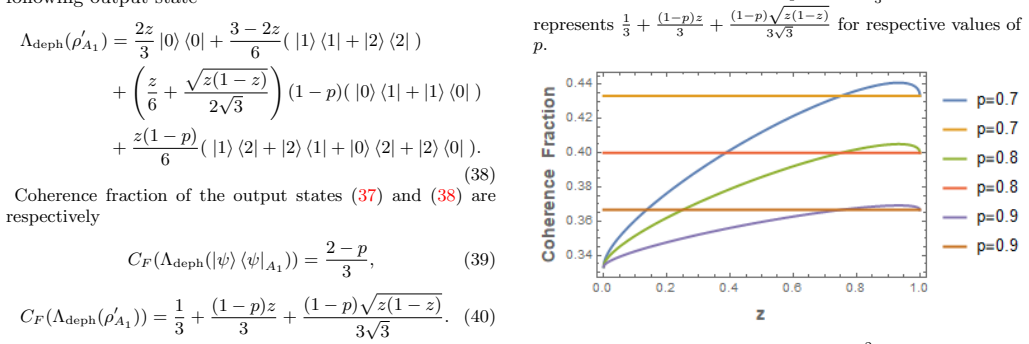
In realistic quantum information processing tasks, quantum states are inevitably affected by environmental noise, leading to decoherence and degradation of useful quantum resources. The coherence fraction, which serves as an important figure of merit for several quantum protocols, may decrease significantly after the action of a noisy channel. Such degradation can result in unsatisfactory performance in real-world applications. In this work, we investigate whether catalysis can be used to pre-process the input state to enhance the coherence fraction of an output state from a quantum channel. Specifically, we study whether using a processed state $\rho_s'$ as the input to a quantum channel $\Lambda$, instead of the original state $\rho_s$, can yield an output state $\Lambda(\rho_s')$ whose coherence fraction exceeds that of $\Lambda(\rho_s)$. We analyze the conditions under which such an improvement is possible. We also provide a practical application of our setup for the phase discrimination task. Furthermore, we establish a necessary and sufficient condition for an incoherent state preserving CPTP(Completely Positive Trace Preserving) map $\mathcal{E}$ to be a particular type of Strictly Incoherent Operation (SIO). This characterization provides a new structural understanding of SIO and clarifies its role in coherence manipulation. Our results offer practical insights into coherence preservation and enhancement in noisy quantum processes and may be useful for optimizing quantum information protocols under realistic conditions. We also provide numerical examples to support our claims.
Editorial analysis
A structured set of objections, weighed in public.
Referee Report
Summary. The paper claims that catalysis can be used to pre-process an input quantum state ρ_s into ρ_s' such that the coherence fraction of the output Λ(ρ_s') from a noisy channel Λ exceeds that of Λ(ρ_s), under suitable conditions on the catalyst and joint map. It provides a necessary and sufficient condition for an incoherent-state-preserving CPTP map to be a Strictly Incoherent Operation (SIO), includes numerical examples supporting the catalytic enhancement, and applies the framework to a phase discrimination task.
Significance. If the catalytic construction is made rigorous with explicit recovery of the catalyst via a joint CPTP map, the result would offer a concrete method for mitigating decoherence in coherence-based protocols. The SIO characterization supplies a new structural criterion that could aid resource-theoretic analyses of coherence manipulation. The numerical examples and phase-discrimination application are potentially useful for practical quantum information tasks under noise.
major comments (2)
- [Catalytic enhancement results and numerical examples] The central catalytic claim (abstract and main results section) requires a non-trivial joint CPTP map Φ and catalyst σ satisfying Φ(ρ_s ⊗ σ) = ρ_s' ⊗ σ (exactly or with arbitrarily small error) while C(Λ(ρ_s')) > C(Λ(ρ_s)). The provided numerical examples are described only at a high level and do not exhibit or verify the existence of such a Φ for any concrete channel and states; without this explicit construction the improvement reduces to the observation that some other input yields higher output coherence, which does not constitute catalysis under the resource-theoretic constraints implied by the title and SIO section.
- [Characterization of Strictly Incoherent Operations] § on SIO characterization: the necessary and sufficient condition for an incoherent-state-preserving CPTP map E to be SIO is stated, but the proof sketch does not address whether the condition remains valid when the map is composed with the catalytic pre-processing step; this composition is load-bearing for the overall coherence-enhancement protocol.
minor comments (2)
- [Preliminaries] Notation for the coherence fraction C(·) is introduced without an explicit formula or reference to the standard l1-norm or relative-entropy definition used in the numerical plots.
- [Application section] The phase-discrimination application would benefit from a quantitative comparison table showing the improvement in success probability with versus without the catalytic pre-processing.
Simulated Author's Rebuttal
We thank the referee for their careful reading of our manuscript and for providing constructive comments that help improve the clarity and rigor of our results. We address each major comment point by point below.
read point-by-point responses
-
Referee: [Catalytic enhancement results and numerical examples] The central catalytic claim (abstract and main results section) requires a non-trivial joint CPTP map Φ and catalyst σ satisfying Φ(ρ_s ⊗ σ) = ρ_s' ⊗ σ (exactly or with arbitrarily small error) while C(Λ(ρ_s')) > C(Λ(ρ_s)). The provided numerical examples are described only at a high level and do not exhibit or verify the existence of such a Φ for any concrete channel and states; without this explicit construction the improvement reduces to the observation that some other input yields higher output coherence, which does not constitute catalysis under the resource-theoretic constraints implied by the title and SIO section.
Authors: We appreciate the referee highlighting the need for an explicit joint CPTP map to rigorously establish catalysis. Our numerical examples in the original submission demonstrated that there exist input states ρ_s' leading to higher coherence fractions at the output of Λ compared to ρ_s, but we did not provide the explicit form of Φ that achieves the catalytic transformation while recovering σ. This was an oversight in presentation. In the revised manuscript, we now include explicit constructions of the joint map Φ for the numerical examples, along with verification that Φ(ρ_s ⊗ σ) = ρ_s' ⊗ σ holds and that the catalyst is returned unchanged. These additions confirm that the enhancement is achieved via catalysis as claimed. revision: yes
-
Referee: [Characterization of Strictly Incoherent Operations] § on SIO characterization: the necessary and sufficient condition for an incoherent-state-preserving CPTP map E to be SIO is stated, but the proof sketch does not address whether the condition remains valid when the map is composed with the catalytic pre-processing step; this composition is load-bearing for the overall coherence-enhancement protocol.
Authors: The necessary and sufficient condition we provide characterizes SIO among incoherent-state-preserving CPTP maps independently of the catalytic pre-processing. The catalytic step is a pre-processing applied to the input state before it enters the noisy channel Λ, while the SIO characterization pertains to the properties of operations used in coherence manipulation. Nevertheless, we agree that the proof sketch should address the composition to ensure the overall protocol is consistent with the framework. In the revised manuscript, we have extended the proof to explicitly consider the composition of the catalytic map with the subsequent operations, demonstrating that the condition remains valid and that the catalytic pre-processing does not violate the SIO properties when applicable. revision: yes
Circularity Check
No significant circularity detected in derivation chain
full rationale
The paper investigates catalytic pre-processing to enhance coherence fraction after noisy channels and derives a necessary and sufficient condition for CPTP maps preserving incoherent states to qualify as strictly incoherent operations. No load-bearing steps reduce by construction to fitted parameters, self-definitions, or self-citation chains; the abstract and described setup rely on analysis of conditions under which improvement is possible, with numerical examples provided as independent support. The central claims remain self-contained against standard quantum resource theory benchmarks without invoking the target results in their own premises.
Axiom & Free-Parameter Ledger
axioms (1)
- standard math CPTP maps model noisy quantum channels
Lean theorems connected to this paper
-
IndisputableMonolith/Cost/FunctionalEquation.leanwashburn_uniqueness_aczel unclear?
unclearRelation between the paper passage and the cited Recognition theorem.
Theorem 8: ... E(ρ)E(σ)=E(ρσ) ... is the necessary and sufficient condition for the CPTP map to be a SIO of the form E(ρ)=U(A⊙ρ)U† ...
What do these tags mean?
- matches
- The paper's claim is directly supported by a theorem in the formal canon.
- supports
- The theorem supports part of the paper's argument, but the paper may add assumptions or extra steps.
- extends
- The paper goes beyond the formal theorem; the theorem is a base layer rather than the whole result.
- uses
- The paper appears to rely on the theorem as machinery.
- contradicts
- The paper's claim conflicts with a theorem or certificate in the canon.
- unclear
- Pith found a possible connection, but the passage is too broad, indirect, or ambiguous to say the theorem truly supports the claim.
Reference graph
Works this paper leans on
-
[1]
if it admits a Kraus representation Λ(ρ) = X n KnρK † n,(8) such that each Kraus operatorK n individually preserves incoherence state, KnIK † n ⊆ I.(9) Equivalently, for every basis vector|i⟩and everyn Kn |i⟩ ∝ |j⟩(10) Each Kraus operatorK n for IO has at most one non-zero element in each column. Strictly Incoherent Operations: A CPTP mapEis said to be a ...
-
[2]
E. Chitambar and G. Gour, Reviews of modern physics 91, 025001 (2019)
work page 2019
-
[3]
Gour,Quantum Resource Theories(Cambridge Uni- versity Press, 2025)
G. Gour,Quantum Resource Theories(Cambridge Uni- versity Press, 2025)
work page 2025
-
[4]
A. K. Ekert, Physical review letters67, 661 (1991)
work page 1991
-
[5]
C. H. Bennett and S. J. Wiesner, Physical review letters 69, 2881 (1992)
work page 1992
-
[6]
C. H. Bennett, G. Brassard, C. Cr´ epeau, R. Jozsa, A. Peres, and W. K. Wootters, Physical review letters 70, 1895 (1993)
work page 1993
-
[7]
R. Horodecki, P. Horodecki, M. Horodecki, and K. Horodecki, Reviews of modern physics81, 865 (2009)
work page 2009
-
[8]
T. Baumgratz, M. Cramer, and M. Plenio, Physical Re- view Letters113, 140401 (2014)
work page 2014
-
[9]
J. Aberg, arXiv preprint quant-ph/0612146 (2006), https://doi.org/10.48550/arXiv.quant-ph/0612146
work page internal anchor Pith review Pith/arXiv arXiv doi:10.48550/arxiv.quant-ph/0612146 2006
-
[10]
A. Streltsov, G. Adesso, and M. B. Plenio, Reviews of Modern Physics89, 041003 (2017)
work page 2017
-
[11]
I. Marvian and R. W. Spekkens, New Journal of Physics 15, 033001 (2013)
work page 2013
-
[12]
I. Marvian, R. W. Spekkens, and P. Zanardi, Physical Review A93, 052331 (2016)
work page 2016
- [13]
-
[14]
K.-D. Wu, T. V. Kondra, S. Rana, C. M. Scandolo, G.-Y. Xiang, C.-F. Li, G.-C. Guo, and A. Streltsov, Physical Review Letters126, 090401 (2021)
work page 2021
-
[15]
K.-D. Wu, T. V. Kondra, S. Rana, C. M. Scandolo, G.-Y. Xiang, C.-F. Li, G.-C. Guo, and A. Streltsov, Physical Review A103, 032401 (2021)
work page 2021
-
[16]
K.-D. Wu, T. V. Kondra, C. M. Scandolo, S. Rana, G.-Y. Xiang, C.-F. Li, G.-C. Guo, and A. Streltsov, Commu- nications Physics7, 171 (2024)
work page 2024
-
[17]
Entanglement concentration via measurement:- role of imaginarity
I. Biswas, S. Bera, U. Sen, I. Chattopadhyay, and D. Sarkar, arXiv preprint arXiv:2604.12796 (2026), https://doi.org/10.48550/arXiv.2604.12796
work page internal anchor Pith review Pith/arXiv arXiv doi:10.48550/arxiv.2604.12796 2026
- [18]
-
[19]
G. Gour, I. Marvian, and R. W. Spekkens, Physical Re- view A80, 012307 (2009)
work page 2009
-
[20]
E. Chitambar, D. Leung, L. Manˇ cinska, M. Ozols, and A. Winter, Communications in Mathematical Physics 328, 303 (2014)
work page 2014
- [21]
- [22]
- [23]
- [24]
- [25]
- [26]
-
[27]
X. Yuan, H. Zhou, Z. Cao, and X. Ma, Physical Review A92, 022124 (2015)
work page 2015
- [28]
- [29]
-
[30]
Y. Yao, D. Li, and C. Sun, Physical Review A100, 032324 (2019). 12
work page 2019
-
[31]
S. Karmakar, A. Sen, I. Chattopadhyay, A. Bhar, and D. Sarkar, Quantum Information Processing18, 275 (2019)
work page 2019
-
[32]
P. Lipka-Bartosik and P. Skrzypczyk, Physical Review Letters127, 080502 (2021)
work page 2021
- [33]
-
[34]
B. Schumacher and M. D. Westmoreland, Physical Re- view Letters80, 5695 (1998)
work page 1998
-
[35]
M. A. Nielsen and I. L. Chuang,Quantum computation and quantum information(Cambridge university press, 2010)
work page 2010
-
[36]
Hayashi,Quantum information: an introduction (Springer, 2006)
M. Hayashi,Quantum information: an introduction (Springer, 2006)
work page 2006
-
[37]
L. Gyongyosi, S. Imre, and H. V. Nguyen, IEEE Com- munications Surveys & Tutorials20, 1149 (2018)
work page 2018
- [38]
-
[39]
K.-E. Hellwig and K. Kraus, Communications in Mathe- matical Physics16, 142 (1970)
work page 1970
-
[40]
Choi, Linear algebra and its applications10, 285 (1975)
M.-D. Choi, Linear algebra and its applications10, 285 (1975)
work page 1975
-
[41]
W. F. Stinespring, Proceedings of the american mathe- matical society6, 211 (1955)
work page 1955
-
[42]
M. Takahashi, S. Rana, and A. Streltsov, Physical Re- view A105, L060401 (2022)
work page 2022
-
[43]
R. Pal, S. Bandyopadhyay, and S. Ghosh, arXiv preprint arXiv:1401.1388 (2014), https://doi.org/10.1103/PhysRevA.90.052304
work page internal anchor Pith review Pith/arXiv arXiv doi:10.1103/physreva.90.052304 2014
- [44]
- [45]
-
[46]
H. Wakamura, R. Kawakubo, and T. Koike, Physical Review A96, 022325 (2017)
work page 2017
- [47]
- [48]
-
[49]
˚Aberg, Physical review letters113, 150402 (2014)
J. ˚Aberg, Physical review letters113, 150402 (2014)
work page 2014
- [50]
-
[51]
P. Lipka-Bartosik, H. Wilming, and N. H. Ng, Reviews of Modern Physics96, 025005 (2024)
work page 2024
-
[52]
K. Bu, U. Singh, and J. Wu, Physical Review A93, 042326 (2016)
work page 2016
-
[53]
T. V. Kondra, C. Datta, and A. Streltsov, Physical Re- view Letters127, 150503 (2021)
work page 2021
-
[54]
P. Char, D. Chakraborty, A. Bhar, I. Chattopadhyay, and D. Sarkar, Physical Review A107, 012404 (2023)
work page 2023
- [55]
-
[56]
P. Char, A. Sen, A. Bhar, I. Chattopadhyay, and D. Sarkar, Physical Review A109, 052405 (2024)
work page 2024
-
[57]
N. Shiraishi and T. Sagawa, Physical Review Letters126, 150502 (2021)
work page 2021
- [58]
-
[59]
J. Bavaresco, N. Brunner, A. Girardin, P. Lipka-Bartosik, and P. Sekatski, Physical Review Letters135, 220203 (2025)
work page 2025
-
[60]
P. Lipka-Bartosik and K. Korzekwa, Physical Review A 111, 022440 (2025)
work page 2025
-
[61]
F. Ding, X. Hu, and H. Fan, Physical Review A103, 022403 (2021)
work page 2021
-
[62]
C. Zhang, X.-M. Hu, F. Ding, X.-Y. Hu, Y. Guo, B.-H. Liu, Y.-F. Huang, C.-F. Li, and G.-C. Guo, Physical Review Letters133, 140201 (2024)
work page 2024
-
[63]
S. Karmakar, A. Sen, B. Paul, K. Mukherjee, I. Chat- topadhyay, and A. Bhar, International Journal of Quan- tum Information21, 2350014 (2023)
work page 2023
-
[64]
J. Grondalski, D. Etlinger, and D. James, Physics Let- ters A300, 573 (2002)
work page 2002
-
[65]
K. Bu, U. Singh, S.-M. Fei, A. K. Pati, and J. Wu, Physical Review Letters119, 150405 (2017)
work page 2017
-
[66]
M. Horodecki, P. Horodecki, and R. Horodecki, Physical Review A60, 1888 (1999)
work page 1999
-
[67]
Watrous,The Theory of Quantum Information(Cam- bridge University Press, 2018)
J. Watrous,The Theory of Quantum Information(Cam- bridge University Press, 2018)
work page 2018
- [68]
-
[69]
C. Mukhopadhyay, A. K. Pati, and S. Sazim, IOP SciNotes1, 025212 (2020)
work page 2020
discussion (0)
Sign in with ORCID, Apple, or X to comment. Anyone can read and Pith papers without signing in.