REVIEW 2 major objections 2 minor 1 cited by
A critical magnetic charge separates spontaneous scalarization from new scalarization in Einstein-Euler-Heisenberg black holes.
Reviewed by Pith at T0; open to challenge. T0 means a machine referee read the full paper against a public rubric. the ladder, T0–T4 →
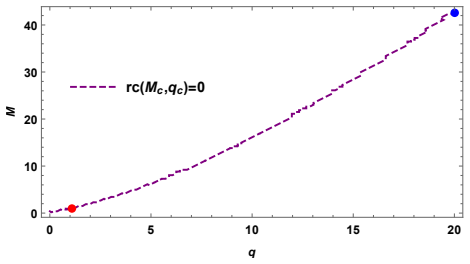
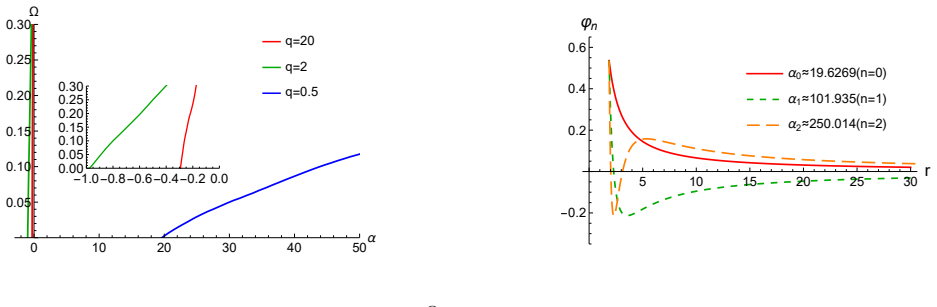
Charge-dependent scalarization of EEH black holes yields stable scalarized branches for 0<q<1.115 with positive α and for q>1.115 with negative α.
T0 review reviewed 2026-05-20 challenge →
load-bearing objection This paper numerically identifies a critical charge qc=1.115 that splits scalarization of EEH black holes into positive-alpha spontaneous and negative-alpha new regimes, with stability for the fundamental or single branches at the quoted q values. the 2 major comments →
Charge-dependent scalarization of Einstein- Euler-Heisenberg black holes
The pith
A machine-rendered reading of the paper's core claim, the machinery that carries it, and where it could break.
The reading
Core claim
The bald Einstein-Euler-Heisenberg black hole with single horizon at fixed action parameter μ=0.3 undergoes spontaneous scalarization (α+) for 0<q<q_c=1.115 with positive α, producing infinite branches whose fundamental n=0 branch is stable to radial perturbations, while new scalarization (α-) occurs for q>q_c with negative α and produces two stable single branches of scalarized solutions.
What carries the argument
Exponential scalar coupling function applied simultaneously to the Maxwell term and the nonlinear Euler-Heisenberg electrodynamic term, which induces tachyonic instability when the effective mass squared becomes negative.
Load-bearing premise
The reported charge thresholds and stability results require fixing the action parameter μ at 0.3 to produce a single-horizon bald black hole and adopting the specific exponential form for the scalar coupling to the electromagnetic terms.
What would settle it
Numerical construction of the scalarized solutions with a non-exponential coupling function or with μ set to a value that produces multiple horizons would yield a different critical charge or different number of stable branches.
Editorial analysis
A structured set of objections, weighed in public.
Referee Report
Summary. The manuscript examines charge-dependent scalarization of Einstein-Euler-Heisenberg black holes in a theory with an exponential scalar coupling (parameter α) to both Maxwell and nonlinear electrodynamic terms. For the bald black hole with fixed action parameter μ=0.3 (yielding a single horizon), the authors report a critical charge q_c=1.115 separating spontaneous scalarization (0<q<q_c, positive α) from new scalarization (q>q_c, negative α). Numerical solutions are constructed for representative charges (q=0.5 with infinite branches whose n=0 mode is stable; q=2 and q=20 each admitting two stable single branches), with stability assessed via radial perturbations.
Significance. If the numerical thresholds and stability conclusions hold under scrutiny, the work adds a concrete charge-dependent example to the scalarization literature in nonlinear electrodynamics, potentially relevant for understanding horizon-scale phenomena in charged black-hole spacetimes. The explicit construction of solution branches and their perturbation spectra provides falsifiable predictions that can be tested against other Einstein-Maxwell-scalar models.
major comments (2)
- [§4] §4 (numerical construction of scalarized solutions): the reported critical charge q_c=1.115 and the distinction between spontaneous and new scalarization regimes rest on numerical integration of the coupled ODEs; the manuscript should specify the precise diagnostic (e.g., the α value at which the trivial solution bifurcates or the sign change in the effective scalar mass) together with convergence tests and grid-resolution studies that establish the quoted precision to three decimal places.
- [§5] §5 (radial stability analysis): the claims that the n=0 branch at q=0.5 is stable while the branches at q=2,20 are stable are central to the physical interpretation; the paper should report the lowest eigenvalue (or the sign of the squared frequency) for at least one representative solution in each family to make the stability conclusion explicit rather than inferred solely from the absence of nodes or from shooting-method behavior.
minor comments (2)
- [§2] The exponential coupling form and the specific choice μ=0.3 are model inputs that define the domain of the reported results; a brief remark on how the thresholds shift for nearby μ values would help readers assess robustness.
- Notation α⁺ and α⁻ is introduced in the abstract but should be defined explicitly at first use in the main text, together with the sign convention for the coupling.
Simulated Author's Rebuttal
We thank the referee for the careful reading and constructive comments on our manuscript. We address each major point below and will revise the manuscript to incorporate the requested clarifications on numerical diagnostics and stability results.
read point-by-point responses
-
Referee: [§4] §4 (numerical construction of scalarized solutions): the reported critical charge q_c=1.115 and the distinction between spontaneous and new scalarization regimes rest on numerical integration of the coupled ODEs; the manuscript should specify the precise diagnostic (e.g., the α value at which the trivial solution bifurcates or the sign change in the effective scalar mass) together with convergence tests and grid-resolution studies that establish the quoted precision to three decimal places.
Authors: We agree that the precise diagnostic used to obtain q_c=1.115 should be stated explicitly. In the revised manuscript we will add that q_c is identified as the charge at which the effective scalar mass squared (derived from the linearized scalar equation around the bald solution) changes sign at the horizon, allowing a zero-mode bifurcation from the trivial solution. We will also include convergence tests performed with radial grids of 500, 1000, and 2000 points, showing that the extracted q_c remains stable to within 0.001 across resolutions. These additions will be placed in §4 and will clarify the separation between the spontaneous (positive-α) and new (negative-α) scalarization regimes. revision: yes
-
Referee: [§5] §5 (radial stability analysis): the claims that the n=0 branch at q=0.5 is stable while the branches at q=2,20 are stable are central to the physical interpretation; the paper should report the lowest eigenvalue (or the sign of the squared frequency) for at least one representative solution in each family to make the stability conclusion explicit rather than inferred solely from the absence of nodes or from shooting-method behavior.
Authors: We accept that explicit reporting of the lowest eigenvalue strengthens the stability statements. In the revised §5 we will tabulate or quote the sign of the squared frequency ω² (or the lowest eigenvalue of the radial perturbation operator) for representative solutions: for the n=0 branch at q=0.5 we obtain ω² > 0, confirming stability; for the single branches at q=2 and q=20 we likewise find positive lowest eigenvalues. These values will be obtained from the same shooting-method spectra already used to count nodes, thereby making the stability conclusions quantitative rather than inferred. revision: yes
Circularity Check
No significant circularity; results from direct numerical integration of field equations
full rationale
The paper selects explicit model inputs (μ=0.3 for single-horizon bald EEHBH and exponential scalar coupling to Maxwell/NED terms) and solves the coupled ODEs for scalarized solutions across ranges of q and α. Charge thresholds such as q_c=1.115, branch structures, and radial stability conclusions emerge as outputs of that integration and perturbation analysis rather than being presupposed by definition, fitted parameters renamed as predictions, or load-bearing self-citations. No step reduces the reported existence/stability statements to the inputs by construction; the derivation remains self-contained against the stated ansatz and numerical methods.
Axiom & Free-Parameter Ledger
free parameters (3)
- μ =
0.3
- α
- q
axioms (1)
- domain assumption Exponential scalar coupling to Maxwell and nonlinear electrodynamic terms is the correct interaction form.
Cite this review
Pith. "Pith review of Charge-dependent scalarization of Einstein- Euler-Heisenberg black holes." pith.science (2026). https://pith.science/paper/YK7R3IAC
@misc{pith2026260515566,
  author       = {Pith},
  title        = {Pith review of: Charge-dependent scalarization of Einstein- Euler-Heisenberg black holes},
  year         = {2026},
  howpublished = {\url{https://pith.science/paper/YK7R3IAC}},
  note         = {Machine review of arXiv:2605.15566}
}
abstract
Charge-dependent scalarization of the Einstein-Euler-Heisenberg (EEH) black hole is carried out in the EEH-scalar theory by introducing an exponential scalar coupling with $\alpha$ coupling constant to the Maxwell and nonlinear electrodynamic terms. The bald black hole (EEHBH) is described by mass $M$ and arbitrary magnetic charge $q$ and has a single horizon when choosing the action parameter $\mu=0.3$. The spontaneous scalarization ($\alpha^+$) of this black hole is available for charge $0<q< q_c=1.115$ and positive $\alpha$, whereas its new scalarization ($\alpha^-$) occurs for $q> q_c$ and negative $\alpha$. The former case of $q=0.5$ implies infinite branches of scalarized EEHBHs but its fundamental branch ($n=0$) is stable against radial perturbations, while the latter cases of $q=2,20$ show two stable single branches of scalarized EEHBHs.
Figures





Lean theorems connected to this paper
-
IndisputableMonolith/Cost/FunctionalEquation.leanwashburn_uniqueness_aczel unclear?
unclearRelation between the paper passage and the cited Recognition theorem.
The bald black hole (EEHBH) is described by mass M and arbitrary magnetic charge q and has a single horizon when choosing the action parameter μ=0.3. ... spontaneous scalarization (α+) ... for 0<q<q_c=1.115 and positive α, whereas its new scalarization (α−) occurs for q>q_c and negative α.
-
IndisputableMonolith/Foundation/RealityFromDistinction.leanreality_from_one_distinction unclear?
unclearRelation between the paper passage and the cited Recognition theorem.
We start with the Einstein-Euler-Heisenberg-scalar (EEHS) theory with an action parameter μ to the NED term ... SEEHS = 1/16π ∫ ... e^{-α ϕ²} (F − μ F²)
What do these tags mean?
- matches
- The paper's claim is directly supported by a theorem in the formal canon.
- supports
- The theorem supports part of the paper's argument, but the paper may add assumptions or extra steps.
- extends
- The paper goes beyond the formal theorem; the theorem is a base layer rather than the whole result.
- uses
- The paper appears to rely on the theorem as machinery.
- contradicts
- The paper's claim conflicts with a theorem or certificate in the canon.
- unclear
- Pith found a possible connection, but the passage is too broad, indirect, or ambiguous to say the theorem truly supports the claim.
Forward citations
Cited by 1 Pith paper
-
Scalarization of Einstein-Euler-Heisenberg black hole with multiple horizons
Stable, positive-mass scalarized EEH black holes exist only in an intermediate primary-scalar-charge window for low/cold horizons and above a lower bound for hot horizons.
Reference graph
Works this paper leans on
-
[1]
Consequences of Dirac Theory of the Positron
W. Heisenberg and H. Euler, Z. Phys.98(1936) no.11-12, 714-732 doi:10.1007/BF01343663 [arXiv:physics/0605038 [physics]]
work page internal anchor Pith review Pith/arXiv arXiv doi:10.1007/bf01343663 1936
-
[2]
Black hole solutions in Euler-Heisenberg theory
H. Yajima and T. Tamaki, Phys. Rev. D63, 064007 (2001) doi:10.1103/PhysRevD.63.064007 [arXiv:gr-qc/0005016 [gr-qc]]
work page internal anchor Pith review Pith/arXiv arXiv doi:10.1103/physrevd.63.064007 2001
-
[3]
Detection of QED vacuum nonlinearities in Maxwell's equations by the use of waveguides
G. Brodin, M. Marklund and L. Stenflo, Phys. Rev. Lett.87(2001), 171801 doi:10.1103/PhysRevLett.87.171801 [arXiv:physics/0108022 [physics.class-ph]]
work page internal anchor Pith review Pith/arXiv arXiv doi:10.1103/physrevlett.87.171801 2001
-
[4]
A. Allahyari, M. Khodadi, S. Vagnozzi and D. F. Mota, JCAP02(2020), 003 doi:10.1088/1475-7516/2020/02/003 [arXiv:1912.08231 [gr-qc]]
-
[5]
S. I. Kruglov, Mod. Phys. Lett. A35(2020) no.35, 2050291 doi:10.1142/S0217732320502910 [arXiv:2009.07657 [gr-qc]]
-
[6]
R. Ruffini and J. A. Wheeler, Phys. Today24, no. 1, 30 (1971). doi:10.1063/1.3022513
-
[7]
C. A. R. Herdeiro and E. Radu, Int. J. Mod. Phys. D24, no. 09, 1542014 (2015) doi:10.1142/S0218271815420146 [arXiv:1504.08209 [gr-qc]]
work page internal anchor Pith review Pith/arXiv arXiv doi:10.1142/s0218271815420146 2015
-
[8]
N. M. Bocharova, K. A. Bronnikov and V. N. Melnikov, Vestn. Mosk. Univ. Ser. III Fiz. Astron. , no. 6, 706 (1970)
work page 1970
-
[9]
J. D. Bekenstein, Annals Phys.82, 535 (1974). doi:10.1016/0003-4916(74)90124-9
-
[10]
D. D. Doneva and S. S. Yazadjiev, Phys. Rev. Lett.120(2018) no.13, 131103 doi:10.1103/PhysRevLett.120.131103 [arXiv:1711.01187 [gr-qc]]
work page internal anchor Pith review Pith/arXiv arXiv doi:10.1103/physrevlett.120.131103 2018
-
[11]
H. O. Silva, J. Sakstein, L. Gualtieri, T. P. Sotiriou and E. Berti, Phys. Rev. Lett.120 (2018) no.13, 131104 doi:10.1103/PhysRevLett.120.131104 [arXiv:1711.02080 [gr-qc]]
work page internal anchor Pith review Pith/arXiv arXiv doi:10.1103/physrevlett.120.131104 2018
-
[12]
Evasion of No-Hair Theorems and Novel Black-Hole Solutions in Gauss-Bonnet Theories
G. Antoniou, A. Bakopoulos and P. Kanti, Phys. Rev. Lett.120(2018) no.13, 131102 doi:10.1103/PhysRevLett.120.131102 [arXiv:1711.03390 [hep-th]]
work page internal anchor Pith review Pith/arXiv arXiv doi:10.1103/physrevlett.120.131102 2018
-
[13]
C. A. R. Herdeiro, E. Radu, N. Sanchis-Gual and J. A. Font, Phys. Rev. Lett.121 (2018) no.10, 101102 doi:10.1103/PhysRevLett.121.101102 [arXiv:1806.05190 [gr-qc]]. 17
work page internal anchor Pith review Pith/arXiv arXiv doi:10.1103/physrevlett.121.101102 2018
-
[14]
T. Karakasis, G. Koutsoumbas, A. Machattou and E. Papantonopoulos, Phys. Rev. D106(2022) no.10, 104006 doi:10.1103/PhysRevD.106.104006 [arXiv:2207.13146 [gr- qc]]
- [15]
-
[16]
X. Y. Chew and Y. S. Myung, Phys. Rev. D110(2024) no.4, 044011 doi:10.1103/PhysRevD.110.044011 [arXiv:2405.04921 [gr-qc]]
-
[17]
L. Zhang, D. C. Zou and Y. S. Myung, Eur. Phys. J. C85(2025) no.12, 1463 doi:10.1140/epjc/s10052-025-15232-4 [arXiv:2510.07954 [gr-qc]]
-
[18]
D. Amaro and A. Mac´ ıas, Phys. Rev. D102, no.10, 104054 (2020) doi:10.1103/PhysRevD.102.104054
-
[19]
N. Bret´ on and L. A. L´ opez, Phys. Rev. D104, no.2, 024064 (2021) doi:10.1103/PhysRevD.104.024064 [arXiv:2105.12283 [gr-qc]]
- [20]
-
[21]
Z. Luo and J. Li, Chin. Phys. C46, no.8, 085107 (2022) doi:10.1088/1674-1137/ac6574
-
[22]
Y. S. Myung and D. C. Zou, Eur. Phys. J. C79(2019) no.3, 273 doi:10.1140/epjc/s10052-019-6792-6 [arXiv:1808.02609 [gr-qc]]
work page internal anchor Pith review Pith/arXiv arXiv doi:10.1140/epjc/s10052-019-6792-6 2019
-
[23]
Y. S. Myung and D. C. Zou, Phys. Lett. B790(2019), 400-407 doi:10.1016/j.physletb.2019.01.046 [arXiv:1812.03604 [gr-qc]]
work page internal anchor Pith review Pith/arXiv arXiv doi:10.1016/j.physletb.2019.01.046 2019
-
[24]
Spontaneous scalarization of charged black holes at the approach to extremality
Y. Brihaye and B. Hartmann, Phys. Lett. B792(2019), 244-250 doi:10.1016/j.physletb.2019.03.043 [arXiv:1902.05760 [gr-qc]]
work page internal anchor Pith review Pith/arXiv arXiv doi:10.1016/j.physletb.2019.03.043 2019
-
[25]
C. A. R. Herdeiro, A. M. Pombo and E. Radu, Universe7(2021) no.12, 483 doi:10.3390/universe7120483 [arXiv:2111.06442 [gr-qc]]
-
[26]
S. Hod, Phys. Rev. D102(2020) no.8, 084060 doi:10.1103/PhysRevD.102.084060 [arXiv:2006.09399 [gr-qc]]
-
[27]
Gravitational instability of Einstein-Gauss-Bonnet black holes under tensor mode perturbations
G. Dotti and R. J. Gleiser, Class. Quant. Grav.22, L1 (2005) doi:10.1088/0264- 9381/22/1/L01 [arXiv:gr-qc/0409005 [gr-qc]]. 18
work page internal anchor Pith review Pith/arXiv arXiv doi:10.1088/0264- 2005
-
[28]
S. Hod, Phys. Lett. B798(2019), 135025 doi:10.1016/j.physletb.2019.135025 [arXiv:2002.01948 [gr-qc]]. 19
This paper was first reviewed by grok-4.3 on May 20, 2026.
discussion (0)
Sign in with ORCID, Apple, or X to comment. Anyone can read and Pith papers without signing in.