Operator spreading in random circuits with orthogonal or symplectic symmetry
Pith reviewed 2026-06-28 09:20 UTC · model grok-4.3
The pith
Random circuits with orthogonal or symplectic symmetry relax Pauli-string weights to a ternary structure with finite-width domain walls.
A machine-rendered reading of the paper's core claim, the machinery that carries it, and where it could break.
Core claim
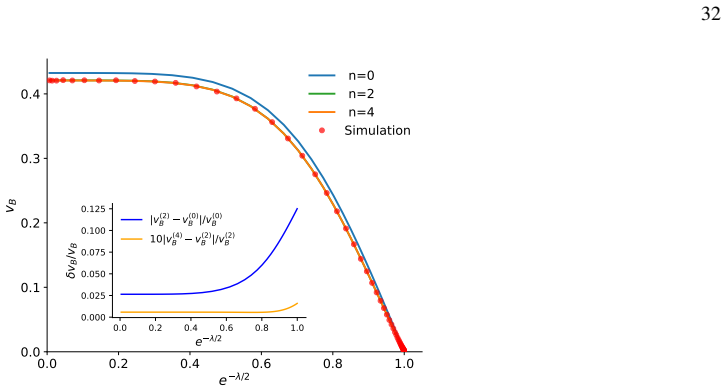
For circuits whose two-qubit gates are drawn from orthogonal-invariant or symplectic-invariant ensembles, the ensemble-averaged Pauli-string weights relax to a ternary-valued structure. The domain wall separating trivial and scrambled regions has finite width even for Haar-random gates. The negative-determinant sector of the orthogonal group exhibits a non-zero lower bound for butterfly velocity, and for qudit size two this velocity can exceed the Haar value.
What carries the argument
The domain wall in the spatial profile of ensemble-averaged Pauli-string weights.
If this is right
- Butterfly velocity is bounded below by a positive constant in the negative-determinant orthogonal ensemble for any gate distribution.
- For qubits the butterfly velocity can exceed the value obtained from Haar-random unitary circuits.
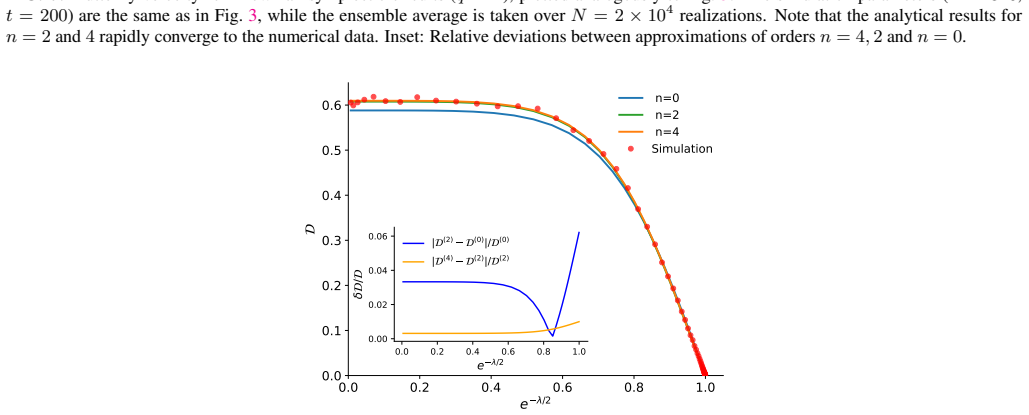
- Domain walls retain finite width for Haar-distributed gates taken from the orthogonal or symplectic ensembles.
- Symplectic-invariant circuits exhibit the same ternary relaxation pattern as orthogonal-invariant circuits.
Where Pith is reading between the lines
- Additional discrete symmetries such as time reversal may produce structured relaxation of operator weights beyond the continuous symmetry groups studied here.
- The ternary pattern could appear in other models whose gates respect only a subgroup of the full unitary group.
- Small-system simulations could directly test whether the three-valued structure survives beyond the ensemble average.
Load-bearing premise
Two-qubit gates are drawn independently from the orthogonal- or symplectic-invariant ensembles and the ensemble averaging remains well-defined at finite qudit dimension.
What would settle it
Numerical computation of the spatial profile of averaged Pauli weights after many layers of orthogonal gates, checking whether exactly three weight values appear and whether the transition region width stays finite.
Figures


read the original abstract
We investigate operator spreading in random quantum circuits with gates drawn from orthogonal-invariant or symplectic-invariant ensembles, revealing several key distinctions from the well-studied unitary-invariant case. We find that the ensemble-averaged Pauli-string weights relax to a ternary-valued structure, instead of the binary structure of unitary-invariant circuits. For orthogonal- or symplectic-invariant circuits, the domain wall separating trivial and scrambled regions has a finite width even for Haar-random gates, whereas domain walls are sharp for Haar-distributed random unitary circuits. We further find a fundamental dichotomy between random circuits with two-qubit gates from the two disconnected components of the orthogonal group: While the butterfly velocity for the special orthogonal ensemble lies between zero and the Haar value, the negative-determinant sector exhibits a non-zero lower bound for any gate distribution. Moreover, for qudit size $q=2$, the butterfly velocity can exceed that of the Haar-random ensemble.
Editorial analysis
A structured set of objections, weighed in public.
Referee Report
Summary. The manuscript examines operator spreading in random quantum circuits with two-qubit gates drawn from orthogonal-invariant or symplectic-invariant ensembles (including disconnected components). It claims that ensemble-averaged Pauli-string weights relax to a ternary-valued structure (distinct from the binary structure of unitary-invariant circuits), that the domain wall has finite width even for Haar-random gates (unlike sharp walls in the unitary case), and that butterfly velocity exhibits a dichotomy: the special orthogonal ensemble yields velocities between zero and the Haar value, while the negative-determinant sector has a non-zero lower bound for any gate distribution, with the q=2 case allowing velocities exceeding the Haar value.
Significance. If the central claims hold, the work provides a clear extension of operator-spreading results to symmetry-restricted ensembles, identifying qualitative distinctions (ternary weights, finite-width domain walls) that are absent in the unitary case. The explicit treatment of the two components of the orthogonal group and the resulting bounds on butterfly velocity constitute a substantive contribution to the literature on random circuits and scrambling. No machine-checked proofs or parameter-free derivations are indicated, but the symmetry-based distinctions are presented as direct consequences of the ensemble definitions.
minor comments (2)
- [§3] The definition of the domain wall and the precise averaging procedure over the disconnected components should be stated explicitly in the main text (near the discussion of the ternary structure) to allow direct reproduction of the finite-width result.
- [§2] Notation for the Pauli-string weights and the butterfly velocity extraction could be unified between the orthogonal and symplectic cases to improve readability.
Simulated Author's Rebuttal
We thank the referee for their positive assessment of the manuscript and for recommending minor revision. The referee's summary correctly captures the central claims regarding ternary Pauli weights, finite-width domain walls, and the dichotomy in butterfly velocities between the two components of the orthogonal group. No specific major comments were provided in the report.
Circularity Check
No significant circularity detected
full rationale
The abstract presents claims about ternary Pauli weights, finite domain-wall width, and butterfly-velocity bounds as direct consequences of symmetry-restricted ensembles (orthogonal/symplectic vs unitary). No equations, fitted parameters, self-citations, or ansatzes are quoted that reduce predictions to inputs by construction. The reader's assessment of 2.0 aligns with absence of load-bearing self-reference or definitional loops; the skeptic note confirms no derivations available to inspect for hidden reductions. The derivation chain appears self-contained against external ensemble definitions.
Axiom & Free-Parameter Ledger
axioms (2)
- domain assumption Gates are drawn independently from the orthogonal-invariant or symplectic-invariant measure on the appropriate Lie group.
- domain assumption The Pauli-string weight and domain-wall observables are well-defined for the chosen qudit dimension.
Reference graph
Works this paper leans on
-
[1]
, q 2 −1, form a basis for operators acting on a qudit, a quantum sys- tem withqdegrees of freedom|m⟩,m= 0,1,
orthogonal case The generalized Pauli matricesσ a,a= 0,1, . . . , q 2 −1, form a basis for operators acting on a qudit, a quantum sys- tem withqdegrees of freedom|m⟩,m= 0,1, . . . , q−1. We represent the indexa= (a ′, a′′)as a pair of two integersa ′, a′′ ∈Z q. The Weyl-Heisenberg choice for the complete fam- ily ofq 2 independent generalized Pauli matric...
-
[2]
In this case, the qudit dimensionqmust be even
symplectic case Symplectic invariance applies to qudits of half-integer spin. In this case, the qudit dimensionqmust be even. Without loss of generality, we may choose the qudit basis such that the involution matrixZ x of Eq. (16) takes the form Zx =11q/2 ⊗σ 2 (A15) 13 parityσparityσ ′ countσ: [σ, σ ′] = 0countσ:{σ, σ ′}= 0 e e ′ q(q+ 2)/4q 2/4 e o ′ q2/4...
-
[3]
Orthogonal and symplectic ensembles When the two-qudit gate operatorsUsatisfyU † =U T (or- thogonal case) orU † =U R (symplectic case),i.e.,Uis an orthogonal or symplecticq 2×q2 matrix, respectively, the sym- metry constraints on the coefficientsBj simplify significantly. In both cases, we find that additional equalities hold for the coefficientsB j, B1 =...
-
[4]
The circular or- thogonal and symplectic ensembles (COE and CSE, respec- tively) from random matrix theory are examples of ensembles with such symmetry [29]
Symmetric and self-dual ensembles The symmetry contraints on the coefficientsB j also sim- plify significantly if the two-qudit gate operatorsUare sym- metric or self-dual matrices,U=U T orU=U R for the orthogonal or symplectic case, respectively. The circular or- thogonal and symplectic ensembles (COE and CSE, respec- tively) from random matrix theory ar...
-
[5]
Specifically, we examine the Symmetric Orthogonal case (U=U ∗ =U T , corresponding toσ= 1) and the Self-dual Symplectic case (U=U R =U †, corresponding toσ=−1)
Combined symmetries Finally, we consider the most constrained ensembles, where the matrixUpossesses both symmetries. Specifically, we examine the Symmetric Orthogonal case (U=U ∗ =U T , corresponding toσ= 1) and the Self-dual Symplectic case (U=U R =U †, corresponding toσ=−1). The combined symmetries impose constraints on the coef- ficientsB j, B1 =B 2 =B...
-
[6]
o” (corresponding to ternary index−1) and “11
The caseq= 2 m Forq= 2 m, to show that the projected binary-string distri- bution¯ρ¯psatisfies a closed evolution equation, it is sufficient to consider the adjacent quditsxandx+ 1, which are subject to a two-qudit gate. From Eqs. (31) and (35) we then have ¯ρ¯px,¯px+1(t) = X ax,ax+1 ρax,ax+1;ax,ax+1(t−1) × X px→¯px X px+1→¯px+1 ⟨|Wax,ax+1;px,px+1 |2⟩. (C...
-
[7]
(36), where the transition matrixT ¯a¯phas a block structure as in Eq
General qudit sizeq For a general qudit sizeq, which is not a power of2, we can also obtain a closed Markovian evolution equation of the 24 form of Eq. (36), where the transition matrixT ¯a¯phas a block structure as in Eq. (63). This matrix is constructed by summing the transition prob- abilitiesW ab;pq over all Pauli stringspandqwith the weight factorsχ ...
-
[8]
and combine¯ρ (n)(x;t)and¯ρ (n)(x+ 1, t)into a two- component spinor, R(n)(∆x;t) = ¯ρ(n)(∆x;t) ¯ρ(n)(∆x+ 1;t) ,(D1) where now∆xis always even. The evolution equations (45)– (46) with the truncation prescription (47), may then be repre- sented as R(n)(∆x;t) =D (n)R(n)(∆x;t−1) +D ′(n)R(n)(∆x+ 2;t−1),(D2) whereD (n) andD ′(n) are(4×3 n)×(4×3 n)matrices. The ...
-
[9]
We denote the ensemble of two-qudit gate operators byEand the transition matrix corresponding to the two-qudit operatorUbyW(U)
Detailed derivation Before giving the full derivation, we first outline the logical structure. We denote the ensemble of two-qudit gate operators byEand the transition matrix corresponding to the two-qudit operatorUbyW(U)
-
[10]
We show that the largest singular value of the ensemble average⟨W⟩is1
-
[11]
We show that if⟨W⟩ρ=c ρwith|c|= 1, thenW(U)ρ= c ρfor allU∈ E
-
[12]
We show that if the ensemble is unitary-invariant and ⟨W⟩ρ iµ =c i ρiµ, thenW(V)ρ iµ =ρ iµ for allq 2 ×q 2 unitary matricesV
-
[13]
We identify the solutions in point 3 as the steady states
-
[14]
We derive the inequality (E5)
-
[15]
steady state
We give an upper bound for∥⟨W 2W1⟩∥′ ∞. We begin by bounding the singular values of the averaged two-qudit gate operator⟨W ab;pq⟩=⟨W apW ∗ bq⟩. The positive semi-definiteness of the variance ofWimplies that for any normalized two-qudit state∥eρ∥= 1, one has the inequality eρ† (W− ⟨W⟩) W † − ⟨W †⟩ eρ =eρ† W W † − ⟨W⟩⟨W †⟩ eρ = 1−eρ†⟨W⟩⟨W †⟩eρ ≥0.(E11) Here...
-
[16]
Unitary invariant ensembles We can vectorize the generalized Pauli operatorsOa, so that Wab;pq can be written in terms of the Hilbert-Schmidt inner product, Wab;pq =⟨ab ∗|U ∗ ⊗U⊗U⊗U ∗ |pq∗⟩,(E18) or, in matrix notation, W(U) =U ∗ ⊗U⊗U⊗U ∗.(E19) Here, we have used the identities [38] tr(A†B) =⟨vec(A)|vec(B)⟩,(E20) ⟨vec(ABC)|=C T ⊗A|vec(B)⟩(E21) and we defi...
-
[17]
We also note that W(V) =W(V ′),(E34) becauseVandV ′ only differ by a factor, see Eq
=C i ν′ν(11) =δ ν′ν. We also note that W(V) =W(V ′),(E34) becauseVandV ′ only differ by a factor, see Eq. (E31), and Vcontains as equally many factorsUandU ∗, see Eq. (E18). Likewise, any matrixU i ∈ Ecan be written asU i = (detU i)1/q2 U ′ i withU ′ i ∈SU(q 2). IfEis a group, then the set{U ′ i }also forms a group. Indeed, ifU iUj =U k, then UiUj = (det(...
-
[18]
Orthogonal invariant ensembles A parallel argument applies to orthogonal-invariant ensem- bles. Unlike the unitary case, the orthogonal group is not con- nected, so there are two disjoint components: the special or- thogonal groupSO(q 2)and the determinant-−1component SO−(q2)[43]. For any matrixV ′′ inSO −(q2), we can write V ′′ =RV ′,(E48) whereR= diag(−...
-
[19]
The constructed groupGis invariant under symplectic trans- formations
Symplectic invariant ensembles For the symplectic-invariant ensemble, one proceeds almost the same as the orthogonal case, with a few small differences. The constructed groupGis invariant under symplectic trans- formations. In theW(V)representation, up to the trivial ac- tion, there are only two nontrivial possibilities of the image of G:Sp(q 2/2), the pr...
-
[20]
B, which also guarantees the validation of the projection method
Relaxation time One can verify that⟨W⟩commutes withB, by using the Weingarten calculus result in App. B, which also guarantees the validation of the projection method. As an example, consider the termC 16 = B16 tr ΣaΣ† pΣ∗ bΣT q and investigate its action on a density matrixρ pq of ternary form. The nonzero elements of such density matrices havep=qorp=q T...
-
[21]
We recall that the primed norm∥ · ∥′ 2 is the largest singular value of the matrix evaluated after excluding vectors withρ−Bρ= 0
Hereto, we may re- strict to vectors withρ−Bρ̸= 0. We recall that the primed norm∥ · ∥′ 2 is the largest singular value of the matrix evaluated after excluding vectors withρ−Bρ= 0. We writeσ 2 ∈[0,1) for the largest singular value of the local transition matrix⟨W⟩ smaller than1. An upper bound for∥⟨W 2⟩⟨W1⟩∥′ 2 follows from submultiplicativity, ∥⟨W2⟩⟨W1⟩∥...
-
[22]
Here∥P 1∥′ 2 =∥P 2∥′ 2 = 0if the only eigenvalue-1 vectors in P1 andP 2 are ternary states (so the projectors have no support on the(11−B)sector); otherwise∥P 1∥′ 2 =∥P 2∥′ 2 = 1
sup ∥ρ∥2=1 ρ−Bρ̸=0 ∥P ′ 1⟨W1⟩ρ∥2. Here∥P 1∥′ 2 =∥P 2∥′ 2 = 0if the only eigenvalue-1 vectors in P1 andP 2 are ternary states (so the projectors have no support on the(11−B)sector); otherwise∥P 1∥′ 2 =∥P 2∥′ 2 = 1. The eigenspace of⟨W 1⟩decomposes asP 1 ⊕Q 1. Given |x⟩=aˆx 1 +bˆx′ 1, whereˆx1 andˆx′ 1 are normalized vectors in theP 1 andQ 1 sectors, respec...
-
[23]
Consequently, atχ= 0, the vanishing of∥P 2∥′ 2 simplifies the bound to∥⟨W 2⟩⟨W1⟩∥′2 2 ≤σ 4 2, thereby recovering the unitary limit. Appendix F: Haar orthogonal circuit for general qudit sizeq For a Haar orthogonal circuit of a general qudit sizeq, the steady state is defined in terms of the function ρ∞ p,sp(t) = X q γp(t)γ∗ q (t) Y x χspx (px, qx),(F1) 31...
-
[24]
W. Brown and O. Fawzi, Scrambling speed of random quantum circuits, arXiv:1210.6644 (2013)
Pith/arXiv arXiv 2013
-
[25]
Nahum, J
A. Nahum, J. Ruhman, S. Vijay, and J. Haah, Quantum Entan- glement Growth under Random Unitary Dynamics, Phys. Rev. X7, 031016 (2017)
2017
-
[26]
A. Chan, A. De Luca, and J. T. Chalker, Solution of a Minimal Model for Many-Body Quantum Chaos, Phys. Rev. X8, 041019 (2018). 33
2018
-
[27]
Nahum, S
A. Nahum, S. Vijay, and J. Haah, Operator Spreading in Ran- dom Unitary Circuits, Phys. Rev. X8, 021014 (2018)
2018
-
[28]
C. W. von Keyserlingk, T. Rakovszky, F. Pollmann, and S. L. Sondhi, Operator Hydrodynamics, OTOCs, and Entanglement Growth in Systems without Conservation Laws, Phys. Rev. X 8, 021013 (2018)
2018
-
[29]
Rakovszky, F
T. Rakovszky, F. Pollmann, and C. von Keyserlingk, Diffu- sive Hydrodynamics of Out-of-Time-Ordered Correlators with Charge Conservation, Phys. Rev. X8, 031058 (2018)
2018
-
[30]
Khemani, A
V . Khemani, A. Vishwanath, and D. A. Huse, Operator Spread- ing and the Emergence of Dissipative Hydrodynamics under Unitary Evolution with Conservation Laws, Phys. Rev. X8, 031057 (2018)
2018
-
[31]
M. P. Fisher, V . Khemani, A. Nahum, and S. Vijay, Random Quantum Circuits, Annu. Rev. Condens. Matter Phys.14, 335 (2023)
2023
-
[32]
B. Skinner, Lecture Notes: Introduction to random unitary cir- cuits and the measurement-induced entanglement phase transi- tion, arXiv:2307.02986 (2023)
arXiv 2023
-
[33]
Xu and B
S. Xu and B. Swingle, Locality, Quantum Fluctuations, and Scrambling, Phys. Rev. X9, 031048 (2019)
2019
-
[34]
Styliaris, N
G. Styliaris, N. Anand, and P. Zanardi, Information Scrambling over Bipartitions: Equilibration, Entropy Production, and Typi- cality, Phys. Rev. Lett.126, 030601 (2021)
2021
-
[35]
Xu and B
S. Xu and B. Swingle, Scrambling Dynamics and Out-of-Time- Ordered Correlators in Quantum Many-Body Systems, PRX Quantum5, 010201 (2024)
2024
-
[36]
X. Mi, P. Roushan, C. Quintana, S. Mandr `a, J. Marshall, C. Neill, F. Arute, K. Arya, J. Atalaya, R. Babbush, J. C. Bardin, R. Barends, J. Basso, A. Bengtsson, S. Boixo, A. Bourassa, M. Broughton, B. B. Buckley, D. A. Buell, B. Burkett,et al., Information scrambling in quantum circuits, Science374, 1479 (2021)
2021
-
[37]
S. Vardhan and J. Wang, Free mutual information and higher- point otocs, arXiv:2509.13406 (2025)
arXiv 2025
-
[38]
G. Q. AI, Observation of constructive interference at the edge of quantum ergodicity, Nature646, 825 (2025)
2025
-
[39]
Tan and P
Z. Tan and P. W. Brouwer, Operator spreading in random uni- tary circuits with unitary-invariant gate distributions, Phys. Rev. B111, 184301 (2025)
2025
-
[40]
P. J. Forrester,Log-Gases and Random Matrices(Princeton University Press, 2010)
2010
-
[41]
M. L. Mehta,Random Matrices(Elsevier, 2004)
2004
-
[42]
A. K. Hashagen, S. T. Flammia, D. Gross, and J. J. Wallman, Real Randomized Benchmarking, Quantum2, 85 (2018)
2018
-
[43]
M. West, A. Anna Mele, M. Larocca, and M. Cerezo, Real clas- sical shadows, Journal of Physics A: Mathematical and Theo- retical58, 245304 (2025)
2025
-
[44]
O. Shaya, Z. Holmes, C. Hirche, and A. Angrisani, On the Com- plexity of Quantum States and Circuits from the Orthogonal and Symplectic Groups, arXiv:2509.07573 (2025)
Pith/arXiv arXiv 2025
-
[45]
Altland and M
A. Altland and M. R. Zirnbauer, Nonstandard symmetry classes in mesoscopic normal-superconducting hybrid structures, Phys. Rev. B55, 1142 (1997)
1997
-
[46]
A. P. Schnyder, S. Ryu, A. Furusaki, and A. W. W. Ludwig, Classification of topological insulators and superconductors in three spatial dimensions, Phys. Rev. B78, 195125 (2008)
2008
-
[47]
Kitaev, Periodic table for topological insulators and super- conductors, AIP Conf
A. Kitaev, Periodic table for topological insulators and super- conductors, AIP Conf. Proc.1134, 22 (2009)
2009
-
[48]
Hunter-Jones, Operator growth in random quantum circuits with symmetry, arXiv:1812.08219 (2018)
N. Hunter-Jones, Operator growth in random quantum circuits with symmetry, arXiv:1812.08219 (2018)
Pith/arXiv arXiv 2018
-
[49]
F. J. Dyson, A Brownian-Motion Model for the Eigenvalues of a Random Matrix, J. Math. Phys.3, 1191 (1962)
1962
-
[50]
F. J. Dyson, A Class of Matrix Ensembles, J. Math. Phys.13, 90 (1972)
1972
-
[51]
M. L. Mehta and A. Pandey, On some Gaussian ensembles of Hermitian matrices, J. Phys. A: Math. Gen16, 2655 (1983)
1983
-
[52]
M. L. Mehta, Random matrices and matrix models: The JNU lectures, Pramana - J Phys48, 7 (1997)
1997
-
[53]
R. A. Horn and C. R. Johnson,Matrix analysis(Cambridge uni- versity press, 2012)
2012
-
[54]
Patera and H
J. Patera and H. Zassenhaus, The Pauli matrices inndimen- sions and finest gradings of simple Lie algebras of typeA n−1, J. Math. Phys.29, 665 (1988)
1988
-
[55]
P. W. Brouwer and C. W. J. Beenakker, Diagrammatic method of integration over the unitary group, with applications to quan- tum transport in mesoscopic systems, J. Math. Phys.37, 4904 (1996)
1996
-
[56]
Weingarten, Asymptotic behavior of group integrals in the limit of infinite rank, J
D. Weingarten, Asymptotic behavior of group integrals in the limit of infinite rank, J. Math. Phys.19, 999 (1978)
1978
-
[57]
Samuel, U(N) Integrals, 1/N, and the De Wit-’t Hooft anoma- lies, J
S. Samuel, U(N) Integrals, 1/N, and the De Wit-’t Hooft anoma- lies, J. Math. Phys.21, 2695 (1980)
1980
-
[58]
Collins and P
B. Collins and P. ´Sniady, Integration with Respect to the Haar Measure on Unitary, Orthogonal and Symplectic Group, Com- mun. Math. Phys.264, 773 (2006)
2006
-
[59]
Matsumoto, Weingarten calculus for matrix ensembles asso- ciated with compact symmetric spaces, Random Matrices: The- ory Appl.02, 1350001 (2013)
S. Matsumoto, Weingarten calculus for matrix ensembles asso- ciated with compact symmetric spaces, Random Matrices: The- ory Appl.02, 1350001 (2013)
2013
-
[60]
Brauer, On Algebras Which are Connected with the Semisimple Continuous Groups, Ann
R. Brauer, On Algebras Which are Connected with the Semisimple Continuous Groups, Ann. Math.38, 857 (1937)
1937
-
[61]
H. D. Macedo and J. N. Oliveira, Typing linear algebra: A biproduct-oriented approach, Sci. Comput. Program.78, 2160 (2013)
2013
-
[62]
Dummit and R
D. Dummit and R. Foote,Abstract Algebra(Wiley, 2003)
2003
-
[63]
J. B. Fraleigh,A First Course in Abstract Algebra(Pearson Ed- ucation India, 2003)
2003
-
[64]
M. R. Sepanski,Compact Lie Groups(Springer, 2007)
2007
-
[65]
Fulton and J
W. Fulton and J. Harris,Representation Theory, Graduate Texts in Mathematics, V ol. 129 (Springer, 2004)
2004
-
[66]
Hall,Lie Groups, Lie Algebras, and Representations: An Elementary Introduction, Graduate Texts in Mathematics (Springer, 2003)
B. Hall,Lie Groups, Lie Algebras, and Representations: An Elementary Introduction, Graduate Texts in Mathematics (Springer, 2003)
2003
-
[67]
L. C. Grove,Classical Groups and Geometric Algebra, Grad- uate Studies in Mathematics, V ol. 39 (American Mathematical Society, 2002)
2002
-
[68]
Tan and P.W
Z. Tan and P.W. Brouwer, unpublished
discussion (0)
Sign in with ORCID, Apple, or X to comment. Anyone can read and Pith papers without signing in.