REVIEW 4 major objections 5 minor 67 references
KinemaFX: A Kinematic-Driven Interactive System for Particle Effect Exploration and Customization
T0 review · 4 major / 5 minor · reviewed 2026-08-06 · deepseek-v4-flash
Pith's one-line read KinemaFX claims that non-expert users can find and compose particle effects by combining text with simple motion sketches, reducing mental effort.
desk verdict Solid, novel creative-support system whose core kinematic metric is asserted rather than validated; deserving of review but in need of honest statistical and perceptual-validation work. read the letter →
The pith
A machine-rendered reading of the paper's core claim, the machinery that carries it, and where it could break.
The reading
What carries the argument
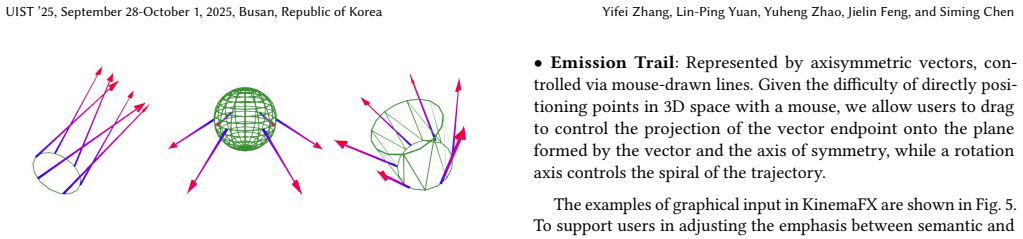
The load-bearing object is the structured particle effect representation $R=(S,K)$, with $S$ a semantic embedding and $K=(\text{shape},\text{trail},\text{duration})$. Trail is encoded as a sequence of spherical-coordinate changes $(\Delta r_i,\Delta \theta_i,\Delta \phi_i)$ of the particles on the outer boundary of the initial emission shape across $N=8$ lifetime divisions, exploiting the effects' axial symmetry. The kinematic distance between two effects is computed per time step as the Hausdorff distance between transformed shapes plus a rotation penalty $\lambda(1-\cos\Delta\phi_j)$, summed over steps and multiplied by a duration adjustment factor; search minimizes this distance together with semantic cosine distance while allowing transformations such as translation, rotation, scaling, and duration adjustment.
What would settle it
Build a set of particle effect pairs, collect human similarity ratings of their motion, and compute the paper's kinematic distance $D_k$ using the same representation; if the rank correlation with human ratings is near zero, the metric fails and the search advantage claimed in the study would not generalize beyond the demo dataset.
Extended reading notes
Core claim
The central claim is that particle effects can be designed through kinematics as a first-class query language, with semantics as a flexible complement. The paper argues that because people describe motion poorly in words, the system should let them draw the emission shape, the trail, and the duration, and should let them pick promising intermediate results instead of rephrasing queries. It then claims that the kinematic behavior of many effects can be abstracted as the evolution of a primitive emission shape through time and encoded by the spherical-coordinate changes of boundary particles; this encoding, combined with semantic embeddings, supports search, alignment, and composition. The reported evaluation shows the full system outperforming ablations on intent expression, convergent and divergent exploration, kinematic harmony, and effort.
Load-bearing premise
The load-bearing premise is that the spherical-coordinate boundary-shape encoding, Hausdorff distance, and rotation penalty capture the motion features human viewers actually perceive; the paper offers illustrative examples but no human validation of this metric.
Editorial extensions
If this is right
- Users who lack particle-system expertise can express motion intent through simple shapes and drawn lines, without first learning jargon or parameter panels.
- By selecting satisfying intermediate results, users steer the search implicitly; the system alternates local and directional exploration to both converge on intent and avoid local optima.
- Aligning kinematic behavior during retrieval reduces the manual repositioning, rescaling, and retiming normally needed to combine effects into one artwork.
- Semantic and kinematic similarity can be weighted per query, so a user with a vague concept can lean on text, while a user with a clear motion in mind can lean on graphics.
Reading between the lines
- The paper does not separately validate that its kinematic metric matches human perceptual similarity; a test of that mapping would show whether the study's benefits come from the metric or from the workflow around it.
- Because the representation reduces motion to one composite shape, it may transfer to other multi-object dynamics, such as gesture or swarm motion, but only if the shape-abstraction step remains perceptually faithful in those domains.
- The metric's weights $\lambda$ and $\alpha$ are tunable and unreported; a data-driven setting of these weights from human similarity ratings could make the method more general and easier to reproduce.
Editorial analysis
A structured set of objections, weighed in public.
Referee Report
Summary. KinemaFX is an interactive system that supports non-expert users in exploring and customizing 3D particle effect artworks. The paper proposes a conceptual model separating semantic features from kinematic behavior, and builds a workflow around LLM-based semantic processing, graphical input of emission shapes/trails/duration, and an iterative exploration loop that alternates between local search around user-selected effects and directional extrapolation between two selected effects. The core technical contribution is a structured representation of particle effects (shape, trail, duration encoded in spherical coordinates) and a distance metric combining semantic cosine similarity with a kinematic distance based on Hausdorff shape distances, a rotation penalty, and a duration adjustment factor. The system is evaluated through two usage scenarios and a within-subjects user study with 16 participants comparing four conditions: Baseline, Preference-Guided Exploration, Kinematic-Driven Search, and full KinemaFX. The authors report that KinemaFX improves intent expression, supports convergent and divergent exploration, improves kinematic harmony, reduces mental effort, and leads to satisfying effect artworks.
Significance. If the reported results hold, KinemaFX would be a useful step toward making complex 3D particle-effect creation accessible to non-experts, and its abstraction of kinematic behavior as transformations of a composite shape is a reasonable design idea that could generalize to other dynamic effects. The paper has clear strengths: a formative study with interviews and dataset analysis that motivates the design goals, a concrete and well-integrated system description, a user study with counterbalanced within-subjects conditions, and qualitative quotes that give insight into user experience. The authors also explicitly acknowledge some limitations, such as the lack of independent LLM evaluation. However, the quantitative evidence for the central claims is currently under-reported, and the kinematic distance metric—the paper's main technical novelty—is not validated against human perception and depends on unreported free parameters. These issues are load-bearing because the user study is the only empirical support for the claimed benefits of kinematic-driven search.
major comments (4)
- [Section 5.2, Figure 11] The quantitative basis for the central claim is under-reported. The text states that repeated-measures ANOVA or Friedman tests with Bonferroni correction were used, but it does not report F or chi-square statistics, degrees of freedom, p-values, means, standard deviations, or effect sizes for any of Q1–Q15. With n=16 and six pairwise comparisons per item, a bare significance star in Figure 11 is not sufficient to determine which differences actually reached the corrected threshold, and the reader cannot assess the magnitude of the reported advantages. Please add a full statistics table with descriptive statistics, test statistics, and effect sizes, and clarify in the figure which comparisons each star denotes.
- [Section 4.3.3, Eqs. (5)–(8)] The distance metric D_k depends on the free parameters lambda (rotation penalty weight) and alpha (duration adjustment weight), but the manuscript never reports these values, their ranges, or a sensitivity analysis. Since the rankings produced by Eq. (4) are directly controlled by these weights, the search component is not reproducible as described, and the robustness of the claimed benefits of kinematic-driven search cannot be assessed. Please report the parameter settings used in the study and include a sensitivity analysis, or otherwise justify the chosen values.
- [Section 5.1, study conditions] The ablation does not isolate the contribution of the kinematic distance metric. The Kinematic-Driven Search condition introduces both graphical kinematic input and the metric D_k relative to Baseline, while KinemaFX adds preference-guided exploration on top; consequently, the differences attributed to kinematic-driven search could be produced by the additional input modality alone, with no evidence that D_k itself aligns with human perception. Please add a control condition that provides graphical input while ranking by semantic similarity only, or provide an independent validation of D_k against human similarity judgments (for example, a perceptual rating study over retrieved rankings), and temper the claims accordingly.
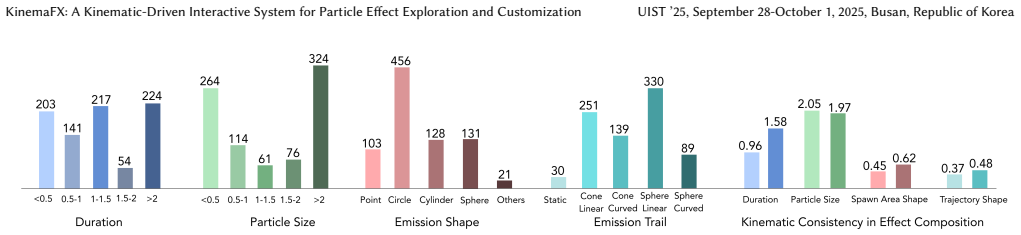
- [Section 3.3 and Section 2.1] The statement that the proposed kinematic representation "better aligns with human visual perception" is asserted rather than demonstrated. The qualitative analysis of the dataset establishes that axial symmetry is common and that within-artwork kinematic features are more similar than between-artwork features, but it does not test whether the spherical-coordinate trail encoding or the Hausdorff-plus-rotation-penalty distance matches human judgments of kinematic similarity. Figure 8 shows illustrative examples, not a validation. Given that the kinematic metric is the paper's core technical contribution, this missing validation is load-bearing for the generality of the search claims.
minor comments (5)
- [Figure 11] The significance stars are not accompanied by a description of which pairwise comparisons are shown; please add brackets, annotations, or a table so the reader can determine which conditions are being compared.
- [Abstract and Contributions] The phrase "customarily creating particle effect artworks" appears to be a typo; "in a customized manner" or "customized creation" would be clearer.
- [References] Reference [40] appears malformed after "Lars St"; the author names should be corrected.
- [Sections 4.2.2 and 4.3.1] The default values N=8 for lifetime discretization and K=4 for the number of local results are stated without justification; a brief explanation or a pilot-test reference would improve reproducibility.
- [Section 3.3] The comparison of within-artwork versus between-artwork feature differences is reported only with a significance threshold; please provide the test used and the sample sizes for that analysis.
Circularity Check
No significant circularity; the kinematic metric's unvalidated perceptual claims are an empirical validity concern, not a derivation-loop.
full rationale
The paper's central effectiveness claim is supported by a within-subjects user study with ablation conditions, Likert ratings, and qualitative interviews, not by quantities derived from its own kinematic equations. The kinematic distance metric in Eqs. 5-8 has unreported weights lambda and alpha and is not validated against human perceptual judgments, but this is a correctness or generalizability risk, not circularity: no parameter is fitted to the study outcomes, and no reported result is equal to an input by construction. The kinematic representation was informed by the same collected asset set used in the study, yet the evaluation measures subjective experience and task outcomes rather than the metric's ranking accuracy, so there is no fitted-input-called-prediction loop. Self-citations to prior work by the same authors (e.g., refs. 51, 57, 58, 59) appear only in related-work context and instrumentation references, and none carries the load of the paper's technical claims. No uniqueness theorem, no imported ansatz, and no renamed empirical pattern is used to force the system's design. Therefore, no specific circular step can be exhibited under the required standard.
Assumptions & free parameters
free parameters (4)
- lambda (rotation penalty weight) =
not reported
- alpha (duration adjustment weight) =
not reported
- N (lifetime discretization) =
8
- K (top results per local search) =
4
assumptions (5)
- domain assumption Particle effect emission shapes are adequately represented by circle, cylinder, and sphere primitives.
- domain assumption Particle effects are approximately axisymmetric, allowing alignment with the polar axis.
- ad hoc to paper Hausdorff distance on transformed primitive shapes plus rotation penalty captures perceptually meaningful kinematic similarity.
- domain assumption LLM semantic standardization and candidate generation preserve user intent well enough for retrieval and directional exploration.
- domain assumption The curated dataset of 147 artworks and 839 effects from two Unity Asset Store studios is representative of diverse particle effects.
Cite this review
Pith. "Pith review of KinemaFX: A Kinematic-Driven Interactive System for Particle Effect Exploration and Customization." pith.science (2026). https://pith.science/paper/YLA4LQAF
@misc{pith2026250719782,
  author       = {Pith},
  title        = {Pith review of: KinemaFX: A Kinematic-Driven Interactive System for Particle Effect Exploration and Customization},
  year         = {2026},
  howpublished = {\url{https://pith.science/paper/YLA4LQAF}},
  note         = {Machine review of arXiv:2507.19782}
}
read the original abstract
Particle effects are widely used in games and animation to simulate natural phenomena or stylized visual effects. However, creating effect artworks is challenging for non-expert users due to their lack of specialized skills, particularly in finding particle effects with kinematic behaviors that match their intent. To address these issues, we present KinemaFX, a kinematic-driven interactive system, to assist non-expert users in constructing customized particle effect artworks. We propose a conceptual model of particle effects that captures both semantic features and kinematic behaviors. Based on the model, KinemaFX adopts a workflow powered by Large Language Models (LLMs) that supports intent expression through combined semantic and kinematic inputs, while enabling implicit preference-guided exploration and subsequent creation of customized particle effect artworks based on exploration results. Additionally, we developed a kinematic-driven method to facilitate efficient interactive particle effect search within KinemaFX via structured representation and measurement of particle effects. To evaluate KinemaFX, we illustrate usage scenarios and conduct a user study employing an ablation approach. Evaluation results demonstrate that KinemaFX effectively supports users in efficiently and customarily creating particle effect artworks.
Figures


Figures from the paper (8 more)



Reference graph
Works this paper leans on
-
[1]
Matias Acuña. 2024. Visual Effects for Stilized Video Games. (2024)
work page 2024
-
[2]
Shm Garanganao Almeda, JD Zamfirescu-Pereira, Kyu Won Kim, Pradeep Mani Rathnam, and Bjoern Hartmann. 2024. Prompting for Discovery: Flex- ible Sense-Making for AI Art-Making with Dreamsheets. In Proceedings of the CHI Conference on Human Factors in Computing Systems . 1–17
2024
-
[3]
Milton Friedman and. 1937. The Use of Ranks to Avoid the Assumption of Normality Implicit in the Analysis of Variance. J. Amer. Statist. Assoc. 32, 200 (1937), 675–701. arXiv:https://www.tandfonline.com/doi/pdf/10.1080/01621459.1937.10503522 doi:10.1080/01621459.1937.10503522
arXiv 1937
-
[4]
Tyler Angert, Miroslav Suzara, Jenny Han, Christopher Pondoc, and Hariharan Subramonyam. 2023. Spellburst: A node-based interface for exploratory creative coding with natural language prompts. In Proceedings of the 36th Annual ACM Symposium on User Interface Software and Technology . 1–22
work page 2023
-
[5]
Rahul Arora, Rubaiat Habib Kazi, Danny M Kaufman, Wilmot Li, and Karan Singh
-
[6]
Liuqing Chen, Qianzhi Jing, Yixin Tsang, Qianyi Wang, Ruocong Liu, Duowei Xia, Yunzhan Zhou, and Lingyun Sun. 2024. AutoSpark: Supporting Automobile Appearance Design Ideation with Kansei Engineering and Generative AI. In Proceedings of the 37th Annual ACM Symposium on User Interface Software and Technology. 1–19
work page 2024
-
[7]
Chia-Hsing Chiu, Yuki Koyama, Yu-Chi Lai, Takeo Igarashi, and Yonghao Yue
-
[8]
Byungkuk Choi, Roger Blanco i Ribera, John P Lewis, Yeongho Seol, Seokpyo Hong, Haegwang Eom, Sunjin Jung, and Junyong Noh. 2016. SketchiMo: sketch- based motion editing for articulated characters. ACM Transactions on Graphics (ToG) 35, 4 (2016), 1–12
work page 2016
Show all 67 references
-
[9]
DaEun Choi, Sumin Hong, Jeongeon Park, John Joon Young Chung, and Juho Kim. 2024. CreativeConnect: Supporting Reference Recombination for Graphic Design Ideation with Generative AI. In Proceedings of the CHI Conference on Human Factors in Computing Systems . 1–25
2024
-
[10]
Yunjey Choi, Minje Choi, Munyoung Kim, Jung-Woo Ha, Sunghun Kim, and Jaegul Choo. 2018. Stargan: Unified generative adversarial networks for multi- domain image-to-image translation. In Proceedings of the IEEE conference on computer vision and pattern recognition . 8789–8797
2018
-
[11]
Jorge Chueca, Carlos Cetina, Oscar Pastor, and Jaime Font. 2024. Search-based co-creation of software models: The case of particle systems for video games. Information and Software Technology 171 (2024), 107466
2024
-
[12]
John Joon Young Chung and Eytan Adar. 2023. Artinter: AI-Powered Boundary Objects for Commissioning Visual Arts. InProceedings of the 2023 ACM Designing Interactive Systems Conference. 1997–2018
2023
-
[13]
John Joon Young Chung and Eytan Adar. 2023. Promptpaint: Steering text-to- image generation through paint medium-like interactions. In Proceedings of the 36th Annual ACM Symposium on User Interface Software and Technology . 1–17
2023
-
[14]
Hai Dang, Frederik Brudy, George Fitzmaurice, and Fraser Anderson. 2023. World- Smith: Iterative and Expressive Prompting for World Building with a Generative AI. In Proceedings of the 36th Annual ACM Symposium on User Interface Software and Technology. 1–17
2023
-
[15]
Charles Finance and Susan Zwerman. 2015. The visual effects producer: under- standing the art and business of VFX . Routledge
2015
-
[16]
Rao Fu, Zehao Wen, Zichen Liu, and Srinath Sridhar. 2024. Anyhome: Open- vocabulary generation of structured and textured 3d homes. In European Confer- ence on Computer Vision . Springer, 52–70
2024
-
[17]
Epic Games. 2023. Cascade Particle System. https://dev.epicgames. com/documentation/en-us/unreal-engine/cascade-particle-editor- reference?application_version=4.27
2023
-
[18]
Epic Games. 2023. Niagara Particle System. https://dev.epicgames.com/ documentation/en-us/unreal-engine/overview-of-niagara-effects-for-unreal- engine
2023
-
[19]
Martin Guay, Rémi Ronfard, Michael Gleicher, and Marie-Paule Cani. 2015. Space- time sketching of character animation. ACM Transactions on Graphics (ToG) 34, 4 (2015), 1–10
2015
-
[20]
Sandra G Hart and Lowell E Staveland. 1988. Development of NASA-TLX (Task Load Index): Results of empirical and theoretical research. In Advances in psy- chology. Vol. 52. Elsevier, 139–183
1988
-
[21]
Erin J Hastings, Ratan K Guha, and Kenneth O Stanley. 2008. Interactive evolution of particle systems for computer graphics and animation. IEEE Transactions on Evolutionary Computation 13, 2 (2008), 418–432
2008
-
[22]
Rong Huang, Haichuan Lin, Chuanzhang Chen, Kang Zhang, and Wei Zeng. 2024. PlantoGraphy: Incorporating iterative design process into generative artificial intelligence for landscape rendering. In Proceedings of the CHI Conference on Human Factors in Computing Systems . 1–19
2024
-
[23]
VES Jeffrey Okun and VES Susan Zwerman. 2020. The VES handbook of visual effects: industry standard VFX practices and procedures . Routledge
2020
-
[24]
Janin Koch, Nicolas Taffin, Michel Beaudouin-Lafon, Markku Laine, Andrés Lucero, and Wendy E Mackay. 2020. Imagesense: An intelligent collaborative ideation tool to support diverse human-computer partnerships. Proceedings of the ACM on human-computer interaction 4, CSCW1 (2020), 1–27
2020
-
[25]
Yuki Koyama and Masataka Goto. 2022. BO as assistant: Using Bayesian opti- mization for asynchronously generating design suggestions. In Proceedings of the 35th Annual ACM Symposium on User Interface Software and Technology . 1–14
2022
-
[26]
Boyu Li, Linping Yuan, Zhe Yan, Qianxi Liu, Yulin Shen, and Zeyu Wang. 2024. Anicraft: Crafting everyday objects as physical proxies for prototyping 3d char- acter animation in mixed reality. In Proceedings of the Annual ACM Symposium on User Interface Software and Technology . 1–14
2024
-
[27]
Jiawei Lin, Jiaqi Guo, Shizhao Sun, Zijiang Yang, Jian-Guang Lou, and Dongmei Zhang. 2023. Layoutprompter: awaken the design ability of large language models. Advances in Neural Information Processing Systems 36 (2023), 43852–43879
2023
-
[28]
Vivian Liu, Rubaiat Habib Kazi, Li-Yi Wei, Matthew Fisher, Timothy Langlois, Seth Walker, and Lydia Chilton. 2025. Logomotion: Visually-grounded code synthesis for creating and editing animation. In Proceedings of the 2025 CHI Conference on Human Factors in Computing Systems . 1–16
2025
-
[29]
Vivian Liu, Jo Vermeulen, George Fitzmaurice, and Justin Matejka. 2023. 3DALL- E: Integrating text-to-image AI in 3D design workflows. In Proceedings of the 2023 ACM designing interactive systems conference . 1955–1977
2023
-
[30]
Aitor Luque Bodet. 2022. Node-based particle system . B.S. thesis. Universitat Politècnica de Catalunya
2022
-
[31]
Damien Masson, Sylvain Malacria, Géry Casiez, and Daniel Vogel. 2024. Direct- gpt: A direct manipulation interface to interact with large language models. In Proceedings of the 2024 CHI Conference on Human Factors in Computing Systems . 1–16
2024
-
[32]
Meri Mattila. 2018. Visual effects for a 3D action game. (2018)
2018
-
[33]
We Are Visual Thinkers, Not Verbal Thinkers!
Hyerim Park, Joscha Eirich, Andre Luckow, and Michael Sedlmair. 2024. " We Are Visual Thinkers, Not Verbal Thinkers!": A Thematic Analysis of How Professional Designers Use Generative AI Image Generation Tools. In Proceedings of the 13th Nordic Conference on Human-Computer Int...
2024
-
[34]
Xiaohan Peng, Janin Koch, and Wendy E Mackay. 2024. Designprompt: Using multimodal interaction for design exploration with generative ai. In Proceedings of the 2024 ACM Designing Interactive Systems Conference . 804–818
2024
-
[35]
Wanli Qian, Chenfeng Gao, Anup Sathya, Ryo Suzuki, and Ken Nakagaki. 2024. SHAPE-IT: Exploring Text-to-Shape-Display for Generative Shape-Changing Behaviors with LLMs. In Proceedings of the 37th Annual ACM Symposium on User Interface Software and Technology. 1–29
2024
-
[36]
Joona Raappana. 2018. Great Particles and How to Make Them: Development of guidelines for the Unity Particle System. (2018)
2018
-
[37]
Rintar¯o Sat¯o and Michael Cohen. 2022. Particle System Parametrization with Bimanual Hand Gestures. In SHS Web of Conferences , Vol. 139. EDP Sciences, 03023
2022
-
[38]
Xinyu Shi, Yinghou Wang, Ryan Rossi, and Jian Zhao. 2025. Brickify: Enabling Expressive Design Intent Specification through Direct Manipulation on Design Tokens. In Proceedings of the CHI Conference on Human Factors in Computing Systems. 1–20
2025
-
[39]
Kihoon Son, DaEun Choi, Tae Soo Kim, Young-Ho Kim, and Juho Kim. 2024. Gen- query: Supporting expressive visual search with generative models. InProceedings of the CHI Conference on Human Factors in Computing Systems . 1–19. KinemaFX: A Kinematic-Driven Interactive System for ...
2024
-
[40]
Lars St, Svante Wold, et al. 1989. Analysis of variance (ANOVA). Chemometrics and intelligent laboratory systems 6, 4 (1989), 259–272
1989
-
[41]
Sangho Suh, Meng Chen, Bryan Min, Toby Jia-Jun Li, and Haijun Xia. 2024. Luminate: Structured Generation and Exploration of Design Space with Large Language Models for Human-AI Co-Creation. InProceedings of the CHI Conference on Human Factors in Computing Systems . 1–26
2024
-
[42]
Hou In Ivan Tam, Hou In Derek Pun, Austin T Wang, Angel X Chang, and Manolis Savva. 2024. SceneMotifCoder: Example-driven visual program learning for generating 3D object arrangements. arXiv preprint arXiv:2408.02211 (2024)
2024 arXiv
-
[43]
Unity Technologies. [n. d.]. Visual Effect Graph. https://unity.com/features/visual- effect-graph
-
[44]
Unity Technologies. 2023. Shuriken Particle System. https://docs.unity3d.com/ 355/Documentation/Components/class-ParticleSystem.html
2023
-
[45]
Tiffany Tseng, Ruijia Cheng, and Jeffrey Nichols. 2024. Keyframer: Empowering animation design using large language models. arXiv preprint arXiv:2402.06071 (2024)
2024 arXiv
-
[46]
Tero Vääräniemi. 2016. Example Solutions of Visual Effects in Fantasy Games. (2016)
2016
-
[47]
Cheng Wang, Haojin Yang, and Christoph Meinel. 2015. Deep semantic mapping for cross-modal retrieval. In 2015 IEEE 27th International conference on tools with artificial intelligence (ICTAI). IEEE, 234–241
2015
-
[48]
Can Wang, Hongliang Zhong, Menglei Chai, Mingming He, Dongdong Chen, and Jing Liao. 2024. Chat2Layout: Interactive 3D furniture layout with a multimodal LLM. arXiv preprint arXiv:2407.21333 (2024)
2024 arXiv
-
[49]
Shun-Yu Wang, Wei-Chung Su, Serena Chen, Ching-Yi Tsai, Marta Misztal, Kather- ine M Cheng, Alwena Lin, Yu Chen, and Mike Y Chen. 2024. RoomDreaming: Generative-AI Approach to Facilitating Iterative, Preliminary Interior Design Exploration. In Proceedings of the CHI Conference...
2024
-
[50]
Zhijie Wang, Yuheng Huang, Da Song, Lei Ma, and Tianyi Zhang. 2024. PromptCharm: Text-to-Image Generation through Multi-modal Prompting and Refinement. In Proceedings of the CHI Conference on Human Factors in Computing Systems. 1–21
2024
-
[51]
Zhan Wang, Lin-Ping Yuan, Liangwei Wang, Bingchuan Jiang, and Wei Zeng
-
[52]
Eric W Weisstein. 2004. Bonferroni correction. https://mathworld. wolfram. com/ (2004)
2004
-
[53]
Shishi Xiao, Liangwei Wang, Xiaojuan Ma, and Wei Zeng. 2024. TypeDance: Creating semantic typographic logos from image through personalized genera- tion. In Proceedings of the 2024 CHI Conference on Human Factors in Computing Systems. 1–18
2024
-
[54]
Jun Xing, Rubaiat Habib Kazi, Tovi Grossman, Li-Yi Wei, Jos Stam, and George Fitzmaurice. 2016. Energy-brushes: Interactive tools for illustrating stylized elemental dynamics. InProceedings of the 29th Annual Symposium on User Interface Software and Technology. 755–766
2016
-
[55]
Hui Ye, Kin Chung Kwan, Wanchao Su, and Hongbo Fu. 2020. ARAnimator: In-situ character animation in mobile AR with user-defined motion gestures. ACM Transactions on Graphics (TOG) 39, 4 (2020), 83–1
2020
-
[56]
Emilie Yu, Kevin Blackburn-Matzen, Cuong Nguyen, Oliver Wang, Rubaiat Habib Kazi, and Adrien Bousseau. 2023. Videodoodles: Hand-drawn anima- tions on videos with scene-aware canvases. ACM Transactions on Graphics (TOG) 42, 4 (2023), 1–12
2023
-
[57]
Lin-Ping Yuan, John J Dudley, Per Ola Kristensson, and Huamin Qu. 2025. Per- sonalized Dual-Level Color Grading for 360-degree Images in Virtual Reality. IEEE Transactions on Visualization and Computer Graphics (2025)
2025
-
[58]
You’ll Be Alice Adventuring in Wonderland!
Lin-Ping Yuan, Feilin Han, Liwenhan Xie, Junjie Zhang, Jian Zhao, and Huamin Qu. 2025. " You’ll Be Alice Adventuring in Wonderland!" Processes, Challenges, and Opportunities of Creating Animated Virtual Reality Stories. In Proceedings of the CHI Conference on Human Factors in ...
2025
-
[59]
Lin-Ping Yuan, Ziqi Zhou, Jian Zhao, Yiqiu Guo, Fan Du, and Huamin Qu. 2021. Infocolorizer: Interactive recommendation of color palettes for infographics.IEEE Transactions on Visualization and Computer Graphics 28, 12 (2021), 4252–4266
2021
-
[60]
Xingchen Zeng, Ziyao Gao, Yilin Ye, and Wei Zeng. 2024. IntentTuner: an interactive framework for integrating human intentions in fine-tuning text-to- image generative models. In Proceedings of the 2024 CHI Conference on Human Factors in Computing Systems . 1–18
2024
-
[61]
Bingqing Zhang and Wenfeng Hu. 2017. Game special effect simulation based on particle system of Unity3D. In 2017 IEEE/ACIS 16th International Conference on Computer and Information Science (ICIS) . IEEE, 595–598
2017
-
[62]
Enhao Zhang and Nikola Banovic. 2021. Method for exploring generative adver- sarial networks (gans) via automatically generated image galleries. InProceedings of the 2021 CHI Conference on Human Factors in Computing Systems . 1–15
2021
-
[63]
Hao Zhou, Chengming Hu, Ye Yuan, Yufei Cui, Yili Jin, Can Chen, Haolun Wu, Dun Yuan, Li Jiang, Di Wu, et al. 2024. Large language model (llm) for telecom- munications: A comprehensive survey on principles, key techniques, and oppor- tunities. IEEE Communications Surveys & Tuto...
2024
-
[64]
Qian Zhou, David Ledo, George Fitzmaurice, and Fraser Anderson. 2024. TimeTun- nel: Integrating Spatial and Temporal Motion Editing for Character Animation in Virtual Reality. In Proceedings of the 2024 CHI Conference on Human Factors in Computing Systems. 1–17
2024
-
[2019]
In Proceedings of the 32nd annual ACM symposium on user interface software and technology
Magicalhands: Mid-air hand gestures for animating in vr. In Proceedings of the 32nd annual ACM symposium on user interface software and technology . 463–477
-
[2020]
ACM Transactions on Graphics (TOG) 39, 4 (2020), 85–1
Human-in-the-loop differential subspace search in high-dimensional latent space. ACM Transactions on Graphics (TOG) 39, 4 (2020), 85–1
2020
-
[2024]
In Proceedings of the 2024 CHI Conference on Human Factors in Computing Systems
Virtuwander: Enhancing multi-modal interaction for virtual tour guidance through large language models. In Proceedings of the 2024 CHI Conference on Human Factors in Computing Systems . 1–20
2024
Reviewed August 6, 2026 · model on record in the stance chip above.
Discussion (0). Continue with ORCID to comment.