REVIEW 3 major objections 5 minor 1 cited by
How the cool-core population transitions from galaxy groups to massive clusters: A comparison of the largest Magneticum simulation with eROSITA, XMM-Newton, Chandra and LOFAR observations
T0 review · 3 major / 5 minor · reviewed 2026-08-11 · deepseek-v4-flash
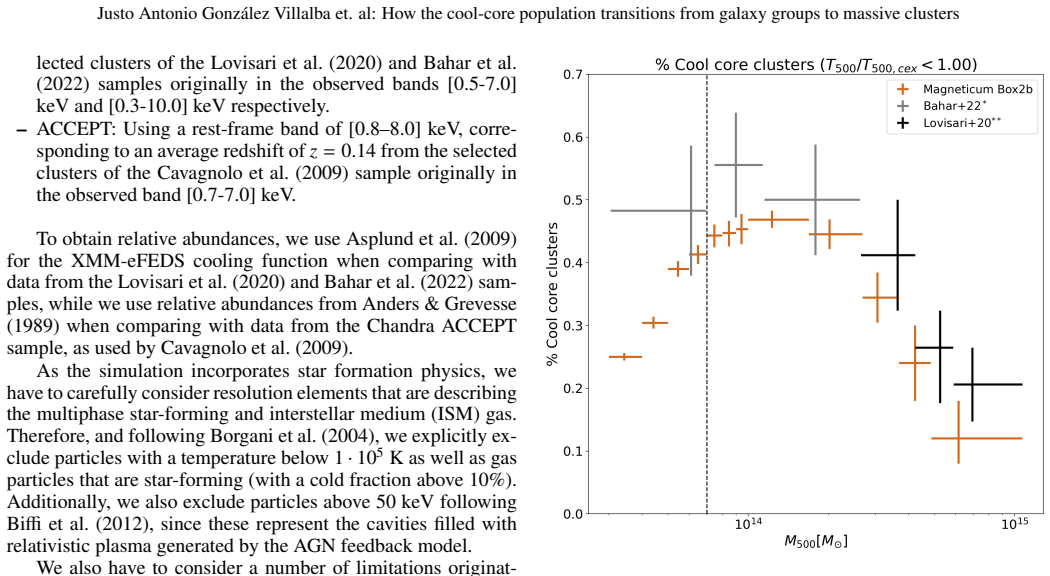
Pith's one-line read A large cosmological simulation reproduces the observed rise and fall of cool-core cluster fractions across mass, with the peak near $10^{14}$ solar masses.
desk verdict A genuinely useful new simulation-observation comparison with a solid high-mass result, but the claimed low-mass decline is overinterpreted and the new feedback model is calibrated to the same cavity data it is tested against. read the letter →
The pith
A machine-rendered reading of the paper's core claim, the machinery that carries it, and where it could break.
The reading
What carries the argument
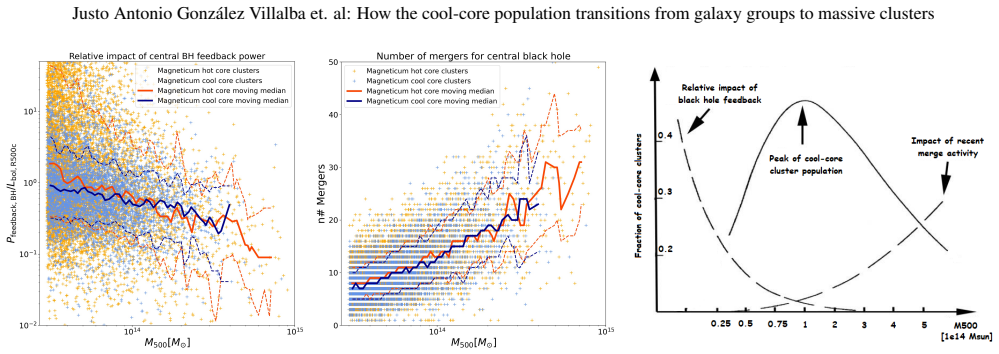
The load-bearing diagnostic is the core temperature ratio $T_{\mathrm{ratio},500}=T_{X,500}/T_{X,500,\mathrm{cex}}$, the emission-weighted temperature inside $R_{500c}$ divided by the temperature in the shell $0.15\,R_{500c}<r<R_{500c}$, with a threshold of unity defining cool versus hot cores in both observations and simulation. This ratio avoids resolution and K-correction biases and provides a common yardstick for X-ray-selected eFEDS groups and SZ-selected Planck/XMM clusters. The interpretive machinery is a two-factor balance in the simulation: the ratio of AGN feedback power to core bolometric luminosity decreases with mass, while both the number of black hole mergers and the effective Spitzer conductivity, scaled as $\kappa\propto T^{5/2}$, increase with mass, jointly producing the peak. The corrective machinery is the observed relation between cavity power and Bondi accretion rate, converted into a mass- and accretion-dependent total feedback efficiency, together with a cavity-reach versus power scaling used to replace the fixed sphere-of-influence injection radius.
What would settle it
A complete, mass-selected survey of galaxy groups below $M_{500c}\sim 7\times10^{12}\,M_\odot$ that measures temperature profiles and finds most low-mass groups are hot-core systems with flat entropy cores would falsify the claim that the low-mass decline is physical. Conversely, cavity-power measurements at group scales that do not fall below the simulation's current high feedback values would falsify the proposed reduced-efficiency correction.
Extended reading notes
Core claim
The central claim is that the cool-core population is not a monotonic function of halo mass: the fraction of systems with $T_{X,500}/T_{X,500,\mathrm{cex}}<1$ reaches a maximum around $M_{500c}\approx 10^{14}\,M_\odot$ and declines on both sides, and Magneticum Box2b/hr reproduces this curve within the observational error bars. The interpretation is two-factor: AGN feedback power relative to core luminosity grows toward low masses, making groups prone to overheating, while merger-injected kinetic energy, once thermalized and spread by Spitzer conductivity, grows in importance toward high masses and destroys cool cores. A direct simulation-observation comparison of cavity power shows the same energies at cluster scales but excess feedback at group scales, which the paper traces not to the total energy budget but to the definition of the black hole sphere of influence used for injection. The proposed fix, a total radio-mode efficiency $\epsilon_t \propto \dot{M}_{\mathrm{BH}}^{1/8}$ calibrated by the observed Bondi-power/cavity-power relation, reproduces observed cavity powers across the full mass range.
Load-bearing premise
The low-mass observational baseline assumes the combined eFEDS and Planck/XMM samples are complete and unbiased above $M_{500c}=0.7\times10^{13}\,M_\odot$ at $z<0.3$; if undetected hot-core groups are common, the observed rise toward low masses—and the inferred need for weaker AGN feedback there—is partly an artifact.
Editorial extensions
If this is right
- If the central claim is right, the observed decline of cool-core fraction toward high mass is a real physical trend, not a selection artifact, and any successful simulation must reproduce it with the same classification criterion.
- AGN heating dominates group scales: lower radio-mode efficiency toward low accretion rates is required to avoid overheating, so feedback models calibrated only on massive clusters will overheat groups.
- Merger activity alone does not destroy cool cores; the injected kinetic energy must be thermalized and transported inward, so thermal conductivity is a necessary ingredient in cluster-scale simulations.
- Simulation failures in star formation at cluster scales point to the injection scheme, not the energy budget: fixing the injection radius via observed cavity reach would improve resolution convergence.
- The cavity power–Bondi rate relation implies a weak but measurable mass trend in radio-mode efficiency, testable with larger cavity and radio samples across group and cluster masses.
Reading between the lines
- If the $1/8$ exponent is physical, cavity power should scale as $\dot{M}_{\mathrm{BH}}^{1.14}$; a dedicated sample of groups with both Bondi-rate estimates and cavity powers could confirm or refute this scaling independently of simulations.
- A deeper, mass-selected group survey that finds many hot-core groups below $M_{500c}\sim 7\times10^{12}\,M_\odot$ would indicate that part of the observed low-mass decline is a selection artifact, weakening the empirical case for reduced AGN efficiency at group scales.
- The sphere-of-influence diagnosis predicts a resolution dependence: rerunning a small-volume cluster with higher resolution and the same subgrid model should worsen the over-suppression of cool cores unless the injection radius is rescaled according to cavity reach.
- If BH spin decreases with BH mass as the paper cites, the Frolov-type spin-independent process offers a way to keep mechanical feedback strong in massive clusters; this could be tested by comparing jet power with independent spin estimates for a sample of brightest cluster galaxies.
Editorial analysis
A structured set of objections, weighed in public.
Referee Report
Summary. This paper compares the cool-core population in the Magneticum Box2b/hr cosmological simulation at z=0.25 with observational samples from eFEDS and Planck/XMM, and also compares simulated radial temperature, density, and entropy profiles with the Chandra ACCEPT sample, and AGN feedback energetics with Chandra cavity powers and LOFAR kinetic luminosities. The authors find a characteristic mass dependence of the cool-core fraction that peaks near M500c ≈ 10^14 Msun and decreases toward both lower-mass groups and higher-mass clusters, and they interpret this as a transition from AGN-dominated feedback at group scales to merger-driven thermalization and thermal conductivity at cluster scales. They further propose, based on an observed Bondi-power–cavity-power relation, that the AGN feedback efficiency in radio mode should decrease toward lower accretion rates, and they argue that the excessive star formation in simulated clusters is due to the numerical definition of the black hole sphere of influence rather than to insufficient total feedback energy.
Significance. If the central comparison is correct, this is a valuable, large-scale test of cool-core physics spanning two orders of magnitude in halo mass, using a consistent cool-core definition for both simulations and observations and a large simulated sample. The paper is also useful for the community because it explicitly quantifies the cool-core fraction with bootstrap errors, reproduces the observed temperature, density, and entropy profile shapes, and makes a falsifiable proposal about mass-dependent AGN feedback efficiency. The use of the same observational indicators for simulations and data, the detailed cooling-function treatment, and the honest discussion of the low-mass-group discrepancy are notable strengths. However, the main interpretive claims rest on two load-bearing points that need additional scrutiny: the statistical and selection robustness of the observed low-mass decline, and the extent to which the proposed AGN feedback correction is calibrated rather than independently validated by the cavity data.
major comments (3)
- [Sec. 4.4, Tables 1–2] See comment above.
- [Sec. 7.2, Eq. (7), Fig. 11] See comment above.
- [Sec. 4.5–4.6, Figs. 4–5] See comment above.
minor comments (5)
- [Sec. 4.4] See comment above.
- [Fig. 4 caption] See comment above.
- [Sec. 4.2] See comment above.
- [Sec. 4.5] See comment above.
- [Sec. 5.3 and Fig. 8] See comment above.
Circularity Check
Sec. 7.2 validates the 'corrected' AGN feedback model by recomputing a fit to the same cavity-power data it is then said to match; the cool-core population comparison itself remains an independent external benchmark.
-
fitted input called prediction
[Sec. 7.2, Eq. 7 and Fig. 11 (left panel)]
"We now can express the observed cavity power directly as a function of the inferred Bondi accretion rate ... the final parameters are P0 = 13.60+55.56−35.74 and βP = 1.14+0.09−0.22: ..."
Eq. 7 is an empirical power-law fit of Pcavity to ṀB made from the same observed cavity-power / Bondi-rate measurements (Rafferty et al. 2006, Russell et al. 2013, Eckert et al. 2021) that are plotted in Fig. 11. When this fit is evaluated at the simulation's ṀB values and the result is reported as 'matches the observed cavity power', the agreement is guaranteed by construction: the corrected-model curve is the fitting function itself, not an independent prediction. The claimed conclusion that a decreasing radio-mode efficiency toward groups is 'required' is an inference from the fitted slope, and the apparent validation in Fig. 11 therefore does not add independent support. The cool-core population comparison in Secs.
full rationale
The only forced step is the validation loop in Sec. 7.2: Eq. 7 is a fit to observed cavity power versus Bondi rate, Eq. 8 is the same relation divided by ṀBc², and the 'corrected' model's agreement with the observed cavity power in Fig. 11 is therefore a consistency check, not a prediction. That is a partial circularity and sets the score at 6. The paper's principal cool-core population result is not circular: the observed eFEDS + Planck/XMM cool-core fractions and the Magneticum Box2b/hr values are computed independently with the same temperature-ratio indicator, and no parameter of the simulation is fitted to those observed fractions. The acknowledged low-mass discrepancy ('can be lack of data or undetected hot-core systems') is a completeness/selection concern, not a circularity. The self-citations to earlier Magneticum validation papers are contextual and are not used to forbid alternatives or to import a uniqueness result, so they do not raise the score. The Frolov-collision efficiency argument in Sec. 7.4 is an independent theoretical input, though its agreement with Eq. 8 is naturally expected since Eq. 8 is a fit. Overall: one 'prediction' reduces by construction, while the central cool-core comparison remains self-contained.
Assumptions & free parameters
free parameters (5)
- P0 (normalization of P_cavity-Mdot relation, Eq. 7) =
13.60 (+55.56 / -35.74)
- beta_P (exponent in Eq. 7) =
1.14 (+0.09 / -0.22)
- epsilon_0 (normalization of total efficiency, Eq. 8) =
0.024 (+0.10 / -0.06)
- r0 (normalization of cavity reach vs power, Eq. 9) =
4.2 +/- 1.3 kpc
- beta_r (exponent in Eq. 9) =
0.37 +/- 0.05
assumptions (6)
- domain assumption The Bondi-Hoyle-Lyttleton accretion formula with boost factor alpha=100 (Eq. 5) describes accretion onto the central BH in groups and clusters.
- domain assumption Isotropic thermal conductivity at 1/20 of the Spitzer value (Eq. 4) is the correct effective transport model for cluster cores.
- domain assumption Observed cavity powers are computed with gamma=4/3 and an additional factor 2 for shock energy (Sec. 7.1).
- domain assumption The combined eFEDS and Planck/XMM samples are effectively complete and mass-selected above M500c = 0.7e13 Msun at z < 0.3.
- domain assumption The number of BH mergers of the central galaxy is a proxy for the merger history of the whole cluster.
- domain assumption The ADAF magnetic field scaling (Eq. 11) and the Frolov (2012) collision-energy mechanism apply to radio-mode AGN feedback and yield epsilon ~ Mdot^(1/8).
Cite this review
Pith. "Pith review of How the cool-core population transitions from galaxy groups to massive clusters: A comparison of the largest Magneticum simulation with eROSITA, XMM-Newton, Chandra and LOFAR observations." pith.science (2026). https://pith.science/paper/YMEUO435
@misc{pith2026241213182,
  author       = {Pith},
  title        = {Pith review of: How the cool-core population transitions from galaxy groups to massive clusters: A comparison of the largest Magneticum simulation with eROSITA, XMM-Newton, Chandra and LOFAR observations},
  year         = {2026},
  howpublished = {\url{https://pith.science/paper/YMEUO435}},
  note         = {Machine review of arXiv:2412.13182}
}
read the original abstract
Our aim is to understand how the interplay between AGN feedback and merge processes can effectively turn cool-core galaxy clusters into hot-core clusters in the modern universe. Additionally, we also aim to clarify which parameters of the AGN feedback model used in simulations can cause an excess of feedback at the scale of galaxy groups while not efficiently suppressing star formation at the scale of galaxy clusters. To obtain robust statistics of the cool-core population, we compare the modern Universe snapshot (z=0.25) of the largest Magneticum simulation (Box2b/hr) with the eROSITA eFEDS survey and Planck SZ-selected clusters observed with XMM-Newton. Additionally, we compare the AGN feedback injected by the simulation in radio mode with Chandra observations of X-ray cavities, and LOFAR observations of radio emission. We confirm a decreasing trend in cool-core fractions towards the most massive galaxy clusters, which is well reproduced by the Magneticum simulations. This evolution is connected with an increased merge activity that injects high-energy particles into the core region, but it also requires thermalization and conductivity to enhance mixing through the ICM core, where both factors are increasingly efficient towards the high mass end. On the other hand, AGN feedback remains as the dominant factor at the scale of galaxy groups, while its relative impact decreases towards the most massive clusters. The problems suppressing star formation in simulations are not caused by low AGN feedback efficiencies. They root in the definition of the black hole sphere of influence used to distribute the feedback, which decreases as density and accretion rate increase. Actually, a decreasing AGN feedback efficiency towards low-mass galaxy groups is required to prevent overheating.
Figures

Figures from the paper (9 more)


Forward citations
Cited by 1 Pith paper
-
Average soft X-ray surface brightness profile of massive galaxy clusters in Magneticum simulations
Magneticum simulations reproduce the eROSITA stacked soft X-ray surface brightness profile of massive clusters out to about 3 R500, with a central difference attributed to AGN feedback.
Reference graph
Works this paper leans on
-
[1]
, " * write output.state after.block = add.period write newline
ENTRY address archiveprefix author booktitle chapter edition editor howpublished institution eprint journal key month note number organization pages publisher school series title type volume year label extra.label sort.label short.list INTEGERS output.state before.all mid.sentence after.sentence after.block FUNCTION init.state.consts #0 'before.all := #1 ...
-
[2]
write newline
" write newline "" before.all 'output.state := FUNCTION n.dashify 't := "" t empty not t #1 #1 substring "-" = t #1 #2 substring "--" = not "--" * t #2 global.max substring 't := t #1 #1 substring "-" = "-" * t #2 global.max substring 't := while if t #1 #1 substring * t #2 global.max substring 't := if while FUNCTION word.in bbl.in " " * FUNCTION format....
-
[3]
T., Bower, R
Altamura, E., Kay, S. T., Bower, R. G., et al. 2023, Monthly Notices of the Royal Astronomical Society, 520, 3164
2023
-
[4]
& Grevesse, N
Anders, E. & Grevesse, N. 1989, Geochimica et Cosmochimica acta, 53, 197
1989
-
[5]
R., et al
Andrade-Santos, F., Jones, C., Forman, W. R., et al. 2017, The Astrophysical Journal, 843, 76
2017
-
[6]
2022, , 663, L6
Angelinelli , M., Ettori , S., Dolag , K., Vazza , F., & Ragagnin , A. 2022, , 663, L6
2022
-
[7]
2023, , 675, A188
Angelinelli , M., Ettori , S., Dolag , K., Vazza , F., & Ragagnin , A. 2023, , 675, A188
2023
-
[8]
Arth , A., Dolag , K., Beck , A. M., Petkova , M., & Lesch , H. 2014, arXiv e-prints, arXiv:1412.6533
arXiv 2014
Show all 137 references
-
[9]
J., & Scott, P
Asplund, M., Grevesse, N., Sauval, A. J., & Scott, P. 2009, Annual review of astronomy and astrophysics, 47, 481
2009
-
[10]
M., Lim, P
Astropy, C., Price-Whelan, A. M., Lim, P. L., et al. 2022, Astrophysical Journal, 935
2022
-
[11]
E., Bulbul, E., Clerc, N., et al
Bahar, Y. E., Bulbul, E., Clerc, N., et al. 2022, Astronomy & Astrophysics, 661, A7
2022
-
[12]
E., Bulbul, E., Ghirardini, V., et al
Bahar, Y. E., Bulbul, E., Ghirardini, V., et al. 2024, The SRG/eROSITA All-Sky Survey: Constraints on AGN Feedback in Galaxy Groups
2024
-
[13]
Baker, N. P. & Frolov, V. P. 2023, Physical Review D, 108, 024045
2023
-
[14]
J., Kannan , R., Vogelsberger , M., et al
Barnes , D. J., Kannan , R., Vogelsberger , M., et al. 2019, , 488, 3003
2019
-
[15]
J., Kay, S
Barnes, D. J., Kay, S. T., Bah \'e , Y. M., et al. 2017, Monthly Notices of the Royal Astronomical Society, 471, 1088
2017
-
[16]
J., Vogelsberger, M., Kannan, R., et al
Barnes, D. J., Vogelsberger, M., Kannan, R., et al. 2018, Monthly Notices of the Royal Astronomical Society, 481, 1809
2018
-
[17]
M., Murante, G., Arth, A., et al
Beck, A. M., Murante, G., Arth, A., et al. 2016, Monthly Notices of the Royal Astronomical Society, 455, 2110
2016
-
[18]
2016, The Astrophysical Journal, 827, 112
Biffi, V., Borgani, S., Murante, G., et al. 2016, The Astrophysical Journal, 827, 112
2016
-
[19]
2012, Monthly Notices of the Royal Astronomical Society, 420, 3545
Biffi, V., Dolag, K., Boehringer, H., & Lemson, G. 2012, Monthly Notices of the Royal Astronomical Society, 420, 3545
2012
-
[20]
2013, , 428, 1395
Biffi , V., Dolag , K., & B \"o hringer , H. 2013, , 428, 1395
2013
-
[21]
2018 a , , 481, 2213
Biffi , V., Dolag , K., & Merloni , A. 2018 a , , 481, 2213
2018
-
[22]
H., et al
Biffi , V., Dolag , K., Reiprich , T. H., et al. 2022, , 661, A17
2022
-
[23]
2018 b , , 214, 123
Biffi , V., Mernier , F., & Medvedev , P. 2018 b , , 214, 123
2018
-
[24]
Blandford, R. D. & Znajek, R. L. 1977, Monthly Notices of the Royal Astronomical Society, 179, 433
1977
-
[25]
2011, arXiv preprint arXiv:1112.5035
Boehringer, H., Dolag, K., & Chon, G. 2011, arXiv preprint arXiv:1112.5035
2011 arXiv
-
[26]
Boggs, P. T. & Rogers, J. E. 1990, Contemporary mathematics, 112, 183
1990
-
[27]
1952, Monthly Notices of the Royal Astronomical Society, 112, 195
Bondi, H. 1952, Monthly Notices of the Royal Astronomical Society, 112, 195
1952
-
[28]
& Hoyle, F
Bondi, H. & Hoyle, F. 1944, Monthly Notices of the Royal Astronomical Society, 104, 273
1944
-
[29]
& Kravtsov, A
Borgani, S. & Kravtsov, A. 2011, Advanced Science Letters, 4, 204
2011
-
[30]
2004, Monthly Notices of the Royal Astronomical Society, 348, 1078
Borgani, S., Murante, G., Springel, V., et al. 2004, Monthly Notices of the Royal Astronomical Society, 348, 1078
2004
-
[31]
O., Hallman, E
Burns, J. O., Hallman, E. J., Gantner, B., Motl, P. M., & Norman, M. L. 2008, The Astrophysical Journal, 675, 1125
2008
-
[32]
Caswell, T. et al. 2023, matplotlib/matplotlib: REL: v3. 7.0 rc1, doi: 10.5281/zenodo. 7570264
2023 doi
-
[33]
W., Donahue, M., Voit, G
Cavagnolo, K. W., Donahue, M., Voit, G. M., & Sun, M. 2008, The Astrophysical Journal, 682, 821
2008
-
[34]
W., Donahue, M., Voit, G
Cavagnolo, K. W., Donahue, M., Voit, G. M., & Sun, M. 2009, The Astrophysical Journal Supplement Series, 182, 12
2009
-
[35]
2003, Publications of the Astronomical Society of the Pacific, 115, 763
Chabrier, G. 2003, Publications of the Astronomical Society of the Pacific, 115, 763
2003
-
[36]
2007, Astronomy & Astrophysics, 466, 805
Chen, Y., Reiprich, T., B \"o hringer, H., Ikebe, Y., & Zhang, Y.-Y. 2007, Astronomy & Astrophysics, 466, 805
2007
-
[37]
2022, Astronomy & Astrophysics, 661, A11
Chiu, I.-N., Ghirardini, V., Liu, A., et al. 2022, Astronomy & Astrophysics, 661, A11
2022
-
[38]
u ggen, M., Kaiser, C., B \
Churazov, E., Br \"u ggen, M., Kaiser, C., B \"o hringer, H., & Forman, W. 2001, The Astrophysical Journal, 554, 261
2001
-
[39]
2005, Monthly Notices of the Royal Astronomical Society: Letters, 363, L91
Churazov, E., Sazonov, S., Sunyaev, R., et al. 2005, Monthly Notices of the Royal Astronomical Society: Letters, 363, L91
2005
-
[40]
Collaboration, E. H. T. et al. 2021, arXiv preprint arXiv:2105.01173
2021 arXiv
-
[41]
2018, Publications of the Astronomical Society of Japan, 70, 9
Collaboration, H., Aharonian, F., Akamatsu, H., et al. 2018, Publications of the Astronomical Society of Japan, 70, 9
2018
-
[42]
2020, arXiv preprint arXiv:2008.08404
Comparat, J., Eckert, D., Finoguenov, A., et al. 2020, arXiv preprint arXiv:2008.08404
2020 arXiv
-
[43]
& Dehnen, W
Cullen, L. & Dehnen, W. 2010, Monthly Notices of the Royal Astronomical Society, 408, 669
2010
-
[44]
J., D’Aloisio, A., & Natarajan, P
Davis, A. J., D’Aloisio, A., & Natarajan, P. 2011, Monthly Notices of the Royal Astronomical Society, 416, 242
2011
-
[45]
& Aly, H
Dehnen, W. & Aly, H. 2012, Monthly Notices of the Royal Astronomical Society, 425, 1068
2012
-
[46]
2005, nature, 433, 604
Di Matteo, T., Springel, V., & Hernquist, L. 2005, nature, 433, 604
2005
-
[47]
2015, IAU General Assembly, 29, 2250156
Dolag, K. 2015, IAU General Assembly, 29, 2250156
2015
-
[48]
2004, The Astrophysical Journal, 606, L97
Dolag, K., Jubelgas, M., Springel, V., Borgani, S., & Rasia, E. 2004, The Astrophysical Journal, 606, L97
2004
-
[49]
2017, Galaxies, 5, 35
Dolag , K., Mevius , E., & Remus , R.-S. 2017, Galaxies, 5, 35
2017
-
[50]
2005, Monthly Notices of the Royal Astronomical Society, 364, 753
Dolag, K., Vazza, F., Brunetti, G., & Tormen, G. 2005, Monthly Notices of the Royal Astronomical Society, 364, 753
2005
-
[51]
M., & O’Sullivan, E
Eckert, D., Gaspari, M., Gastaldello, F., Le Brun, A. M., & O’Sullivan, E. 2021, Universe, 7, 142
2021
-
[52]
2019, Astronomy and Astrophysics, 621, A40
Eckert, D., Ghirardini, V., Ettori, S., et al. 2019, Astronomy and Astrophysics, 621, A40
2019
-
[53]
2003, Monthly Notices of the Royal Astronomical Society, 344, L27
Fabian, A. 2003, Monthly Notices of the Royal Astronomical Society, 344, L27
2003
-
[54]
Fabian, A. C. 2002, in Lighthouses of the Universe: The Most Luminous Celestial Objects and Their Use for Cosmology: Proceedings of the MPA/ESO/MPE/USM Joint Astronomy Conference Held in Garching, Germany, 6-10 August 2001, Springer, 24--36
2002
-
[55]
2010, Monthly Notices of the Royal Astronomical Society, 401, 1670
Fabjan, D., Borgani, S., Tornatore, L., et al. 2010, Monthly Notices of the Royal Astronomical Society, 401, 1670
2010
-
[56]
S., et al
Foster, A., Smith, R., Brickhouse, N. S., et al. 2018, in American Astronomical Society Meeting Abstracts\# 231, Vol. 231, 253--03
2018
-
[57]
Foster, A. R. & Heuer, K. 2020, Atoms, 8, 49
2020
-
[58]
J., & Pimbblet, K
Fraser-McKelvie, A., Brown, M. J., & Pimbblet, K. A. 2014, Monthly Notices of the Royal Astronomical Society: Letters, 444, L63
2014
-
[59]
Frolov, V. P. 2012, Physical Review D, 85, 024020
2012
-
[60]
2014, arXiv preprint arXiv:1406.6366
Fujita, Y., Kawakatu, N., & Shlosman, I. 2014, arXiv preprint arXiv:1406.6366
2014 arXiv
-
[61]
2016, Publications of the Astronomical Society of Japan, 68, 26
Fujita, Y., Kawakatu, N., & Shlosman, I. 2016, Publications of the Astronomical Society of Japan, 68, 26
2016
-
[62]
2013, Astronomische Nachrichten, 334, 394
Gaspari, M., Brighenti, F., & Ruszkowski, M. 2013, Astronomische Nachrichten, 334, 394
2013
-
[63]
L., et al
Gaspari , M., McDonald , M., Hamer , S. L., et al. 2018, , 854, 167
2018
-
[64]
E., Bulbul, E., et al
Ghirardini, V., Bahar, Y. E., Bulbul, E., et al. 2022, AAS/High Energy Astrophysics Division, 54, 107
2022
-
[65]
2022, Astrophysics Source Code Library, ascl
Gobat, C. 2022, Astrophysics Source Code Library, ascl
2022
-
[66]
H., Zaritsky, D., & Zabludoff, A
Gonzalez, A. H., Zaritsky, D., & Zabludoff, A. I. 2007, The Astrophysical Journal, 666, 147
2007
-
[67]
& Mathews, W
Guo, F. & Mathews, W. G. 2010, The Astrophysical Journal, 712, 1311
2010
-
[68]
J., Dolag , K., & Liu , J
Gupta , N., Saro , A., Mohr , J. J., Dolag , K., & Liu , J. 2017, , 469, 3069
2017
-
[69]
2001, Clusters of galaxies and the high redshift universe observed in X-rays
Haardt, F., Madau, P., Neumann, D., & Tran, J. 2001, Clusters of galaxies and the high redshift universe observed in X-rays
2001
-
[70]
2017, Monthly Notices of the Royal Astronomical Society, 470, 166
Hahn, O., Martizzi, D., Wu, H.-Y., et al. 2017, Monthly Notices of the Royal Astronomical Society, 470, 166
2017
-
[71]
R., Millman, K
Harris, C. R., Millman, K. J., Van Der Walt, S. J., et al. 2020, Nature, 585, 357
2020
-
[72]
2014, Monthly Notices of the Royal Astronomical Society, 442, 2304
Hirschmann, M., Dolag, K., Saro, A., et al. 2014, Monthly Notices of the Royal Astronomical Society, 442, 2304
2014
-
[73]
S., Donahue, M., Hicks, A., & Barthelemy, R
Hoffer, A. S., Donahue, M., Hicks, A., & Barthelemy, R. 2012, The Astrophysical Journal Supplement Series, 199, 23
2012
-
[74]
2017, The Astrophysical Journal, 837, 51
Hogan, M., McNamara, B., Pulido, F., et al. 2017, The Astrophysical Journal, 837, 51
2017
-
[75]
& Lyttleton, R
Hoyle, F. & Lyttleton, R. A. 1939, Mathematical Proceedings of the Cambridge Philosophical Society, 35, 405–415
1939
-
[76]
& Dale, D
Hunter, J. & Dale, D. 2007, Matplotlib 0.90. 0 user’s guide
2007
-
[77]
2016, Monthly Notices of the Royal Astronomical Society, 457, 4340
Klypin, A., Yepes, G., Gottl \"o ber, S., Prada, F., & Hess, S. 2016, Monthly Notices of the Royal Astronomical Society, 457, 4340
2016
-
[78]
M., Dunkley, J., et al
Komatsu, E., Smith, K. M., Dunkley, J., et al. 2011, The Astrophysical Journal Supplement Series, 192, 18
2011
-
[79]
2013, Astronomy & Astrophysics, 555, A66
Lagan \'a , T., Martinet, N., Durret, F., et al. 2013, Astronomy & Astrophysics, 555, A66
2013
-
[80]
M., McCarthy, I
Le Brun, A. M., McCarthy, I. G., Schaye, J., & Ponman, T. J. 2014, Monthly Notices of the Royal Astronomical Society, 441, 1270
2014
-
[81]
2024, Astronomy & Astrophysics
Lehle, K., Nelson, D., Pillepich, A., Truong, N., & Rohr, E. 2024, Astronomy & Astrophysics
2024
-
[82]
2022, Astronomy & Astrophysics, 661, A2
Liu, A., Bulbul, E., Ghirardini, V., et al. 2022, Astronomy & Astrophysics, 661, A2
2022
-
[83]
2020, The Astrophysical Journal, 892, 102
Lovisari, L., Schellenberger, G., Sereno, M., et al. 2020, The Astrophysical Journal, 892, 102
2020
-
[84]
2024, arXiv e-prints, arXiv:2404.12719
Marini , I., Popesso , P., Lamer , G., et al. 2024, arXiv e-prints, arXiv:2404.12719
2024 arXiv
-
[85]
2012, Monthly Notices of the Royal Astronomical Society, 421, 1583
Maughan, B., Giles, P., Randall, S., Jones, C., & Forman, W. 2012, Monthly Notices of the Royal Astronomical Society, 421, 1583
2012
-
[86]
2004, Monthly Notices of the Royal Astronomical Society, 354, 10
Mazzotta, P., Rasia, E., Moscardini, L., & Tormen, G. 2004, Monthly Notices of the Royal Astronomical Society, 354, 10
2004
-
[87]
G., Babul, A., Bower, R
McCarthy, I. G., Babul, A., Bower, R. G., & Balogh, M. L. 2008, Monthly Notices of the Royal Astronomical Society, 386, 1309
2008
-
[88]
McCourt , M., Sharma , P., Quataert , E., & Parrish , I. J. 2012, , 419, 3319
2012
-
[89]
A., Vikhlinin , A., et al
McDonald , M., Benson , B. A., Vikhlinin , A., et al. 2013, , 774, 23
2013
-
[90]
2018, The Astrophysical Journal, 858, 45
McDonald, M., Gaspari, M., McNamara, B., & Tremblay, G. 2018, The Astrophysical Journal, 858, 45
2018
-
[91]
M., Burns, J
Motl, P. M., Burns, J. O., Loken, C., Norman, M. L., & Bryan, G. 2004, The Astrophysical Journal, 606, 635
2004
-
[92]
V., & Vikhlinin, A
Nagai, D., Kravtsov, A. V., & Vikhlinin, A. 2007, The Astrophysical Journal, 668, 1
2007
-
[93]
Narayan, R. & Yi, I. 1995, Astrophysical Journal v. 452, p. 710, 452, 710
1995
-
[94]
2014, Monthly Notices of the Royal Astronomical Society, 438, 2341
Panagoulia, E., Fabian, A., & Sanders, J. 2014, Monthly Notices of the Royal Astronomical Society, 438, 2341
2014
-
[95]
2022, Astronomy & Astrophysics, 661, A13
Pasini, T., Br \"u ggen, M., Hoang, D., et al. 2022, Astronomy & Astrophysics, 661, A13
2022
-
[96]
2003, The Astrophysical Journal, 590, 207
Peterson, J., Kahn, S., Paerels, F., et al. 2003, The Astrophysical Journal, 590, 207
2003
-
[97]
2013, , 431, 1487
Planelles , S., Borgani , S., Dolag , K., et al. 2013, , 431, 1487
2013
-
[98]
& Quilis, V
Planelles, S. & Quilis, V. 2009, Monthly Notices of the Royal Astronomical Society, 399, 410
2009
-
[99]
B., Babul, A., McCarthy, I
Poole, G. B., Babul, A., McCarthy, I. G., Sanderson, A., & Fardal, M. A. 2008, Monthly Notices of the Royal Astronomical Society, 391, 1163
2008
-
[100]
Price, D. J. 2008, Journal of Computational Physics, 227, 10040
2008
-
[101]
A., McNamara, B., Nulsen, P., & Wise, M
Rafferty, D. A., McNamara, B., Nulsen, P., & Wise, M. 2006, The Astrophysical Journal, 652, 216
2006
-
[102]
2017, Astronomy and Computing, 20, 52
Ragagnin , A., Dolag , K., Biffi , V., et al. 2017, Astronomy and Computing, 20, 52
2017
-
[103]
2019, , 486, 4001
Ragagnin , A., Dolag , K., Moscardini , L., Biviano , A., & D'Onofrio , M. 2019, , 486, 4001
2019
-
[104]
2021, , 500, 5056
Ragagnin , A., Saro , A., Singh , P., & Dolag , K. 2021, , 500, 5056
2021
-
[105]
2015, The Astrophysical Journal Letters, 813, L17
Rasia, E., Borgani, S., Murante, G., et al. 2015, The Astrophysical Journal Letters, 813, L17
2015
-
[106]
2004, The Astrophysical Journal, 618, L1
Rasia, E., Mazzotta, P., Borgani, S., et al. 2004, The Astrophysical Journal, 618, L1
2004
-
[107]
Reynolds, C. S. 2021, Annual Review of Astronomy and Astrophysics, 59, 117
2021
-
[108]
P., Tollerud, E
Robitaille, T. P., Tollerud, E. J., Greenfield, P., et al. 2013, Astronomy & Astrophysics, 558, A33
2013
-
[109]
2018, Astronomy & Astrophysics, 618, A39
Roncarelli, M., Gaspari, M., Ettori, S., et al. 2018, Astronomy & Astrophysics, 618, A39
2018
-
[110]
2017, Monthly Notices of the Royal Astronomical Society, 468, 1917
Rossetti, M., Gastaldello, F., Eckert, D., et al. 2017, Monthly Notices of the Royal Astronomical Society, 468, 1917
2017
-
[111]
2013, Monthly Notices of the Royal Astronomical Society, 432, 530
Russell, H., McNamara, B., Edge, A., et al. 2013, Monthly Notices of the Royal Astronomical Society, 432, 530
2013
-
[112]
2023, arXiv preprint arXiv:2312.07657
Sala, L., Valentini, M., Biffi, V., & Dolag, K. 2023, arXiv preprint arXiv:2312.07657
2023 arXiv
-
[113]
2010, Monthly Notices of the Royal Astronomical Society, 402, 127
Sanders, J., Fabian, A., Frank, K., Peterson, J., & Russell, H. 2010, Monthly Notices of the Royal Astronomical Society, 402, 127
2010
-
[114]
2018, Monthly Notices of the Royal Astronomical Society, 474, 1065
Sanders, J., Fabian, A., Russell, H., & Walker, S. 2018, Monthly Notices of the Royal Astronomical Society, 474, 1065
2018
-
[115]
J., Edge, A
Sanderson, A. J., Edge, A. C., & Smith, G. P. 2009, Monthly Notices of the Royal Astronomical Society, 398, 1698
2009
-
[116]
S., Rosati, P., Tozzi, P., et al
Santos, J. S., Rosati, P., Tozzi, P., et al. 2008, Astronomy & Astrophysics, 483, 35
2008
-
[117]
S., Tozzi, P., Rosati, P., & B \"o hringer, H
Santos, J. S., Tozzi, P., Rosati, P., & B \"o hringer, H. 2010, Astronomy & Astrophysics, 521, A64
2010
-
[118]
Sarazin, C. L. 2002, Merging Processes in Galaxy Clusters, 1
2002
-
[119]
& Perktold, J
Seabold, S. & Perktold, J. 2010, SciPy, 7
2010
-
[120]
Shakura, N. I. & Sunyaev, R. A. 1973, Astronomy and Astrophysics, Vol. 24, p. 337-355, 24, 337
1973
-
[121]
2007, Monthly Notices of the Royal Astronomical Society, 380, 877
Sijacki, D., Springel, V., Di Matteo, T., & Hernquist, L. 2007, Monthly Notices of the Royal Astronomical Society, 380, 877
2007
-
[122]
K., Brickhouse, N
Smith, R. K., Brickhouse, N. S., Liedahl, D. A., & Raymond, J. C. 2001, The Astrophysical Journal, 556, L91
2001
-
[123]
1962, Jr., Physics of fully ionized gases
Spitzer, L. 1962, Jr., Physics of fully ionized gases
1962
-
[124]
2005, Monthly notices of the royal astronomical society, 364, 1105
Springel, V. 2005, Monthly notices of the royal astronomical society, 364, 1105
2005
-
[125]
2005, Monthly Notices of the Royal Astronomical Society, 361, 776
Springel, V., Di Matteo, T., & Hernquist, L. 2005, Monthly Notices of the Royal Astronomical Society, 361, 776
2005
-
[126]
& Hernquist, L
Springel, V. & Hernquist, L. 2003, Monthly Notices of the Royal Astronomical Society, 339, 289
2003
-
[127]
2007, , 382, 1050
Tornatore , L., Borgani , S., Dolag , K., & Matteucci , F. 2007, , 382, 1050
2007
-
[128]
2004, Monthly Notices of the Royal Astronomical Society, 349, L19
Tornatore, L., Borgani, S., Matteucci, F., Recchi, S., & Tozzi, P. 2004, Monthly Notices of the Royal Astronomical Society, 349, L19
2004
-
[129]
& Drake Jr, F
Van Rossum, G. & Drake Jr, F. L. 1995, Python tutorial, Vol. 620 (Centrum voor Wiskunde en Informatica Amsterdam, The Netherlands)
1995
-
[130]
E., et al
Virtanen, P., Gommers, R., Oliphant, T. E., et al. 2020, Nature methods, 17, 261
2020
-
[131]
2013, Monthly Notices of the Royal Astronomical Society, 436, 3031
Vogelsberger, M., Genel, S., Sijacki, D., et al. 2013, Monthly Notices of the Royal Astronomical Society, 436, 3031
2013
-
[132]
M., Donahue , M., Bryan , G
Voit , G. M., Donahue , M., Bryan , G. L., & McDonald , M. 2015, , 519, 203
2015
-
[133]
2008, Monthly Notices of the Royal Astronomical Society, 387, 427
Wadsley, J., Veeravalli, G., & Couchman, H. 2008, Monthly Notices of the Royal Astronomical Society, 387, 427
2008
-
[134]
P., Schaye, J., & Smith, B
Wiersma, R. P., Schaye, J., & Smith, B. D. 2009, Monthly Notices of the Royal Astronomical Society, 393, 99
2009
-
[135]
& Narayan, R
Yuan, F. & Narayan, R. 2014, Annual Review of Astronomy and Astrophysics, 52, 529
2014
-
[136]
& Han, J
Yuan, Z. & Han, J. 2020, Monthly Notices of the Royal Astronomical Society, 497, 5485
2020
-
[137]
2012, The Astrophysical Journal, 762, 78
ZuHone, J., Markevitch, M., Brunetti, G., & Giacintucci, S. 2012, The Astrophysical Journal, 762, 78
2012
Reviewed August 11, 2026 · model on record in the stance chip above.
Discussion (0). Continue with ORCID to comment.