REVIEW 3 major objections 5 minor 118 references
Tuning seven simulation dials reproduces low gas in galaxy clusters
Reviewed by Pith at T0; open to challenge. T0 means a machine referee read the full paper against a public rubric. the ladder, T0–T4 →
T0 review · deepseek-v4-flash
2026-08-02 06:02 UTC pith:YMQHOW7H
load-bearing objection Solid calibration study with an overstrong punchline: MTNG can be pushed toward low eROSITA gas fractions by retuning seven subgrid parameters, but the confirmatory simulation is never compared to the data, so the 'cannot be ruled out' claim needs direct support. the 3 major comments →
Evaluating the flexibility of the MillenniumTNG galaxy formation model with multi-zoom re-simulations
The pith
A machine-rendered reading of the paper's core claim, the machinery that carries it, and where it could break.
Core claim
The central claim is that the MillenniumTNG model 'cannot be ruled out at high significance' by current measurements of the galaxy stellar mass function and cluster gas fractions. A point in its seven-dimensional subgrid parameter space produces a qualitatively good simultaneous fit, with the key changes being less energetic stellar winds and more energetic, rarer kinetic AGN feedback events. This best-fit point is confirmed by a dedicated re-simulation, and the residual disagreement at the most massive clusters is substantially reduced, though not eliminated.
What carries the argument
Gaussian-process emulators trained on 31 multi-zoom re-simulations drawn from a Latin-hypercube design over a seven-dimensional subspace of the MillenniumTNG subgrid model. The emulators interpolate the galaxy stellar mass function and gas fractions across parameter space with roughly 0.1 dex and 10% precision, allowing an MCMC search for a parameter set consistent with both datasets; the multi-zoom technique is what makes 31 variations affordable, at about forty times lower cost than combined individual zoom-in runs.
Load-bearing premise
The claimed consistency with low gas fractions holds only if the seven varied parameters span a range wide enough to represent what the model can actually do; the best-fit values pressing against the prior edges suggest this may not be fully guaranteed.
What would settle it
Run the best-fit parameter set at a higher mass resolution than MillenniumTNG's native resolution. The paper itself shows that the galaxy stellar mass function shifts with resolution; if the simultaneous fit to the stellar mass function and the low gas fractions degrades beyond the emulator's stated errors, the claim that the model cannot be ruled out would not survive.
If this is right
- The MillenniumTNG model does not require new physical mechanisms such as AGN jets or hot-gas bubbles to approach the low gas fractions reported by recent X-ray surveys; recalibrating existing parameters suffices.
- The best-fit regime—weaker stellar feedback with stronger, rarer kinetic AGN feedback—offers a concrete target for interpreting strong-feedback scenarios in galaxy formation.
- The most massive clusters (M500,c above about 10^14 solar masses) remain in tension, so the model still cannot match the most extreme low-gas measurements; the gap is reduced but not closed.
- The multi-zoom technique makes systematic parameter exploration of large-volume simulations economically feasible, well below the cost of uniform boxes or individual zoom suites.
- The explicit validation run at the best-fit point confirms that the emulator-based conclusion reflects a real property of the simulation model, not an interpolation artifact.
Where Pith is reading between the lines
- If the roughly 28 unvaried subgrid parameters were also allowed to vary, the fit would likely improve further, but the model's 'flexibility' would become harder to distinguish from an ability to accommodate nearly any observation; the total of about 35 adjustable parameters is worth remembering when interpreting flexibility claims.
- The paper notes the galaxy stellar mass function shifts with mass resolution; a higher-resolution counterpart of the best-fit simulation would test whether the recalibrated parameters are genuinely viable or an artifact of MillenniumTNG's resolution.
- The same emulator-plus-validation pipeline could map which regions of parameter space remain consistent with other strong-feedback observations, such as thermal Sunyaev-Zeldovich profiles or dispersion measures, turning flexibility into a quantifiable property of different simulation codes.
- The fact that two best-fit parameters press against the prior bounds hints that the true flexibility of the model may lie partly outside the probed ranges; extending the priors on the kinetic AGN efficiency and burstiness axes would clarify the robustness of the found solution.
Editorial analysis
A structured set of objections, weighed in public.
Referee Report
Summary. The paper introduces a suite of multi-zoom re-simulations of halos selected from MillenniumTNG (MTNG), running 31 variations of seven subgrid parameters controlling stellar feedback, star formation, and AGN feedback. The authors validate a reweighting procedure for reconstructing population statistics from the selected halos, measure the GSMF and gas fractions, and train Gaussian-process emulators for these quantities. The emulators are then fit to recent measurements of the GSMF and to two gas-fraction datasets: the K23 compilation ("high" gas fractions) and the P26 eROSITA measurements ("low" gas fractions). A joint best-fit parameter combination is found for the GSMF + P26 data, and the authors run one additional simulation at that best-fit point to validate the emulator prediction. They conclude that the MTNG/TNG model is flexible enough to provide plausible simultaneous fits to the GSMF and gas fractions and therefore cannot be ruled out by these data at high significance, although the fit still leaves tension at the highest cluster masses.
Significance. If substantiated, this is a valuable result. The multi-zoom technique appears to reduce computational cost by roughly an order of magnitude relative to individual zooms, and the reweighting validation on 100 random halo selections is a solid, constructive test. The GP emulators are cross-validated, and the paper includes an explicit direct simulation at the best-fit parameter point, which is a strong and commendable check that the emulator is not extrapolating nonsense. The astrophysical conclusion would also be significant: it would suggest that the MTNG model does not necessarily require additional physical mechanisms such as jets or bubbles to approach the low eROSITA gas fractions, and that recalibrating seven subgrid parameters substantially reduces the tension. However, the central statistical claim is currently stronger than what the validation supports, because the direct simulation is compared to the emulator, not to the observations.
major comments (3)
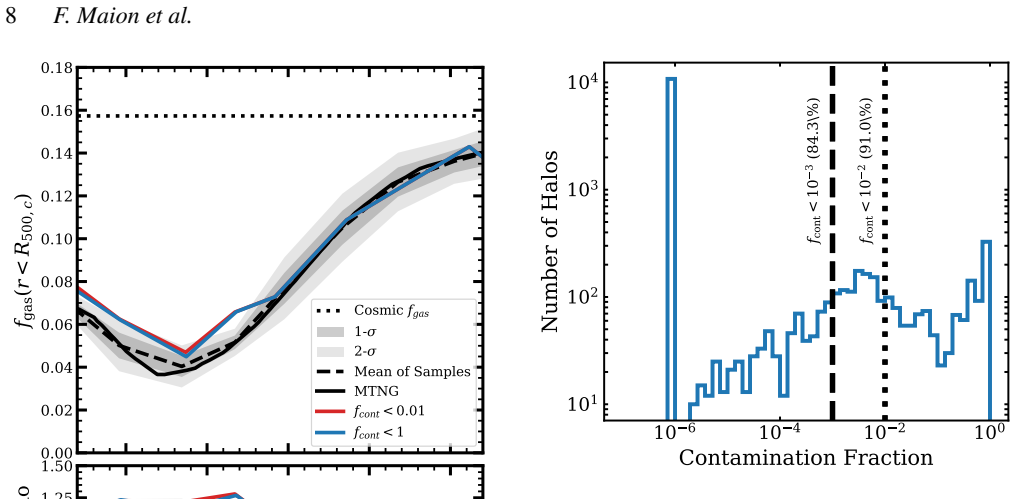
- [§6.3, Fig. 15; §7] The direct 'Joint Best-Fit Run' in Fig. 15 is compared only against the GP emulator prediction, not against the P26 gas-fraction or GSMF data points. The calibration likelihood (Eqs. 32–34) includes the GP predictive covariance K_pred(θ) as part of the model uncertainty, so the object that maximizes the likelihood is the emulator-smoothed prediction. The statement in §7 that the model 'cannot be ruled out at high significance' therefore requires a goodness-of-fit test of the actual simulated quantities against the observations, using the reconstruction covariance (Section 2.4) plus observational errors, without K_pred. Such a chi-squared/p-value is not provided and is needed to support the central claim.
- [Table 2 vs Table 4] The best-fit value A_AGN,1 = 1.06 exceeds the stated prior maximum of 1.0, and f_re = 35.8 lies within 10% of its maximum 40. The authors acknowledge in §6.2.2 that these parameters are pushed to the edge of their prior. Combined with the fact that only 7 of the ~35 model parameters are varied (as noted in §7), this weakens the generalization that the MTNG model 'cannot be ruled out.' The fit may exist only at or beyond the probed boundary, and other unvaried parameters could change the flexibility. A sensitivity test extending the A_AGN,1 range, or a more cautious phrasing of the conclusion, is required.
- [§6.2.2, Fig. 14] The emulator at the joint MLP provides a good fit to P26 below M500,c ~ 10^13.5 Msun, but the authors themselves state that the model cannot produce similarly low gas fractions for M500,c ≳ 10^14 Msun. The phrase 'significantly reducing the tension' is not quantified, and the central claim is only qualitative ('qualitatively good fit'). Because 'cannot be ruled out at high significance' is a statistical statement, the paper needs a quantitative measure of the residual discrepancy, not just a visual comparison.
minor comments (5)
- [§6.3] Typo: 'GSFM' should be 'GSMF' in the sentence 'while maintaining consistency with the GSFM.'
- [Table A1] The column headers for the simulation parameters are difficult to parse; consider adding a separate header row with units and the parameter symbols used in Table 2.
- [Section 2.4, Eq. (20)] The set S500,c is used before it is defined; reorder the definition for clarity.
- [Eq. (13) and Table 2] The parameter f_re is called a 'reorientation parameter' in Eq. (13) but is described as 'burstiness/reorientation' in Table 2. A short precise definition of what f_re controls in the implementation would help.
- [Abstract / Fig. 8] The abstract claims emulator precision of ~0.1 dex and ~10%, but the cross-validation section does not quote these numbers explicitly. Adding a quantitative statement in Section 5.2 would make the claim easier to verify.
Circularity Check
No significant circularity: the paper performs an explicit calibration fit, not a prediction, and its central flexibility claim rests on a genuinely independent validation simulation.
full rationale
The derivation chain is self-contained. The paper runs 31 multi-zoom simulations at sampled subgrid parameters, measures the GSMF and gas fractions, trains GP emulators on those simulation outputs, cross-validates them against held-out simulations (Figure 8), and then performs an explicit MCMC calibration of the seven varied parameters to external observational data (Eqs. 32-34). The 'good fit' is the product of a fitting procedure, not a disguised first-principles prediction; the abstract and Section 6 consistently say 'fit' and 'calibrate.' The central flexibility claim is therefore not circular: it is an existence statement obtained by optimizing a likelihood. The explicit validation run at the best-fit point is a genuinely new simulation, independent of the GP training set, and its agreement with the GP prediction (Figure 15) checks the emulator interpolation. The paper itself flags the remaining caveat that it has not examined many other observables, and the statistical support for 'cannot be ruled out' would be stronger if the direct simulation were compared to the observations rather than only to the emulator; that is a completeness/statistical-support limitation, not a circular reduction. The only overlapping-author citation (Genel et al. 2026 for the count of 35 TNG parameters) is ancillary and not load-bearing for the fitted result, so it does not raise the circularity score.
Axiom & Free-Parameter Ledger
free parameters (9)
- e_w (wind energy) =
1.41 (fiducial 3.6, range 0.9-14.4)
- kappa_w (wind velocity) =
10.0 (fiducial 7.4, range 3.7-14.8)
- rho_rec (recoupling density) =
0.13 (fiducial 0.05)
- t0_SFR (star-formation timescale) =
2.2 Gyr (fiducial 2.27, range 1.135-4.54)
- A_AGN,1 (kinetic AGN efficiency) =
1.06 (fiducial 0.1, stated max 1)
- eps_f,high (quasar-mode thermal coupling) =
0.081 (fiducial 0.1, range 0.05-0.2)
- f_re (AGN reorientation/burstiness) =
35.8 (fiducial 20, range 10-40)
- b_* (stellar mass bias) =
marginalized with prior log10 b_* ~ N(0,0.14)
- b_cv (cosmic variance amplitude) =
marginalized with prior b_cv ~ N(1,0.06)
axioms (6)
- domain assumption The IllustrisTNG/MTNG subgrid model (star formation, SNII winds, AGN kinetic and thermal feedback) is an adequate representation of galaxy formation for this purpose.
- domain assumption The multi-zoom N-GENIC initial conditions correctly reproduce the large-scale tidal field and the evolution of high-resolution regions.
- domain assumption A Gaussian process with RBF kernel and MLE hyperparameters faithfully interpolates the 7-dimensional simulation response surface.
- standard math The reweighting approximation that conditional GSMF and gas fractions are constant within each fine halo-mass bin is accurate.
- domain assumption The observational systematics models adopted (HSE bias correction from K23, Eddington bias sigma=min(0.070+0.071z,0.3), stellar-mass-bias prior, cosmic-variance prior) are correct and complete.
- standard math Planck 2016 cosmological parameters are fixed and correct.
read the original abstract
In this study we introduce a new simulation campaign designed to understand how parameters that control star-formation and AGN feedback processes in cosmological hydrodynamical simulations impact observables such as the galaxy stellar-mass function (GSMF) and the gas fractions in large dark matter halos. These simulations are zoom-ins to halos selected from the MillenniumTNG (MTNG) simulation, and are run employing a novel multi-zoom approach which simultaneously re-simulates several sub-regions of a given large volume at a higher resolution than the background, thus reducing computational cost and imbalances in parallelization. We measure the GSMF and gas-fractions in halos for each of the re-simulations, and train Gaussian-process emulators on these quantities. The resulting emulators predict the GSMF and gas-fractions in halos with $\sim0.1\,\mathrm{dex}$ and $\sim 10\%$ precision respectively. Using the emulators we can simultaneously fit recent measurements of both quantities, in particular the lower gas fractions now observed even for comparatively massive clusters. Interestingly, we find a combination of parameters of the MTNG galaxy formation model that provides a qualitatively good fit to both the measured GSMF and gas fractions. This combination of parameters differs from the fiducial one mainly by requiring that stellar-feedback is significantly less energetic, and that kinetic AGN feedback events are significantly more energetic and rare. This finding implies that the MTNG model can be consistent with scenarios of strong feedback that remove large amounts of gas from groups and clusters, albeit we caution that we have not extensively examined the effect of these new parameters on many quantities for which MTNG made successful predictions.
Figures




Reference graph
Works this paper leans on
-
[1]
On the Significance of Covariance for Constraining Theoretical Models from Galaxy Observables. , keywords =. doi:10.3847/1538-4357/ae19e4 , archivePrefix =. 2410.21722 , primaryClass =
-
[2]
Vogelsberger, M. and Genel, S. and Springel, V. and Torrey, P. and Sijacki, D. and Xu, D. and Snyder, G. and Bird, S. and Nelson, D. and Hernquist, L. , year=. Properties of galaxies reproduced by a hydrodynamic simulation , volume=. Nature , publisher=. doi:10.1038/nature13316 , number=
-
[3]
2025 , eprint=
Joint X-ray, kinetic Sunyaev-Zeldovich, and weak lensing measurements: toward a consensus picture of efficient gas expulsion from groups and clusters , author=. 2025 , eprint=
2025
-
[4]
The hot gas mass fraction in halos: From Milky Way-like groups to massive clusters. , keywords =. doi:10.1051/0004-6361/202453256 , archivePrefix =. 2411.16555 , primaryClass =
-
[5]
First results from the IllustrisTNG simulations: the stellar mass content of groups and clusters of galaxies. , keywords =. doi:10.1093/mnras/stx3112 , archivePrefix =. 1707.03406 , primaryClass =
-
[6]
Galaxy And Mass Assembly (GAMA): Data Release 4 and the z<0.1 total and z < 0.08 morphological galaxy stellar mass functions , volume=
Driver, Simon P and Bellstedt, Sabine and Robotham, Aaron S G and Baldry, Ivan K and Davies, Luke J and Liske, Jochen and Obreschkow, Danail and Taylor, Edward N and Wright, Angus H and Alpaslan, Mehmet and Bamford, Steven P and Bauer, Amanda E and Bland-Hawthorn, Joss and Bilicki, Maciej and Bravo, Matías and Brough, Sarah and Casura, Sarah and Cluver, M...
-
[7]
Simulating galaxy formation with the IllustrisTNG model , volume=
Pillepich, Annalisa and Springel, Volker and Nelson, Dylan and Genel, Shy and Naiman, Jill and Pakmor, Rüdiger and Hernquist, Lars and Torrey, Paul and Vogelsberger, Mark and Weinberger, Rainer and Marinacci, Federico , year=. Simulating galaxy formation with the IllustrisTNG model , volume=. Monthly Notices of the Royal Astronomical Society , publisher=....
-
[8]
E pur si muove:Galilean-invariant cosmological hydrodynamical simulations on a moving mesh , volume=
Springel, Volker , year=. E pur si muove:Galilean-invariant cosmological hydrodynamical simulations on a moving mesh , volume=. Monthly Notices of the Royal Astronomical Society , publisher=. doi:10.1111/j.1365-2966.2009.15715.x , number=
arXiv 2009
-
[9]
The AREPO Public Code Release. , keywords =. doi:10.3847/1538-4365/ab908c , archivePrefix =. 1909.04667 , primaryClass =
Pith/arXiv arXiv 1909
-
[10]
The MillenniumTNG Project: the hydrodynamical full physics simulation and a first look at its galaxy clusters. , keywords =. doi:10.1093/mnras/stac3620 , archivePrefix =. 2210.10060 , primaryClass =
-
[11]
Simulating galaxy formation with black hole driven thermal and kinetic feedback. , keywords =. doi:10.1093/mnras/stw2944 , archivePrefix =. 1607.03486 , primaryClass =
-
[12]
The CAMELS Project: Cosmology and Astrophysics with Machine-learning Simulations. , keywords =. doi:10.3847/1538-4357/abf7ba , archivePrefix =. 2010.00619 , primaryClass =
Pith/arXiv arXiv 2010
-
[13]
Monthly Notices of the Royal Astronomical Society , volume =
Preston, Calvin and Amon, Alexandra and Efstathiou, George , title =. Monthly Notices of the Royal Astronomical Society , volume =. 2023 , month =. doi:10.1093/mnras/stad2573 , url =
-
[14]
Determining the baryon impact on the matter power spectrum with galaxy clusters. , keywords =. doi:10.1093/mnras/stae259 , archivePrefix =. 2309.02920 , primaryClass =
-
[15]
The velocity of clusters of galaxies relative to the microwave background - The possibility of its measurement. , keywords =. doi:10.1093/mnras/190.3.413 , adsurl =
-
[16]
Missing baryons recovered: A measurement of the gas fraction in galaxies and groups with the kinematic Sunyaev-Zel'dovich effect and CMB lensing. , keywords =. doi:10.1103/mdhz-fgj8 , archivePrefix =. 2507.14136 , primaryClass =
-
[17]
FLAMINGO: calibrating large cosmological hydrodynamical simulations with machine learning. , keywords =. doi:10.1093/mnras/stad2540 , archivePrefix =. 2306.05492 , primaryClass =
-
[18]
Chandra Sample of Nearby Relaxed Galaxy Clusters: Mass, Gas Fraction, and Mass-Temperature Relation. , keywords =. doi:10.1086/500288 , archivePrefix =. astro-ph/0507092 , primaryClass =
-
[19]
Maughan, B. J. and Jones, C. and Forman, W. and Van Speybroeck, L. , year=. Images, Structural Properties, and Metal Abundances of Galaxy Clusters Observed withChandraACIS‐I at 0.1 <z< 1.3 , volume=. The Astrophysical Journal Supplement Series , publisher=. doi:10.1086/521225 , number=
-
[20]
Rasmussen, Jesper and Ponman, Trevor J. , year=. Temperature and abundance profiles of hot gas in galaxy groups – I. Results and statistical analysis , volume=. Monthly Notices of the Royal Astronomical Society , publisher=. doi:10.1111/j.1365-2966.2007.12191.x , number=
arXiv 2007
-
[21]
Chandra Studies of the X-Ray Gas Properties of Galaxy Groups. , keywords =. doi:10.1088/0004-637X/693/2/1142 , archivePrefix =. 0805.2320 , primaryClass =
-
[22]
Gas entropy in a representative sample of nearby X-ray galaxy clusters (REXCESS): relationship to gas mass fraction. , keywords =. doi:10.1051/0004-6361/200913309 , archivePrefix =. 0909.3776 , primaryClass =
-
[23]
Baryon Content of Massive Galaxy Clusters at z = 0-0.6. , keywords =. doi:10.1088/2041-8205/745/1/L3 , archivePrefix =. 1112.1705 , primaryClass =
Pith/arXiv arXiv 2041
-
[24]
A comprehensive picture of baryons in groups and clusters of galaxies. , keywords =. doi:10.1051/0004-6361/201220423 , archivePrefix =. 1304.6061 , primaryClass =
-
[25]
The baryon budget on the galaxy group/cluster boundary. , keywords =. doi:10.1093/mnras/sts586 , archivePrefix =. 1212.1613 , primaryClass =
-
[26]
Galaxy Cluster Baryon Fractions Revisited. , keywords =. doi:10.1088/0004-637X/778/1/14 , archivePrefix =. 1309.3565 , primaryClass =
-
[27]
Scaling properties of a complete X-ray selected galaxy group sample. , keywords =. doi:10.1051/0004-6361/201423954 , archivePrefix =. 1409.3845 , primaryClass =
-
[28]
The Canadian Cluster Comparison Project: detailed study of systematics and updated weak lensing masses. , keywords =. doi:10.1093/mnras/stv275 , archivePrefix =. 1502.01883 , primaryClass =
-
[29]
Galaxy And Mass Assembly: search for a population of high-entropy galaxy groups. , keywords =. doi:10.1093/mnras/stx1081 , archivePrefix =. 1706.03361 , primaryClass =
-
[30]
LoCuSS: scaling relations between galaxy cluster mass, gas, and stellar content. , keywords =. doi:10.1093/mnras/sty3484 , archivePrefix =. 1901.11276 , primaryClass =
Pith/arXiv arXiv 1901
-
[31]
X-Ray Scaling Relations for a Representative Sample of Planck-selected Clusters Observed with XMM-Newton. , keywords =. doi:10.3847/1538-4357/ab7997 , archivePrefix =. 2002.11740 , primaryClass =
Pith/arXiv arXiv 2002
-
[32]
HSC-XXL: Baryon budget of the 136 XXL groups and clusters , volume=
Akino, Daichi and Eckert, Dominique and Okabe, Nobuhiro and Sereno, Mauro and Umetsu, Keiichi and Oguri, Masamune and Gastaldello, Fabio and Chiu, I-Non and Ettori, Stefano and Evrard, August E and Farahi, Arya and Maughan, Ben and Pierre, Marguerite and Ricci, Marina and Valtchanov, Ivan and McCarthy, Ian and McGee, Sean and Miyazaki, Satoshi and Nishiza...
-
[33]
Backlighting extended gas halos around luminous red galaxies: Kinematic Sunyaev-Zel'dovich effect from DESI Y1 and ACT data. , keywords =. doi:10.1103/lqbj-wcqj , archivePrefix =. 2503.19870 , primaryClass =
-
[34]
SIMBA: Cosmological simulations with black hole growth and feedback. , keywords =. doi:10.1093/mnras/stz937 , archivePrefix =. 1901.10203 , primaryClass =
Pith/arXiv arXiv 1901
-
[35]
SZ effects in the Magneticum Pathfinder simulation: comparison with the Planck, SPT, and ACT results. , keywords =. doi:10.1093/mnras/stw2035 , archivePrefix =. 1509.05134 , primaryClass =
-
[36]
The BAHAMAS project: calibrated hydrodynamical simulations for large-scale structure cosmology. , keywords =. doi:10.1093/mnras/stw2792 , archivePrefix =. 1603.02702 , primaryClass =
-
[37]
The FLAMINGO project: cosmological hydrodynamical simulations for large-scale structure and galaxy cluster surveys. , keywords =. doi:10.1093/mnras/stad2419 , archivePrefix =. 2306.04024 , primaryClass =
-
[38]
FLAMINGO: combining kinetic SZ effect and galaxy galaxy lensing measurements to gauge the impact of feedback on large-scale structure. , keywords =. doi:10.1093/mnras/staf731 , archivePrefix =. 2410.19905 , primaryClass =
-
[39]
Implications of the nanoHertz Gravitational-Wave Background for Galactic Feedback and Massive Black Hole Growth. arXiv e-prints , keywords =. doi:10.48550/arXiv.2602.15938 , archivePrefix =. 2602.15938 , primaryClass =
work page internal anchor Pith review Pith/arXiv arXiv doi:10.48550/arxiv.2602.15938
-
[40]
Encyclopedia Magneticum: Scaling Relations from Cosmic Dawn to Present Day. arXiv e-prints , keywords =. doi:10.48550/arXiv.2504.01061 , archivePrefix =. 2504.01061 , primaryClass =
-
[41]
The baryon cycle in modern cosmological hydrodynamical simulations. , keywords =. doi:10.1093/mnras/stae1688 , archivePrefix =. 2402.08408 , primaryClass =
-
[42]
A Deep Chandra View of A2597: Bubbles, Shocks, Cold Fueling, and a Plasma Depletion Layer. , keywords =. doi:10.3847/1538-4357/ae2006 , archivePrefix =. 2511.13817 , primaryClass =
-
[43]
Gusty, gaseous flows of FIRE: galactic winds in cosmological simulations with explicit stellar feedback. , keywords =. doi:10.1093/mnras/stv2126 , archivePrefix =. 1501.03155 , primaryClass =
-
[44]
Regulation of Star Formation by a Hot Circumgalactic Medium. , keywords =. doi:10.3847/1538-4357/acc4c7 , archivePrefix =. 2211.05115 , primaryClass =
-
[45]
Prevention is better than cure? Feedback from high specific energy winds in cosmological simulations with ARKENSTONE. , keywords =. doi:10.1093/mnras/staf1440 , archivePrefix =. 2410.12909 , primaryClass =
-
[46]
Hydrodynamical Simulations of the Galaxy Population: Enduring Successes and Outstanding Challenges. , keywords =. doi:10.1146/annurev-astro-041923-043618 , archivePrefix =. 2309.17075 , primaryClass =
-
[47]
How to zoom: bias, contamination and Lagrange volumes in multimass cosmological simulations. , keywords =. doi:10.1093/mnras/stt2020 , archivePrefix =. 1305.6923 , primaryClass =
-
[48]
Introducing the TNG-Cluster simulation: Overview and the physical properties of the gaseous intracluster medium. , keywords =. doi:10.1051/0004-6361/202348608 , archivePrefix =. 2311.06338 , primaryClass =
-
[49]
Cosmological smoothed particle hydrodynamics simulations: a hybrid multiphase model for star formation. , keywords =. doi:10.1046/j.1365-8711.2003.06206.x , archivePrefix =. astro-ph/0206393 , primaryClass =
arXiv 2003
-
[50]
Proceedings of the Cambridge Philosophical Society , year = 1939, month = jan, volume =
The effect of interstellar matter on climatic variation. Proceedings of the Cambridge Philosophical Society , year = 1939, month = jan, volume =. doi:10.1017/S0305004100021150 , adsurl =
-
[51]
, year = 1944, month = jan, volume =
On the mechanism of accretion by stars. , year = 1944, month = jan, volume =. doi:10.1093/mnras/104.5.273 , adsurl =
-
[52]
, year = 1952, month = jan, volume =
On spherically symmetrical accretion. , year = 1952, month = jan, volume =. doi:10.1093/mnras/112.2.195 , adsurl =
-
[54]
A model for cosmological simulations of galaxy formation physics. , keywords =. doi:10.1093/mnras/stt1789 , archivePrefix =. 1305.2913 , primaryClass =
-
[55]
Zooming by in the CARPoolGP Lane: New CAMELS-TNG Simulations of Zoomed-in Massive Halos. , keywords =. doi:10.3847/1538-4357/ad3d4a , archivePrefix =. 2403.10609 , primaryClass =
-
[56]
Introducing the DREAMS Project: DaRk mattEr and Astrophysics with Machine Learning and Simulations. , keywords =. doi:10.3847/1538-4357/adb8e5 , archivePrefix =. 2405.00766 , primaryClass =
-
[57]
Galaxy and Mass Assembly (GAMA): the GAMA galaxy group catalogue (G ^ 3 Cv1). , keywords =. doi:10.1111/j.1365-2966.2011.19217.x , archivePrefix =. 1106.1994 , primaryClass =
arXiv 2011
-
[58]
The eROSITA Final Equatorial Depth Survey (eFEDS). X-ray catalogue. , keywords =. doi:10.1051/0004-6361/202141266 , archivePrefix =. 2106.14517 , primaryClass =
-
[59]
Average X-ray properties of galaxy groups: From Milky Way-like halos to massive clusters. , keywords =. doi:10.1051/0004-6361/202453255 , archivePrefix =. 2411.17120 , primaryClass =
-
[60]
and Marini, I
Popesso, P. and Marini, I. and Dolag, K. and Lamer, G. and Csizi, B. and Vladutescu-Zopp, S. and Biffi, V. and Robothan, A. and Bravo, M. and Tempel, E. and Yang, X. and Li, Q. and Biviano, A. and Lovisari, L. and Ettori, S. and Angelinelli, M. and Driver, S. and Toptun, V. and Dev, A. and Mazengo, D. and Merloni, A. and Mroczkowski, T. and Comparat, J. a...
-
[61]
, year = 1913, month = mar, volume =
On a formula for correcting statistics for the effects of a known error of observation. , year = 1913, month = mar, volume =. doi:10.1093/mnras/73.5.359 , adsurl =
-
[62]
UNIVERSEMACHINE: The correlation between galaxy growth and dark matter halo assembly from z = 0-10. , keywords =. doi:10.1093/mnras/stz1182 , archivePrefix =. 1806.07893 , primaryClass =
-
[63]
Coevolution (Or Not) of Supermassive Black Holes and Host Galaxies. , keywords =. doi:10.1146/annurev-astro-082708-101811 , archivePrefix =. 1304.7762 , primaryClass =
-
[64]
The MillenniumTNG Project: inferring cosmology from galaxy clustering with accelerated N-body scaling and subhalo abundance matching. , keywords =. doi:10.1093/mnras/stac3699 , archivePrefix =. 2210.10075 , primaryClass =
-
[65]
The MillenniumTNG Project: an improved two-halo model for the galaxy-halo connection of red and blue galaxies. , keywords =. doi:10.1093/mnras/stad731 , archivePrefix =. 2210.10072 , primaryClass =
-
[66]
The MillenniumTNG Project: refining the one-halo model of red and blue galaxies at different redshifts. , keywords =. doi:10.1093/mnras/stad279 , archivePrefix =. 2210.10068 , primaryClass =
-
[67]
The MillenniumTNG Project: high-precision predictions for matter clustering and halo statistics. , keywords =. doi:10.1093/mnras/stad1657 , archivePrefix =. 2210.10059 , primaryClass =
-
[68]
The MillenniumTNG Project: the large-scale clustering of galaxies. , keywords =. doi:10.1093/mnras/stad1097 , archivePrefix =. 2210.10065 , primaryClass =
-
[69]
The MillenniumTNG Project: the impact of baryons and massive neutrinos on high-resolution weak gravitational lensing convergence maps. , keywords =. doi:10.1093/mnras/stad2205 , archivePrefix =. 2304.12338 , primaryClass =
-
[70]
Fully non-linear simulations of galaxy intrinsic alignments for weak lensing with the MillenniumTNG light-cone. , keywords =. doi:10.1093/mnras/staf1722 , archivePrefix =. 2505.15882 , primaryClass =
-
[71]
The MillenniumTNG project: intrinsic alignments of galaxies and haloes. , keywords =. doi:10.1093/mnras/stad1781 , archivePrefix =. 2304.12346 , primaryClass =
-
[72]
The MillenniumTNG project: the galaxy population at z 8. , keywords =. doi:10.1093/mnras/stac3743 , archivePrefix =. 2210.10066 , primaryClass =
-
[73]
The EAGLE project: simulating the evolution and assembly of galaxies and their environments. , keywords =. doi:10.1093/mnras/stu2058 , archivePrefix =. 1407.7040 , primaryClass =
-
[74]
Learning Cosmology and Clustering with Cosmic Graphs. , keywords =. doi:10.3847/1538-4357/ac8930 , archivePrefix =. 2204.13713 , primaryClass =
-
[75]
Weighing the Milky Way and Andromeda galaxies with artificial intelligence. , keywords =. doi:10.1103/PhysRevD.107.103003 , archivePrefix =. 2111.14874 , primaryClass =
-
[76]
An observationally driven multifield approach for probing the circum-galactic medium with convolutional neural networks. , keywords =. doi:10.1093/mnras/stad3784 , archivePrefix =. 2309.07912 , primaryClass =
-
[77]
HIFLOW: Generating Diverse HI Maps and Inferring Cosmology while Marginalizing over Astrophysics Using Normalizing Flows. , keywords =. doi:10.3847/1538-4357/ac8b09 , archivePrefix =. 2110.02983 , primaryClass =
-
[78]
Debiasing with Diffusion: Probabilistic Reconstruction of Dark Matter Fields from Galaxies with CAMELS. , keywords =. doi:10.3847/1538-4357/ad5957 , archivePrefix =. 2403.10648 , primaryClass =
-
[79]
Applying a star formation model calibrated on high-resolution interstellar medium simulations to cosmological simulations of galaxy formation. , keywords =. doi:10.1093/mnras/staf1720 , archivePrefix =. 2502.13244 , primaryClass =
-
[80]
Simulating galactic outflows with kinetic supernova feedback. , keywords =. doi:10.1111/j.1365-2966.2008.13322.x , archivePrefix =. 0801.2770 , primaryClass =
arXiv 2008
-
[81]
The CGM with local universe FRBs: evidence of strong AGN feedback in a massive elliptical galaxy. arXiv e-prints , keywords =. doi:10.48550/arXiv.2602.16781 , archivePrefix =. 2602.16781 , primaryClass =
discussion (0)
Sign in with ORCID, Apple, or X to comment. Anyone can read and Pith papers without signing in.