Path-Extrema Upper Bounds on Mean Entropy Production
Pith reviewed 2026-05-20 15:16 UTC · model grok-4.3
The pith
Path extrema set an upper envelope on mean entropy production, with the actual mean equal to that envelope minus allocation and curvature gaps.
A machine-rendered reading of the paper's core claim, the machinery that carries it, and where it could break.
Core claim
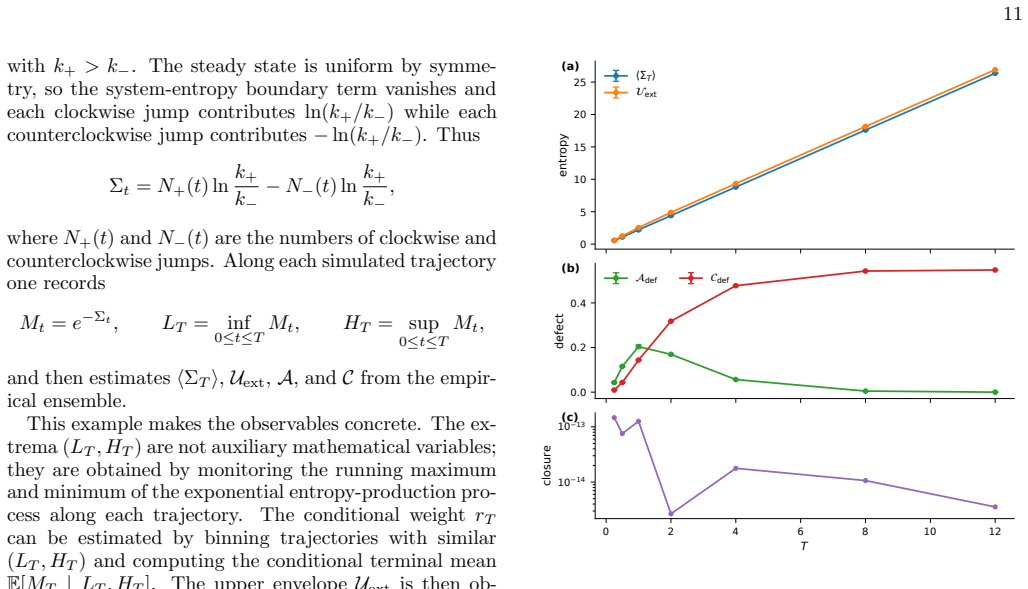
For steady-state processes with entropy-production martingale M_t = e^{-Σ_t}, the mean entropy production obeys the exact identity ⟨Σ_T⟩ = U_ext − A − C, where U_ext is the path-extrema upper envelope obtained by ranking realized intervals with the ratio ln(H_T/L_T)/(H_T − L_T) and solving the relaxed problem as a continuous knapsack, A is the allocation gap across realized envelopes, and C is the curvature gap inside each envelope.
What carries the argument
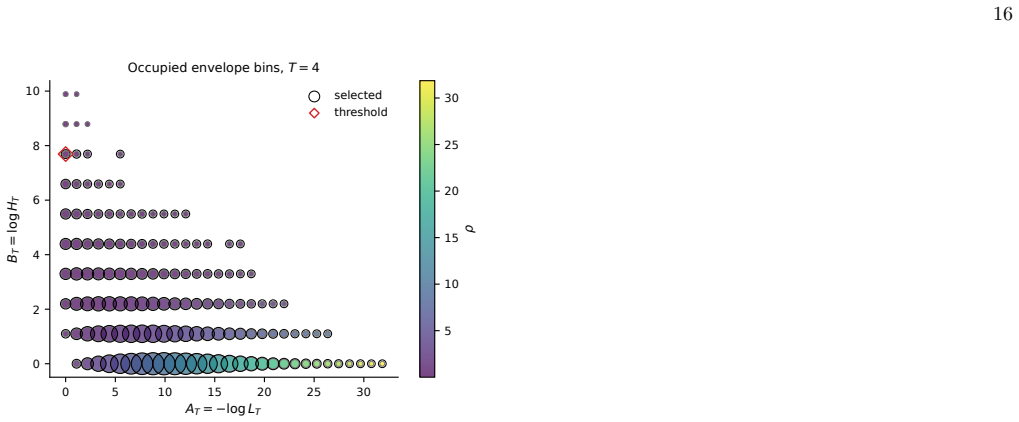
The path-extrema upper envelope U_ext obtained by ranking intervals according to the ratio ln(H_T/L_T)/(H_T − L_T) and solving the relaxed envelope problem as a continuous knapsack.
If this is right
- The positive running maximum alone cannot tighten the upper bound on mean entropy production beyond the trivial endpoint value.
- The allocation gap A and curvature gap C separately quantify how terminal outcomes are distributed across envelope classes and how they are placed inside each class.
- Path-extrema information supplies a concrete numerical upper bound that is complementary to the lower bounds supplied by fluctuation relations.
- The continuous-knapsack ranking gives an explicit procedure for converting observed extrema into a computable envelope.
Where Pith is reading between the lines
- The same envelope construction might be applied to other martingales that arise in stochastic thermodynamics, such as those tied to work or heat.
- Numerical simulations of simple models could test how large the gaps A and C typically become under different driving strengths.
- Extending the ranking procedure to non-stationary or finite-time processes would require a modified ratio that accounts for time dependence.
- The knapsack formulation suggests that standard optimization algorithms could be used to compute the envelope for large numbers of observed paths.
Load-bearing premise
The entropy production process must be a martingale for a steady-state dynamics so that the ratio ln(H_T/L_T)/(H_T − L_T) correctly ranks intervals in the relaxed knapsack problem.
What would settle it
Measure L_T and H_T along individual trajectories in a known steady-state process, compute the corresponding U_ext, A, and C, and check whether the sample average of Σ_T exactly equals U_ext minus those gaps; any systematic excess would refute the identity.
Figures


read the original abstract
Fluctuation relations imply the second-law inequality $\langle\Sigma_T\rangle\ge0$, but path extrema can also constrain how large the mean entropy production can be. For steady-state processes with entropy-production martingale $M_t=e^{-\Sigma_t}$, we show that knowing only the positive running maximum of $\Sigma_t$ gives no improvement over the trivial endpoint bound: rare negative entropy-production excursions can still carry the exponential weight required by the fluctuation relation. Using the running extrema $L_T=\inf M_t$ and $H_T=\sup M_t$, we derive a path-extrema upper envelope $\mathcal{U}_{\rm ext}$. The relaxed envelope problem ranks realized intervals by the entropy gain per martingale cost, $\ln(H_T/L_T)/(H_T-L_T)$, giving a continuous knapsack problem. The actual mean satisfies the exact identity $\langle\Sigma_T\rangle=\mathcal{U}_{\rm ext}-\mathcal{A}-\mathcal{C}$, where $\mathcal{A}$ is an allocation gap across realized envelopes and $\mathcal{C}$ is a curvature gap within each envelope. Thus path extrema set the upper envelope, while the two gaps quantify how actual dynamics allocate terminal outcomes across envelope classes and place terminal values within each realized envelope. This turns path-extrema information into a quantitative upper-bound theory for entropy production, complementary to the usual lower-bound role of fluctuation relations.
Editorial analysis
A structured set of objections, weighed in public.
Referee Report
Summary. The paper claims that for steady-state processes with entropy-production martingale M_t = e^{-Σ_t}, the running extrema L_T = inf M_t and H_T = sup M_t define a path-extrema upper envelope U_ext obtained by ranking realized intervals via the ratio ln(H_T/L_T)/(H_T - L_T) and solving the resulting continuous knapsack problem. It further asserts that the actual mean satisfies the exact identity ⟨Σ_T⟩ = U_ext − A − C, where A is the allocation gap across realized envelopes and C is the curvature gap within each envelope. This supplies a quantitative upper-bound theory for mean entropy production that is complementary to the lower bounds furnished by fluctuation relations.
Significance. If the central identity holds, the work supplies a parameter-free, martingale-derived decomposition that converts observed path extrema into explicit upper bounds on ⟨Σ_T⟩ while quantifying the dynamical gaps that separate the bound from the actual mean. The approach is complementary to fluctuation theorems and rests on a clean relaxation to a continuous knapsack problem; these features would constitute a genuine advance in the quantitative use of path information for entropy-production bounds.
major comments (1)
- [§4] §4 (derivation of the exact identity ⟨Σ_T⟩=U_ext−A−C): the claim that the greedy ranking by ln(H_T/L_T)/(H_T−L_T) solves the relaxed envelope problem exactly, yielding an identity rather than an inequality, rests on the optimality of that ordering for jointly realized (L_T, H_T) pairs. Because L_T and H_T are extrema of one continuous trajectory, the intervals are statistically dependent; the manuscript must supply an explicit argument (or counter-example check) showing that the martingale property alone guarantees the greedy solution is optimal without residual sub-optimality. If this step is only heuristic, the identity becomes an inequality and the quantitative upper-bound claim is weakened.
minor comments (2)
- [Abstract] Abstract and §2: the statement that 'knowing only the positive running maximum of Σ_t gives no improvement' is important but would benefit from a one-sentence reminder of why the martingale weight can still be carried by rare negative excursions.
- [Notation] Notation: the symbols U_ext, A, and C are introduced clearly, but a short table or inline reminder of their definitions would aid readers who consult only the results section.
Simulated Author's Rebuttal
We are grateful to the referee for the positive assessment of the significance of our work and for the constructive major comment. We address the concern about the exactness of the identity in §4 below and will incorporate the necessary clarifications in the revised manuscript.
read point-by-point responses
-
Referee: [§4] §4 (derivation of the exact identity ⟨Σ_T⟩=U_ext−A−C): the claim that the greedy ranking by ln(H_T/L_T)/(H_T−L_T) solves the relaxed envelope problem exactly, yielding an identity rather than an inequality, rests on the optimality of that ordering for jointly realized (L_T, H_T) pairs. Because L_T and H_T are extrema of one continuous trajectory, the intervals are statistically dependent; the manuscript must supply an explicit argument (or counter-example check) showing that the martingale property alone guarantees the greedy solution is optimal without residual sub-optimality. If this step is only heuristic, the identity becomes an inequality and the quantitative upper-bound claim is weakened.
Authors: We thank the referee for highlighting this important point regarding the optimality of the greedy algorithm in the presence of trajectory-induced dependence. The martingale property of M_t = e^{-Σ_t} ensures that the ranking by the ratio ln(H_T/L_T)/(H_T - L_T) corresponds to the marginal entropy production per unit of martingale resource. Although the extrema L_T and H_T are dependent within each realization, the continuous knapsack formulation treats each realized interval as a distinct item in the relaxation, and the greedy ordering by value density is optimal for the fractional knapsack problem regardless of correlations between items, as long as the objective and constraints are linear. The dependence does not introduce sub-optimality because the allocation is decided after observing all realized pairs. We will add an explicit proof in the revised §4 demonstrating that the greedy solution achieves the relaxed optimum pathwise. We will also include a numerical verification using a simple Markov model to confirm the absence of residual sub-optimality. Consequently, the identity remains exact. revision: yes
Circularity Check
No significant circularity; derivation uses martingale input to construct envelope and gaps independently
full rationale
The paper starts from the given martingale property M_t = e^{-Σ_t} for steady-state processes and the observed running extrema L_T and H_T. It constructs the upper envelope U_ext via a continuous knapsack ranking using the ratio ln(H_T/L_T)/(H_T - L_T), then defines the allocation gap A and curvature gap C explicitly as the shortfalls from this envelope. The identity ⟨Σ_T⟩ = U_ext - A - C is therefore a decomposition that quantifies how far the actual process falls short of the constructed envelope; it does not reduce to a fitted parameter or self-citation by construction. No load-bearing self-citation, uniqueness theorem, or ansatz smuggling appears in the abstract or described derivation. The central result remains an independent upper-bound statement complementary to fluctuation-relation lower bounds, with the gaps serving as measurable diagnostics rather than tautological redefinitions.
Axiom & Free-Parameter Ledger
axioms (1)
- domain assumption Entropy production forms a martingale M_t = e^{-Σ_t} for steady-state processes
Lean theorems connected to this paper
-
IndisputableMonolith/Cost/FunctionalEquation.leanwashburn_uniqueness_aczel unclear?
unclearRelation between the paper passage and the cited Recognition theorem.
The relaxed envelope problem ranks realized intervals by the entropy gain per martingale cost, ln(H_T/L_T)/(H_T−L_T), giving a continuous knapsack problem. The actual mean satisfies the exact identity ⟨Σ_T⟩=U_ext−A−C
-
IndisputableMonolith/Foundation/RealityFromDistinction.leanreality_from_one_distinction unclear?
unclearRelation between the paper passage and the cited Recognition theorem.
For steady-state processes with entropy-production martingale M_t = e^{-Σ_t}
What do these tags mean?
- matches
- The paper's claim is directly supported by a theorem in the formal canon.
- supports
- The theorem supports part of the paper's argument, but the paper may add assumptions or extra steps.
- extends
- The paper goes beyond the formal theorem; the theorem is a base layer rather than the whole result.
- uses
- The paper appears to rely on the theorem as machinery.
- contradicts
- The paper's claim conflicts with a theorem or certificate in the canon.
- unclear
- Pith found a possible connection, but the passage is too broad, indirect, or ambiguous to say the theorem truly supports the claim.
Reference graph
Works this paper leans on
-
[1]
The mean entropy production is ⟨ΣT ⟩= 1 2 1 2 ln 2− 1 2 ln 3 2 + 1 2 5 6 ln 5− 1 6 ln 5
Each mode separately satisfiesE[M T |j] = 1, and therefore the full ensemble satisfies⟨M T ⟩= 1. The mean entropy production is ⟨ΣT ⟩= 1 2 1 2 ln 2− 1 2 ln 3 2 + 1 2 5 6 ln 5− 1 6 ln 5 . Equivalently, ⟨ΣT ⟩= 1 4 ln 4 3 + 1 3 ln 5. Numerically,⟨Σ T ⟩ ≃0.6084. The efficiency ratios of the two mode windows are ρ1 = ln(H1/L1) H1 −L 1 = ln 3≃1.0986, and ρ2 = l...
-
[2]
Seifert, Physical Review Letters95, 040602 (2005)
U. Seifert, Physical Review Letters95, 040602 (2005)
work page 2005
-
[3]
A. C. Barato and U. Seifert, Physical Review Letters 114, 158101 (2015)
work page 2015
-
[4]
T. R. Gingrich, J. M. Horowitz, N. Perunov, and J. L. England, Physical Review Letters116, 120601 (2016)
work page 2016
-
[5]
J. M. Horowitz and T. R. Gingrich, Nature Physics16, 15 (2020)
work page 2020
-
[6]
N. Shiraishi, K. Funo, and K. Saito, Physical Review Let- ters121, 070601 (2018)
work page 2018
-
[7]
A. Dechant and S.-i. Sasa, Journal of Statistical Mechan- ics: Theory and Experiment2018, 063209 (2018)
work page 2018
- [8]
-
[9]
Seifert, Annual Review of Condensed Matter Physics 10, 171 (2019)
U. Seifert, Annual Review of Condensed Matter Physics 10, 171 (2019)
work page 2019
-
[10]
P. E. Harunari, S. Dutta, M. Polettini, and E. Rold´ an, Physical Review X12, 041026 (2022)
work page 2022
- [11]
-
[12]
Limkumnerd, Physical Review E95, 032125 (2017)
S. Limkumnerd, Physical Review E95, 032125 (2017)
work page 2017
- [13]
-
[14]
E. Rold´ an, I. Neri, M. D¨ orpinghaus, H. Meyr, and F. J¨ ulicher, Physical Review Letters115, 250602 (2015)
work page 2015
-
[15]
I. Neri, E. Rold´ an, and F. J¨ ulicher, Physical Review X 7, 011019 (2017)
work page 2017
-
[16]
S. Pigolotti, I. Neri, E. Rold´ an, and F. J¨ ulicher, Physical Review Letters119, 140604 (2017)
work page 2017
-
[17]
I. Neri, E. Rold´ an, S. Pigolotti, and F. J¨ ulicher, Journal of Statistical Mechanics: Theory and Experiment2019, 104006 (2019)
work page 2019
-
[18]
Neri, Physical Review Letters124, 040601 (2020)
I. Neri, Physical Review Letters124, 040601 (2020)
work page 2020
- [19]
-
[20]
E. Rold´ an, I. Neri, R. Chetrite, S. Gupta, S. Pigolotti, F. J¨ ulicher, and K. Sekimoto, Advances in Physics72, 231 (2024)
work page 2024
-
[21]
Seifert, Reports on Progress in Physics75, 126001 (2012)
U. Seifert, Reports on Progress in Physics75, 126001 (2012)
work page 2012
- [22]
discussion (0)
Sign in with ORCID, Apple, or X to comment. Anyone can read and Pith papers without signing in.