REVIEW 3 major objections 4 minor 136 references
Into the Mystic: the MUSE view of the ionized gas in the Mystic Mountains in Carina
T0 review · 3 major / 4 minor · reviewed 2026-08-10 · deepseek-v4-flash
Pith's one-line read This paper maps the ionized gas on Carina's Mystic Mountains with MUSE and concludes the complex will be fully photoevaporated in $8\pm2$ Myr, with the smallest globules surviving longest and shielding embedded protostars for more than a…
desk verdict Nice MUSE dataset with a real arithmetic error in the lifetime section: the complex-wide photoevaporation rate is averaged instead of summed, so 8 Myr becomes ~1 Myr. read the letter →
The pith
A machine-rendered reading of the paper's core claim, the machinery that carries it, and where it could break.
The reading
What carries the argument
The load-bearing machinery is MUSE's continuous spatial and spectral coverage from 4650 to 9300 Å, which lets the authors measure line ratios pixel by pixel: [S II] $\lambda6731/6717$ for electron density, [N II] $\lambda5755/(6548+6583)$ for temperature, He I $\lambda6678$/[S II] for ionization, and H$\alpha$/H$\beta$ for extinction. The photoevaporation rates come from the side-illuminated-cylinder expression $\dot{M}\simeq 2\pi r^2 m_H n_H v$, where $r$ is the fitted radius of curvature of each pillar head, $n_H=1.4n_e$, and $v\approx10$ km s$^{-1}$ is the sound speed of ionized gas. These rates are divided into the ALMA molecular masses to obtain local and global remaining lifetimes, while the [C I] 8727 Å line serves as the tracer of dissociation in the photoevaporating HH 901 outflow.
What would settle it
Integrate the total mass-loss rate over the entire evaporating surface of the Mystic Mountains—for example, from the spatially integrated H$\alpha$ or radio recombination-line flux, which counts every ionized surface—rather than averaging eight local rates. If the integrated rate comes out near $3\times10^{-5}\,M_\odot\,\mathrm{yr^{-1}}$, the complex-wide lifetime is about 1 Myr, directly contradicting the $8\pm2$ Myr claim.
Extended reading notes
Core claim
On its own terms, the paper establishes that the Mystic Mountains are being eroded from the outside in by UV photons from Trumpler 14, and that the erosion is readable in the ionized gas. The MUSE data show electron densities often above $10^3\,\mathrm{cm^{-3}}$ concentrated at pillar heads and ionization fronts, electron temperatures near $10^4$ K, and a sharp drop in ionization at pillar boundaries; the jets appear as high-density, low-ionization features, and extended [C I] 8727 Å emission along HH 901 traces the dissociation of its molecular outflow. Using the side-illuminated-cylinder formula, the authors derive local photoevaporation rates from $2\times10^{-7}$ to $1.2\times10^{-5}\,M_\odot\,\mathrm{yr^{-1}}$. Averaged, these give $\sim4\times10^{-6}\,M_\odot\,\mathrm{yr^{-1}}$, and with the complex's ALMA-measured molecular mass of $33.7\pm5.7\,M_\odot$, the authors conclude that the entire Mystic Mountains will be gone in $8\pm2$ Myr, with sub-pillars ranging from about 1 to 13 Myr. The inverse correlation between structure size and lifetime — the smallest globules last longest, independent of distance from the ionizing cluster — leads them to propose that ionization-driven compression, not triggered collapse, is what keeps the embedded stars' cocoons intact, shielding the HH 901 young star for $\gtrsim2.5$ Myr.
Load-bearing premise
The load-bearing premise is that the mean of the eight local photoevaporation rates, roughly $4\times10^{-6}\,M_\odot\,\mathrm{yr^{-1}}$, is the total rate at which the entire $33.7\,M_\odot$ complex is being eroded; if the tabulated rates are summed instead, the total is about $3.1\times10^{-5}\,M_\odot\,\mathrm{yr^{-1}}$ and the remaining lifetime drops to roughly 1 Myr rather than $8\pm2$ Myr.
Editorial extensions
If this is right
- The Mystic Mountains as a whole will be completely evaporated in $8\pm2$ Myr, while individual pillars and globules have remaining lifetimes between about 1 and 13 Myr.
- The smallest structures have the longest remaining lifetimes regardless of their distance from Trumpler 14, supporting the view that ionizing feedback has compressed them and increased their shielding.
- The HH 901 embedded young star will remain shielded behind its globule for $\gtrsim2.5$ Myr, long enough for planet formation to proceed with limited external photoevaporation under current disk-evolution models.
- Embedded young stars in the complex will be revealed at different times as the surrounding gas is stripped, so the exposed protostar population reflects ongoing erosion rather than a single burst of triggered star formation.
- Extended [C I] emission along HH 901 marks the rapid dissociation of a photoevaporating molecular outflow once it leaves the pillar, showing directly how external UV destroys outflows.
Reading between the lines
- If the tabulated local photoevaporation rates are summed rather than averaged, the total mass-loss rate is about $3.1\times10^{-5}\,M_\odot\,\mathrm{yr^{-1}}$, shortening the complex-wide lifetime to roughly 1 Myr; the $8\pm2$ Myr conclusion thus depends on how well the eight measured interfaces represent the whole evaporating surface.
- The observed pattern that small structures survive longest implies a selection effect for pillar surveys: large, fragile structures are destroyed quickly, so samples of surviving pillars may over-represent compact globules and understate the true photoevaporation rate of a region.
- A testable follow-up is to measure proper motions of the HH 901 and HH 1066 globules over several years; acceleration away from Trumpler 14 would confirm the rocket-effect compression invoked here, while no acceleration would favor pre-existing overdensities as the origin of the pillars.
- For planet-formation modeling, these results imply that a single shielding time per region is insufficient, since shielding varies by more than an order of magnitude within one complex; disk photoevaporation models should use spatially resolved gas-clearing times.
Editorial analysis
A structured set of objections, weighed in public.
Referee Report
Summary. This paper presents MUSE integral-field observations of the Mystic Mountains, a heavily irradiated pillar complex in Carina, and derives maps of extinction, electron density, electron temperature, and ionization state across the region. The authors measure local photoevaporation rates at eight pillar-head interfaces using the Smith et al. (2004) cylinder formula (Eq. 1), combine these with ALMA-derived molecular masses from Reiter et al. (2023), and estimate the remaining lifetime of the complex (8 ± 2 Myr) and of its individual pillars. They report that the longest remaining lifetimes belong to the smallest structures, interpret this as evidence of compression by ionizing feedback, and discuss the shielding time available for embedded YSOs and disks relative to planet-formation models. The paper also analyzes the HH 901, 902, and 1066 jets, reports a new candidate jet seen only in [Fe II], and identifies extended [C I] emission from HH 901 as tracing dissociation of a photoevaporating molecular outflow.
Significance. If the quantitative lifetime results are correct, the paper would provide an unusually complete, spatially resolved picture of feedback in a high-mass star-forming region, connecting ionized-gas diagnostics with cold molecular gas and with implications for triggered star formation and the shielding of planet-forming disks. The observational products—density/temperature/excitation maps, jet P-V diagrams, the [C I] dissociation structure, and the candidate jet—are valuable and are based on public MUSE and ALMA data, with clear potential for reuse. However, the central quantitative claim (lifetime of 8 ± 2 Myr and the statement that the smallest structures live longest) is not supported by the paper's own tabulated rates because the total photoevaporation rate is computed as the arithmetic mean of eight local rates rather than their sum. The qualitative morphological findings and the new jet/C I detections stand independently, but the lifetime and shielding-time conclusions need reworking.
major comments (3)
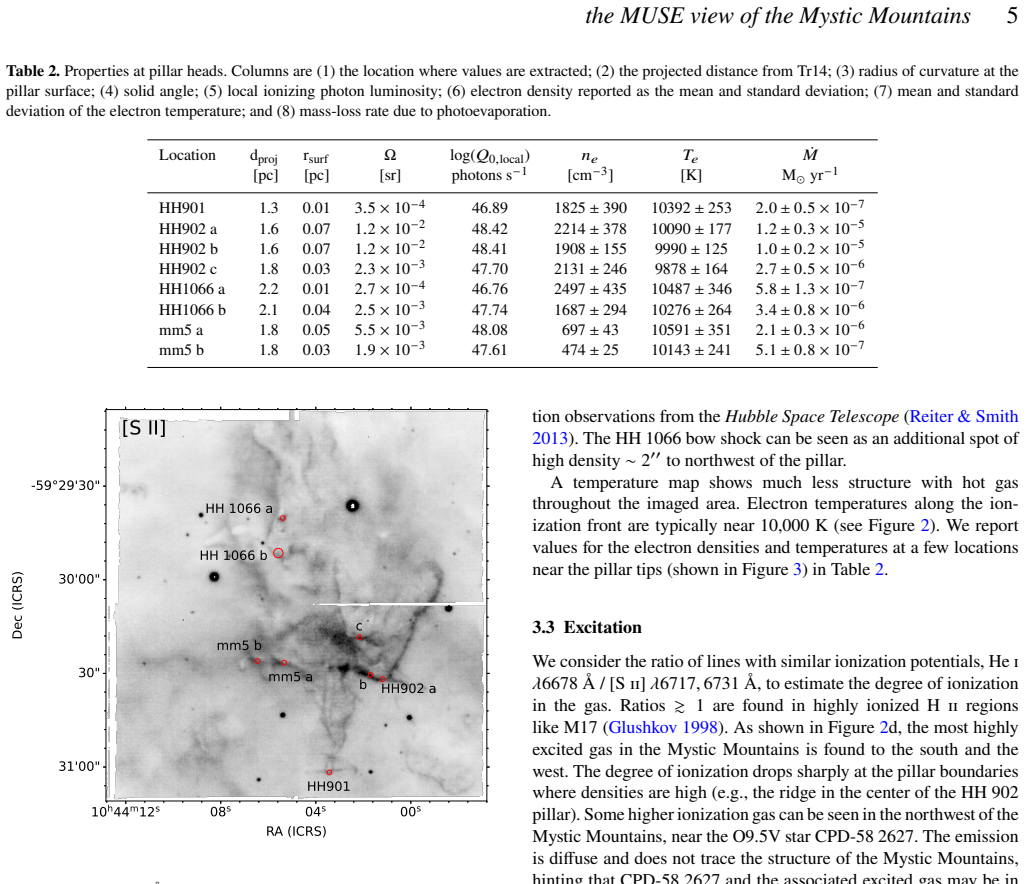
- [Section 4.3, Table 2] The complex-wide lifetime is obtained by dividing the total molecular mass M = 33.7 ± 5.7 M_sun (Table 3) by an 'average photoevaporation rate' of ~4 × 10^-6 M_sun/yr, which is the arithmetic mean of the eight local rates listed in Table 2. The total photoevaporation rate of the complex should instead be the sum over all ionized surfaces; summing the eight tabulated rates gives ~3.1 × 10^-5 M_sun/yr, which yields a remaining lifetime of ~1.1 Myr rather than 8 ± 2 Myr. Since the eight extraction regions do not cover the full ionized boundary of the complex, the summed rate is a lower limit, so the true complex lifetime is likely even shorter. The paper's own tabulated data therefore do not support the headline lifetime quoted in the abstract and Section 4.3.
- [Section 4.3, Table 3] The per-pillar lifetimes are computed by dividing a pillar's molecular mass by a single local mass-loss rate at the pillar tip (e.g., HH 901 mass divided by 2.0 × 10^-7 M_sun/yr gives ~16 Myr for the full pillar and ~2.6 Myr for its envelope). This ignores photoevaporation from other ionized surfaces of the same pillar, such as the high-density spine of HH 901 and the extended ionization fronts present in the HH 902 and HH 1066 pillars. Consequently, the conclusion that 'the longest remaining lifetimes are for the smallest structures' is not established by the data as presented; it may be an artifact of selecting the smallest local rate for each pillar. The authors should integrate the mass-loss rate over each pillar's full ionized boundary, or explicitly state that the quoted lifetimes are lower limits based on a single interface.
- [Section 4.3 and Conclusions] The shielding-time argument (comparing with the ~1.5 Myr threshold from Qiao et al. 2023) depends directly on the lifetimes from the two previous points. With the total rate corrected to the sum of the tabulated values, the complex-wide shielding time becomes roughly 1 Myr or less, and the per-pillar values are likely shorter once additional ionized surfaces are included. The claim that embedded YSOs and disks in the Mystic Mountains remain shielded for more than 1 Myr therefore needs to be re-evaluated and re-stated with the corrected rates, or explicitly qualified as applying only to the local pillar-tip geometry.
minor comments (4)
- [Section 4.1, Eq. (1)] The radius of curvature r is described as 'the radius of the circle that best matches the curvature at the pillar head'; the fitting procedure and its uncertainty should be documented in more detail, since r enters quadratically in the mass-loss rate and is likely a dominant systematic.
- [Section 4.3] The stated uncertainty of ±2 Myr on the 8 Myr lifetime reflects only the 17% mass uncertainty; the substantial scatter in the local photoevaporation rates (over two orders of magnitude) and the systematic uncertainty in r are not propagated into this estimate.
- [Figure 6 and Section 3.4] The figure caption labels the orange circles as 'Reiter et al. 2024' while the text (Section 3.4) and reference list cite Reiter et al. (2023) for these 1.3 mm continuum sources; the citation in the caption should be corrected.
- [Abstract] The phrase 'we compute the photoevaporation rate' and the resulting lifetime figure in the abstract do not convey that the quoted value is based on an average of local rates rather than a total; adding a short qualifier would help readers avoid the aggregation error highlighted above.
Circularity Check
No significant circularity: the photoevaporation rates and ALMA masses are independent inputs combined through a literature formula; the mean-versus-sum lifetime issue is an aggregation concern, not a circular one.
full rationale
The paper's central derivation is a straightforward combination of measured inputs through a literature formula. The local photoevaporation rates in Table 2 are computed from MUSE-derived electron densities, temperatures, and measured radii of curvature using the Smith et al. (2004) cylinder formula (Section 4.1, Eq. 1). The remaining lifetime is then the ALMA-derived molecular mass (Reiter et al. 2023, Table 3) divided by a photoevaporation rate (Section 4.3). No fitted parameter is used to force the resulting lifetime: the rates are measured from the ionized gas and the masses are measured from the cold molecular gas, and neither quantity is derived from the other. The self-citations to Reiter et al. (2023) and Itrich et al. (2024) supply data products with independent observational bases, not an imported uniqueness theorem or ansatz that determines the conclusion. The skeptical critique that the complex-wide lifetime uses the arithmetic mean of eight local rates rather than their sum is a legitimate statistical and physical aggregation concern, and it changes the numerical lifetime, but it does not make the derivation self-referential: t = M / Mdot remains an externally grounded ratio of two independent measurements. Similarly, the statement that the smallest structures have the longest remaining lifetimes is a scaling consequence of dividing each structure's mass by its own local photoevaporation rate, not a circularly imposed premise. No step in the derivation reduces by construction to its own inputs, so the circularity score is 0.
Assumptions & free parameters
free parameters (1)
- radius of curvature r at each pillar head =
0.01 pc (HH 901), 0.07 pc (HH 902 a/b), 0.03 pc (HH 902 c, mm5 b), etc.
assumptions (6)
- domain assumption The photoevaporation mass-loss rate is given by the cylinder formula Mdot ~ 2 pi r^2 m_H n_H v (Smith et al. 2004, Eq. 1).
- domain assumption n_H = 1.4 n_e
- domain assumption The outflow velocity v equals the sound speed of ionized gas (about 10 km/s).
- standard math Case B recombination with T = 10^4 K and n_e = 10^3 cm^-3 gives (H-alpha/H-beta)_int = 2.86.
- domain assumption The molecular gas masses from Reiter et al. (2023) are accurate.
- ad hoc to paper The arithmetic mean of local photoevaporation rates represents the total rate for the complex.
Cite this review
Pith. "Pith review of Into the Mystic: the MUSE view of the ionized gas in the Mystic Mountains in Carina." pith.science (2026). https://pith.science/paper/YPO75AFP
@misc{pith2026250118029,
  author       = {Pith},
  title        = {Pith review of: Into the Mystic: the MUSE view of the ionized gas in the Mystic Mountains in Carina},
  year         = {2026},
  howpublished = {\url{https://pith.science/paper/YPO75AFP}},
  note         = {Machine review of arXiv:2501.18029}
}
read the original abstract
We present optical integral field unit (IFU) observations of the Mystic Mountains, a dust pillar complex in the center of the Carina Nebula that is heavily irradiated by the nearby young massive cluster Trumpler 14. With the continuous spatial and spectral coverage of data from the Multi-Unit Spectroscopic Explorer (MUSE), we measure the physical properties in the ionized gas including the electron density and temperature, excitation, and ionization. MUSE also provides an excellent view of the famous jets HH 901, 902, and 1066, revealing them to be high-density, low-ionization outflows despite the harsh environment. HH 901 shows spatially extended [C I] emission tracing the rapid dissociation of the photoevaporating molecular outflow in this highly irradiated source. We compute the photoevaporation rate of the Mystic Mountains and combine it with recent ALMA observations of the cold molecular gas to estimate the remaining lifetime of the Mystic Mountains and the corresponding shielding time for the embedded protostars. The longest remaining lifetimes are for the smallest structures, suggesting that they have been compressed by ionizing feedback. Our data do not suggest that star formation in the Mystic Mountains has been triggered but it does point to the role that ionization-driven compression may play in enhancing the shielding of embedded stars and disks. Planet formation models suggest that the shielding time is a strong determinant of the mass and orbital architecture of planets, making it important to quantify in high-mass regions like Carina that represent the type of environment where most stars form.
Figures


Figures from the paper (7 more)


Reference graph
Works this paper leans on
-
[1]
Adamo A., et al., 2017, @doi [ ] 10.3847/1538-4357/aa7132 , https://ui.adsabs.harvard.edu/abs/2017ApJ...841..131A 841, 131
-
[2]
Aharonian F., Yang R., de O \ n a Wilhelmi E., 2019, @doi [Nature Astronomy] 10.1038/s41550-019-0724-0 , https://ui.adsabs.harvard.edu/abs/2019NatAs...3..561A 3, 561
-
[3]
Alexander M. J., Kobulnicky H. A., Kerton C. R., Arvidsson K., 2013, @doi [ ] 10.1088/0004-637X/770/1/1 , https://ui.adsabs.harvard.edu/abs/2013ApJ...770....1A 770, 1
-
[4]
Ali A., Harries T. J., Douglas T. A., 2018, @doi [ ] 10.1093/mnras/sty1001 , https://ui.adsabs.harvard.edu/abs/2018MNRAS.477.5422A 477, 5422
-
[6]
Bacon R., et al., 2010, in Ground-based and Airborne Instrumentation for Astronomy III. p. 773508, @doi 10.1117/12.856027
-
[7]
Barnes A. T., Longmore S. N., Dale J. E., Krumholz M. R., Kruijssen J. M. D., Bigiel F., 2020, @doi [ ] 10.1093/mnras/staa2719 , https://ui.adsabs.harvard.edu/abs/2020MNRAS.498.4906B 498, 4906
-
[8]
Barnes A. T., et al., 2021, @doi [ ] 10.1093/mnras/stab2958 , https://ui.adsabs.harvard.edu/abs/2021MNRAS.508.5362B 508, 5362
-
[9]
Belfiore F., et al., 2023, @doi [ ] 10.1051/0004-6361/202347175 , https://ui.adsabs.harvard.edu/abs/2023A&A...678A.129B 678, A129
Show all 136 references
-
[10]
Bern \'e O., et al., 2022, @doi [ ] 10.1088/1538-3873/ac604c , https://ui.adsabs.harvard.edu/abs/2022PASP..134e4301B 134, 054301
2022 doi
-
[11]
Bern \'e O., et al., 2023, @doi [ ] 10.1038/s41586-023-06307-x , https://ui.adsabs.harvard.edu/abs/2023Natur.621...56B 621, 56
2023 doi
-
[12]
Bertoldi F., 1989, @doi [ ] 10.1086/168055 , http://adsabs.harvard.edu/abs/1989ApJ...346..735B 346, 735
1989 doi
-
[13]
F., 1990, @doi [ ] 10.1086/168713 , http://adsabs.harvard.edu/abs/1990ApJ...354..529B 354, 529
Bertoldi F., McKee C. F., 1990, @doi [ ] 10.1086/168713 , http://adsabs.harvard.edu/abs/1990ApJ...354..529B 354, 529
1990 doi
-
[14]
F., 1992, @doi [ ] 10.1086/171638 , https://ui.adsabs.harvard.edu/abs/1992ApJ...395..140B 395, 140
Bertoldi F., McKee C. F., 1992, @doi [ ] 10.1086/171638 , https://ui.adsabs.harvard.edu/abs/1992ApJ...395..140B 395, 140
1992 doi
-
[15]
Billot N., Noriega-Crespo A., Carey S., Guieu S., Shenoy S., Paladini R., Latter W., 2010, @doi [ ] 10.1088/0004-637X/712/2/797 , https://ui.adsabs.harvard.edu/abs/2010ApJ...712..797B 712, 797
2010 doi
-
[16]
G., W \"u nsch R., Whitworth A
Bisbas T. G., W \"u nsch R., Whitworth A. P., Hubber D. A., Walch S., 2011, @doi [ ] 10.1088/0004-637X/736/2/142 , http://adsabs.harvard.edu/abs/2011ApJ...736..142B 736, 142
2011 doi
-
[17]
G., van Dishoeck E
Bisbas T. G., van Dishoeck E. F., Papadopoulos P. P., Sz u cs L., Bialy S., Zhang Z.-Y., 2017, @doi [ ] 10.3847/1538-4357/aa696d , https://ui.adsabs.harvard.edu/abs/2017ApJ...839...90B 839, 90
2017 doi
-
[18]
M., Dale J
Boneberg D. M., Dale J. E., Girichidis P., Ercolano B., 2015, @doi [ ] 10.1093/mnras/stu2498 , http://adsabs.harvard.edu/abs/2015MNRAS.447.1341B 447, 1341
2015 doi
-
[19]
Bonne L., et al., 2022, @doi [ ] 10.3847/1538-4357/ac8052 , https://ui.adsabs.harvard.edu/abs/2022ApJ...935..171B 935, 171
2022 doi
-
[20]
P., Waller W
Bowler B. P., Waller W. H., Megeath S. T., Patten B. M., Tamura M., 2009, @doi [ ] 10.1088/0004-6256/137/3/3685 , https://ui.adsabs.harvard.edu/abs/2009AJ....137.3685B 137, 3685
2009 doi
-
[21]
Calzetti D., et al., 2015, @doi [ ] 10.1088/0004-6256/149/2/51 , https://ui.adsabs.harvard.edu/abs/2015AJ....149...51C 149, 51
2015 doi
-
[22]
Calzetti D., et al., 2024, @doi [ ] 10.3847/1538-4357/ad53c0 , https://ui.adsabs.harvard.edu/abs/2024ApJ...971..118C 971, 118
2024 doi
-
[23]
A., Clayton G
Cardelli J. A., Clayton G. C., Mathis J. S., 1989, @doi [ ] 10.1086/167900 , http://adsabs.harvard.edu/abs/1989ApJ...345..245C 345, 245
1989 doi
-
[24]
Caselli P., Ceccarelli C., 2012, @doi [ ] 10.1007/s00159-012-0056-x , https://ui.adsabs.harvard.edu/abs/2012A&ARv..20...56C 20, 56
2012 doi
-
[25]
S., Dullemond C
Ceccarelli C., Caselli P., Bockel \'e e-Morvan D., Mousis O., Pizzarello S., Robert F., Semenov D., 2014, in Beuther H., Klessen R. S., Dullemond C. P., Henning T., eds, Protostars and Planets VI. pp 859--882 ( @eprint arXiv 1403.7143 ), @doi 10.2458/azu_uapress_9780816531240-ch037
2014 arXiv
-
[26]
Chevance M., et al., 2022, @doi [ ] 10.1093/mnras/stab2938 , https://ui.adsabs.harvard.edu/abs/2022MNRAS.509..272C 509, 272
2022 doi
-
[27]
R., McLeod A
Chevance M., Krumholz M. R., McLeod A. F., Ostriker E. C., Rosolowsky E. W., Sternberg A., 2023, in Inutsuka S., Aikawa Y., Muto T., Tomida K., Tamura M., eds, Astronomical Society of the Pacific Conference Series Vol. 534, Protostars and Planets VII. p. 1 ( @eprint arXiv 2203...
-
[28]
A., Toal \'a J
Cortes-Rangel G., Zapata L. A., Toal \'a J. A., Ho P. T. P., Takahashi S., Mesa-Delgado A., Masqu \'e J. M., 2020, @doi [ ] 10.3847/1538-3881/ab6295 , https://ui.adsabs.harvard.edu/abs/2020AJ....159...62C 159, 62
2020 doi
-
[29]
A., Rivera-Ortiz P
Cortes-Rangel G., Zapata L. A., Rivera-Ortiz P. R., Reiter M., Takahashi S., Masqu \'e J. M., 2023, @doi [ ] 10.3847/1538-4357/ad021b , https://ui.adsabs.harvard.edu/abs/2023ApJ...958..193C 958, 193
2023 doi
-
[30]
R., Cernicharo J., Fuente A., Pety J., Tercero B., 2017, @doi [ ] 10.1051/0004-6361/201730459 , https://ui.adsabs.harvard.edu/abs/2017A&A...603A.124C 603, A124
Cuadrado S., Goicoechea J. R., Cernicharo J., Fuente A., Pety J., Tercero B., 2017, @doi [ ] 10.1051/0004-6361/201730459 , https://ui.adsabs.harvard.edu/abs/2017A&A...603A.124C 603, A124
2017 doi
-
[31]
E., 2017, @doi [ ] 10.1093/mnras/stx028 , http://adsabs.harvard.edu/abs/2017MNRAS.467.1067D 467, 1067
Dale J. E., 2017, @doi [ ] 10.1093/mnras/stx028 , http://adsabs.harvard.edu/abs/2017MNRAS.467.1067D 467, 1067
2017 doi
-
[32]
E., Ercolano B., Bonnell I
Dale J. E., Ercolano B., Bonnell I. A., 2012, @doi [ ] 10.1111/j.1365-2966.2012.21205.x , https://ui.adsabs.harvard.edu/abs/2012MNRAS.424..377D 424, 377
2012
-
[33]
E., Haworth T
Dale J. E., Haworth T. J., Bressert E., 2015, @doi [ ] 10.1093/mnras/stv396 , http://adsabs.harvard.edu/abs/2015MNRAS.450.1199D 450, 1199
2015 doi
-
[34]
Dalgarno A., Lepp S., 1984, @doi [ ] 10.1086/184395 , https://ui.adsabs.harvard.edu/abs/1984ApJ...287L..47D 287, L47
1984 doi
- [35]
-
[36]
K., et al., 2024, @doi [ ] 10.1093/mnras/stae150 , https://ui.adsabs.harvard.edu/abs/2024MNRAS.528.3909D 528, 3909
Dewangan L. K., et al., 2024, @doi [ ] 10.1093/mnras/stae150 , https://ui.adsabs.harvard.edu/abs/2024MNRAS.528.3909D 528, 3909
2024 doi
-
[37]
A., Comer \'o n F., Schneider N., 2017, @doi [ ] 10.1051/0004-6361/201628962 , https://ui.adsabs.harvard.edu/abs/2017A&A...599A..37D 599, A37
Djupvik A. A., Comer \'o n F., Schneider N., 2017, @doi [ ] 10.1051/0004-6361/201628962 , https://ui.adsabs.harvard.edu/abs/2017A&A...599A..37D 599, A37
2017 doi
-
[38]
P., Hartigan P., Isella A., 2023, @doi [ ] 10.1093/mnras/stac3718 , https://ui.adsabs.harvard.edu/abs/2023MNRAS.519.5427D 519, 5427
Downes T. P., Hartigan P., Isella A., 2023, @doi [ ] 10.1093/mnras/stac3718 , https://ui.adsabs.harvard.edu/abs/2023MNRAS.519.5427D 519, 5427
2023 doi
-
[40]
Escalante V., Sternberg A., Dalgarno A., 1991, @doi [ ] 10.1086/170225 , http://adsabs.harvard.edu/abs/1991ApJ...375..630E 375, 630
1991 doi
-
[41]
C., 2007, @doi [ ] 10.1111/j.1365-2966.2007.11609.x , http://adsabs.harvard.edu/abs/2007MNRAS.377..383E 377, 383
Esquivel A., Raga A. C., 2007, @doi [ ] 10.1111/j.1365-2966.2007.11609.x , http://adsabs.harvard.edu/abs/2007MNRAS.377..383E 377, 383
2007
-
[43]
Gabici S., 2022, @doi [ ] 10.1007/s00159-022-00141-2 , https://ui.adsabs.harvard.edu/abs/2022A&ARv..30....4G 30, 4
2022 doi
-
[44]
Gaczkowski B., Preibisch T., Ratzka T., Roccatagliata V., Ohlendorf H., Zinnecker H., 2013, @doi [ ] 10.1051/0004-6361/201219836 , https://ui.adsabs.harvard.edu/abs/2013A&A...549A..67G 549, A67
2013 doi
-
[45]
Gaia Collaboration et al., 2023, @doi [ ] 10.1051/0004-6361/202243940 , https://ui.adsabs.harvard.edu/abs/2023A&A...674A...1G 674, A1
2023 doi
-
[46]
I., 1998, Astronomy Reports, http://adsabs.harvard.edu/abs/1998ARep...42..137G 42, 137
Glushkov Y. I., 1998, Astronomy Reports, http://adsabs.harvard.edu/abs/1998ARep...42..137G 42, 137
1998
-
[47]
R., et al., 2016, @doi [ ] 10.1038/nature18957 , https://ui.adsabs.harvard.edu/abs/2016Natur.537..207G 537, 207
Goicoechea J. R., et al., 2016, @doi [ ] 10.1038/nature18957 , https://ui.adsabs.harvard.edu/abs/2016Natur.537..207G 537, 207
2016 doi
-
[48]
R., Santa-Maria M
Goicoechea J. R., Santa-Maria M. G., Bron E., Teyssier D., Marcelino N., Cernicharo J., Cuadrado S., 2019, @doi [ ] 10.1051/0004-6361/201834409 , https://ui.adsabs.harvard.edu/abs/2019A&A...622A..91G 622, A91
2019 doi
-
[49]
R., et al., 2021, @doi [ ] 10.1051/0004-6361/202039756 , https://ui.adsabs.harvard.edu/abs/2021A&A...647A..10G 647, A10
Goicoechea J. R., et al., 2021, @doi [ ] 10.1051/0004-6361/202039756 , https://ui.adsabs.harvard.edu/abs/2021A&A...647A..10G 647, A10
2021 doi
- [50]
-
[51]
G \"o ppl C., Preibisch T., 2022, @doi [ ] 10.1051/0004-6361/202142576 , https://ui.adsabs.harvard.edu/abs/2022A&A...660A..11G 660, A11
2022 doi
-
[52]
Gregg B., et al., 2024, @doi [ ] 10.3847/1538-4357/ad54b4 , https://ui.adsabs.harvard.edu/abs/2024ApJ...971..115G 971, 115
2024 doi
-
[53]
Gritschneder M., Naab T., Walch S., Burkert A., Heitsch F., 2009, @doi [ ] 10.1088/0004-637X/694/1/L26 , http://adsabs.harvard.edu/abs/2009ApJ...694L..26G 694, L26
2009 doi
-
[54]
Gritschneder M., Burkert A., Naab T., Walch S., 2010, @doi [ ] 10.1088/0004-637X/723/2/971 , http://adsabs.harvard.edu/abs/2010ApJ...723..971G 723, 971
2010 doi
-
[55]
Y., Guszejnov D., Hopkins P
Grudi \'c M. Y., Guszejnov D., Hopkins P. F., Offner S. S. R., Faucher-Gigu \`e re C.-A., 2021, @doi [ ] 10.1093/mnras/stab1347 , https://ui.adsabs.harvard.edu/abs/2021MNRAS.506.2199G 506, 2199
2021 doi
-
[56]
Hartigan P., Reiter M., Smith N., Bally J., 2015, @doi [ ] 10.1088/0004-6256/149/3/101 , https://ui.adsabs.harvard.edu/abs/2015AJ....149..101H 149, 101
2015 doi
-
[57]
arXiv:2209.10013
Hartigan P., Hummel M., Isella A., Downes T., 2022, arXiv e-prints, https://ui.adsabs.harvard.edu/abs/2022arXiv220910013H p. arXiv:2209.10013
2022 arXiv
-
[58]
J., et al., 2023, @doi [ ] 10.1093/mnras/stad2581 , https://ui.adsabs.harvard.edu/abs/2023MNRAS.525.4129H 525, 4129
Haworth T. J., et al., 2023, @doi [ ] 10.1093/mnras/stad2581 , https://ui.adsabs.harvard.edu/abs/2023MNRAS.525.4129H 525, 4129
2023 doi
-
[59]
J., et al., 1996, @doi [ ] 10.1086/117968 , https://ui.adsabs.harvard.edu/abs/1996AJ....111.2349H 111, 2349
Hester J. J., et al., 1996, @doi [ ] 10.1086/117968 , https://ui.adsabs.harvard.edu/abs/1996AJ....111.2349H 111, 2349
1996 doi
-
[60]
S., 2012, @doi [ ] 10.1088/0004-6256/143/2/41 , http://adsabs.harvard.edu/abs/2012AJ....143...41H 143, 41
Hur H., Sung H., Bessell M. S., 2012, @doi [ ] 10.1088/0004-6256/143/2/41 , http://adsabs.harvard.edu/abs/2012AJ....143...41H 143, 41
2012 doi
-
[61]
Itrich D., et al., 2024, @doi [ ] 10.1051/0004-6361/202347380 , https://ui.adsabs.harvard.edu/abs/2024A&A...685A.100I 685, A100
2024 doi
-
[62]
L., et al., 2023, @doi [ ] 10.3847/1538-3881/acff6c , https://ui.adsabs.harvard.edu/abs/2023AJ....166..240K 166, 240
Karim R. L., et al., 2023, @doi [ ] 10.3847/1538-3881/acff6c , https://ui.adsabs.harvard.edu/abs/2023AJ....166..240K 166, 240
2023 doi
-
[63]
D., Reiter M
Klaassen P. D., Reiter M. R., McLeod A. F., Mottram J. C., Dale J. E., Gritschneder M., 2020, @doi [ ] 10.1093/mnras/stz3012 , https://ui.adsabs.harvard.edu/abs/2020MNRAS.491..178K 491, 178
2020 doi
-
[64]
Kruijssen J. M. D., et al., 2019, @doi [ ] 10.1038/s41586-019-1194-3 , https://ui.adsabs.harvard.edu/abs/2019Natur.569..519K 569, 519
2019 doi
-
[65]
R., McKee C
Krumholz M. R., McKee C. F., Bland-Hawthorn J., 2019, @doi [ ] 10.1146/annurev-astro-091918-104430 , https://ui.adsabs.harvard.edu/abs/2019ARA&A..57..227K 57, 227
2019 doi
-
[66]
R., Crocker R
Krumholz M. R., Crocker R. M., Offner S. S. R., 2023, @doi [ ] 10.1093/mnras/stad459 , https://ui.adsabs.harvard.edu/abs/2023MNRAS.520.5126K 520, 5126
2023 doi
-
[67]
C., et al., 2022, @doi [ ] 10.3847/1538-4365/ac1fe5 , https://ui.adsabs.harvard.edu/abs/2022ApJS..258...10L 258, 10
Lee J. C., et al., 2022, @doi [ ] 10.3847/1538-4365/ac1fe5 , https://ui.adsabs.harvard.edu/abs/2022ApJS..258...10L 258, 10
2022 doi
-
[68]
Lefloch B., Lazareff B., 1994, , http://adsabs.harvard.edu/abs/1994A
1994
-
[69]
L., Gagn \'e M., Mytyk A., McCaughrean M., Andersen M., 2007, @doi [ ] 10.1086/508763 , https://ui.adsabs.harvard.edu/abs/2007ApJ...654..347L 654, 347
Linsky J. L., Gagn \'e M., Mytyk A., McCaughrean M., Andersen M., 2007, @doi [ ] 10.1086/508763 , https://ui.adsabs.harvard.edu/abs/2007ApJ...654..347L 654, 347
2007 doi
-
[70]
A., Krumholz M
Lopez L. A., Krumholz M. R., Bolatto A. D., Prochaska J. X., Ramirez-Ruiz E., 2011, @doi [ ] 10.1088/0004-637X/731/2/91 , https://ui.adsabs.harvard.edu/abs/2011ApJ...731...91L 731, 91
2011 doi
-
[71]
A., Krumholz M
Lopez L. A., Krumholz M. R., Bolatto A. D., Prochaska J. X., Ramirez-Ruiz E., Castro D., 2014, @doi [ ] 10.1088/0004-637X/795/2/121 , https://ui.adsabs.harvard.edu/abs/2014ApJ...795..121L 795, 121
2014 doi
-
[72]
A., 2013, PyNeb: Analysis of emission lines , Astrophysics Source Code Library, record ascl:1304.021 ( @eprint ascl 1304.021 )
Luridiana V., Morisset C., Shaw R. A., 2013, PyNeb: Analysis of emission lines , Astrophysics Source Code Library, record ascl:1304.021 ( @eprint ascl 1304.021 )
2013
-
[73]
A., 2015, @doi [ ] 10.1051/0004-6361/201323152 , http://adsabs.harvard.edu/abs/2015A
Luridiana V., Morisset C., Shaw R. A., 2015, @doi [ ] 10.1051/0004-6361/201323152 , http://adsabs.harvard.edu/abs/2015A
2015 doi
-
[74]
F., Dale J
McLeod A. F., Dale J. E., Ginsburg A., Ercolano B., Gritschneder M., Ramsay S., Testi L., 2015, @doi [ ] 10.1093/mnras/stv680 , http://adsabs.harvard.edu/abs/2015MNRAS.450.1057M 450, 1057
2015 doi
-
[75]
F., et al., 2016, @doi [ ] 10.1093/mnras/stw1864 , https://ui.adsabs.harvard.edu/abs/2016MNRAS.462.3537M 462, 3537
McLeod A. F., et al., 2016, @doi [ ] 10.1093/mnras/stw1864 , https://ui.adsabs.harvard.edu/abs/2016MNRAS.462.3537M 462, 3537
2016 doi
-
[76]
F., Dale J
McLeod A. F., Dale J. E., Evans C. J., Ginsburg A., Kruijssen J. M. D., Pellegrini E. W., Ramsay S. K., Testi L., 2019, @doi [ ] 10.1093/mnras/sty2696 , https://ui.adsabs.harvard.edu/abs/2019MNRAS.486.5263M 486, 5263
2019 doi
-
[77]
F., et al., 2020, @doi [ ] 10.3847/1538-4357/ab6d63 , https://ui.adsabs.harvard.edu/abs/2020ApJ...891...25M 891, 25
McLeod A. F., et al., 2020, @doi [ ] 10.3847/1538-4357/ab6d63 , https://ui.adsabs.harvard.edu/abs/2020ApJ...891...25M 891, 25
2020 doi
-
[78]
F., et al., 2021, @doi [ ] 10.1093/mnras/stab2726 , https://ui.adsabs.harvard.edu/abs/2021MNRAS.508.5425M 508, 5425
McLeod A. F., et al., 2021, @doi [ ] 10.1093/mnras/stab2726 , https://ui.adsabs.harvard.edu/abs/2021MNRAS.508.5425M 508, 5425
2021 doi
-
[79]
T., Cox P., Bronfman L., Roelfsema P
Megeath S. T., Cox P., Bronfman L., Roelfsema P. R., 1996, , https://ui.adsabs.harvard.edu/abs/1996A&A...305..296M 305, 296
1996
- [80]
-
[81]
H., Federrath C., Kuiper R., 2020, @doi [ ] 10.1093/mnras/staa580 , https://ui.adsabs.harvard.edu/abs/2020MNRAS.493.4643M 493, 4643
Menon S. H., Federrath C., Kuiper R., 2020, @doi [ ] 10.1093/mnras/staa580 , https://ui.adsabs.harvard.edu/abs/2020MNRAS.493.4643M 493, 4643
2020 doi
-
[82]
H., Federrath C., Klaassen P., Kuiper R., Reiter M., 2021, @doi [ ] 10.1093/mnras/staa3271 , https://ui.adsabs.harvard.edu/abs/2021MNRAS.500.1721M 500, 1721
Menon S. H., Federrath C., Klaassen P., Kuiper R., Reiter M., 2021, @doi [ ] 10.1093/mnras/staa3271 , https://ui.adsabs.harvard.edu/abs/2021MNRAS.500.1721M 500, 1721
2021 doi
-
[83]
J., Puzia T
Mesa-Delgado A., Zapata L., Henney W. J., Puzia T. H., Tsamis Y. G., 2016, @doi [ ] 10.3847/2041-8205/825/1/L16 , http://adsabs.harvard.edu/abs/2016ApJ...825L..16M 825, L16
2016 doi
-
[84]
F., 2012, @doi [ ] 10.1051/0004-6361/201118181 , http://adsabs.harvard.edu/abs/2012A
Ohlendorf H., Preibisch T., Gaczkowski B., Ratzka T., Grellmann R., McLeod A. F., 2012, @doi [ ] 10.1051/0004-6361/201118181 , http://adsabs.harvard.edu/abs/2012A
2012 doi
-
[85]
Ohlendorf H., Preibisch T., Gaczkowski B., Ratzka T., Ngoumou J., Roccatagliata V., Grellmann R., 2013, @doi [ ] 10.1051/0004-6361/201220218 , https://ui.adsabs.harvard.edu/abs/2013A&A...552A..14O 552, A14
2013 doi
-
[86]
M., Lopez L
Olivier G. M., Lopez L. A., Rosen A. L., Nayak O., Reiter M., Krumholz M. R., Bolatto A. D., 2021, @doi [ ] 10.3847/1538-4357/abd24a , https://ui.adsabs.harvard.edu/abs/2021ApJ...908...68O 908, 68
2021 doi
-
[87]
E., Ferland G
Osterbrock D. E., Ferland G. J., 2006, Astrophysics of gaseous nebulae and active galactic nuclei
2006
-
[88]
R., Pandey A
Panwar N., Samal M. R., Pandey A. K., Singh H. P., Sharma S., 2019, @doi [ ] 10.3847/1538-3881/aafbe6 , https://ui.adsabs.harvard.edu/abs/2019AJ....157..112P 157, 112
2019 doi
-
[89]
E., Fari \ n a C., Petriella A., Rubio M., Ashley R
Paron S., Celis Pe \ n a M., Ortega M. E., Fari \ n a C., Petriella A., Rubio M., Ashley R. P., 2017, @doi [ ] 10.1093/mnras/stx1486 , https://ui.adsabs.harvard.edu/abs/2017MNRAS.470.4662P 470, 4662
2017 doi
-
[90]
Pattle K., et al., 2018, @doi [ ] 10.3847/2041-8213/aac771 , https://ui.adsabs.harvard.edu/abs/2018ApJ...860L...6P 860, L6
2018 doi
-
[91]
Peimbert M., Peimbert A., Delgado-Inglada G., 2017, @doi [ ] 10.1088/1538-3873/aa72c3 , https://ui.adsabs.harvard.edu/abs/2017PASP..129h2001P 129, 082001
2017 doi
-
[92]
Peron G., Casanova S., Gabici S., Baghmanyan V., Aharonian F., 2024, @doi [Nature Astronomy] 10.1038/s41550-023-02168-6 , https://ui.adsabs.harvard.edu/abs/2024NatAs...8..530P 8, 530
2024 doi
-
[93]
S., et al., 2011, @doi [ ] 10.1088/0067-0049/194/1/14 , http://adsabs.harvard.edu/abs/2011ApJS..194...14P 194, 14
Povich M. S., et al., 2011, @doi [ ] 10.1088/0067-0049/194/1/14 , http://adsabs.harvard.edu/abs/2011ApJS..194...14P 194, 14
2011 doi
-
[94]
J., Sellek A
Qiao L., Haworth T. J., Sellek A. D., Ali A. A., 2022, @doi [ ] 10.1093/mnras/stac684 , https://ui.adsabs.harvard.edu/abs/2022MNRAS.512.3788Q 512, 3788
2022 doi
-
[95]
Qiao L., Coleman G. A. L., Haworth T. J., 2023, @doi [ ] 10.1093/mnras/stad944 , https://ui.adsabs.harvard.edu/abs/2023MNRAS.522.1939Q 522, 1939
2023 doi
-
[96]
C., Lora V., Smith N., 2010, , http://adsabs.harvard.edu/abs/2010RMxAA..46..179R 46, 179
Raga A. C., Lora V., Smith N., 2010, , http://adsabs.harvard.edu/abs/2010RMxAA..46..179R 46, 179
2010
-
[97]
M., Brooks K
Rathborne J. M., Brooks K. J., Burton M. G., Cohen M., Bontemps S., 2004, @doi [ ] 10.1051/0004-6361:20031631 , https://ui.adsabs.harvard.edu/abs/2004A&A...418..563R 418, 563
2004 doi
-
[98]
Rebolledo D., et al., 2016, @doi [ ] 10.1093/mnras/stv2776 , http://adsabs.harvard.edu/abs/2016MNRAS.456.2406R 456, 2406
2016 doi
-
[99]
Rebolledo D., et al., 2020, @doi [ ] 10.3847/1538-4357/ab6d76 , https://ui.adsabs.harvard.edu/abs/2020ApJ...891..113R 891, 113
2020 doi
-
[100]
Reiter M., Smith N., 2013, @doi [ ] 10.1093/mnras/stt889 , http://adsabs.harvard.edu/abs/2013MNRAS.433.2226R 433, 2226
2013 doi
-
[101]
Reiter M., Smith N., 2014, @doi [ ] 10.1093/mnras/stu1979 , http://adsabs.harvard.edu/abs/2014MNRAS.445.3939R 445, 3939
2014 doi
-
[102]
M., Bally J., Anderson J., 2015, @doi [ ] 10.1093/mnras/stu177 , http://adsabs.harvard.edu/abs/2015arXiv150106564R 448, 3429
Reiter M., Smith N., Kiminki M. M., Bally J., Anderson J., 2015, @doi [ ] 10.1093/mnras/stu177 , http://adsabs.harvard.edu/abs/2015arXiv150106564R 448, 3429
2015 doi
-
[103]
Reiter M., Smith N., Bally J., 2016, @doi [ ] 10.1093/mnras/stw2296 , http://adsabs.harvard.edu/abs/2016MNRAS.463.4344R 463, 4344
2016 doi
-
[104]
M., Smith N., Bally J., 2017, @doi [ ] 10.1093/mnras/stx1489 , http://adsabs.harvard.edu/abs/2017MNRAS.470.4671R 470, 4671
Reiter M., Kiminki M. M., Smith N., Bally J., 2017, @doi [ ] 10.1093/mnras/stx1489 , http://adsabs.harvard.edu/abs/2017MNRAS.470.4671R 470, 4671
2017 doi
-
[105]
F., Klaassen P
Reiter M., McLeod A. F., Klaassen P. D., Guzm \'a n A. E., Dale J. E., Mottram J. C., Garay G., 2019, @doi [ ] 10.1093/mnras/stz2752 , https://ui.adsabs.harvard.edu/abs/2019MNRAS.tmp.2356R p. 2356
2019 doi
-
[106]
E., Haworth T
Reiter M., Guzm \'a n A. E., Haworth T. J., Klaassen P. D., McLeod A. F., Garay G., Mottram J. C., 2020a, @doi [ ] 10.1093/mnras/staa1504 , https://ui.adsabs.harvard.edu/abs/2020MNRAS.496..394R 496, 394
-
[107]
J., Guzm \'a n A
Reiter M., Haworth T. J., Guzm \'a n A. E., Klaassen P. D., McLeod A. F., Garay G., 2020b, @doi [ ] 10.1093/mnras/staa2156 , https://ui.adsabs.harvard.edu/abs/2020MNRAS.497.3351R 497, 3351
-
[108]
D., Moser-Fischer L., McLeod A
Reiter M., Klaassen P. D., Moser-Fischer L., McLeod A. F., Itrich D., 2023, @doi [ ] 10.1093/mnras/stad2750 , https://ui.adsabs.harvard.edu/abs/2023MNRAS.526..717R 526, 717
2023 doi
-
[109]
J., Manara C
Reiter M., Haworth T. J., Manara C. F., Ramsay S., Klaassen P. D., Itrich D., McLeod A. F., 2024, @doi [ ] 10.1093/mnras/stad3304 , https://ui.adsabs.harvard.edu/abs/2024MNRAS.527.3220R 527, 3220
2024 doi
-
[110]
Roccatagliata V., Preibisch T., Ratzka T., Gaczkowski B., 2013, @doi [ ] 10.1051/0004-6361/201321081 , http://adsabs.harvard.edu/abs/2013A
2013 doi
-
[111]
L., Lopez L
Rosen A. L., Lopez L. A., Krumholz M. R., Ramirez-Ruiz E., 2014, @doi [ ] 10.1093/mnras/stu1037 , https://ui.adsabs.harvard.edu/abs/2014MNRAS.442.2701R 442, 2701
2014 doi
-
[112]
R., 2012, @doi [ ] 10.1088/2041-8205/761/2/L21 , http://adsabs.harvard.edu/abs/2012ApJ...761L..21S 761, L21
Sahai R., G \"u sten R., Morris M. R., 2012, @doi [ ] 10.1088/2041-8205/761/2/L21 , http://adsabs.harvard.edu/abs/2012ApJ...761L..21S 761, L21
2012 doi
-
[113]
T., Whitaker R
Sandford II M. T., Whitaker R. W., Klein R. I., 1982, @doi [ ] 10.1086/160245 , http://adsabs.harvard.edu/abs/1982ApJ...260..183S 260, 183
1982 doi
-
[114]
M., et al., 2023a, @doi [ ] 10.3847/2041-8213/acb0cf , https://ui.adsabs.harvard.edu/abs/2023ApJ...944L...7S 944, L7
Sandstrom K. M., et al., 2023a, @doi [ ] 10.3847/2041-8213/acb0cf , https://ui.adsabs.harvard.edu/abs/2023ApJ...944L...7S 944, L7
-
[115]
M., et al., 2023b, @doi [ ] 10.3847/2041-8213/aca972 , https://ui.adsabs.harvard.edu/abs/2023ApJ...944L...8S 944, L8
Sandstrom K. M., et al., 2023b, @doi [ ] 10.3847/2041-8213/aca972 , https://ui.adsabs.harvard.edu/abs/2023ApJ...944L...8S 944, L8
-
[116]
Scheuermann F., et al., 2023, @doi [ ] 10.1093/mnras/stad878 , https://ui.adsabs.harvard.edu/abs/2023MNRAS.522.2369S 522, 2369
2023 doi
-
[117]
Schneider N., et al., 2016, @doi [ ] 10.1051/0004-6361/201628328 , https://ui.adsabs.harvard.edu/abs/2016A&A...591A..40S 591, A40
2016 doi
-
[118]
Schneider N., et al., 2020, @doi [ ] 10.1088/1538-3873/aba840 , https://ui.adsabs.harvard.edu/abs/2020PASP..132j4301S 132, 104301
2020 doi
-
[119]
A., 2003, @doi [ ] 10.1086/375312 , http://adsabs.harvard.edu/abs/2003ApJ...587L.105S 587, L105
Smith N., Bally J., Morse J. A., 2003, @doi [ ] 10.1086/375312 , http://adsabs.harvard.edu/abs/2003ApJ...587L.105S 587, L105
2003 doi
-
[120]
H., Walborn N
Smith N., Barb \'a R. H., Walborn N. R., 2004, @doi [ ] 10.1111/j.1365-2966.2004.07894.x , http://adsabs.harvard.edu/abs/2004MNRAS.351.1457S 351, 1457
2004
-
[122]
Smith N., et al., 2010b, @doi [ ] 10.1111/j.1365-2966.2010.16792.x , http://adsabs.harvard.edu/abs/2010MNRAS.406..952S 406, 952
2010
-
[123]
Sofue Y., 2020, @doi [ ] 10.1093/mnras/staa226 , https://ui.adsabs.harvard.edu/abs/2020MNRAS.492.5966S 492, 5966
2020 doi
-
[124]
Spitzer Lyman J., 1954, @doi [ ] 10.1086/145876 , https://ui.adsabs.harvard.edu/abs/1954ApJ...120....1S 120, 1
1954 doi
-
[125]
Spitzer L., 1962, Physics of Fully Ionized Gases
1962
-
[126]
Tapia M., Roth M., Bohigas J., Persi P., 2011, @doi [ ] 10.1111/j.1365-2966.2011.19191.x , https://ui.adsabs.harvard.edu/abs/2011MNRAS.416.2163T 416, 2163
2011
-
[127]
K., Feigelson E
Townsley L. K., Feigelson E. D., Montmerle T., Broos P. S., Chu Y.-H., Garmire G. P., 2003, @doi [ ] 10.1086/376692 , https://ui.adsabs.harvard.edu/abs/2003ApJ...593..874T 593, 874
2003 doi
-
[128]
Tremblin P., Audit E., Minier V., Schneider N., 2012a, @doi [ ] 10.1051/0004-6361/201118031 , https://ui.adsabs.harvard.edu/abs/2012A&A...538A..31T 538, A31
-
[129]
Tremblin P., Audit E., Minier V., Schmidt W., Schneider N., 2012b, @doi [ ] 10.1051/0004-6361/201219224 , https://ui.adsabs.harvard.edu/abs/2012A&A...546A..33T 546, A33
-
[130]
Tremblin P., et al., 2013, @doi [ ] 10.1051/0004-6361/201322233 , http://adsabs.harvard.edu/abs/2013A
2013 doi
-
[131]
N., Soam A., Reach W
Tung N.-D., Tram L. N., Soam A., Reach W. T., Das E., Chambers E., Mathew B., Richter H., 2024, @doi [ ] 10.3847/1538-4357/ad3baa , https://ui.adsabs.harvard.edu/abs/2024ApJ...969..113T 969, 113
2024 doi
-
[132]
P., Bisbas T
Walch S., Whitworth A. P., Bisbas T. G., W \"u nsch R., Hubber D. A., 2013, @doi [ ] 10.1093/mnras/stt1115 , http://adsabs.harvard.edu/abs/2013MNRAS.435..917W 435, 917
2013 doi
-
[133]
M., Streicher O., Urrutia T., Jarno A., P \'e contal-Rousset A., Bacon R., B \"o hm P., 2012, in Software and Cyberinfrastructure for Astronomy II
Weilbacher P. M., Streicher O., Urrutia T., Jarno A., P \'e contal-Rousset A., Bacon R., B \"o hm P., 2012, in Software and Cyberinfrastructure for Astronomy II. p. 84510B, @doi 10.1117/12.925114
2012 doi
-
[134]
Wenger M., et al., 2000, @doi [ ] 10.1051/aas:2000332 , https://ui.adsabs.harvard.edu/abs/2000A&AS..143....9W 143, 9
2000 doi
-
[135]
Wenzl L., 2022, lukaswenzl/astrometry: Astrometry v1.5
2022
-
[136]
S., Dale J
Westmoquette M. S., Dale J. E., Ercolano B., Smith L. J., 2013, @doi [ ] 10.1093/mnras/stt1172 , https://ui.adsabs.harvard.edu/abs/2013MNRAS.435...30W 435, 30
2013 doi
-
[137]
Wilhelm M. J. C., Portegies Zwart S., Cournoyer-Cloutier C., Lewis S. C., Polak B., Tran A., Mac Low M.-M., 2023, @doi [ ] 10.1093/mnras/stad445 , https://ui.adsabs.harvard.edu/abs/2023MNRAS.520.5331W 520, 5331
2023 doi
-
[138]
Williams R. J. R., Ward-Thompson D., Whitworth A. P., 2001, @doi [ ] 10.1046/j.1365-8711.2001.04757.x , https://ui.adsabs.harvard.edu/abs/2001MNRAS.327..788W 327, 788
2001
-
[139]
Xu J.-L., et al., 2019, @doi [ ] 10.1051/0004-6361/201935024 , https://ui.adsabs.harvard.edu/abs/2019A&A...627A..27X 627, A27
2019 doi
-
[140]
F., Grebel E
Zeidler P., Nota A., Sabbi E., Luljak P., McLeod A. F., Grebel E. K., Pasquali A., Tosi M., 2019, @doi [ ] 10.3847/1538-3881/ab44bb , https://ui.adsabs.harvard.edu/abs/2019AJ....158..201Z 158, 201
2019 doi
Reviewed August 10, 2026 · model on record in the stance chip above.
Discussion (0). Continue with ORCID to comment.