Gravitational Wave Signatures from Periodic Orbits around a Non--commutative Schwarzschild Black Hole
Pith reviewed 2026-06-26 01:34 UTC · model grok-4.3
The pith
Non-commutative corrections to Schwarzschild black holes shift periodic orbits inward and generate gravitational waves with phase shifts plus amplitude enhancement.
A machine-rendered reading of the paper's core claim, the machinery that carries it, and where it could break.
Core claim
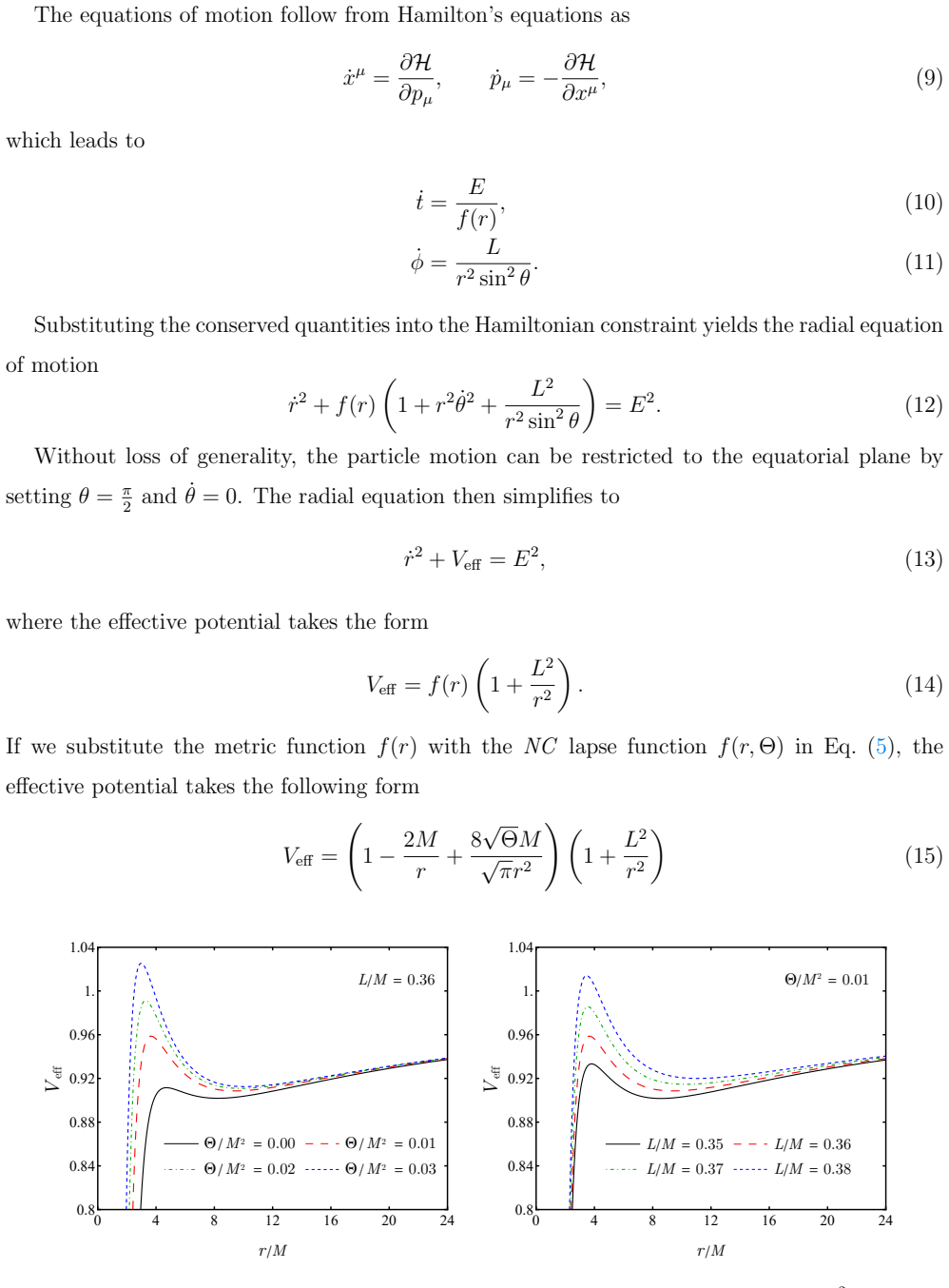
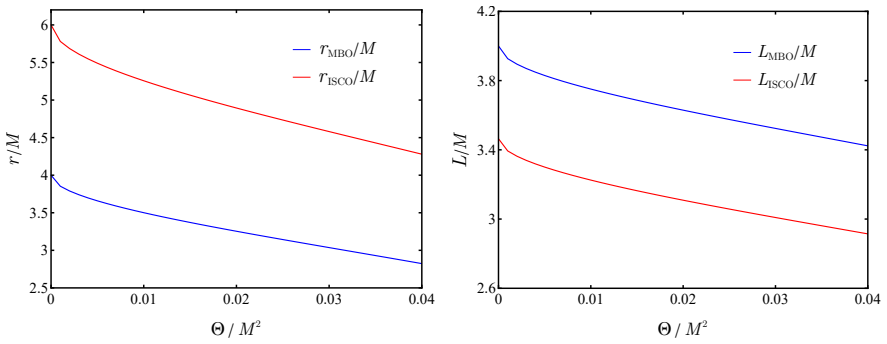
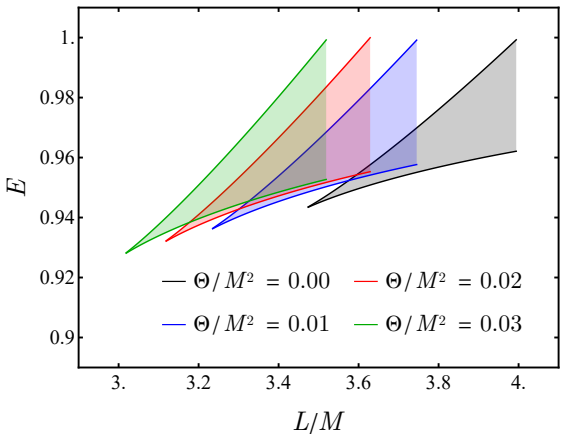
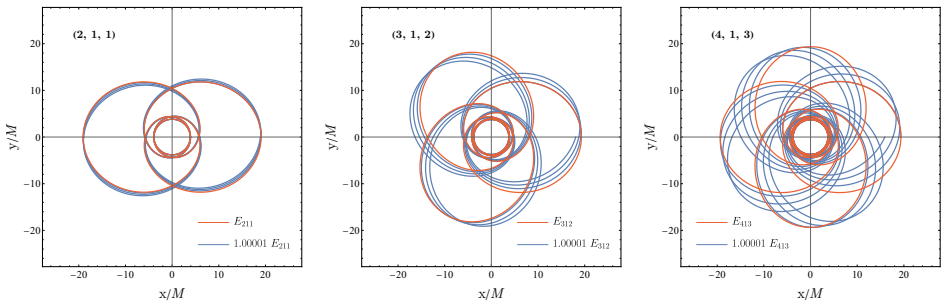
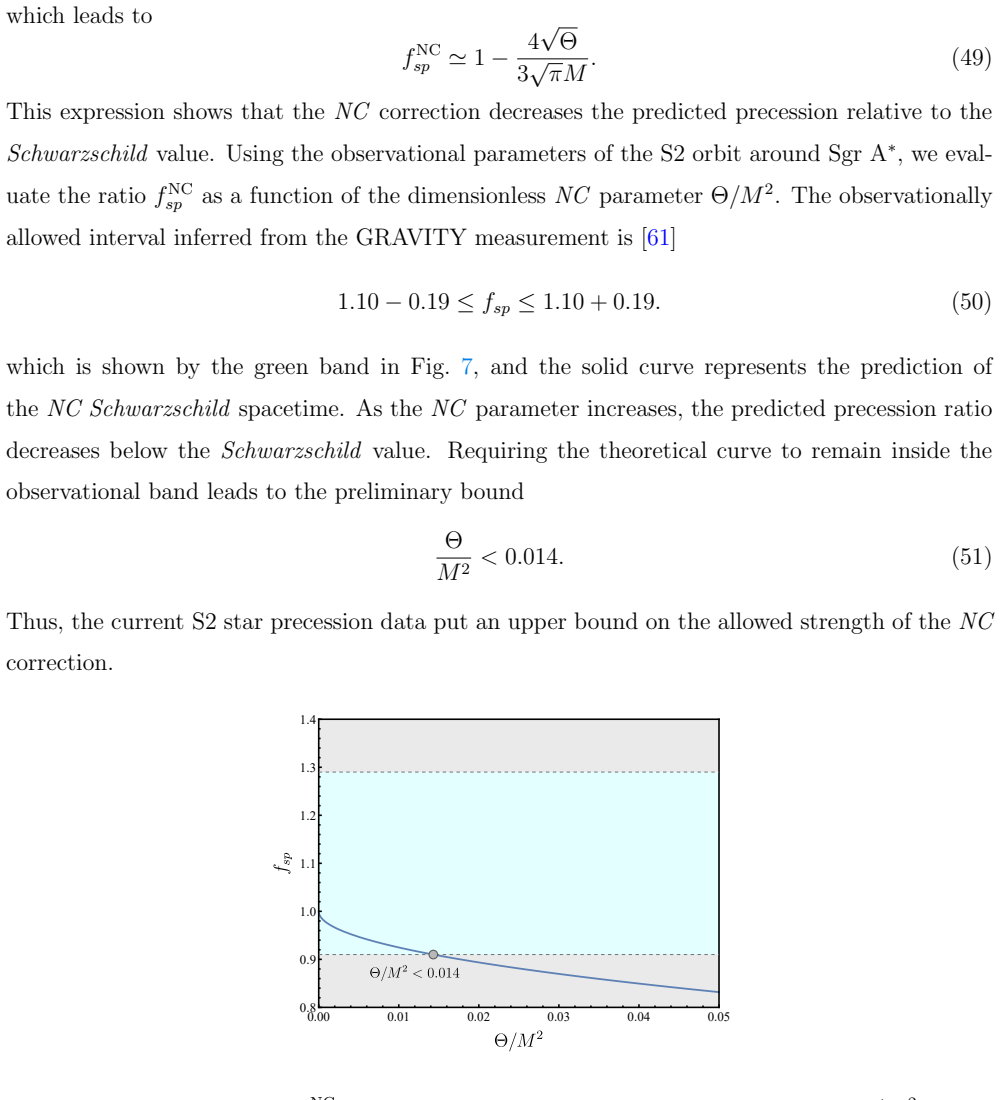
The central claim is that the non-commutative Schwarzschild metric modifies the effective potential and characteristic orbits, displacing the marginally bound orbit and ISCO to smaller radii while reducing required energies and angular momenta; periodic trajectories classified by the rational parameter q become more compact at fixed topology, and the resulting gravitational wave polarizations computed in the adiabatic and numerical kludge approximations display phase shifts together with an overall amplitude enhancement, yielding the preliminary constraint heta/M^{2} < 0.014 from S2 star data.
What carries the argument
The non-commutative Schwarzschild metric sourced by a Lorentzian distribution together with the rational parameter q that fixes the ratio of radial to azimuthal frequencies for periodic trajectories.
If this is right
- The allowed region in the (E,L) plane moves toward lower values, favoring more tightly bound orbits.
- For fixed orbital topology the energy required decreases and zoom-whirl configurations become more compact as the non-commutative parameter grows.
- Small deviations from the exact periodic energies produce observable precessional drift in the trajectory.
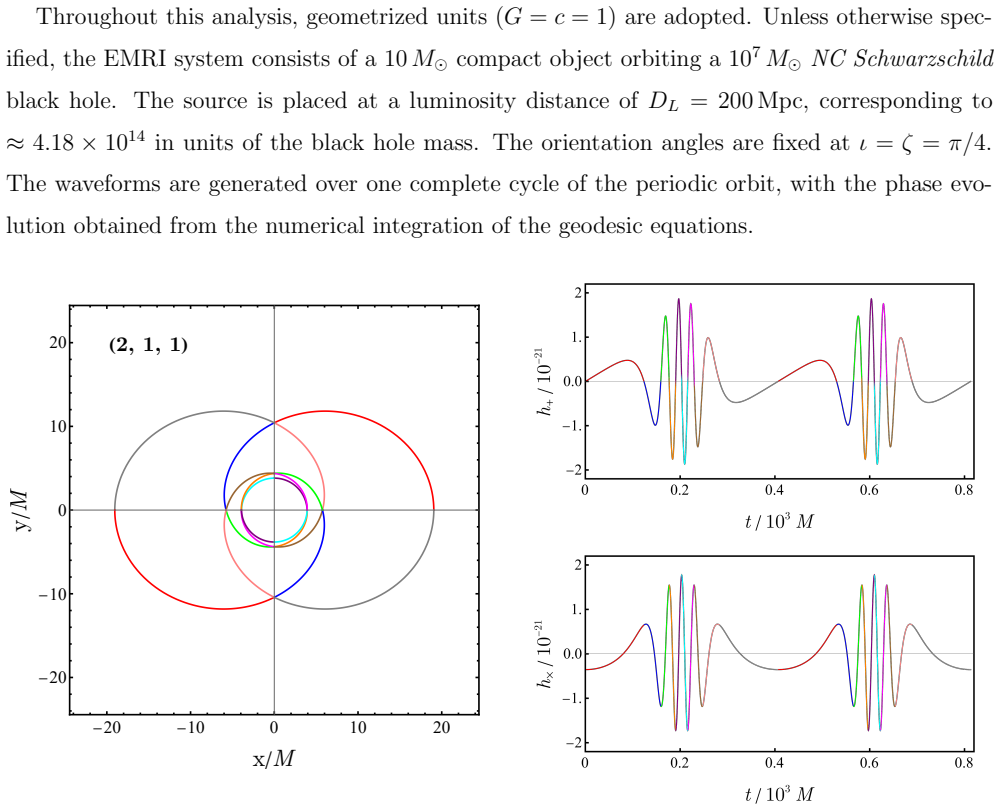
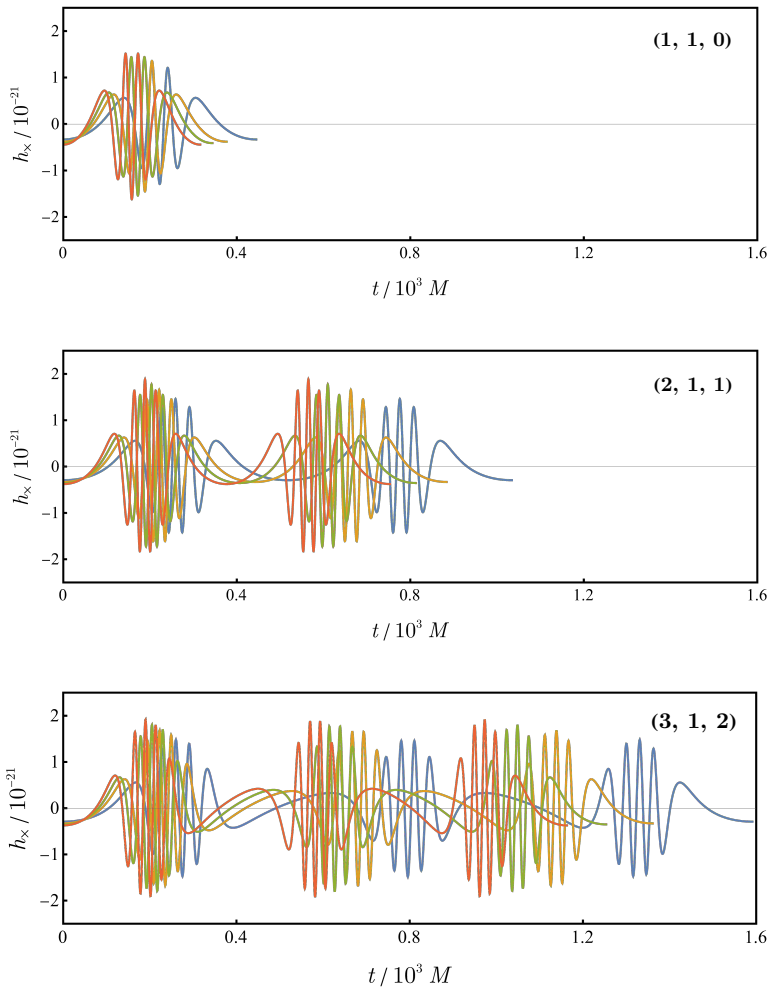
- Gravitational wave signals acquire measurable phase shifts and an overall amplitude boost compared with the commutative Schwarzschild case.
Where Pith is reading between the lines
- The same orbit modifications would appear in other non-commutative geometries if the Lorentzian source is retained.
- Tighter bounds on the parameter could be obtained by combining the S2 constraint with future stellar-orbit data around Sgr A*.
- The reported phase shifts suggest that extreme-mass-ratio inspirals around such black holes could carry distinguishable non-commutative signatures in the waveform.
Load-bearing premise
The non-commutative Schwarzschild metric sourced by a Lorentzian matter distribution is the correct spacetime background and the adiabatic plus numerical kludge approximations remain valid when the non-commutative parameter is nonzero.
What would settle it
A measurement of the S2 star periastron advance that requires heta/M^{2} greater than 0.014, or a detection of gravitational waves from a periodic orbit that lacks the predicted phase shift and amplitude increase.
Figures




read the original abstract
In this work, we investigate massive particle motion and the gravitational wave emission generated by periodic trajectories around a non--commutative \textit{Schwarzschild} black hole sourced by a Lorentzian matter distribution. We analyze the effective potential, the marginally bound orbit, and the innermost stable circular orbit, showing that non--commutative corrections shift these characteristic orbits toward smaller radii and reduce their corresponding angular momenta. The allowed region in the $(E, L)$ plane is also displaced toward lower values, favoring more tightly bound configurations. Periodic trajectories are classified through the rational parameter $q$, which relates the radial and azimuthal frequencies. For a fixed orbital topology, increasing the non--commutative parameter lowers the energy required to produce the orbit and results in more compact zoom--whirl configurations. Small deviations from the periodic energies are also shown to generate precessional drift. From the periastron advance of the S2 star around Sgr~A$^*$, we obtain the preliminary bound $\Theta/M^{2}<0.014$. Finally, using the adiabatic and numerical kludge approximations, we compute the gravitational wave polarizations and find phase shifts and an overall enhancement of the amplitude.
Editorial analysis
A structured set of objections, weighed in public.
Referee Report
Summary. The paper studies geodesic motion of massive particles on periodic orbits around a non-commutative Schwarzschild black hole sourced by a Lorentzian matter distribution. It examines shifts in the effective potential, marginally bound orbits, and ISCO; classifies periodic trajectories via the rational frequency ratio q; derives the preliminary bound Θ/M² < 0.014 from the periastron advance of the S2 star; and computes gravitational-wave polarizations via the adiabatic and numerical-kludge approximations, reporting phase shifts and an overall amplitude enhancement.
Significance. If the waveform approximations remain accurate on the modified background, the work supplies an astrophysical constraint on the non-commutative parameter and identifies potentially observable modifications to zoom-whirl waveforms. The orbit classification and bound extraction follow standard methods, while the GW results would be of interest for strong-field tests if validated.
major comments (1)
- [GW computation (following the orbit analysis)] The headline GW results rest on direct application of the adiabatic and numerical-kludge constructions to geodesics in the non-commutative metric. These constructions were calibrated for the standard Schwarzschild effective potential and frequency relations; the Lorentzian correction modifies both the radial potential and the mapping between coordinate and proper-time periods. No convergence tests with respect to Θ, error budget, or cross-check against an independent waveform method (e.g., Teukolsky or self-force) is supplied, so the reported phase shifts and amplitude enhancement cannot be separated from possible systematic bias introduced by the approximation itself.
Simulated Author's Rebuttal
We thank the referee for the careful reading of the manuscript and the constructive feedback. The single major comment concerns the application of the adiabatic and numerical-kludge waveform approximations to the non-commutative background. We address this point below and indicate the revisions we are prepared to make.
read point-by-point responses
-
Referee: [GW computation (following the orbit analysis)] The headline GW results rest on direct application of the adiabatic and numerical-kludge constructions to geodesics in the non-commutative metric. These constructions were calibrated for the standard Schwarzschild effective potential and frequency relations; the Lorentzian correction modifies both the radial potential and the mapping between coordinate and proper-time periods. No convergence tests with respect to Θ, error budget, or cross-check against an independent waveform method (e.g., Teukolsky or self-force) is supplied, so the reported phase shifts and amplitude enhancement cannot be separated from possible systematic bias introduced by the approximation itself.
Authors: We agree that the adiabatic and numerical-kludge methods were developed and calibrated in the Schwarzschild spacetime. In the present work the geodesic equations are solved exactly on the non-commutative metric, so the orbital frequencies, periastron advance, and zoom-whirl structure already incorporate the Lorentzian correction. The waveform routines are then applied to these modified trajectories using the same quadrupole and kludge prescriptions as in the literature. Because the coordinate-to-proper-time mapping and the effective potential are altered, it is indeed possible that part of the reported phase shift and amplitude enhancement could contain a systematic component from the waveform approximation itself. We did not perform explicit convergence tests in Θ or cross-checks against Teukolsky or self-force calculations. We will revise the manuscript to (i) add an explicit discussion of the domain of validity of the kludge approximations when the background deviates from Schwarzschild, (ii) include a brief error-budget estimate based on the size of the non-commutative correction, and (iii) state clearly that the quantitative GW results should be regarded as indicative until validated by more accurate waveform methods. These changes will be placed in a new subsection following the orbit analysis. revision: yes
Circularity Check
No circularity: derivations from metric to orbits/bounds/waveforms are forward and externally constrained
full rationale
The paper starts from the given non-commutative Schwarzschild metric (sourced by Lorentzian distribution), derives effective potentials, ISCO/MBO locations, periodic orbits via rational q, and periastron advance to bound Θ/M² from external S2-star observations. Waveform polarizations are then computed forward via adiabatic/numerical-kludge methods applied to those geodesics. None of these steps reduce a claimed prediction to an internally fitted constant, self-citation chain, or definitional equivalence; the central results remain independent of the paper's own inputs.
Axiom & Free-Parameter Ledger
free parameters (1)
- non-commutative parameter Θ
axioms (2)
- domain assumption The background spacetime is a non-commutative Schwarzschild geometry sourced by a Lorentzian matter distribution.
- domain assumption The adiabatic and numerical kludge approximations remain sufficiently accurate when the non-commutative parameter is non-zero.
invented entities (1)
-
non-commutative Schwarzschild black hole
no independent evidence
Reference graph
Works this paper leans on
-
[1]
z” denotes the number of radial oscillations required for the orbit to close, “w
3.2 3.4 3.6 3.8 4. 0.9 0.92 0.94 0.96 0.98 1. L/M E Figure 3: Allowed parameter space for bound timelike motion in the (E, L)–plane for several values of theNCparameter Θ/M 2. To analyze the periodic structure of bound timelike motion, we employ the rational number classification introduced in Ref. [57]. In this approach, each periodic trajectory is assoc...
2025
-
[2]
N. Herceg, T. Juri´ c, A. Samsarov, I. Smoli´ c, Metric perturbations in noncommutative gravity, Journal of High Energy Physics 06 (2024) 130.arXiv:2310.06038,doi:10.1007/JHEP06(2024) 130
-
[3]
Chaichian, A
M. Chaichian, A. Tureanu, G. Zet, Corrections to schwarzschild solution in noncommutative gauge theory of gravity, Physics Letters B 660 (5) (2008) 573–578
2008
-
[4]
Juri´ c, A
T. Juri´ c, A. N. Kumara, F. Poˇ zar, Constructing noncommutative black holes, Nuclear Physics B 1017 (2025) 116950
2025
-
[5]
Nicolini, A
P. Nicolini, A. Smailagic, E. Spallucci, Noncommutative geometry inspired schwarzschild black hole, Physics Letters B 632 (4) (2006) 547–551. 22
2006
-
[6]
Y. S. Myung, Y.-W. Kim, Y.-J. Park, Thermodynamics and evaporation of the noncommutative black hole, Journal of High Energy Physics 2007 (02) (2007) 012
2007
-
[7]
A. A. Ara´ ujo Filho, S. Zare, P. J. Porf´ ırio, J. Kˇ r´ ıˇ z, H. Hassanabadi, Thermodynamics and evapo- ration of a modified schwarzschild black hole in a non-commutative gauge theory, Physics Letters B 838 (2023) 137744
2023
-
[8]
Nozari, B
K. Nozari, B. Fazlpour, Thermodynamics of noncommutative schwarzschild black hole, Modern Physics Letters A 22 (38) (2007) 2917–2930
2007
-
[9]
Banerjee, B
R. Banerjee, B. R. Majhi, S. Samanta, Noncommutative black hole thermodynamics, Physical Review D 77 (12) (2008) 124035
2008
-
[10]
K. Nozari, B. Fazlpour, Reissner-nordstr¨ om black hole thermodynamics in noncommutative spaces, arXiv preprint (2006).arXiv:gr-qc/0608077
Pith/arXiv arXiv 2006
-
[11]
Sharif, W
M. Sharif, W. Javed, Thermodynamics of a bardeen black hole in noncommutative space, Canadian Journal of Physics 89 (10) (2011) 1027–1033
2011
-
[12]
Heidari, A
N. Heidari, A. A. Ara´ ujo Filho, I. P. Lobo, Non-commutativity in hayward spacetime, Journal of Cosmology and Astroparticle Physics 2025 (09) (2025) 051
2025
-
[13]
A. A. Ara´ ujo Filho, N. Heidari, I. P. Lobo, A non-commutative kalb-ramond black hole, Journal of Cosmology and Astroparticle Physics 2025 (09) (2025) 076
2025
-
[14]
N. Heidari, Imprints of non-commutativity on charged black holes, Classical and Quantum Gravity 43 (3) (2026) 035004.doi:10.1088/1361-6382/ae351b
-
[15]
Y. Zhao, Y. Cai, S. Das, G. Lambiase, E. N. Saridakis, E. C. Vagenas, Quasinormal modes in noncommutative schwarzschild black holes, arXiv preprint (2023).arXiv:2301.09147
arXiv 2023
-
[16]
M. A. Anacleto, F. A. Brito, J. A. V. Campos, E. Passos, Absorption, scattering and shadow by a noncommutative black hole with global monopole, The European Physical Journal C 83 (4) (2023) 298
2023
-
[17]
M. A. Anacleto, F. A. Brito, J. A. V. Campos, E. Passos, Absorption and scattering of a noncommutative black hole, Physics Letters B 803 (2020) 135334.arXiv:1907.13107,doi: 10.1016/j.physletb.2020.135334
-
[18]
Heidari, H
N. Heidari, H. Hassanabadi, A. A. Ara´ ujo Filho, J. Kriz, Exploring non-commutativity as a pertur- bation in the schwarzschild black hole: quasinormal modes, scattering, and shadows, The European Physical Journal C 84 (6) (2024) 566
2024
-
[19]
R. B. Mann, P. Nicolini, Cosmological production of noncommutative black holes, Physical Review D 84 (6) (2011) 064014
2011
-
[20]
J. A. V. Campos, M. A. Anacleto, F. A. Brito, E. Passos, Quasinormal modes and shadow of noncommutative black hole, Scientific Reports 12 (1) (2022) 8516. 23
2022
-
[21]
M. A. Anacleto, J. A. V. Campos, F. A. Brito, E. Passos, Quasinormal modes and shadow of a schwarzschild black hole with gup, Annals of Physics 434 (2021) 168662
2021
-
[22]
G. Zet, V. Manta, S. Babeti, Desitter gauge theory of gravitation, International Journal of Modern Physics C 14 (01) (2003) 41–48
2003
-
[23]
Karimabadi, S
M. Karimabadi, S. A. Alavi, D. M. Yekta, Non-commutative effects on gravitational measurements, Classical and Quantum Gravity 37 (8) (2020) 085009
2020
-
[24]
J. C. Lopez-Dominguez, O. Obregon, M. Sabido, C. Ramirez, Towards noncommutative quantum black holes, Physical Review D 74 (8) (2006) 084024
2006
-
[25]
Modesto, P
L. Modesto, P. Nicolini, Charged rotating noncommutative black holes, Physical Review D 82 (10) (2010) 104035
2010
-
[26]
Nicolini, Noncommutative black holes, the final appeal to quantum gravity: a review, Interna- tional Journal of Modern Physics A 24 (07) (2009) 1229–1308
P. Nicolini, Noncommutative black holes, the final appeal to quantum gravity: a review, Interna- tional Journal of Modern Physics A 24 (07) (2009) 1229–1308
2009
-
[27]
A. A. Ara´ ujo Filho, J. R. Nascimento, A. Y. Petrov, P. J. Porf´ ırio, A.¨Ovg¨ un, Properties of an ax- isymmetric lorentzian non-commutative black hole, Physics of the Dark Universe 47 (2025) 101796. arXiv:2411.04674,doi:10.1016/j.dark.2024.101796
-
[28]
A. A. A. Filho, J. R. Nascimento, A. Y. Petrov, P. J. Porf´ ırio, A.¨Ovg¨ un, Effects of non-commutative geometry on black hole properties, Physics of the Dark Universe 46 (2024) 101630.arXiv:2406. 12015,doi:10.1016/j.dark.2024.101630
-
[29]
M. A. Anacleto, A. T. N. Silva, L. Casarini, Shadow of a noncommutative thin-shell gravastar, arXiv preprint (2026).arXiv:2605.03897
Pith/arXiv arXiv 2026
-
[30]
A. A. Ara´ ujo Filho, N. Heidari, A. ¨Ovg¨ un, Geodesics, accretion disk, gravitational lensing, time delay, and effects on neutrinos induced by a non-commutative black hole, Journal of Cosmology and Astroparticle Physics 06 (2025) 062.arXiv:2412.08369,doi:10.1088/1475-7516/2025/06/062
-
[31]
A. A. Ara´ ujo Filho, N. Heidari, Y. Shi, Neutrino dynamics in a non-commutative spacetime, arXiv preprint (2025).arXiv:2504.04474
arXiv 2025
-
[32]
H. Gong, S. Long, X.-J. Wang, Z. Xia, J.-P. Wu, Q. Pan, Gravitational waveforms from periodic orbits around a novel regular black hole, The European Physical Journal C 86 (5) (2026) 469
2026
- [33]
-
[35]
E. L. B. Junior, J. T. S. S. Junior, F. S. N. Lobo, M. E. Rodrigues, D. Rubiera-Garcia, L. F. D. 24 da Silva, H. A. Vieira, Periodical orbits and waveforms with spontaneous lorentz symmetry-breaking in kalb-ramond gravity, The European Physical Journal C 85 (5) (2025) 557.arXiv:2412.00769, doi:10.1140/epjc/s10052-025-14299-3
-
[36]
S. Lu, T. Zhu, Gravitational radiations from periodic orbits around einstein-æther black holes, Physics of the Dark Universe 50 (2025) 102141.arXiv:2505.00294,doi:10.1016/j.dark.2025. 102141
work page internal anchor Pith review Pith/arXiv arXiv doi:10.1016/j.dark.2025 2025
-
[37]
C.-H. Wang, X.-C. Meng, Y.-P. Zhang, T. Zhu, S.-W. Wei, Equatorial periodic orbits and gravi- tational waveforms in a black hole free of cauchy horizon, Journal of Cosmology and Astroparticle Physics 07 (2025) 021.arXiv:2502.08994,doi:10.1088/1475-7516/2025/07/021
-
[38]
A. Addazi, et al., Quantum gravity phenomenology at the dawn of the multi-messenger era – a review, Progress in Particle and Nuclear Physics 125 (2022) 103948.arXiv:2111.05659,doi: 10.1016/j.ppnp.2022.103948
-
[39]
J. Chen, J. Yang, Periodic orbits and gravitational waveforms in quantum-corrected black hole spacetimes, The European Physical Journal C 85 (7) (2025) 726.arXiv:2505.02660,doi:10. 1140/epjc/s10052-025-14457-7
arXiv 2025
- [40]
-
[41]
Z. Shi, X. Zhang, Y. Liu, Periodic orbits and gravitational waveforms of black holes in bumblebee gravity, Physics of the Dark Universe (2026) 102349
2026
-
[42]
Liu, L.-X
M.-J. Liu, L.-X. Huang, Y.-Q. Wang, K. Yang, Boson stars in bumblebee gravity and their grav- itational waveforms from extreme-mass-ratio inspirals, The European Physical Journal C 86 (6) (2026) 651
2026
-
[43]
Y.-Z. Li, X.-M. Kuang, The bound orbits and gravitational waveforms of timelike particles around renormalization group improved kerr black holes, The European Physical Journal C 86 (3) (2026) 261.arXiv:2509.07333,doi:10.1140/epjc/s10052-026-15510-9
-
[44]
Z. Hua, Z.-T. He, J.-Q. Lai, J. Jiao, Y. Tian, Taxonomy of periodic orbits and gravitational waves in a non-rotating destounis-suvorov-kokkotas black hole spacetime, Physics Letters B 876 (2026) 140402.arXiv:2601.00550,doi:10.1016/j.physletb.2026.140402
work page internal anchor Pith review Pith/arXiv arXiv doi:10.1016/j.physletb.2026.140402 2026
-
[45]
T. Xamidov, S. Shaymatov, Q. Wu, T. Zhu, Gravitational wave signatures from periodic orbits around a schwarzschild-bertotti-robinson black hole, arXiv preprint (2026).arXiv:2602.09453
arXiv 2026
-
[46]
M. Alloqulov, S. Shaymatov, B. Ahmedov, T. Zhu, Gravitational waveforms from periodic orbits around a dyonic modmax black hole, The European Physical Journal C 86 (3) (2026) 259.arXiv: 2511.15237,doi:10.1140/epjc/s10052-026-15469-7
-
[47]
A. Mohammadi, A. Kumar, H. Tan, S. G. Ghosh, Periodic orbits as probes of charged loop quantum 25 gravity black holes through gravitational waves (2026).arXiv:2606.11728
Pith/arXiv arXiv 2026
-
[49]
W. Deng, S. Long, Q. Tan, J. Jing, Gravitational waveforms from periodic orbits around a charged black hole with scalar hair, Chinese Physics C 50 (3) (2026) 035103.arXiv:2510.24468,doi: 10.1088/1674-1137/ae28eb
-
[50]
Kumar, R
S. Kumar, R. K. Singh, A. Chowdhuri, A. Bhattacharyya, Exploring waveforms with non-gr devi- ations for extreme mass-ratio inspirals, Journal of Cosmology and Astroparticle Physics 2024 (10) (2024) 047
2024
-
[51]
A. Kumar, A. Mohammadi, S. G. Ghosh, Probing gravitational wave signatures from periodic orbits of regular black holes in asymptotically safe gravity, arXiv preprint (2026).arXiv:2605.07187
Pith/arXiv arXiv 2026
- [52]
-
[53]
H. Hassanabadi, J. Zhang, D. J. Gogoi, F. Hosseinifar, S. Zare, Periodic orbits and quasinormal modes of a black hole surrounded by king dark matter halo, The European Physical Journal C 86 (2) (2026) 119.doi:10.1140/epjc/s10052-026-15344-5
-
[54]
G.-H. Li, C.-K. Qiao, J. Tao, Periodic orbits and their gravitational waves in emris: supermassive black hole affected by galactic dark matter halos, arXiv preprint (2025).arXiv:2510.24989
Pith/arXiv arXiv 2025
-
[55]
M. Alloqulov, T. Xamidov, S. Shaymatov, B. Ahmedov, Gravitational waveforms from peri- odic orbits around a schwarzschild black hole embedded in a dehnen-type dark matter halo, The European Physical Journal C 85 (7) (2025) 798.arXiv:2504.05236,doi:10.1140/epjc/ s10052-025-14529-8
-
[56]
N. Heidari, I. P. Lobo, et al., Gravitational wave signatures and periodic orbits of a charged black hole in a hernquist dark matter halo, arXiv preprint (2026).arXiv:2604.11863
Pith/arXiv arXiv 2026
-
[57]
F. Ahmed, Q. Wu, S. G. Ghosh, T. Zhu, Gravitational wave signatures from periodic orbits around a non-commutative inspired black hole surrounded by quintessence, Journal of Cosmology and Astroparticle Physics 02 (2026) 004.arXiv:2511.08456,doi:10.1088/1475-7516/2026/02/004
-
[58]
Levin, G
J. Levin, G. Perez-Giz, A periodic table for black hole orbits, Physical Review D 77 (10) (2008) 103005
2008
-
[59]
Healy, J
J. Healy, J. Levin, D. Shoemaker, Zoom-whirl orbits in black hole binaries, Physical Review Letters 103 (13) (2009) 131101
2009
-
[60]
R. Wang, F. Gao, H. Chen, Periodic orbits around a static spherically symmetric black hole sur- 26 rounded by quintessence, Annals of Physics 447 (2022) 169167
2022
-
[61]
Shabbir, M
O. Shabbir, M. Jamil, M. Azreg-A¨ ınou, Periodic orbits and their gravitational wave radiations around the schwarzschild-mog black hole, Physics of the Dark Universe 47 (2025) 101816
2025
-
[62]
Abuter, et al., Detection of the schwarzschild precession in the orbit of the star s2 near the galactic centre massive black hole, Astronomy & Astrophysics 636 (2020) L5
R. Abuter, et al., Detection of the schwarzschild precession in the orbit of the star s2 near the galactic centre massive black hole, Astronomy & Astrophysics 636 (2020) L5
2020
-
[63]
J.-T. Yao, X. Li, Probing covariant quantum black holes in effective quantum gravity through the orbital motion of the s2 star around sagittarius a ∗, Physical Review D 113 (8) (2026) 084003
2026
-
[64]
Li, X.-M
Y.-Z. Li, X.-M. Kuang, Y. Sang, Precessing and periodic timelike orbits and their potential appli- cations in einsteinian cubic gravity, The European Physical Journal C 84 (5) (2024) 529
2024
-
[65]
Lin, X.-M
H.-Y. Lin, X.-M. Deng, Precessing and periodic orbits around lee-wick black holes, The European Physical Journal Plus 137 (2) (2022) 176
2022
-
[66]
Amaro-Seoane, et al., Laser interferometer space antenna, arXiv preprint (2017).arXiv:1702
P. Amaro-Seoane, et al., Laser interferometer space antenna, arXiv preprint (2017).arXiv:1702. 00786
2017
-
[67]
Hu, Y.-L
W.-R. Hu, Y.-L. Wu, The taiji program in space for gravitational wave physics and the nature of gravity, National Science Review 4 (5) (2017) 685–686
2017
-
[68]
Y. Gong, J. Luo, B. Wang, Concepts and status of chinese space gravitational wave detection projects, Nature Astronomy 5 (9) (2021) 881–889
2021
-
[69]
S. A. Hughes, Evolution of circular, nonequatorial orbits of kerr black holes due to gravitational- wave emission, Physical Review D 61 (8) (2000) 084004
2000
-
[70]
S. A. Hughes, Evolution of circular, nonequatorial orbits of kerr black holes due to gravitational- wave emission. ii. inspiral trajectories and gravitational waveforms, Physical Review D 64 (6) (2001) 064004
2001
-
[71]
S. A. Hughes, S. Drasco, E. E. Flanagan, J. Franklin, Gravitational radiation reaction and inspiral waveforms in the adiabatic limit, Physical Review Letters 94 (22) (2005) 221101
2005
-
[72]
P. A. Sundararajan, G. Khanna, S. A. Hughes, Towards adiabatic waveforms for inspiral into kerr black holes: A new model of the source for the time domain perturbation equation, Physical Review D 76 (10) (2007) 104005
2007
-
[73]
Miller, A
J. Miller, A. Pound, Two-timescale evolution of extreme-mass-ratio inspirals: waveform generation scheme for quasicircular orbits in schwarzschild spacetime, Physical Review D 103 (6) (2021) 064048
2021
-
[74]
Isoyama, R
S. Isoyama, R. Fujita, A. J. K. Chua, H. Nakano, A. Pound, N. Sago, Adiabatic waveforms from extreme-mass-ratio inspirals: an analytical approach, Physical Review Letters 128 (23) (2022) 231101
2022
-
[75]
Babak, H
S. Babak, H. Fang, J. R. Gair, K. Glampedakis, S. A. Hughes, “kludge” gravitational waveforms for a test-body orbiting a kerr black hole, Physical Review D 75 (2) (2007) 024005. 27
2007
-
[76]
Yang, Y.-P
S. Yang, Y.-P. Zhang, T. Zhu, L. Zhao, Y.-X. Liu, Gravitational waveforms from periodic orbits around a quantum-corrected black hole, Journal of Cosmology and Astroparticle Physics 2025 (01) (2025) 091
2025
-
[77]
L. Zhao, M. Tang, Z. Xu, Periodic orbits and gravitational wave radiation in short hair black hole spacetimes for an extreme mass ratio system, The European Physical Journal C 85 (1) (2025) 36
2025
-
[78]
Poisson, C
E. Poisson, C. M. Will, Gravity: Newtonian, Post-Newtonian, Relativistic, Cambridge University Press, Cambridge, 2014
2014
-
[79]
Maselli, N
A. Maselli, N. Franchini, L. Gualtieri, T. P. Sotiriou, S. Barsanti, P. Pani, Detecting fundamen- tal fields with lisa observations of gravitational waves from extreme mass-ratio inspirals, Nature Astronomy 6 (4) (2022) 464–470
2022
-
[80]
Liang, R
D. Liang, R. Xu, Z.-F. Mai, L. Shao, Probing vector hair of black holes with extreme-mass-ratio inspirals, Physical Review D 107 (4) (2023) 044053. 28
2023
discussion (0)
Sign in with ORCID, Apple, or X to comment. Anyone can read and Pith papers without signing in.