REVIEW 3 minor 34 references
FlexLink: Decoupling Control and Data Beams for Next-Generation Wideband Networks
T0 review · 0 major / 3 minor · reviewed 2026-06-28 · grok-4.3
Pith's one-line read A delay-phased array architecture decouples control and data beams in wideband networks without beamforming loss.
desk verdict FlexLink prototypes a delay-phased array on 4-7 GHz hardware that forms multiple full-gain beams and nearly doubles spectral efficiency over standard phased arrays. read the letter →
The pith
A machine-rendered reading of the paper's core claim, the machinery that carries it, and where it could break.
The reading
What carries the argument
delay-phased array architecture that redistributes energy jointly across frequency and space to form multiple narrow beams
What would settle it
A field measurement in a scaled commercial wideband deployment that shows spectral efficiency no higher than conventional phased arrays when control and data beams operate simultaneously.
Extended reading notes
Core claim
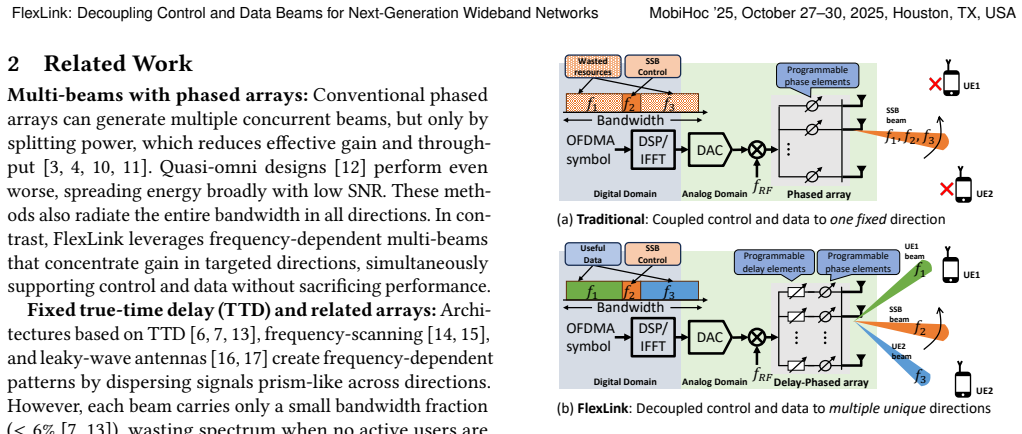
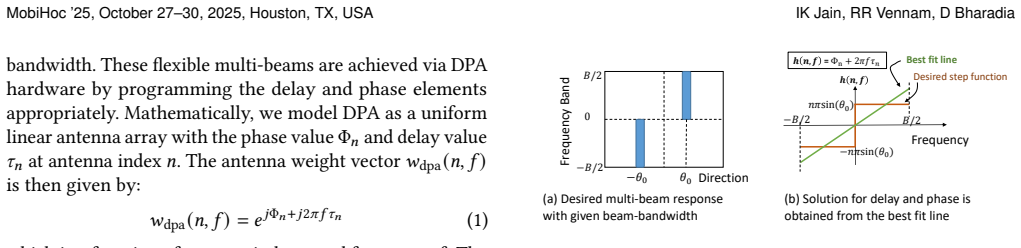
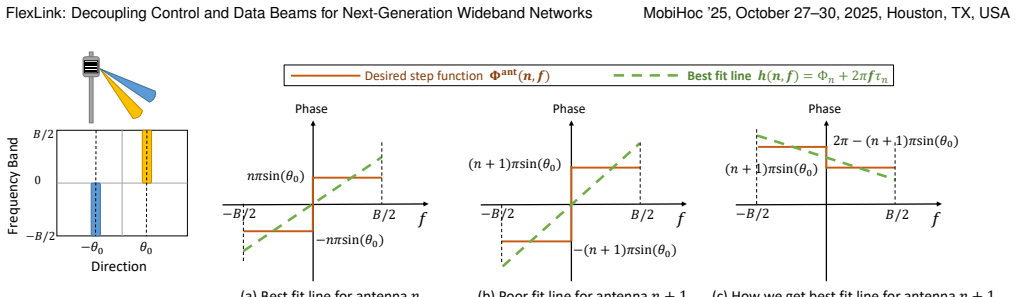
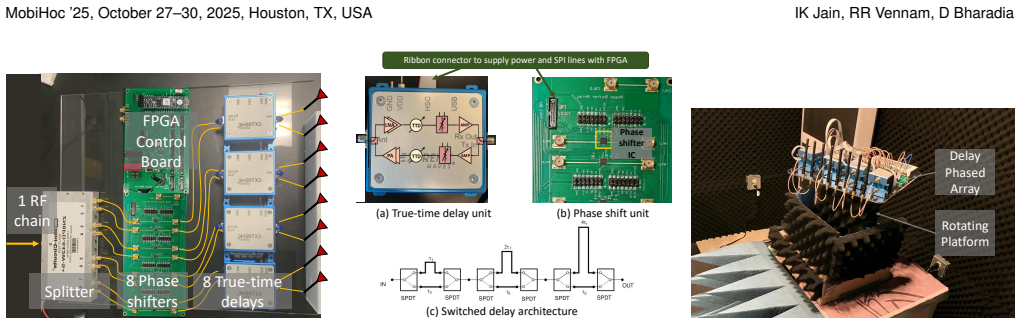
FlexLink uses a delay-phased array architecture to overcome the fundamental constraint of phased arrays at mmWave and mid-bands, which are limited to a single beam or suffer sharp beamforming loss when split across directions. By redistributing energy jointly across frequency and space, the design enables multiple narrow beams without sacrificing per-beam gain or requiring additional power. The custom hardware prototype at 4-7 GHz demonstrates for the first time that control and data beams can be decoupled in practice, achieving nearly double spectral efficiency over conventional phased arrays.
Load-bearing premise
The custom 4-7 GHz testbed hardware and measurement setup faithfully represent the beamforming loss and spectral efficiency limits that would appear in deployed wideband 6G networks at scale.
Editorial extensions
If this is right
- Multiple narrow beams can be formed at once for control and data without per-beam gain loss.
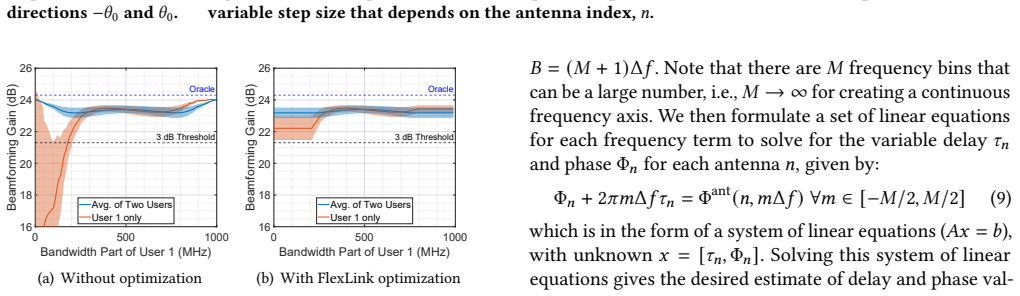
- Spectral efficiency can reach nearly twice that of conventional phased arrays.
- Simultaneous control-data support becomes possible at low latency without extra power.
- The architecture works across ultra-wideband spectrum and massive antenna arrays.
Reading between the lines
- The same redistribution principle could extend to higher-frequency mmWave bands where beam loss is more severe.
- Network operators might reduce the number of separate arrays needed per base station.
- The approach could be tested by measuring beam patterns across wider frequency ranges in outdoor deployments.
Signed reviews
Editorial analysis
A structured set of objections, weighed in public.
Referee Report
Summary. The paper introduces FlexLink, a delay-phased array architecture that decouples control and data beams in ultra-wideband networks by redistributing energy jointly across frequency and space. It prototypes the design on a custom 4-7 GHz hardware testbed and reports that this enables multiple narrow beams without per-beam gain loss or extra power, achieving nearly double spectral efficiency versus conventional phased arrays.
Significance. If the prototype results hold under the reported conditions, the work provides the first experimental demonstration of practical beam decoupling for simultaneous control-data operation in wideband arrays. This directly addresses a stated limitation of phased arrays at mmWave and mid-bands and supplies hardware measurements, beam patterns, and SE calculations that support the central claim within the testbed scope.
minor comments (3)
- Abstract: the claim of 'nearly double spectral efficiency' would be strengthened by including a brief statement of the exact baseline (e.g., single-beam phased array at same total power), the frequency band(s) used for the comparison, and whether error bars or multiple trials are reported in the full manuscript.
- The manuscript should clarify in the methods or results section how spectral efficiency was computed (e.g., formula, noise model, and whether it accounts for beamforming loss across the 4-7 GHz band).
- Figure captions or § on beam pattern measurements should explicitly note the number of independent trials and any post-selection of directions or sub-bands to allow readers to assess robustness.
Simulated Author's Rebuttal
We thank the referee for the positive assessment of our work on FlexLink and the recommendation for minor revision. The report correctly identifies the core contribution as the first experimental demonstration of practical beam decoupling for simultaneous control-data operation in wideband arrays. No major comments were provided in the report.
Circularity Check
No significant circularity in experimental prototype results
full rationale
The manuscript reports a hardware prototype and direct measurements on a custom 4-7 GHz testbed demonstrating decoupled control and data beams with measured spectral efficiency gains. No load-bearing equations, fitted parameters, or self-citations are present that reduce the reported gains or beam patterns to quantities defined by the authors' own prior work or normalization choices. The central claim rests on empirical hardware validation rather than any derivation chain, making the result self-contained against external benchmarks.
Assumptions & free parameters
Cite this review
Pith. "Pith review of FlexLink: Decoupling Control and Data Beams for Next-Generation Wideband Networks." pith.science (2026). https://pith.science/paper/YQTUNXAR
@misc{pith2026260601454,
  author       = {Pith},
  title        = {Pith review of: FlexLink: Decoupling Control and Data Beams for Next-Generation Wideband Networks},
  year         = {2026},
  howpublished = {\url{https://pith.science/paper/YQTUNXAR}},
  note         = {Machine review of arXiv:2606.01454}
}
read the original abstract
The next generation of 6G networks aims to utilize ultra-wideband spectrum and massive antenna arrays to serve multiple users with both control and data channels at low latency and high efficiency. However, phased arrays at mmWave and mid-bands are fundamentally constrained to a single beam or suffer sharp beamforming loss when split across directions, limiting simultaneous control-data support. In FlexLink, we introduce and prototype a novel delay-phased array architecture that overcomes this limitation by redistributing energy jointly across frequency and space, enabling multiple narrow beams without sacrificing per-beam gain or requiring additional power. We design and prototype FlexLink on a custom 4-7 GHz hardware testbed, demonstrating for the first time that control and data beams can be decoupled in practice, achieving nearly double spectral efficiency compared to conventional phased arrays.
Figures

Figures from the paper (8 more)


Reference graph
Works this paper leans on
-
[1]
5G NR (New Radio) Release 16
3GPP. 5G NR (New Radio) Release 16. 3GPP.https://www.3gpp.org/ release-16, Oct 2019
2019
-
[2]
Ahmad Bazzi, Roberto Bomfin, Marco Mezzavilla, Sundeep Rangan, Theodore Rappaport, and Marwa Chafii. Upper mid-band spectrum for 6g: Vision, opportunity and challenges.arXiv preprint arXiv:2502.17914, 2025
-
[3]
Two beams are better than one: towards reliable and high throughput mmwave links
Ish Kumar Jain, Raghav Subbaraman, and Dinesh Bharadia. Two beams are better than one: towards reliable and high throughput mmwave links. InProceedings of the 2021 ACM SIGCOMM 2021 Conference, pages 488–502, 2021
2021
-
[4]
Smartlink: Exploiting channel clustering effects for reliable millimeter wave communications
Irmak Aykin, Berk Akgun, and Marwan Krunz. Smartlink: Exploiting channel clustering effects for reliable millimeter wave communications. InIEEE INFOCOM 2019-IEEE Conference on Computer Communications, pages 1117–1125. IEEE, 2019
2019
-
[5]
Rainbow-link: Beam- alignment-free and grant-free mmw multiple access using true-time- delay array.IEEE Journal on Selected Areas in Communications, 2022
Ruifu Li, Han Yan, and Danijela Cabric. Rainbow-link: Beam- alignment-free and grant-free mmw multiple access using true-time- delay array.IEEE Journal on Selected Areas in Communications, 2022
2022
-
[6]
Wideband millimeter- wave beam training with true-time-delay array architecture
Han Yan, Veljko Boljanovic, and Danijela Cabric. Wideband millimeter- wave beam training with true-time-delay array architecture. In2019 53rd Asilomar Conference on Signals, Systems, and Computers, pages 1447–1452. IEEE, 2019
2019
-
[7]
Fast beam training with true-time-delay arrays in wideband millimeter-wave systems.IEEE Transactions on Circuits and Systems I: Regular Papers, 68(4):1727–1739, 2021
Veljko Boljanovic et al. Fast beam training with true-time-delay arrays in wideband millimeter-wave systems.IEEE Transactions on Circuits and Systems I: Regular Papers, 68(4):1727–1739, 2021
2021
-
[8]
Ish Kumar Jain, Rohith Reddy Vennam, Raghav Subbaraman, and Dinesh Bharadia. mmflexible: Flexible directional frequency mul- tiplexing for multi-user mmwave networks, IEEE INFOCOM 2023. https://ieeexplore.ieee.org/document/10229065, 2023
Show all 34 references
-
[9]
Joint phase-time arrays: A paradigm for frequency-dependent analog beamforming in 6g.IEEE Access, 10:73364–73377, 2022
Vishnu V Ratnam, Jianhua Mo, Ahmad Alammouri, Boon Loong Ng, Jianzhong Zhang, and Andreas F Molisch. Joint phase-time arrays: A paradigm for frequency-dependent analog beamforming in 6g.IEEE Access, 10:73364–73377, 2022
2022
-
[10]
Split antenna array in mil- limeter wave for secure vehicular communication
Shah Marjan, Lin Bai, and Chao Han. Split antenna array in mil- limeter wave for secure vehicular communication. InMATEC Web of Conferences, volume 173, page 02024. EDP Sciences, 2018
2018
-
[11]
Fast millimeter wave beam alignment
Haitham Hassanieh, Omid Abari, Michael Rodriguez, Mohammed Abdelghany, Dina Katabi, and Piotr Indyk. Fast millimeter wave beam alignment. InProceedings of the 2018 Conference of the ACM Special Interest Group on Data Communication, pages 432–445. ACM, 2018
2018
-
[12]
Adaptive beam-frequency allocation algorithm with posi- tion uncertainty for millimeter-wave mimo systems
Rafail Ismayilov, Megumi Kaneko, Takefumi Hiraguri, and Kentaro Nishimori. Adaptive beam-frequency allocation algorithm with posi- tion uncertainty for millimeter-wave mimo systems. In2018 IEEE 87th Vehicular Technology Conference (VTC Spring), pages 1–5. IEEE, 2018
2018
-
[13]
3d rainbow beam design for fast beam training with true-time-delay arrays in wideband millimeter-wave systems
Aditya Wadaskar, Veljko Boljanovic, Han Yan, and Danijela Cabric. 3d rainbow beam design for fast beam training with true-time-delay arrays in wideband millimeter-wave systems. In2021 55th Asilomar Conference on Signals, Systems, and Computers, pages 85–92. IEEE, 2021
2021
-
[14]
Bringing wifi localization to any wifi devices
Tianxiang Li, Haofan Lu, Reza Rezvani, Ali Abedi, and Omid Abari. Bringing wifi localization to any wifi devices. InProceedings of the 21st ACM Workshop on Hot Topics in Networks, pages 46–52, 2022
2022
-
[15]
Frequency scanning x-band antenna for 3d radar systems
S Sekretarov, D Vavriv, V Vinogradov, A Kravtsov, Y Bulakh, and V Zolotarev. Frequency scanning x-band antenna for 3d radar systems. In2023 53rd European Microwave Conference (EuMC), pages 959–962. IEEE, 2023
2023
-
[16]
Hooman Saeidi, Suresh Venkatesh, Xuyang Lu, and Kaushik Sengupta. Thz prism: One-shot simultaneous localization of multiple wireless nodes with leaky-wave thz antennas and transceivers in cmos.IEEE Journal of Solid-State Circuits, 56(12):3840–3854, 2021
2021
-
[17]
Single-shot link discovery for terahertz wireless networks.Nature communications, 11(1):1–6, 2020
Yasaman Ghasempour, Rabi Shrestha, Aaron Charous, Edward Knightly, and Daniel M Mittleman. Single-shot link discovery for terahertz wireless networks.Nature communications, 11(1):1–6, 2020
2020
-
[18]
Beamforming with joint phase and time array: System design, prototyping and performance.arXiv preprint arXiv:2502.00139, 2025
Jianhua Mo, Ahmad AlAmmouri, Shenggang Dong, Younghan Nam, Won-Suk Choi, Gary Xu, et al. Beamforming with joint phase and time array: System design, prototyping and performance.arXiv preprint arXiv:2502.00139, 2025
2025
-
[19]
Fast frequency-direction mapping design for data communication with true-time-delay array architecture
Ding Zhao, Ibrahim Pehlivan, Aditya Wadaskar, and Danijela Cabric. Fast frequency-direction mapping design for data communication with true-time-delay array architecture. In2024 International Conference on Computing, Networking and Communications (ICNC), pages 1071–1076. IEEE, 2024
2024
-
[20]
Joint delay-phase precoding under true-time delay constraints in wideband sub-thz hybrid massive mimo systems.IEEE Transactions on Communications, 2024
Dang Qua Nguyen and Taejoon Kim. Joint delay-phase precoding under true-time delay constraints in wideband sub-thz hybrid massive mimo systems.IEEE Transactions on Communications, 2024
2024
-
[21]
3d beamforming through joint phase-time arrays.arXiv preprint arXiv:2401.00819, 2024
Ozlem Yildiz, Ahmad AlAmmouri, Jianhua Mo, Younghan Nam, Elza Erkip, et al. 3d beamforming through joint phase-time arrays.arXiv preprint arXiv:2401.00819, 2024
2024
-
[22]
Fast 3d beam training with true-time-delay arrays in wideband millimeter- wave systems.IEEE Transactions on Wireless Communications, 2025
Aditya Wadaskar, Veljko Boljanovic, Han Yan, and Danijela Cabric. Fast 3d beam training with true-time-delay arrays in wideband millimeter- wave systems.IEEE Transactions on Wireless Communications, 2025
2025
-
[23]
Hybrid near/far-field frequency-dependent beamforming via joint phase-time arrays.arXiv preprint arXiv:2501.15207, 2025
Yeyue Cai, Meixia Tao, Jianhua Mo, and Shu Sun. Hybrid near/far-field frequency-dependent beamforming via joint phase-time arrays.arXiv preprint arXiv:2501.15207, 2025
2025
-
[24]
Structured two-stage true-time-delay array code book design for multi- user data communication
Aditya Wadaskar, Ding Zhao, Ibrahim Pehlivan, and Danijela Cabric. Structured two-stage true-time-delay array code book design for multi- user data communication. InGLOBECOM 2023-2023 IEEE Global Com- munications Conference, pages 3378–3384. IEEE, 2023
2023
-
[25]
Imon Mondal and Nagendra Krishnapura. A 2-ghz bandwidth, 0.25–1.7 ns true-time-delay element using a variable-order all-pass filter archi- tecture in 0.13𝜇m cmos.IEEE Journal of Solid-State Circuits, 52(8):2180– 2193, 2017
2017
-
[26]
A 3–5-ghz, 385–540-ps cmos true time delay element for ultra-wideband antenna arrays.AEU-International Journal of Electronics and Communications, 149:154175, 2022
SR Aghazadeh, Herminio Martinez-Garcia, Enrique Barajas-Ojeda, and Alireza Saberkari. A 3–5-ghz, 385–540-ps cmos true time delay element for ultra-wideband antenna arrays.AEU-International Journal of Electronics and Communications, 149:154175, 2022
2022
-
[27]
An 800-ps origami true-time-delay-based cmos receiver front end for 6.5–9-ghz phased arrays.IEEE Solid-State Circuits Letters, 3:382–385, 2020
Min Li, Nayu Li, Huiyan Gao, Zijiang Zhang, Shaogang Wang, Yen- Cheng Kuan, Chunyi Song, Xiaopeng Yu, Qun Jane Gu, and Zhiwei Xu. An 800-ps origami true-time-delay-based cmos receiver front end for 6.5–9-ghz phased arrays.IEEE Solid-State Circuits Letters, 3:382–385, 2020
2020
-
[28]
Continuous true-time delay phase shifter using distributed inductive and capacitive miller effect
Wooram Lee and Alberto Valdes-Garcia. Continuous true-time delay phase shifter using distributed inductive and capacitive miller effect. IEEE Transactions on Microwave Theory and Techniques, 67(7):3053– 3063, 2019
2019
-
[29]
Silicon integrated microwave photonic beamformer.Optica, 7(9):1162–1170, 2020
Chen Zhu, Liangjun Lu, Wensheng Shan, Weihan Xu, Gangqiang Zhou, Linjie Zhou, and Jianping Chen. Silicon integrated microwave photonic beamformer.Optica, 7(9):1162–1170, 2020
2020
-
[30]
Phased Arrays for mmWave and Radar applications
Extreme Waves. Phased Arrays for mmWave and Radar applications. https://www.extreme-waves.com/, Mar 2025
2025
-
[31]
An integrated discrete-time delay-compensating technique for large-array beamformers.IEEE Transactions on Circuits and Systems I: Regular Papers, 66(9):3296–3306, 2019
Erfan Ghaderi et al. An integrated discrete-time delay-compensating technique for large-array beamformers.IEEE Transactions on Circuits and Systems I: Regular Papers, 66(9):3296–3306, 2019
2019
-
[32]
Design considerations of time-interleaved discrete-time beamformers toward wideband communications.IEEE Transactions on Circuits and Systems II: Express Briefs, 2023
Chung-Ching Lin, Qiuyan Xu, Huan Hu, and Subhanshu Gupta. Design considerations of time-interleaved discrete-time beamformers toward wideband communications.IEEE Transactions on Circuits and Systems II: Express Briefs, 2023
2023
-
[33]
Microwave delay lines for analogue signal correlation
Zenon Szczepaniak and Waldemar Susek. Microwave delay lines for analogue signal correlation. InRadioelectronic Systems Conference 2019, volume 11442, pages 505–516. SPIE, 2020
2019
-
[34]
Cmod A7-35T.https://www.xilinx.com/products/boards-and- kits/1-f3zdsm.html, Jul 2021
Xilinx. Cmod A7-35T.https://www.xilinx.com/products/boards-and- kits/1-f3zdsm.html, Jul 2021
2021
Reviewed June 28, 2026 · model on record in the stance chip above.
Discussion (0). Continue with ORCID to comment.