REVIEW 5 major objections 5 minor 68 references
Eddeep: a deep-learning framework for fast eddy-current distortion correction in diffusion MRI
T0 review · 5 major / 5 minor · reviewed 2026-08-01 · deepseek-v4-flash
Pith's one-line read Deep learning corrects diffusion MRI eddy distortion in one pass at 30x speed.
desk verdict Strong engineering, real speedup, but the registration network may never have learned to estimate eddy distortions—needs synthetic-truth validation before the central claim is taken at face value. read the letter →
The pith
A machine-rendered reading of the paper's core claim, the machinery that carries it, and where it could break.
The reading
What carries the argument
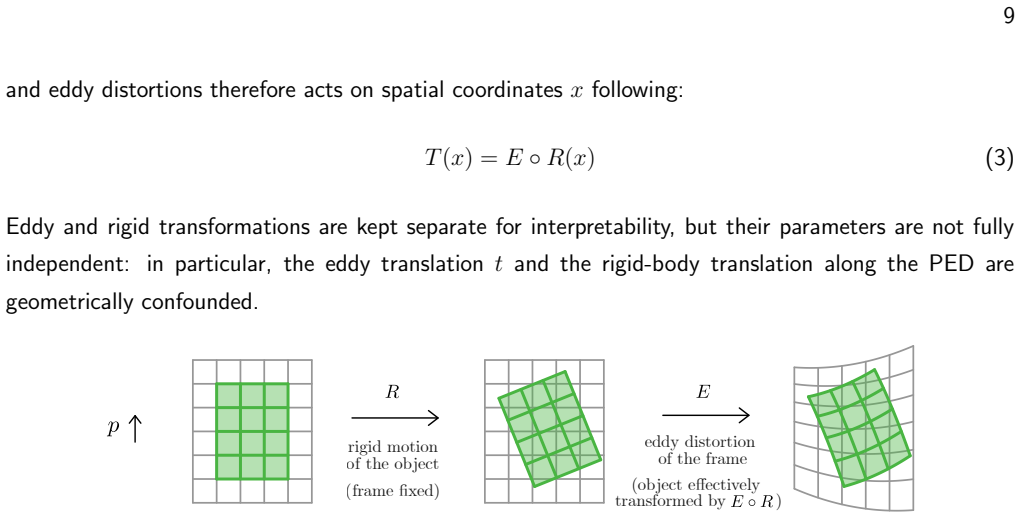
The framework has two trained components. First, a 3D U-Net (encoder-decoder convolutional network) translator, trained in a supervised way on previously corrected volumes, maps every volume to a subject-specific reference appearance: the direction-averaged image at a moderate b-value, with CSF and direction-dependent attenuation removed. Second, a registration network composed of a CNN geometry encoder and a multilayer perceptron regresses 16 parameters: 10 defining a global quadratic displacement along the phase-encoding direction (translation, linear, symmetric quadratic terms) and 6 for rigid body motion, composed as E∘R. The predicted transform is applied by backward resampling with Jac
What would settle it
Simulate ground-truth distortions with known parameters by applying the quadratic model to corrected volumes from a held-out subject, run Eddeep on the simulated distorted volumes, and compare the predicted 16 parameters and final geometry to the known ones; if the translator introduces geometric errors on distorted inputs, the parameter estimates will deviate systematically and the claimed parity with iterative correction would not survive.
Extended reading notes
Core claim
On its own terms, Eddeep's central claim is that correction quality comparable to FSL Eddy can be achieved without any iterative optimisation: a translator standardises contrast so that a simple MSE similarity is sufficient, and a registration network regresses the global eddy/rigid transform directly. The paper demonstrates this on UK Biobank (in-domain) and Memodyn (out-of-domain) with jitter, DKI residuals, signal regularity and mutual information all at parity or better, and wall-clock inference of about 2 minutes versus over 1 hour. The correction uses the same quadratic phase-encoding-direction distortion model, Jacobian intensity modulation, and trilinear interpolation as the baseline
Load-bearing premise
The load-bearing premise is that the translator, trained only on previously corrected volumes, also standardises contrast and preserves geometry when applied to uncorrected distorted volumes at inference; the paper asserts this mismatch is tolerable but provides no quantitative verification of it.
Editorial extensions
If this is right
- If the results hold, eddy-current correction can run inside a clinical or large-scale processing pipeline in about two minutes instead of more than an hour, without sacrificing correction quality.
- Because the registration network regresses parameters directly, the approach needs no assumption about gradient sampling at inference; it handles arbitrary b-value and direction schemes.
- Contrast standardisation makes a simple intensity-based loss sufficient for registration, avoiding the need for specialised similarity metrics that fail at high b-values.
- The out-of-domain results suggest the trained network transfers to a different scanner and protocol, a precondition for practical deployment.
- The method corrects eddy distortion and head motion but not within-volume motion or outlier slices, which remain separate advanced features of existing tools.
Reading between the lines
- Because the translator is trained only on previously corrected volumes, Eddeep's ceiling is set by the correction quality of the tool that produced its training targets; any systematic bias in those targets is inherited rather than removed.
- The paper argues, without a quantitative bound, that applying the translator to distorted volumes at inference is tolerable because eddy distortions are small relative to the contrast variations the U-Net generalises over; a direct test using simulated known distortions would settle how much geometric error the translator introduces.
- The same two-stage decoupling could be applied to other EPI distortion problems where between-volume contrast varies, provided a suitable reference appearance can be defined.
- If a low-frequency deformation field replaces the quadratic model, the architecture could correct non-quadratic distortion components that polynomial terms miss, at the cost of a denser parameter space.
Editorial analysis
A structured set of objections, weighed in public.
Referee Report
Summary. The paper proposes Eddeep, a two-stage deep-learning framework for eddy-current distortion correction in diffusion MRI. A 3D U-Net translator standardises the appearance of b=0 and diffusion-weighted volumes to a common target contrast, and an unsupervised registration network estimates a physics-constrained 10-dof quadratic eddy transformation composed with a 6-dof rigid transform, warping each volume in a single forward pass. The models are trained on UK Biobank data and evaluated on held-out UK Biobank and out-of-domain Memodyn data using jitter, DKI-based residuals, signal irregularity, mutual information, and processing time. The authors report correction quality comparable to FSL Eddy with a more than 30-fold reduction in inference time.
Significance. If the central claim holds, the paper makes a useful practical contribution: replacing the iterative prediction-correction loop of FSL Eddy with a feed-forward correction would substantially accelerate large-scale diffusion MRI preprocessing. The manuscript has notable strengths: the code is openly available, the evaluation includes multiple complementary metrics and an out-of-domain dataset, the transformation model is clearly specified, and the authors are candid about the lack of ground truth and the dependence on an external correction tool for training targets. However, the central claim rests on the registration network actually learning to estimate the quadratic eddy parameters, and this point is not convincingly demonstrated; the paper also contains an evaluation design choice that leaks test-subject information into a reported metric. These issues are load-bearing for the headline result and require clarification or additional validation.
major comments (5)
- [§4.1.2, §3.3.1, Fig. 4] The manuscript does not state unambiguously whether the registration model was trained on the frozen translator's outputs for previously FSL-Eddy-corrected volumes or for raw uncorrected volumes. Section 3.2.3 states that the translator's training inputs are previously corrected, and the Fig. 4 caption appears to label the registration-training block with corrected inputs. If the registration model saw only corrected pairs, the optimal transformation for every training pair is identity. Since no spatial augmentation was used during registration training (§4.1.2), the loss would provide no gradient signal for the eddy linear (e2–e4) and quadratic (e5–e10) heads of Eq. (1), and the model would collapse to an identity or motion-only estimator. This would invalidate the central claim. If uncorrected volumes were in fact used, please state this explicitly and provide evidence that the network
- [§4.3.2, Eq. (10)] The 'oracle translator' is trained directly on the subjects of the test set. This is a training/test leak: the translator has seen the test subjects' corrected geometry and appearance during training, so the translated-jitter metric ejit is not an independent measure of correction quality. While all compared methods use the same oracle, the absolute values and the generalisation claim are affected; a translator that memorises test subjects may conceal translation-induced misregistration. Please either replace this with a translator trained only on the training split or clearly reposition the oracle experiment as a diagnostic with the corresponding caveat.
- [§4.4, Table 2] The processing-time comparison is not hardware-neutral. Eddeep inference is timed on the Apple M3 GPU (tensorflow-metal), whereas FSL Eddy runs multi-threaded on the CPU. The reported >30x speedup therefore conflates algorithmic advantage with hardware assignment. Please report Eddeep on CPU only (with the same machine), or provide a GPU-based FSL Eddy baseline if one exists, so that the speed claim is separated from hardware effects.
- [Figs. 8–12] No statistical significance tests are reported for any of the correction-quality metrics. The boxplots show substantial overlap between Eddeep variants and FSL Eddy, and the conclusions of comparability or slight superiority are based on visual inspection of medians. Please add paired tests across subjects (e.g., Wilcoxon signed-rank tests) for the headline comparisons versus FSL Eddy on both datasets.
- [§3.2.3] The claim that the translator's train/inference mismatch is 'tolerable because eddy distortions ... are small in amplitude relative to the variations the U-Net generalises over' is asserted without quantitative support. Since the registration network's inputs are translator outputs, any geometry distortion introduced by the translator on distorted inputs directly corrupts the eddy parameter estimates. Please provide a direct check of geometry preservation on distorted inputs, for example by applying synthetic quadratic eddy distortions to corrected volumes and comparing brain-mask or landmark displacement before and after translation.
minor comments (5)
- [Abstract / §3] The phrase 'single forward pass' is potentially misleading because the pipeline consists of two networks applied in sequence. Please clarify that the registration step is a single forward pass, or that the pipeline is a single two-stage pass.
- [§4.1.2] The term 'previously-corrected' is used frequently and should be defined once globally: corrected with FSL Eddy using the specified settings (quadratic model, Jacobian modulation, trilinear interpolation, no outlier replacement).
- [§4.3.4, Eq. (13)] For b=0, θ is set to 1 to measure plain signal difference; this mixes units (a ratio of signal difference per angular distance for DW, and signal difference for b=0). Please clarify the interpretational consequence or define a b=0-specific version.
- [Table 1] Table 1 is visually dense and the two-panel format is difficult to parse. Consider splitting the protocol summary and the split summary into separate, clearer tables.
- [Fig. 5] The 'tight brain mask' overlaid on the translated outputs should be explicitly identified as the SynthSeg-derived non-CSF mask defined in §4.1.4, and the same mask should be used consistently in the visual assessment.
Circularity Check
No significant circularity: Eddeep's correction claim is supported by independent metrics, and its dependence on FSL Eddy for training targets is an acknowledged external limitation, not a self-referential derivation.
full rationale
Eddeep's derivation chain does not reduce to its own inputs. The two-stage pipeline separates a contrast-standardising translator from an unsupervised registration network: the translator is trained on previously FSL-Eddy-corrected volumes to map to a target appearance (Eq. 4), while the registration network is trained by maximising similarity between translated volume pairs (Eq. 5) without ground-truth transformations. The headline correction-quality metrics — between-volume jitter, DKI residuals, signal irregularity, and normalised mutual information — are computed on corrected outputs and compared against FSL Eddy; they are not terms in the training losses and are not fitted parameters renamed as predictions. The use of FSL Eddy to construct the translation target (Section 3.2.4) is an acknowledged external dependence, explicitly listed as a limitation in Section 5 ('training the translation model requires previously-corrected data generated with an external tool, which introduces a dependence on an existing correction method to build the training set'), not a hidden equivalence. The quadratic distortion model is adopted from external tools (Andersson & Sotiropoulos 2016; Irfanoglu et al.) rather than from an unverified self-citation. Self-citations to the MICCAI 2024 preliminary version and to Legouhy et al. 2022 are contextual and not load-bearing for the central claim. The MAE/SSIM translation metrics measure agreement with the chosen target by definition, but they are not the evidence for the correction-quality claim. No equation in the paper is identical to its input by construction, and the speed comparison is a direct wall-clock measurement. Therefore, no circularity step can be exhibited under the required standard.
Assumptions & free parameters
free parameters (5)
- Network weights (translator and registration models) =
learned from UKB training subjects (80 each; partial overlap)
- Translation target b-value (b_ref) =
2000 s/mm²
- Augmentation probability =
0.5 (trans+), 1.0 (trans++)
- GAN loss weight (variants) =
1e-2
- Training hyperparameters =
Adam lr=1e-4, batch size 4, 300/200 epochs
assumptions (5)
- domain assumption Eddy-current distortions are well approximated by a global unidirectional quadratic transformation along the phase-encoding direction (Eq. 1, 10 dof).
- domain assumption Between-volume head motion is rigid and within-volume motion is negligible; the combined transform is T = E∘R (Eq. 3).
- domain assumption Averaging all b=2000 volumes over gradient directions yields a direction-independent target with no outer-CSF boundary (Section 3.2.4).
- domain assumption The translator trained on corrected volumes transfers to distorted volumes at inference (Section 3.2.3).
- domain assumption Standard CNN training/generalization assumptions (i.i.d. training/test from UKB; out-of-domain from same scanner vendor/protocol family) hold.
Cite this review
Pith. "Pith review of Eddeep: a deep-learning framework for fast eddy-current distortion correction in diffusion MRI." pith.science (2026). https://pith.science/paper/YRYXL2B3
@misc{pith2026260726292,
  author       = {Pith},
  title        = {Pith review of: Eddeep: a deep-learning framework for fast eddy-current distortion correction in diffusion MRI},
  year         = {2026},
  howpublished = {\url{https://pith.science/paper/YRYXL2B3}},
  note         = {Machine review of arXiv:2607.26292}
}
read the original abstract
Diffusion MRI (dMRI) relies on diffusion-weighted echo-planar imaging, which is highly susceptible to eddy-current-induced geometric distortions. These distortions vary across diffusion volumes according to gradient strength and direction, causing between-volume misalignment that can bias downstream microstructural analyses. Current state-of-the-art correction methods, such as FSL Eddy, achieve high-quality correction through iterative prediction-correction schemes but are computationally expensive. We propose Eddeep, a deep-learning framework for fast eddy-current distortion correction in dMRI. Eddeep decomposes the problem into two stages. First, a supervised image translation network standardises the appearance of diffusion-weighted and b=0 images, removing contrast differences that hinder reliable registration. Second, an unsupervised registration network estimates both eddy-current distortion and between-volume head motion parameters under a physics-constrained quadratic distortion model, enabling correction in a single forward pass. The method was trained on UK Biobank data and evaluated on both in-domain (UK Biobank) and out-of-domain (Memodyn) datasets. Across a range of complementary metrics, including between-volume jitter, diffusion kurtosis imaging residuals, signal irregularity, and mutual information, Eddeep achieved correction quality comparable to that of FSL Eddy while substantially reducing inference time. These results demonstrate that deep learning can provide accurate and efficient eddy-current distortion correction without relying on iterative optimisation, supporting the development of faster diffusion MRI processing pipelines for large-scale studies and clinical deployment. The code is available at: https://github.com/CIG-UCL/eddeep.
Figures


Figures from the paper (9 more)


Reference graph
Works this paper leans on
-
[1]
arXiv preprint arXiv:2103.15980 , year=
A tutorial on SE(3) transformation parameterizations and on-manifold optimization , author=. arXiv preprint arXiv:2103.15980 , year=
-
[2]
Neuroimage , volume=
Advances in diffusion MRI acquisition and processing in the Human Connectome Project , author=. Neuroimage , volume=. 2013 , publisher=
2013
-
[3]
Iscience , volume=
Microstructural dynamics of motor learning and sleep-dependent consolidation: A diffusion imaging study , author=. Iscience , volume=. 2023 , publisher=
2023
-
[4]
Adam: A method for stochastic optimization , author=
-
[5]
Pattern recognition , volume=
An overlap invariant entropy measure of 3D medical image alignment , author=. Pattern recognition , volume=. 1999 , publisher=
1999
-
[6]
and Andersson, Jesper L.R
Alfaro-Almagro, Fidel and Jenkinson, Mark and Bangerter, Neal K. and Andersson, Jesper L.R. and Griffanti, Ludovica and Douaud, Gwenaelle and Sotiropoulos, Stamatios N. and Jbabdi, Saad and Hernandez-Fernandez, Moises and Vallee, Emmanuel and Vidaurre, Diego and Webster, Matthew and McCarthy, Paul and Rorden, Christopher and Daducci, Alessandro and Alexan...
-
[7]
and Helpern, Joseph A
Jensen, Jens H. and Helpern, Joseph A. and Ramani, Anita and Lu, Hanzhang and Kaczynski, Kyle , title =. Magnetic Resonance in Medicine , year =
-
[8]
Eddeep: Fast Eddy-Current Distortion Correction for Diffusion MRI with Deep Learning
Legouhy, Antoine and Callaghan, Ross and Stee, Whitney and Peigneux, Philippe and Azadbakht, Hojjat and Zhang, Hui. Eddeep: Fast Eddy-Current Distortion Correction for Diffusion MRI with Deep Learning. Medical Image Computing and Computer Assisted Intervention -- MICCAI 2024. 2024
2024
Show all 68 references
-
[9]
2004 , publisher=
Handbook of MRI pulse sequences , author=. 2004 , publisher=
2004
-
[10]
IEEE transactions on medical imaging , volume=
Analysis of the eddy-current induced artifacts and the temporal compensation in nuclear magnetic resonance imaging , author=. IEEE transactions on medical imaging , volume=. 1991 , publisher=
1991
-
[11]
2021 , eprint=
Q-space Conditioned Translation Networks for Directional Synthesis of Diffusion Weighted Images from Multi-modal Structural MRI , author=. 2021 , eprint=
2021
-
[12]
Nature neuroscience , volume=
Multimodal population brain imaging in the UK Biobank prospective epidemiological study , author=. Nature neuroscience , volume=. 2016 , publisher=
2016
-
[13]
and Moore, James R
Haselgrove, John C. and Moore, James R. , title =. Magnetic Resonance in Medicine , volume =. 1996 , keywords =
1996
-
[14]
and Yousry, Tarek and Gandini Wheeler-Kingshott, Claudia A
Rot, Samuel and Dragonu, Iulius and Triantafyllou, Christina and Grech-Sollars, Matthew and Papadaki, Anastasia and Mancini, Laura and Wastling, Stephen and Steeden, Jennifer and Thornton, John S. and Yousry, Tarek and Gandini Wheeler-Kingshott, Claudia A. M. and Thomas, David...
2026
-
[15]
Human brain mapping , volume=
Sources of distortion in functional MRI data , author=. Human brain mapping , volume=. 1999 , publisher=
1999
-
[16]
and Cercignani, Mara , title =
Jones, Derek K. and Cercignani, Mara , title =. NMR in Biomedicine , volume =
-
[17]
and Klaassen, Remy and Thoeny, Harriet C
Barbieri, Sebastiano and Gurney-Champion, Oliver J. and Klaassen, Remy and Thoeny, Harriet C. , title =. Magnetic Resonance in Medicine , volume =
-
[18]
and Menzel, Marion I
Golkov, Vladimir and Dosovitskiy, Alexey and Sperl, Jonathan I. and Menzel, Marion I. and Czisch, Michael and Sämann, Philipp and Brox, Thomas and Cremers, Daniel , journal=. q-Space Deep Learning: Twelve-Fold Shorter and Model-Free Diffusion MRI Scans , year=
-
[19]
and Whitaker, Hayley C
Sen, Snigdha and Singh, Saurabh and Pye, Hayley and Moore, Caroline M. and Whitaker, Hayley C. and Punwani, Shonit and Atkinson, David and Panagiotaki, Eleftheria and Slator, Paddy J. , title =. Magnetic Resonance in Medicine , volume =
-
[20]
ISMRM , year=
Set deep learning for protocol generalisation in machine-learning-based brain microstructure estimation , author=. ISMRM , year=
-
[21]
ISMRM 25th annual meeting , year=
TORTOISE v3: Improvements and new features of the NIH diffusion MRI processing pipeline , author=. ISMRM 25th annual meeting , year=
-
[22]
European Radiology , volume=
From research to clinical practice: a European neuroradiological survey on quantitative advanced MRI implementation , author=. European Radiology , volume=. 2021 , publisher=
2021
-
[23]
2013 , issn =
Mean apparent propagator (MAP) MRI: A novel diffusion imaging method for mapping tissue microstructure , journal =. 2013 , issn =
2013
-
[24]
1999 , issn =
Correction of eddy current-induced artefacts in diffusion tensor imaging using iterative cross-correlation , journal =. 1999 , issn =
1999
-
[25]
Mangin and C
J.-F. Mangin and C. Poupon and C. Clark and D. Distortion correction and robust tensor estimation for MR diffusion imaging , journal =. 2002 , note =
2002
-
[26]
and Tsuruda, Jay S
Alexander, Andrew L. and Tsuruda, Jay S. and Parker, Dennis L. , title =. Magnetic Resonance in Medicine , volume =
-
[27]
Magnetic Resonance in Medicine: An Official Journal of the International Society for Magnetic Resonance in Medicine , volume=
Reduction of eddy-current-induced distortion in diffusion MRI using a twice-refocused spin echo , author=. Magnetic Resonance in Medicine: An Official Journal of the International Society for Magnetic Resonance in Medicine , volume=. 2003 , publisher=
2003
-
[28]
1986 , issn =
Active magnetic screening of gradient coils in NMR imaging , journal =. 1986 , issn =
1986
-
[29]
and Dyrby, Tim B
Alexander, Daniel C. and Dyrby, Tim B. and Nilsson, Markus and Zhang, Hui , title =. NMR in Biomedicine , volume =. doi:https://doi.org/10.1002/nbm.3841 , url =. https://analyticalsciencejournals.onlinelibrary.wiley.com/doi/pdf/10.1002/nbm.3841 , note =
-
[30]
Neuroimage , volume=
Diffusion MRI at 25: exploring brain tissue structure and function , author=. Neuroimage , volume=. 2012 , publisher=
2012
-
[31]
Biophysical journal , volume=
MR diffusion tensor spectroscopy and imaging , author=. Biophysical journal , volume=. 1994 , publisher=
1994
-
[32]
Magnetic resonance imaging clinics of North America , volume=
Diffusion MR tractography as a tool for surgical planning , author=. Magnetic resonance imaging clinics of North America , volume=. 2009 , publisher=
2009
-
[33]
Stroke , volume=
CT and diffusion-weighted MR imaging in randomized order: diffusion-weighted imaging results in higher accuracy and lower interrater variability in the diagnosis of hyperacute ischemic stroke , author=. Stroke , volume=. 2002 , publisher=
2002
-
[34]
NMR in biomedicine , volume=
Diffusion imaging of brain tumors , author=. NMR in biomedicine , volume=. 2010 , publisher=
2010
-
[35]
Diffusion MRI: Theory, Methods, and Applications , volume=
EPI-based pulse sequences for diffusion tensor MRI , author=. Diffusion MRI: Theory, Methods, and Applications , volume=. 2011 , publisher=
2011
-
[36]
Imaging Neuroscience , year=
TORTOISEV4: ReImagining the NIH Diffusion MRI Processing Pipeline , author=. Imaging Neuroscience , year=
-
[37]
IEEE transactions on medical imaging , volume=
A technique for accurate magnetic resonance imaging in the presence of field inhomogeneities , author=. IEEE transactions on medical imaging , volume=. 1992 , publisher=
1992
-
[38]
Magnetic resonance in medicine , volume=
Characterization of and correction for eddy current artifacts in echo planar diffusion imaging , author=. Magnetic resonance in medicine , volume=. 1998 , publisher=
1998
-
[39]
Neuroimage , volume=
An integrated approach to correction for off-resonance effects and subject movement in diffusion MR imaging , author=. Neuroimage , volume=. 2016 , publisher=
2016
-
[40]
Magnetic Resonance in Medicine: An Official Journal of the International Society for Magnetic Resonance in Medicine , volume=
Comprehensive approach for correction of motion and distortion in diffusion-weighted MRI , author=. Magnetic Resonance in Medicine: An Official Journal of the International Society for Magnetic Resonance in Medicine , volume=. 2004 , publisher=
2004
-
[41]
International Journal of Imaging Systems and Technology , volume=
Unifying Maximum Likelihood Approaches in Medical Image Registration , author=. International Journal of Imaging Systems and Technology , volume=. 1999 , publisher=
1999
-
[42]
Proceedings of the IEEE conference on computer vision and pattern recognition , pages=
Image-to-image translation with conditional adversarial networks , author=. Proceedings of the IEEE conference on computer vision and pattern recognition , pages=
-
[43]
Proceedings of the IEEE international conference on computer vision , pages=
Unpaired image-to-image translation using cycle-consistent adversarial networks , author=. Proceedings of the IEEE international conference on computer vision , pages=
-
[44]
arXiv:1411.1784 , year=
Conditional generative adversarial nets , author=. arXiv:1411.1784 , year=
-
[45]
NeuroImage , volume=
SynthStrip: skull-stripping for any brain image , author=. NeuroImage , volume=. 2022 , publisher=
2022
-
[46]
Magnetic resonance imaging , volume=
Synthesized b0 for diffusion distortion correction (Synb0-DisCo) , author=. Magnetic resonance imaging , volume=. 2019 , publisher=
2019
-
[47]
IEEE transactions on medical imaging , volume=
Voxelmorph: a learning framework for deformable medical image registration , author=. IEEE transactions on medical imaging , volume=. 2019 , publisher=
2019
-
[48]
Dalca and Guha Balakrishnan and John Guttag and Mert R
Adrian V. Dalca and Guha Balakrishnan and John Guttag and Mert R. Sabuncu , URL =. Unsupervised learning of probabilistic diffeomorphic registration for images and surfaces , volume =. Medical Image Analysis , pages =
-
[49]
International Workshop on Deep Learning in Medical Image Analysis , pages=
End-to-end unsupervised deformable image registration with a convolutional neural network , author=. International Workshop on Deep Learning in Medical Image Analysis , pages=. 2017 , organization=
2017
-
[50]
Medical image analysis , volume=
A deep learning framework for unsupervised affine and deformable image registration , author=. Medical image analysis , volume=. 2019 , publisher=
2019
-
[51]
Neuroimage , volume=
Non-parametric representation and prediction of single-and multi-shell diffusion-weighted MRI data using Gaussian processes , author=. Neuroimage , volume=. 2015 , publisher=
2015
-
[52]
International Conference on Medical image computing and computer-assisted intervention , pages=
U-net: Convolutional networks for biomedical image segmentation , author=. International Conference on Medical image computing and computer-assisted intervention , pages=. 2015 , organization=
2015
-
[53]
Advances in neural information processing systems , volume=
Spatial transformer networks , author=. Advances in neural information processing systems , volume=
-
[54]
Neuroimage , volume=
FSL , author=. Neuroimage , volume=. 2012 , publisher=
2012
-
[55]
IEEE transactions on medical imaging , volume=
N4ITK: improved N3 bias correction , author=. IEEE transactions on medical imaging , volume=. 2010 , publisher=
2010
-
[56]
Eleventh Annual Meeting of the Organization for Human Brain Mapping, 2005 , volume=
BET2: MR-based estimation of brain, skull and scalp surfaces , author=. Eleventh Annual Meeting of the Organization for Human Brain Mapping, 2005 , volume=
2005
-
[57]
and Puonti, Oula and Thielscher, Axel and Van Leemput, Koen and Fischl, Bruce and Dalca, Adrian V
Billot, Benjamin and Greve, Douglas N. and Puonti, Oula and Thielscher, Axel and Van Leemput, Koen and Fischl, Bruce and Dalca, Adrian V. and Iglesias, Juan Eugenio , journal =. SynthSeg:. 2023 , volume =
2023
-
[58]
, author=
Echo-planar imaging of intravoxel incoherent motion. , author=. Radiology , volume=
-
[59]
2006 , publisher=
Pattern recognition and machine learning , author=. 2006 , publisher=
2006
-
[60]
Biological Psychiatry Global Open Science , volume=
Neurite orientation dispersion and density imaging in psychiatric disorders: a systematic literature review and a technical note , author=. Biological Psychiatry Global Open Science , volume=. 2023 , publisher=
2023
-
[61]
Magnetic Resonance Imaging , volume=
An unsupervised deep learning technique for susceptibility artifact correction in reversed phase-encoding EPI images , author=. Magnetic Resonance Imaging , volume=. 2020 , publisher=
2020
-
[62]
International Workshop on Computational Diffusion MRI , pages=
Correction of susceptibility distortion in EPI: a semi-supervised approach with deep learning , author=. International Workshop on Computational Diffusion MRI , pages=. 2022 , organization=
2022
-
[63]
NeuroImage , volume=
Realistic simulation of artefacts in diffusion MRI for validating post-processing correction techniques , author=. NeuroImage , volume=. 2016 , publisher=
2016
-
[64]
and Bray, Timothy J
Epstein, Sean C. and Bray, Timothy J. P. and Hall-Craggs, Margaret and Zhang, Hui. Choice of training label matters: how to best use deep learning for quantitative MRI parameter estimation. Machine Learning for Biomedical Imaging. 2024
2024
-
[65]
and Alexander, Daniel C
Zhang, Hui and Schneider, Torben and Wheeler-Kingshott, Claudia A. and Alexander, Daniel C. , number =. 2012 , journal =. doi:10.1016/j.neuroimage.2012.03.072 , issn =
2012 doi
-
[66]
2020 , journal =
Kamiya, Kouhei and Hori, Masaaki and Aoki, Shigeki , number =. 2020 , journal =. doi:10.1016/j.jneumeth.2020.108908 , issn =
2020
-
[67]
Neuroimage , volume=
Incorporating outlier detection and replacement into a non-parametric framework for movement and distortion correction of diffusion MR images , author=. Neuroimage , volume=. 2016 , publisher=
2016
-
[68]
Neuroimage , volume=
Towards a comprehensive framework for movement and distortion correction of diffusion MR images: Within volume movement , author=. Neuroimage , volume=. 2017 , publisher=
2017
Reviewed August 1, 2026 · model on record in the stance chip above.
Discussion (0). Continue with ORCID to comment.