Verification of Parametric Markov Automata under Time-bounded Reachability
Pith reviewed 2026-06-26 12:37 UTC · model grok-4.3
The pith
Parametric Markov automata can be discretized to parametric Markov decision processes to solve two synthesis problems for time-bounded reachability up to arbitrary precision.
A machine-rendered reading of the paper's core claim, the machinery that carries it, and where it could break.
Core claim
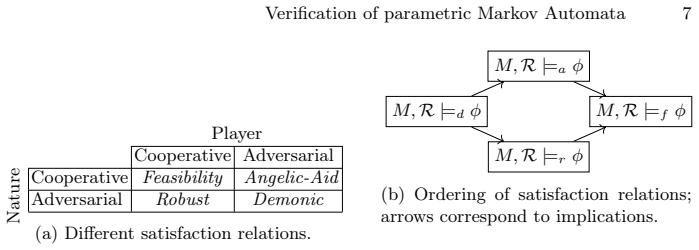
By converting a parametric Markov automaton into a parametric Markov decision process through discretization, upper and lower bounds on time-bounded reachability probabilities can be computed; these bounds become tight enough, as error terms are reduced, to decide existence of satisfying valuations and to partition the parameter space into satisfying and violating regions for any requested precision.
What carries the argument
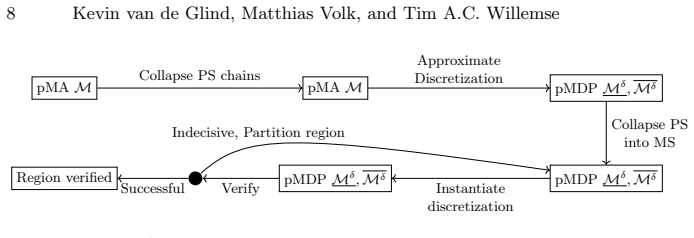
Discretization step that turns a parametric Markov automaton into a parametric Markov decision process whose reachability bounds are then analyzed to control accumulated error.
If this is right
- Both the existence and the partitioning synthesis problems become decidable up to any chosen precision.
- The accumulated discretization and numerical errors can be reduced without bound by increasing refinement.
- The method is implemented inside the Storm model checker and terminates on the tested benchmarks.
- Performance is limited primarily by the cost of the initial discretization step.
Where Pith is reading between the lines
- The same discretization-plus-bounding technique could be reused for other time-dependent properties once the underlying pMDP analysis is extended.
- Parameter-space partitioning yields explicit regions that could guide controller synthesis or robust design under rate uncertainty.
- If the discretization error bound is tightened further, the approach might scale to models with more parameters before hitting computational limits.
Load-bearing premise
Discretization must preserve the original reachability probability bounds tightly enough that the total error can be driven below any given threshold without creating artifacts that change the synthesis answers.
What would settle it
A concrete parametric Markov automaton for which repeated refinement of the discretization still leaves an error interval that straddles the decision threshold for the synthesis problem, producing an inconclusive or incorrect answer.
Figures




read the original abstract
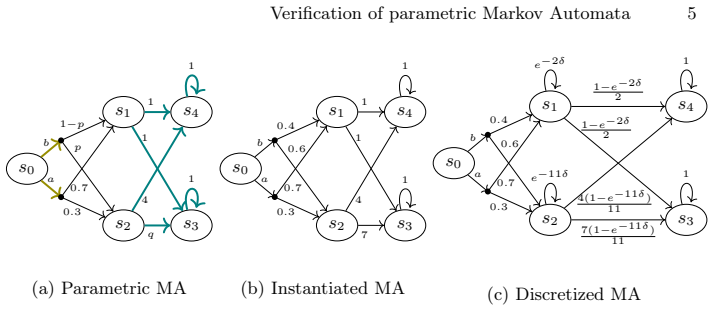
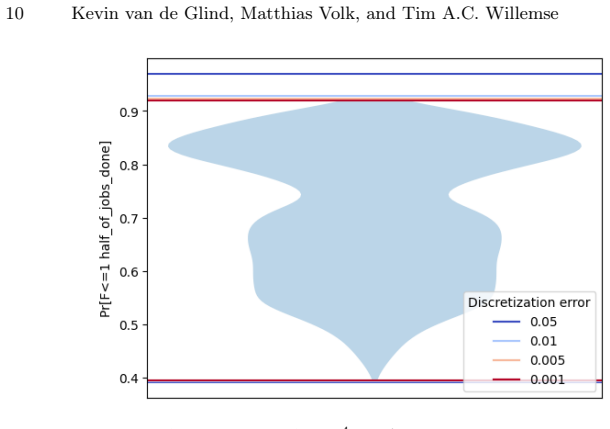
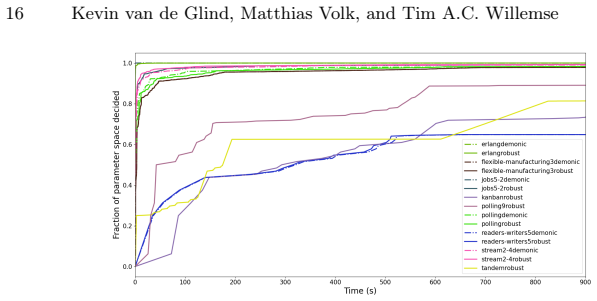
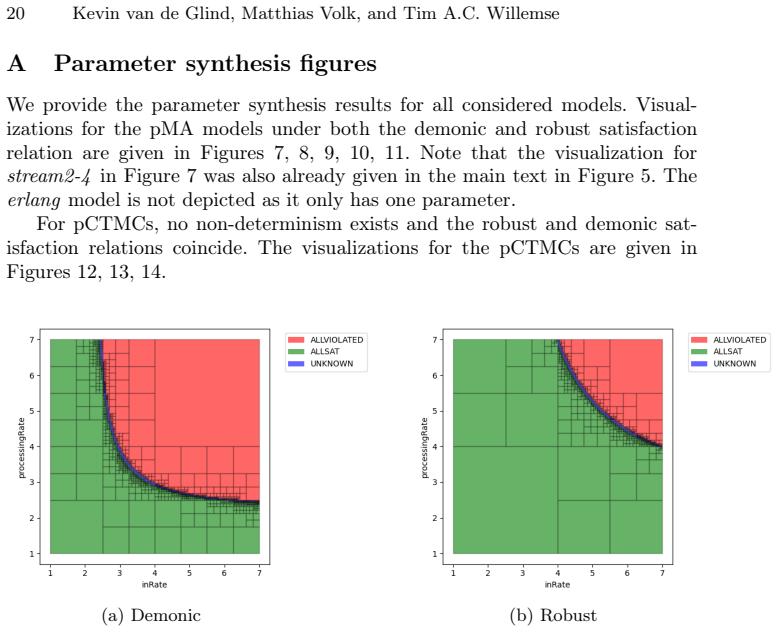
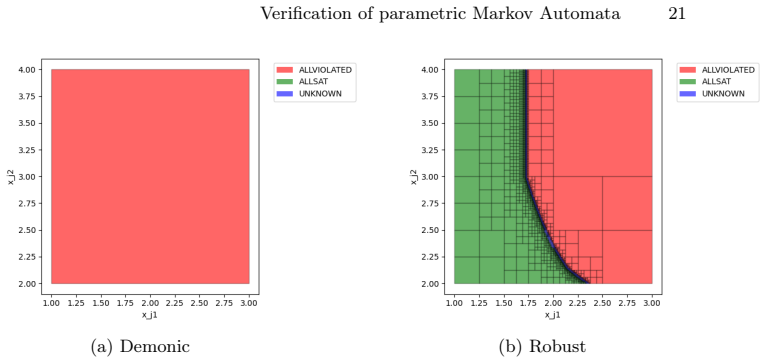
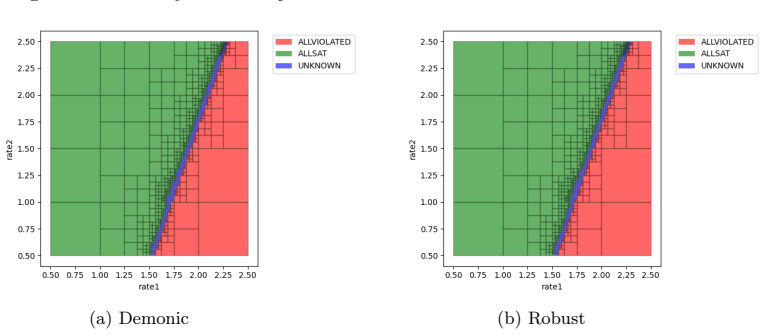
Analysis of Markov models is of high importance for formal verification. Until now, analysis of Markov Automata required them to be fully specified, which is a considerable restriction as rates may be unknown or influenced by uncertainty of the environment. We introduce parametric Markov Automata (pMA) to capture this uncertainty with parametric transition functions. On these parametrized models, two different synthesis problems for time-bounded reachability properties are considered: I) Does there exist a valuation in the parameter space such that the instantiated model satisfies/violates the property, and II) given the parameter space, how can it be partitioned into satisfying and violating regions? Our approach comprises two steps: I) The pMA is discretized to a parametric Markov decision process (pMDP), and II) through analysis of the pMDP, bounds are obtained for the reachability probability in the parametric MA. This approach solves the above problems up to a specified precision, as the accumulated error terms can be made arbitrarily small. We implemented the approach using the Storm model checker. Our experimental evaluation shows that the main performance bottlenecks originate from the discretization of the pMA.
Editorial analysis
A structured set of objections, weighed in public.
Referee Report
Summary. The paper introduces parametric Markov Automata (pMA) to capture uncertainty in transition rates. It defines two synthesis problems for time-bounded reachability properties: (I) existence of a parameter valuation making the instantiated model satisfy or violate the property, and (II) partitioning the parameter space into satisfying and violating regions. The method discretizes the pMA into a pMDP, then analyzes the pMDP to derive bounds on reachability probabilities; the abstract asserts that accumulated discretization error terms can be driven below any given threshold. The approach is implemented in the Storm model checker, with experiments identifying discretization as the main performance bottleneck.
Significance. If the error-control claim holds with uniform bounds over the parameter space, the work would extend existing MA verification techniques to models with uncertain rates, directly supporting synthesis queries that arise in practice. The Storm implementation and the experimental identification of discretization as the bottleneck are concrete strengths that would aid reproducibility and future optimization.
major comments (1)
- [Abstract] Abstract: the central claim that 'the accumulated error terms can be made arbitrarily small' is load-bearing for both synthesis problems being solved 'up to a specified precision,' yet the text provides neither an explicit error-bound formula nor a derivation showing how the discretization step (uniformization or time-stepping) interacts with parametric rates whose supremum is taken over the entire parameter space.
Simulated Author's Rebuttal
We thank the referee for the careful reading and for highlighting the need for greater clarity on the error-control argument that underpins the precision claims.
read point-by-point responses
-
Referee: [Abstract] Abstract: the central claim that 'the accumulated error terms can be made arbitrarily small' is load-bearing for both synthesis problems being solved 'up to a specified precision,' yet the text provides neither an explicit error-bound formula nor a derivation showing how the discretization step (uniformization or time-stepping) interacts with parametric rates whose supremum is taken over the entire parameter space.
Authors: We agree that the abstract and surrounding text would benefit from an explicit error-bound formula and a short derivation addressing the interaction with the supremum over the parameter space. The technical development already selects the discretization step size on the basis of the supremum rate, but the manuscript does not isolate and display the resulting uniform bound. We will therefore add a concise statement of the error formula (including the dependence on the supremum rate) together with a one-paragraph derivation sketch, either in the abstract or in a new paragraph of the introduction, and we will cross-reference the detailed proofs in Sections 4–5. revision: yes
Circularity Check
No circularity; derivation reduces to independent pMDP analysis
full rationale
The paper presents a two-step reduction: discretize pMA to pMDP, then obtain reachability bounds via pMDP analysis, with the claim that accumulated discretization errors can be driven below any threshold. No equations or steps are shown that define a quantity in terms of itself, rename a fit as a prediction, or rely on self-citation for a uniqueness result. The error controllability is asserted as a property of the discretization (standard for MA), not derived from the target synthesis answers. This is a normal non-circular reduction to an external analysis problem.
Axiom & Free-Parameter Ledger
axioms (1)
- domain assumption Markov automata can be discretized to MDPs while preserving reachability probabilities up to controllable error.
invented entities (1)
-
parametric Markov Automaton (pMA)
no independent evidence
Reference graph
Works this paper leans on
-
[1]
In: ATVA
Ashok, P., Butkova, Y., Hermanns, H., Kretínský, J.: Continuous-time Markov decisions based on partial exploration. In: ATVA. Lecture Notes in Com- puter Science, vol. 11138, pp. 317–334. Springer (2018). https://doi.org/10.1007/ 978-3-030-01090-4_19
2018
-
[2]
Aziz, A., Sanwal, K., Singhal, V., Brayton, R.K.: Verifying continuous time Markov chains. In: CAV. Lecture Notes in Computer Science, vol. 1102, pp. 269–276. Springer (1996). https://doi.org/10.1007/3-540-61474-5_75
-
[3]
In: QAPL
Braitling, B., Fioriti, L.M.F., Hatefi, H., Wimmer, R., Becker, B., Hermanns, H.: MeGARA: Menu-based game abstraction and abstraction refinement of Markov automata. In: QAPL. EPTCS, vol. 154, pp. 48–63 (2014). https://doi.org/10.4204/ EPTCS.154.4
2014
-
[4]
In: TACAS (2)
Butkova, Y., Fox, G.: Optimal time-bounded reachability analysis for concurrent systems. In: TACAS (2). Lecture Notes in Computer Science, vol. 11428, pp. 191–
-
[5]
Springer (2019). https://doi.org/10.1007/978-3-030-17465-1_11
-
[6]
Butkova, Y., Hartmanns, A., Hermanns, H.: A modest approach to modelling and checking Markov automata. In: QEST. Lecture Notes in Computer Science, vol. 11785, pp. 52–69. Springer (2019). https://doi.org/10.1007/978-3-030-30281-8_4
-
[7]
In: Finkbeiner, B., Pu, G., Zhang, L
Butkova, Y., Hatefi, H., Hermanns, H., Krcál, J.: Optimal continuous time Markov decisions. In: ATVA. Lecture Notes in Computer Science, vol. 9364, pp. 166–182. Springer (2015). https://doi.org/10.1007/978-3-319-24953-7_12
-
[8]
Butkova, Y., Wimmer, R., Hermanns, H.: Long-run rewards for Markov automata. In: TACAS(2). Lecture Notes in ComputerScience, vol.10206, pp. 188–203(2017). https://doi.org/10.1007/978-3-662-54580-5_11
-
[9]
Acta Informatica54(6), 589– 623 (2017)
Ceska, M., Dannenberg, F., Paoletti, N., Kwiatkowska, M., Brim, L.: Precise pa- rameter synthesis for stochastic biochemical systems. Acta Informatica54(6), 589– 623 (2017). https://doi.org/10.1007/S00236-016-0265-2
-
[10]
In: TACAS (2)
Ceska, M., Jansen, N., Junges, S., Katoen, J.P.: Shepherding hordes of Markov chains. In: TACAS (2). Lecture Notes in Computer Science, vol. 11428, pp. 172–
-
[11]
https://doi.org/10.1007/978-3-030-17465-1_10
Springer (2019). https://doi.org/10.1007/978-3-030-17465-1_10
-
[12]
Ceska, M., Pilar, P., Paoletti, N., Brim, L., Kwiatkowska, M.Z.: PRISM-PSY: precise GPU-accelerated parameter synthesis for stochastic systems. In: TACAS. Lecture Notes in Computer Science, vol. 9636, pp. 367–384. Springer (2016). https://doi.org/10.1007/978-3-662-49674-9_21
-
[13]
Daws, C.: Symbolic and parametric model checking of discrete-time Markov chains. In: ICTAC. Lecture Notes in Computer Science, vol. 3407, pp. 280–294. Springer (2004). https://doi.org/10.1007/978-3-540-31862-0_21
-
[14]
IEEE Transactions on reliability41(3), 363–377 (2002)
Dugan, J.B., Bavuso, S.J., Boyd, M.A.: Dynamic fault-tree models for fault- tolerant computer systems. IEEE Transactions on reliability41(3), 363–377 (2002)
2002
-
[15]
In: LICS
Eisentraut, C., Hermanns, H., Zhang, L.: On probabilistic automata in continuous time. In: LICS. pp. 342–351. IEEE Computer Society (2010). https://doi.org/10. 1109/LICS.2010.41
2010
-
[16]
Garling, D.J.: A Course in Mathematical Analysis: Volume 2, Metric and Topolog- ical Spaces, Functions of a Vector Variable, chap. 12. Cambridge University Press (2014)
2014
-
[17]
Master’s thesis, Universität des Saarlandes (2018)
Gros, T.P.: Markov Automata taken by Storm. Master’s thesis, Universität des Saarlandes (2018)
2018
-
[18]
In: NASA Formal Methods
Guck, D., Han, T., Katoen, J.P., Neuhäußer, M.R.: Quantitative timed analy- sis of interactive Markov chains. In: NASA Formal Methods. Lecture Notes in 18 Kevin van de Glind, Matthias Volk, and Tim A.C. Willemse Computer Science, vol. 7226, pp. 8–23. Springer (2012). https://doi.org/10.1007/ 978-3-642-28891-3_4
2012
-
[19]
Guck, D., Hatefi, H., Hermanns, H., Katoen, J.P., Timmer, M.: Analysis of timed and long-run objectives for Markov automata. Log. Methods Comput. Sci.10(3) (2014). https://doi.org/10.2168/LMCS-10(3:17)2014
-
[20]
In: NASA Formal Methods
Hahn, E.M., Han, T., Zhang, L.: Synthesis for PCTL in parametric Markov decision processes. In: NASA Formal Methods. Lecture Notes in Computer Science, vol. 6617, pp. 146–161. Springer (2011). https://doi.org/10.1007/ 978-3-642-20398-5_12
2011
-
[21]
Hahn, E.M., Hartmanns, A.: A comparison of time- and reward-bounded proba- bilistic model checking techniques. In: SETTA. Lecture Notes in Computer Science, vol. 9984, pp. 85–100 (2016). https://doi.org/10.1007/978-3-319-47677-3_6
-
[22]
Hahn, E.M., Hermanns, H., Zhang, L.: Probabilistic reachability for parametric Markov models. Int. J. Softw. Tools Technol. Transf.13(1), 3–19 (2011). https: //doi.org/10.1007/S10009-010-0146-X
-
[23]
Hahn, E.M., Li, Y., Schewe, S., Turrini, A., Zhang, L.: iscasMc: A web-based probabilistic model checker. In: FM. Lecture Notes in Computer Science, vol. 8442, pp. 312–317. Springer (2014). https://doi.org/10.1007/978-3-319-06410-9_22
-
[24]
Han, T., Katoen, J.P., Mereacre, A.: Approximate parameter synthesis for proba- bilistic time-bounded reachability. In: RTSS. pp. 173–182. IEEE Computer Society (2008). https://doi.org/10.1109/RTSS.2008.19
-
[25]
In: TACAS
Hartmanns, A., Hermanns, H.: The modest toolset: An integrated environment for quantitative modelling and verification. In: TACAS. Lecture Notes in Com- puter Science, vol. 8413, pp. 593–598. Springer (2014). https://doi.org/10.1007/ 978-3-642-54862-8_51
2014
-
[26]
Hartmanns, A., Katoen, J.P., Kohlen, B., Spel, J.: Tweaking the odds in proba- bilistic timed automata. In: QEST. Lecture Notes in Computer Science, vol. 12846, pp. 39–58. Springer (2021). https://doi.org/10.1007/978-3-030-85172-9_3
-
[27]
In: TACAS (1)
Hartmanns, A., Klauck, M., Parker, D., Quatmann, T., Ruijters, E.: The quan- titative verification benchmark set. In: TACAS (1). Lecture Notes in Com- puter Science, vol. 11427, pp. 344–350. Springer (2019). https://doi.org/10.1007/ 978-3-030-17462-0_20
2019
-
[28]
Elec- tron
Hatefi, H., Hermanns, H.: Model checking algorithms for Markov automata. Elec- tron. Commun. Eur. Assoc. Softw. Sci. Technol.53(2012). https://doi.org/10. 14279/TUJ.ECEASST.53.783
2012
-
[29]
Hensel, C., Junges, S., Katoen, J.P., Quatmann, T., Volk, M.: The probabilistic model checker Storm. Int. J. Softw. Tools Technol. Transf.24(4), 589–610 (2022). https://doi.org/10.1007/S10009-021-00633-Z
-
[30]
Hermanns, H.: Interactive Markov Chains: The Quest for Quantified Quality, Lec- ture Notes in Computer Science, vol. 2428. Springer (2002). https://doi.org/10. 1007/3-540-45804-2
2002
-
[31]
Formal Methods Syst
Junges, S., Ábrahám, E., Hensel, C., Jansen, N., Katoen, J.P., Quatmann, T., Volk, M.: Parameter synthesis for Markov models: covering the parameter space. Formal Methods Syst. Des.62(1), 181–259 (2024). https://doi.org/10.1007/ S10703-023-00442-X
2024
-
[32]
Katoen, J.P.: The probabilistic model checking landscape. In: LICS. pp. 31–45. ACM (2016). https://doi.org/10.1145/2933575.2934574
-
[33]
Kwiatkowska, M.Z., Norman, G., Parker, D.: PRISM 4.0: Verification of proba- bilistic real-time systems. In: CAV. Lecture Notes in Computer Science, vol. 6806, pp. 585–591. Springer (2011). https://doi.org/10.1007/978-3-642-22110-1_47 Verification of parametric Markov Automata 19
-
[34]
Marsan, M.A., Conte, G., Balbo, G.: A class of generalized stochastic Petri nets for the performance evaluation of multiprocessor systems. ACM Trans. Comput. Syst.2(2), 93–122 (1984). https://doi.org/10.1145/190.191
-
[35]
SIAM Journal on Control6(2), 266–280 (May 1968)
Miller, B.L.: Finite state continuous time Markov decision processes with a finite planning horizon. SIAM Journal on Control6(2), 266–280 (May 1968). https:// doi.org/10.1137/0306020
-
[36]
Neuhäußer, M.R.: Model checking nondeterministic and randomly timed systems. Ph.D. thesis, RWTH Aachen University (2010)
2010
-
[37]
In: FoSSaCS
Neuhäußer, M.R., Stoelinga, M., Katoen, J.P.: Delayed nondeterminism in continuous-time Markov decision processes. In: FoSSaCS. Lecture Notes in Com- puter Science, vol. 5504, pp. 364–379. Springer (2009). https://doi.org/10.1007/ 978-3-642-00596-1_26
2009
-
[38]
Quatmann, T., Dehnert, C., Jansen, N., Junges, S., Katoen, J.P.: Parameter syn- thesis for Markov models: Faster than ever. In: ATVA. Lecture Notes in Computer Science,vol.9938,pp.50–67(2016).https://doi.org/10.1007/978-3-319-46520-3_4
-
[39]
Cengage (2021) 20 Kevin van de Glind, Matthias Volk, and Tim A.C
Stewart, J., Clegg, D., Watson, S.: Calculus: early transcendentals. Cengage (2021) 20 Kevin van de Glind, Matthias Volk, and Tim A.C. Willemse A Parameter synthesis figures We provide the parameter synthesis results for all considered models. Visual- izations for the pMA models under both the demonic and robust satisfaction relation are given in Figures ...
2021
discussion (0)
Sign in with ORCID, Apple, or X to comment. Anyone can read and Pith papers without signing in.