REVIEW 4 major objections 6 minor 214 references
Acquiring and Adapting Priors for Novel Tasks via Neural Meta-Architectures
T0 review · 4 major / 6 minor · reviewed 2026-08-06 · deepseek-v4-flash
Pith's one-line read Neural meta-architectures—networks that generate or carry another network's parameters—can acquire more transferable priors than standard networks when data is scarce, as shown across image, 3D, and molecular tasks.
desk verdict A solid compilation of three peer-reviewed meta-learning papers, but the central cross-domain generalization claim is undercut by a parameter-count/regularization confound, and the only new chapter is far too thin to carry the abstract's broad promises. read the letter →
The pith
A machine-rendered reading of the paper's core claim, the machinery that carries it, and where it could break.
The reading
What carries the argument
The load-bearing objects are a set of parameter-generating and parameter-modulating designs. First is the hypernetwork as weight generator: a convolutional hypernetwork maps a trainable per-layer embedding to the target layer's weights, with design fixes that stabilize training—removing the hypernetwork's bias term, regularizing the $\ell^2$ norm of generated weights, using per-layer unshared hypernetworks, and applying Stochastic Weight Averaging—plus a MAML routine in which the inner loop adapts the embeddings and the outer loop trains the hypernetwork to produce generalizable weights. Second is distributed neural memory: ConvLSTM cells placed at every layer of a feature extractor, with the previous label fed into the network as an input, convert task adaptation into a purely activation-space process that needs no gradient updates at inference. Third is the dynamic hypernetwork and NeRF distillation behind HyperFields: each hypernetwork MLP predicts the next NeRF layer's weights from a text-conditioning token and the previous layer's activations (with stop-gradients), and training uses a photometric loss against pre-trained single-scene teacher NeRFs instead of score distillation sampling, which lets one model learn many scenes without mode collapse. The molecular application reuses a pre-trained MiDi diffusion model as a fixed feature extractor, taking intermediate activations at low noise and mean-aggregating over atoms for downstream prediction.
What would settle it
A controlled cross-domain experiment with identical pre-training data and adaptation budget: if a standard network fine-tuned for the same number of inner-loop steps matches or beats the hypernetwork-generated network on a held-out task distribution, the core claim that hypernetworks acquire more generalizable priors is falsified.
Extended reading notes
Core claim
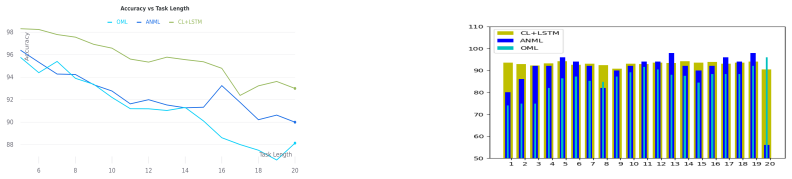
On its own terms, the paper establishes that neural meta-architectures—models whose parameters are produced or modulated by another network—can learn priors that transfer better than a conventionally trained network's parameters when data is scarce. For hypernetworks, the key finding is that training the weight-generating network with MAML, updating per-task embeddings in the inner loop and the hypernetwork in the outer loop, yields target networks that adapt more rapidly and generalize better under distribution shift: on cross-domain few-shot tasks (meta-training on FewShot-CIFAR-100, meta-testing on MiniImageNet), hypernetwork-generated WideResNets exceed standard WideResNets by roughly 3 to 9 accuracy points. In online settings, distributing LSTM memory cells across all layers, with labels injected as inputs, lets the whole network adapt through hidden states alone and outperform both gradient-based meta-learners and prototype methods. In 3D, HyperFields shows that a dynamic hypernetwork—whose MLP modules take the previous NeRF-layer activations plus a text-conditioning token as input—can pack over 100 scenes into one model, synthesize unseen combinations zero-shot, and converge about five times faster than DreamFusion baselines when fine-tuned on novel prompts. Finally, frozen MiDi diffusion features aggregated over atoms improve binding-affinity AUROC from 0.850 to 0.877 when concatenated to ChemBERTa embeddings, even with only a few hundred labeled examples.
Load-bearing premise
The transfer claims rest on the assumption that few-shot tasks carved from large image datasets, such as ImageNet or CIFAR, faithfully represent the real low-data tasks in medical imaging, chemistry, and immunology where these methods are meant to be deployed.
Editorial extensions
If this is right
- If hypernetworks trained via MAML truly acquire more generalizable priors, cross-domain few-shot learning—where training and test task distributions differ—becomes the setting where they should be the default choice over standard backbones.
- If HyperFields' amortization holds, text-to-3D generation shifts from per-prompt optimization (roughly 30 minutes per scene) to a shared model that renders new in-distribution scenes in a forward pass and needs at most a few thousand fine-tuning steps for out-of-distribution prompts.
- If distributed memory matches or beats gradient-based online adaptation, continual and online learning systems can adapt without backpropagation during deployment, saving compute in settings like robotics or streaming perception.
- If diffusion-derived features add 2.7 AUROC points to ChemBERTa on binding prediction, then generative models trained on unlabeled molecular data become a practical pre-training source for low-data drug discovery, worth combining with sequence models rather than replacing them.
Reading between the lines
- I would expect the same MAML-plus-hypernetwork recipe to transfer to other weight spaces where fine-tuning is expensive—for example, generating adapter weights for frozen language models or conditioning tokens for protein structure predictors—since the mechanism of a shared generator that outputs task-specific parameters is not specific to ResNets or NeRFs.
- The MiDi feature result suggests a testable generalization: frozen generative models of other modalities (e.g., equivariant diffusion for proteins, or latent diffusion for medical images) should also provide complementary features in the low-label regime; a failure there would indicate the gain is specific to molecular geometry rather than a general property of diffusion representations.
- Chapter 7's proposal of episodic pre-training is left untested; the cross-domain few-shot gains imply that structuring pre-training as support/query episodes may help out-of-distribution generalization, but this needs a direct comparison against standard pre-training on the same backbone and data budget.
- The five-fold convergence speedup for out-of-distribution prompts is measured against DreamFusion baselines that are not initialized from the same scene prior; a fairer comparison would initialize the baseline from the same zero-shot output as HyperFields, which would reveal how much of the speedup comes from the learned prior rather than the initialization.
Editorial analysis
A structured set of objections, weighed in public.
Referee Report
Summary. The manuscript is a PhD dissertation posted to arXiv that combines four research threads: distributed-memory architectures for online few-shot and continual learning (Chapter 2), hypernetwork design and MAML-based training for classification and cross-domain few-shot learning (Chapter 3), the HyperFields dynamic hypernetwork for text-conditioned NeRF generation (Chapter 4), and diffusion-derived molecular features for property prediction (Chapter 5). The abstract states that hypernetwork designs acquire more generalizable priors than standard networks when trained with MAML, and each chapter is presented as evidence for this overarching claim. The reported experiments include Omniglot/CIFAR-FS online few-shot learning, CIFAR/ImageNet classification, cross-domain MiniImageNet few-shot evaluation, text-to-3D generation with distillation, and an AUROC comparison on a proprietary drug-binding prediction task.
Significance. If the central claim were established, the work would provide a practical recipe for transferring priors in low-data and out-of-distribution settings, which matters for domains such as medical imaging and computational chemistry. The dissertation has genuine strengths: Chapter 2 is peer-reviewed NeurIPS work with a clear architectural contribution; the CIFAR/ImageNet hypernetwork experiments are extensive; and HyperFields introduces a plausible dynamic-hypernetwork mechanism with amortized inference and a user study. These are valuable pieces. However, the abstract-level claim about superior generalizable priors under MAML rests on a single cross-domain comparison that is not controlled for capacity or regularization, and it is contradicted in the standard MiniImageNet 5-shot setting. The molecular chapter reports one AUROC value without uncertainty. The significance of the synthesis is therefore conditional on additional controlled experiments and appropriate hedging of the claims.
major comments (4)
- [Abstract; §3.4.3, Tables 3.6 and 3.7] The abstract claim that hypernetworks acquire more generalizable priors than standard networks when trained with MAML is not supported by the full set of results. In the standard MiniImageNet setting (Table 3.6), HyperResNet-12 is worse than ResNet-12 on 5-shot accuracy (73.00 vs. 74.33), and only comparable on 1-shot. The positive evidence is confined to the cross-domain FewShot-CIFAR-100 to MiniImageNet setting (Table 3.7). The claim should either be restricted to that setting or accompanied by an explanation of why the cross-domain result, rather than the same-domain result, establishes a generalizable-prior advantage.
- [§3.5, Table 3.7; §3.4.1, Table 3.3] The headline cross-domain comparison is confounded. The unshared HyperWRN variants have roughly 1.8–1.9 times more trainable parameters than their standard counterparts (e.g., 10.3M vs. 5.8M for WRN-28-4; 4.17M vs. 2.2M for WRN-40-2), and the regularization schemes differ: standard WRNs use weight decay 5e-4, while hypernetworks use an l2 penalty of 6.25e-5 on generated outputs and no weight decay on hypernetwork or embedding parameters. Table 3.7 reports no variance, confidence intervals, or significance tests. The observed gains could come from added capacity or different regularization rather than from a more generalizable prior learned by the hypernetwork. Please add matched-capacity baselines (e.g., wider versions of the standard WRN with the same parameter count), align the regularization strengths, and report multiple seeds with error bars.
- [§3.4.3, Figure 3.5] The inner-loop parameter movement plots are not by themselves evidence of a better prior. The magnitude of parameter movement depends on parameterization, initialization scale, and optimizer geometry, so larger movement for hypernetwork-predicted weights does not imply stronger or better task adaptation. The claim needs a direct behavioral measure, such as final adapted accuracy on held-out tasks, adaptation speed curves over inner-loop steps, or an analysis that controls for parameter scale.
- [§5.4, Table 5.1] The molecular property prediction experiment reports a single AUROC value of 0.877 versus 0.850 for ChemBERTa, with no error bars, no number of evaluation molecules or repeats, and no description of how the 'few hundred' affinity labels were split. The 2.7-point improvement is therefore not statistically assessable. Please provide repeated runs with standard deviation, dataset size and split details, significance testing, and the exact downstream classifier training protocol; otherwise the improvement claim is not supported.
minor comments (6)
- [§4.4.2] The section heading 'HyperFields with Proflic Dreamer Teachers' contains a typo; it should read 'Prolific Dreamer'.
- [§5.3.2] There is a typo in 'continous atom coordinates'; it should be 'continuous'. Also, 'MiDi' is spelled inconsistently as 'Midi' in Table 5.1 and elsewhere.
- [§5.4] The target protein is named 'Claudine'; if the intended name is 'Claudin', please correct it. Also, the claim that the wet lab observed a more diverse set of candidate molecules is anecdotal and should be labeled as such or removed from the results section.
- [§5.3.4] The downstream classifier is said to use a standard supervised loss such as mean squared error (MSE), but the evaluation metric is AUROC and the task is a binary classification of binding versus non-binding; cross-entropy or binary cross-entropy would be the standard loss unless a regression formulation is intended and justified.
- [References [9], [10], [11]] The dissertation's central results in Chapters 2, 3, and 4 depend heavily on self-citations to [9], [10], and [11], but the text does not always cite the peer-reviewed or published versions (e.g., [11] is NeurIPS 2021). Please cite the final published versions where they exist and state clearly which parts of the dissertation are new synthesis versus previously published work.
- [§4.4.7] The statement that generation is 'an order of magnitude faster' than DreamFusion is not supported by the preceding arithmetic: roughly 14 hours for 27 DreamFusion scenes versus about 2 hours of distillation overhead plus under a minute of generation is roughly a 7x saving, not 10x. Please either state the comparison precisely or avoid the order-of-magnitude phrasing.
Circularity Check
No significant circularity; central claims rest on internal experiments and external baselines.
full rationale
The dissertation is a synthesis of the author's externally peer-reviewed works (NeurIPS 2021 for Chapter 2, arXiv 2020 for Chapter 3, arXiv 2023 for Chapter 4) and it reproduces the relevant experiments and ablations rather than merely citing them. The central claim that hypernetworks acquire more generalizable priors than standard networks under MAML is supported by Tables 3.6 and 3.7, where models are pre-trained and meta-trained on FewShot-CIFAR-100 and evaluated on MiniImageNet; no parameter is fitted to the reported test metric, so the comparison is not circular by construction. The hypernetwork advantage is confounded by larger train-time parameter counts and different regularization (Tables 3.3, 3.5), but this is a correctness/control concern, not a circularity. HyperFields (Chapter 4) trains teacher NeRFs with SDS, distills them into a hypernetwork, then evaluates on held-out shape-color combinations and OOD prompts; those held-out prompts are not used to fit the model, and the convergence-speed comparison is against independently trained DreamFusion baselines. The molecular result (Chapter 5) uses a pre-trained MiDi diffusion model trained on approximately 450k molecules as a frozen feature extractor; the features are not fit to the target binding dataset, so the reported 2.7-point AUROC improvement over ChemBERTa is an empirical transfer result, not a renamed fit. One reporting limitation: Section 5.4 says "we fine-tune the classifier head on" the few hundred binding affinities and then "measure model performance using the AUROC," without explicitly describing a held-out split; as written, an evaluation on the same fine-tuning samples would be a training-fit metric rather than a prediction, but the text is ambiguous and no equation or parameter reduction makes this circular. The self-citations [9], [10], [11] are used as pointers to the author's own prior publications and are not invoked as unverified uniqueness theorems or as substitutes for the experiments in the dissertation; therefore they do not constitute load-bearing circularity. Overall, no claimed prediction reduces to its own inputs by the paper's own equations or definitions.
Assumptions & free parameters
free parameters (4)
- Hypernetwork output regularization coefficient =
6.25e-5
- Inner-loop learning rate alpha =
0.01
- Outer-loop learning rate beta =
0.001 (Adam, decayed by half every 1000 iterations)
- MiDi noise level t =
Not disclosed
assumptions (4)
- domain assumption Episodic few-shot tasks constructed by segmenting large classification datasets are representative of real-world low-data tasks.
- domain assumption Score Distillation Sampling (SDS) gradients provide valid supervisory signal for optimizing NeRF scene parameters.
- domain assumption The frozen MiDi diffusion model, trained on ~450k molecules, yields geometry-aware features that transfer to binding-affinity prediction for an unseen protein target.
- standard math Neural network training via backpropagation and standard optimizers (SGD, Adam) is a valid optimization framework.
Cite this review
Pith. "Pith review of Acquiring and Adapting Priors for Novel Tasks via Neural Meta-Architectures." pith.science (2026). https://pith.science/paper/Z2MD2UPX
@misc{pith2026250710446,
  author       = {Pith},
  title        = {Pith review of: Acquiring and Adapting Priors for Novel Tasks via Neural Meta-Architectures},
  year         = {2026},
  howpublished = {\url{https://pith.science/paper/Z2MD2UPX}},
  note         = {Machine review of arXiv:2507.10446}
}
read the original abstract
The ability to transfer knowledge from prior experiences to novel tasks stands as a pivotal capability of intelligent agents, including both humans and computational models. This principle forms the basis of transfer learning, where large pre-trained neural networks are fine-tuned to adapt to downstream tasks. Transfer learning has demonstrated tremendous success, both in terms of task adaptation speed and performance. However there are several domains where, due to lack of data, training such large pre-trained models or foundational models is not a possibility - computational chemistry, computational immunology, and medical imaging are examples. To address these challenges, our work focuses on designing architectures to enable efficient acquisition of priors when large amounts of data are unavailable. In particular, we demonstrate that we can use neural memory to enable adaptation on non-stationary distributions with only a few samples. Then we demonstrate that our hypernetwork designs (a network that generates another network) can acquire more generalizable priors than standard networks when trained with Model Agnostic Meta-Learning (MAML). Subsequently, we apply hypernetworks to 3D scene generation, demonstrating that they can acquire priors efficiently on just a handful of training scenes, thereby leading to faster text-to-3D generation. We then extend our hypernetwork framework to perform 3D segmentation on novel scenes with limited data by efficiently transferring priors from earlier viewed scenes. Finally, we repurpose an existing molecular generative method as a pre-training framework that facilitates improved molecular property prediction, addressing critical challenges in computational immunology.
Figures


Figures from the paper (19 more)


Reference graph
Works this paper leans on
-
[1]
Structural interplay between germline interactions and adaptive recognition deter- mines the bandwidth of tcr-peptide-mhc cross-reactivity
Jarrett J Adams, Samanthi Narayanan, Michael E Birnbaum, Sachdev S Sidhu, Sydney J Blevins, Marvin H Gee, Leah V Sibener, Brian M Baker, David M Kranz, and K Christopher Garcia. Structural interplay between germline interactions and adaptive recognition deter- mines the bandwidth of tcr-peptide-mhc cross-reactivity. Nature immunology, 17(1):87–94, 2016
2016
-
[2]
Yuval Alaluf, Omer Tov, Ron Mokady, Rinon Gal, and Amit H. Bermano. Hyperstyle: Stylegan inversion with hypernetworks for real image editing, 2021
2021
-
[3]
Efficient 3d deep learning model for medical image semantic segmentation
Nasser Alalwan, Amr Abozeid, AbdAllah A ElHabshy, and Ahmed Alzahrani. Efficient 3d deep learning model for medical image semantic segmentation. Alexandria Engineering Journal, 60(1):1231–1239, 2021
2021
-
[4]
Flamingo: a visual language model for few-shot learning
Jean-Baptiste Alayrac, Jeff Donahue, Pauline Luc, Antoine Miech, Iain Barr, Yana Hasson, Karel Lenc, Arthur Mensch, Katherine Millican, Malcolm Reynolds, et al. Flamingo: a visual language model for few-shot learning. Advances in Neural Information Processing Systems, 35:23716–23736, 2022
2022
-
[5]
Deep speech 2: End-to-end speech recognition in english and mandarin
Dario Amodei, Sundaram Ananthanarayanan, Rishita Anubhai, Jingliang Bai, Eric Bat- tenberg, Carl Case, Jared Casper, Bryan Catanzaro, Qiang Cheng, Guoliang Chen, et al. Deep speech 2: End-to-end speech recognition in english and mandarin. In International conference on machine learning, pages 173–182. PMLR, 2016
2016
-
[6]
Hoffman, David Pfau, Tom Schaul, and Nando de Freitas
Marcin Andrychowicz, Misha Denil, Sergio Gomez Colmenarejo, Matthew W. Hoffman, David Pfau, Tom Schaul, and Nando de Freitas. Learning to learn by gradient descent by gradient descent. In Advances in Neural Information Processing Systems 29: Annual Con- ference on Neural Information Processing Systems 2016, December 5-10, 2016, Barcelona, Spain, pages 398...
2016
-
[7]
Defining Benchmarks for Continual Few-Shot Learning
Antreas Antoniou, Massimiliano Patacchiola, Mateusz Ochal, and Amos Storkey. Defining benchmarks for continual few-shot learning. arXiv preprint arXiv:2004.11967, 2020
work page Pith review arXiv 2004
-
[8]
On the texture bias for few-shot cnn segmentation
Reza Azad, Abdur R Fayjie, Claude Kauffmann, Ismail Ben Ayed, Marco Pedersoli, and Jose Dolz. On the texture bias for few-shot cnn segmentation. In Proceedings of the IEEE/CVF Winter Conference on Applications of Computer Vision, pages 2674–2683, 2021
2021
Show all 214 references
-
[9]
Hyperfields: Towards zero-shot generation of nerfs from text, 2023
Sudarshan Babu, Richard Liu, Avery Zhou, Michael Maire, Greg Shakhnarovich, and Rana Hanocka. Hyperfields: Towards zero-shot generation of nerfs from text, 2023. 72
2023
-
[10]
Hypernetwork designs for improved classification and robust meta-learning, 2020
Sudarshan Babu, Pedro Savarese, and Michael Maire. Hypernetwork designs for improved classification and robust meta-learning, 2020
2020
-
[11]
Online meta-learning via learning with layer-distributed memory
Sudarshan Babu, Pedro Savarese, and Michael Maire. Online meta-learning via learning with layer-distributed memory. Advances in Neural Information Processing Systems, 34:14795– 14808, 2021
2021
-
[12]
Meta-drn: Meta-learning for 1-shot image segmentation
Atmadeep Banerjee. Meta-drn: Meta-learning for 1-shot image segmentation. arXiv preprint arXiv:2008.00247, 2020
2008 arXiv
-
[13]
Pixelnet: Representation of the pixels, by the pixels, and for the pixels, 2017
Aayush Bansal, Xinlei Chen, Bryan Russell, Abhinav Gupta, and Deva Ramanan. Pixelnet: Representation of the pixels, by the pixels, and for the pixels, 2017
2017
-
[14]
Mip-nerf: A multiscale representation for anti-aliasing neural radiance fields
Jonathan T Barron, Ben Mildenhall, Matthew Tancik, Peter Hedman, Ricardo Martin-Brualla, and Pratul P Srinivasan. Mip-nerf: A multiscale representation for anti-aliasing neural radiance fields. In Proceedings of the IEEE/CVF International Conference on Computer Vision, pages 5...
2021
-
[15]
Mip- nerf 360: Unbounded anti-aliased neural radiance fields
Jonathan T Barron, Ben Mildenhall, Dor Verbin, Pratul P Srinivasan, and Peter Hedman. Mip- nerf 360: Unbounded anti-aliased neural radiance fields. In Proceedings of the IEEE/CVF Conference on Computer Vision and Pattern Recognition, pages 5470–5479, 2022
2022
-
[16]
Rae, Simon Osindero, and Timothy P
Sergey Bartunov, Jack W. Rae, Simon Osindero, and Timothy P. Lillicrap. Meta-learning deep energy-based memory models. In 8th International Conference on Learning Representations, ICLR 2020, Addis Ababa, Ethiopia, April 26-30, 2020. OpenReview.net, 2020
2020
-
[17]
Stanley, Jeff Clune, and Nick Cheney
Shawn Beaulieu, Lapo Frati, Thomas Miconi, Joel Lehman, Kenneth O. Stanley, Jeff Clune, and Nick Cheney. Learning to continually learn. In ECAI 2020 - 24th European Conference on Artificial Intelligence, 29 August-8 September 2020, Santiago de Compostela, Spain, August 29 - Se...
2020
-
[18]
On the optimization of a synaptic learning rule
Samy Bengio, Yoshua Bengio, Jocelyn Cloutier, and Jan Gecsei. On the optimization of a synaptic learning rule. In Preprints Conf. Optimality in Artificial and Biological Neural Networks, volume 2, 1992
1992
-
[19]
Practical recommendations for gradient-based training of deep architectures
Yoshua Bengio. Practical recommendations for gradient-based training of deep architectures. In Neural networks: Tricks of the trade, pages 437–478. Springer, 2012
2012
-
[20]
Henriques, Philip H
Luca Bertinetto, Jo˜ao F. Henriques, Philip H. S. Torr, and Andrea Vedaldi. Meta-learning with differentiable closed-form solvers. In 7th International Conference on Learning Repre- sentations, ICLR 2019, New Orleans, LA, USA, May 6-9, 2019. OpenReview.net, 2019
2019
-
[21]
Stylegan knows normal, depth, albedo, and more
Anand Bhattad, Daniel McKee, Derek Hoiem, and David Forsyth. Stylegan knows normal, depth, albedo, and more. Advances in Neural Information Processing Systems, 36, 2024. 73
2024
-
[22]
Online fast adaptation and knowledge accumulation: a new approach to continual learning
Massimo Caccia, Pau Rodriguez, Oleksiy Ostapenko, Fabrice Normandin, Min Lin, Lucas Caccia, Issam Laradji, Irina Rish, Alexande Lacoste, David Vazquez, et al. Online fast adaptation and knowledge accumulation: a new approach to continual learning. arXiv preprint arXiv:2003.05856, 2020
2003 arXiv
-
[23]
Unsupervised learning of visual features by contrasting cluster assignments.Advances in neural information processing systems, 33:9912–9924, 2020
Mathilde Caron, Ishan Misra, Julien Mairal, Priya Goyal, Piotr Bojanowski, and Armand Joulin. Unsupervised learning of visual features by contrasting cluster assignments.Advances in neural information processing systems, 33:9912–9924, 2020
2020
-
[24]
Deep local shapes: Learning local sdf priors for detailed 3d reconstruction
Rohan Chabra, Jan E Lenssen, Eddy Ilg, Tanner Schmidt, Julian Straub, Steven Lovegrove, and Richard Newcombe. Deep local shapes: Learning local sdf priors for detailed 3d reconstruction. In Computer Vision–ECCV 2020: 16th European Conference, Glasgow, UK, August 23–28, 2020, P...
2020
-
[25]
Chang, Thomas Funkhouser, Leonidas Guibas, Pat Hanrahan, Qixing Huang, Zimo Li, Silvio Savarese, Manolis Savva, Shuran Song, Hao Su, Jianxiong Xiao, Li Yi, and Fisher Yu
Angel X. Chang, Thomas Funkhouser, Leonidas Guibas, Pat Hanrahan, Qixing Huang, Zimo Li, Silvio Savarese, Manolis Savva, Shuran Song, Hao Su, Jianxiong Xiao, Li Yi, and Fisher Yu. Shapenet: An information-rich 3d model repository, 2015
2015
-
[26]
Principled weight initialization for hyper- networks
Oscar Chang, Lampros Flokas, and Hod Lipson. Principled weight initialization for hyper- networks. In International Conference on Learning Representations, 2019
2019
-
[28]
Tensorf: Tensorial radiance fields, 2022
Anpei Chen, Zexiang Xu, Andreas Geiger, Jingyi Yu, and Hao Su. Tensorf: Tensorial radiance fields, 2022
2022
-
[29]
Fantasia3d: Disentangling geometry and appearance for high-quality text-to-3d content creation, 2023
Rui Chen, Yongwei Chen, Ningxin Jiao, and Kui Jia. Fantasia3d: Disentangling geometry and appearance for high-quality text-to-3d content creation, 2023
2023
-
[30]
A simple frame- work for contrastive learning of visual representations
Ting Chen, Simon Kornblith, Mohammad Norouzi, and Geoffrey Hinton. A simple frame- work for contrastive learning of visual representations. In International conference on machine learning, pages 1597–1607. PMLR, 2020
2020
-
[31]
A closer look at few-shot classification
Wei-Yu Chen, Yen-Cheng Liu, Zsolt Kira, Yu-Chiang Frank Wang, and Jia-Bin Huang. A closer look at few-shot classification. arXiv preprint arXiv:1904.04232, 2019
1904 arXiv
-
[32]
Improved baselines with momen- tum contrastive learning
Xinlei Chen, Haoqi Fan, Ross Girshick, and Kaiming He. Improved baselines with momen- tum contrastive learning. arXiv preprint arXiv:2003.04297, 2020
2003 arXiv
-
[33]
Dynamic convolution: Attention over convolution kernels
Yinpeng Chen, Xiyang Dai, Mengchen Liu, Dongdong Chen, Lu Yuan, and Zicheng Liu. Dynamic convolution: Attention over convolution kernels. In Proceedings of the IEEE/CVF conference on computer vision and pattern recognition, pages 11030–11039, 2020
2020
-
[34]
Stylizing 3d scene via implicit representation and hypernetwork, 2021
Pei-Ze Chiang, Meng-Shiun Tsai, Hung-Yu Tseng, Wei-sheng Lai, and Wei-Chen Chiu. Stylizing 3d scene via implicit representation and hypernetwork, 2021
2021
-
[35]
Chemberta: Large-scale self-supervised pretraining for molecular property prediction, 2020
Seyone Chithrananda, Gabriel Grand, and Bharath Ramsundar. Chemberta: Large-scale self-supervised pretraining for molecular property prediction, 2020. 74
2020
-
[36]
3d u-net: learning dense volumetric segmentation from sparse annotation
¨Ozg¨un C ¸ic ¸ek, Ahmed Abdulkadir, Soeren S Lienkamp, Thomas Brox, and Olaf Ronneberger. 3d u-net: learning dense volumetric segmentation from sparse annotation. In Medical Image Computing and Computer-Assisted Intervention–MICCAI 2016: 19th International Conference, Athens,...
2016
-
[37]
T-cell antigen receptor genes and t-cell recognition
Mark M Davis and Pamela J Bjorkman. T-cell antigen receptor genes and t-cell recognition. Nature, 334(6181):395–402, 1988
1988
-
[38]
Imagenet: A large- scale hierarchical image database
Jia Deng, Wei Dong, Richard Socher, Li-Jia Li, Kai Li, and Li Fei-Fei. Imagenet: A large- scale hierarchical image database. In 2009 IEEE Conference on Computer Vision and Pattern Recognition, pages 248–255, 2009
2009
-
[39]
Imagenet: A large- scale hierarchical image database
Jia Deng, Wei Dong, Richard Socher, Li-Jia Li, Kai Li, and Li Fei-Fei. Imagenet: A large- scale hierarchical image database. In Proceedings of the IEEE Conference on Computer Vision and Pattern Recognition, pages 248–255. IEEE, 2009
2009
-
[40]
Bert: Pre-training of deep bidirectional transformers for language understanding.arXiv preprint arXiv:1810.04805, 2018
Jacob Devlin, Ming-Wei Chang, Kenton Lee, and Kristina Toutanova. Bert: Pre-training of deep bidirectional transformers for language understanding.arXiv preprint arXiv:1810.04805, 2018
2018 arXiv
-
[41]
Improved regularization of convolutional neural networks with cutout
Terrance DeVries and Graham W Taylor. Improved regularization of convolutional neural networks with cutout. arXiv preprint arXiv:1708.04552, 2017
2017 arXiv
-
[42]
Diffusion models beat gans on image synthesis
Prafulla Dhariwal and Alexander Nichol. Diffusion models beat gans on image synthesis. Advances in neural information processing systems, 34:8780–8794, 2021
2021
-
[43]
Unsupervised visual representation learning by context prediction
Carl Doersch, Abhinav Gupta, and Alexei A Efros. Unsupervised visual representation learning by context prediction. In Proceedings of the IEEE international conference on computer vision, pages 1422–1430, 2015
2015
-
[44]
Machine learning methods for small data challenges in molecular science
Bozheng Dou, Zailiang Zhu, Ekaterina Merkurjev, Lu Ke, Long Chen, Jian Jiang, Yueying Zhu, Jie Liu, Bengong Zhang, and Guo-Wei Wei. Machine learning methods for small data challenges in molecular science. Chemical Reviews, 123(13):8736–8780, 2023. PMID: 37384816
2023
-
[45]
Hyperdiffu- sion: Generating implicit neural fields with weight-space diffusion
Ziya Erkoc ¸, Fangchang Ma, Qi Shan, Matthias Nießner, and Angela Dai. Hyperdiffu- sion: Generating implicit neural fields with weight-space diffusion. In Proceedings of the IEEE/CVF international conference on computer vision, pages 14300–14310, 2023
2023
-
[46]
Kiloneus: A versatile neural implicit surface representation for real-time rendering, 2022
Stefano Esposito, Daniele Baieri, Stefan Zellmann, Andr´e Hinkenjann, and Emanuele Rodol`a. Kiloneus: A versatile neural implicit surface representation for real-time rendering, 2022
2022
-
[47]
Model-agnostic meta-learning for fast adaptation of deep networks
Chelsea Finn, Pieter Abbeel, and Sergey Levine. Model-agnostic meta-learning for fast adaptation of deep networks. In International Conference on Machine Learning , pages 1126–1135. PMLR, 2017. 75
2017
-
[48]
Kakade, and Sergey Levine
Chelsea Finn, Aravind Rajeswaran, Sham M. Kakade, and Sergey Levine. Online meta- learning. In Proceedings of the 36th International Conference on Machine Learning, ICML 2019, 9-15 June 2019, Long Beach, California, USA, volume 97 of Proceedings of Machine Learning Research, p...
2019
-
[49]
Nerf: Neural radiance field in 3d vision, a comprehensive review, 2022
Kyle Gao, Yina Gao, Hongjie He, Dening Lu, Linlin Xu, and Jonathan Li. Nerf: Neural radiance field in 3d vision, a comprehensive review, 2022
2022
-
[50]
Fast r-cnn
Ross Girshick. Fast r-cnn. In Proceedings of the IEEE international conference on computer vision, pages 1440–1448, 2015
2015
-
[51]
Evolving modular fast-weight networks for control
Faustino Gomez and J ¨urgen Schmidhuber. Evolving modular fast-weight networks for control. In International Conference on Artificial Neural Networks, pages 383–389. Springer, 2005
2005
-
[52]
Neural turing machines
Alex Graves, Greg Wayne, and Ivo Danihelka. Neural turing machines. arXiv:1410.5401, 2014
2014 arXiv
-
[53]
Development or dreamfield delusions: Assessing casino gambling’s costs and benefits
Earl L Grinols and JD Omorov. Development or dreamfield delusions: Assessing casino gambling’s costs and benefits. JL & Com., 16:49, 1996
1996
-
[54]
Snapnet-r: Consistent 3d multi-view semantic labeling for robotics
Joris Guerry, Alexandre Boulch, Bertrand Le Saux, Julien Moras, Aur´elien Plyer, and David Filliat. Snapnet-r: Consistent 3d multi-view semantic labeling for robotics. In Proceedings of the IEEE international conference on computer vision workshops, pages 669–678, 2017
2017
-
[55]
An investigation of model-free planning
Arthur Guez, Mehdi Mirza, Karol Gregor, Rishabh Kabra, S´ebastien Racani`ere, Th´eophane Weber, David Raposo, Adam Santoro, Laurent Orseau, Tom Eccles, et al. An investigation of model-free planning. In International Conference on Machine Learning, pages 2464–2473. PMLR, 2019
2019
-
[56]
Spottune: transfer learning through adaptive fine-tuning
Yunhui Guo, Honghui Shi, Abhishek Kumar, Kristen Grauman, Tajana Rosing, and Rogerio Feris. Spottune: transfer learning through adaptive fine-tuning. In Proceedings of the IEEE/CVF conference on computer vision and pattern recognition, pages 4805–4814, 2019
2019
-
[57]
Hypernetworks
David Ha, Andrew Dai, and Quoc V Le. Hypernetworks. arXiv preprint arXiv:1609.09106, 2016
2016 arXiv
-
[58]
David Ha, Andrew Dai, and Quoc V . Le. Hypernetworks, 2016
2016
-
[59]
Masked autoencoders are scalable vision learners
Kaiming He, Xinlei Chen, Saining Xie, Yanghao Li, Piotr Doll´ar, and Ross Girshick. Masked autoencoders are scalable vision learners. In Proceedings of the IEEE/CVF conference on computer vision and pattern recognition, pages 16000–16009, 2022
2022
-
[60]
Girshick
Kaiming He, Haoqi Fan, Yuxin Wu, Saining Xie, and Ross B. Girshick. Momentum contrast for unsupervised visual representation learning. CoRR, abs/1911.05722, 2019
1911 arXiv
-
[61]
Mask r-cnn
Kaiming He, Georgia Gkioxari, Piotr Doll´ar, and Ross Girshick. Mask r-cnn. In Proceedings of the IEEE international conference on computer vision, pages 2961–2969, 2017. 76
2017
-
[62]
Deep residual learning for image recognition
Kaiming He, Xiangyu Zhang, Shaoqing Ren, and Jian Sun. Deep residual learning for image recognition. In 2016 IEEE Conference on Computer Vision and Pattern Recognition, CVPR 2016, Las Vegas, NV , USA, June 27-30, 2016, pages 770–778. IEEE Computer Society, 2016
2016
-
[63]
Deep residual learning for image recognition
Kaiming He, Xiangyu Zhang, Shaoqing Ren, and Jian Sun. Deep residual learning for image recognition. In Proceedings of the IEEE conference on computer vision and pattern recognition, pages 770–778, 2016
2016
-
[64]
On the effectiveness of adapter-based tuning for pretrained language model adaptation
Ruidan He, Linlin Liu, Hai Ye, Qingyu Tan, Bosheng Ding, Liying Cheng, Jia-Wei Low, Lidong Bing, and Luo Si. On the effectiveness of adapter-based tuning for pretrained language model adaptation. arXiv preprint arXiv:2106.03164, 2021
2021 arXiv
-
[65]
Denoising diffusion probabilistic models
Jonathan Ho, Ajay Jain, and Pieter Abbeel. Denoising diffusion probabilistic models. Advances in neural information processing systems, 33:6840–6851, 2020
2020
-
[66]
Long short-term memory
Sepp Hochreiter and J¨urgen Schmidhuber. Long short-term memory. Neural computation, 9(8):1735–1780, 1997
1997
-
[67]
Learning to learn using gradient descent
Sepp Hochreiter, A Steven Younger, and Peter R Conwell. Learning to learn using gradient descent. In International Conference on Artificial Neural Networks, pages 87–94. Springer, 2001
2001
-
[68]
Avatarclip: Zero-shot text-driven generation and animation of 3d avatars
Fangzhou Hong, Mingyuan Zhang, Liang Pan, Zhongang Cai, Lei Yang, and Ziwei Liu. Avatarclip: Zero-shot text-driven generation and animation of 3d avatars. ACM Transactions on Graphics (TOG), 41(4):1–19, 2022
2022
-
[69]
Equivariant diffusion for molecule generation in 3d, 2022
Emiel Hoogeboom, Victor Garcia Satorras, Cl´ement Vignac, and Max Welling. Equivariant diffusion for molecule generation in 3d, 2022
2022
-
[70]
Meta-learning in neural networks: A survey
Timothy Hospedales, Antreas Antoniou, Paul Micaelli, and Amos Storkey. Meta-learning in neural networks: A survey. arXiv preprint arXiv:2004.05439, 2020
2004 arXiv
-
[71]
Universal language model fine-tuning for text classifi- cation
Jeremy Howard and Sebastian Ruder. Universal language model fine-tuning for text classifi- cation. arXiv preprint arXiv:1801.06146, 2018
2018 arXiv
-
[72]
Attention-based multi-context guiding for few-shot semantic segmentation
Tao Hu, Pengwan Yang, Chiliang Zhang, Gang Yu, Yadong Mu, and Cees GM Snoek. Attention-based multi-context guiding for few-shot semantic segmentation. In Proceedings of the AAAI conference on artificial intelligence, pages 8441–8448, 2019
2019
-
[73]
Supervoxel convolution for online 3d semantic segmentation
Shi-Sheng Huang, Ze-Yu Ma, Tai-Jiang Mu, Hongbo Fu, and Shi-Min Hu. Supervoxel convolution for online 3d semantic segmentation. ACM Transactions on Graphics (TOG), 40(3):1–15, 2021
2021
-
[74]
Self-challenging improves cross-domain generalization
Zeyi Huang, Haohan Wang, Eric P Xing, and Dong Huang. Self-challenging improves cross-domain generalization. In Computer vision–ECCV 2020: 16th European conference, Glasgow, UK, August 23–28, 2020, proceedings, part II 16, pages 124–140. Springer, 2020
2020
-
[75]
Can we predict t cell specificity with digital biology and machine learning? Nature Reviews Immunology, pages 1–11, 2023
Dan Hudson, Ricardo A Fernandes, Mark Basham, Graham Ogg, and Hashem Koohy. Can we predict t cell specificity with digital biology and machine learning? Nature Reviews Immunology, pages 1–11, 2023. 77
2023
-
[76]
Averaging weights leads to wider optima and better generalization
Pavel Izmailov, Dmitrii Podoprikhin, Timur Garipov, Dmitry Vetrov, and Andrew Gordon Wilson. Averaging weights leads to wider optima and better generalization. arXiv preprint arXiv:1803.05407, 2018
2018 arXiv
-
[77]
Barron, Pieter Abbeel, and Ben Poole
Ajay Jain, Ben Mildenhall, Jonathan T. Barron, Pieter Abbeel, and Ben Poole. Zero-shot text-guided object generation with dream fields. CVPR, 2022
2022
-
[78]
Putting nerf on a diet: Semantically consistent few-shot view synthesis
Ajay Jain, Matthew Tancik, and Pieter Abbeel. Putting nerf on a diet: Semantically consistent few-shot view synthesis. In Proceedings of the IEEE/CVF International Conference on Computer Vision (ICCV), pages 5885–5894, October 2021
2021
-
[79]
Meta-learning representations for continual learning
Khurram Javed and Martha White. Meta-learning representations for continual learning. In H. Wallach, H. Larochelle, A. Beygelzimer, F. d'Alch´e-Buc, E. Fox, and R. Garnett, editors, Advances in Neural Information Processing Systems, volume 32. Curran Associates, Inc., 2019
2019
-
[80]
Transfer learning from speaker verification to multispeaker text-to-speech synthesis
Ye Jia, Yu Zhang, Ron Weiss, Quan Wang, Jonathan Shen, Fei Ren, Patrick Nguyen, Ruoming Pang, Ignacio Lopez Moreno, Yonghui Wu, et al. Transfer learning from speaker verification to multispeaker text-to-speech synthesis. Advances in neural information processing systems, 31, 2018
2018
-
[81]
Human learning and memory
Marcia K Johnson and Lynn Hasher. Human learning and memory. Annual review of psychology, 38(1):631–668, 1987
1987
-
[82]
Shap-e: Generating conditional 3d implicit functions, 2023
Heewoo Jun and Alex Nichol. Shap-e: Generating conditional 3d implicit functions, 2023
2023
-
[83]
Lerf: Language embedded radiance fields
Justin Kerr, Chung Min Kim, Ken Goldberg, Angjoo Kanazawa, and Matthew Tancik. Lerf: Language embedded radiance fields. In Proceedings of the IEEE/CVF International Conference on Computer Vision, pages 19729–19739, 2023
2023
-
[84]
Kingma and Jimmy Ba
Diederik P. Kingma and Jimmy Ba. Adam: A method for stochastic optimization. In Yoshua Bengio and Yann LeCun, editors, 3rd International Conference on Learning Representations, ICLR 2015, San Diego, CA, USA, May 7-9, 2015, Conference Track Proceedings, 2015
2015
-
[85]
Overcoming catastrophic forgetting in neural networks
James Kirkpatrick, Razvan Pascanu, Neil Rabinowitz, Joel Veness, Guillaume Desjardins, Andrei A Rusu, Kieran Milan, John Quan, Tiago Ramalho, Agnieszka Grabska-Barwinska, et al. Overcoming catastrophic forgetting in neural networks. Proceedings of the national academy of scien...
2017
-
[86]
Meta learning backpropagation and improving it
Louis Kirsch and J ¨urgen Schmidhuber. Meta learning backpropagation and improving it. arXiv preprint arXiv:2012.14905, 2020
2012 arXiv
-
[87]
Decomposing nerf for editing via feature field distillation
Sosuke Kobayashi, Eiichi Matsumoto, and Vincent Sitzmann. Decomposing nerf for editing via feature field distillation. Advances in Neural Information Processing Systems, 35:23311– 23330, 2022
2022
-
[88]
Learning multiple layers of features from tiny images, 2009
Alex Krizhevsky, Geoffrey Hinton, et al. Learning multiple layers of features from tiny images, 2009. 78
2009
-
[89]
Imagenet classification with deep convolutional neural networks
Alex Krizhevsky, Ilya Sutskever, and Geoffrey E Hinton. Imagenet classification with deep convolutional neural networks. In Advances in neural information processing systems, pages 1097–1105, 2012
2012
-
[90]
Role of cognitive factors in the acquisition of cognitive skill
Patrick C Kyllonen and Dan J Woltz. Role of cognitive factors in the acquisition of cognitive skill. In Abilities, motivation and methodology, pages 239–280. Routledge, 2014
2014
-
[91]
Omniglot git repo, 2015
Brenden Lake. Omniglot git repo, 2015
2015
-
[92]
Human-level concept learning through probabilistic program induction
Brenden M Lake, Ruslan Salakhutdinov, and Joshua B Tenenbaum. Human-level concept learning through probabilistic program induction. Science, 350(6266):1332–1338, 2015
2015
-
[93]
Colorization as a proxy task for visual understanding
Gustav Larsson, Michael Maire, and Gregory Shakhnarovich. Colorization as a proxy task for visual understanding. In Proceedings of the IEEE conference on computer vision and pattern recognition, pages 6874–6883, 2017
2017
-
[94]
Deeper, broader and artier domain generalization
Da Li, Yongxin Yang, Yi-Zhe Song, and Timothy M Hospedales. Deeper, broader and artier domain generalization. In Proceedings of the IEEE International Conference on Computer Vision (ICCV), pages 5542–5550. IEEE, 2017
2017
-
[95]
Learning to generalize: Meta-learning for domain generalization
Da Li, Yongxin Yang, Yi-Zhe Song, and Timothy M Hospedales. Learning to generalize: Meta-learning for domain generalization. In Thirty-Second AAAI Conference on Artificial Intelligence, 2018
2018
-
[96]
Referring image segmentation via recurrent refinement networks
Ruiyu Li, Kaican Li, Yi-Chun Kuo, Michelle Shu, Xiaojuan Qi, Xiaoyong Shen, and Jiaya Jia. Referring image segmentation via recurrent refinement networks. In Proceedings of the IEEE Conference on Computer Vision and Pattern Recognition, pages 5745–5753, 2018
2018
-
[97]
Fss-1000: A 1000-class dataset for few-shot segmentation
Xiang Li, Tianhan Wei, Yau Pun Chen, Yu-Wing Tai, and Chi-Keung Tang. Fss-1000: A 1000-class dataset for few-shot segmentation. In Proceedings of the IEEE/CVF Conference on Computer Vision and Pattern Recognition, pages 2869–2878, 2020
2020
-
[98]
Meta-sgd: Learning to learn quickly for few-shot learning
Zhenguo Li, Fengwei Zhou, Fei Chen, and Hang Li. Meta-sgd: Learning to learn quickly for few-shot learning. arXiv preprint arXiv:1707.09835, 2017
2017 arXiv
-
[99]
Magic3d: High-resolution text-to-3d content creation
Chen-Hsuan Lin, Jun Gao, Luming Tang, Towaki Takikawa, Xiaohui Zeng, Xun Huang, Karsten Kreis, Sanja Fidler, Ming-Yu Liu, and Tsung-Yi Lin. Magic3d: High-resolution text-to-3d content creation. arXiv preprint arXiv:2211.10440, 2022
2022 arXiv
-
[100]
Lee, and Michael I
Qiang Liu, Jason D. Lee, and Michael I. Jordan. A kernelized stein discrepancy for goodness- of-fit tests and model evaluation, 2016
2016
-
[101]
Audio self-supervised learning: A survey
Shuo Liu, Adria Mallol-Ragolta, Emilia Parada-Cabaleiro, Kun Qian, Xin Jing, Alexander Kathan, Bin Hu, and Bjoern W Schuller. Audio self-supervised learning: A survey. Patterns, 3(12), 2022
2022
-
[102]
Fully convolutional networks for semantic segmentation
Jonathan Long, Evan Shelhamer, and Trevor Darrell. Fully convolutional networks for semantic segmentation. In Proceedings of the IEEE conference on computer vision and pattern recognition, pages 3431–3440, 2015. 79
2015
-
[103]
Att3d: Amortized text-to-3d object synthesis
Jonathan Lorraine, Kevin Xie, Xiaohui Zeng, Chen-Hsuan Lin, Towaki Takikawa, Nicholas Sharp, Tsung-Yi Lin, Ming-Yu Liu, Sanja Fidler, and James Lucas. Att3d: Amortized text-to-3d object synthesis. arXiv, 2023
2023
-
[104]
Vilbert: Pretraining task-agnostic visiolinguistic representations for vision-and-language tasks
Jiasen Lu, Dhruv Batra, Devi Parikh, and Stefan Lee. Vilbert: Pretraining task-agnostic visiolinguistic representations for vision-and-language tasks. Advances in neural information processing systems, 32, 2019
2019
-
[105]
End-to-end audio-visual speech recognition with conformers
Pingchuan Ma, Stavros Petridis, and Maja Pantic. End-to-end audio-visual speech recognition with conformers. In ICASSP 2021 - 2021 IEEE International Conference on Acoustics, Speech and Signal Processing (ICASSP), pages 7613–7617, 2021
2021
-
[106]
On-line learning with delayed label feedback
Chris Mesterharm. On-line learning with delayed label feedback. InInternational Conference on Algorithmic Learning Theory, pages 399–413. Springer, 2005
2005
-
[107]
Latent-nerf for shape-guided generation of 3d shapes and textures, 2022
Gal Metzer, Elad Richardson, Or Patashnik, Raja Giryes, and Daniel Cohen-Or. Latent-nerf for shape-guided generation of 3d shapes and textures, 2022
2022
-
[108]
Latent-nerf for shape-guided generation of 3d shapes and textures
Gal Metzer, Elad Richardson, Or Patashnik, Raja Giryes, and Daniel Cohen-Or. Latent-nerf for shape-guided generation of 3d shapes and textures. In Proceedings of the IEEE/CVF Conference on Computer Vision and Pattern Recognition, pages 12663–12673, 2023
2023
-
[109]
Text2mesh: Text-driven neural stylization for meshes
Oscar Michel, Roi Bar-On, Richard Liu, Sagie Benaim, and Rana Hanocka. Text2mesh: Text-driven neural stylization for meshes. arXiv preprint arXiv:2112.03221, 2021
2021 arXiv
-
[110]
Srinivasan, Matthew Tancik, Jonathan T
Ben Mildenhall, Pratul P. Srinivasan, Matthew Tancik, Jonathan T. Barron, Ravi Ramamoor- thi, and Ren Ng. Nerf: Representing scenes as neural radiance fields for view synthesis, 2020
2020
-
[111]
Nerf: Representing scenes as neural radiance fields for view synthesis
Ben Mildenhall, Pratul P Srinivasan, Matthew Tancik, Jonathan T Barron, Ravi Ramamoor- thi, and Ren Ng. Nerf: Representing scenes as neural radiance fields for view synthesis. Communications of the ACM, 65(1):99–106, 2021
2021
-
[112]
A simple neural attentive meta-learner
Nikhil Mishra, Mostafa Rohaninejad, Xi Chen, and Pieter Abbeel. A simple neural attentive meta-learner. In 6th International Conference on Learning Representations, ICLR 2018, Van- couver, BC, Canada, April 30 - May 3, 2018, Conference Track Proceedings. OpenReview.net, 2018
2018
-
[113]
Diffusion based representation learning
Sarthak Mittal, Korbinian Abstreiter, Stefan Bauer, Bernhard Sch¨olkopf, and Arash Mehrjou. Diffusion based representation learning. In International Conference on Machine Learning, pages 24963–24982. PMLR, 2023
2023
-
[114]
Feedforward semantic segmentation with zoom-out features
Mohammadreza Mostajabi, Payman Yadollahpour, and Gregory Shakhnarovich. Feedforward semantic segmentation with zoom-out features. In Proceedings of the IEEE Conference on Computer Vision and Pattern Recognition (CVPR), June 2015
2015
-
[115]
K for the price of 1: Parameter-efficient multi-task and transfer learning
Pramod Kaushik Mudrakarta, Mark Sandler, Andrey Zhmoginov, and Andrew Howard. K for the price of 1: Parameter-efficient multi-task and transfer learning. arXiv preprint arXiv:1810.10703, 2018. 80
2018 arXiv
-
[116]
Instant neural graphics primitives with a multiresolution hash encoding
Thomas M¨uller, Alex Evans, Christoph Schied, and Alexander Keller. Instant neural graphics primitives with a multiresolution hash encoding. ACM Trans. Graph., 41(4):102:1–102:15, July 2022
2022
-
[117]
Meta networks
Tsendsuren Munkhdalai and Hong Yu. Meta networks. In International Conference on Machine Learning, pages 2554–2563. PMLR, 2017
2017
-
[118]
Deep online learning via meta-learning: Continual adaptation for model-based RL
Anusha Nagabandi, Chelsea Finn, and Sergey Levine. Deep online learning via meta-learning: Continual adaptation for model-based RL. In 7th International Conference on Learning Representations, ICLR 2019, New Orleans, LA, USA, May 6-9, 2019. OpenReview.net, 2019
2019
-
[119]
Stacked hourglass networks for human pose estimation
Alejandro Newell, Kaiyu Yang, and Jia Deng. Stacked hourglass networks for human pose estimation. In Computer Vision–ECCV 2016: 14th European Conference, Amsterdam, The Netherlands, October 11-14, 2016, Proceedings, Part VIII 14 , pages 483–499. Springer, 2016
2016
-
[120]
Point-e: A system for generating 3d point clouds from complex prompts, 2022
Alex Nichol, Heewoo Jun, Prafulla Dhariwal, Pamela Mishkin, and Mark Chen. Point-e: A system for generating 3d point clouds from complex prompts, 2022
2022
-
[121]
Representation learning with contrastive predictive coding
Aaron van den Oord, Yazhe Li, and Oriol Vinyals. Representation learning with contrastive predictive coding. arXiv preprint arXiv:1807.03748, 2018
2018 arXiv
-
[122]
Ai and compute, 2018
OpenAi. Ai and compute, 2018
2018
-
[123]
Oreshkin, Pau Rodr´ıguez L´opez, and Alexandre Lacoste
Boris N. Oreshkin, Pau Rodr´ıguez L´opez, and Alexandre Lacoste. TADAM: task dependent adaptive metric for improved few-shot learning. In Advances in Neural Information Pro- cessing Systems 31: Annual Conference on Neural Information Processing Systems 2018, NeurIPS 2018, Dece...
2018
-
[124]
A survey on transfer learning
Sinno Jialin Pan and Qiang Yang. A survey on transfer learning. IEEE Transactions on knowledge and data engineering, 22(10):1345–1359, 2009
2009
-
[125]
Transferrable prototypical networks for unsupervised domain adaptation
Yingwei Pan, Ting Yao, Yehao Li, Yu Wang, Chong-Wah Ngo, and Tao Mei. Transferrable prototypical networks for unsupervised domain adaptation. In Proceedings of the IEEE/CVF Conference on Computer Vision and Pattern Recognition, pages 2239–2247, 2019
2019
-
[126]
Meta-curvature
Eunbyung Park and Junier B Oliva. Meta-curvature. In Advances in Neural Information Processing Systems, pages 3314–3324, 2019
2019
-
[127]
Film: Visual reasoning with a general conditioning layer, 2017
Ethan Perez, Florian Strub, Harm de Vries, Vincent Dumoulin, and Aaron Courville. Film: Visual reasoning with a general conditioning layer, 2017
2017
-
[128]
Film: Visual reasoning with a general conditioning layer
Ethan Perez, Florian Strub, Harm De Vries, Vincent Dumoulin, and Aaron Courville. Film: Visual reasoning with a general conditioning layer. In Proceedings of the AAAI conference on artificial intelligence, volume 32, 2018
2018
-
[129]
Barron, and Ben Mildenhall
Ben Poole, Ajay Jain, Jonathan T. Barron, and Ben Mildenhall. Dreamfusion: Text-to-3d using 2d diffusion, 2022. 81
2022
-
[130]
Barron, and Ben Mildenhall
Ben Poole, Ajay Jain, Jonathan T. Barron, and Ben Mildenhall. Dreamfusion: Text-to-3d using 2d diffusion, 2022
2022
-
[131]
Neural episodic control
Alexander Pritzel, Benigno Uria, Sriram Srinivasan, Adria Puigdomenech Badia, Oriol Vinyals, Demis Hassabis, Daan Wierstra, and Charles Blundell. Neural episodic control. In International Conference on Machine Learning, pages 2827–2836. PMLR, 2017
2017
-
[132]
Pointnet: Deep learning on point sets for 3d classification and segmentation
Charles R Qi, Hao Su, Kaichun Mo, and Leonidas J Guibas. Pointnet: Deep learning on point sets for 3d classification and segmentation. In Proceedings of the IEEE conference on computer vision and pattern recognition, pages 652–660, 2017
2017
-
[133]
Pointnet++: Deep hierarchical feature learning on point sets in a metric space
Charles Ruizhongtai Qi, Li Yi, Hao Su, and Leonidas J Guibas. Pointnet++: Deep hierarchical feature learning on point sets in a metric space. Advances in neural information processing systems, 30, 2017
2017
-
[134]
Learning transferable visual models from natural language supervision
Alec Radford, Jong Wook Kim, Chris Hallacy, Aditya Ramesh, Gabriel Goh, Sandhini Agarwal, Girish Sastry, Amanda Askell, Pamela Mishkin, Jack Clark, et al. Learning transferable visual models from natural language supervision. In International conference on machine learning, pa...
2021
-
[135]
Learning transferable visual models from natural language supervision, 2021
Alec Radford, Jong Wook Kim, Chris Hallacy, Aditya Ramesh, Gabriel Goh, Sandhini Agarwal, Girish Sastry, Amanda Askell, Pamela Mishkin, Jack Clark, Gretchen Krueger, and Ilya Sutskever. Learning transferable visual models from natural language supervision, 2021
2021
-
[136]
Robust speech recognition via large-scale weak supervision, 2022
Alec Radford, Jong Wook Kim, Tao Xu, Greg Brockman, Christine McLeavey, and Ilya Sutskever. Robust speech recognition via large-scale weak supervision, 2022
2022
-
[137]
Improving language understanding by generative pre-training, 2018
Alec Radford and Karthik Narasimhan. Improving language understanding by generative pre-training, 2018
2018
-
[138]
Language models are unsupervised multitask learners
Alec Radford, Jeffrey Wu, Rewon Child, David Luan, Dario Amodei, Ilya Sutskever, et al. Language models are unsupervised multitask learners. OpenAI blog, 1(8):9, 2019
2019
-
[139]
Scaling memory-augmented neural networks with sparse reads and writes
Jack W Rae, Jonathan J Hunt, Tim Harley, Ivo Danihelka, Andrew Senior, Greg Wayne, Alex Graves, and Timothy P Lillicrap. Scaling memory-augmented neural networks with sparse reads and writes. arXiv preprint arXiv:1610.09027, 2016
-
[140]
Rapid learning or feature reuse? towards understanding the effectiveness of maml
Aniruddh Raghu, Maithra Raghu, Samy Bengio, and Oriol Vinyals. Rapid learning or feature reuse? towards understanding the effectiveness of maml. arXiv preprint arXiv:1909.09157, 2019
1909 arXiv
-
[141]
Ham- precht, Yoshua Bengio, and Aaron Courville
Nasim Rahaman, Aristide Baratin, Devansh Arpit, Felix Draxler, Min Lin, Fred A. Ham- precht, Yoshua Bengio, and Aaron Courville. On the spectral bias of neural networks. International Conference in Machine Learning (ICML), 2018
2018
-
[142]
Efros, and Sergey Levine
Kate Rakelly, Evan Shelhamer, Trevor Darrell, Alyosha A. Efros, and Sergey Levine. Con- ditional networks for few-shot semantic segmentation. In 6th International Conference on Learning Representations, ICLR 2018, Vancouver, BC, Canada, April 30 - May 3, 2018, Workshop Track P...
2018
-
[143]
Adaptive posterior learning: few-shot learning with a surprise-based memory module
Tiago Ramalho and Marta Garnelo. Adaptive posterior learning: few-shot learning with a surprise-based memory module. arXiv preprint arXiv:1902.02527, 2019
1902 arXiv
-
[144]
Zero-shot text-to-image generation
Aditya Ramesh, Mikhail Pavlov, Gabriel Goh, Scott Gray, Chelsea V oss, Alec Radford, Mark Chen, and Ilya Sutskever. Zero-shot text-to-image generation. In International Conference on Machine Learning, pages 8821–8831. PMLR, 2021
2021
-
[145]
Zero-shot text-to-image generation, 2021
Aditya Ramesh, Mikhail Pavlov, Gabriel Goh, Scott Gray, Chelsea V oss, Alec Radford, Mark Chen, and Ilya Sutskever. Zero-shot text-to-image generation, 2021
2021
-
[146]
Optimization as a model for few-shot learning
Sachin Ravi and Hugo Larochelle. Optimization as a model for few-shot learning. In 5th International Conference on Learning Representations, ICLR 2017, Toulon, France, April 24-26, 2017, Conference Track Proceedings. OpenReview.net, 2017
2017
-
[147]
Mengye Ren, Michael Louis Iuzzolino, Michael Curtis Mozer, and Richard S. Zemel. Wander- ing within a world: Online contextualized few-shot learning. In 9th International Conference on Learning Representations, ICLR 2021, Virtual Event, Austria, May 3-7, 2021. OpenRe- view.net, 2021
2021
-
[148]
High-resolution image synthesis with latent diffusion models, 2021
Robin Rombach, Andreas Blattmann, Dominik Lorenz, Patrick Esser, and Bj ¨orn Ommer. High-resolution image synthesis with latent diffusion models, 2021
2021
-
[149]
U-net: Convolutional networks for biomedical image segmentation
Olaf Ronneberger, Philipp Fischer, and Thomas Brox. U-net: Convolutional networks for biomedical image segmentation. In International Conference on Medical image computing and computer-assisted intervention, pages 234–241. Springer, 2015
2015
-
[150]
Residual parameter transfer for deep domain adaptation
Artem Rozantsev, Mathieu Salzmann, and Pascal Fua. Residual parameter transfer for deep domain adaptation. In Proceedings of the IEEE Conference on Computer Vision and Pattern Recognition, pages 4339–4348, 2018
2018
-
[151]
Bernstein, Alexander C
Olga Russakovsky, Jia Deng, Hao Su, Jonathan Krause, Sanjeev Satheesh, Sean Ma, Zhiheng Huang, Andrej Karpathy, Aditya Khosla, Michael S. Bernstein, Alexander C. Berg, and Li Fei-Fei. Imagenet large scale visual recognition challenge. CoRR, abs/1409.0575, 2014
2014 arXiv
-
[152]
Meta-learning with latent embedding optimization
Andrei A Rusu, Dushyant Rao, Jakub Sygnowski, Oriol Vinyals, Razvan Pascanu, Simon Osindero, and Raia Hadsell. Meta-learning with latent embedding optimization. arXiv preprint arXiv:1807.05960, 2018
2018 arXiv
-
[153]
Sara Mahdavi, Rapha Gontijo Lopes, Tim Salimans, Jonathan Ho, David J Fleet, and Mohammad Norouzi
Chitwan Saharia, William Chan, Saurabh Saxena, Lala Li, Jay Whang, Emily Denton, Seyed Kamyar Seyed Ghasemipour, Burcu Karagol Ayan, S. Sara Mahdavi, Rapha Gontijo Lopes, Tim Salimans, Jonathan Ho, David J Fleet, and Mohammad Norouzi. Photorealistic text-to-image diffusion mod...
2022
-
[154]
Domain generalization of 3d semantic segmentation in autonomous driving
Jules Sanchez, Jean-Emmanuel Deschaud, and Franc ¸ois Goulette. Domain generalization of 3d semantic segmentation in autonomous driving. In Proceedings of the IEEE/CVF International Conference on Computer Vision, pages 18077–18087, 2023. 83
2023
-
[155]
Clip-forge: Towards zero-shot text-to-shape generation
Aditya Sanghi, Hang Chu, Joseph G Lambourne, Ye Wang, Chin-Yi Cheng, and Marco Fumero. Clip-forge: Towards zero-shot text-to-shape generation. arXiv preprint arXiv:2110.02624, 2021
2021 arXiv
-
[156]
Textcraft: Zero-shot generation of high-fidelity and diverse shapes from text, 2022
Aditya Sanghi, Rao Fu, Vivian Liu, Karl Willis, Hooman Shayani, Amir Hosein Khasahmadi, Srinath Sridhar, and Daniel Ritchie. Textcraft: Zero-shot generation of high-fidelity and diverse shapes from text, 2022
2022
-
[157]
One-shot learning with memory-augmented neural networks
Adam Santoro, Sergey Bartunov, Matthew Botvinick, Daan Wierstra, and Timothy Lil- licrap. One-shot learning with memory-augmented neural networks. arXiv preprint arXiv:1605.06065, 2016
2016 arXiv
-
[158]
Learning implicitly recurrent cnns through parameter sharing
Pedro Savarese and Michael Maire. Learning implicitly recurrent cnns through parameter sharing. arXiv preprint arXiv:1902.09701, 2019
1902 arXiv
-
[159]
Evolutionary principles in self-referential learning, or on learning how to learn: the meta-meta-
J¨urgen Schmidhuber. Evolutionary principles in self-referential learning, or on learning how to learn: the meta-meta-... hook. PhD thesis, Technische Universit¨at M¨unchen, 1987
1987
-
[160]
Learning to control fast-weight memories: An alternative to dynamic recurrent networks
J¨urgen Schmidhuber. Learning to control fast-weight memories: An alternative to dynamic recurrent networks. Neural Computation, 4(1):131–139, 1992
1992
-
[161]
Improved protein structure prediction using potentials from deep learning
Andrew W Senior, Richard Evans, John Jumper, James Kirkpatrick, Laurent Sifre, Tim Green, Chongli Qin, Augustin ˇZ´ıdek, Alexander WR Nelson, Alex Bridgland, et al. Improved protein structure prediction using potentials from deep learning. Nature, 577(7792):706–710, 2020
2020
-
[162]
One-shot learning for semantic segmentation
Amirreza Shaban, Shray Bansal, Zhen Liu, Irfan Essa, and Byron Boots. One-shot learning for semantic segmentation. In British Machine Vision Conference 2017, BMVC 2017, London, UK, September 4-7, 2017. BMV A Press, 2017
2017
-
[163]
Convolutional LSTM network: A machine learning approach for precipitation nowcasting
Xingjian Shi, Zhourong Chen, Hao Wang, Dit-Yan Yeung, Wai-Kin Wong, and Wang- chun Woo. Convolutional LSTM network: A machine learning approach for precipitation nowcasting. In Corinna Cortes, Neil D. Lawrence, Daniel D. Lee, Masashi Sugiyama, and Roman Garnett, editors, Advan...
2015
-
[164]
Panoptic lifting for 3d scene understanding with neural fields
Yawar Siddiqui, Lorenzo Porzi, Samuel Rota Bul`o, Norman M¨uller, Matthias Nießner, Angela Dai, and Peter Kontschieder. Panoptic lifting for 3d scene understanding with neural fields. In Proceedings of the IEEE/CVF Conference on Computer Vision and Pattern Recognition, pages 9...
2023
-
[165]
Harvard University Press, 1989
Mark K Singley and John Robert Anderson.The transfer of cognitive skill. Harvard University Press, 1989
1989
-
[166]
Martel, Alexander W
Vincent Sitzmann, Julien N.P. Martel, Alexander W. Bergman, David B. Lindell, and Gordon Wetzstein. Implicit neural representations with periodic activation functions. In Proc. NeurIPS, 2020. 84
2020
-
[167]
Freeman, Joshua B
Vincent Sitzmann, Semon Rezchikov, William T. Freeman, Joshua B. Tenenbaum, and Fredo Durand. Light field networks: Neural scene representations with single-evaluation rendering, 2021
2021
-
[168]
Scene representation networks: Continuous 3d-structure-aware neural scene representations, 2019
Vincent Sitzmann, Michael Zollh¨ofer, and Gordon Wetzstein. Scene representation networks: Continuous 3d-structure-aware neural scene representations, 2019
2019
-
[169]
Github implementation of prototypical-networks, 2017
Jake Snell. Github implementation of prototypical-networks, 2017
2017
-
[170]
Prototypical networks for few-shot learning
Jake Snell, Kevin Swersky, and Richard Zemel. Prototypical networks for few-shot learning. In I. Guyon, U. V . Luxburg, S. Bengio, H. Wallach, R. Fergus, S. Vishwanathan, and R. Garnett, editors, Advances in Neural Information Processing Systems, volume 30. Curran Associates, ...
2017
-
[171]
Denoising diffusion implicit models
Jiaming Song, Chenlin Meng, and Stefano Ermon. Denoising diffusion implicit models. arXiv preprint arXiv:2010.02502, 2020
2010 arXiv
-
[172]
Equibind: Geometric deep learning for drug binding structure prediction
Hannes St¨ark, Octavian Ganea, Lagnajit Pattanaik, Regina Barzilay, and Tommi Jaakkola. Equibind: Geometric deep learning for drug binding structure prediction. In International conference on machine learning, pages 20503–20521. PMLR, 2022
2022
-
[173]
Direct voxel grid optimization: Super-fast convergence for radiance fields reconstruction, 2021
Cheng Sun, Min Sun, and Hwann-Tzong Chen. Direct voxel grid optimization: Super-fast convergence for radiance fields reconstruction, 2021
2021
-
[174]
Meta-transfer learning for few-shot learning
Qianru Sun, Yaoyao Liu, Tat-Seng Chua, and Bernt Schiele. Meta-transfer learning for few-shot learning. In Proceedings of the IEEE Conference on Computer Vision and Pattern Recognition, pages 403–412, 2019
2019
-
[175]
Lxmert: Learning cross-modality encoder representations from transformers
Hao Tan and Mohit Bansal. Lxmert: Learning cross-modality encoder representations from transformers. arXiv preprint arXiv:1908.07490, 2019
1908 arXiv
-
[176]
Block-nerf: Scalable large scene neural view synthesis
Matthew Tancik, Vincent Casser, Xinchen Yan, Sabeek Pradhan, Ben Mildenhall, Pratul P Srinivasan, Jonathan T Barron, and Henrik Kretzschmar. Block-nerf: Scalable large scene neural view synthesis. In Proceedings of the IEEE/CVF Conference on Computer Vision and Pattern Recogni...
2022
-
[177]
Stable-dreamfusion: Text-to-3d with stable-diffusion, 2022
Jiaxiang Tang. Stable-dreamfusion: Text-to-3d with stable-diffusion, 2022. https://github.com/ashawkey/stable-dreamfusion
2022
-
[178]
Real-time deep learning semantic segmentation during intra-operative surgery for 3d augmented reality assistance
Leonardo Tanzi, Pietro Piazzolla, Francesco Porpiglia, and Enrico Vezzetti. Real-time deep learning semantic segmentation during intra-operative surgery for 3d augmented reality assistance. International Journal of Computer Assisted Radiology and Surgery, 16(9):1435– 1445, 2021
2021
-
[179]
Seg- cloud: Semantic segmentation of 3d point clouds
Lyne Tchapmi, Christopher Choy, Iro Armeni, JunYoung Gwak, and Silvio Savarese. Seg- cloud: Semantic segmentation of 3d point clouds. In 2017 international conference on 3D vision (3DV), pages 537–547. IEEE, 2017. 85
2017
-
[180]
Lifelong learning algorithms
Sebastian Thrun. Lifelong learning algorithms. In Learning to learn , pages 181–209. Springer, 1998
1998
-
[181]
Recurrent fully convolutional networks for video segmentation
Sepehr Valipour, Mennatullah Siam, Martin Jagersand, and Nilanjan Ray. Recurrent fully convolutional networks for video segmentation. In 2017 IEEE Winter Conference on Appli- cations of Computer Vision (WACV), pages 29–36. IEEE, 2017
2017
-
[182]
Attention is all you need.Advances in neural information processing systems, 30, 2017
Ashish Vaswani, Noam Shazeer, Niki Parmar, Jakob Uszkoreit, Llion Jones, Aidan N Gomez, Łukasz Kaiser, and Illia Polosukhin. Attention is all you need.Advances in neural information processing systems, 30, 2017
2017
-
[183]
Midi: Mixed graph and 3d denoising diffusion for molecule generation
Clement Vignac, Nagham Osman, Laura Toni, and Pascal Frossard. Midi: Mixed graph and 3d denoising diffusion for molecule generation. In Joint European Conference on Machine Learning and Knowledge Discovery in Databases, pages 560–576. Springer, 2023
2023
-
[184]
Matching networks for one shot learning
Oriol Vinyals, Charles Blundell, Timothy Lillicrap, and Daan Wierstra. Matching networks for one shot learning. Advances in neural information processing systems, 29:3630–3638, 2016
2016
-
[185]
Medfmc: A real-world dataset and benchmark for foundation model adaptation in medical image classification
Dequan Wang, Xiaosong Wang, Lilong Wang, Mengzhang Li, Qian Da, Xiaoqiang Liu, Xiangyu Gao, Jun Shen, Junjun He, Tian Shen, et al. Medfmc: A real-world dataset and benchmark for foundation model adaptation in medical image classification. arXiv preprint arXiv:2306.09579, 2023
2023 arXiv
-
[186]
Yeh, and Greg Shakhnarovich
Haochen Wang, Xiaodan Du, Jiahao Li, Raymond A. Yeh, and Greg Shakhnarovich. Score jacobian chaining: Lifting pretrained 2d diffusion models for 3d generation, 2022
2022
-
[187]
Neus: Learning neural implicit surfaces by volume rendering for multi-view reconstruction, 2021
Peng Wang, Lingjie Liu, Yuan Liu, Christian Theobalt, Taku Komura, and Wenping Wang. Neus: Learning neural implicit surfaces by volume rendering for multi-view reconstruction, 2021
2021
-
[188]
Pro- lificdreamer: High-fidelity and diverse text-to-3d generation with variational score distillation
Zhengyi Wang, Cheng Lu, Yikai Wang, Fan Bao, Chongxuan Li, Hang Su, and Jun Zhu. Pro- lificdreamer: High-fidelity and diverse text-to-3d generation with variational score distillation. arXiv preprint arXiv:2305.16213, 2023
2023 arXiv
-
[189]
A survey of transfer learning
Karl Weiss, Taghi M Khoshgoftaar, and DingDing Wang. A survey of transfer learning. Journal of Big data, 3(1):1–40, 2016
2016
-
[190]
The marginal value of adaptive gradient methods in machine learning
Ashia C Wilson, Rebecca Roelofs, Mitchell Stern, Nati Srebro, and Benjamin Recht. The marginal value of adaptive gradient methods in machine learning. Advances in neural information processing systems, 30, 2017
2017
-
[191]
Lillicrap
Yan Wu, Greg Wayne, Alex Graves, and Timothy P. Lillicrap. The kanerva machine: A generative distributed memory. In 6th International Conference on Learning Representations, ICLR 2018, Vancouver, BC, Canada, April 30 - May 3, 2018, Conference Track Proceedings. OpenReview.net,...
2018
-
[192]
Lillicrap
Yan Wu, Gregory Wayne, Karol Gregor, and Timothy P. Lillicrap. Learning attractor dynamics for generative memory. In Advances in Neural Information Processing Systems 31: Annual Conference on Neural Information Processing Systems 2018, NeurIPS 2018, December 3-8, 2018, Montr´e...
2018
-
[193]
Neural fields in visual computing and beyond, 2021
Yiheng Xie, Towaki Takikawa, Shunsuke Saito, Or Litany, Shiqin Yan, Numair Khan, Federico Tombari, James Tompkin, Vincent Sitzmann, and Srinath Sridhar. Neural fields in visual computing and beyond, 2021
2021
-
[194]
Geometric- facilitated denoising diffusion model for 3d molecule generation
Can Xu, Haosen Wang, Weigang Wang, Pengfei Zheng, and Hongyang Chen. Geometric- facilitated denoising diffusion model for 3d molecule generation. In Proceedings of the AAAI Conference on Artificial Intelligence, pages 338–346, 2024
2024
-
[195]
Geometric latent diffusion models for 3d molecule generation
Minkai Xu, Alexander S Powers, Ron O Dror, Stefano Ermon, and Jure Leskovec. Geometric latent diffusion models for 3d molecule generation. In International Conference on Machine Learning, pages 38592–38610. PMLR, 2023
2023
-
[196]
Diffusion model as representation learner
Xingyi Yang and Xinchao Wang. Diffusion model as representation learner. In Proceedings of the IEEE/CVF International Conference on Computer Vision (ICCV), pages 18938–18949, October 2023
2023
-
[197]
V olume rendering of neural implicit surfaces, 2021
Lior Yariv, Jiatao Gu, Yoni Kasten, and Yaron Lipman. V olume rendering of neural implicit surfaces, 2021
2021
-
[198]
How transferable are features in deep neural networks? Advances in neural information processing systems, 27, 2014
Jason Yosinski, Jeff Clune, Yoshua Bengio, and Hod Lipson. How transferable are features in deep neural networks? Advances in neural information processing systems, 27, 2014
2014
-
[199]
Large batch training of convolutional networks
Yang You, Igor Gitman, and Boris Ginsburg. Large batch training of convolutional networks. arXiv preprint arXiv:1708.03888, 2017
2017 arXiv
-
[200]
Plenoctrees for real-time rendering of neural radiance fields, 2021
Alex Yu, Ruilong Li, Matthew Tancik, Hao Li, Ren Ng, and Angjoo Kanazawa. Plenoctrees for real-time rendering of neural radiance fields, 2021
2021
-
[201]
pixelNeRF: Neural radiance fields from one or few images
Alex Yu, Vickie Ye, Matthew Tancik, and Angjoo Kanazawa. pixelNeRF: Neural radiance fields from one or few images. In CVPR, 2021
2021
-
[202]
Wide residual networks
Sergey Zagoruyko and Nikos Komodakis. Wide residual networks. arXiv preprint arXiv:1605.07146, 2016
2016 arXiv
-
[203]
A survey of deep learning-based methods for cryo-electron tomography data analysis
Xiangrui Zeng, Xiaoyan Yang, Zhenyu Wang, and Min Xu. A survey of deep learning-based methods for cryo-electron tomography data analysis. In State of the Art in Neural Networks and their Applications, pages 63–72. Elsevier, 2021
2021
-
[204]
Lion: Latent point diffusion models for 3d shape generation, 2022
Xiaohui Zeng, Arash Vahdat, Francis Williams, Zan Gojcic, Or Litany, Sanja Fidler, and Karsten Kreis. Lion: Latent point diffusion models for 3d shape generation, 2022
2022
-
[205]
What does stable diffusion know about the 3d scene? arXiv preprint arXiv:2310.06836, 2023
Guanqi Zhan, Chuanxia Zheng, Weidi Xie, and Andrew Zisserman. What does stable diffusion know about the 3d scene? arXiv preprint arXiv:2310.06836, 2023. 87
2023 arXiv
-
[206]
Open-nerf: Towards open vocabulary nerf decomposition
Hao Zhang, Fang Li, and Narendra Ahuja. Open-nerf: Towards open vocabulary nerf decomposition. In Proceedings of the IEEE/CVF Winter Conference on Applications of Computer Vision, pages 3456–3465, 2024
2024
-
[207]
Dino: Detr with improved denoising anchor boxes for end-to-end object detection
Hao Zhang, Feng Li, Shilong Liu, Lei Zhang, Hang Su, Jun Zhu, Lionel M Ni, and Heung- Yeung Shum. Dino: Detr with improved denoising anchor boxes for end-to-end object detection. arXiv preprint arXiv:2203.03605, 2022
2022 arXiv
-
[208]
Colorful image colorization
Richard Zhang, Phillip Isola, and Alexei A Efros. Colorful image colorization. In Computer Vision–ECCV 2016: 14th European Conference, Amsterdam, The Netherlands, October 11-14, 2016, Proceedings, Part III 14, pages 649–666. Springer, 2016
2016
-
[209]
High-throughput determination of the antigen specificities of t cell receptors in single cells
Shu-Qi Zhang, Ke-Yue Ma, Alexandra A Schonnesen, Mingliang Zhang, Chenfeng He, Eric Sun, Chad M Williams, Weiping Jia, and Ning Jiang. High-throughput determination of the antigen specificities of t cell receptors in single cells. Nature biotechnology, 36(12):1156– 1159, 2018
2018
-
[210]
Structural adversarial objectives for self-supervised repre- sentation learning
Xiao Zhang and Michael Maire. Structural adversarial objectives for self-supervised repre- sentation learning. arXiv preprint arXiv:2310.00357, 2023
2023 arXiv
-
[211]
Deciphering ’what’ and ’where’ visual pathways from spectral clustering of layer-distributed neural representations, 2023
Xiao Zhang, David Yunis, and Michael Maire. Deciphering ’what’ and ’where’ visual pathways from spectral clustering of layer-distributed neural representations, 2023
2023
-
[212]
Point transformer
Hengshuang Zhao, Li Jiang, Jiaya Jia, Philip HS Torr, and Vladlen Koltun. Point transformer. In Proceedings of the IEEE/CVF international conference on computer vision, pages 16259– 16268, 2021
2021
-
[213]
3d shape generation and completion through point- voxel diffusion, 2021
Linqi Zhou, Yilun Du, and Jiajun Wu. 3d shape generation and completion through point- voxel diffusion, 2021
2021
-
[214]
Less is more: Towards efficient few-shot 3d semantic segmentation via training-free networks
Xiangyang Zhu, Renrui Zhang, Bowei He, Ziyu Guo, Jiaming Liu, Hao Dong, and Peng Gao. Less is more: Towards efficient few-shot 3d semantic segmentation via training-free networks. arXiv preprint arXiv:2308.12961, 2023
2023 arXiv
-
[215]
plaid”, “Terracotta
Barret Zoph, Golnaz Ghiasi, Tsung-Yi Lin, Yin Cui, Hanxiao Liu, Ekin Dogus Cubuk, and Quoc Le. Rethinking pre-training and self-training. Advances in neural information processing systems, 33:3833–3845, 2020. 88 APPENDIX A Online Adaptation via Distributed Neural Memory A.1 De...
2020
Reviewed August 6, 2026 · model on record in the stance chip above.
Discussion (0). Sign in to comment.