REVIEW 3 major objections 4 minor 203 references
The Azahar Project: Non-Thermal Physics Drives Star Formation Burstiness and the Evolution of the UV Luminosity Density at Cosmic Dawn
T0 review · 3 major / 4 minor · reviewed 2026-08-01 · deepseek-v4-flash
Pith's one-line read Simulations with on-the-fly radiation, cosmic rays, and magnetic fields — not boosted supernova feedback — reproduce the UV luminosity function from z≈14 to z≈3 via burstier star formation and ejective-to-preventive outflows.
desk verdict A valuable first large-volume RT+CR+MHD cosmological simulation result whose central causal claim is plausible but not yet isolated from the reduced thermal/kinetic SN budget. read the letter →
The pith
A machine-rendered reading of the paper's core claim, the machinery that carries it, and where it could break.
The reading
What carries the argument
The load-bearing element is the Non-Thermal galaxy formation model: a ~20 pc resolution zoom-in cosmological setup that couples moment-based radiative transfer, a diffusive cosmic-ray fluid, and constrained-transport magnetohydrodynamics to a magneto-thermo-turbulent star formation prescription. Cosmic rays receive 10% of each 10^51 erg supernova and diffuse with a constant coefficient (3×10^28 cm²/s); magnetic fields receive 1%; the rest goes to thermal and kinetic channels. Radiation suppresses star formation on short (~Myr) timescales, while cosmic rays build up a smooth, sustained pressure that supports the ISM and drives temperate outflows. Together they produce bursty, self-regulated g
What would settle it
Run a control simulation identical to Non-Thermal but with cosmic-ray and magnetic-field injection disabled while keeping the supernova energy split and all numerical parameters fixed; if that control still matches the UV luminosity function and burstiness from z≈14 to z≈3, the paper’s causal story is wrong.
Extended reading notes
Core claim
The central claim is that a galaxy formation model with radiative transfer, cosmic-ray hydrodynamics, and magnetic fields running on the fly — the Non-Thermal model — simultaneously matches the observed UV luminosity function from z≈14 to z≈3, the stellar mass function, the star-forming main sequence, and gas-phase metallicities, while standard hydrodynamics overproduces stars and boosted-supernova feedback suppresses early star formation too strongly. The model achieves this through two linked mechanisms: star formation becomes burstier on both long and short timescales, and outflows shift from ejective at high redshift to preventive at cosmic noon as cosmic-ray pressure accumulates in the
Load-bearing premise
The paper attributes the success of its Non-Thermal model to radiation, cosmic rays, and magnetic fields, but that run also gives each supernova less energy to thermal and kinetic channels, and the authors have not yet run a control that separates those two changes.
Editorial extensions
If this is right
- If the Non-Thermal result is correct, JWST’s abundant bright galaxies at z>10 arise naturally from bursty, self-regulated star formation rather than requiring new cosmology or extreme feedback-free starbursts.
- Calibrated boosted-supernova models are disfavored: their outflows remain too ejective at z≈3, over-suppressing star formation and leaving galaxies too metal-poor.
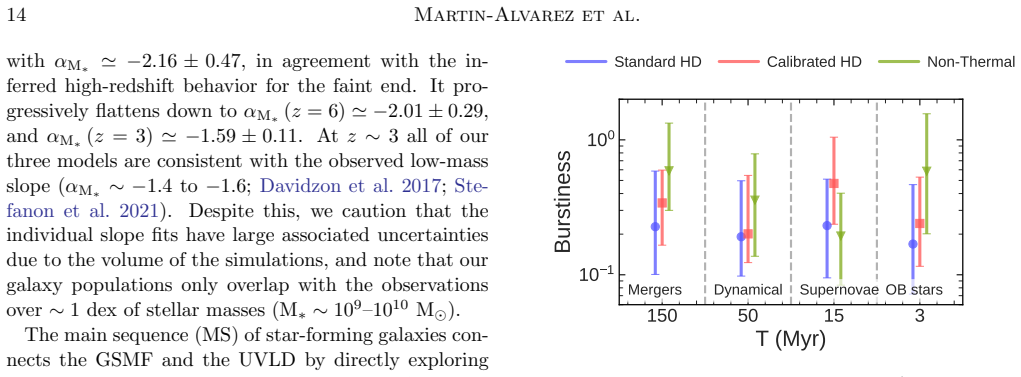
- Star formation burstiness, measured by the 3-to-50 Myr SFR ratio, becomes a discriminating observable, consistent with current JWST samples and predicted to decrease toward higher stellar mass and lower redshift.
- The neutral-gas energy budget shifts from thermal to cosmic-ray pressure after z≈7, implying that cosmic rays become a primary ISM support channel in galaxies by cosmic noon.
- The model predicts a distinctive CGM/IGM signature: smoother Lyα absorption and shallower metal concentration profiles than either standard or calibrated feedback, while preserving filament coherence.
Reading between the lines
- The paper leaves open whether the results are caused by non-thermal physics per se or by the 11% reduction in thermal/kinetic supernova energy; a control run with the same energy split but without cosmic-ray and magnetic injection would settle this.
- If the ejective-to-preventive transition is real, it should be visible in individual galaxy trajectories — outflow mass loading should decline along merger-free evolutionary tracks, not only in population medians.
- A testable extension: comparing the B_3/50 burstiness diagnostic with Hα and UV photometry of hundreds of JWST galaxies at z≈6–10 could falsify the timescale structure of the feedback model.
- The same runs predict LyC photon escape that varies with burst phase, linking the UVLF match to reionization and giving an independent observational probe of non-thermal feedback.
Editorial analysis
A structured set of objections, weighed in public.
Referee Report
Summary. This paper presents the Azahar suite of high-resolution zoom-in cosmological simulations and compares three models: Standard HD, Calibrated HD (boosted thermal SN feedback), and Non-Thermal (MHD + radiative transfer + cosmic rays on the fly). The central claim is that non-thermal feedback channels produce burstier star formation, drive a transition from ejective to preventive outflows as cosmic-ray pressure builds up, and thereby reproduce the observed UV luminosity function from z~14 to z~3, along with the SFRD, stellar mass function, main sequence, and mass-metallicity relation. The authors argue that simple boosted thermal SN feedback cannot simultaneously match the early and late galaxy populations seen by JWST.
Significance. If the causal claim holds, this is a significant result: a largely uncalibrated model with radiative transfer, cosmic rays, and magnetic fields would naturally explain JWST's bright high-redshift galaxies without artificially boosted thermal feedback. The paper's strengths include a large (~20 pc, ~12 cMpc)^3 sample, a wide set of observational diagnostics, and an explicit, honest treatment of volume and overlap uncertainties. The non-thermal parameters (f_CR, kappa_CR, f_mag) are not fitted to the target observables, which is a genuine methodological strength. However, the central attribution to non-thermal physics is not yet isolated from a simultaneous change in the thermal/kinetic SN energy budget, and the high-redshift UVLF claim is stated more strongly in the abstract than the volume/overlap limitations in the text justify.
major comments (3)
- [§2.1.4, Table 1, §3.3, §4] The causal claim is confounded: Non-Thermal changes two things relative to Standard HD—it enables RT/CR/MHD and reduces the thermal+kinetic SN energy budget from 100% to ~89% (10% CR, 1% magnetic). No control run has the same reduced thermal+kinetic budget with all non-thermal channels disabled, and no sensitivity study varies f_CR or kappa_CR. The paper itself states in §3.3 that 'the specific influence of each non-thermal component will be systematically addressed in future work.' As written, the conclusion 'non-thermal physics drives' could instead reflect the energy split or the adopted CR transport parameters. A control run and/or parameter variations, or a substantially softened causal claim, are needed.
- [§3.2.1, Fig. 3, footnote 8] The abstract claims the model reproduces the observed UV luminosity function from z~14, but at z>=12.5 the simulated volume primarily samples M_UV ≳ -18, only partially overlapping current JWST measurements. The text explicitly says the faint-end slopes at these redshifts are 'rough estimates' and that the comparison 'focuses on the relative model behavior rather than on the agreement with observations.' The quantitative match at z~14 is therefore not established at the same level as at z~6–3. Please either restrict the high-z claim in the abstract/conclusions or add a JWST-like selection/overlap analysis that makes the comparison direct.
- [§2.1.5, §3.4] The non-thermal parameters are fixed to literature values, but the paper's quantitative predictions—especially the cosmic-ray pressure buildup and the ejective-to-preventive outflow transition in §3.4—may be sensitive to choices such as kappa_CR = 3e28 cm^2/s and f_CR = 0.1. No sensitivity runs are shown. Given that these parameters directly control the strength and propagation of cosmic-ray feedback, a variation over the observationally plausible range is needed to demonstrate that the mechanism, rather than the specific parameter values, is responsible for the reported behavior.
minor comments (4)
- [Abstract] The abstract refers to the 'full-physics model' while the rest of the paper uses 'Non-Thermal' for the same model. Please make the naming consistent.
- [Appendix C] Equation (C2) is labeled C2 but there is no Equation (C1) in the appendix; renumber or add the missing equation.
- [§3.3] The text references 'thesan-zoom'; the simulation name should be typeset consistently as 'Thesan-zoom' or similar italic style.
- [Fig. 3 caption] Minor typographical spacing issues in the caption (e.g., 'Calibrated HD' appears without spaces in a few places); a proofread pass is recommended.
Circularity Check
No significant circularity: the Non-Thermal model's parameters are fixed from independent constraints, and the headline comparisons are external benchmarks rather than fitted targets.
full rationale
The Azahar Non-Thermal simulation is not calibrated to the observed UVLF, stellar mass function, SFRD, main sequence, outflow loading, or metallicities that are used as evidence. Section 2.1.5 states: "none of the non-thermal parameter values described were adjusted to match galaxy property observables; their values are instead motivated by independent observational, theoretical, or numerical constraints," with f_CR = 0.1, kappa_CR = 3e28 cm^2/s, and f_mag = 0.01 tied to external cosmic-ray, supernova-remnant, and magnetic-field constraints. The model is then compared against independent JWST and ground-based datasets (Figs. 3-6, 8, 10, 12); success or failure is not encoded in the model construction. The Calibrated HD model is the only run tuned to a target, and the paper explicitly acknowledges that its z=3 GSMF agreement is "by construction" rather than a prediction. Self-citations (Pandora papers, Dome et al.) appear in motivation and consistency checks, but the central derivation—running an uncalibrated, parameter-fixed model against external benchmarks—does not reduce to those citations. The paper's own admission that "the specific influence of each non-thermal component will be systematically addressed in future work" and the absence of a control run with the same reduced thermal/kinetic SN budget but without RT/CR/MHD weaken the causal attribution to non-thermal physics, but this is a confounded-experiment/correctness concern, not a definitional or fitted-input circularity. No equation or parameter is equivalent to the claimed prediction by construction.
Assumptions & free parameters
free parameters (6)
- SN feedback boost α_SN (Calibrated HD) =
4.0
- CR energy fraction f_CR =
0.1
- CR diffusion coefficient κ_CR =
3e28 cm^2/s
- SN magnetic energy fraction f_mag =
0.01
- Initial magnetic field B0 =
3e-20 G
- Reduced speed of light c~ =
0.01c
assumptions (7)
- domain assumption Planck 2016 cosmology and initial conditions generated with MUSIC at z=127.
- domain assumption Star formation follows the magneto-thermo-turbulent (MTT) prescription with local efficiency from turbulent and magnetic pressure.
- domain assumption Mechanical SN feedback with Kroupa IMF, E_SN=1e51 erg, and fixed mass/metal return fractions.
- domain assumption Radiative transfer solved with a moment method using three hydrogen/helium ionization bins, bpass v2.0 spectra, and reduced speed of light.
- domain assumption Cosmic rays modeled as a single-fluid energy-density component with constant isotropic diffusion and no streaming.
- domain assumption Haardt & Madau UV background switched on at z=9.
- domain assumption Effective volume estimated by matching the simulated halo mass function to Sheth-Tormen.
Cite this review
Pith. "Pith review of The Azahar Project: Non-Thermal Physics Drives Star Formation Burstiness and the Evolution of the UV Luminosity Density at Cosmic Dawn." pith.science (2026). https://pith.science/paper/Z3WGENQW
@misc{pith2026260715344,
  author       = {Pith},
  title        = {Pith review of: The Azahar Project: Non-Thermal Physics Drives Star Formation Burstiness and the Evolution of the UV Luminosity Density at Cosmic Dawn},
  year         = {2026},
  howpublished = {\url{https://pith.science/paper/Z3WGENQW}},
  note         = {Machine review of arXiv:2607.15344}
}
abstract
JWST observations, which have pushed the discovery and characterization of galaxies to cosmic dawn, have revealed significant deficiencies in state-of-the-art galaxy formation simulations, motivating the need for novel, physically grounded models. We present the first results from the Azahar suite of ten high-resolution ($\sim$20 pc), large-volume zoom-in cosmological simulations, which follow the formation of thousands of galaxies and progressively incorporate radiative transfer (RT), cosmic rays (CRs), and magnetohydrodynamics in addition to the 'standard' baryonic physics. Our Non-Thermal model, which simultaneously includes RT and CRs on the fly, reproduces the observed UV luminosity function from high redshifts ($z \sim 14$) to cosmic noon ($z \sim 3$), as well as the evolution of the stellar mass function, the galaxy main sequence, and observed gas metallicities. It does so through a combination of burstier star formation, with enhanced variability on both long ($\gtrsim 50$ Myr) and short ($\lesssim 10$ Myr) timescales, and a transition from high to low outflow mass-loading factors over cosmic time as CR pressure builds up in the ISM. We find that simple (boosted) thermal SN feedback models fail to capture the cosmic evolution of the very first galaxies because they lack realistic feedback channels that operate on different timescales and have distinct thermodynamical properties, thereby either overproducing stellar mass or driving overly explosive outflows. Our results indicate that non-thermal galaxy formation physics is crucial for providing a robust theoretical framework with which to interpret the high-redshift galaxy populations now being uncovered by JWST.
Figures


Figures from the paper (14 more)




Reference graph
Works this paper leans on
-
[1]
Abel, T., Bryan, G. L., & Norman, M. L. 2002, Science, 295, 93, doi: 10.1126/SCIENCE.1063991
-
[2]
2012, ApJ, 755, 164, doi: 10.1088/0004-637X/755/2/164
Ackermann, M., Ajello, M., Allafort, A., et al. 2012, ApJ, 755, 164, doi: 10.1088/0004-637X/755/2/164
-
[3]
Agertz, O., Kravtsov, A. V., Leitner, S. N., & Gnedin, N. Y. 2013, ApJ, 770, 25, doi: 10.1088/0004-637X/770/1/25
-
[4]
Andersson, E. P., Mac Low, M. M., Agertz, O., Renaud, F., & Li, H. 2024, A&A, 681, A28, doi: 10.1051/0004-6361/202347792
-
[5]
Armillotta, L., Ostriker, E. C., & Jiang, Y.-F. 2021, ApJ, 922, 11, doi: 10.3847/1538-4357/AC1DB2
-
[6]
2023, MNRAS, 527, 11372, doi: 10.1093/MNRAS/STAD3902
Asada, Y., Sawicki, M., Abraham, R., et al. 2023, MNRAS, 527, 11372, doi: 10.1093/MNRAS/STAD3902
-
[7]
2021, MNRAS, 504, 2346, doi: 10.1093/mnras/stab1030
Attia, O., Teyssier, R., Katz, H., et al. 2021, MNRAS, 504, 2346, doi: 10.1093/mnras/stab1030
-
[8]
2004, MNRAS, 352, 376, doi: 10.1111/j.1365-2966.2004.07883.x
Aubert, D., Pichon, C., & Colombi, S. 2004, MNRAS, 352, 376, doi: 10.1111/j.1365-2966.2004.07883.x
arXiv 2004
Show all 203 references
-
[9]
H., Hearin, A
Behroozi, P., Wechsler, R. H., Hearin, A. P., & Conroy, C. 2019, MNRAS, 488, 3143, doi: 10.1093/mnras/stz1182
2019 doi
-
[10]
2026, A&A, 707, A396, doi: 10.1051/0004-6361/202557901
Paladino, R. 2026, A&A, 707, A396, doi: 10.1051/0004-6361/202557901
2026 doi
-
[11]
J., Illingworth, G
Bouwens, R. J., Illingworth, G. D., Oesch, P. A., et al. 2015, ApJ, 803, 34, doi: 10.1088/0004-637X/803/1/34
2015 doi
-
[12]
J., Aravena, M., Decarli, R., et al
Bouwens, R. J., Aravena, M., Decarli, R., et al. 2016, ApJ, 833, 72, doi: 10.3847/1538-4357/833/1/72
2016 doi
-
[13]
J., Oesch, P
Bouwens, R. J., Oesch, P. A., Stefanon, M., et al. 2021, AJ, 162, 47, doi: 10.3847/1538-3881/ABF83E
2021 doi
-
[14]
2023, Nature Astronomy, 7, 731, doi: 10.1038/s41550-023-01937-7
Boylan-Kolchin, M. 2023, Nature Astronomy, 7, 731, doi: 10.1038/s41550-023-01937-7
2023 doi
-
[15]
H., et al
Brauer, K., Mead, J., Wise, J. H., et al. 2025, ApJ, 993, 2, doi: 10.3847/1538-4357/ae06a4
2025 doi
- [16]
-
[17]
S., & Quinn, T
Butsky, I. S., & Quinn, T. R. 2018, ApJ, 868, 108, doi: 10.3847/1538-4357/aaeac2
2018 doi
-
[18]
M., Stanway, E
Byrne, C. M., Stanway, E. R., Eldridge, J. J., McSwiney, L., & Townsend, O. T. 2022, MNRAS, 512, 5329, doi: 10.1093/MNRAS/STAC807
2022 doi
-
[19]
P., et al
Cadiou, C., Katz, H., Rey, M. P., et al. 2025, arXiv. https://arxiv.org/pdf/2510.05667
2025
-
[20]
C., Engelbracht, C
Calzetti, D., Kennicutt, R. C., Engelbracht, C. W., et al. 2007, ApJ, 666, 870, doi: 10.1086/520082
2007 doi
-
[21]
2024, A&A, 685, A99, doi: 10.1051/0004-6361/202347230
Carniani, S., Venturi, G., Parlanti, E., et al. 2024, A&A, 685, A99, doi: 10.1051/0004-6361/202347230
2024 doi
-
[22]
2025, A&A, 704, A290, doi: 10.1051/0004-6361/202556471
Carvajal-Bohorquez, C., Ciesla, L., Laporte, N., et al. 2025, A&A, 704, A290, doi: 10.1051/0004-6361/202556471
2025 doi
-
[23]
2026, MNRAS, 548, doi: 10.1093/MNRAS/STAG740
Chaikin, E., Schaye, J., Schaller, M., et al. 2026, MNRAS, 548, doi: 10.1093/MNRAS/STAG740
2026 doi
-
[24]
2024, ApJL, 976, L15, doi: 10.3847/2041-8213/AD8DC9
Chemerynska, I., Atek, H., Dayal, P., et al. 2024, ApJL, 976, L15, doi: 10.3847/2041-8213/AD8DC9
2024 doi
-
[25]
J., et al
Chemerynska, I., Atek, H., Furtak, L. J., et al. 2026, MNRAS, 546, doi: 10.1093/MNRAS/STAF2267
2026 doi
-
[26]
E., Mead, A
Chisari, N. E., Mead, A. J., Joudaki, S., et al. 2019, The Open Journal of Astrophysics, 2, 9452, doi: 10.21105/astro.1905.06082
2019 arXiv
-
[27]
2018, MNRAS, 481, 1690, doi: 10.1093/MNRAS/STY2380
Chisholm, J., Tremonti, C., & Leitherer, C. 2018, MNRAS, 481, 1690, doi: 10.1093/MNRAS/STY2380
2018 doi
-
[28]
A., Leitherer, C., & Chen, Y
Chisholm, J., Tremonti, C. A., Leitherer, C., & Chen, Y. 2017, MNRAS, 469, 4831, doi: 10.1093/mnras/stx1164
2017 doi
-
[29]
R., Kereˇ s, D., Hopkins, P
Choban, C. R., Kereˇ s, D., Hopkins, P. F., et al. 2022, MNRAS, 514, 4506, doi: 10.1093/MNRAS/STAC1542
2022 doi
-
[30]
E., Lam, N., et al
Clarke, L., Shapley, A. E., Lam, N., et al. 2025, arXiv. https://arxiv.org/pdf/2510.06681
2025
-
[31]
W., Papovich, C., Finkelstein, S
Cole, J. W., Papovich, C., Finkelstein, S. L., et al. 2025, ApJ, 979, 193, doi: 10.3847/1538-4357/AD9A6A
2025 doi
-
[32]
2022, MNRAS, 513, 2535, doi: 10.1093/mnras/stac1026
Concas, A., Maiolino, R., Curti, M., et al. 2022, MNRAS, 513, 2535, doi: 10.1093/mnras/stac1026
2022 doi
-
[33]
A., Schaye, J., Bower, R
Crain, R. A., Schaye, J., Bower, R. G., et al. 2015, MNRAS, 450, 1937, doi: 10.1093/mnras/stv725
2015 doi
-
[34]
C., Stone, E
Cummings, A. C., Stone, E. C., Heikkila, B. C., et al. 2016, ApJ, 831, 18, doi: 10.3847/0004-637x/831/1/18
2016 doi
-
[35]
2020, MNRAS, 492, 821, doi: 10.1093/mnras/stz3379
Curti, M., Maiolino, R., Cirasuolo, M., et al. 2020, MNRAS, 492, 821, doi: 10.1093/mnras/stz3379
2020 doi
-
[36]
2022, MNRAS, 518, 425, doi: 10.1093/MNRAS/STAC2737
Curti, M., D’Eugenio, F., Carniani, S., et al. 2022, MNRAS, 518, 425, doi: 10.1093/MNRAS/STAC2737
2022 doi
-
[37]
2024, A&A, 684, A75, doi: 10.1051/0004-6361/202346698
Curti, M., Maiolino, R., Curtis-Lake, E., et al. 2024, A&A, 684, A75, doi: 10.1051/0004-6361/202346698
2024 doi
-
[38]
2025, ApJ, 980, 197, doi: 10.3847/1538-4357/ADAB72
Lopez-Rodriguez, E. 2025, ApJ, 980, 197, doi: 10.3847/1538-4357/ADAB72
2025 doi
-
[39]
L., Tacchella, S., ¨Ubler, H., et al
Danhaive, A. L., Tacchella, S., ¨Ubler, H., et al. 2025, MNRAS, 543, 3249, doi: 10.1093/mnras/staf1540 Bursty First Galaxies in the Azahar Simulations29
2025 doi
-
[40]
2020, A&A, 638, A123, doi: 10.1051/0004-6361/201936339 Dav´ e, R., Angl´ es-Alc´ azar, D., Narayanan, D., et al
Dashyan, G., & Dubois, Y. 2020, A&A, 638, A123, doi: 10.1051/0004-6361/201936339 Dav´ e, R., Angl´ es-Alc´ azar, D., Narayanan, D., et al. 2019, MNRAS, 486, 2827, doi: 10.1093/MNRAS/STZ937
2020 doi
-
[41]
2017, A&A, 605, A70, doi: 10.1051/0004-6361/201730419
Davidzon, I., Ilbert, O., Laigle, C., et al. 2017, A&A, 605, A70, doi: 10.1051/0004-6361/201730419
2017 doi
-
[42]
2023, MNRAS, 523, 3201, doi: 10.1093/MNRAS/STAD1557
Li, Z. 2023, MNRAS, 523, 3201, doi: 10.1093/MNRAS/STAD1557
2023 doi
-
[43]
2024, A&A, 691, A231, doi: 10.1051/0004-6361/202450699
Deng, Y., Li, H., Liu, B., et al. 2024, A&A, 691, A231, doi: 10.1051/0004-6361/202450699
2024 doi
-
[44]
2018, ApJS, 239, 35, doi: 10.3847/1538-4365/AAEE8C
Diemer, B. 2018, ApJS, 239, 35, doi: 10.3847/1538-4365/AAEE8C
2018 doi
-
[45]
2025, MNRAS, 537, 629, doi: 10.1093/MNRAS/STAF006
Sijacki, D. 2025, MNRAS, 537, 629, doi: 10.1093/MNRAS/STAF006
2025 doi
-
[46]
T., McLure, R
Donnan, C. T., McLure, R. J., Dunlop, J. S., et al. 2024, MNRAS, 533, 3222, doi: 10.1093/MNRAS/STAE2037
2024 doi
-
[47]
2016, A&A, 585, A138, doi: 10.1051/0004-6361/201527126
Dubois, Y., & Commer¸ con, B. 2016, A&A, 585, A138, doi: 10.1051/0004-6361/201527126
2016 doi
-
[48]
2019, A&A, 631, A121, doi: 10.1051/0004-6361/201936275
Dubois, Y., Commer¸ con, B., Marcowith, A., & Brahimi, L. 2019, A&A, 631, A121, doi: 10.1051/0004-6361/201936275
2019 doi
-
[49]
2014, MNRAS, 444, 1453, doi: 10.1093/mnras/stu1227
Dubois, Y., Pichon, C., Welker, C., et al. 2014, MNRAS, 444, 1453, doi: 10.1093/mnras/stu1227
2014 doi
-
[50]
2021, A&A, 651, A109, doi: 10.1051/0004-6361/202039429
Dubois, Y., Beckmann, R., Bournaud, F., et al. 2021, A&A, 651, A109, doi: 10.1051/0004-6361/202039429
2021 doi
-
[51]
2024, A&A, 687, A240, doi: 10.1051/0004-6361/202449784
Dubois, Y., Rodr ´ ıguez Montero, F., Guerra, C., et al. 2024, A&A, 687, A240, doi: 10.1051/0004-6361/202449784
2024 doi
-
[52]
1992, MNRAS, 256, 43P, doi: 10.1093/mnras/256.1.43P
Efstathiou, G. 1992, MNRAS, 256, 43P, doi: 10.1093/mnras/256.1.43P
1992 doi
-
[54]
2025, ApJ, 987, 189, doi: 10.3847/1538-4357/addc74
Whitler, L. 2025, ApJ, 987, 189, doi: 10.3847/1538-4357/addc74
2025 doi
-
[55]
P., Whitler, L., et al
Endsley, R., Stark, D. P., Whitler, L., et al. 2023, MNRAS, 524, 2312, doi: 10.1093/mnras/stad1919
2023 doi
-
[56]
P., Whitler, L., et al
Endsley, R., Stark, D. P., Whitler, L., et al. 2024, MNRAS, 533, 1111, doi: 10.1093/MNRAS/STAE1857
2024 doi
-
[57]
Bushby, P. J. 2019, MNRAS, 488, 5065, doi: 10.1093/mnras/stz2084
2019 doi
-
[58]
Larson, K. L. 2019, ApJ, 884, 133, doi: 10.3847/1538-4357/AB425B
2019 doi
-
[59]
2022, MNRAS, 513, 5000, doi: 10.1093/mnras/stac1196
Martin-Alvarez, S. 2022, MNRAS, 513, 5000, doi: 10.1093/mnras/stac1196
2022 doi
-
[60]
2025, A&A, 698, A89, doi: 10.1051/0004-6361/202553924 Faucher-Gigu` ere, C
Farcy, M., Rosdahl, J., Dubois, Y., et al. 2025, A&A, 698, A89, doi: 10.1051/0004-6361/202553924 Faucher-Gigu` ere, C. A., Quataert, E., & Hopkins, P. F. 2013, MNRAS, 433, 1970, doi: 10.1093/MNRAS/STT866
2025 doi
-
[61]
Federrath, C., & Klessen, R. S. 2012, ApJ, 761, 156, doi: 10.1088/0004-637X/761/2/156
2012 doi
-
[62]
J., Korista, K
Ferland, G. J., Korista, K. T., Verner, D. A., et al. 1998, PASP, 110, 761, doi: 10.1086/316190
1998 doi
-
[63]
2023, MNRAS, 522, 3986, doi: 10.1093/MNRAS/STAD1095
Ferrara, A., Pallottini, A., & Dayal, P. 2023, MNRAS, 522, 3986, doi: 10.1093/MNRAS/STAD1095
2023 doi
-
[64]
A., Mackey, J., Grassitelli, L., Romano-D ´ ıaz, E., & Porciani, C
Fichtner, Y. A., Mackey, J., Grassitelli, L., Romano-D ´ ıaz, E., & Porciani, C. 2024, A&A, 690, A72, doi: 10.1051/0004-6361/202449638
2024 doi
-
[65]
L., Ryan, R
Finkelstein, S. L., Ryan, R. E., Papovich, C., et al. 2015, ApJ, 810, 71, doi: 10.1088/0004-637X/810/1/71
2015 doi
-
[66]
L., Bagley, M
Finkelstein, S. L., Bagley, M. B., Ferguson, H. C., et al. 2023, ApJL, 946, L13, doi: 10.3847/2041-8213/acade4
2023 doi
-
[67]
L., Leung, G
Finkelstein, S. L., Leung, G. C. K., Bagley, M. B., et al. 2024, ApJL, 969, L2, doi: 10.3847/2041-8213/AD4495
2024 doi
-
[68]
B., Dav´ e, R., Oppenheimer, B
Ford, A. B., Dav´ e, R., Oppenheimer, B. D., et al. 2014, MNRAS, 444, 1260, doi: 10.1093/mnras/stu1418
2014 doi
-
[69]
2006, A&A, 457, 371, doi: 10.1051/0004-6361:20065371
Fromang, S., Hennebelle, P., & Teyssier, R. 2006, A&A, 457, 371, doi: 10.1051/0004-6361:20065371
2006 doi
-
[70]
2015, MNRAS, 454, 4484, doi: 10.1093/mnras/stv2272
Geen, S., Hennebelle, P., Tremblin, P., & Rosdahl, J. 2015, MNRAS, 454, 4484, doi: 10.1093/mnras/stv2272
2015 doi
-
[71]
R., Yan, R., & Tinker, J
Geha, M., Blanton, M. R., Yan, R., & Tinker, J. L. 2012, ApJ, 757, 85, doi: 10.1088/0004-637X/757/1/85
2012 doi
-
[72]
2018, MNRAS, 479, 3042, doi: 10.1093/mnras/sty1653
Girichidis, P., Naab, T., Hanasz, M., & Walch, S. 2018, MNRAS, 479, 3042, doi: 10.1093/mnras/sty1653
2018 doi
-
[73]
2022, MNRAS, 510, 3917, doi: 10.1093/mnras/stab3462
Girichidis, P., Pfrommer, C., Pakmor, R., & Springel, V. 2022, MNRAS, 510, 3917, doi: 10.1093/mnras/stab3462
2022 doi
-
[74]
2010, Nature 2010 463:7278, 463, 203, doi: 10.1038/nature08640
Governato, F., Brook, C., Mayer, L., et al. 2010, Nature 2010 463:7278, 463, 203, doi: 10.1038/nature08640
2010 doi
-
[75]
E., Labbe, I., Goulding, A
Greene, J. E., Labbe, I., Goulding, A. D., et al. 2024, ApJ, 964, 39, doi: 10.3847/1538-4357/ad1e5f
2024 doi
-
[77]
1996, ApJ, 461, 20, doi: 10.1086/177035
Haardt, F., & Madau, P. 1996, ApJ, 461, 20, doi: 10.1086/177035
1996 doi
-
[79]
2013, ApJL, 777, L38, doi: 10.1088/2041-8205/777/2/L38
Hanasz, M., Lesch, H., Naab, T., et al. 2013, ApJL, 777, L38, doi: 10.1088/2041-8205/777/2/L38
2013 doi
-
[80]
2024, ApJ, 960, 56, doi: 10.3847/1538-4357/AD0B7E
Harikane, Y., Nakajima, K., Ouchi, M., et al. 2024, ApJ, 960, 56, doi: 10.3847/1538-4357/AD0B7E
2024 doi
-
[81]
2023, ApJS, 265, 5, doi: 10.3847/1538-4365/ACAAA9
Harikane, Y., Ouchi, M., Oguri, M., et al. 2023, ApJS, 265, 5, doi: 10.3847/1538-4365/ACAAA9
2023 doi
-
[82]
K., Ellis, R
Harikane, Y., Inoue, A. K., Ellis, R. S., et al. 2025, ApJ, 980, 138, doi: 10.3847/1538-4357/AD9B2C 30Martin-Alvarez et al
2025 doi
-
[83]
J., Adams, N
Harvey, T., Conselice, C. J., Adams, N. J., et al. 2025, ApJ, 978, 89, doi: 10.3847/1538-4357/AD8C29
2025 doi
-
[84]
T., Kruijssen, J
Haydon, D. T., Kruijssen, J. M., Chevance, M., et al. 2020, MNRAS, 498, 235, doi: 10.1093/MNRAS/STAA2430
2020 doi
-
[85]
C., & Hopkins, P
Hayward, C. C., & Hopkins, P. F. 2017, MNRAS, 465, 1682, doi: 10.1093/mnras/stw2888
2017 doi
-
[86]
2015, ApJ, 809, 147, doi: 10.1088/0004-637X/809/2/147
Overzier, R., & Leitherer, C. 2015, ApJ, 809, 147, doi: 10.1088/0004-637X/809/2/147
2015 doi
-
[87]
M., & Furlanetto, S
Hegde, S., Wyatt, M. M., & Furlanetto, S. R. 2024, Journal of Cosmology and Astroparticle Physics, 2024, doi: 10.1088/1475-7516/2024/08/025
2024 doi
-
[88]
A., Vink, J., Bamba, A., et al
Helder, E. A., Vink, J., Bamba, A., et al. 2013, MNRAS, 435, 910, doi: 10.1093/mnras/stt993
2013 doi
-
[89]
F., Butsky, I
Hopkins, P. F., Butsky, I. S., Panopoulou, G. V., et al. 2022, MNRAS, 516, 3470, doi: 10.1093/MNRAS/STAC1791
2022 doi
-
[90]
F., Chan, T
Hopkins, P. F., Chan, T. K., Ji, S., et al. 2021, MNRAS, 501, 3640, doi: 10.1093/mnras/staa3690
2021 doi
-
[91]
F., Kereˇ s, D., O˜ norbe, J., et al
Hopkins, P. F., Kereˇ s, D., O˜ norbe, J., et al. 2014, MNRAS, 445, 581, doi: 10.1093/mnras/stu1738
2014 doi
-
[92]
F., Quataert, E., & Murray, N
Hopkins, P. F., Quataert, E., & Murray, N. 2012, MNRAS, 421, 3522, doi: 10.1111/j.1365-2966.2012.20593.x
2012
-
[93]
2018, ApJ, 854, 73, doi: 10.3847/1538-4357/AAA544
Ishigaki, M., Kawamata, R., Ouchi, M., et al. 2018, ApJ, 854, 73, doi: 10.3847/1538-4357/AAA544
2018 doi
-
[94]
G., Speagle, J
Iyer, K. G., Speagle, J. S., Caplar, N., et al. 2024, ApJ, 961, 53, doi: 10.3847/1538-4357/ACFF64
2024 doi
-
[95]
P., & McCourt, M
Ji, S., Oh, S. P., & McCourt, M. 2018, MNRAS, 476, 852, doi: 10.1093/mnras/sty293
2018 doi
-
[96]
2017, MNRAS, 467, 906, doi: 10.1093/mnras/stx127
Ji, S., Peng Oh, S., & McCourt, M. 2017, MNRAS, 467, 906, doi: 10.1093/mnras/stx127
2017 doi
-
[97]
2024, ApJ, 966, 129, doi: 10.3847/1538-4357/AD3042
Kado-Fong, E., Geha, M., Mao, Y.-Y., et al. 2024, ApJ, 966, 129, doi: 10.3847/1538-4357/AD3042
2024 doi
-
[98]
2021, MNRAS, doi: 10.1093/MNRAS/STAB3710
Kannan, R., Garaldi, E., Smith, A., et al. 2021, MNRAS, doi: 10.1093/MNRAS/STAB3710
2021 doi
-
[99]
2025, The Open Journal of Astrophysics, 8, doi: 10.33232/001C.145804
Kannan, R., Puchwein, E., Smith, A., et al. 2025, The Open Journal of Astrophysics, 8, doi: 10.33232/001C.145804
2025 doi
-
[100]
P., Cadiou, C., Kimm, T., & Agertz, O
Katz, H., Rey, M. P., Cadiou, C., Kimm, T., & Agertz, O. 2026, The Open Journal of Astrophysics, 9, doi: 10.33232/001C.156097
2026 doi
-
[101]
2020, MNRAS, 494, 2200, doi: 10.1093/mnras/staa639
Katz, H., Ramsoy, M., Rosdahl, J., et al. 2020, MNRAS, 494, 2200, doi: 10.1093/mnras/staa639
2020 doi
-
[102]
P., Cadiou, C., et al
Katz, H., Rey, M. P., Cadiou, C., et al. 2025, arXiv. https://arxiv.org/pdf/2510.05201
2025
-
[103]
Kennicutt, Jr., R. C. 1998, ApJ, 498, 541, doi: 10.1086/305588
1998 doi
-
[104]
Kim, C.-G., Kim, J.-G., Gong, M., & Ostriker, E. C. 2023, ApJ, 946, 3, doi: 10.3847/1538-4357/acbd3a
2023 doi
-
[105]
2014, ApJ, 788, 121, doi: 10.1088/0004-637X/788/2/121
Kimm, T., & Cen, R. 2014, ApJ, 788, 121, doi: 10.1088/0004-637X/788/2/121
2014 doi
-
[106]
2015, MNRAS, 451, 2900, doi: 10.1093/mnras/stv1211
Kimm, T., Cen, R., Devriendt, J., Dubois, Y., & Slyz, A. 2015, MNRAS, 451, 2900, doi: 10.1093/mnras/stv1211
2015 doi
-
[107]
2017, MNRAS, 466, 4826, doi: 10.1093/MNRAS/STX052
Kimm, T., Katz, H., Haehnelt, M., et al. 2017, MNRAS, 466, 4826, doi: 10.1093/MNRAS/STX052
2017 doi
-
[108]
A., Taylor, A
Kokorev, V., Ch´ avez Ortiz, O. A., Taylor, A. J., et al. 2025, ApJL, 988, L10, doi: 10.3847/2041-8213/ade8f5
2025 doi
-
[109]
P., Wijesekera, J
Koprowski, M. P., Wijesekera, J. V., Dunlop, J. S., et al. 2024, A&A, 691, A164, doi: 10.1051/0004-6361/202449948
2024 doi
-
[111]
2023, MNRAS, 526, 6103, doi: 10.1093/MNRAS/STAD2540 Labb´ e, I., van Dokkum, P., Nelson, E., et al
Kugel, R., Schaye, J., Schaller, M., et al. 2023, MNRAS, 526, 6103, doi: 10.1093/MNRAS/STAD2540 Labb´ e, I., van Dokkum, P., Nelson, E., et al. 2023, Nature, 616, 266, doi: 10.1038/s41586-023-05786-2
2023 doi
-
[112]
Leung, G. C. K., Bagley, M. B., Finkelstein, S. L., et al. 2023, ApJL, 954, L46, doi: 10.3847/2041-8213/ACF365
2023 doi
-
[113]
2023, A&A, 676, A53, doi: 10.1051/0004-6361/202346232
Llerena, M., Amor ´ ın, R., Pentericci, L., et al. 2023, A&A, 676, A53, doi: 10.1051/0004-6361/202346232
2023 doi
-
[114]
J., D’Eugenio, F., Maiolino, R., et al
Looser, T. J., D’Eugenio, F., Maiolino, R., et al. 2024, Nature, 629, 53, doi: 10.1038/s41586-024-07227-0
2024 doi
-
[115]
2014, ARA&A, 52, 415, doi: 10.1146/annurev-astro-081811-125615
Madau, P., & Dickinson, M. 2014, ARA&A, 52, 415, doi: 10.1146/annurev-astro-081811-125615
2014 doi
-
[116]
2008, A&A, 488, 463, doi: 10.1051/0004-6361:200809678
Maiolino, R., Nagao, T., Grazian, A., et al. 2008, A&A, 488, 463, doi: 10.1051/0004-6361:200809678
2008 doi
-
[117]
2024, Nature, 627, 59, doi: 10.1038/s41586-024-07052-5
Maiolino, R., Scholtz, J., Witstok, J., et al. 2024, Nature, 627, 59, doi: 10.1038/s41586-024-07052-5
2024 doi
-
[118]
2023, A&A, 670, A92, doi: 10.1051/0004-6361/202244895
Marasco, A., Belfiore, F., Cresci, G., et al. 2023, A&A, 670, A92, doi: 10.1051/0004-6361/202244895
2023 doi
-
[119]
2019, MNRAS, 489, 4233, doi: 10.1093/mnras/stz2391
Springel, V. 2019, MNRAS, 489, 4233, doi: 10.1093/mnras/stz2391
2019 doi
-
[120]
2022, MNRAS, 513, 3326, doi: 10.1093/mnras/stac1099
Martin-Alvarez, S., Devriendt, J., Slyz, A., et al. 2022, MNRAS, 513, 3326, doi: 10.1093/mnras/stac1099
2022 doi
-
[121]
2025, MNRAS, 539, 1738, doi: 10.1093/MNRAS/STAF470
Martin-Alvarez, S., Irˇ siˇ c, V., Koudmani, S., et al. 2025, MNRAS, 539, 1738, doi: 10.1093/MNRAS/STAF470
2025 doi
-
[122]
2021, MNRAS, 504, 2517, doi: 10.1093/mnras/stab968
Slyz, A. 2021, MNRAS, 504, 2517, doi: 10.1093/mnras/stab968
2021 doi
-
[123]
G., et al
Martin-Alvarez, S., Sijacki, D., Haehnelt, M. G., et al. 2023, MNRAS, 525, 3806, doi: 10.1093/mnras/stad2559
2023 doi
-
[124]
2020, MNRAS, 495, 4475, doi: 10.1093/mnras/staa1438
Martin-Alvarez, S., Slyz, A., Devriendt, J., & G´ omez-Guijarro, C. 2020, MNRAS, 495, 4475, doi: 10.1093/mnras/staa1438
2020 doi
-
[125]
2024, ApJ, 966, 43, doi: 10.3847/1538-4357/ad2e9e
Martin-Alvarez, S., Lopez-Rodriguez, E., Dacunha, T., et al. 2024, ApJ, 966, 43, doi: 10.3847/1538-4357/ad2e9e
2024 doi
-
[126]
G., et al
Martin-Alvarez, S., Sijacki, D., Haehnelt, M. G., et al. 2026, MNRAS, 545, doi: 10.1093/mnras/staf2106
2026 doi
-
[127]
A., Trenti, M., & Treu, T
Mason, C. A., Trenti, M., & Treu, T. 2023, MNRAS, 521, 497, doi: 10.1093/MNRAS/STAD035 Bursty First Galaxies in the Azahar Simulations31
2023 doi
-
[128]
2025, MNRAS, 544, 513, doi: 10.1093/MNRAS/STAF1660
McClymont, W., Tacchella, S., Smith, A., et al. 2025, MNRAS, 544, 513, doi: 10.1093/MNRAS/STAF1660
2025 doi
-
[129]
B., van Zee, L., & Skillman, E
McQuinn, K. B., van Zee, L., & Skillman, E. D. 2019, Galactic Winds in Low-Mass Galaxies, doi: 10.1017/s1743921319000085
2019 doi
-
[130]
R., Heckman, T
Meurer, G. R., Heckman, T. M., & Calzetti, D. 1999, ApJ, 521, 64, doi: 10.1086/307523
1999 doi
-
[131]
2012, A&A, 538, A81, doi: 10.1051/0004-6361/201117855
Morlino, G., & Caprioli, D. 2012, A&A, 538, A81, doi: 10.1051/0004-6361/201117855
2012 doi
-
[132]
L., Kereˇ s, D., Faucher-Gigu` ere, C
Muratov, A. L., Kereˇ s, D., Faucher-Gigu` ere, C. A., et al. 2015, MNRAS, 454, 2691, doi: 10.1093/mnras/stv2126
2015 doi
-
[133]
I., et al
Navarro-Carrera, R., Rinaldi, P., Caputi, K. I., et al. 2024, ApJ, 961, 207, doi: 10.3847/1538-4357/AD0DF6
2024 doi
-
[134]
J., Suess, K
Nelson, E. J., Suess, K. A., Bezanson, R., et al. 2023, ApJL, 948, L18, doi: 10.3847/2041-8213/ACC1E1
2023 doi
-
[135]
A., Bouwens, R
Oesch, P. A., Bouwens, R. J., Illingworth, G. D., Labbe, I., & Stefanon, M. 2018, ApJ, 855, 105, doi: 10.3847/1538-4357/aab03f
2018 doi
-
[136]
A., Bouwens, R
Oesch, P. A., Bouwens, R. J., Illingworth, G. D., et al. 2013, ApJ, 773, 75, doi: 10.1088/0004-637X/773/1/75
2013 doi
-
[137]
D., Dav´ e, R., Kereˇ s, D., et al
Oppenheimer, B. D., Dav´ e, R., Kereˇ s, D., et al. 2010, MNRAS, 406, 2325, doi: 10.1111/J.1365-2966.2010.16872.X
2010
-
[138]
P., et al
Pakmor, R., Springel, V., Coles, J. P., et al. 2023, MNRAS, 524, 2539, doi: 10.1093/mnras/stac3620
2023 doi
-
[139]
2022, MNRAS, 513, 5621, doi: 10.1093/mnras/stac1281
Pallottini, A., Ferrara, A., Gallerani, S., et al. 2022, MNRAS, 513, 5621, doi: 10.1093/mnras/stac1281
2022 doi
-
[140]
Parizot, E., Marcowith, A., Ballet, J., & Gallant, Y. A. 2006, A&A, 453, 387, doi: 10.1051/0004-6361:20064985
2006 doi
-
[141]
Peacock, J. A. 1999, Cosmological Physics (Cambridge University Press)
1999
-
[142]
2007, MNRAS, 378, 385, doi: 10.1111/J.1365- 2966.2007.11732.X/2/M{ }MNRAS0378-0385-M13.GIF
Dolag, K. 2007, MNRAS, 378, 385, doi: 10.1111/J.1365- 2966.2007.11732.X/2/M{ }MNRAS0378-0385-M13.GIF
2007
-
[143]
2017a, MNRAS, 465, 4500, doi: 10.1093/mnras/stw2941
Springel, V. 2017a, MNRAS, 465, 4500, doi: 10.1093/mnras/stw2941
-
[144]
M., & Springel, V
Pfrommer, C., Pakmor, R., Simpson, C. M., & Springel, V. 2017b, ApJ, 847, L13, doi: 10.3847/2041-8213/aa8bb1
-
[145]
2018, MNRAS, 475, 648, doi: 10.1093/mnras/stx3112
Pillepich, A., Nelson, D., Hernquist, L., et al. 2018, MNRAS, 475, 648, doi: 10.1093/mnras/stx3112
2018 doi
-
[146]
A., Best, P
Pirie, C. A., Best, P. N., Duncan, K. J., et al. 2025, MNRAS, 541, 1348, doi: 10.1093/MNRAS/STAF1006 Planck Collaboration, Ade, P. A., Aghanim, N., et al. 2016, A&A, 594, A13, doi: 10.1051/0004-6361/201525830
2025 doi
-
[148]
H., Raicevic, M., & Schaye, J
Rahmati, A., Pawlik, A. H., Raicevic, M., & Schaye, J. 2013, MNRAS, 430, 2427, doi: 10.1093/MNRAS/STT066
2013 doi
-
[149]
2006, A&A, 445, 1, doi: 10.1051/0004-6361:20053116
Rasera, Y., & Teyssier, R. 2006, A&A, 445, 1, doi: 10.1051/0004-6361:20053116
2006 doi
-
[150]
E., Naab, T., Walch, S., et al
Rathjen, T. E., Naab, T., Walch, S., et al. 2023, MNRAS, 522, 1843, doi: 10.1093/MNRAS/STAD1104
2023 doi
-
[151]
A., & Steidel, C
Reddy, N. A., & Steidel, C. C. 2009, ApJ, 692, 778, doi: 10.1088/0004-637X/692/1/778
2009 doi
-
[152]
2025, MNRAS, 543, 12, doi: 10.1093/mnras/staf1372
Michel-Dansac, L. 2025, MNRAS, 543, 12, doi: 10.1093/mnras/staf1372
2025 doi
-
[153]
D., Tacchella, S., et al
Robertson, B., Johnson, B. D., Tacchella, S., et al. 2024, ApJ, 970, 31, doi: 10.3847/1538-4357/AD463D
2024 doi
-
[154]
2024, MNRAS, 534, 1420, doi: 10.1093/MNRAS/STAE2132 Roca-F` abrega, S., Dekel, A., Faerman, Y., et al
Robinson, H., & Wadsley, J. 2024, MNRAS, 534, 1420, doi: 10.1093/MNRAS/STAE2132 Roca-F` abrega, S., Dekel, A., Faerman, Y., et al. 2019, MNRAS, 484, 3625, doi: 10.1093/MNRAS/STZ063 Rodr ´ ıguez Montero, F., Dubois, Y., Katz, H., Slyz, A., &
2024 doi
-
[155]
2026, http://arxiv.org/abs/2602.21790 Rodr ´ ıguez Montero, F., Martin-Alvarez, S., Slyz, A., et al
Devriendt, J. 2026, http://arxiv.org/abs/2602.21790 Rodr ´ ıguez Montero, F., Martin-Alvarez, S., Slyz, A., et al. 2024, MNRAS, 530, 3617, doi: 10.1093/MNRAS/STAE1083
2026
-
[156]
2013, MNRAS, 436, 2188, doi: 10.1093/mnras/stt1722
Rosdahl, J., Blaizot, J., Aubert, D., Stranex, T., & Teyssier, R. 2013, MNRAS, 436, 2188, doi: 10.1093/mnras/stt1722
2013 doi
-
[157]
2015, MNRAS, 451, 34, doi: 10.1093/mnras/stv937
Rosdahl, J., Schaye, J., Teyssier, R., & Agertz, O. 2015, MNRAS, 451, 34, doi: 10.1093/mnras/stv937
2015 doi
-
[158]
2015, MNRAS, 449, 4380, doi: 10.1093/mnras/stv567
Rosdahl, J., & Teyssier, R. 2015, MNRAS, 449, 4380, doi: 10.1093/mnras/stv567
2015 doi
-
[159]
2018, MNRAS, 479, 994, doi: 10.1093/mnras/sty1655
Rosdahl, J., Katz, H., Blaizot, J., et al. 2018, MNRAS, 479, 994, doi: 10.1093/mnras/sty1655
2018 doi
-
[160]
Rosen, A., & Bregman, J. N. 1995, ApJ, 440, 634, doi: 10.1086/175303
1995 doi
-
[161]
2023, A&A Rv, 31, doi: 10.1007/s00159-023-00149-2
Ruszkowski, M., & Pfrommer, C. 2023, A&A Rv, 31, doi: 10.1007/s00159-023-00149-2
2023 doi
-
[162]
2025, MNRAS, 544, 132, doi: 10.1093/MNRAS/STAF1680
Saldana-Lopez, A., Chisholm, J., Gazagnes, S., et al. 2025, MNRAS, 544, 132, doi: 10.1093/MNRAS/STAF1680
2025 doi
-
[163]
L., & Corlies, L
Salem, M., Bryan, G. L., & Corlies, L. 2016, MNRAS, 456, 582, doi: 10.1093/mnras/stv2641
2016 doi
-
[164]
2024, A&A, 690, A59, doi: 10.1051/0004-6361/202449822
Sanati, M., Martin-Alvarez, S., Schober, J., et al. 2024, A&A, 690, A59, doi: 10.1051/0004-6361/202449822
2024 doi
-
[165]
L., Shapley, A
Sanders, R. L., Shapley, A. E., Topping, M. W., Reddy, N. A., & Brammer, G. B. 2024, ApJ, 962, 24, doi: 10.3847/1538-4357/AD15FC
2024 doi
-
[166]
L., Shapley, A
Sanders, R. L., Shapley, A. E., Jones, T., et al. 2021, ApJ, 914, 19, doi: 10.3847/1538-4357/ABF4C1
2021 doi
-
[167]
S., Vandenbroucke, B., Falceta-Goncalves, D., & Wood, K
Sartorio, N. S., Vandenbroucke, B., Falceta-Goncalves, D., & Wood, K. 2020, MNRAS, 500, 1833, doi: 10.1093/MNRAS/STAA3380
2020 doi
-
[168]
J., Katz, H., et al
Saxena, A., Cameron, A. J., Katz, H., et al. 2026, MNRAS, 548, doi: 10.1093/MNRAS/STAG808
2026 doi
-
[169]
2023, MNRAS, 526, 4978, doi: 10.1093/mnras/stad2419 32Martin-Alvarez et al
Schaye, J., Kugel, R., Schaller, M., et al. 2023, MNRAS, 526, 4978, doi: 10.1093/mnras/stad2419 32Martin-Alvarez et al
2023 doi
-
[170]
2012, MNRAS, 419, 1566, doi: 10.1111/j.1365-2966.2011.19818.x
Schneider, R., Omukai, K., Bianchi, S., & Valiante, R. 2012, MNRAS, 419, 1566, doi: 10.1111/j.1365-2966.2011.19818.x
2012
-
[171]
A., Conroy, C., & Hernquist, L
Semenov, V. A., Conroy, C., & Hernquist, L. 2025, ApJ, 989, 219, doi: 10.3847/1538-4357/ADE22D
2025 doi
-
[172]
2023, MNRAS, 525, 3254, doi: 10.1093/MNRAS/STAD2508
Shen, X., Vogelsberger, M., Boylan-Kolchin, M., Tacchella, S., & Kannan, R. 2023, MNRAS, 525, 3254, doi: 10.1093/MNRAS/STAD2508
2023 doi
-
[173]
K., Mo, H
Sheth, R. K., Mo, H. J., & Tormen, G. 2001, MNRAS, 323, 1, doi: 10.1046/J.1365-8711.2001.04006.X
2001
-
[174]
Gent, F. A. 2018, Magnetic field effects on the ISM structure and galactic outflows, Tech. rep., International Astronomical Union. http://arxiv.org/abs/1810.01202https: //arxiv.org/pdf/1810.01202.pdf
2018 arXiv
-
[175]
2025, A&A, 695, A20, doi: 10.1051/0004-6361/202452570
Shuntov, M., Ilbert, O., Toft, S., et al. 2025, A&A, 695, A20, doi: 10.1051/0004-6361/202452570
2025 doi
-
[176]
2025, ApJ, 987, 204, doi: 10.3847/1538-4357/adda3d
Weber, M. 2025, ApJ, 987, 204, doi: 10.3847/1538-4357/adda3d
2025 doi
-
[177]
2025, MNRAS, 544, 4551, doi: 10.1093/MNRAS/STAF1950
Simmonds, C., Tacchella, S., McClymont, W., et al. 2025, MNRAS, 544, 4551, doi: 10.1093/MNRAS/STAF1950
2025 doi
-
[178]
C., Sijacki, D., & Shen, S
Smith, M. C., Sijacki, D., & Shen, S. 2019, MNRAS, 485, 3317, doi: 10.1093/mnras/stz599
2019 doi
-
[179]
C., Fielding, D
Smith, M. C., Fielding, D. B., Bryan, G. L., et al. 2023, MNRAS, 527, 1216, doi: 10.1093/mnras/stad3168
2023 doi
-
[180]
S., & Dav´ e, R
Somerville, R. S., & Dav´ e, R. 2015, ARA&A, 53, 51, doi: 10.1146/ANNUREV-ASTRO-082812- 140951/CITE/REFWORKS
2015 doi
-
[181]
2003, MNRAS, 339, 289, doi: 10.1046/j.1365-8711.2003.06206.x
Springel, V., & Hernquist, L. 2003, MNRAS, 339, 289, doi: 10.1046/j.1365-8711.2003.06206.x
2003
-
[182]
R., & Eldridge, J
Stanway, E. R., & Eldridge, J. J. 2018, MNRAS, 479, 75, doi: 10.1093/MNRAS/STY1353
2018 doi
-
[183]
R., Eldridge, J
Stanway, E. R., Eldridge, J. J., & Becker, G. D. 2016, MNRAS, 456, 485, doi: 10.1093/mnras/stv2661
2016 doi
-
[184]
J., Labb´ e, I., et al
Stefanon, M., Bouwens, R. J., Labb´ e, I., et al. 2021, ApJ, 922, 29, doi: 10.3847/1538-4357/AC1BB6
2021 doi
-
[185]
J., Labb´ e, I., et al
Stefanon, M., Bouwens, R. J., Labb´ e, I., et al. 2017, ApJ, 843, 36, doi: 10.3847/1538-4357/AA72D8
2017 doi
-
[186]
2023, ApJL, 951, L40, doi: 10.3847/2041-8213/ACDEF6
Sneppen, A. 2023, ApJL, 951, L40, doi: 10.3847/2041-8213/ACDEF6
2023 doi
-
[187]
2024, ApJ, 970, 14, doi: 10.3847/1538-4357/AD499A
Sugimura, K., Ricotti, M., Park, J., et al. 2024, ApJ, 970, 14, doi: 10.3847/1538-4357/AD499A
2024 doi
-
[188]
A., Hayward, C
Sun, G., Faucher-Gigu` ere, C. A., Hayward, C. C., & Shen, X. 2023, MNRAS, 526, 2665, doi: 10.1093/MNRAS/STAD2902
2023 doi
-
[189]
2022, MNRAS, 513, 2904, doi: 10.1093/MNRAS/STAC818
Tacchella, S., Smith, A., Kannan, R., et al. 2022, MNRAS, 513, 2904, doi: 10.1093/MNRAS/STAC818
2022 doi
-
[190]
2025, A&A, 696, A226, doi: 10.1051/0004-6361/202453311
Taziaux, S., M¨ uller, A., Adebahr, B., et al. 2025, A&A, 696, A226, doi: 10.1051/0004-6361/202453311
2025 doi
-
[191]
2002, A&A, 385, 337, doi: 10.1051/0004-6361:20011817
Teyssier, R. 2002, A&A, 385, 337, doi: 10.1051/0004-6361:20011817
2002 doi
-
[192]
2006, Journal of Computational Physics, 218, 44, doi: 10.1016/j.jcp.2006.01.042
Teyssier, R., Fromang, S., & Dormy, E. 2006, Journal of Computational Physics, 218, 44, doi: 10.1016/j.jcp.2006.01.042
2006 doi
-
[193]
A., & Heckman, T
Thompson, T. A., & Heckman, T. M. 2024, ARA&A, 62, 529, doi: 10.1146/annurev-astro-041224-011924
2024 doi
-
[194]
V., Klypin, A., et al
Tinker, J., Kravtsov, A. V., Klypin, A., et al. 2008, ApJ, 688, 709, doi: 10.1086/591439 T´ oth, G. 2000, Journal of Computational Physics, 161, 605, doi: 10.1006/jcph.2000.6519
2008
-
[195]
W., Schaye, J., Correa, C., et al
Trayford, J. W., Schaye, J., Correa, C., et al. 2026, MNRAS, 545, doi: 10.1093/mnras/staf2040
2026 doi
-
[196]
V., et al
Trotta, R., J´ ohannesson, G., Moskalenko, I. V., et al. 2011, ApJ, 729, 106, doi: 10.1088/0004-637X/729/2/106
2011 doi
-
[197]
S., & Werk, J
Tumlinson, J., Peeples, M. S., & Werk, J. K. 2017, ARA&A, 55, 389, doi: 10.1146/ANNUREV-ASTRO-091916-055240/1
2017 doi
-
[198]
2009, A&A, 506, 647, doi: 10.1051/0004-6361/200911787 ¨Ubler, H., Mazzolari, G., Maiolino, R., et al
Tweed, D., Devriendt, J., Blaizot, J., Colombi, S., & Slyz, A. 2009, A&A, 506, 647, doi: 10.1051/0004-6361/200911787 ¨Ubler, H., Mazzolari, G., Maiolino, R., et al. 2025, arXiv. https://arxiv.org/pdf/2509.21575 van Daalen, M. P., McCarthy, I. G., & Schaye, J. 2020, MNRAS, 491,...
2009 arXiv
-
[199]
2020, Nature Reviews Physics, 2, 42, doi: 10.1038/s42254-019-0127-2
Vogelsberger, M., Marinacci, F., Torrey, P., & Puchwein, E. 2020, Nature Reviews Physics, 2, 42, doi: 10.1038/s42254-019-0127-2
2020 doi
-
[200]
A., Barrufet, L., et al
Weibel, A., Oesch, P. A., Barrufet, L., et al. 2024, MNRAS, 533, 1808, doi: 10.1093/MNRAS/STAE1891
2024 doi
-
[201]
d., Setton, D
Weibel, A., Graaff, A. d., Setton, D. J., et al. 2025, ApJ, 983, 11, doi: 10.3847/1538-4357/adab7a
2025 doi
-
[202]
2017, MNRAS, 465, 3291, doi: 10.1093/mnras/stw2944
Weinberger, R., Springel, V., Hernquist, L., et al. 2017, MNRAS, 465, 3291, doi: 10.1093/mnras/stw2944
2017 doi
-
[203]
K., Prochaska, J
Werk, J. K., Prochaska, J. X., Tumlinson, J., et al. 2014, ApJ, 792, 8, doi: 10.1088/0004-637X/792/1/8
2014 doi
-
[204]
K., Prochaska, J
Werk, J. K., Prochaska, J. X., Cantalupo, S., et al. 2016, ApJ, 833, 54, doi: 10.3847/1538-4357/833/1/54
2016 doi
-
[205]
P., Topping, M
Whitler, L., Stark, D. P., Topping, M. W., et al. 2025, ApJ, 992, 63, doi: 10.3847/1538-4357/ADFDDC
2025 doi
-
[206]
G., et al
Yuan, Y., Martin-Alvarez, S., Haehnelt, M. G., et al. 2025, MNRAS, 542, 762, doi: 10.1093/MNRAS/STAF1252
2025 doi
-
[207]
2024, MNRAS, 532, 3643, doi: 10.1093/MNRAS/STAE1606 Bursty First Galaxies in the Azahar Simulations33
Sijacki, D. 2024, MNRAS, 532, 3643, doi: 10.1093/MNRAS/STAE1606 Bursty First Galaxies in the Azahar Simulations33
2024 doi
-
[208]
S., Ponti, G., Carretti, E., et al
Zhang, H. S., Ponti, G., Carretti, E., et al. 2024, Nature Astronomy 2024 8:11, 8, 1416, doi: 10.1038/s41550-024-02362-0
2024 doi
Reviewed August 1, 2026 · model on record in the stance chip above.
Discussion (0). Sign in to comment.