Large-eddy simulation of moderately dense evaporating sprays with particle-informed super-resolution
Pith reviewed 2026-05-20 02:20 UTC · model grok-4.3
The pith
Particle-informed super-resolution reconstructs gas fields to match DNS evaporation rates in large-eddy simulations of moderately dense sprays.
A machine-rendered reading of the paper's core claim, the machinery that carries it, and where it could break.
Core claim
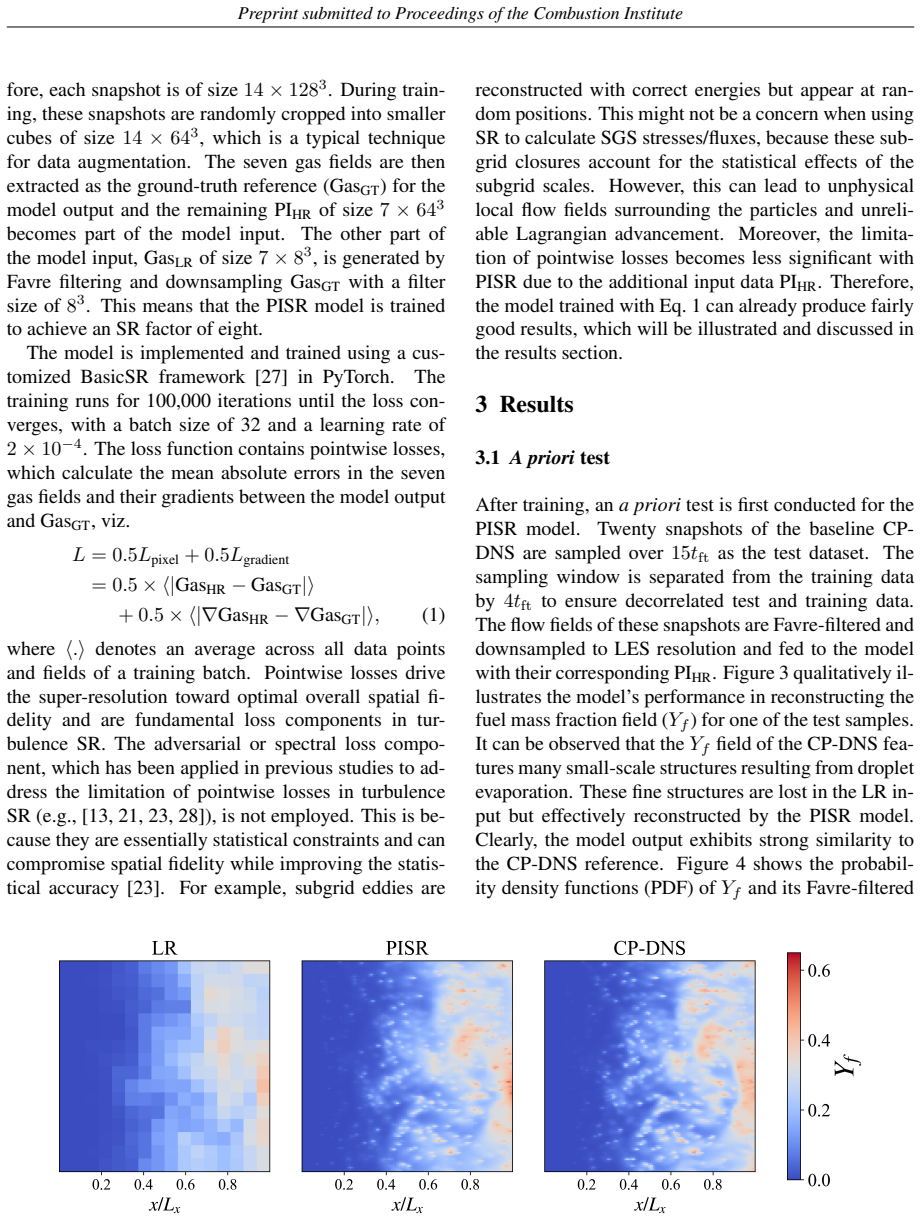
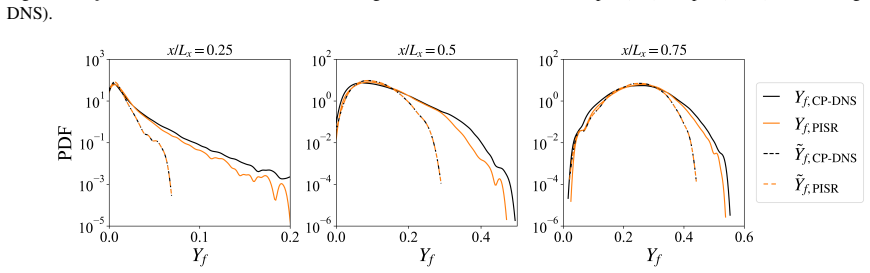
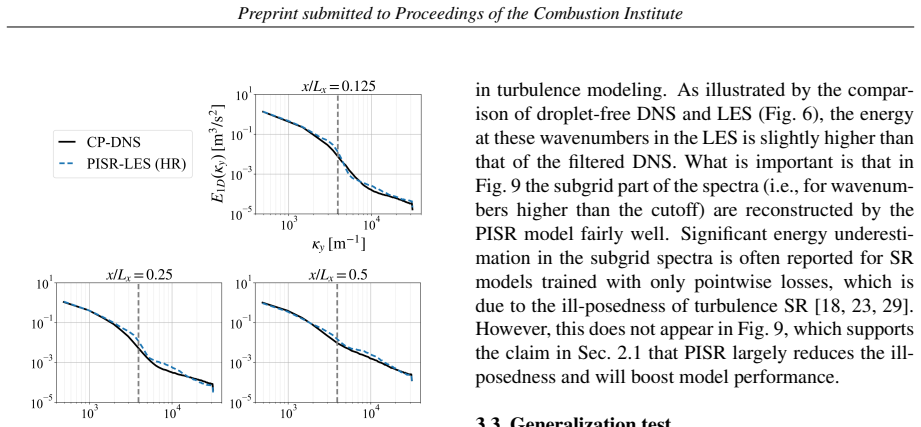
The paper establishes that integrating particle-informed super-resolution into large-eddy simulation allows the computed evaporation rates to closely replicate those obtained from carrier-phase direct numerical simulation. This correction substantially reduces the difference in the predicted fuel mass fraction field between the two approaches. The trained model further generalizes to spray cases with air temperatures, droplet diameters, and turbulent Reynolds numbers that were not present in the training data.
What carries the argument
Particle-informed super-resolution (PISR), a deep-learning method that takes droplet positions as additional input to reconstruct high-resolution gas velocity and scalar fields between droplets for use in evaporation rate calculations.
If this is right
- Evaporation rates obtained from large-eddy simulation of moderately dense sprays become comparable to those from carrier-phase direct numerical simulation.
- The fuel mass fraction field predicted by large-eddy simulation shows markedly smaller deviation from the detailed simulation reference.
- The correction remains effective when air temperature, droplet diameter, or turbulent Reynolds number change from the values used in training.
- Practical spray combustion calculations can employ coarser meshes without losing accuracy in the evaporation step.
Where Pith is reading between the lines
- Coarser meshes could be used throughout an entire engine-scale spray simulation, lowering overall computational cost while preserving evaporation accuracy.
- The same reconstruction idea might be tested on other subgrid phenomena in multiphase flows such as breakup or collision modeling.
- Coupling the corrected evaporation fields with ignition and flame models could improve predictions of ignition delay in clustered spray regions.
Load-bearing premise
The super-resolution network trained on a limited set of spray configurations can accurately reconstruct inter-droplet gas fields for evaporation modeling across cases that differ in air temperature, droplet diameter, and turbulent Reynolds number.
What would settle it
Running a carrier-phase direct numerical simulation and a PISR large-eddy simulation on a spray configuration whose temperature, droplet size, or Reynolds number lies outside the training distribution and finding large persistent differences in evaporation rate or fuel mass fraction would falsify the central claim.
Figures






read the original abstract
In large-eddy simulation (LES) of dense sprays or sprays with pronounced clustering, evaporation rates can be inaccurate when the mesh is too coarse to provide realistic boundary conditions for the widely employed single droplet evaporation model. This is especially relevant to liquid spray combustion in practical applications. Deep learning-based super-resolution (SR) has recently emerged as a promising method for LES subgrid-scale modeling, capable of enhancing flow field resolution. This technique appears well-suited to reconstruct the local gas fields within the inter-droplet space that can be used to correct the evaporation rates. However, it has not yet been applied for this purpose. This paper presents an innovative SR approach $-$ particle-informed super-resolution (PISR) $-$ that approximates high-resolution flow fields for improved evaporation computation. It is validated with a priori, a posteriori and generalization tests on moderately dense sprays. The results show that PISR-LES can closely replicate the evaporation rates computed in a carrier-phase direct numerical simulation (CP-DNS), significantly reducing the discrepancy in the fuel mass fraction field between LES and CP-DNS. Furthermore, the PISR model exhibits robust generalization to cases unseen in training when varying air temperature, droplet diameter, and turbulent Reynolds number.
Editorial analysis
A structured set of objections, weighed in public.
Referee Report
Summary. The manuscript introduces particle-informed super-resolution (PISR), a deep-learning approach that reconstructs high-resolution gas temperature and vapor fields around droplets from coarse LES data and particle positions. These reconstructed fields are then used to supply improved boundary conditions to the standard single-droplet evaporation model. The method is tested on moderately dense evaporating sprays through a priori tests, a posteriori LES runs, and generalization experiments that vary air temperature, droplet diameter, and turbulent Reynolds number. The central claim is that PISR-LES reproduces evaporation rates obtained from carrier-phase DNS (CP-DNS) and substantially reduces the discrepancy in the fuel mass-fraction field relative to standard LES.
Significance. If the reported accuracy gains hold under realistic LES conditions, the approach could allow coarser meshes to be used for spray combustion simulations without sacrificing evaporation-rate fidelity, which is a practical advantage for engineering-scale computations. The paper is credited for performing the three complementary validation tiers (a priori, a posteriori, generalization) and for explicitly incorporating particle locations into the super-resolution network.
major comments (1)
- [Generalization tests] Generalization section: the reported generalization tests vary air temperature, droplet diameter, and turbulent Reynolds number, yet they appear to supply the network with low-resolution fields obtained by filtering high-fidelity DNS rather than with fields that already contain the modeling errors typical of an actual LES (filtered velocity, subgrid scalar transport, etc.). Because the central claim concerns PISR-LES performance, this domain-shift issue is load-bearing; a quantitative assessment of reconstruction error when the input is taken from a standard LES run (rather than filtered DNS) is needed to support the claim that evaporation rates closely replicate CP-DNS.
minor comments (2)
- [Abstract] Abstract and results sections: quantitative error metrics (e.g., L2 norms on evaporation rate or fuel mass fraction), mesh resolutions, and training-set size are not stated; these numbers should be added for reproducibility.
- [Method] Notation: the distinction between the super-resolved fields used for evaporation and the fields used for the carrier-phase LES evolution is not always explicit; a short clarifying paragraph or diagram would help.
Simulated Author's Rebuttal
We thank the referee for the constructive and detailed review of our manuscript. The single major comment raises an important point about domain shift in the generalization tests, which we address directly below. We agree that this warrants clarification and additional analysis to strengthen the support for our central claims regarding PISR-LES performance.
read point-by-point responses
-
Referee: [Generalization tests] Generalization section: the reported generalization tests vary air temperature, droplet diameter, and turbulent Reynolds number, yet they appear to supply the network with low-resolution fields obtained by filtering high-fidelity DNS rather than with fields that already contain the modeling errors typical of an actual LES (filtered velocity, subgrid scalar transport, etc.). Because the central claim concerns PISR-LES performance, this domain-shift issue is load-bearing; a quantitative assessment of reconstruction error when the input is taken from a standard LES run (rather than filtered DNS) is needed to support the claim that evaporation rates closely replicate CP-DNS.
Authors: We appreciate the referee's observation on this domain-shift issue. The generalization experiments were designed to assess robustness to changes in air temperature, droplet diameter, and turbulent Reynolds number while using low-resolution inputs obtained by filtering the high-fidelity DNS data. This choice maintains consistency with the training procedure and isolates the impact of parameter variations on reconstruction quality. The primary validation of PISR-LES performance under realistic conditions is provided by the a posteriori tests, in which the network receives inputs directly from the evolving LES solution (including subgrid-scale modeling effects) and is shown to improve evaporation rates toward CP-DNS levels. Nevertheless, we acknowledge that the generalization section does not yet include a direct quantitative assessment using actual LES-generated fields. In the revised manuscript we will add this assessment: for the same parameter variations, we will extract low-resolution fields from standard (non-PISR) LES runs, apply the trained PISR network, and report the resulting reconstruction errors together with the achieved evaporation-rate accuracy relative to CP-DNS. These results will be presented in an expanded generalization section with an additional figure or table. revision: yes
Circularity Check
No circularity: validation against independent CP-DNS provides external grounding
full rationale
The paper trains a particle-informed super-resolution network on selected spray configurations and evaluates it via a priori, a posteriori, and generalization tests that compare reconstructed evaporation rates and fuel mass fraction fields directly to carrier-phase DNS results. These benchmarks are generated from separate high-fidelity simulations whose governing equations and numerical resolution are independent of the trained network weights. No equation or claim reduces a reported prediction to a fitted parameter by construction, nor does any load-bearing step rely on a self-citation chain whose content is itself unverified within the present work. Generalization across air temperature, droplet diameter, and Reynolds number is tested on unseen cases, keeping the derivation self-contained against external data.
Axiom & Free-Parameter Ledger
Lean theorems connected to this paper
-
IndisputableMonolith/Foundation/Cost/FunctionalEquation.leanwashburn_uniqueness_aczel unclear?
unclearRelation between the paper passage and the cited Recognition theorem.
particle-informed super-resolution (PISR) ... approximates high-resolution flow fields for improved evaporation computation ... validated with a priori, a posteriori and generalization tests
-
IndisputableMonolith/Foundation/AlphaCoordinateFixation.leanJ_uniquely_calibrated_via_higher_derivative unclear?
unclearRelation between the paper passage and the cited Recognition theorem.
RRDB blocks ... pointwise losses L = 0.5 L_pixel + 0.5 L_gradient
What do these tags mean?
- matches
- The paper's claim is directly supported by a theorem in the formal canon.
- supports
- The theorem supports part of the paper's argument, but the paper may add assumptions or extra steps.
- extends
- The paper goes beyond the formal theorem; the theorem is a base layer rather than the whole result.
- uses
- The paper appears to rely on the theorem as machinery.
- contradicts
- The paper's claim conflicts with a theorem or certificate in the canon.
- unclear
- Pith found a possible connection, but the passage is too broad, indirect, or ambiguous to say the theorem truly supports the claim.
Reference graph
Works this paper leans on
-
[1]
Current status of droplet and liquid com- bustion,
G. M. Faeth, “Current status of droplet and liquid com- bustion,”Prog. Energy Combust. Sci., vol. 3, no. 4, pp. 191–224, 1977
work page 1977
-
[2]
Droplet vaporiza- tion model for spray combustion calculations,
B. Abramzon and W. A. Sirignano, “Droplet vaporiza- tion model for spray combustion calculations,”Int. J. Heat Mass Transf., vol. 32, no. 9, pp. 1605–1618, 1989
work page 1989
-
[3]
Grid dependence of evaporation rates in Euler-Lagrange sim- ulations of dilute sprays,
M. Sontheimer, A. Kronenburg, and O. T. Stein, “Grid dependence of evaporation rates in Euler-Lagrange sim- ulations of dilute sprays,”Combust. Flame, vol. 232, p. 111515, 2021
work page 2021
-
[4]
Burning characteristics of premixed sprays and gas- liquid coburning mixtures,
K. Nakabe, Y . Mizutani, T. Hirao, and S. Tanimura, “Burning characteristics of premixed sprays and gas- liquid coburning mixtures,”Combust. Flame, vol. 74, no. 1, pp. 39–51, 1988
work page 1988
-
[5]
Measurement of the local group combustion number of droplet clusters in a premixed spray stream,
F. Akamatsu, Y . Miutani, M. Katsuki, S. Tsushima, and Y . D. Cho, “Measurement of the local group combustion number of droplet clusters in a premixed spray stream,” Symp. (Int.) Combust., vol. 26, no. 1, pp. 1723–1729, 1996
work page 1996
-
[6]
S. Tsushima, H. Saitoh, F. Akamatsu, and M. Katsuki, “Observation of combustion characteristics of droplet clusters in a premixed-spray flame by simultaneous monitoring of planar spray images and local chemi- luminescence,”Symp. (Int.) Combust., vol. 27, no. 2, pp. 1967–1974, 1998
work page 1967
-
[7]
Combustion of partially premixed spray jets,
M. Mikami, K. Yamamoto, O. Moriue, and N. Kojima, “Combustion of partially premixed spray jets,”Proc. Combust. Inst., vol. 30, no. 2, pp. 2021–2028, 2005
work page 2021
-
[8]
Optical characterization of droplet clusters and group combustion in spray diffusion flames,
M Manish and S. Sahu, “Optical characterization of droplet clusters and group combustion in spray diffusion flames,”Proc. Combust. Inst., vol. 38, no. 2, pp. 3409– 3416, 2021
work page 2021
-
[9]
Group combustion of liq- uid droplets,
H. H. Chiu and T. M. Liu, “Group combustion of liq- uid droplets,”Combust. Sci. Technol., vol. 17, no. 3-4, pp. 127–142, 1977
work page 1977
-
[10]
N. Pandurangan and S. Sahu, “Group evaporation of small- and large-scale droplet clusters in a fuel spray- laden homogeneous and isotropic turbulent airflow,” Proc. Combust. Inst., vol. 40, no. 1, p. 105434, 2024
work page 2024
-
[11]
Fuel droplet vaporization and spray combustion theory,
W. A. Sirignano, “Fuel droplet vaporization and spray combustion theory,”Prog. Energy Combust. Sci., vol. 9, no. 4, pp. 291–322, 1983
work page 1983
-
[12]
Advances in droplet array combus- tion theory and modeling,
W. A. Sirignano, “Advances in droplet array combus- tion theory and modeling,”Prog. Energy Combust. Sci., vol. 42, pp. 54–86, 2014
work page 2014
-
[13]
M. Bode, M. Gauding, Z. Lian, D. Denker, M. Davi- dovic, K. Kleinheinz, J. Jitsev, and H. Pitsch, “Using physics-informed enhanced super-resolution generative adversarial networks for subfilter modeling in turbulent reactive flows,”Proc. Combust. Inst., vol. 38, no. 2, pp. 2617–2625, 2021
work page 2021
-
[14]
M. Bode, “Applying physics-informed enhanced super- resolution generative adversarial networks to large-eddy simulations of ECN spray C,”SAE Int. J. Adv. Curr . Prac. Mobil., vol. 4, no. 2022-01-0503, pp. 2211–2219, 2022
work page 2022
-
[15]
M. Bode, M. Gauding, D. Goeb, T. Falkenstein, and H. Pitsch, “Applying physics-informed enhanced super- resolution generative adversarial networks to turbulent premixed combustion and engine-like flame kernel di- rect numerical simulation data,”Proc. Combust. Inst., vol. 39, no. 4, pp. 5289–5298, 2023
work page 2023
-
[16]
S. Maejima and S. Kawai, “Unsupervised and super- vised machine learning pipeline for super-resolution- based subgrid scale modelling in coarse-grid large-eddy simulations,”J. Fluid Mech., vol. 1013, p. A28, 2025
work page 2025
-
[17]
Super-resolution of turbu- lent velocity fields in two-way coupled particle-laden flows,
A. Shamooni, R. Cheng, T. Zirwes, H. Tofighian, O. T. Stein, and A. Kronenburg, “Super-resolution of turbu- lent velocity fields in two-way coupled particle-laden flows,”Phys. Fluids, vol. 37, no. 9, p. 093383, 2025
work page 2025
-
[18]
Three-dimensional super-resolution reconstruction of turbulent spray flow fields,
R. Cheng, A. Shamooni, T. Zirwes, and A. Kronenburg, “Three-dimensional super-resolution reconstruction of turbulent spray flow fields,” inILASS Europe 2025
work page 2025
-
[19]
A. Shamooni, R. Cheng, T. Zirwes, O. T. Stein, and A. Kronenburg, “Super-resolution reconstruction of scalar fields from the pyrolysis of pulverised biomass using deep learning,”Proc. Combust. Inst., vol. 41, p. 105982, 2025
work page 2025
-
[20]
ESRGAN: Enhanced super-resolution generative adversarial networks,
X. Wang, K. Yu, S. Wu, J. Gu, Y . Liu, C. Dong, Y . Qiao, and C. C. Loy, “ESRGAN: Enhanced super-resolution generative adversarial networks,” inECCV 2018 Work- shops, pp. 63–79, 2019
work page 2018
-
[21]
L. Nista, C. D. K. Schumann, T. Grenga, A. Attili, and H. Pitsch, “Investigation of the generalization capabil- ity of a generative adversarial network for large eddy simulation of turbulent premixed reacting flows,”Proc. Combust. Inst., vol. 39, no. 4, pp. 5279–5288, 2023
work page 2023
-
[22]
Influence of ad- versarial training on super-resolution turbulence recon- struction,
L. Nista, H. Pitsch, C. D. K. Schumann, M. Bode, T. Grenga, J. F. MacArt, and A. Attili, “Influence of ad- versarial training on super-resolution turbulence recon- struction,”Phys. Rev. Fluids, vol. 9, no. 6, p. 064601, 2024
work page 2024
-
[23]
Improved super-resolution reconstruction of turbulent flows with spectral loss function,
R. Cheng, A. Shamooni, T. Zirwes, and A. Kronenburg, “Improved super-resolution reconstruction of turbulent flows with spectral loss function,”Phys. Fluids, vol. 37, no. 3, p. 035208, 2025
work page 2025
-
[24]
On the physical mech- anisms of two-way coupling in particle-laden isotropic turbulence,
A. Ferrante and S. Elghobashi, “On the physical mech- anisms of two-way coupling in particle-laden isotropic turbulence,”Phys. Fluids, vol. 15, no. 2, pp. 315–329, 2003
work page 2003
-
[25]
A. H. Abdelsamie and C. Lee, “Decaying versus sta- tionary turbulence in particle-laden isotropic turbu- lence: Turbulence modulation mechanism,”Phys. Flu- ids, vol. 24, no. 1, p. 015106, 2012
work page 2012
-
[26]
B. Wang, A. Kronenburg, and O. T. Stein, “Modelling sub-grid passive scalar statistics in moderately dense 8 Preprint submitted to Proceedings of the Combustion Institute evaporating sprays,”Flow Turbul. Combust., vol. 103, no. 2, pp. 519–535, 2019
work page 2019
-
[27]
BasicSR: Open source image and video restoration toolbox
X. Wang, L. Xie, K. Yu, K. C. Chan, C. C. Loy, and C. Dong, “BasicSR: Open source image and video restoration toolbox.” https://github.com/XPixelGroup/BasicSR
-
[28]
H. Tofighian, J. A. Denev, and N. Kornev, “A condi- tional deep learning model for super-resolution recon- struction of small-scale turbulent structures in particle- laden flows,”Phys. Fluids, vol. 36, no. 11, p. 115173, 2024
work page 2024
-
[29]
Unsupervised deep learning for super-resolution reconstruction of tur- bulence,
H. Kim, J. Kim, S. Won, and C. Lee, “Unsupervised deep learning for super-resolution reconstruction of tur- bulence,”J. Fluid Mech., vol. 910, p. A29, 2021. 9
work page 2021
discussion (0)
Sign in with ORCID, Apple, or X to comment. Anyone can read and Pith papers without signing in.