REVIEW 2 major objections 5 minor 62 references
Initial-state inhomogeneities can make waiting times between quantum jumps finite and independent of system size, resolving detector limits while the measurement-induced phase transition survives, at the cost of longer entanglement saturati
Reviewed by Pith at T0; open to challenge. T0 means a machine referee read the full paper against a public rubric. the ladder, T0–T4 →
T0 review · grok-4.5
2026-07-12 08:53 UTC pith:Z4UWQWHA
load-bearing objection Clean angular-momentum control of waiting times that fully kills the 1/N detector problem at heta=π, with MIPT survival; the only real softness is the authors’ own caveat on saturation-time asymptotics. the 2 major comments →
Controlling Waiting Time Statistics in Monitored Collective Spins: Mitigating Detector's Resolution Barrier in Measurement-Induced Phase Transitions
The pith
A machine-rendered reading of the paper's core claim, the machinery that carries it, and where it could break.
Core claim
By partitioning a collectively monitored spin ensemble into two subsystems rotated by an angle θ, the average waiting time between quantum jumps can be controlled: it still scales as 1/N for intermediate θ but with a strongly enhanced prefactor, and becomes finite and independent of N when θ=π. The measurement-induced phase transition survives the inhomogeneity, showing area-law entanglement in the stationary phase and sub-logarithmic growth inside the boundary time-crystalline phase. Detector-resolution mitigation is therefore achieved, yet entanglement saturation times lengthen beyond the logarithmic scaling of the homogeneous case, partially restoring a post-selection cost.
What carries the argument
An angular-momentum bound on the jump rate: total spin is conserved on average over trajectories, so the waiting time satisfies W ≳ N/(2κ⟨J²⟩), where the initial relative orientation θ of the two sub-ensembles sets ⟨J²⟩ and can cancel the leading O(N²) term when the ensembles are anti-aligned.
Load-bearing premise
The claim that longer saturation times partially reintroduce the post-selection barrier rests on finite-size trends (up to N≈80) that the authors themselves describe as inconclusive for the largest sizes.
What would settle it
Prepare anti-aligned (θ=π) and intermediate-θ ensembles of several hundred spins, record waiting times and entanglement saturation times under continuous monitoring; if waiting time stays O(1) while saturation time grows only logarithmically (or slower than any power of N), the stated trade-off is weaker than claimed.
If this is right
- Detector temporal resolution no longer needs to improve with system size once the initial state is prepared anti-aligned.
- The measurement-induced phase transition remains experimentally accessible with realistic finite-resolution detectors by tuning the initial-state angle.
- Experiments must collect trajectories for longer times because entanglement saturates more slowly once inhomogeneity is present.
- Intermediate angles give a continuous experimental dial between waiting-time gain and saturation-time cost.
- Initial-state inhomogeneity itself becomes a route to highly entangled steady states without dark-state engineering.
Where Pith is reading between the lines
- The same initial-state control of waiting times should transfer to other infinite-range monitored models whose jump operators scale with collective spin.
- If larger-system data show that saturation time remains only polynomial, the residual post-selection overhead stays manageable for moderate experimental sizes.
- Continuous drive or dissipation engineering might restore logarithmic saturation while preserving the waiting-time gain, eliminating the trade-off.
- The logarithmic entanglement observed for all couplings when θ=π suggests anti-alignment effectively freezes the trajectory ensemble at a critical-like point.
Editorial analysis
A structured set of objections, weighed in public.
Referee Report
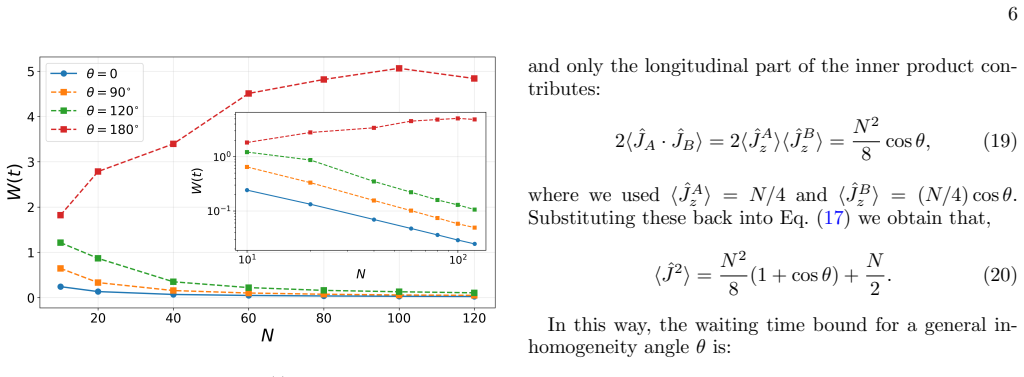
Summary. The manuscript studies a collectively driven and monitored spin ensemble that supports a boundary time-crystalline (BTC) phase, and shows that a controllable initial-state inhomogeneity—implemented by bipartitioning the ensemble into two Dicke subsystems rotated by an angle θ—can systematically increase the average waiting time W between quantum jumps. An angular-momentum bound (Eqs. 16–22) demonstrates that W scales as 1/N with a θ-dependent prefactor that grows by orders of magnitude, remaining finite and N-independent for the anti-aligned case θ=π, thereby fully mitigating the detector-resolution barrier. Numerical quantum-trajectory simulations (MCWF, 250 trajectories) corroborate the bound (Fig. 4). The measurement-induced phase transition survives under inhomogeneity, with area-law and sub-logarithmic entanglement regimes whose critical point tracks the mean-field stationary-to-BTC boundary (Figs. 2 and 5). The authors also report that the entanglement saturation time t* lengthens with θ (Fig. 6c), partially reintroducing a post-selection cost and establishing an experimental trade-off between detector resolution and post-selection overhead.
Significance. The work addresses a concrete experimental bottleneck for measurement-induced phases in collective systems: finite detector temporal resolution that forces coarse-graining of trajectories when W∼1/N. The angular-momentum lower bound on W is model-derived, parameter-free once θ is fixed, and cleanly separates the waiting-time control from the more delicate saturation-time issue. Survival of the MIPT under inhomogeneity, together with the explicit trade-off between resolution and post-selection, supplies a practical design principle for cold-atom or cavity-QED platforms that already realize collective spin models. The finite-size caveat on t* is already acknowledged by the authors and does not undermine the central waiting-time claim.
major comments (2)
- Sec. IV B and Fig. 6c: the claim that inhomogeneity “partially reintroduces the postselection barrier” rests on a finite-size trend of t* that the authors themselves describe as inconclusive for the largest accessible sizes (N≤80). A polynomial fit t*∼N^α_θ is offered, yet the largest-N points for θ=π/2 and 2π/3 visibly flatten. Either additional system sizes, an asymptotic argument (e.g., spin-wave or large-N rate equations), or a more cautious statement that the thermodynamic scaling of t* remains open is needed before the quantitative severity of the re-introduced barrier can be asserted.
- Eqs. 16–22 and the surrounding text: the lower bound W≳N/(2κ⟨J^{2}⟩) is derived from the trajectory-averaged jump rate and angular-momentum conservation. While the numerics of Fig. 4 confirm that the bound captures the correct N and θ dependence, the manuscript never quantifies how tight the bound remains at intermediate times or deep in the BTC phase (where ⟨J_z⟩ and ⟨J_z^{2}⟩ fluctuate). A short comparison of the instantaneous ⟨J+J-⟩ against the initial ⟨J^{2}⟩ would strengthen the analytic claim.
minor comments (5)
- Fig. 2 caption and Sec. II A: the numerical threshold “standard deviation exceeds 0.05” used to locate the mean-field critical point is arbitrary; a brief sensitivity check or an alternative criterion (e.g., long-time Fourier peak) would improve reproducibility.
- Sec. IV, numerical methods: the first-order MCWF integrator with κdt=0.01/N is stated without a convergence test against smaller steps or higher-order schemes; a short remark would reassure readers that the waiting-time statistics are free of integrator bias.
- Eq. (8) and surrounding text: the long-time average window T_avg and the choice of t0 after the transient are not specified numerically; stating the values used for the data in Figs. 5–6 would aid reproduction.
- Typographical: “T rajectories” and “ST A TE PREP ARA TION” in section headings contain spurious spaces; “Schrödinger” is occasionally rendered with an incorrect umlaut encoding.
- References [54] and [55] are cited as arXiv preprints; if published versions now exist they should be updated.
Circularity Check
No significant circularity: waiting-time bound and MIPT survival are derived from the model operators and direct numerics, not forced by definition or self-citation.
full rationale
The central analytical result is the lower bound on average waiting time W(t) ≳ N/(2κ ⟨J^{2}⟩_{t=0}) obtained from the angular-momentum identity ⟨J_{+}J_{-}⟩ ≤ ⟨J^{2}⟩ + ⟨J_z⟩ together with conservation of total spin sectors under the Lindbladian (Eqs. 16–22). Expanding ⟨J^{2}⟩ for the bipartition initial state of Eq. (15) immediately yields the explicit θ dependence, including the O(1) finite value at θ=π; this is a direct algebraic consequence of the jump operator and the prepared state, not a fit or a renamed input. The survival of the MIPT and the entanglement scalings are measured from quantum-trajectory averages (Figs. 5–6), not assumed. Self-citations to earlier BTC/MIPT works supply background phase-diagram context and the homogeneous-limit logarithmic saturation time, but none of them is invoked as a uniqueness theorem or load-bearing premise that forces the new θ-dependent waiting-time or trade-off claims. No parameters are fitted to one data subset and then “predicted” on a related subset; no ansatz is smuggled via citation. The only softness (finite-size saturation-time trend) is already flagged by the authors themselves and does not circularize the waiting-time result. The derivation chain is therefore self-contained against the paper’s own equations and numerics.
Axiom & Free-Parameter Ledger
free parameters (4)
- inhomogeneity angle heta
- drive-to-dissipation ratio ω_{0}/κ
- entanglement scaling exponent eta_ heta
- saturation-time exponent α_ heta
axioms (4)
- domain assumption Lindblad master equation with collective jump operator L = √(2κ/N) J_- generates the ensemble-averaged dynamics
- standard math Total angular momentum J^{2} is conserved on average over trajectories, so the weight of each total-spin sector is fixed by the initial state
- domain assumption Quantum-jump (MCWF) unraveling correctly samples the pure-state trajectories whose entanglement is the MIPT diagnostic
- ad hoc to paper Initial state is a product of two fully polarized Dicke states rotated by heta about x
read the original abstract
In collective dissipative spin systems, the postselection barrier can be partially mitigated; however, a further obstacle may be posed by the finite temporal resolution of detectors. In this work, we investigate how initial-state inhomogeneities can control waiting-time statistics between quantum jumps, thereby mitigating the detector-resolution problem. We consider a collectively monitored spin model with a boundary time-crystalline phase, introducing inhomogeneity by partitioning the ensemble into two subsystems rotated by an angle $\theta$. We find that the measurement-induced phase transition survives under inhomogeneities, with different entanglement scaling regimes. The waiting time increases with $\theta$, scaling as $1/N$ but with a prefactor strongly enhanced by orders of magnitude, and in the anti-aligned limit $\theta = \pi$ it remains finite, fully resolving the resolution barrier. This mitigation, however, comes at a cost: the entanglement saturation time becomes significantly longer, partially reintroducing the postselection barrier. Our results highlight a trade-off between detector resolution and postselection overhead, with direct implications for the experimental observation of measurement-induced phenomena.
Figures




Reference graph
Works this paper leans on
-
[1]
R. Fazio, J. Keeling, L. Mazza, and M. Schir` o, Many- body open quantum systems (2024), arXiv:2409.10300 [quant-ph]
Pith/arXiv arXiv 2024
-
[2]
Passarelli, X
G. Passarelli, X. Turkeshi, A. Russomanno, P. Lucig- nano, M. Schir` o, and R. Fazio, Phys. Rev. Lett.132, 163401 (2024)
2024
-
[3]
Y. Li, X. Chen, and M. P. A. Fisher, Phys. Rev. B98, 205136 (2018)
2018
-
[4]
Skinner, J
B. Skinner, J. Ruhman, and A. Nahum, Phys. Rev. X9, 031009 (2019)
2019
-
[5]
H. J. Carmichael,Statistical Methods in Quantum Optics 1(Springer, 1999). 9
1999
-
[6]
H. M. Wiseman and G. J. Milburn,Quantum Measure- ment and Control(Cambridge University Press, 2009)
2009
-
[7]
Jacobs,Quantum Measurement Theory and its Appli- cations(Cambridge University Press, 2014)
K. Jacobs,Quantum Measurement Theory and its Appli- cations(Cambridge University Press, 2014)
2014
-
[8]
Y. Li, X. Chen, and M. P. A. Fisher, Phys. Rev. B100, 134306 (2019)
2019
-
[9]
Szyniszewski, A
M. Szyniszewski, A. Romito, and H. Schomerus, Phys. Rev. B100, 064204 (2019)
2019
-
[10]
Jian, Y.-Z
C.-M. Jian, Y.-Z. You, R. Vasseur, and A. W. W. Ludwig, Phys. Rev. B101, 104302 (2020)
2020
-
[11]
Zabalo, M
A. Zabalo, M. J. Gullans, J. H. Wilson, S. Gopalakrish- nan, D. A. Huse, and J. H. Pixley, Phys. Rev. B101, 060301 (2020)
2020
-
[12]
Szyniszewski, A
M. Szyniszewski, A. Romito, and H. Schomerus, Phys. Rev. Lett.125, 210602 (2020)
2020
-
[13]
Turkeshi, R
X. Turkeshi, R. Fazio, and M. Dalmonte, Phys. Rev. B 102, 014315 (2020)
2020
-
[14]
O. Lunt, M. Szyniszewski, and A. Pal, Phys. Rev. B104, 155111 (2021)
2021
-
[15]
Sierant, M
P. Sierant, M. Schir` o, M. Lewenstein, and X. Turkeshi, Phys. Rev. B106, 214316 (2022)
2022
-
[16]
Nahum, S
A. Nahum, S. Roy, B. Skinner, and J. Ruhman, PRX Quantum2, 010352 (2021)
2021
-
[17]
Zabalo, M
A. Zabalo, M. J. Gullans, J. H. Wilson, R. Vasseur, A. W. W. Ludwig, S. Gopalakrishnan, D. A. Huse, and J. H. Pixley, Phys. Rev. Lett.128, 050602 (2022)
2022
-
[18]
Sierant and X
P. Sierant and X. Turkeshi, Phys. Rev. Lett.128, 130605 (2022)
2022
-
[19]
Chiriaco, M
G. Chiriaco, M. Tsitsishvili, D. Poletti, R. Fazio, and M. Dalmonte, Phys. Rev. B108, 075151 (2023)
2023
-
[20]
Klocke and M
K. Klocke and M. Buchhold, Phys. Rev. X13, 041028 (2023)
2023
-
[21]
X. Cao, A. Tilloy, and A. De Luca, SciPost Phys.7, 024 (2019)
2019
-
[22]
Nahum and B
A. Nahum and B. Skinner, Phys. Rev. Research2, 023288 (2020)
2020
-
[23]
Buchhold, Y
M. Buchhold, Y. Minoguchi, A. Altland, and S. Diehl, Phys. Rev. X11, 041004 (2021)
2021
-
[24]
C.-M. Jian, B. Bauer, A. Keselman, and A. W. W. Lud- wig, Phys. Rev. B106, 134206 (2022)
2022
-
[25]
Coppola, E
M. Coppola, E. Tirrito, D. Karevski, and M. Collura, Phys. Rev. B105, 094303 (2022)
2022
-
[26]
M. Fava, L. Piroli, T. Swann, D. Bernard, and A. Nahum, Phys. Rev. X13, 041045 (2023)
2023
-
[27]
Poboiko, P
I. Poboiko, P. P¨ opperl, I. V. Gornyi, and A. D. Mirlin, Phys. Rev. X13, 041046 (2023)
2023
-
[28]
Merritt and L
J. Merritt and L. Fidkowski, Phys. Rev. B107, 064303 (2023)
2023
-
[29]
Alberton, M
O. Alberton, M. Buchhold, and S. Diehl, Phys. Rev. Lett. 126, 170602 (2021)
2021
-
[30]
Turkeshi, A
X. Turkeshi, A. Biella, R. Fazio, M. Dalmonte, and M. Schir´ o, Phys. Rev. B103, 224210 (2021)
2021
-
[31]
Turkeshi, M
X. Turkeshi, M. Dalmonte, R. Fazio, and M. Schir´ o, Phys. Rev. B105, L241114 (2022)
2022
-
[32]
Piccitto, A
G. Piccitto, A. Russomanno, and D. Rossini, Phys. Rev. B105, 064305 (2022)
2022
-
[33]
Piccitto, A
G. Piccitto, A. Russomanno, and D. Rossini, SciPost Phys. Core6, 078 (2023)
2023
-
[34]
Tirrito, A
E. Tirrito, A. Santini, R. Fazio, and M. Collura, SciPost Phys.15, 096 (2023)
2023
-
[35]
Paviglianiti and A
A. Paviglianiti and A. Silva, Phys. Rev. B108, 184302 (2023)
2023
-
[36]
Rossini and E
D. Rossini and E. Vicari, Phys. Rev. B102, 035119 (2020)
2020
-
[37]
Tang and W
Q. Tang and W. Zhu, Phys. Rev. Research2, 013022 (2020)
2020
-
[38]
Fuji and Y
Y. Fuji and Y. Ashida, Phys. Rev. B102, 054302 (2020)
2020
-
[39]
Sierant, G
P. Sierant, G. Chiriac` o, F. M. Surace, S. Sharma, X. Turkeshi, M. Dalmonte, R. Fazio, and G. Pagano, Quantum6, 638 (2022)
2022
-
[40]
E. V. H. Doggen, Y. Gefen, I. V. Gornyi, A. D. Mir- lin, and D. G. Polyakov, Phys. Rev. Research4, 023146 (2022)
2022
-
[41]
Altland, M
A. Altland, M. Buchhold, S. Diehl, and T. Micklitz, Phys. Rev. Research4, L022066 (2022)
2022
-
[42]
C. Noel, P. Niroula, D. Zhu, A. Risinger, L. Egan,et al., Nat. Phys.18, 760 (2022)
2022
-
[43]
J. M. Koh, S.-N. Sun, M. Motta, and A. J. Minnich, Nat. Phys.19, 1314 (2023)
2023
-
[44]
C. Y. Leung, D. Meidan, and A. Romito, Theory of free fermions dynamics under partial post-selected monitor- ing (2023), arXiv:2312.14022 [quant-ph]
Pith/arXiv arXiv 2023
-
[45]
S. J. Garratt and E. Altman, PRX Quantum5, 10.1103/prxquantum.5.030311 (2024)
-
[46]
Google Quantum AI and Collaborators, Nature622, 481 (2023)
2023
-
[47]
Y. Li, Y. Zou, P. Glorioso, E. Altman, and M. P. A. Fisher, Phys. Rev. Lett.130, 220404 (2023)
2023
-
[48]
Li and M
Y. Li and M. P. A. Fisher, Phys. Rev. B108, 214302 (2023)
2023
-
[49]
S. J. Garratt and E. Altman, Probing postmea- surement entanglement without post-selection (2023), arXiv:2305.20092 [quant-ph]
Pith/arXiv arXiv 2023
-
[50]
M. J. Gullans and D. A. Huse, Phys. Rev. Lett.125, 070606 (2020)
2020
-
[51]
Ippoliti and V
M. Ippoliti and V. Khemani, Phys. Rev. Lett.126, 060501 (2021)
2021
-
[52]
Iadecola, S
T. Iadecola, S. Ganeshan, J. H. Pixley, and J. H. Wilson, Phys. Rev. Lett.131, 060403 (2023)
2023
-
[53]
M. Buchhold, T. M¨ uller, and S. Diehl, Revealing measurement-induced phase transitions by pre-selection (2022), arXiv:2208.10506 [quant-ph]
Pith/arXiv arXiv 2022
-
[54]
A. Delmonte, Z. Li, G. Passarelli, E. Y. Song, D. Bar- berena, A. M. Rey, and R. Fazio, Measurement-induced phase transitions in monitored infinite-range interacting systems (2024), arXiv:2410.05394 [quant-ph]
Pith/arXiv arXiv 2024
-
[55]
Z. Li, A. Delmonte, X. Turkeshi, and R. Fazio, Mon- itored long-range interacting systems: Spin-wave the- ory for quantum trajectories (2024), arXiv:2405.12124 [quant-ph]
Pith/arXiv arXiv 2024
-
[56]
Iemini, A
F. Iemini, A. Russomanno, J. Keeling, M. Schir` o, M. Dal- monte, and R. Fazio, Phys. Rev. Lett.121, 035301 (2018)
2018
-
[57]
F. Iemini, D. Chang, and J. Marino, Physical Review A 109, 10.1103/physreva.109.032204 (2024)
-
[58]
M. B. Plenio and P. L. Knight, Rev. Mod. Phys.70, 101 (1998)
1998
-
[59]
A. J. Daley, Advances in Physics63, 77 (2014)
2014
-
[60]
Mattes, I
R. Mattes, I. Lesanovsky, and F. Carollo, Phys. Rev. A 108, 062216 (2023)
2023
-
[61]
L. d. S. Souza, L. F. dos Prazeres, and F. Iemini, Phys. Rev. Lett.130, 180401 (2023)
2023
-
[62]
Kraus, H
B. Kraus, H. P. B¨ uchler, S. Diehl, A. Kantian, A. Micheli, and P. Zoller, Phys. Rev. A78, 042307 (2008)
2008
discussion (0)
Sign in with ORCID, Apple, or X to comment. Anyone can read and Pith papers without signing in.