REVIEW 3 major objections 5 minor 39 references
Global-Local Interface for On-Demand Teleoperation
T0 review · 3 major / 5 minor · reviewed 2026-08-07 · deepseek-v4-flash
Pith's one-line read Splitting a teleoperation master into a coarse-motion global half and a fine-motion local half lets a single system cover both wide workspace moves and precise contact tasks, and the paper demonstrates the split in two physical forms.
desk verdict The G-L interface is a real design pattern with two built systems, but the empirical claim of consistent outperformance is under-supported by a small, leaky user study. read the letter →
The pith
A machine-rendered reading of the paper's core claim, the machinery that carries it, and where it could break.
The reading
What carries the argument
The load-bearing object is the decoupled master system itself, defined by three criteria: a global component that represents the slave's collision configuration and makes large, fast pose adjustments; a local component that enables precise, dexterous end-effector control; and a combined mapping that covers all slave DOFs. In the temporal realization the mechanism is sequential activation with re-initialization of the local component's origin each time it is switched in, plus a 'global follows slave' mode that keeps the replica synchronized during local control so switching back causes no jump. In the spatial realization the mechanism is the dual-IMU relative rotation $R_s = R_1^{-1}R_1^i(R_2^i)^{-1}R_2$, where $R_1^i,R_2^i$ are the sensors' home orientations and $R_1,R_2$ their current orientations; the last three joint targets are obtained by decomposing $R_s$ into intrinsic X-Y-Z Euler angles.
What would settle it
Set up the dual-IMU local component beside an optical motion-capture system with rigid markers on the same forearm and hand, have an operator twist the wrist through the range used in the bottle-reorientation task, and compare the IMU-derived $R_s$ with the marker-derived rotation. If the average angular error is more than a few degrees, the spatial-decoupling orientation claim fails for that task.
Extended reading notes
Core claim
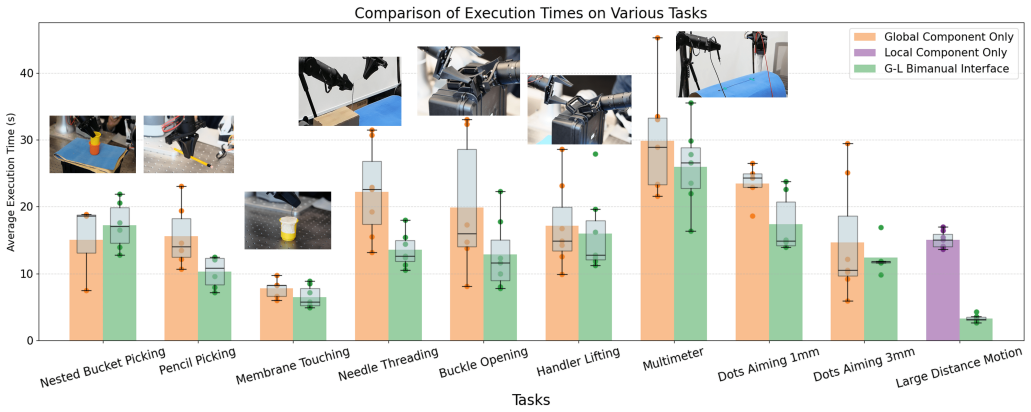
The central claim is that decoupling the master into global and local components is a general interface design, not a task-specific trick. The global component must give the operator an intuitive picture of the slave's collision configuration and allow rapid large-scale pose changes; the local component must transfer the operator's fine manipulation skill to the end-effector; and together the two components must command every degree of freedom of the slave. The paper validates the claim twice: temporal decoupling, where both components control all DOFs but are activated one at a time with automatic resynchronization of the replica, and spatial decoupling, where the global component replicates the first $N-3$ joints and a dual-IMU wrist sensor controls the final three orientation joints. The quantitative study concludes that the G-L interface consistently outperforms the isolated global or local components across most tasks, with the combined system's main advantage appearing in the final fine motions that the global-only setup struggles to complete.
Load-bearing premise
The spatial variant rests on the assumption that two inertial sensors worn on the operator's forearm and palm report the true wrist rotation even as skin shifts and the mount moves, so the $R_s$ measurement really is the rotation the slave's last three joints should copy.
Editorial extensions
If this is right
- A single G-L rig can carry an operator through tasks that span the robot's full reach and then demand fine contact, such as retrieving an object from a cabinet and inserting a key, without changing master devices.
- Because the two components cover disjoint or sequentially swapped DOFs, operators can switch between coarse and fine control through simple foot pedals, making bimanual fine manipulation possible with two slave arms.
- The seven-participant comparison predicts higher success rates and shorter completion times for combined G-L operation on precision contact tasks compared with using either component alone, with the main exception being a single task where the isolated global component was marginally faster but less successful.
- Spatial decoupling frees the operator's hand from mechanical constraints while retaining full joint-space control of the slave arm, which is what lets a glove-shaped exoskeleton drive a five-fingered hand on the same system.
- The G-L criteria give a concrete checklist: a global component for collision-aware gross motion, a local component for skilled fine motion, and together full slave-DOF coverage; any hardware satisfying these can claim to be a G-L interface.
Reading between the lines
- [Editorial inference] The decoupling principle is hardware-agnostic: a joystick or body tracking could serve as the global component and a pen or fingertip tracker as the local component, which the paper does not test but its criteria permit.
- [Editorial inference] The dual-IMU local component's reliability could be quantified by comparing its $R_s$ output to an optical motion-capture ground truth across the wrist's usable range; this would map where skin movement breaks the spatial variant.
- [Editorial inference] If temporal G-L produces cleaner demonstrations with fewer failed contacts, imitation-learning datasets collected through it could need less filtering; the paper motivates data collection but does not evaluate learning outcomes.
- [Editorial inference] The 'global follows slave' resynchronization trick for smooth switching could be lifted into any hybrid teleoperation scheme that alternates between a replica master and a free-space device, independent of the G-L framing.
Editorial analysis
A structured set of objections, weighed in public.
Referee Report
Summary. The paper introduces a Global-Local (G-L) teleoperation interface that separates the master device into a global component, intended for large-range, workspace-aware motions, and a local component, intended for fine, dexterous end-effector control. Two implementations are presented: temporal decoupling, where a scaled replica arm and haptic devices are activated sequentially, and spatial decoupling, where a replica of the first N-3 arm joints is combined with a dual-IMU wrist sensor and an exoskeleton hand, allowing simultaneous use. The manuscript reports qualitative demonstrations in precise manipulation, large-range tasks, bimanual daily-object manipulation, and dexterous hand control, plus a quantitative user study with seven participants comparing the temporal-decoupling G-L interface against global-only and local-only conditions across several tasks. The central claim is that the G-L interface consistently outperforms the isolated components in completion time and success rate.
Significance. The G-L interface is a sensible design pattern that addresses a well-known trade-off between workspace coverage and precision in teleoperation, and the two hardware instantiations demonstrate creativity and breadth. The paper contributes explicit design criteria for a valid G-L implementation, two fully integrated prototypes, and qualitative feasibility demonstrations across diverse tasks. The authors also deserve credit for honestly disclosing limitations, particularly the dual-IMU wrist-sensing sensitivity to skin movement and the scaling limits of the Touch X orientation control. The spatial-decoupling demonstrations are feasible proof-of-concept results, but the dual-IMU measurement issue is acknowledged and does not directly threaten the quantitative comparison for temporal decoupling. However, the quantitative evidence for the headline claim is thin: seven participants, apparently one trial per condition per task, failed trials excluded from time averages, and no significance tests, error bars, or effect sizes. The claim that the G-L interface 'consistently outperforms' is therefore not yet supported by the reported statistics.
major comments (3)
- [§IV-A, Fig. 8, Table II] The claim that 'the G–L interface consistently outperforms the isolated global or local components across most tasks' is not supported by the reported data. The study has only seven participants, failed trials are excluded from the computation of average completion time without any censoring model, and Fig. 8 shows aggregate bars without error bars, confidence intervals, or significance tests. Because success rates differ between conditions (Table II), excluding failures biases the time comparison toward the condition with a higher failure rate. Furthermore, Table II reports success rates only for the global-only and G-L conditions; no local-only success rates are given, so the accuracy comparison against the local component is unsubstantiated. Please report per-condition completion-time distributions, paired significance tests (e.g., Wilcoxon signed-rank), and an analysis that includes failed trials (e.g., as censored or worst-case times), and report success rates for all three conditions.
- [§IV-A experimental design] The comparative design is not fully specified. Each participant appears to have performed each task once in the global-only condition and once in the G-L condition (the sentence 'performed each task twice, once under each condition' is ambiguous, but the natural reading is two trials total per task). With a single trial per condition per participant, any practice or fatigue effect between the two conditions is fully confounded with the condition order, and the manuscript does not state whether the order was counterbalanced. Considering the learning curve acknowledged in §V, please report the trial order, counterbalancing, and whether repeated trials were averaged.
- [§V, §II-B] The spatial-decoupling local component measures wrist rotation with a dual-IMU system using R_s = R1^{-1} R_i1 R_i2^{-1} R2, and the paper itself concedes that skin movement 'can increase discrepancies between the measured wrist rotation and its ground truth, leading to counterintuitive behavior.' This means the spatial-decoupling demonstrations support feasibility but not a quantitative performance claim. The abstract's broad statement that the G-L interface enables 'challenging fine manipulation' should be qualified to indicate that the spatial-decoupling instantiation currently lacks reliable orientation accuracy under wrist rotation; otherwise the reader may overgeneralize the temporal-decoupling results to the spatial-decoupling system.
minor comments (5)
- [Throughout] The manuscript contains several typos: 'V olunteers' in §IV-A, 'releoperation' in reference [13], 'replcia' in the Fig. 3 caption, and 'the and and lift' in Fig. 14(e).
- [Table I] The abbreviations '(Bi)' and '(Si)' in the first two columns of Table I are never defined in the caption or text; please clarify whether they denote bimanual and single-arm implementations.
- [§IV-A] The sentence 'Each participant performed each task twice, once under each condition' is ambiguous; please state explicitly whether there was one or two trials per condition per participant.
- [§IV-A] The set of tasks included in the quantitative study is unclear: the text references tasks whose snapshots are in the supplementary material, then adds Needle Threading and Wire Testing, while Table II lists only five tasks with failure criteria; please clarify which tasks appear in Fig. 8 and which have pre-defined failure conditions.
- [§IV-B] The 'Large Range Manipulation' section reports only qualitative success for two demonstrations; please state whether these were repeated across multiple operators or were single-operator feasibility trials, and consider reporting completion times or other quantitative measures.
Circularity Check
No significant circularity: the G-L interface claims rest on a constructive design and comparative experiments, not on equations fitted to the outcomes, and the few self-citations are not load-bearing.
full rationale
The paper's central contribution is a design pattern, not a derived prediction: Section II defines the G-L interface through checkable criteria (global component covers workspace, local component provides fine control, combined control covers all slave DOFs), Section III builds two physical realizations, and Section IV evaluates them empirically. The claim that 'the G-L interface consistently outperforms the isolated global or local components across most tasks' is supported by bar charts and success-rate tables; no equation of the interface, including the linear/rotational scaling factors α_l and α_r or the dual-IMU wrist-rotation formula R_s = R_1^{-1} R_i1 R_i2^{-1} R_2, is fitted to those experimental results. The R_s formula is a kinematic measurement construction, not a derivation that presupposes the measured outcome. The self-citations in the paper, references [20] and [37], are used only for data-collection motivation and for the virtual-finger convention in the exoskeleton mapping; neither carries the load of the central claim. The admitted limitation of skin-motion-induced wrist-rotation error (Section V) reduces robustness but does not make the argument circular. No equation in the paper reduces by construction to its inputs, and no load-bearing premise depends on a self-citation chain, so the appropriate finding is no significant circularity, with only a minor score for the incidental self-citations.
Assumptions & free parameters
free parameters (2)
- Linear scaling factor alpha_l =
not reported
- Rotational scaling factor alpha_r =
not reported
assumptions (4)
- domain assumption For serial industrial robots, the final three joints primarily influence end-effector orientation while the proximal joints dominate position and collision configuration.
- domain assumption A scaled replica of the slave arm gives the operator an intuitive and comprehensive representation of the slave's workspace and collision configuration.
- domain assumption The dual-IMU relative rotation R_s equals the human wrist rotation, with skin movement and mounting shifts negligible.
- ad hoc to paper Seven participants with one hour of practice and two trials per condition provide a representative measure of task completion time.
Cite this review
Pith. "Pith review of Global-Local Interface for On-Demand Teleoperation." pith.science (2026). https://pith.science/paper/Z4WPDSMA
@misc{pith2026250209960,
  author       = {Pith},
  title        = {Pith review of: Global-Local Interface for On-Demand Teleoperation},
  year         = {2026},
  howpublished = {\url{https://pith.science/paper/Z4WPDSMA}},
  note         = {Machine review of arXiv:2502.09960}
}
read the original abstract
Teleoperation is a critical method for human-robot interface, holds significant potential for enabling robotic applications in industrial and unstructured environments. Existing teleoperation methods have distinct strengths and limitations in flexibility, range of workspace and precision. To fuse these advantages, we introduce the Global-Local (G-L) Teleoperation Interface. This interface decouples robotic teleoperation into global behavior, which ensures the robot motion range and intuitiveness, and local behavior, which enhances human operator's dexterity and capability for performing fine tasks. The G-L interface enables efficient teleoperation not only for conventional tasks like pick-and-place, but also for challenging fine manipulation and large-scale movements. Based on the G-L interface, we constructed a single-arm and a dual-arm teleoperation system with different remote control devices, then demonstrated tasks requiring large motion range, precise manipulation or dexterous end-effector control. Extensive experiments validated the user-friendliness, accuracy, and generalizability of the proposed interface.
Figures


Figures from the paper (10 more)




Reference graph
Works this paper leans on
-
[1]
Gello: A general, low-cost, and intuitive teleoperation frame- work for robot manipulators,
P. Wu, Y . Shentu, Z. Yi, X. Lin, and P. Abbeel, “Gello: A general, low-cost, and intuitive teleoperation frame- work for robot manipulators,” inIEEE/RSJ International Conference on Intelligent Robots and Systems, 2024
work page 2024
-
[2]
Ace: A cross-platform visual-exoskeletons system for low-cost dexterous tele- operation,
S. Yang, M. Liu, Y . Qin, R. Ding, J. Li, X. Cheng, R. Yang, S. Yi, and X. Wang, “Ace: A cross-platform visual-exoskeletons system for low-cost dexterous tele- operation,” inConference on Robot Learning, 2024
work page 2024
-
[3]
Open- television: Teleoperation with immersive active visual feedback,
X. Cheng, J. Li, S. Yang, G. Yang, and X. Wang, “Open- television: Teleoperation with immersive active visual feedback,” inConference on Robot Learning, 2024
work page 2024
-
[4]
Trends and challenges in robot manipulation,
A. Billard and D. Kragic, “Trends and challenges in robot manipulation,”Science, vol. 364, no. 6446, p. eaat8414, 2019
work page 2019
-
[5]
Design, fabrication and control of soft robots,
D. Rus and M. T. Tolley, “Design, fabrication and control of soft robots,”Nature, vol. 521, no. 7553, pp. 467–475, 2015
2015
-
[6]
Vertut,Teleoperation and robotics: applications and technology
J. Vertut,Teleoperation and robotics: applications and technology. Springer Science & Business Media, 2013, vol. 3
work page 2013
-
[7]
Teleoperation of humanoid robots: A survey,
K. Darvish, L. Penco, J. Ramos, R. Cisneros, J. Pratt, E. Yoshida, S. Ivaldi, and D. Pucci, “Teleoperation of humanoid robots: A survey,”IEEE Transactions on Robotics, vol. 39, no. 3, pp. 1706–1727, 2023
2023
-
[8]
On human-in-the-loop optimization of human–robot interaction,
P. Slade, C. Atkeson, J. M. Donelan, H. Houdijk, K. A. Ingraham, M. Kim, K. Kong, K. L. Poggensee, R. Riener, M. Steinertet al., “On human-in-the-loop optimization of human–robot interaction,”Nature, vol. 633, no. 8031, pp. 779–788, 2024
work page 2024
Show all 39 references
-
[9]
History of robotic surgery: From aesop and zeus to da vinci,
F. Pugin, P. Bucher, and P. Morel, “History of robotic surgery: From aesop and zeus to da vinci,”Journal of Visceral Surgery, vol. 148, no. 5, pp. e3–e8, 2011
2011
-
[10]
A scaled bilateral teleoperation system for robotic-assisted surgery with time delay,
J. Guo, C. Liu, and P. Poignet, “A scaled bilateral teleoperation system for robotic-assisted surgery with time delay,”Journal of Intelligent and Robotic Systems, vol. 95, pp. 165–192, 2019
2019
-
[11]
Surgery in space: The future of robotic telesurgery,
T. Haidegger, J. S ´andor, and Z. Beny´o, “Surgery in space: The future of robotic telesurgery,”Surgical Endoscopy, vol. 25, pp. 681–690, 2011
2011
-
[12]
Controlling ocean one: Human-robot collaboration for deep-sea manipulation,
G. Brantner and O. Khatib, “Controlling ocean one: Human-robot collaboration for deep-sea manipulation,” Journal of Field Robotics, vol. 38, no. 1, pp. 28–51, 2021
2021
-
[13]
Space releoperation through time delay: Review and prognosis,
T. B. Sheridan, “Space releoperation through time delay: Review and prognosis,”IEEE Transactions on Robotics and Automation, vol. 9, no. 5, pp. 592–606, 1993
1993
-
[14]
Model- based space robot teleoperation of ets-vii manipulator,
W.-K. Yoon, T. Goshozono, H. Kawabe, M. Kinami, Y . Tsumaki, M. Uchiyama, M. Oda, and T. Doi, “Model- based space robot teleoperation of ets-vii manipulator,” IEEE Transactions on Robotics and Automation, vol. 20, no. 3, pp. 602–612, 2004
2004
-
[15]
Approaches to robotic teleoperation in a disaster scenario: From supervised autonomy to direct control,
K. D. Katyal, C. Y . Brown, S. A. Hechtman, M. P. Para, T. G. McGee, K. C. Wolfe, R. J. Murphy, M. D. Kutzer, E. W. Tunstel, M. P. McLoughlinet al., “Approaches to robotic teleoperation in a disaster scenario: From supervised autonomy to direct control,” inIEEE/RSJ Internation...
2014
-
[16]
Design of a semi- humanoid telepresence robot for plant disaster response and prevention,
I. S. Cardenas and J.-H. Kim, “Design of a semi- humanoid telepresence robot for plant disaster response and prevention,” inIEEE/RSJ International Conference on Intelligent Robots and Systems, 2019
2019
-
[17]
Dynamic locomotion synchro- nization of bipedal robot and human operator via bilateral feedback teleoperation,
J. Ramos and S. Kim, “Dynamic locomotion synchro- nization of bipedal robot and human operator via bilateral feedback teleoperation,”Science Robotics, vol. 4, no. 35, p. eaav4282, 2019
2019
-
[18]
Mobile aloha: Learning bimanual mobile manipulation with low-cost whole-body teleoperation,
Z. Fu, T. Z. Zhao, and C. Finn, “Mobile aloha: Learning bimanual mobile manipulation with low-cost whole-body teleoperation,” inConference on Robot Learning, 2024
2024
-
[19]
Diffusion pol- icy: Visuomotor policy learning via action diffusion,
C. Chi, Z. Xu, S. Feng, E. Cousineau, Y . Du, B. Burchfiel, R. Tedrake, and S. Song, “Diffusion pol- icy: Visuomotor policy learning via action diffusion,” The International Journal of Robotics Research, p. 02783649241273668, 2023
2023
-
[20]
Dih-tele: Dexterous in-hand teleoperation framework for learning multi-objects manipulation with tactile sensing,
J. Huang, K. Chen, J. Zhou, X. Lin, P. Abbeel, Q. Dou, and Y . Liu, “Dih-tele: Dexterous in-hand teleoperation framework for learning multi-objects manipulation with tactile sensing,”IEEE Transactions on Mechatronics, 2025
2025
-
[21]
Rt-2: Vision-language-action models transfer web knowledge to robotic control,
B. Zitkovich, T. Yu, S. Xu, P. Xu, T. Xiao, F. Xia, J. Wu, P. Wohlhart, S. Welker, A. Wahidet al., “Rt-2: Vision-language-action models transfer web knowledge to robotic control,” inConference on Robot Learning, 2023
2023
-
[22]
Eva: An embodied world model for future video anticipation,
X. Chi, H. Zhang, C. K. Fan, X. Qi, R. Zhang, A. Chen, C. M. Chan, W. Xue, W. Luo, S. Zhanget al., “Eva: An embodied world model for future video anticipation,” arXiv preprint arXiv:2410.15461, 2024
2024 arXiv
-
[23]
A survey of robot learning from demonstration,
B. D. Argall, S. Chernova, M. Veloso, and B. Brown- ing, “A survey of robot learning from demonstration,” Robotics and autonomous systems, vol. 57, no. 5, pp. 469–483, 2009
2009
-
[24]
Deep imitation learning for complex manipulation tasks from virtual reality teleop- eration,
T. Zhang, Z. McCarthy, O. Jow, D. Lee, X. Chen, K. Goldberg, and P. Abbeel, “Deep imitation learning for complex manipulation tasks from virtual reality teleop- eration,” inIEEE International Conference on Robotics and Automation, 2018
2018
-
[25]
Open x-embodiment: Robotic learning datasets and rt-x models,
Q. Vuong, S. Levine, H. R. Walke, K. Pertsch, A. Singh, R. Doshi, C. Xu, J. Luo, L. Tan, and D. e. a. Shah, “Open x-embodiment: Robotic learning datasets and rt-x models,” inConference on Robot Learning, 2023
2023
-
[26]
A shared-control teleoperation ar- chitecture for nonprehensile object transportation,
M. Selvaggio, J. Cacace, C. Pacchierotti, F. Ruggiero, and P. R. Giordano, “A shared-control teleoperation ar- chitecture for nonprehensile object transportation,”IEEE Transactions on Robotics, vol. 38, no. 1, pp. 569–583, 2021
2021
-
[27]
Tele- moma: A modular and versatile teleoperation system for mobile manipulation,
S. Dass, W. Ai, Y . Jiang, S. Singh, J. Hu, R. Zhang, P. Stone, B. Abbatematteo, and R. Martin-Martin, “Tele- moma: A modular and versatile teleoperation system for mobile manipulation,” inIEEE International Conference on Robotics and Automation, Workshop on Mobile Ma- nipulat...
2024
-
[28]
Open teach: A versatile teleoperation system for robotic manipulation,
A. Iyer, Z. Peng, Y . Dai, I. Guzey, S. Haldar, S. Chintala, and L. Pinto, “Open teach: A versatile teleoperation system for robotic manipulation,” inConference on Robot Learning, 2024
2024
-
[29]
Bunny-visionpro: Real-time bimanual dexterous teleoperation for imitation learning,
R. Ding, Y . Qin, J. Zhu, C. Jia, S. Yang, R. Yang, X. Qi, and X. Wang, “Bunny-visionpro: Real-time bimanual dexterous teleoperation for imitation learning,”arXiv preprint arXiv:2407.03162, 2024
2024 arXiv
-
[30]
Dexhub and dart: Towards internet scale robot data collection,
Y . Park, J. S. Bhatia, L. Ankile, and P. Agrawal, “Dexhub and dart: Towards internet scale robot data collection,” inConference on Robot Learning, Workshop on Whole- body Control and Bimanual Manipulation: Applications in Humanoids and Beyond, 2024
2024
-
[31]
Anyteleop: A gen- eral vision-based dexterous robot arm-hand teleoperation system,
Y . Qin, W. Yang, B. Huang, K. Van Wyk, H. Su, X. Wang, Y .-W. Chao, and D. Fox, “Anyteleop: A gen- eral vision-based dexterous robot arm-hand teleoperation system,” inRobotics: Science and Systems, 2023
2023
-
[32]
Learning visuotactile skills with two multifingered hands,
T. Lin, Y . Zhang, Q. Li, H. Qi, B. Yi, S. Levine, and J. Malik, “Learning visuotactile skills with two multifingered hands,” inIEEE International Conference on Robotics and Automation, 2025
2025
-
[33]
Review of exoskele- ton: History, design and control,
V . Kumar, Y . V . Hote, and S. Jain, “Review of exoskele- ton: History, design and control,” inIEEE International Conference on Recent Developments in Control, Automa- tion and Power Engineering, 2019
2019
-
[34]
Hand exoskeleton systems, clinical rehabilitation practices, and future prospects,
P. Tran, S. Jeong, K. R. Herrin, and J. P. Desai, “Hand exoskeleton systems, clinical rehabilitation practices, and future prospects,”IEEE Transactions on Medical Robotics and Bionics, vol. 3, no. 3, pp. 606–622, 2021
2021
-
[35]
Aloha 2: An enhanced low-cost hardware for bi- manual teleoperation,
J. Aldaco, T. Armstrong, R. Baruch, J. Bingham, S. Chan, K. Draper, D. Dwibedi, C. Finn, P. Florence, S. Goodrich et al., “Aloha 2: An enhanced low-cost hardware for bi- manual teleoperation,”arXiv preprint arXiv:2405.02292, 2024
2024 arXiv
-
[36]
Airexo: Low-cost exoskeletons for learning whole-arm manipulation in the wild,
H. Fang, H.-S. Fang, Y . Wang, J. Ren, J. Chen, R. Zhang, W. Wang, and C. Lu, “Airexo: Low-cost exoskeletons for learning whole-arm manipulation in the wild,” inIEEE International Conference on Robotics and Automation, 2024
2024
-
[37]
A dexterous and compliant (dexco) hand based on soft hydraulic actuation for human-inspired fine in-hand ma- nipulation,
J. Zhou, J. Huang, Q. Dou, P. Abbeel, and Y . Liu, “A dexterous and compliant (dexco) hand based on soft hydraulic actuation for human-inspired fine in-hand ma- nipulation,”IEEE Transactions on Robotics, Nov 2024
2024
-
[38]
Modelling natural and artificial hands with synergies,
A. Bicchi, M. Gabiccini, and M. Santello, “Modelling natural and artificial hands with synergies,”Philosophical Transactions of the Royal Society B: Biological Sciences, vol. 366, no. 1581, pp. 3153–3161, 2011
2011
-
[39]
Yale-cmu- berkeley dataset for robotic manipulation research,
B. Calli, A. Singh, J. Bruce, A. Walsman, K. Konolige, S. Srinivasa, P. Abbeel, and A. M. Dollar, “Yale-cmu- berkeley dataset for robotic manipulation research,”The International Journal of Robotics Research, vol. 36, no. 3, pp. 261–268, 2017. Fig. 12: Design details of the ex...
2017
Reviewed August 7, 2026 · model on record in the stance chip above.
Discussion (0). Continue with ORCID to comment.