Constraining Scale-Dependent Growth in f(R) Gravity with Future 21 cm Surveys
Pith reviewed 2026-06-28 08:30 UTC · model grok-4.3
The pith
Future 21 cm surveys can constrain the scale-dependent growth index in f(R) gravity models.
A machine-rendered reading of the paper's core claim, the machinery that carries it, and where it could break.
Core claim
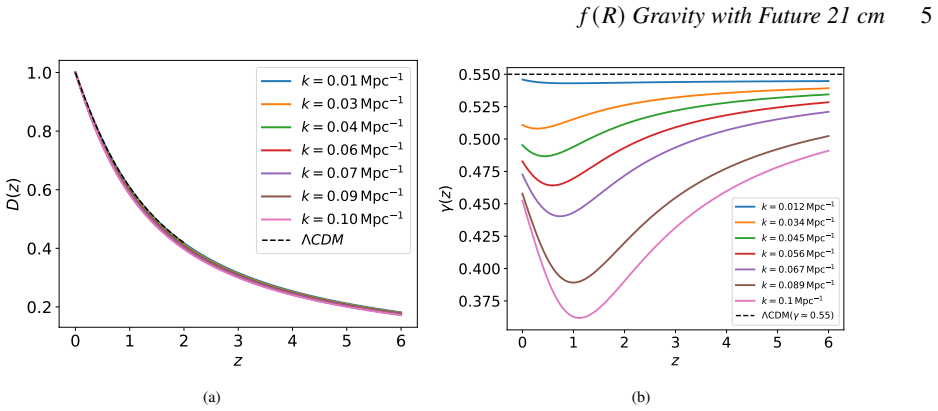
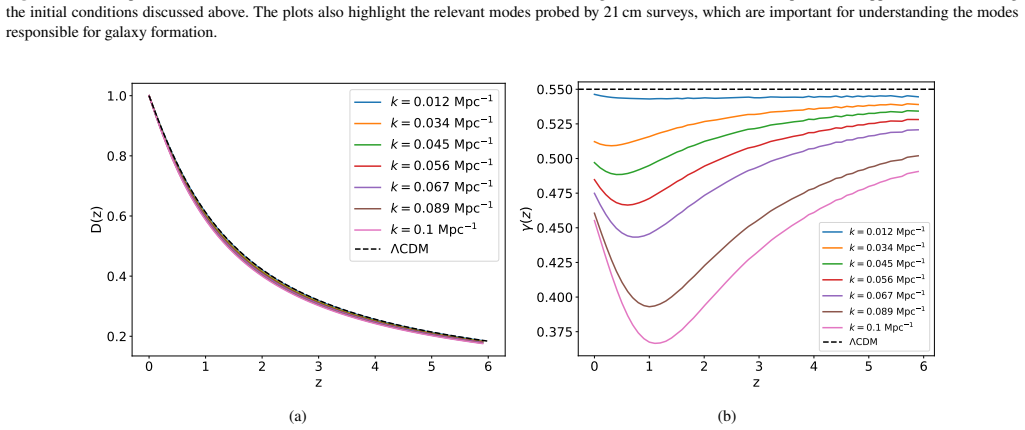
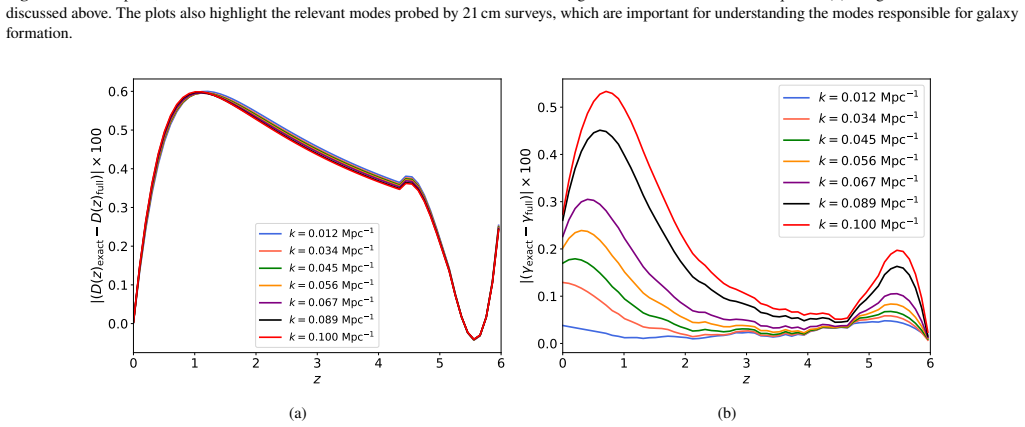
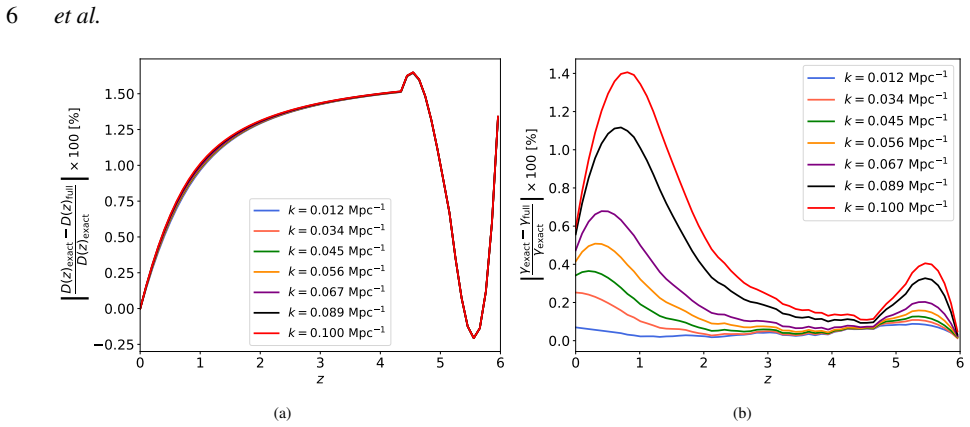
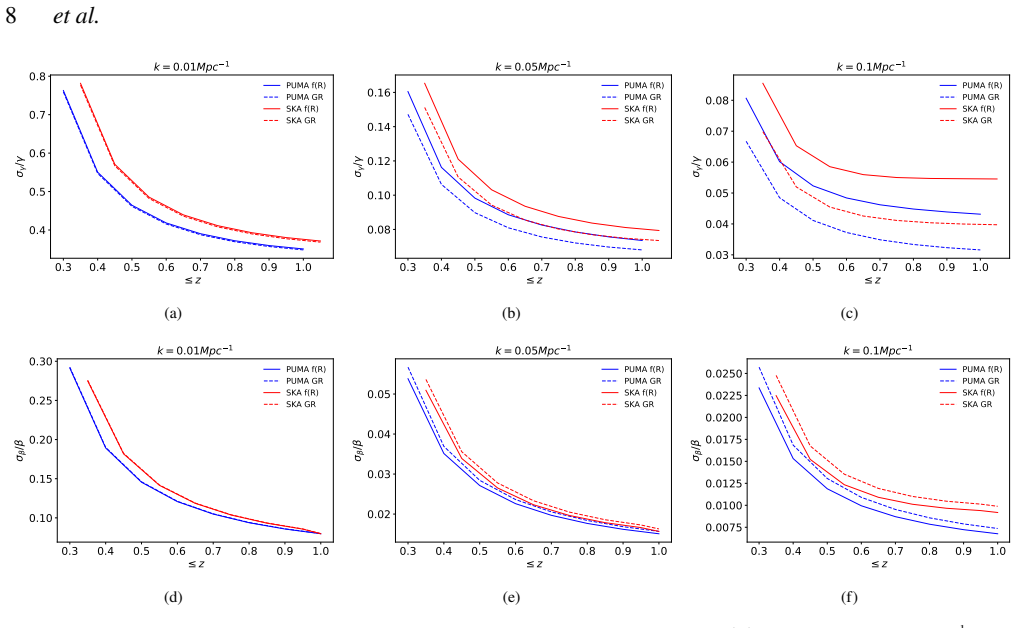
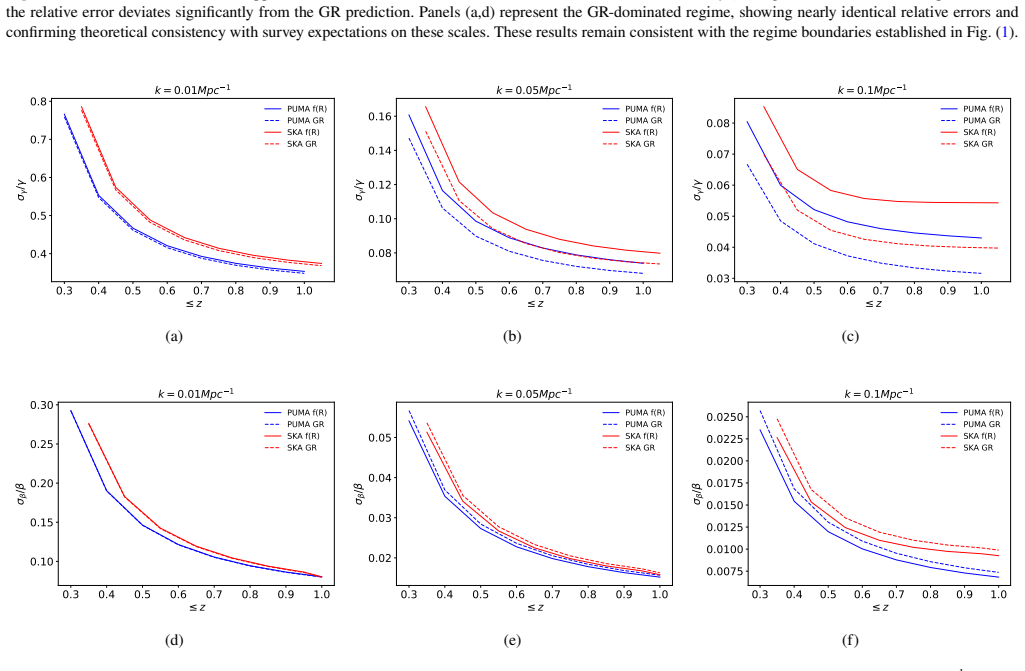
In f(R) gravity the linear matter density contrast evolves in a scale-dependent way, so the growth index becomes a function of both wavenumber and redshift. Viable f(R) models reproduce LambdaCDM at high redshift yet drive acceleration at late times. Forthcoming 21 cm surveys can measure this scale-dependent growth index together with the combined HI bias and growth-rate parameter, thereby supplying moderate constraints that support these modified gravity models.
What carries the argument
The scale-dependent growth index gamma(k,z) in f(R) gravity, extracted from 21 cm power spectrum measurements of the HI bias-growth-rate product.
If this is right
- The growth index can be measured at different scales to test for scale dependence predicted by f(R).
- Moderate constraints on viable f(R) functional forms become possible from the data.
- The combined HI bias and growth-rate parameter can be jointly constrained alongside the growth index.
- 21 cm observations provide an independent probe of late-time acceleration in modified gravity.
Where Pith is reading between the lines
- Combining 21 cm constraints with galaxy surveys such as DESI could produce tighter limits on f(R) parameters.
- The forecasts assume a particular form for the f(R) model; relaxing that assumption would require checking whether the extraction remains stable.
- If unmodeled systematics in the 21 cm signal prove larger than expected, the moderate support claimed for modified gravity would weaken.
Load-bearing premise
The assumption that the scale-dependent growth index and combined HI bias-growth-rate parameter can be extracted from 21 cm data without being dominated by unmodeled systematics or by the specific choice of f(R) functional form.
What would settle it
A measurement showing the growth index is constant with scale and matches general relativity within survey errors would falsify the claim that 21 cm data supports f(R) scenarios.
Figures

read the original abstract
Recent observations, particularly from DESI, have provided intriguing hints of dynamical behaviour in late-time dark energy. Modified gravity theories offer a compelling framework for interpreting such phenomena, with $f(R)$ gravity emerging as one of the most extensively studied examples. A central challenge in these models, however, lies in determining the precise functional form of $f(R)$. Nevertheless, several viable models have been proposed that successfully reproduce the standard $\Lambda$CDM cosmology at high red shifts while generating late-time cosmic acceleration without an explicit dark energy component. Within this framework, the evolution of the linear matter density contrast becomes scale dependent, leading to a growth index that varies with both scale and redshift. In this work, we explore the capability of forthcoming 21 cm observations to constrain the growth index, as well as the combined neutral hydrogen (HI) bias and growth-rate parameter. Our results indicate that future 21 cm surveys can provide meaningful, though moderate, support for these modified gravity scenarios.
Editorial analysis
A structured set of objections, weighed in public.
Referee Report
Summary. The manuscript forecasts the ability of future 21 cm intensity-mapping surveys to constrain the scale-dependent growth index γ(k,z) in viable f(R) gravity models (which reproduce ΛCDM at high redshift while driving late-time acceleration) together with the combined HI bias–growth-rate parameter. It concludes that these surveys can deliver meaningful though moderate support for the modified-gravity scenarios relative to GR.
Significance. If the forecast assumptions prove robust, the work would usefully inform survey design for testing gravity on cosmological scales with intensity mapping. The identification of scale dependence in the growth index as a distinguishing feature of f(R) is correctly noted. The result remains a forecast rather than a data-driven constraint, so its significance is moderate and contingent on the realism of the covariance modeling and systematics treatment.
major comments (2)
- [§3] §3 (Fisher-matrix setup): the central claim that γ(k,z) and the HI bias–growth-rate combination can be recovered with errors small enough to yield moderate support for f(R) rests on the unquantified assumption that foreground residuals, instrumental noise, and nonlinear bias evolution remain sub-dominant at the relevant k and z; no explicit error budget or end-to-end simulation is shown to demonstrate that these systematics do not inflate the forecasted errors by the factors of 2–5 commonly reported in 21 cm literature.
- [§4] §4 (results and model comparison): the statement that results are insensitive to the specific f(R) functional form is not demonstrated; the growth-index parametrization is introduced as a fitted function of scale and redshift, so the claimed support for f(R) over GR may depend on the chosen parametrization and on the particular f(R) model used to generate the mock data.
minor comments (2)
- Notation for the combined HI bias–growth-rate parameter is introduced without an explicit equation; adding a numbered definition would improve clarity.
- Figure captions should state the exact survey specifications (redshift range, k-range, noise model) used for each forecast curve.
Simulated Author's Rebuttal
We thank the referee for the detailed and constructive report. We address the two major comments point by point below, indicating the revisions that will be incorporated in the next version of the manuscript.
read point-by-point responses
-
Referee: [§3] §3 (Fisher-matrix setup): the central claim that γ(k,z) and the HI bias–growth-rate combination can be recovered with errors small enough to yield moderate support for f(R) rests on the unquantified assumption that foreground residuals, instrumental noise, and nonlinear bias evolution remain sub-dominant at the relevant k and z; no explicit error budget or end-to-end simulation is shown to demonstrate that these systematics do not inflate the forecasted errors by the factors of 2–5 commonly reported in 21 cm literature.
Authors: We agree that the Fisher-matrix analysis is performed under the assumption that the listed systematics remain sub-dominant and that no explicit error budget or end-to-end simulation is provided. This is a standard limitation of many forecast papers, but the referee is correct that it should be stated more explicitly. In the revised manuscript we will add a new subsection in §3 that (i) summarizes the dominant 21 cm systematics, (ii) cites the literature reporting typical error inflation factors, and (iii) clarifies that the quoted constraints represent the statistical floor under idealized conditions. We will also add a short paragraph in the conclusions noting that realistic systematics could degrade the forecasted precision. revision: yes
-
Referee: [§4] §4 (results and model comparison): the statement that results are insensitive to the specific f(R) functional form is not demonstrated; the growth-index parametrization is introduced as a fitted function of scale and redshift, so the claimed support for f(R) over GR may depend on the chosen parametrization and on the particular f(R) model used to generate the mock data.
Authors: The referee correctly notes that we did not demonstrate insensitivity to the choice of f(R) functional form or to the precise parametrization of γ(k,z). The manuscript employs one representative viable f(R) model to generate the mock data and adopts a specific scale- and redshift-dependent parametrization for γ. We will revise the text in §4 (and the abstract) to remove the claim of insensitivity, to state explicitly that the results apply to the class of viable f(R) models that produce scale-dependent growth, and to note that the scale dependence itself is the generic distinguishing feature relative to GR. This will make the interpretation of the model-comparison results more precise. revision: yes
Circularity Check
No circularity: standard forecast based on independent perturbation theory and survey modeling
full rationale
The paper performs a forecast of parameter constraints from future 21 cm intensity mapping on the scale-dependent growth index in f(R) models. The derivation relies on established linear perturbation equations in modified gravity (yielding scale-dependent growth) combined with standard Fisher-matrix forecasting on the HI power spectrum; neither step reduces to a self-definition, a fitted quantity renamed as a prediction, or a load-bearing self-citation chain. The growth-index parametrization is an input modeling choice drawn from the literature, not derived from the forecast results themselves. The analysis remains self-contained against external cosmological codes, survey specifications, and independent f(R) model implementations.
Axiom & Free-Parameter Ledger
free parameters (1)
- growth index gamma(k,z)
axioms (1)
- domain assumption Linear matter density contrast evolution remains valid on the scales probed by 21 cm surveys
Reference graph
Works this paper leans on
-
[1]
Ocampo, I. and others. Euclid: Forecasts on \ CDM consistency tests with growth rate data. arXiv e-prints. 2025. arXiv:2507.22780
arXiv 2025
-
[2]
Observational Constraints on Growth Index with Cosmography
Yin, Zhao-Yu and Wei, Hao. Observational Constraints on Growth Index with Cosmography. Eur. Phys. J. C. 2019. doi:10.1140/epjc/s10052-019-7191-8. arXiv:1902.00289
-
[3]
Mon. Not. Roy. Astron. Soc. , number =. 2023 , bdsk-url-1 =. doi:10.1093/mnras/stad2639 , eprint =
-
[4]
Astrophys. J. , pages =. 1997 , bdsk-url-1 =. doi:10.1086/303939 , eprint =
-
[5]
Phys. Rev. D , note =. 2011 , bdsk-url-1 =. doi:10.1103/PhysRevD.83.083005 , eprint =
-
[6]
JCAP , pages =. 2021 , bdsk-url-1 =. doi:10.1088/1475-7516/2021/03/039 , eprint =
-
[7]
Planck 2018 results. X. Constraints on inflation
Astron. Astrophys. , pages =. 2020 , bdsk-url-1 =. doi:10.1051/0004-6361/201833887 , eprint =
work page internal anchor Pith review doi:10.1051/0004-6361/201833887 2020
-
[8]
Phys. Rev. D , number =. 2014 , bdsk-url-1 =. doi:10.1103/PhysRevD.89.023002 , eprint =
-
[9]
Mon. Not. Roy. Astron. Soc. , pages =. 2004 , bdsk-url-1 =. doi:10.1111/j.1365-2966.2004.07907.x , eprint =
-
[10]
The anisotropic power spectrum and bispectrum in the f(phi) F^2 mechanism
Bartolo, Nicola and Matarrese, Sabino and Peloso, Marco and Ricciardone, Angelo. Anisotropic power spectrum and bispectrum in the f( )F^2 mechanism. Phys. Rev. D. 2013. doi:10.1103/PhysRevD.87.023504. arXiv:1210.3257
work page internal anchor Pith review Pith/arXiv arXiv doi:10.1103/physrevd.87.023504 2013
-
[11]
Asymmetric Sky from the Long Mode Modulations
Abolhasani, Ali Akbar and Baghram, Shant and Firouzjahi, Hassan and Namjoo, Mohammad Hossein. Asymmetric Sky from the Long Mode Modulations. Phys. Rev. D. 2014. doi:10.1103/PhysRevD.89.063511. arXiv:1306.6932
work page internal anchor Pith review Pith/arXiv arXiv doi:10.1103/physrevd.89.063511 2014
-
[12]
The CMB asymmetry from inflation
Lyth, David H. The CMB modulation from inflation. JCAP. 2013. doi:10.1088/1475-7516/2013/08/007. arXiv:1304.1270
work page internal anchor Pith review Pith/arXiv arXiv doi:10.1088/1475-7516/2013/08/007 2013
-
[13]
JCAP , pages =. 2022 , bdsk-url-1 =. doi:10.1088/1475-7516/2022/11/003 , eprint =
-
[15]
Cosmology , year =
Weinberg, Steven , date-added =. Cosmology , year =
-
[16]
21 cm cosmology in the 21st century , url =
Jonathan R Pritchard and Abraham Loeb , date-added =. 21 cm cosmology in the 21st century , url =. 2012 , bdsk-url-1 =. doi:10.1088/0034-4885/75/8/086901 , journal =
-
[17]
Constraining statistical isotropy using 21 cm power spectrum and bispectrum
Joshi, Bhuwan and Kothari, Rahul. Constraining statistical isotropy using 21 cm power spectrum and bispectrum. JCAP. 2025. doi:10.1088/1475-7516/2025/08/047. arXiv:2502.10717
-
[18]
Constraints on growth index parameters from current and future observations
Dossett, Jason and Ishak, Mustapha and Moldenhauer, Jacob and Gong, Yungui and Wang, Anzhong and Gong, Yungui. Constraints on growth index parameters from current and future observations. JCAP. 2010. doi:10.1088/1475-7516/2010/04/022. arXiv:1004.3086
work page internal anchor Pith review Pith/arXiv arXiv doi:10.1088/1475-7516/2010/04/022 2010
-
[19]
The 21cm angular-power spectrum from the dark ages , volume =. Phys. Rev. D , pages =. 2007 , bdsk-url-1 =. doi:10.1103/PhysRevD.76.083005 , eprint =
-
[20]
doi:10.1088/2514-3433/ab4a73 , adsurl =
The Cosmic 21-cm Revolution , url =. 2019 , bdsk-url-1 =. doi:10.1088/2514-3433/ab4a73 , editor =
-
[21]
Cosmological Reconstruction From Galaxy Light: Neural Network Based Light-Matter Connection
Modi, Chirag and Feng, Yu and Seljak, Uros. Cosmological Reconstruction From Galaxy Light: Neural Network Based Light-Matter Connection. JCAP. 2018. doi:10.1088/1475-7516/2018/10/028. arXiv:1805.02247
work page internal anchor Pith review Pith/arXiv arXiv doi:10.1088/1475-7516/2018/10/028 2018
-
[22]
Towards optimal extraction of cosmological information from nonlinear data
Seljak, Uros and Aslanyan, Grigor and Feng, Yu and Modi, Chirag. Towards optimal extraction of cosmological information from nonlinear data. JCAP. 2017. doi:10.1088/1475-7516/2017/12/009. arXiv:1706.06645
work page internal anchor Pith review Pith/arXiv arXiv doi:10.1088/1475-7516/2017/12/009 2017
-
[23]
Wang, Huiyuan and Mo, H. J. and Yang, Xiaohu and Zhang, Youcai and Shi, JingJing and Jing, Y. P. and Liu, Chengze and Li, Shijie and Kang, Xi and Gao, Yang. ELUCID - Exploring the Local Universe with reConstructed Initial Density field III: Constrained Simulation in the SDSS Volume. Astrophys. J. 2016. doi:10.3847/0004-637X/831/2/164. arXiv:1608.01763
work page internal anchor Pith review Pith/arXiv arXiv doi:10.3847/0004-637x/831/2/164 2016
-
[24]
Wang, Huiyuan and Mo, H. J. and Yang, Xiaohu and Jing, Y. P. and Lin, W. P. ELUCID - Exploring the Local Universe with reConstructed Initial Density field I: Hamiltonian Markov Chain Monte Carlo Method with Particle Mesh Dynamics. Astrophys. J. 2014. doi:10.1088/0004-637X/794/1/94. arXiv:1407.3451
work page internal anchor Pith review Pith/arXiv arXiv doi:10.1088/0004-637x/794/1/94 2014
-
[25]
The Initial Conditions of the Universe from Constrained Simulations
Kitaura, Francisco-Shu. The Initial Conditions of the Universe from Constrained Simulations. Mon. Not. Roy. Astron. Soc. 2013. doi:10.1093/mnrasl/sls029. arXiv:1203.4184
work page internal anchor Pith review Pith/arXiv arXiv doi:10.1093/mnrasl/sls029 2013
-
[26]
2011, MNRAS, 411, 2439, doi: 10.1111/j.1365-2966.2010.17855.x 20
Jasche, J. and Kitaura, F. S. Fast Hamiltonian sampling for large scale structure inference. Mon. Not. Roy. Astron. Soc. 2010. doi:10.1111/j.1365-2966.2010.16897.x. arXiv:0911.2496
-
[28]
Liu, Adrian and Tegmark, Max , year=. How well can we measure and understand foregrounds with 21-cm experiments?: Measuring and understanding 21-cm foregrounds , volume=. Monthly Notices of the Royal Astronomical Society , publisher=. doi:10.1111/j.1365-2966.2011.19989.x , number=
-
[29]
A method for 21-cm power spectrum estimation in the presence of foregrounds , volume=
Liu, Adrian and Tegmark, Max , year=. A method for 21-cm power spectrum estimation in the presence of foregrounds , volume=. Physical Review D , publisher=. doi:10.1103/physrevd.83.103006 , number=
-
[30]
Phys. Rept. , pages =. 2006 , bdsk-url-1 =. doi:10.1016/j.physrep.2006.08.002 , eprint =
-
[31]
21 Centimeter Fluctuations from Cosmic Gas at High Redshifts
Zaldarriaga, Matias and Furlanetto, Steven R. and Hernquist, Lars. 21 Centimeter fluctuations from cosmic gas at high redshifts. Astrophys. J. 2004. doi:10.1086/386327. arXiv:astro-ph/0311514
work page internal anchor Pith review Pith/arXiv arXiv doi:10.1086/386327 2004
-
[32]
The Fast Fourier Transform Telescope
Tegmark, Max and Zaldarriaga, Matias. The Fast Fourier Transform Telescope. Phys. Rev. D. 2009. doi:10.1103/PhysRevD.79.083530. arXiv:0805.4414
work page internal anchor Pith review Pith/arXiv arXiv doi:10.1103/physrevd.79.083530 2009
-
[33]
Dodelson, Scott , date-added =
-
[34]
The foreground wedge and 21 cm BAO surveys
Seo, Hee-Jong and Hirata, Christopher M. The foreground wedge and 21 cm BAO surveys. Mon. Not. Roy. Astron. Soc. 2016. doi:10.1093/mnras/stv2806. arXiv:1508.06503
work page internal anchor Pith review Pith/arXiv arXiv doi:10.1093/mnras/stv2806 2016
-
[35]
What Next-Generation 21 cm Power Spectrum Measurements Can Teach Us About the Epoch of Reionization
Pober, Jonathan C. and others. What Next-Generation 21 cm Power Spectrum Measurements Can Teach Us About the Epoch of Reionization. Astrophys. J. 2014. doi:10.1088/0004-637X/782/2/66. arXiv:1310.7031
work page internal anchor Pith review Pith/arXiv arXiv doi:10.1088/0004-637x/782/2/66 2014
-
[36]
A Per-Baseline, Delay-Spectrum Technique for Accessing the 21cm Cosmic Reionization Signature
Parsons, Aaron R. and Pober, Jonathan C. and Aguirre, James E. and Carilli, Christopher L. and Jacobs, Daniel C. and Moore, David F. A Per-Baseline, Delay-Spectrum Technique for Accessing the 21cm Cosmic Reionization Signature. Astrophys. J. 2012. doi:10.1088/0004-637X/756/2/165. arXiv:1204.4749
work page internal anchor Pith review Pith/arXiv arXiv doi:10.1088/0004-637x/756/2/165 2012
-
[37]
Statistical Methods Lecture Notes , url =
Luca Amendola , date-added =. Statistical Methods Lecture Notes , url =. 2024 , bdsk-url-1 =
2024
-
[38]
A wide-angle formulation of foreground filters for HI intensity mapping
Kothari, Rahul and Maartens, Roy. A wide-angle formulation of foreground filters for HI intensity mapping. JCAP. 2024. doi:10.1088/1475-7516/2024/05/089. arXiv:2308.03462
-
[39]
Astron. Astrophys. , pages =. 2022 , bdsk-url-1 =. doi:10.1051/0004-6361/202141707 , eprint =
-
[40]
Mon. Not. Roy. Astron. Soc. , number =. 2021 , bdsk-url-1 =. doi:10.1093/mnras/stab3064 , eprint =
-
[41]
All-Sky Interferometry with Spherical Harmonic Transit Telescopes
Shaw, J. Richard and Sigurdson, Kris and Pen, Ue-Li and Stebbins, Albert and Sitwell, Michael. All-Sky Interferometry with Spherical Harmonic Transit Telescopes. Astrophys. J. 2014. doi:10.1088/0004-637X/781/2/57. arXiv:1302.0327
work page internal anchor Pith review Pith/arXiv arXiv doi:10.1088/0004-637x/781/2/57 2014
-
[42]
Mon. Not. Roy. Astron. Soc. , number =. 2016 , bdsk-url-1 =. doi:10.1093/mnras/stw1039 , eprint =
-
[43]
Relating the inhomogeneous power spectrum to the CMB hemispherical anisotropy
Rath, Pranati K. and Aluri, Pavan K. and Jain, Pankaj. Relating the inhomogeneous power spectrum to the CMB hemispherical anisotropy. Phys. Rev. D. 2015. doi:10.1103/PhysRevD.91.023515. arXiv:1403.2567
work page internal anchor Pith review Pith/arXiv arXiv doi:10.1103/physrevd.91.023515 2015
-
[44]
Phys. Rev. D , number =. 2016 , bdsk-url-1 =. doi:10.1103/PhysRevD.94.063531 , eprint =
-
[45]
Phys. Rev. D , pages =. 2007 , bdsk-url-1 =. doi:10.1103/PhysRevD.76.103529 , eprint =
-
[46]
Mon. Not. Roy. Astron. Soc. , number =. 2021 , bdsk-url-1 =. doi:10.1093/mnras/stab027 , eprint =
-
[47]
Mon. Not. Roy. Astron. Soc. , number =. 2015 , bdsk-url-1 =. doi:10.1093/mnras/stu2575 , eprint =
-
[48]
Phys. Rev. D , number =. 2017 , bdsk-url-1 =. doi:10.1103/PhysRevD.96.043515 , eprint =
-
[49]
JCAP , pages =. 2020 , bdsk-url-1 =. doi:10.1088/1475-7516/2020/11/052 , eprint =
-
[50]
Constraints on cosmic hemispherical power anomalies from quasars
Hirata, Christopher M. Constraints on cosmic hemispherical power anomalies from quasars. JCAP. 2009. doi:10.1088/1475-7516/2009/09/011. arXiv:0907.0703
work page internal anchor Pith review Pith/arXiv arXiv doi:10.1088/1475-7516/2009/09/011 2009
-
[51]
Newburgh, L. B. and others. HIRAX: A Probe of Dark Energy and Radio Transients. Proc. SPIE Int. Soc. Opt. Eng. 2016. doi:10.1117/12.2234286. arXiv:1607.02059
work page internal anchor Pith review Pith/arXiv arXiv doi:10.1117/12.2234286 2016
-
[52]
Hydrogen Intensity and Real-Time Analysis Experiment: 256-element array status and overview
Crichton, Devin and others. Hydrogen Intensity and Real-Time Analysis Experiment: 256-element array status and overview. J. Astron. Telesc. Instrum. Syst. 2022. doi:10.1117/1.JATIS.8.1.011019. arXiv:2109.13755
-
[53]
Inflation and Early Dark Energy with a Stage II Hydrogen Intensity Mapping experiment
Ansari, R \'e za and others. Inflation and Early Dark Energy with a Stage II Hydrogen Intensity Mapping experiment. arXiv e-prints. 2018. arXiv:1810.09572
arXiv 2018
-
[54]
Publ. Astron. Soc. Pac. , number =. 2020 , bdsk-url-1 =. doi:10.1088/1538-3873/ab5bfd , eprint =
-
[56]
Phys. Rev. D , number =. 2015 , bdsk-url-1 =. doi:10.1103/PhysRevD.91.083514 , eprint =
-
[57]
Mon. Not. Roy. Astron. Soc. , pages =. 2015 , bdsk-url-1 =. doi:10.1093/mnras/stu2474 , eprint =
-
[58]
Mon. Not. Roy. Astron. Soc. , number =. 2019 , bdsk-url-1 =. doi:10.1093/mnras/stz1916 , eprint =
-
[59]
doi:10.1093/mnras/stac2343 , eprint =
2021 , bdsk-url-1 =. doi:10.1093/mnras/stac2343 , eprint =
-
[60]
Bacon, David J. and others. Cosmology with Phase 1 of the Square Kilometre Array: Red Book 2018: Technical specifications and performance forecasts. Publ. Astron. Soc. Austral. 2020. doi:10.1017/pasa.2019.51. arXiv:1811.02743
-
[61]
JCAP , pages =. 2019 , bdsk-url-1 =. doi:10.1088/1475-7516/2019/04/053 , eprint =
-
[62]
JCAP , pages =. 2016 , bdsk-url-1 =. doi:10.1088/1475-7516/2016/01/016 , eprint =
-
[63]
Phys. Rev. D , pages =. 2001 , bdsk-url-1 =. doi:10.1103/PhysRevD.64.083005 , eprint =
-
[64]
Class. Quant. Grav. , number =. 2021 , bdsk-url-1 =. doi:10.1088/1361-6382/abf1c1 , eprint =
-
[65]
JCAP , pages =. 2020 , bdsk-url-1 =. doi:10.1088/1475-7516/2020/12/003 , eprint =
-
[66]
Li, Botao and Chen, Zhaoting and Cai, Yi-Fu and Mao, Yi. Testing the scale-dependent hemispherical asymmetry with the 21-cm power spectrum from the epoch of reionization. Mon. Not. Roy. Astron. Soc. 2019. doi:10.1093/mnras/stz1619. arXiv:1904.04683
-
[67]
The OH line contamination of 21 cm intensity fluctuation measurements for z=1~4
Gong, Yan and Chen, Xuelei and Silva, Marta and Cooray, Asantha and Santos, Mario G. The OH line contamination of 21 cm intensity fluctuation measurements for z=1 4. Astrophys. J. Lett. 2011. doi:10.1088/2041-8205/740/1/L20. arXiv:1108.0947
work page internal anchor Pith review Pith/arXiv arXiv doi:10.1088/2041-8205/740/1/l20 2011
-
[68]
Is the observable Universe consistent with the cosmological principle?
Aluri, Pavan Kumar and others. Is the observable Universe consistent with the cosmological principle?. Class. Quant. Grav. 2023. doi:10.1088/1361-6382/acbefc. arXiv:2207.05765
-
[70]
Phys. Rev. D , pages =. 2005 , bdsk-url-1 =. doi:10.1103/PhysRevD.71.083508 , eprint =
-
[71]
Astrophys. J. , pages =. 2007 , bdsk-url-1 =. doi:10.1086/510511 , eprint =
-
[72]
Phys. Rev. D , pages =. 2005 , bdsk-url-1 =. doi:10.1103/PhysRevD.72.103002 , eprint =
-
[73]
Astron. Astrophys. , pages =. 2020 , bdsk-url-1 =. doi:10.1051/0004-6361/201935201 , eprint =
-
[74]
Cosmology with a SKA HI intensity mapping survey
Santos, Mario G. and others. Cosmology from a SKA HI intensity mapping survey. PoS. 2015. doi:10.22323/1.215.0019. arXiv:1501.03989
work page internal anchor Pith review Pith/arXiv arXiv doi:10.22323/1.215.0019 2015
-
[75]
Ade, P. A. R. and others. Planck 2015 results. XVI. Isotropy and statistics of the CMB. Astron. Astrophys. 2016. doi:10.1051/0004-6361/201526681. arXiv:1506.07135
work page internal anchor Pith review Pith/arXiv arXiv doi:10.1051/0004-6361/201526681 2015
-
[76]
Ade, P. A. R. and others. Planck 2013 results. XXIII. Isotropy and statistics of the CMB. Astron. Astrophys. 2014. doi:10.1051/0004-6361/201321534. arXiv:1303.5083
work page internal anchor Pith review Pith/arXiv arXiv doi:10.1051/0004-6361/201321534 2013
-
[77]
Astrophys. J. Lett. , pages =. 2007 , bdsk-url-1 =. doi:10.1086/518091 , eprint =
-
[78]
Astrophys. J. , pages =. 2009 , bdsk-url-1 =. doi:10.1088/0004-637X/699/2/985 , eprint =
-
[79]
Astrophys. J. , note =. 2004 , bdsk-url-1 =. doi:10.1086/382267 , eprint =
-
[80]
Phys. Rev. D , number =. 2016 , bdsk-url-1 =. doi:10.1103/PhysRevD.93.103506 , eprint =
-
[81]
Could dark energy be vector-like?
Armendariz-Picon, Christian. Could dark energy be vector-like?. JCAP. 2004. doi:10.1088/1475-7516/2004/07/007. arXiv:astro-ph/0405267
work page internal anchor Pith review Pith/arXiv arXiv doi:10.1088/1475-7516/2004/07/007 2004
-
[82]
Scoccimarro, Roman and Couchman, H. M. P. and Frieman, Joshua A. The Bispectrum as a Signature of Gravitational Instability in Redshift-Space. Astrophys. J. 1999. doi:10.1086/307220. arXiv:astro-ph/9808305
work page internal anchor Pith review Pith/arXiv arXiv doi:10.1086/307220 1999
-
[83]
Large-Scale Structure of the Universe and Cosmological Perturbation Theory
Bernardeau, F. and Colombi, S. and Gaztanaga, E. and Scoccimarro, R. Large scale structure of the universe and cosmological perturbation theory. Phys. Rept. 2002. doi:10.1016/S0370-1573(02)00135-7. arXiv:astro-ph/0112551
work page internal anchor Pith review Pith/arXiv arXiv doi:10.1016/s0370-1573(02)00135-7 2002
-
[84]
Evidence for Quadratic Tidal Tensor Bias from the Halo Bispectrum
Baldauf, Tobias and Seljak, Uros and Desjacques, Vincent and McDonald, Patrick. Evidence for Quadratic Tidal Tensor Bias from the Halo Bispectrum. Phys. Rev. D. 2012. doi:10.1103/PhysRevD.86.083540. arXiv:1201.4827
work page internal anchor Pith review Pith/arXiv arXiv doi:10.1103/physrevd.86.083540 2012
discussion (0)
Sign in with ORCID, Apple, or X to comment. Anyone can read and Pith papers without signing in.