Continuum-statistical dynamics of colloidal suspensions under kinematic reversibility
Pith reviewed 2026-05-16 05:58 UTC · model grok-4.3
The pith
Onsager reciprocal relations emerge from the Lorentz reciprocal theorem under kinematic reversibility in colloidal suspensions.
A machine-rendered reading of the paper's core claim, the machinery that carries it, and where it could break.
Core claim
Onsager reciprocal relations emerge from the Lorentz reciprocal theorem under kinematic reversibility, based on the auxiliary flow problem of colloidal sedimentation. The framework applies to suspensions containing multiple species of microparticles and derives all non-equilibrium contributions to colloidal diffusion from a single application of the Lorentz reciprocal theorem, irrespective of whether a slip or no-slip hydrodynamic boundary condition is imposed at the colloidal surface. A boundary layer treatment is assumed only for microswimming, while thermodynamic forces for phoretic motion are resolved fully. For diffusiophoretic motion from solute volume exclusion, a colloid moves toward
What carries the argument
Decoupling of hydrostatic and hydrodynamic stress combined with one application of the Lorentz reciprocal theorem to the colloidal sedimentation auxiliary flow.
If this is right
- The framework applies to suspensions containing multiple species of microparticles.
- All non-equilibrium contributions to colloidal diffusion are obtained from one application of the Lorentz reciprocal theorem.
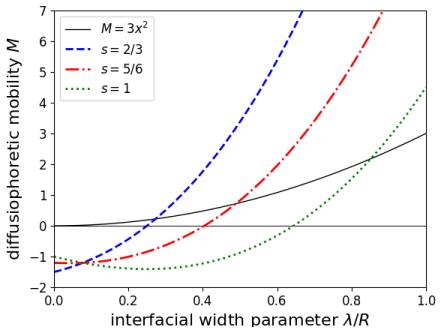
- Colloids are drawn toward higher solute concentration in diffusiophoretic motion except when the excluded-volume layer thickness approaches the particle radius.
- Transport coefficients in dense suspensions can be computed numerically without resolving the underlying microhydrodynamics.
- Thermodynamic forces giving rise to phoretic motion are resolved beyond the boundary-layer approximation.
Where Pith is reading between the lines
- The single-application structure could simplify numerical models of flow-driven transport in multi-component colloidal mixtures.
- If reversibility and stress decoupling hold more broadly, the same reduction might apply to reciprocity in other soft-matter flows with similar separation of pressure and viscous contributions.
- The independence from slip versus no-slip conditions suggests the result could be tested in systems with tunable surface mobility.
Load-bearing premise
Kinematic reversibility of colloidal motion together with clean decoupling of hydrostatic and hydrodynamic stress at the particle scale.
What would settle it
Direct measurement of cross-diffusion coefficients between two colloidal species in a reversible sedimentation flow that violates the reciprocity obtained from a single Lorentz theorem application would disprove the central claim.
Figures
read the original abstract
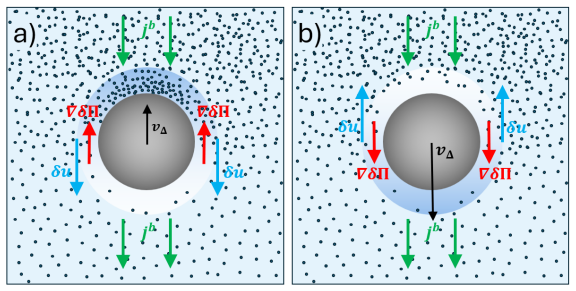
We present a linear response theory that establishes the continuum-mechanical origin of Onsager reciprocity in colloidal motion. By decoupling hydrostatic and hydrodynamic stress, we show that Onsager reciprocal relations emerge when the Lorentz reciprocal theorem is applied under kinematic reversibility to the auxiliary flow problem of colloidal sedimentation. Our framework applies to suspensions containing multiple species of microparticles and derives all non-equilibrium contributions to colloidal diffusion from a single application of the Lorentz reciprocal theorem, irrespective of whether a slip or no-slip hydrodynamic boundary condition is imposed at the colloidal surface. Furthermore, a boundary-layer treatment is only assumed for ciliary motion, while the hydrostatic forces giving rise to non-equilibrium thermodynamic motion are fully resolved beyond the boundary-layer approximation. In particular, our framework is consistent with classical osmosis through a semi-permeable membrane, where fluid flow occurs without interfacial potential interactions. For diffusiophoresis due to volume exclusion of a solute, our results therefore predict colloidal motion towards higher solute concentration for thin excluded-volume layers, whereas the opposite trend is recovered for longer-ranged, moderately repulsive potentials.
Editorial analysis
A structured set of objections, weighed in public.
Referee Report
Summary. The paper presents a linear response theory for colloidal suspensions that derives Onsager reciprocal relations from the Lorentz reciprocal theorem applied to an auxiliary sedimentation problem. Under the assumptions of kinematic reversibility and clean decoupling between hydrostatic (thermodynamic) and hydrodynamic stresses, the framework claims to obtain all non-equilibrium contributions to the diffusion tensors—including cross terms for multi-species systems—from a single application of the theorem, independent of slip or no-slip boundary conditions at the particle surface. It further resolves phoretic forces beyond the boundary-layer approximation (except for microswimming) and predicts that diffusiophoretic colloids are drawn toward higher solute concentrations unless the excluded-volume layer thickness becomes comparable to the particle radius. The linear structure is said to enable numerical computation of transport coefficients in dense suspensions without explicit microhydrodynamic resolution.
Significance. If the central derivation holds, the work provides a unified continuum-statistical route to the full Onsager matrix for colloidal transport that avoids fitting parameters and resolves thermodynamic forces directly. This could streamline calculations for multi-species and dense systems while clarifying the mechanical origin of reciprocity, with the auxiliary-problem approach offering a practical advantage for numerical implementations.
major comments (2)
- [derivation of diffusion tensors] The central claim that a single application of the Lorentz theorem to the auxiliary sedimentation problem generates the entire set of diffusion tensors (including all cross-species terms) rests on the decoupling of hydrostatic and hydrodynamic stresses. The abstract notes an exception for diffusiophoretic motion when the excluded-volume layer thickness approaches the particle radius; the derivation must explicitly demonstrate that this regime does not generate additional hydrodynamic stresslets that would require further applications of the theorem or violate the single-application premise (see abstract and the section deriving the diffusion tensors).
- [kinematic reversibility and boundary conditions] The kinematic-reversibility assumption must be shown to remain exact at the particle surface when solute-exclusion forces are fully resolved (beyond boundary-layer treatment). If these forces modify the no-slip or slip condition, the auxiliary flow problem may not capture the full hydrodynamic velocity field, undermining the derivation of all non-equilibrium contributions from one theorem application.
minor comments (1)
- [notation] Clarify the notation for the multi-species Onsager matrix elements to ensure the cross-diffusion coefficients are unambiguously identified with the single auxiliary-problem output.
Simulated Author's Rebuttal
We thank the referee for the careful reading, positive assessment, and recommendation for minor revision. The comments raise valid points about the scope of the single-application derivation and the treatment of forces at the particle surface. We address each below and will incorporate clarifications into the revised manuscript.
read point-by-point responses
-
Referee: [derivation of diffusion tensors] The central claim that a single application of the Lorentz theorem to the auxiliary sedimentation problem generates the entire set of diffusion tensors (including all cross-species terms) rests on the decoupling of hydrostatic and hydrodynamic stresses. The abstract notes an exception for diffusiophoretic motion when the excluded-volume layer thickness approaches the particle radius; the derivation must explicitly demonstrate that this regime does not generate additional hydrodynamic stresslets that would require further applications of the theorem or violate the single-application premise (see abstract and the section deriving the diffusion tensors).
Authors: We appreciate the referee highlighting the need for explicit demonstration in this regime. In the framework, thermodynamic forces from solute exclusion enter exclusively through the hydrostatic stress (via the chemical potential gradient and excluded-volume potential), while hydrodynamic stresses are generated solely by the flow field obeying the Stokes equations and the fixed hydrodynamic boundary conditions at the particle surface. When the excluded-volume layer thickness approaches the particle radius, these forces remain conservative and hydrostatic; they do not produce additional hydrodynamic stresslets because the velocity field in the auxiliary sedimentation problem is unchanged. The Lorentz theorem is applied once to this auxiliary flow, yielding all diffusion tensors (including cross terms) without violation of the premise. We will revise the diffusion-tensors section to add a short explicit step showing that the stresslet decomposition remains identical in this limit. revision: yes
-
Referee: [kinematic reversibility and boundary conditions] The kinematic-reversibility assumption must be shown to remain exact at the particle surface when solute-exclusion forces are fully resolved (beyond boundary-layer treatment). If these forces modify the no-slip or slip condition, the auxiliary flow problem may not capture the full hydrodynamic velocity field, undermining the derivation of all non-equilibrium contributions from one theorem application.
Authors: Solute-exclusion forces are incorporated as distributed conservative body forces in the fluid domain (derived from the interaction potential), without any modification to the hydrodynamic boundary conditions imposed directly at the particle surface. Kinematic reversibility follows from the linearity of the Stokes equations under these fixed surface conditions and is therefore preserved exactly, independent of the spatial extent of the body-force distribution. The auxiliary sedimentation problem employs the identical surface boundary conditions, so the velocity field remains fully captured. We will add a clarifying paragraph in the derivation section confirming that the forces do not alter slip or no-slip conditions and that reversibility holds for the fully resolved case. revision: yes
Circularity Check
No circularity: derivation rests on external Lorentz theorem after explicit decoupling assumption
full rationale
The paper's central derivation applies the established Lorentz reciprocal theorem to an auxiliary sedimentation flow problem once hydrostatic and hydrodynamic stresses are decoupled. This step is presented as independent of the target Onsager matrix; the theorem itself is a standard external result, not derived or fitted within the paper. No equations redefine transport coefficients in terms of themselves, no parameters are fitted to a subset and then relabeled as predictions, and no load-bearing uniqueness theorem is imported solely via self-citation. The framework claims applicability to multi-species cases and independence from boundary-condition details, but these are stated as consequences of the decoupling premise rather than tautological redefinitions. The provided abstract and reader summary contain no quoted reduction of any final result to an input by construction. This is the normal case of a self-contained derivation anchored in prior independent mathematics.
Axiom & Free-Parameter Ledger
axioms (2)
- standard math Lorentz reciprocal theorem holds for the auxiliary sedimentation flow
- domain assumption Kinematic reversibility of colloidal motion
Lean theorems connected to this paper
-
IndisputableMonolith/Foundation/ArithmeticFromLogic.leanreality_from_one_distinction unclear?
unclearRelation between the paper passage and the cited Recognition theorem.
decoupling hydrostatic and hydrodynamic stress... kinematic reversibility... representative volume element
What do these tags mean?
- matches
- The paper's claim is directly supported by a theorem in the formal canon.
- supports
- The theorem supports part of the paper's argument, but the paper may add assumptions or extra steps.
- extends
- The paper goes beyond the formal theorem; the theorem is a base layer rather than the whole result.
- uses
- The paper appears to rely on the theorem as machinery.
- contradicts
- The paper's claim conflicts with a theorem or certificate in the canon.
- unclear
- Pith found a possible connection, but the passage is too broad, indirect, or ambiguous to say the theorem truly supports the claim.
discussion (0)
Sign in with ORCID, Apple, or X to comment. Anyone can read and Pith papers without signing in.