Multi-Modal Environment-Aware Beam Management for Massive MIMO: A Geometry-Driven Virtual Base Station Framework
Pith reviewed 2026-06-26 03:25 UTC · model grok-4.3
The pith
LiDAR point clouds and mirror symmetry let virtual base stations reconstruct channels for low-overhead beam management in massive MIMO.
A machine-rendered reading of the paper's core claim, the machinery that carries it, and where it could break.
Core claim
By building a compact VBS database that encodes the propagation environment through mirror-symmetry modeling of reflections on LiDAR-derived facades, the framework supplies geometric parameters for direct coarse channel reconstruction; this representation then supports a partial beam-training procedure and a hierarchical reinforcement-learning policy that together deliver measurable reductions in training overhead and gains in beam-selection performance relative to heuristic and learning baselines.
What carries the argument
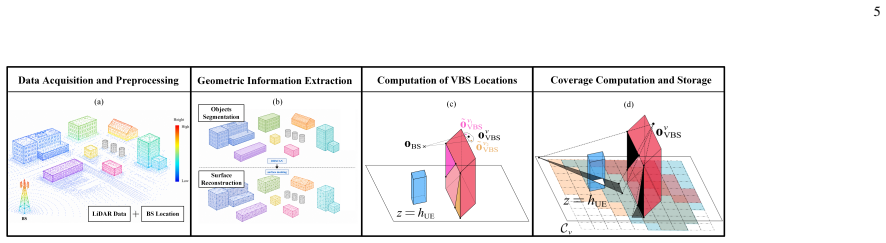
The virtual base station (VBS) database, which supplies a sparse geometric description of dominant paths via mirror symmetry on LiDAR-reconstructed building facades and thereby bridges environmental data to channel parameters.
If this is right
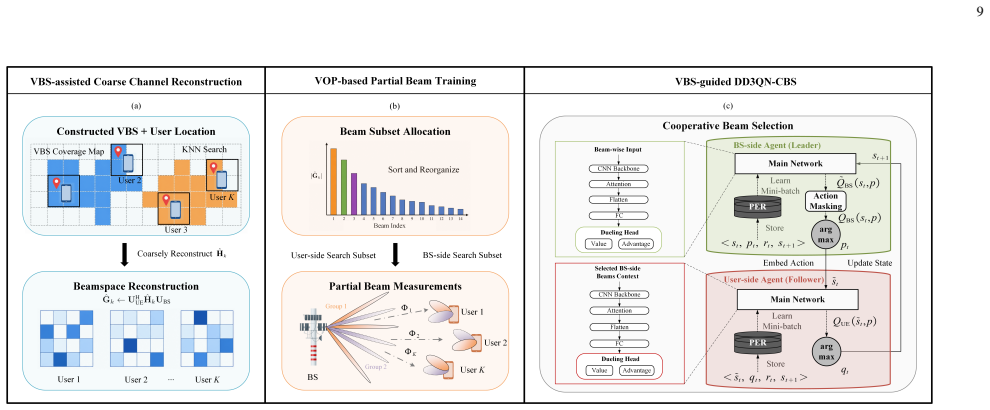
- The VBS database enables a VOP-based partial beam training scheme that refines coarse estimates with minimal online overhead.
- The dual-agent DD3QN-CBS policy addresses the combinatorial beam selection problem while managing inter-user interference.
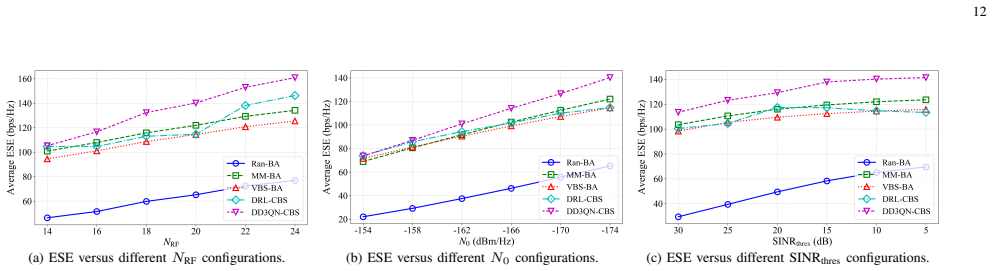
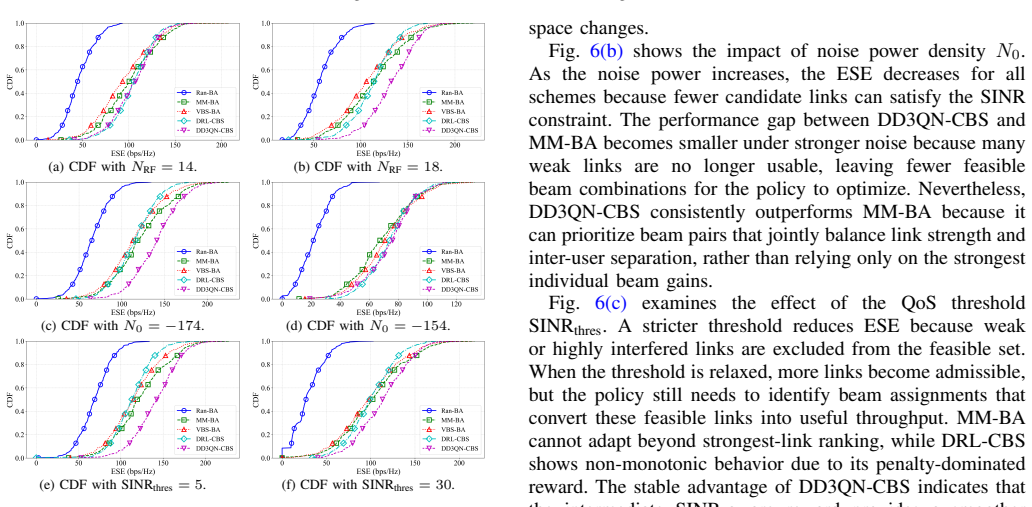
- Simulation results show consistent gains in both beam training efficiency and beam selection performance over heuristic and learning-based baselines.
- Multi-modal environmental data (LiDAR plus location) supplies an interpretable alternative to exhaustive pilot-based training in MU-MIMO.
Where Pith is reading between the lines
- Updating the LiDAR database in real time could extend the method to moderately dynamic scenes without retraining the entire system.
- The same geometric reconstruction might be combined with other sensor modalities to improve robustness in non-urban settings.
- Lower pilot overhead could translate directly into higher spectral efficiency or reduced base-station energy use in dense deployments.
Load-bearing premise
Dominant reflection paths can be modeled via mirror symmetry across building facades reconstructed from LiDAR point clouds, enabling accurate coarse channel reconstruction from geometric relationships.
What would settle it
Field measurements in which the coarse channel estimates derived from the VBS geometric relationships deviate substantially from measured channels in the same environment, particularly when non-specular or dynamic scatterers dominate.
Figures



read the original abstract
High-frequency massive multiple-input multiple-output (MIMO) systems promise ultra-high data rates. However, efficient beam management remains challenging due to the prohibitive beam training overhead and intricate coordination required in multi-user MIMO (MU-MIMO) scenarios. To address these bottlenecks, environment-aware communications have emerged as a promising paradigm, leveraging site-specific knowledge to circumvent exhaustive pilot-based beam training and streamline multi-user communications. In this paper, we propose an interpretable and geometry-driven framework that utilizes multi-modal environmental data, specifically regional 3D light detection and ranging (LiDAR) point clouds and location information, to construct an offline virtual base station (VBS) database. By modeling dominant reflection paths via mirror symmetry across building facades reconstructed from the point clouds, the VBS database provides a compact and sparse description of the wireless propagation environment. To bridge the semantic gap between geometric information and wireless channels, we develop a coarse channel reconstruction mechanism that estimates channel parameters directly from VBS-derived geometric relationships. Based on the resulting coarse beamspace representation, we design a VBS-assisted orthogonal-pilot (VOP)-based partial beam training scheme to refine the coarse estimates with minimal online training overhead. Finally, to tackle the combinatorial beam selection problem and manage inter-user interference, we propose a hierarchical deep reinforcement learning framework, namely a dual-agent dueling double deep Q-network, for coordinated beam selection (DD3QN-CBS). Simulation results demonstrate consistent gains in both beam training efficiency and beam selection performance over heuristic and learning-based baselines.
Editorial analysis
A structured set of objections, weighed in public.
Referee Report
Summary. The paper proposes a geometry-driven framework for environment-aware beam management in high-frequency massive MIMO systems. It uses regional 3D LiDAR point clouds and user location data to build an offline virtual base station (VBS) database by modeling dominant reflection paths via mirror symmetry across reconstructed building facades. This yields a coarse channel reconstruction mechanism, a VBS-assisted orthogonal-pilot (VOP) partial beam training scheme, and a dual-agent dueling double deep Q-network for coordinated beam selection (DD3QN-CBS). The central claim is that simulations demonstrate consistent gains in beam training efficiency and beam selection performance relative to heuristic and learning-based baselines.
Significance. If the geometric modeling assumptions hold in practice, the approach could meaningfully reduce beam training overhead in MU-MIMO scenarios by leveraging site-specific multi-modal data, offering an interpretable alternative to purely data-driven methods. The combination of explicit geometry-based coarse reconstruction with hierarchical DRL for interference management is a notable strength, as is the emphasis on bridging semantic gaps between environmental geometry and wireless channels.
major comments (2)
- [§3, §4] §3 (geometry-driven VBS construction) and §4 (coarse channel estimation): The load-bearing modeling step is the assumption that dominant reflection paths can be accurately predicted via image-source mirror symmetry across planar facades extracted from LiDAR point clouds. This directly determines the coarse beamspace representation supplied to both the VOP scheme and DD3QN-CBS. The manuscript provides no analysis or additional simulations under realistic violations of this assumption (e.g., diffuse scattering, non-specular surfaces, or LiDAR reconstruction errors), so the reported efficiency and selection gains may be artifacts of the idealized simulation environment.
- [Simulation results] Simulation results section: The strongest claim (consistent gains over baselines) rests entirely on channels generated under the same mirror-symmetry model used to build the VBS database. Without cross-validation against measured channels or ray-tracing data that deliberately include non-specular components, it is unclear whether the performance advantage would persist outside the modeled scenario.
minor comments (1)
- [Abstract, Introduction] The abstract and introduction use several invented terms (VBS database, VOP scheme, DD3QN-CBS) without immediate expansion; a short table or footnote defining each acronym on first use would improve readability.
Simulated Author's Rebuttal
We thank the referee for the constructive feedback and positive assessment of the framework's potential. We address the two major comments point-by-point below, agreeing that additional robustness analysis is warranted and outlining the revisions we will implement.
read point-by-point responses
-
Referee: [§3, §4] §3 (geometry-driven VBS construction) and §4 (coarse channel estimation): The load-bearing modeling step is the assumption that dominant reflection paths can be accurately predicted via image-source mirror symmetry across planar facades extracted from LiDAR point clouds. This directly determines the coarse beamspace representation supplied to both the VOP scheme and DD3QN-CBS. The manuscript provides no analysis or additional simulations under realistic violations of this assumption (e.g., diffuse scattering, non-specular surfaces, or LiDAR reconstruction errors), so the reported efficiency and selection gains may be artifacts of the idealized simulation environment.
Authors: We agree that the lack of analysis under violations of the mirror-symmetry assumption is a limitation that should be addressed. In the revised manuscript, we will add a dedicated robustness subsection to the simulation results. This will include new experiments that introduce controlled model mismatches, such as (i) adding diffuse scattering paths with random power and angles, (ii) perturbing facade normals extracted from the LiDAR point clouds, and (iii) injecting Gaussian noise into the point-cloud coordinates to emulate reconstruction errors. We will report the resulting degradation in coarse channel accuracy, VOP training overhead, and DD3QN-CBS performance to quantify the sensitivity of the reported gains. revision: yes
-
Referee: [Simulation results] Simulation results section: The strongest claim (consistent gains over baselines) rests entirely on channels generated under the same mirror-symmetry model used to build the VBS database. Without cross-validation against measured channels or ray-tracing data that deliberately include non-specular components, it is unclear whether the performance advantage would persist outside the modeled scenario.
Authors: The current results are generated under the same geometric model to isolate the benefit of the VBS-derived priors. We acknowledge that this leaves open the question of generalization. In revision we will augment the simulation campaign with an independent ray-tracing engine that incorporates non-specular components (diffuse scattering lobes and surface roughness parameters). Performance curves for both VOP and DD3QN-CBS will be recomputed under these richer channels and compared against the same baselines. While we do not possess site-specific measured channel datasets, the extended ray-tracing validation will provide a stronger test of whether the efficiency and selection gains remain outside the idealized mirror-symmetry setting. revision: yes
Circularity Check
No circularity: framework derives from external LiDAR geometry and mirror symmetry without self-referential reduction.
full rationale
The derivation chain begins with external LiDAR point clouds to reconstruct facades, applies mirror symmetry (image-source) to model dominant paths for VBS database construction, performs coarse channel estimation from those geometric relationships, then applies VOP training and DD3QN-CBS. Simulation gains are reported relative to baselines under the same model. No step reduces a claimed prediction to a fitted parameter defined by the same equations, no load-bearing self-citation chains appear, and no ansatz is smuggled via prior author work. The approach is self-contained against the stated geometric inputs and external data.
Axiom & Free-Parameter Ledger
axioms (1)
- domain assumption Mirror symmetry across building facades reconstructed from point clouds accurately captures dominant reflection paths.
invented entities (3)
-
Virtual Base Station (VBS) database
no independent evidence
-
VBS-assisted orthogonal-pilot (VOP) scheme
no independent evidence
-
Dual-agent dueling double deep Q-network for coordinated beam selection (DD3QN-CBS)
no independent evidence
Reference graph
Works this paper leans on
-
[1]
Multi-modal data driven virtual base station construction for massive MIMO beam alignment,
Y . Bian, W. Guo, J. Yang, S. Song, J. Zhang, S. Jin, and K. B. Letaief, “Multi-modal data driven virtual base station construction for massive MIMO beam alignment,” inProc. IEEE Wireless Commun. and Netw. Conf. (WCNC), Apr. 2026, pp. 1–3
2026
-
[2]
The roadmap to 6G: AI empowered wireless networks,
K. B. Letaief, W. Chen, Y . Shi, J. Zhang, and Y .-J. A. Zhang, “The roadmap to 6G: AI empowered wireless networks,”IEEE Commun. Mag., vol. 57, no. 8, pp. 84–90, Aug. 2019
2019
-
[3]
Hybrid analog and digital beamforming for mmWave OFDM large-scale antenna arrays,
F. Sohrabi and W. Yu, “Hybrid analog and digital beamforming for mmWave OFDM large-scale antenna arrays,”IEEE J. Sel. Areas Commun., vol. 35, no. 7, pp. 1432–1443, Jul. 2017
2017
-
[4]
Hybrid beamforming for millimeter wave systems using the MMSE criterion,
T. Lin, J. Cong, Y . Zhu, J. Zhang, and K. Ben Letaief, “Hybrid beamforming for millimeter wave systems using the MMSE criterion,” IEEE Trans. Commun., vol. 67, no. 5, pp. 3693–3708, May 2019
2019
-
[5]
A tutorial on beam management for 3GPP NR at mmWave frequencies,
M. Giordani, M. Polese, A. Roy, D. Castor, and M. Zorzi, “A tutorial on beam management for 3GPP NR at mmWave frequencies,”IEEE Commun. Surveys Tuts., vol. 21, no. 1, pp. 173–196, 1st Quart. 2019
2019
-
[6]
A survey of beam management for mmWave and THz communications towards 6G,
Q. Xue, C. Ji, S. Ma, J. Guo, Y . Xu, Q. Chen, and W. Zhang, “A survey of beam management for mmWave and THz communications towards 6G,”IEEE Commun. Surveys Tuts., vol. 26, no. 3, pp. 1520–1559, 3rd Quart. 2024
2024
-
[7]
Scenario-adaptive meta- learning for mmWave beam alignment,
Z. Xu, S. Wang, and Y .-J. Angela Zhang, “Scenario-adaptive meta- learning for mmWave beam alignment,”IEEE Trans. Wireless Com- mun., vol. 24, no. 4, pp. 3192–3208, Apr. 2025
2025
-
[8]
Joint deep reinforcement learning and unfolding: Beam selection and precoding for mmWave multiuser MIMO with lens arrays,
Q. Hu, Y . Liu, Y . Cai, G. Yu, and Z. Ding, “Joint deep reinforcement learning and unfolding: Beam selection and precoding for mmWave multiuser MIMO with lens arrays,”IEEE J. Sel. Areas Commun., vol. 39, no. 8, pp. 2289–2304, Aug. 2021
2021
-
[9]
LiDAR aided future beam prediction in real-world millimeter wave V2I communications,
S. Jiang, G. Charan, and A. Alkhateeb, “LiDAR aided future beam prediction in real-world millimeter wave V2I communications,”IEEE Wireless Commun. Lett., vol. 12, no. 2, pp. 212–216, Feb. 2023
2023
-
[10]
LIDAR data for deep learning-based mmWave beam-selection,
A. Klautau, N. Gonz ´alez-Prelcic, and R. W. Heath, “LIDAR data for deep learning-based mmWave beam-selection,”IEEE Wireless Com- mun. Lett., vol. 8, no. 3, pp. 909–912, 2019
2019
-
[11]
Radar aided 6G beam prediction: Deep learning algorithms and real-world demonstration,
U. Demirhan and A. Alkhateeb, “Radar aided 6G beam prediction: Deep learning algorithms and real-world demonstration,” inProc. IEEE Wireless Commun. and Netw. Conf. (WCNC), Austin, TX, USA, Apr. 2022, pp. 2655–2660
2022
-
[12]
Camera based mmWave beam prediction: Towards multi-candidate real-world scenarios,
G. Charan, M. Alrabeiah, T. Osman, and A. Alkhateeb, “Camera based mmWave beam prediction: Towards multi-candidate real-world scenarios,”IEEE Trans. Veh. Technol., vol. 74, no. 4, pp. 5897–5913, Apr. 2025
2025
-
[13]
Environment sensing- aided beam prediction with transfer learning for smart factory,
Y . Feng, C. Zhao, F. Gao, Y . Zhang, and S. Ma, “Environment sensing- aided beam prediction with transfer learning for smart factory,”IEEE Trans. Wireless Commun., vol. 24, no. 1, pp. 676–690, Jan. 2025
2025
-
[14]
Environment semantics aided wireless communications: A case study of mmWave beam pre- diction and blockage prediction,
Y . Yang, F. Gao, X. Tao, G. Liu, and C. Pan, “Environment semantics aided wireless communications: A case study of mmWave beam pre- diction and blockage prediction,”IEEE J. Sel. Areas Commun., vol. 41, no. 7, pp. 2025–2040, Jul. 2023
2025
-
[15]
3-D LiDAR and GPS aided beam tracking in millimeter wave vehicular communications,
Y . Bian, J. Yang, S. Xia, and S. Jin, “3-D LiDAR and GPS aided beam tracking in millimeter wave vehicular communications,”IEEE Wireless Commun. Lett., vol. 13, no. 12, pp. 3290–3294, Dec. 2024
2024
-
[16]
Machine learning-based vision-aided beam selection for mmWave multiuser MISO system,
H. Ahn, I. Orikumhi, J. Kang, H. Park, H. Jwa, J. Na, and S. Kim, “Machine learning-based vision-aided beam selection for mmWave multiuser MISO system,”IEEE Wireless Commun. Lett., vol. 11, no. 6, pp. 1263–1267, Jun. 2022
2022
-
[17]
Harnessing multimodal sensing for multi- user beamforming in mmWave systems,
K. Patel and R. W. Heath, “Harnessing multimodal sensing for multi- user beamforming in mmWave systems,”IEEE Trans. Wireless Com- mun., vol. 23, no. 12, pp. 18 725–18 739, Dec. 2024
2024
-
[18]
Beam selection in ISAC using contextual bandit with multi-modal transformer and transfer learning,
M. Farzanullah, H. Zhang, A. B. Sediq, A. Afana, and M. Erol-Kantarci, “Beam selection in ISAC using contextual bandit with multi-modal transformer and transfer learning,” inProc. IEEE Int. Conf. Commun. Workshops (ICC Workshops), Jun. 2025, pp. 1978–1983
2025
-
[19]
An analytical model for millimeter wave outdoor directional non-line-of-sight channels,
R. T. Rakesh, G. Das, and D. Sen, “An analytical model for millimeter wave outdoor directional non-line-of-sight channels,” inProc. IEEE Int. Conf. Commun. (ICC), May 2017, pp. 1–6
2017
-
[20]
Characterizing the first-arriving multipath component in 5G millimeter wave networks: TOA, AOA, and non-line-of-sight bias,
C. E. O’Lone, H. S. Dhillon, and R. M. Buehrer, “Characterizing the first-arriving multipath component in 5G millimeter wave networks: TOA, AOA, and non-line-of-sight bias,”IEEE Trans. Wireless Com- mun., vol. 21, no. 3, pp. 1602–1620, Mar. 2022
2022
-
[21]
Hybrid active and passive sensing for SLAM in wireless communication systems,
J. Yang, C.-K. Wen, and S. Jin, “Hybrid active and passive sensing for SLAM in wireless communication systems,”IEEE J. Sel. Areas Commun., vol. 40, no. 7, pp. 2146–2163, Jul. 2022
2022
-
[22]
TERRA: Beam management for outdoor mm-Wave networks,
S. Ganji, J. Kim, R. Sonigra, and P. R. Kumar, “TERRA: Beam management for outdoor mm-Wave networks,”IEEE Trans. Wireless Commun., vol. 23, no. 10, pp. 15 112–15 124, Oct. 2024
2024
-
[23]
A density-based algorithm for discovering clusters in large spatial databases with noise,
M. Ester, H.-P. Kriegel, J. Sander, and X. Xu, “A density-based algorithm for discovering clusters in large spatial databases with noise,” inProc. Int. Conf. Knowl. Discov. Data Min. (KDD), Portland, Oregon, USA, Aug. 1996, pp. 226–231
1996
-
[24]
Three-dimensional alpha shapes,
H. Edelsbrunner and E. P. M ¨ucke, “Three-dimensional alpha shapes,” ACM Trans. Graph., vol. 13, no. 1, pp. 43–72, 1994
1994
-
[25]
Surface simplification using quadric error metrics,
M. Garland and P. S. Heckbert, “Surface simplification using quadric error metrics,” inProc. Annu. Conf. Comput. Graph. Interact. Tech. (SIGGRAPH), Aug. 1997, pp. 209–216
1997
-
[26]
Fast, minimum storage ray-triangle intersection,
T. M ¨oller and B. Trumbore, “Fast, minimum storage ray-triangle intersection,”J. Graph. Tools, vol. 2, no. 1, pp. 21–28, Aug. 1997
1997
-
[27]
Hierarchical density estimates for data clustering, visualization, and outlier detec- tion,
R. J. Campello, D. Moulavi, A. Zimek, and J. Sander, “Hierarchical density estimates for data clustering, visualization, and outlier detec- tion,”ACM Trans. Knowl. Discov. Data, vol. 10, no. 1, pp. 1–51, Jul. 2015
2015
-
[28]
Environment-aware and training-free beam alignment for mmWave massive MIMO via channel knowledge map,
D. Wu, Y . Zeng, S. Jin, and R. Zhang, “Environment-aware and training-free beam alignment for mmWave massive MIMO via channel knowledge map,” inProc. IEEE Int. Conf. Commun. Workshops (ICC Workshops), Montreal, QC, Canada, Jun. 2021, pp. 1–7
2021
-
[29]
Beam training and allocation for mul- tiuser millimeter wave massive MIMO systems,
X. Sun, C. Qi, and G. Y . Li, “Beam training and allocation for mul- tiuser millimeter wave massive MIMO systems,”IEEE Trans. Wireless Commun., vol. 18, no. 2, pp. 1041–1053, Feb. 2019
2019
-
[30]
Decentralized cooperative reinforcement learning with hierarchical information structure,
H. Kao, C.-Y . Wei, and V . Subramanian, “Decentralized cooperative reinforcement learning with hierarchical information structure,” inProc. Int. Conf. Algorithmic Learn. Theory (ALT), S. Dasgupta and N. Hagh- talab, Eds., vol. 167, Apr. 2022, pp. 573–605
2022
-
[31]
Dueling network architectures for deep reinforcement learning,
Z. Wang, T. Schaul, M. Hessel, H. Hasselt, M. Lanctot, and N. Freitas, “Dueling network architectures for deep reinforcement learning,” in Proc. Int. Conf. Mach. Learn. (ICML), vol. 48, New York, New York, USA, Jun. 2016, pp. 1995–2003
2016
-
[32]
Safety- polarized and prioritized reinforcement learning,
K. Fan, J. Zhang, X. Zhang, Y . Wu, J. Cao, Y . Zhou, and J. Ma, “Safety- polarized and prioritized reinforcement learning,” inProc. Int. Conf. Mach. Learn. (ICML), vol. 267, Jul. 2025, pp. 15 862–15 886
2025
-
[33]
Pure-past action masking,
G. Varricchione, N. Alechina, M. Dastani, G. De Giacomo, B. Logan, and G. Perelli, “Pure-past action masking,” inProc. AAAI Conf. Artif. Intell., vol. 38, no. 19, Feb. 2024, pp. 21 646–21 655
2024
-
[34]
Prioritized experience replay,
T. Schaul, J. Quan, I. Antonoglou, and D. Silver, “Prioritized experience replay,” 2016. [Online]. Available: https://arxiv.org/abs/1511.05952
Pith/arXiv arXiv 2016
-
[35]
A vector-perturbation technique for near-capacity multiantenna multiuser communication-part i: channel inversion and regularization,
C. Peel, B. Hochwald, and A. Swindlehurst, “A vector-perturbation technique for near-capacity multiantenna multiuser communication-part i: channel inversion and regularization,”IEEE Trans. Commun., vol. 53, no. 1, pp. 195–202, Jan. 2005
2005
-
[36]
Squeeze-and-excitation networks,
J. Hu, L. Shen, and G. Sun, “Squeeze-and-excitation networks,” inProc. IEEE Conf. Comput. Vis. Pattern Recognit. (CVPR), Jun. 2018, pp. 7132–7141
2018
-
[37]
Sionna: An open-source library for next-generation physical layer research,
J. Hoydis, S. Cammerer, F. A. Aoudia, A. Vem, N. Binder, G. Marcus, and A. Keller, “Sionna: An open-source library for next-generation physical layer research,” 2023. [Online]. Available: https://arxiv.org/abs/2203.11854
arXiv 2023
-
[38]
Beamspace MIMO for high-dimensional multiuser communication at millimeter-wave frequencies,
A. Sayeed and J. Brady, “Beamspace MIMO for high-dimensional multiuser communication at millimeter-wave frequencies,” inProc. IEEE Global Commun. Conf. (GLOBECOM), Dec. 2013, pp. 3679– 3684
2013
discussion (0)
Sign in with ORCID, Apple, or X to comment. Anyone can read and Pith papers without signing in.