REVIEW 4 major objections 4 minor
Dynamics of Learning under User Choice: Overspecialization and Peer-Model Probing
T0 review · 4 major / 4 minor · reviewed 2026-08-02 · deepseek-v4-flash
Pith's one-line read Standard learning in competitive ML markets converges to overspecialization traps; peer-model probing provably restores global competence.
desk verdict Overspecialization and probing dynamics are a real contribution, but Theorem 2's boundary case and the theory-experiment gap for preference-aware probing need attention. read the letter →
The pith
A machine-rendered reading of the paper's core claim, the machinery that carries it, and where it could break.
The reading
What carries the argument
The machinery is a Lyapunov-potential argument for stochastic approximation. For MSGD, the potential is f(Θ) = Σ_i E_{O_i(Θ)}[ℓ(z;θ_i)], where O_i is the mixture of the preference-conditional distribution and the loss-minimizer-conditional distribution, weighted by τ and 1−τ; the iterates track the ODE Θ̇ = −∇f, and f is a strict Lyapunov function, so convergence to stationarity is almost sure (Theorem 1). MSGD-P augments f with probing terms p(L̂_i(θ_i)+λ/2∥θ_i∥²) built from a fixed dataset of pseudo-labels produced by median aggregation over a chosen set of peers; the same stochastic-approximation structure gives convergence to stationary points of f̃ (Theorem 3). The risk bound is carried
What would settle it
Run MSGD on the paper's two-subpopulation construction with τ = 1 and a constant step size, and record the full-population risk of learner 1 over many seeds; Theorem 2 predicts almost-sure convergence to the specialist (C,−1) with risk (1−α)(C+1)^2, so a trajectory that settles near a mixed equilibrium or keeps a risk below Γ would falsify the theorem. As a check on the boundedness assumption, also monitor whether ∥Θ_t∥ diverges; unboundedness would invalidate Assumption 4 and the convergence result.
Extended reading notes
Core claim
The central claim is twofold. First, for any τ ≥ 1/2 (preferences matter at least as much as quality), there exists an instance G of the user-choice market such that MSGD converges almost surely to a unique stationary point Θ̄ where some learner's full-population risk R(θ̄_i) ≥ Γ, even though some model θ* has R(θ*) ≤ ε, with ε and Γ arbitrary (Theorem 2). In the construction, two subpopulations have linear labels with slopes C and −1; the equilibrium forces each learner to fit its own niche exactly, producing global risk (1−α)(C+1)^2 for one learner while the compromise model has risk α(1−α)(C+1)^2 ≤ ε. Second, the paper's probing algorithm MSGD-P converges almost surely to stationary point
Load-bearing premise
The load-bearing premise is that the parameter iterates remain almost surely bounded (Assumption 4), which the paper assumes but does not prove; if iterates can escape to infinity, the stochastic-approximation convergence claim collapses.
Editorial extensions
If this is right
- If left uncorrected, any platform optimizing only over users who select it will lock into a niche, and the worse it serves outsiders the less it learns about them—so the trap is self-reinforcing.
- With probing, even a small fixed dataset of pseudo-labels (n ≈ 50–100 in the experiments) shrinks the gap to within a percentage point of the full-data baseline, making distillation a practical remedy.
- The risk bound scales as (p+1)/p ε + B, so increasing the probing weight p asymptotically removes the multiplicative blow-up of the Bayes risk, while pseudo-label noise B and the 1/√n generalization term remain as ceilings.
- The preference-aware scenario shows that knowledge of user preferences alone suffices for the guarantee, independent of peer quality—a surprising result that broadens the applicability of probing.
- The convergence and bounds are for convex losses and linear predictors; extending to deep networks and online probing is left open, but the convex case provides a clean benchmark.
Reading between the lines
- An immediate unproven extension is that if all learners probe symmetrically, the market's set of equilibria may collapse to globally competent models; the paper's simultaneous-probing experiment suggests this, but the theory covers only a single probing learner.
- The offline-probing design is what makes the bounds tractable; switching to online probing as peers adapt could break the accurate-probing bound and produce model-collapse instabilities, exactly as the paper's discussion of future work warns.
- The preference-aware result could be turned into a practical algorithm: a platform that can estimate which users prefer it (e.g., from opt-in/opt-out data) can route probe queries to the preference-matched peer and achieve global competence without any assumption on peer quality.
- A testable consequence for real markets is that the gap between local and full-population performance should shrink when platforms adopt distillation from a strong incumbent; if an incumbent is absent, the majority-good median rule still helps as long as more than half of peers are near-optimal.
Editorial analysis
A structured set of objections, weighed in public.
Referee Report
Summary. The paper studies multi-learner streaming gradient descent in a market where each arriving user selects a platform according to a mixture of an exogenous inherent preference π(z) and predictive loss (Definition 1). It proves that the standard MSGD dynamics converge almost surely to stationary points of the aggregate observed-loss potential f (Theorem 1), and constructs a two-subpopulation linear regression instance in which, for τ ≥ 1/2, MSGD converges to a unique stationary point where one learner has arbitrarily large full-population risk while a low-risk global model exists (Theorem 2). The paper then proposes MSGD-P (Algorithm 2), which mixes organic updates with gradient steps on an offline pseudo-labeled probing dataset, proves convergence to stationary points of an augmented potential (Theorem 3), and derives finite-sample bounds on the full-population risk of stationary points under an Accurate Probing condition (Theorem 4, Corollary 1). Three sufficient scenarios for accurate probing are given: majority-good peers, a known market leader, and preference-aware probing (Definitions 2–3). The theoretical results are supplemented by semi-synthetic experiments on MovieLens, Census, and Amazon Sentiment data.
Significance. If the results are correct, the paper makes a valuable contribution to performative prediction and multi-learner learning under user choice. It goes beyond prior work by analyzing the streaming dynamics of overspecialization rather than only its existence, and by proposing a concrete, analyzable mitigation mechanism with an interpretable risk decomposition: the bound in Theorem 4 separates Bayes error, probing bias, regularization bias, and finite-sample generalization. The stochastic-approximation treatment of the potential function is technically sound, and the identification of the preference-aware scenario—where probing succeeds without any globally good peer—is interesting and nontrivial. The experiments are well-motivated and the GitHub code availability supports reproducibility. However, the paper's headline negative result (Theorem 2) has a correctness gap at the boundary τ = 1/2, and the empirical validation of the preference-aware scenario does not satisfy the assumptions of the corresponding positive guarantee. These issues need to be fixed or clearly qualified before the central claims can be fully accepted.
major comments (4)
- [Theorem 2, Lemma 10 (Appendix C)] The statement 'for any τ ≥ 1/2' is not supported at τ = 1/2. In Lemma 10, Case 3 is ruled out using d1 > d2, with d1 − d2 proportional to (1−α)(2τ−1); at τ = 1/2 this inequality becomes an equality and the contradiction argument fails. Solving the Case 3 stationary equations at τ = 1/2 gives θ1 = θ2 = αC − (1−α), which is a distinct stationary configuration from the claimed unique point (C,−1). Moreover, at θ1 = θ2 every user is indifferent under loss-based selection, so the argmin set in Definition 1 is not a singleton and the user-choice process M(z;Θ) is not well-defined without a tie-breaking rule; no tie-breaking rule is specified anywhere in the manuscript. Consequently, Theorem 2's conclusion of almost-sure convergence to a unique bad stationary point does not follow for τ = 1/2. The theorem should either be restricted to τ > 1/2, or the case τ = 1/2 should be analyzed separately
- [Assumption 4, Theorems 1 and 3] Assumption 4 (almost sure boundedness of the iterates) is a load-bearing condition for both convergence theorems, but the paper provides no verification of it for the algorithms as stated. For unregularized MSGD (Algorithm 1), gradient updates can grow without bound in general; in the bad-instance construction used in Theorem 2, the proof applies Theorem 1 to conclude convergence without checking that sup_t ||Θ_t|| < ∞ almost surely. Since the theorem's conclusion is a specific limit point, boundedness is not a trivial technicality. If Assumption 4 is intended as a standing assumption, this should be stated more prominently and the content of the claim adjusted; if the intention is that the constructed instance satisfies it, a proof should be supplied. A projected or regularized variant of MSGD would make the assumption verifiable.
- [Definition 3, Lemma 3(iv), Algorithm 2, Section 6] The preference-aware scenario is defined under the assumption that all learners initialize at the specialized ERM solutions Θ̄ = (θ̄_1,...,θ̄_m). However, Algorithm 2 collects pseudo-labels from the actual initial parameters Θ0 (line 4), and the experiments in Section 6 initialize models randomly. Lemma 3(iv), which gives B = ε for preference-aware probing, relies on each peer θ̄_j being the ERM solution on its preference subpopulation. With a random Θ0 this inequality can fail badly, so Assumption 5 is not satisfied and Theorem 4 does not cover the reported preference-aware experiments. The paper should either change the experimental protocol to initialize at the specialized solutions, or derive a preference-aware accuracy bound that holds for general initial models, or explicitly describe the experiments as heuristics that go beyond the theorem's assumptions.
- [Definition 1 and throughout] The user selection rule M(z;Θ) is undefined when multiple learners tie for the minimal loss, since the argmin is then a set and no tie-breaking rule is specified. In the bad instance at τ = 1/2 this is exactly the situation at the stationary point θ1 = θ2, but the issue is general: ties occur on measure-zero sets under Assumption 3, yet at θ1 = θ2 in the constructed example the tie set has positive measure. The algorithm and the convergence analysis need an explicit tie-breaking convention, and the statement of Theorem 2 must respect it.
minor comments (4)
- [Theorem 3] The statement of Theorem 3 lists Assumption 5 (accurate probing) as a hypothesis, but the proof only needs the probing datasets to be fixed finite sets; the accuracy parameter B does not appear in the convergence argument. The convergence result is independent of pseudo-label quality. The assumption should be moved to the performance guarantee (Theorem 4) rather than stated as a condition for convergence.
- [Theorem 4] The expression '(p+1)/p ε' should be typeset as (p+1)ε/p; the current notation 'p+1 / p' is ambiguous and is used in the theorem statement and Corollary 1.
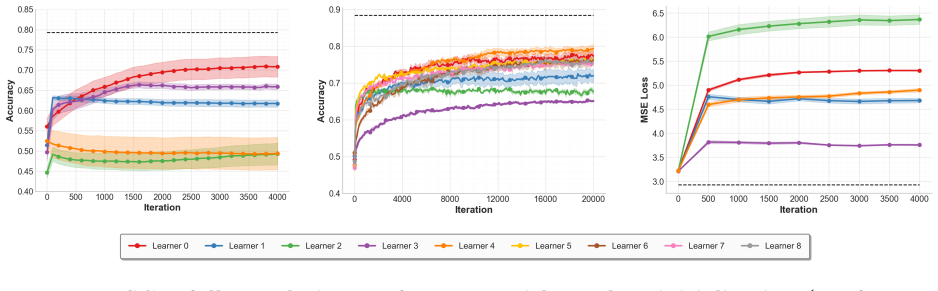
- [Figure 2 caption] The caption says 'random initialization (Preference-aware scenario)', but Definition 3 assumes all learners initialize at the specialized ERM solutions. This inconsistency should be clarified in the caption and in the experimental setup description.
- [Algorithm 2 vs Assumption 5] Algorithm 2 constructs pseudo-labels yagg,i(·, Θ0), while Assumption 5 is stated as yagg,i(x, Θ_{-i}) without specifying the parameter argument. To avoid ambiguity, state explicitly that Assumption 5 is evaluated at the initial snapshot Θ0 used by the algorithm.
Circularity Check
No significant circularity: the derivations are self-contained conditional guarantees; self-citations provide technical lemmas but do not reduce the claims to their inputs.
full rationale
The paper's central claims do not reduce to their inputs. Theorem 2 constructs an explicit instance (Example 1) and computes the risk bounds directly from that construction (Lemma 9) and from a case analysis of stationary points (Lemma 10); the bad risk bound R(θ̄1) ≥ Γ is a computed property of the constructed distribution, not a fitted parameter. Theorem 3's convergence proof uses a stochastic approximation argument with a Lyapunov function; the only reliance on prior work of overlapping authorship is Lemma 13's gradient identity, citing Lemma 4.3 of Su and Dean [47], which is a technical mathematical lemma rather than the target result, and the boundedness Assumption 4 is explicitly stated as an assumption, not derived from the conclusion. Theorem 4's performance bound is stated in terms of the assumed pseudo-label accuracy B (Assumption 5); Lemma 3 proves the boundedness of B in each scenario from explicit conditions (majority-good, market-leader, preference-aware). In the preference-aware case, B ≤ ε follows from the optimality of the initialized specialist ERM solutions θ̄_i, which is an initialization condition stated in Definition 3, not an assertion of the conclusion that probing achieves low global risk. The bound then combines this with the optimization guarantee, which is a genuine conditional derivation. The experiments are empirical validation and are not used as evidence for the theorems. The paper's own discussion acknowledges limitations (convex losses, offline probing, the unproved Assumption 4, and the mismatch between the theory's initialization and the experiments' random initialization), but these are correctness or scope gaps, not circularity. The τ=1/2 boundary issue in Lemma 10, where Case 3 is not ruled out because the inequality is an equality, is a mathematical correctness concern in the uniqueness claim, but it is not a circular dependency: the proof does not assume the uniqueness it is trying to establish. Overall, no step was found where a prediction is equivalent to its input by definition or by fitted parameter renaming.
Assumptions & free parameters
free parameters (2)
- C (slope in bad instance) =
√(Γ+ε) - 1
- α (mixture weight in bad instance) =
ε/(C+1)²
assumptions (6)
- domain assumption Assumption 1: continuous density with bounded support and bounded labels.
- standard math Assumption 2: learning rates satisfy Ση_t=∞ and Ση_t²<∞.
- domain assumption Assumption 3: measure of near-tie sets tends to zero.
- domain assumption Assumption 4: iterates Θ_t are almost surely bounded and the stationary set is compact.
- domain assumption Assumption 5: accurate probing condition, E[(y_agg - y)²] ≤ B.
- standard math Lemma 4.3 of [47] (envelope theorem for gradient of ai(Θ)E_Di[ℓ]).
Cite this review
Pith. "Pith review of Dynamics of Learning under User Choice: Overspecialization and Peer-Model Probing." pith.science (2026). https://pith.science/paper/ZBQ6TL3W
@misc{pith2026260223565,
  author       = {Pith},
  title        = {Pith review of: Dynamics of Learning under User Choice: Overspecialization and Peer-Model Probing},
  year         = {2026},
  howpublished = {\url{https://pith.science/paper/ZBQ6TL3W}},
  note         = {Machine review of arXiv:2602.23565}
}
read the original abstract
In many economically relevant contexts where machine learning is deployed, multiple platforms obtain data from the same pool of users, each of whom selects the platform that best serves them. Prior work in this setting focuses exclusively on the "local" losses of learners on the distribution of data that they observe. We find that there exist instances where learners who use existing algorithms almost surely converge to models with arbitrarily poor global performance, even when models with low full-population loss exist. This happens through a feedback-induced mechanism, which we call the overspecialization trap: as learners optimize for users who already prefer them, they become less attractive to users outside this base, which further restricts the data they observe. Inspired by the recent use of knowledge distillation in modern ML, we propose an algorithm that allows learners to "probe" the predictions of peer models, enabling them to learn about users who do not select them. Our analysis characterizes when probing succeeds: this procedure converges almost surely to a stationary point with bounded full-population risk when probing sources are sufficiently informative, e.g., a known market leader or a majority of peers with good global performance. We verify our findings with semi-synthetic experiments on the MovieLens, Census, and Amazon Sentiment datasets.
Figures


Figures from the paper (8 more)


Reviewed August 2, 2026 · model on record in the stance chip above.
Discussion (0). Continue with ORCID to comment.