REVIEW 5 major objections 7 minor 16 references
Tactile-based Reinforcement Learning for Adaptive Grasping under Observation Uncertainties
T0 review · 5 major / 7 minor · reviewed 2026-08-07 · deepseek-v4-flash
Pith's one-line read A tactile-reactive grasping policy achieves 92–96 percent success in simulation even when object poses are noisy, beating the same controller without touch by up to 14 points.
desk verdict Plausible idea, but the success-rate claim is untestable as presented. read the letter →
The pith
A machine-rendered reading of the paper's core claim, the machinery that carries it, and where it could break.
The reading
What carries the argument
The load-bearing mechanism is the tactile feedback simulator built in MuJoCo. Contact between the gripper's sensor sites and an object generates force readings through a sliding joint whose damping and stiffness parameters model skin-like deformation; the policy receives downsampled tactile observations alongside proprioceptive joint angles and end-effector pose. The PPO policy uses these inputs to output small motion corrections at each step. The reward function ties fingertip contact, finger motion, hand motion, and object pose deviation together, rewarding stable contact and penalizing unnecessary movement. The tactile signal is what lets the policy detect and correct the position error caused by noisy object state estimates.
What would settle it
Run the same PPO training loop on a physical gripper with real tactile sensors, add the pose noise used in simulation, and compare per-object success rates against the no-tactile baseline; if the tactile policy does not beat that baseline by roughly the 3–14 point margin reported in Table I, the claim that simulated tactile feedback transfers to real grasping fails.
Extended reading notes
Core claim
The central claim is that tactile feedback can substitute for accurate object-position knowledge during grasp execution. Using a MuJoCo-based tactile simulator that reads contact forces through a deformable sensor body, and a PPO policy that outputs incremental joint-angle and end-effector adjustments, the gripper adapts its grasp as contact happens. With randomized pose noise added during training, the policy learns to adjust to uncertain observations. The paper's direct evidence is the comparative experiment: across column, capsule, ellipsoid, and sphere objects, tactile-enabled grasping succeeds at 92–96 percent versus 82–89 percent without tactile feedback. The authors conclude that tactile perception contributes meaningfully to grasp stability under observation noise.
Load-bearing premise
The load-bearing premise is that the MuJoCo tactile readings faithfully represent real tactile sensor outputs; if that correspondence is wrong, the trained policy's advantage may exist only in simulation, since the paper reports no physical-robot validation.
Editorial extensions
If this is right
- The method relaxes the assumption that a planned grasp pose is executed perfectly, since corrective adjustments happen during closing motion.
- Policies trained with randomized pose noise can operate from inaccurate object state estimates rather than requiring precise perception.
- Grasp success improves by 3 to 14 percentage points when tactile feedback is enabled, across objects with matched mass and volume but different shapes.
- Downsampled tactile observations are intended to make the policy usable across different tactile sensor resolutions and noise conditions.
Reading between the lines
- The paper does not demonstrate real-robot transfer; its practical value depends on whether simulated contact-force readings match real tactile sensors, which is untested here.
- If the simulation-to-real gap is small, the method could support a pipeline that uses vision only for an initial grasp guess and tactile sensing for mid-grasp correction, reducing reliance on dense 3D reconstruction.
- A natural next experiment is to vary the magnitude of pose noise during training and test whether the tactile advantage grows as observation uncertainty increases.
- The reward objective could be extended to include post-grasp force thresholds, turning binary success rates into a continuous measure of grasp stability.
Editorial analysis
A structured set of objections, weighed in public.
Referee Report
Summary. The paper proposes a tactile-based adaptive grasping method for robotic manipulation under uncertain object state observations. The authors build a MuJoCo-based tactile simulator that outputs contact-force readings from touch sensors on a robotic hand, and they train a Proximal Policy Optimization (PPO) policy that takes tactile feedback, proprioceptive data, and a noisy initial object-pose estimate as input, producing joint-angle and end-effector pose increments. The reward function combines fingertip contact, hand displacement, joint deviation, and object pose-error terms. Experiments compare tactile-enabled (TE) and tactile-disabled (TD) policies on four object shapes (column, capsule, ellipsoid, sphere), reporting success rates of 92--96% with tactile feedback versus 82--89% without it (Table I). The authors conclude that the method improves both success rate and grasp stability in simulation and real-world applications, and that it is robust to occlusions and uncertain observations.
Significance. If the central claim holds, the paper makes a useful contribution to learning-based grasping: it demonstrates a plausible way to use simulated tactile signals for closed-loop grasp adjustment under noisy pose estimates, and it provides an ablation across four shapes. The reported advantage of tactile feedback (3--11 percentage points in success rate) is the kind of result that could motivate follow-up work on tactile-driven manipulation. However, the paper does not release code or trained policies, and the quantitative evidence is presented without statistical support or a formal definition of the success metric. The approach is reasonable in principle, and the issues identified below are fixable with additional experiments and clearer specification of the problem setup.
major comments (5)
- [Section IV-B, Table I] The success-rate comparison is the central quantitative claim, but the manuscript never defines the success criterion used to compute the rates in Table I, nor does it report the number of PPO training seeds, the initial-state sampling distribution, or any variance estimate. PPO is stochastic and its final performance depends strongly on seed and hyperparameters, so a single run per condition cannot establish that tactile feedback—rather than run-to-run luck—causes the reported 3--11 percentage-point differences, especially for the ellipsoid where the gap is only 3%. The authors should specify the success metric precisely, repeat training over multiple seeds, and report confidence intervals or a significance test.
- [Section III-D, Eqs. (4)--(7)] The reward function is under-specified, which prevents an independent assessment of whether the reported success rates partly reflect reward shaping rather than a separate task objective. The text does not define G_diff, T, O_diff, or D_diff; the indexing of G_diff in Eq. (7) is unexplained; and the relationship between the object pose-error penalties (O_diff, D_diff) and the success criterion in Table I is never stated. If 'success' is defined as a threshold on the same pose-error quantity that appears in the reward, the TE versus TD comparison would be confounded with reward shaping. Please define all reward terms and state whether the evaluation metric is identical to, or distinct from, the reward components.
- [Section III-D and Section IV-A] The observation uncertainty model is not specified. The paper says 'we add noise to its position' and 'we introduce random noise to the object's position to enhance the robustness of the policy,' but it never states the distribution, amplitude, or units of this noise, nor how the 'initial (uncertain) observation of the object pose' is generated. Without this information, the claimed robustness to observation uncertainties cannot be reproduced or interpreted, and the comparison between TE and TD conditions is not well-defined in terms of the difficulty of the task.
- [Section V and Section IV] The conclusion that the method improves 'grasp success rates in both simulation and real-world applications' is not supported by the experimental section, which contains only simulation experiments. No real-robot, real-tactile-sensor, or sim-to-real transfer results are reported. The authors should either add real-world validation or remove the real-world claim and soften the conclusion to reflect that the results are simulation-only.
- [Sections III-A and III-B] The tactile simulator is the foundation of the method, yet its fidelity to real tactile sensors is not established. The paper offers no calibration data, no comparison with physical tactile sensor readings, and no justification for the chosen joint damping, stiffness, and inertia-scaling parameters (including the value of alpha in Eq. (2)). Given the stated goal of 'bridg[ing] the gap between simulated and real-world tactile data,' the absence of any sim-to-real evidence leaves the practical applicability of the approach unvalidated; at a minimum, the authors should acknowledge this as a limitation and state that the current results are indicative but not yet validated on hardware.
minor comments (7)
- [Section III-B, Eq. (1)] Equation (1) is presented without introducing all symbols: a0, d, b, k, and r are not defined in the sentence preceding it, and the sentence 'a1 denote the acceleration...' has a subject--verb agreement error. Please define every variable and fix the grammar.
- [Sections I and III-A] The 'downsampled tactile observations' are introduced as a key contribution, but the method description never specifies the sampling pattern, the number of tactile sites, or how uniform spacing is implemented. Please add these details.
- [Section III-B, Eq. (2)] The text contains the typo 'sim2real.representing'; additionally, it is unclear whether alpha is a scalar, a vector, or a matrix, and no value or range is given for it.
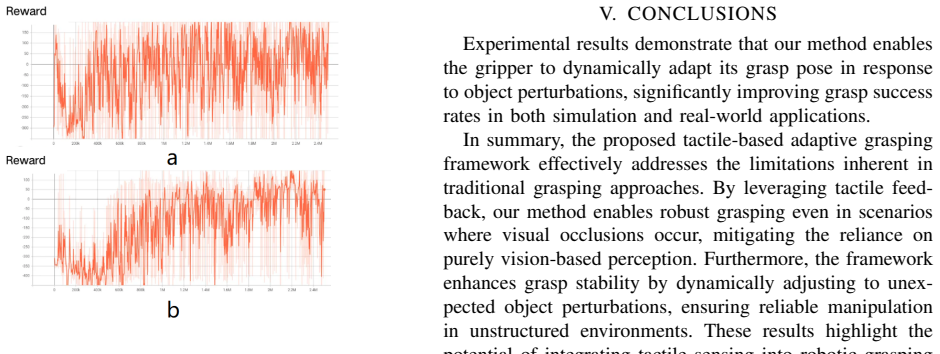
- [Section IV-A] The training-process description refers to subfigures (a) and (b) of Figure 4, but the caption does not state which condition (tactile-enabled or tactile-disabled) corresponds to which subfigure. Please label the figure panels explicitly.
- [Section IV-B] The sentence 'The experimental results demonstrate that incorporating tactile feedback significantly improves the success rate' uses the word 'significantly' without any statistical test; please either provide a statistical test or replace 'significantly' with a term like 'increases'.
- [Section III-A] The phrase 'robotic preceptive data' should be 'proprioceptive data'; this typo appears in the paragraph describing the observation space.
- [References] The reference list and in-text citations contain inconsistent spacing and punctuation (e.g., 'DQN)[16] , and' and 'PPO) have been applied'); please proofread the bibliography.
Circularity Check
No significant circularity: the tactile-grasping comparison is an empirical RL result, and no load-bearing derivation reduces to its own inputs or to self-citations.
full rationale
The paper's central claim is that a PPO-trained policy using tactile feedback improves grasp success and stability under inaccurate object pose estimates, supported by the comparative success rates in Table I. This is an empirical claim about a trained policy, not a derivation in which an output is constructed from its own definition. The reward function (Eqs. 4-7) does include terms penalizing fingertip contact loss, hand/joint motion, and object position/orientation deviation, and the paper never explicitly defines the success criterion used in Table I; if success were a threshold on those same pose-error quantities, there could be partial overlap between training objective and evaluation. However, the text does not state that the success metric is defined by O_diff or D_diff, so no specific Eq. X = Eq. Y reduction, or fitted-parameter-renamed-as-prediction, can be exhibited. The hard rule requiring a quotable reduction therefore precludes flagging this as circularity. There are no self-citations: all references are standard prior works by other authors (MuJoCo, GraspNet, GQ-CNN, etc.), and no uniqueness theorem or ansatz is imported from the authors' own prior publications. The reported weaknesses - undefined success metric, single training run without seed variance, and lack of sim-to-real validation - are correctness, reproducibility, and external-validity concerns, not circularity. Accordingly, the paper is not circular under the stated criteria.
Assumptions & free parameters
free parameters (6)
- Tactile sensor joint damping coefficient
- Tactile sensor joint stiffness parameter
- Tactile sensor inertia scaling parameter alpha
- Contact reward amplitude beta
- Hand displacement scaling factor gamma
- Observation noise level and distribution
assumptions (5)
- domain assumption MuJoCo contact solver outputs (touch sensor scalar forces) are treated as ground-truth tactile signals.
- domain assumption The spring-damper joint model in Eq (1) captures skin-like deformation well enough for grasping policies.
- domain assumption Downsampled tactile observations retain enough information for adaptive grasp correction.
- domain assumption Matching mass and volume across test objects isolates shape as the generalization variable.
- ad hoc to paper The hand-designed reward in Eq (4)-(7) is a valid proxy for grasp success and stability.
Cite this review
Pith. "Pith review of Tactile-based Reinforcement Learning for Adaptive Grasping under Observation Uncertainties." pith.science (2026). https://pith.science/paper/ZIEE56SG
@misc{pith2026250516167,
  author       = {Pith},
  title        = {Pith review of: Tactile-based Reinforcement Learning for Adaptive Grasping under Observation Uncertainties},
  year         = {2026},
  howpublished = {\url{https://pith.science/paper/ZIEE56SG}},
  note         = {Machine review of arXiv:2505.16167}
}
read the original abstract
Robotic manipulation in industrial scenarios such as construction commonly faces uncertain observations in which the state of the manipulating object may not be accurately captured due to occlusions and partial observables. For example, object status estimation during pipe assembly, rebar installation, and electrical installation can be impacted by observation errors. Traditional vision-based grasping methods often struggle to ensure robust stability and adaptability. To address this challenge, this paper proposes a tactile simulator that enables a tactile-based adaptive grasping method to enhance grasping robustness. This approach leverages tactile feedback combined with the Proximal Policy Optimization (PPO) reinforcement learning algorithm to dynamically adjust the grasping posture, allowing adaptation to varying grasping conditions under inaccurate object state estimations. Simulation results demonstrate that the proposed method effectively adapts grasping postures, thereby improving the success rate and stability of grasping tasks.
Figures


Figures from the paper (2 more)

Reference graph
Works this paper leans on
-
[1]
Automated construction of robotic manipulation programs
Diankov, Rosen. Automated construction of robotic manipulation programs. Diss. Carnegie Mellon University, USA, 2010
work page 2010
-
[2]
Tang, C., Huang, D., Dong, W., Xu, R., Zhang, H. (2025). Foundation- grasp: Generalizable task-oriented grasping with foundation models. IEEE Transactions on Automation Science and Engineering
work page 2025
-
[3]
Spiliotopoulos, Jason, George Michalos, and Sotiris Makris. ”A re- configurable gripper for dexterous manipulation in flexible assembly.” Inventions 3.1 (2018): 4
work page 2018
-
[4]
ˇStibinger, Petr, et al. ”Mobile manipulator for autonomous localization, grasping and precise placement of construction material in a semi- structured environment.” IEEE Robotics and Automation Letters 6.2 (2021): 2595-2602
work page 2021
-
[5]
Todorov, Emanuel, Tom Erez, and Yuval Tassa. ”Mujoco: A physics engine for model-based control.” 2012 IEEE/RSJ international confer- ence on intelligent robots and systems. IEEE, 2012
work page 2012
-
[6]
Feix, Thomas, Ian M. Bullock, and Aaron M. Dollar. ”Analysis of human grasping behavior: Object characteristics and grasp type.” IEEE transactions on haptics 7.3 (2014): 311-323
work page 2014
-
[7]
Cutkosky, Mark R., and Robert D. Howe. ”Human grasp choice and robotic grasp analysis.” Dextrous robot hands (1990): 5-31
work page 1990
-
[8]
Nguyen, Van-Duc. ”Constructing force-closure grasps.” The Interna- tional Journal of Robotics Research 7.3 (1988): 3-16
work page 1988
Show all 16 references
-
[9]
”Constructing force-closure grasps in 3D.” Proceedings
Nguyen, V-D. ”Constructing force-closure grasps in 3D.” Proceedings. 1987 IEEE International Conference on Robotics and Automation. V ol
1987
-
[10]
”A model-based scooping grasp for the autonomous picking of unknown objects with a two-fingered gripper.” Robotics and Autonomous Systems 106 (2018): 14-25
L ´evesque, Franc ¸ois, et al. ”A model-based scooping grasp for the autonomous picking of unknown objects with a two-fingered gripper.” Robotics and Autonomous Systems 106 (2018): 14-25
2018
-
[11]
”Model-based strategy for grasping 3D de- formable objects using a multi-fingered robotic hand.” Robotics and Autonomous Systems 95 (2017): 196-206
Zaidi, Lazher, et al. ”Model-based strategy for grasping 3D de- formable objects using a multi-fingered robotic hand.” Robotics and Autonomous Systems 95 (2017): 196-206
2017
-
[12]
”Acronym: A large-scale grasp dataset based on simulation.” 2021 IEEE Interna- tional Conference on Robotics and Automation (ICRA)
Eppner, Clemens, Arsalan Mousavian, and Dieter Fox. ”Acronym: A large-scale grasp dataset based on simulation.” 2021 IEEE Interna- tional Conference on Robotics and Automation (ICRA). IEEE, 2021
2021
-
[13]
”Jacquard: A large scale dataset for robotic grasp detection.” 2018 IEEE/RSJ International Conference on Intelligent Robots and Systems (IROS)
Depierre, Amaury, Emmanuel Dellandr ´ea, and Liming Chen. ”Jacquard: A large scale dataset for robotic grasp detection.” 2018 IEEE/RSJ International Conference on Intelligent Robots and Systems (IROS). IEEE, 2018
2018
-
[14]
”6-dof grasp- net: Variational grasp generation for object manipulation.” Proceedings of the IEEE/CVF international conference on computer vision
Mousavian, Arsalan, Clemens Eppner, and Dieter Fox. ”6-dof grasp- net: Variational grasp generation for object manipulation.” Proceedings of the IEEE/CVF international conference on computer vision. 2019
2019
-
[15]
”Improved GQ-CNN: Deep learning model for planning robust grasps.” arXiv preprint arXiv:1802.05992 (2018)
Ja ´skowski, Maciej, et al. ”Improved GQ-CNN: Deep learning model for planning robust grasps.” arXiv preprint arXiv:1802.05992 (2018)
2018 arXiv
-
[16]
”Deep exploration via bootstrapped DQN.” Ad- vances in neural information processing systems 29 (2016)
Osband, Ian, et al. ”Deep exploration via bootstrapped DQN.” Ad- vances in neural information processing systems 29 (2016)
2016
Reviewed August 7, 2026 · model on record in the stance chip above.
Discussion (0). Continue with ORCID to comment.