Bridging Ab Initio Symmetries and Global Nuclear Masses with Interpretable Neural Networks
Pith reviewed 2026-06-29 01:47 UTC · model grok-4.3
The pith
Wigner's SU(4) symmetry supplies predictive power for nuclear masses across the entire chart when encoded as Casimir operators in compact neural models.
A machine-rendered reading of the paper's core claim, the machinery that carries it, and where it could break.
Core claim
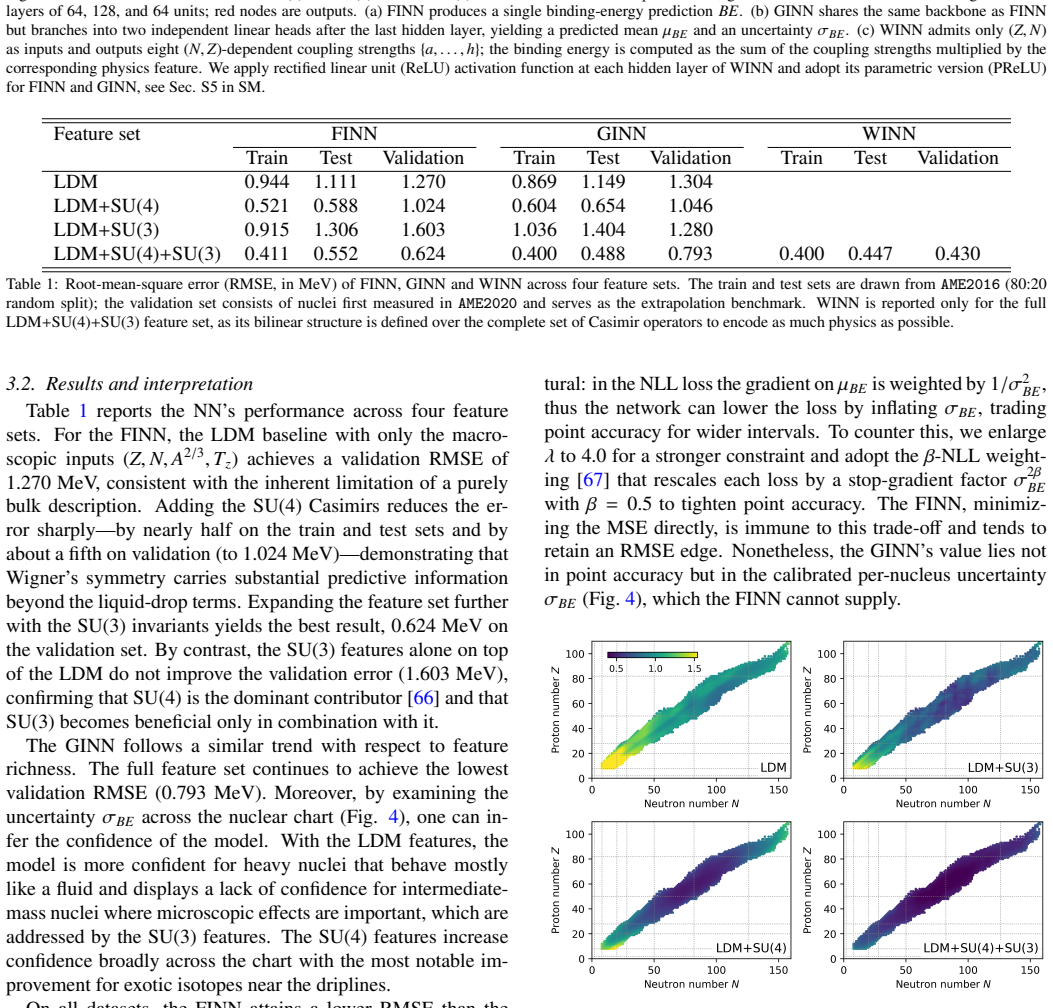
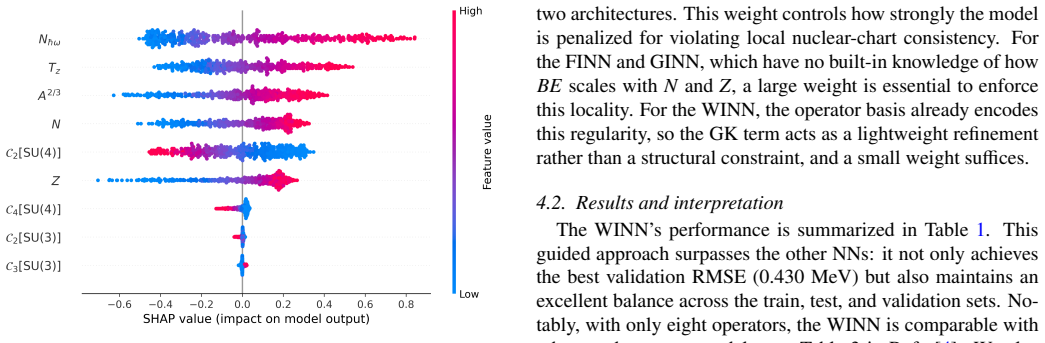
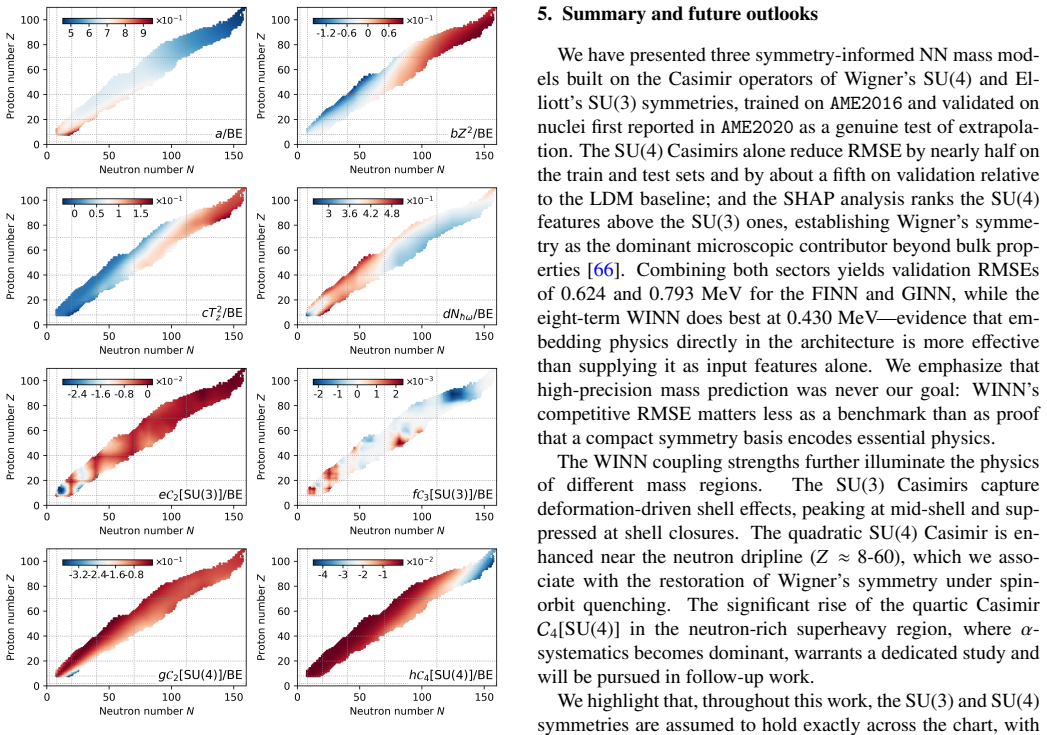
The SU(4) Casimir operators carry information beyond bulk liquid-drop properties; when used as an operator basis they cut RMSE by nearly half on train and test data and by about a fifth on extrapolation. The resulting Wigner-Informed NN (WINN) attains the lowest validation RMSE of 0.430 MeV and further shows an enhancement of the quadratic SU(4) Casimir near the neutron dripline together with an unexpected gain of the quartic operator in the superheavy region.
What carries the argument
The Wigner-Informed NN (WINN), a mass formula that takes the SU(3) and SU(4) Casimir operators directly as its operator basis.
If this is right
- SU(4) symmetry supplies information beyond the liquid-drop model for global nuclear masses.
- WINN reaches competitive accuracy while remaining compact enough for direct physical interpretation.
- The quadratic SU(4) Casimir increases near the neutron dripline, indicating local restoration of Wigner's symmetry.
- The quartic SU(4) operator gains weight in the superheavy region.
Where Pith is reading between the lines
- The same operator basis could be tested on other global observables such as charge radii or quadrupole moments.
- The approach offers a route to embed ab initio symmetry constraints into phenomenological mass tables without increasing model complexity.
- If the quartic-term rise persists in future data, it may point to a new effective degree of freedom in superheavy nuclei.
Load-bearing premise
That the observed error reductions can be attributed specifically to the SU(3) and SU(4) Casimir operators rather than to the general flexibility of neural-network fitting on the chosen data splits.
What would settle it
A control experiment in which a neural network of comparable size and architecture, trained on identical splits but without the Casimir operators, yields RMSE reductions equal to or larger than those obtained when the operators are included.
Figures

read the original abstract
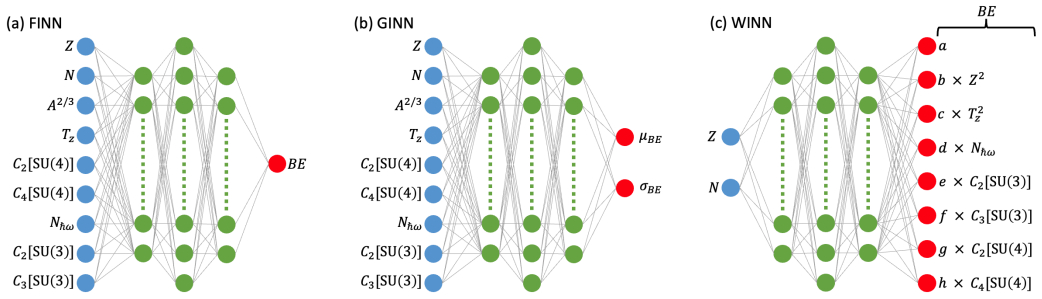
Ab initio modeling has established Wigner's SU(4) and Elliott's SU(3) as dominant symmetries of the nuclear force in light and intermediate-mass nuclei. We ask whether they also govern nuclear binding across the entire chart. Our aim is not high-precision prediction but physical insight, through interpretable, symmetry-based models. From the SU(3) and SU(4) Casimir operators we construct three neural-network (NN) mass models: Feature-Informed NN (FINN) for point predictions, Gaussian-Informed NN (GINN) adding uncertainty quantification, and Wigner-Informed NN (WINN) -- a mass formula using the Casimirs as an operator basis. All are trained on AME2016 and validated on nuclei new to AME2020. The SU(4) operators alone cut the root-mean-square error (RMSE) by nearly half on train and test data, and by about a fifth on extrapolation, relative to the liquid-drop baseline -- showing that Wigner's symmetry carries predictive information beyond bulk properties. Despite its compact form, WINN reaches the lowest validation RMSE, 0.430 MeV -- competitive with state-of-the-art mass models -- which we read less as a benchmark than as evidence that its symmetry basis captures important physics. WINN further reveals i) an enhancement of the quadratic SU(4) Casimir near the neutron dripline, signaling restoration of Wigner's symmetry, and ii) an unexpected gain of the quartic operator in the superheavy region. We thereby elevate emergent symmetries from the hidden order within individual nuclei to a governing principle of the whole nuclear chart.
Editorial analysis
A structured set of objections, weighed in public.
Referee Report
Summary. The paper constructs three neural-network mass models (FINN, GINN, WINN) whose inputs or basis functions are the Casimir operators of SU(3) and SU(4). Trained on AME2016 and validated on nuclei new to AME2020, the models are reported to reduce RMSE by nearly half relative to a liquid-drop baseline on train/test sets and by ~20% on extrapolation; WINN, a compact linear combination of the Casimirs, achieves the lowest validation RMSE of 0.430 MeV and is interpreted as evidence that Wigner’s symmetry governs global masses, with additional claims of quadratic-term enhancement near the dripline and quartic-term gain in the superheavy region.
Significance. If the reported RMSE reductions can be shown to arise specifically from the symmetry operators rather than from the greater expressive power of neural networks, the work would supply an interpretable, symmetry-motivated global mass formula that links ab initio findings to the entire chart. The use of a held-out AME2020 validation set and the compact operator basis of WINN are concrete strengths that would remain valuable even if the attribution to SU(4) requires further controls.
major comments (3)
- [Results section (RMSE tables)] Results section (RMSE tables): all quantitative claims of improvement (nearly 50% on train/test, ~20% on extrapolation) are made relative to a parametric liquid-drop model rather than to a neural network of identical architecture supplied with non-symmetry features of comparable dimensionality (e.g., polynomials in Z and N up to degree 4). Without this control, the central attribution of the RMSE reduction to SU(4) content cannot be distinguished from the general flexibility of the NN on the chosen data splits.
- [§4 (WINN definition)] §4 (WINN definition) and validation paragraph: WINN is a fitted linear combination whose coefficients are determined from the same data used for performance reporting; the interpretation that its basis “captures important physics” therefore rests on post-fit coefficient analysis rather than on a parameter-free derivation or an ablation that isolates the Casimir operators from other possible bases of the same dimension.
- [Methods and results] Methods and results: no error bars, hyperparameter sweeps, or ablation studies on the neural-network components are reported, so the quoted validation RMSE of 0.430 MeV cannot be assessed for statistical significance or sensitivity to architecture choices.
minor comments (2)
- Notation for the Casimir operators should be defined once with explicit expressions (including normalization conventions) rather than assumed from ab initio literature.
- Figure captions for the dripline and superheavy-region plots should state the exact definition of “near the dripline” and the mass-number range used for the quartic-term analysis.
Simulated Author's Rebuttal
We thank the referee for the constructive and detailed report. The comments highlight important controls that would strengthen the attribution of performance gains to the symmetry operators. We address each major comment below and indicate where revisions will be made.
read point-by-point responses
-
Referee: Results section (RMSE tables): all quantitative claims of improvement (nearly 50% on train/test, ~20% on extrapolation) are made relative to a parametric liquid-drop model rather than to a neural network of identical architecture supplied with non-symmetry features of comparable dimensionality (e.g., polynomials in Z and N up to degree 4). Without this control, the central attribution of the RMSE reduction to SU(4) content cannot be distinguished from the general flexibility of the NN on the chosen data splits.
Authors: We agree that a direct comparison against a neural network supplied with non-symmetry features of matched dimensionality is the most rigorous way to isolate the contribution of the Casimir operators. The liquid-drop model was chosen as the conventional baseline for global mass formulas, but it does not control for network expressivity. We will add this control experiment (polynomial features in Z and N up to degree 4, same architecture and training protocol) to the revised Results section and update the RMSE tables accordingly. revision: yes
-
Referee: §4 (WINN definition) and validation paragraph: WINN is a fitted linear combination whose coefficients are determined from the same data used for performance reporting; the interpretation that its basis “captures important physics” therefore rests on post-fit coefficient analysis rather than on a parameter-free derivation or an ablation that isolates the Casimir operators from other possible bases of the same dimension.
Authors: The operator basis itself is selected on theoretical grounds from the established SU(3) and SU(4) Casimirs of ab initio calculations, which supplies the parameter-free motivation for the functional form. The subsequent linear fit then determines the relative weights and reveals systematic trends (quadratic enhancement near the dripline, quartic gain in the superheavy region). We will revise §4 to separate the theoretical basis choice from the data-driven coefficient analysis more explicitly and will add a short ablation comparing WINN performance against a linear model using an alternative four-dimensional basis of comparable size (e.g., simple powers of Z and N) to quantify the advantage of the symmetry operators. revision: partial
-
Referee: Methods and results: no error bars, hyperparameter sweeps, or ablation studies on the neural-network components are reported, so the quoted validation RMSE of 0.430 MeV cannot be assessed for statistical significance or sensitivity to architecture choices.
Authors: We acknowledge that the absence of uncertainty estimates and sensitivity checks limits the ability to judge robustness. In the revised manuscript we will report bootstrap-derived standard errors on all RMSE values and include a concise hyperparameter-sensitivity table (varying learning rate, hidden-layer width, and regularization within the ranges explored during training). Full ablation studies on the neural-network components of FINN and GINN will be added to the Methods section. revision: yes
Circularity Check
No significant circularity in derivation chain
full rationale
The paper constructs neural-network mass models by training on AME2016 data with SU(3)/SU(4) Casimir operators as explicit input features and reports empirical RMSE reductions versus a liquid-drop baseline on both in-sample and held-out AME2020 nuclei. These performance numbers are direct outputs of the supervised fitting procedure rather than quantities derived by algebraic identity or self-referential definition from the same inputs. No load-bearing self-citation, uniqueness theorem, or ansatz is invoked to justify the central attribution; the comparison to the parametric baseline, while methodologically debatable, does not render the reported test-set or extrapolation errors tautological. The derivation chain therefore remains self-contained as an empirical feature-ablation study.
Axiom & Free-Parameter Ledger
free parameters (2)
- Neural network weights and biases
- WINN operator coefficients
axioms (1)
- domain assumption SU(4) and SU(3) Casimir operators encode the dominant symmetry information relevant to nuclear binding energies across the chart.
Reference graph
Works this paper leans on
-
[1]
Boehnlein, M
A. Boehnlein, M. Diefenthaler, N. Sato, M. Schram, V . Ziegler, C. Fanelli, M. Hjorth-Jensen, T. Horn, M. P. Kuchera, D. Lee, W. Nazarewicz, P. Ostroumov, K. Orginos, A. Poon, X.-N. Wang, A. Scheinker, M. S. Smith, L.-G. Pang, Colloquium: Machine learning in nuclear physics, Reviews of Modern Physics 94 (2022) 031003
2022
-
[2]
M. Li, T. M. Sprouse, B. S. Meyer, M. R. Mumpower, Atomic masses with machine learning for the astrophysi- calrprocess, Physics Letters B 848 (2024) 138385
2024
-
[3]
Utama, J
R. Utama, J. Piekarewicz, H. B. Prosper, Nuclear mass predictions for the crustal composition of neutron stars: A Bayesian neural network approach, Physical Review C 93 (2016) 014311
2016
-
[4]
Gao, Y .-J
Z.-P. Gao, Y .-J. Wang, H.-L. Lü, Q.-F. Li, C.-W. Shen, L. Liu, Machine learning the nuclear mass, Nuclear Sci- ence and Techniques 32 (2021) 109
2021
-
[5]
M. R. Mumpower, T. M. Sprouse, A. E. Lovell, A. T. Mo- han, Physically interpretable machine learning for nuclear masses, Physical Review C 106 (2022) L021301
2022
-
[6]
Huang, J
Y . Huang, J. Chen, J. Jia, L.-M. Liu, Y .-G. Ma, C. Zhang, Validation and extrapolation of atomic masses with a physics-informed fully connected neural network, Phys- ical Review C 111 (2025) 034329
2025
-
[7]
Liu, H.-L
G.-P. Liu, H.-L. Wang, Z.-Z. Zhang, M.-L. Liu, Model- repair capabilities of tree-based machine-learning algo- rithms applied to theoretical nuclear mass models, Physi- cal Review C 111 (2025) 024306
2025
-
[8]
Y . Lu, T. Shang, P. Du, J. Li, H. Liang, Z. Niu, Nuclear mass predictions based on a convolutional neural network, Physical Review C 111 (2025) 014325
2025
-
[9]
Z. Niu, H. Liang, Nuclear mass predictions based on bayesian neural network approach with pairing and shell effects, Physics Letters B 778 (2018) 48–53
2018
-
[10]
Utama, J
R. Utama, J. Piekarewicz, Validating neural-network re- finements of nuclear mass models, Physical Review C 97 (2018) 014306
2018
-
[11]
Qu, J.-Y
S. Qu, J.-Y . Zhang, M. Bao, Nuclear mass predictions with a bayesian neural network, Chinese Physics C 49 (10) (2025) 104106
2025
-
[12]
Kejzlar, L
V . Kejzlar, L. Neufcourt, W. Nazarewicz, Local Bayesian Dirichlet mixing of imperfect models, Scientific Reports 13 (2023) 19600
2023
-
[13]
Yüksel, D
E. Yüksel, D. Soydaner, H. Bahtiyar, Nuclear mass pre- dictions using machine learning models, Physical Review C 109 (2024) 064322
2024
-
[14]
W. Ye, N. Wan, Understanding on prediction differences among theoretical mass models with machine learning techniques, Physical Review C 111 (2025) 044317
2025
-
[15]
Jalili, Z
A. Jalili, Z. Saleki, F. Pan, A.-X. Chen, J. P. Draayer, Isospin symmetry breaking and spin-parity effects in nu- clear binding energies with a hybrid DFT-machine learn- ing framework, Journal of Physics G: Nuclear and Particle Physics 53 (5) (2026) 055104
2026
-
[16]
Elliott, Collective motion in the nuclear shell model
J. Elliott, Collective motion in the nuclear shell model. I. Classification schemes for states of mixed configurations, Proceedings of the Royal Society A 245 (1958) 128
1958
-
[17]
J. P. Elliott, Collective Motion in the Nuclear Shell Model. II. The Introduction of Intrinsic Wave-Functions, Proceed- ings of the Royal Society A 245 (1958) 562
1958
-
[18]
J. P. Elliott, M. Harvey, Collective motion in the nuclear shell model III. The calculation of spectra, Proceedings of the Royal Society A 272 (1963) 557
1963
-
[19]
Rowe, Microscopic theory of the nuclear collective model, Reports on Progress in Physics 48 (1985) 1419
D. Rowe, Microscopic theory of the nuclear collective model, Reports on Progress in Physics 48 (1985) 1419
1985
-
[20]
Dytrych, K
T. Dytrych, K. Sviratcheva, C. Bahri, J. Draayer, J. Vary, Evidence for Symplectic Symmetry in Ab Initio No-Core Shell Model Results for Light Nuclei, Physical Review Letters 98 (2007) 162503
2007
-
[21]
Dytrych, K
T. Dytrych, K. D. Launey, J. P. Draayer, P. Maris, J. P. Vary, E. Saule, U. Catalyurek, M. Sosonkina, D. Langr, M. A. Caprio, Collective Modes in Light Nuclei from First Principles, Physical Review Letters 111 (2013) 252501. 7
2013
-
[22]
Dytrych, K
T. Dytrych, K. D. Launey, J. P. Draayer, D. J. Rowe, J. L. Wood, G. Rosensteel, C. Bahri, D. Langr, R. B. Baker, Physics of Nuclei: Key Role of an Emergent Symmetry, Physical Review Letters 124 (2020) 042501
2020
-
[23]
A. E. McCoy, M. A. Caprio, T. Dytrych, P. J. Fasano, Emergent Sp(3,R) Dynamical Symmetry in the Nuclear Many-Body System from an Ab Initio Description, Phys- ical Review Letters 125 (2020) 102505
2020
-
[24]
Mercenne, K
A. Mercenne, K. Launey, T. Dytrych, J. Escher, S. Quaglioni, G. Sargsyan, D. Langr, J. Draayer, Effi- cacy of the symmetry-adapted basis for ab initio nucleon- nucleus interactions for light- and intermediate-mass nu- clei, Computer Physics Communications 280 (2022) 108476
2022
-
[25]
K. D. Launey, G. H. Sargsyan, A. Mercenne, J. E. Es- cher, D. C. Mumma, Ab initio symmetry-adapted ap- proaches to nuclear reactions, Progress in Particle and Nu- clear Physics 148 (2026) 104233
2026
-
[26]
G. H. Sargsyan, K. D. Launey, M. T. Burkey, A. T. Gal- lant, N. D. Scielzo, G. Savard, A. Mercenne, T. Dytrych, D. Langr, L. Varriano, B. Longfellow, T. Y . Hirsh, J. P. Draayer, Impact of clustering on the8Liβdecay and recoil form factors, Physical Review Letters 128 (2022) 202502
2022
-
[27]
K. D. Launey, K. S. Becker, G. H. Sargsyan, O. M. Molchanov, M. Burrows, A. Mercenne, T. Dytrych, D. Langr, J. P. Draayer, Emergent symmetries in atomic nuclei: Probing nuclear dynamics and physics beyond the standard model, SciPost Physics 14 (2023) 007
2023
-
[28]
E. P. Wigner, On the Consequences of the Symmetry of the Nuclear Hamiltonian on the Spectroscopy of Nuclei, Physical Review 51 (1937) 106
1937
-
[29]
E. P. Wigner, On Coupling Conditions in Light Nuclei and the Lifetimes ofβ-Radioactivities, Physical Review 56 (1939) 519
1939
-
[30]
M. G. Mayer, On closed shells in nuclei, Physical Review 74 (1948) 235
1948
-
[31]
M. G. Mayer, On Closed Shells in Nuclei. II, Physical Re- view 75 (1949) 1969
1949
-
[32]
Haxel, J
O. Haxel, J. H. D. Jensen, H. E. Suess, On the Magic Numbers in Nuclear Structure, Physical Review 75 (1949) 1766
1949
-
[33]
J. D. Anderson, C. Wong, J. W. McClure, Isobaric States in Nonmirror Nuclei, Physical Review 126 (1962) 2170– 2173
1962
-
[34]
Franzini, L
P. Franzini, L. Radicati, On the validity of the supermulti- plet model, Physics Letters 6 (4) (1963) 322–324
1963
-
[35]
P. V . Isacker, D. D. Warner, D. S. Brenner, Test of wigner’s spin-isospin symmetry from double binding energy differ- ences, Physical Review Letters 74 (1995) 4607–4610
1995
-
[36]
Cauvin, V
M. Cauvin, V . Gillet, F. Soulmagnon, M. Danos, Mass for- mula based on SU(4), Nuclear Physics A 361 (1) (1981) 192–212
1981
-
[37]
Gaponov, N
Y . Gaponov, N. Shulgina, D. Vladimirov, Wigner SU(4)- symmetry restoration in heavy nuclei and the many-body forces problem, Nuclear Physics A 391 (1) (1982) 93– 117
1982
-
[38]
P. V . Isacker, O. Juillet, B. K. Gjelsten, A nuclear mass for- mula based on SU(4) symmetry, Foundations of Physics 27 (1997) 1047
1997
-
[39]
C. F. von Weizsacker, Zur Theorie der Kernmassen, Zeitschrift fur Physik 96 (1935) 431–458
1935
-
[40]
D. Lee, S. Bogner, B. A. Brown, S. Elhatisari, E. Epel- baum, H. Hergert, M. Hjorth-Jensen, H. Krebs, N. Li, B.-N. Lu, U.-G. Meißner, Hidden Spin-Isospin Exchange Symmetry, Physical Review Letters 127 (2021) 062501
2021
-
[41]
S. R. Beane, D. B. Kaplan, N. Klco, M. J. Savage, Entan- glement Suppression and Emergent Symmetries of Strong Interactions, Physical Review Letters 122 (2019) 102001
2019
-
[42]
S. S. Li Muli, T. R. Djärv, C. Forssén, D. R. Phillips, Role of Spin-Isospin Symmetries in Nuclearβ-Decays, Physi- cal Review Letters 136 (2026) 242501
2026
-
[43]
P. Dang, D. Langr, T. Dytrych, J. P. Draayer, D. Kekejian, Unmasking Hidden Wigner’s Symmetry from First Prin- ciples (2026).arXiv:2604.27144
Pith/arXiv arXiv 2026
-
[44]
Lee, Lattice Effective Field Theory Simulations of Nu- clei, Annual Review of Nuclear and Particle Science 75 (2025) 109–128
D. Lee, Lattice Effective Field Theory Simulations of Nu- clei, Annual Review of Nuclear and Particle Science 75 (2025) 109–128
2025
-
[45]
Niu, B.-N
Z.-W. Niu, B.-N. Lu, Sign-Problem-Free Nuclear Quan- tum Monte Carlo Simulation, Physical Review Letters 135 (2025) 222504
2025
-
[46]
J. Tomsick, S. Boggs, A. Zoglauer, D. H. Hartmann, M. Ajello, E. Burns, C. Fryer, C. Karwin, C. Kier- ans, A. Lowell, J. Malzac, J. Roberts, P. Saint-Hilaire, A. Shih, T. Siegert, C. Sleator, T. Takahashi, F. Tavec- chio, E. Wulf, J. Beechert, H. Gulick, A. Joens, H. Lazar, E. Neights, J. C. Martinez Oliveros, S. Matsumoto, T. Melia, H. Yoneda, M. Amman, ...
arXiv 2024
-
[47]
W. J. Huang, G. Audi, M. Wang, F. G. Kondev, S. Naimi, X. Xing, The AME2016 atomic mass evaluation (I). Eval- uation of input data; and adjustment procedures, Chinese Physics C 41 (3) (2017) 030002
2017
-
[48]
M. Wang, G. Audi, F. G. Kondev, W. J. Huang, S. Naimi, X. Xing, The AME2016 atomic mass evaluation (II). Ta- bles, graphs and references, Chinese Physics C 41 (3) (2017) 030003
2017
-
[49]
W. J. Huang, M. Wang, F. G. Kondev, G. Audi, S. Naimi, The AME 2020 atomic mass evaluation (I). Evaluation of input data, and adjustment procedures, Chinese Physics C 45 (3) (2021) 030002
2020
-
[50]
M. Wang, W. J. Huang, F. Kondev, G. Audi, S. Naimi, The AME 2020 atomic mass evaluation (II). Tables, graphs and references, Chinese Physics C 45 (3) (2021) 030003
2020
-
[51]
Nakkiran, G
P. Nakkiran, G. Kaplun, Y . Bansal, T. Yang, B. Barak, I. Sutskever, Deep double descent: where bigger models and more data hurt, Journal of Statistical Mechanics: The- ory and Experiment 2021 (12) (2021) 124003
2021
-
[52]
Burdet, C
G. Burdet, C. Maguin, A. Partensky, Test sur la symétrie S U4 des noyaux, Il Nuovo Cimento B (1965-1970) 54 (1968) 1
1965
-
[53]
Danos, V
M. Danos, V . Gillet, Quartet effects in the nuclear masses and excitations, Zeitschrift für Physik A Hadrons and nu- clei 249 (1972) 294
1972
-
[54]
J. P. Draayer, SU(4)⊃SU(2)⊗SU(2) Projection Tech- niques, Journal of Mathematical Physics 11 (1970) 3225
1970
-
[55]
V . K. B. Kota, SU(3) Symmetry in Atomic Nuclei, Springer Singapore, 2020
2020
-
[56]
P. Dang, J. P. Draayer, F. Pan, T. Dytrych, D. Langr, D. Kekejian, K. S. Becker, N. Thompson, Coupling and Recoupling Coefficients for Wigner’s U(4) Supermulti- plet Symmetry, The European Physical Journal Plus 139 (2024) 933
2024
-
[57]
J. P. Draayer, G. Rosensteel, U(3)→R(3) Integrity-basis Spectroscopy, Nuclear Physics A 439 (1985) 61
1985
-
[58]
J. P. Draayer, S. C. Park, O. Castaños, Shell-Model Inter- pretation of the Collective-Model Potential-Energy Sur- face, Physical Review Letters 62 (1) (1989) 20
1989
-
[59]
Castaños, J
O. Castaños, J. P. Draayer, Y . Leschber, Shape variables and the shell model, Zeitschrift für Physik A Atomic Nu- clei 329 (1988) 33–43
1988
-
[60]
D. N. Reshef, Y . A. Reshef, H. K. Finucane, S. R. Grossman, G. McVean, P. J. Turnbaugh, E. S. Lander, M. Mitzenmacher, P. C. Sabeti, Detecting Novel Asso- ciations in Large Data Sets, Science 334 (6062) (2011) 1518–1524
2011
-
[61]
Schober, C
P. Schober, C. Boer, L. A. Schwarte, Correlation Coeffi- cients: Appropriate Use and Interpretation, Anesthesia & Analgesia 126 (5) (2018) 1763–1768
2018
-
[62]
Barea, A
J. Barea, A. Frank, J. G. Hirsch, P. V . Isacker, S. Pit- tel, V . Velázquez, Garvey-Kelson relations and the new nuclear mass tables, Physical Review C 77 (2008) 041304(R)
2008
-
[63]
G. T. Garvey, W. J. Gerace, R. L. Jaffe, I. Talmi, I. Kel- son, Set of Nuclear-Mass Relations and a Resultant Mass Table, Review of Modern Physics 41 (1969) S1–S80
1969
-
[64]
N. Vyas, D. Morwani, R. Zhao, M. Kwun, I. Shapira, D. Brandfonbrener, L. Janson, S. Kakade, SOAP: Im- proving and Stabilizing Shampoo using Adam (2025). arXiv:2409.11321
Pith/arXiv arXiv 2025
-
[65]
D. P. Kingma, J. Ba, Adam: A Method for Stochastic Optimization, 3rd International Conference on Learning Representations (ICLR) (2015).arXiv:1412.6980
Pith/arXiv arXiv 2015
-
[66]
B.-N. Lu, N. Li, S. Elhatisari, D. Lee, E. Epelbaum, U.-G. Meißner, Essential elements for nuclear binding, Physics Letters B 797 (2019) 134863
2019
-
[67]
M. Seitzer, A. Tavakoli, D. Antic, G. Martius, On the Pitfalls of Heteroscedastic Uncertainty Estimation with Probabilistic Neural Networks, in: International Confer- ence on Learning Representations (ICLR), 2022.arXiv: 2203.09168
arXiv 2022
-
[68]
S. Lundberg, S.-I. Lee, A Unified Approach to Interpret- ing Model Predictions (2017).arXiv:1705.07874
Pith/arXiv arXiv 2017
-
[69]
Satuła, D
W. Satuła, D. J. Dean, J. Gary, S. Mizutori, W. Nazarewicz, On the origin of the Wigner energy, Physics Letters B 407 (2) (1997) 103–109
1997
-
[70]
N. Wang, M. Liu, X. Wu, Modification of nuclear mass formula by considering isospin effects, Physical Review C 81 (2010) 044322
2010
-
[71]
Goriely, N
S. Goriely, N. Chamel, J. M. Pearson, Further explo- rations of Skyrme-Hartree-Fock-Bogoliubov mass formu- las. XIII. The 2012 atomic mass evaluation and the sym- metry coefficient, Physical Review C 88 (2013) 024308
2012
-
[72]
J. Cseh, S. Szilágyi, On the hidden dimension of the Ikeda diagram and the structural map of clusterization, Journal of Physics G: Nuclear and Particle Physics (2026)
2026
-
[73]
P. Dang, G. Riczu, J. Cseh, Shape isomers ofα-like nuclei in terms of the multiconfigurational dynamical symmetry, Physical Review C 107 (2023) 044315
2023
-
[74]
Lalazissis, D
G. Lalazissis, D. Vretenar, W. Pöschl, P. Ring, Reduction of the spin-orbit potential in light drip-line nuclei, Physics Letters B 418 (1) (1998) 7–12. 9
1998
-
[75]
Lois-Fuentes, B
J. Lois-Fuentes, B. Fernández-Domínguez, T. Roger, F. Delaunay, M. Lozano-González, O. Sorlin, T. Otsuka, T. Suzuki, N. L. Achouri, M. Caamaño, C. Cabo, L. Cac- eres, A. Candiello, A. Cassisa, A. Ceulemans, F. Cresto, Q. Delignac, J. A. Dueñas, D. Fernández-Fernández, S. Fracassetti, J. Giovinazzo, S. Grévy, G. F. Grinyer, V . Guimarães, O. Kamalou, T. Ku...
2026
-
[76]
C. R. Ding, C. C. Wang, J. M. Yao, H. Hergert, H. Z. Liang, S. K. Bogner, From Spin to Pseudospin Symmetry: The Origin of Magic Numbers in Nuclear Structure, Phys. Rev. Lett. 136 (2026) 052501
2026
-
[77]
V ogel, W
P. V ogel, W. E. Ormand, Spin-isospin SU(4) symmetry in sd- and fp-shell nuclei, Physical Review C 47 (1993) 623
1993
-
[78]
Y . S. Lutostansky, V . N. Tikhonov, Charge-exchange res- onances and restoration of the Wigner SU(4)-symmetry in heavy and superheavy nuclei, EPJ Web of Conferences 107 (2016) 06004
2016
-
[79]
P. V . Isacker, O. Juillet, F. Nowacki, Pseudo-SU(4) Sym- metry inpf-Shell Nuclei, Physical Review Letters 82 (1999) 2060–2063
1999
-
[80]
P. V . Isacker, A. Algora, A. Vitéz-Sveiczer, G. G. Kiss, S. E. A. Orrigo, B. Rubio, P. Aguilera, Gamow-Teller Beta Decay and Pseudo-SU(4) Symmetry, Symmetry 15 (11) (2023) 2001
2023
discussion (0)
Sign in with ORCID, Apple, or X to comment. Anyone can read and Pith papers without signing in.