REVIEW 4 major objections 3 minor 27 references
Topological Coding and Topological Matrices Toward Network Overall Security
T0 review · 4 major / 3 minor · reviewed 2026-08-14 · deepseek-v4-flash
Pith's one-line read A single $3\times q$ Topcode-matrix can encode several distinct labelled graphs at once, letting one public matrix authenticate multiple private graph-based passwords.
desk verdict A matrix encoding of graph labelings with a catalog of examples, but the security claim is undefined and the main graphicability theorem is vacuous; desk-reject. read the letter →
The pith
A machine-rendered reading of the paper's core claim, the machinery that carries it, and where it could break.
The reading
What carries the argument
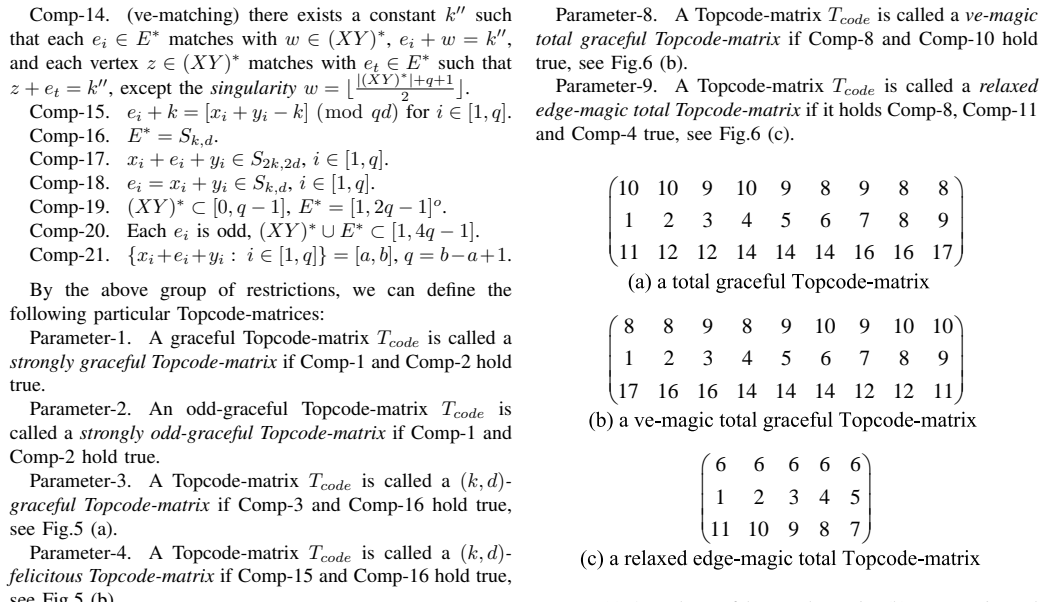
The load-bearing object is the Topcode-matrix, a $3\times q$ array whose $i$-th column $(x_i, e_i, y_i)^T$ records one edge of a labelled graph: $x_i$ and $y_i$ are labels at the two ends and $e_i$ is the edge label derived from them by an evaluation rule. Its power is that many graphs can share the same matrix, because a matrix records labels but not the graph's topological arrangement; the same columns can be reassembled into different non-isomorphic Topsnut-gpws. The paper's operations run on this object: column-exchanging and $XY$-exchanging produce new matrices from the same graph, union-addition $\biguplus$ fuses several matrices into one, and additive or subtractive v-operations make every-zero groups in which any chosen matrix acts as the zero element. These operations carry the security argument, because the public object is a union matrix while the private objects are the constituent matrices and graphs.
What would settle it
Take a public union matrix built from two or more known Topcode-matrices and run a recovery attack: if the constituent columns can be separated by matching degree multiplicities, by solving $e_i=|x_i-y_i|$, or by exploiting the edge-label set, then the claimed one-vs-more security is refuted for that construction.
Extended reading notes
Core claim
The paper's central claim is that a Topcode-matrix can stand for many different labelled graphs at once, and that this one-to-many property is a security feature rather than an ambiguity. A Topcode-matrix is evaluated when an edge label $e_i$ is determined by its two end labels $x_i,y_i$ through a rule such as $e_i=|x_i-y_i|$ or a modular sum, and different graph-labelling conditions (graceful, odd-graceful, edge-magic total, harmonious, and others) become recognisable matrix families. The paper shows that a connected non-tree Topcode-matrix corresponds to at least two Topsnut-gpws, so a single matrix can be published while several non-isomorphic graphs remain usable as private keys. By the union-addition operation, several such matrices merge into one larger matrix, and the paper asserts that splitting that union back into its constituents is hard enough to call the scheme certainly computational security. It then builds every-zero Topcode-matrix groups, graph groups, and number-string groups, and proposes an overall network security mechanism in which each vertex's neighbours must supply group-encrypted permits.
Load-bearing premise
The whole scheme rests on the unproved claim that decomposing a large union Topcode-matrix into its original labelled graphs is computationally infeasible; if that decomposition becomes easy, the public-key and private-key design collapses.
Editorial extensions
If this is right
- One published Topcode-matrix can authenticate several private Topsnut-gpws, so a user or community can rotate private keys without changing the public matrix.
- A Topcode-matrix can be read out as a number string by the fold-line rules, so graph-based passwords can be stored and transmitted in ordinary text-password fields.
- Every-zero Topcode-matrix groups and number-string groups give algebraic operations for encrypting different parts of a dynamic network at different time steps, with any group element usable as zero.
- Equivalence results such as Theorem 11 mean a tree's graceful matrix can be converted into odd-graceful, edge-magic-total, or 6C forms, so the same underlying graph can be presented by many matrix shapes.
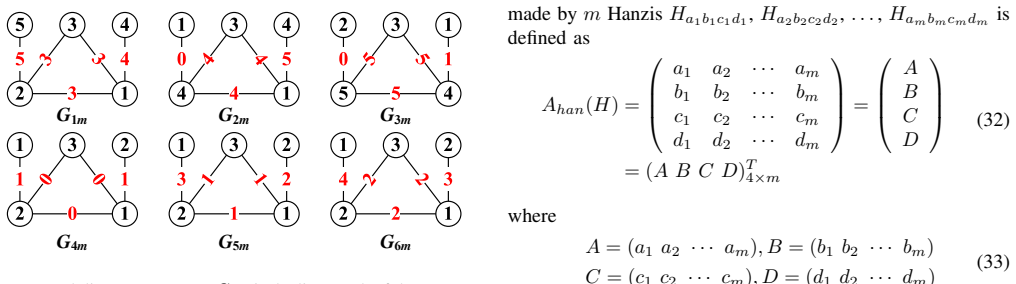
- Hanzi-matrices extend the same framework to Chinese-character codes, so a Chinese sentence can serve as a public key and another as a private key via a linear system.
Reading between the lines
- My inference: the certainly computational security assertion in Section II.C is only as strong as the splitting problem, and a cheap first check would be to test union matrices against degree-sequence and edge-label recovery algorithms.
- My inference: because Theorem 11 identifies matrix families that are equivalent for trees, one could test whether authentication can be made invariant under those transformations, letting a verifier check a canonical matrix class instead of exact private keys.
- My inference: the same every-zero group construction could be applied to higher-dimensional arrays or to matrices whose elements are themselves networks, giving hierarchical encryption layers beyond the $3\times q$ case.
- My inference: if the fold-line reading rules are made canonical, the generated text strings could be benchmarked against dictionary and entropy attacks to see whether the pictorial structure actually survives in the string form.
Signed reviews
Editorial analysis
A structured set of objections, weighed in public.
Referee Report
Summary. This paper introduces Topcode-matrices, which are 3×q arrays (X,E,Y) interpreted as vertex-edge-vertex encodings of 'Topsnut-gpws,' and it catalogues a large number of restricted families obtained by imposing graph-labelling conditions such as graceful, odd-graceful, edge-magic, and harmonious labelings. The paper defines operations on Topcode-matrices (dual, column/XY exchanging, union-addition, splitting), constructs 'every-zero' matrix groups and number-string groups using modular arithmetic in equations (19)-(20), and proposes text-based passwords and an 'overall security mechanism' for networks in which a large Topcode-matrix union serves as a public authentication and its constituent Topsnut-gpws serve as private keys. The paper also discusses Hanzi-matrices, adjacent ve-value matrices, graph equations, and a list of open questions.
Significance. If the claims were established, the one-to-many correspondence between a Topcode-matrix and non-isomorphic graphs (Fig. 1) could be an interesting source of graphical-password constructions, and the proposed catalog would systematize many graph-labelling notions into a matrix formalism. The paper is also explicit about its open questions, which is a useful feature. However, the load-bearing security statement is not proven, the main graphicability criterion is vacuous, and the group constructions are definitional rather than substantive; the paper contains no formal security model, no reduction, and no computational experiments. The useful parts are the explicit examples and the translation of known graph-labelling conditions into matrix conditions; those do not by themselves establish network security, and the paper provides no machine-checked proofs or reproducibility artifacts.
major comments (4)
- [Section II.A.3, Theorem 5] Theorem 5 states that a Topcode-matrix is graphicable if and only if 2q = Σ_{x∈X*}α(x) + Σ_{y∈Y*}α(y). Since X and Y each contain q entries, the right-hand side is identically 2q, so the condition is an identity and cannot discriminate graphicable from non-graphicable matrices. The subsequent citation of the Erdős–Gallai theorem (Theorem 6) is not applied to the degree sequence derived from the appearance counts in Tcode; the degree-sum equation is only necessary, and the Erdős–Gallai inequalities are the missing load-bearing part. As written, Theorem 5 is false as a characterization and invalidates any argument that relies on it to certify that a Topcode-matrix has a graph realization.
- [Section II.C and Section V.B.1] The central security claim that Topsnut-gpws are 'certainly computational security' rests on the assertion that splitting a large union Topcode-matrix into its original constituent Topsnut-gpws is computationally difficult. No adversary model, verifier predicate, reduction to a known hard problem, or lower bound is given. Under the natural reading of Section V.B.1, where Tcode = Tcode(Gpub) ⨄ Tcode(Gpri) is the authentication, a presented 'private' matrix is accepted if it completes the stored union; then any single column, such as (7,1,18)^T from the matrix in Eq. (1), is a valid private key and forgery is trivial. If, alternatively, acceptance requires recovering one of the original graphs exactly, Fig. 1 already exhibits six non-isomorphic graphs with the same Topcode-matrix, so the public data do not determine a unique private key. The conclusion that large matrices 'force attackers to give up' is therefore an unsupported assertion rather than a derived security statement.
- [Section II.D, Eqs. (19)-(20)] The additive v-operation defines x_{λ,r} = (x_{i,r}+x_{j,r}-x_{k,r}) mod M and λ = i+j-k mod M, so F_m is simply an indexed copy of the cyclic group Z_M acting coordinate-wise on each row. Closure, associativity, the identity (the selected T_k), and inverses hold by construction; the same remark applies to the subtractive operation in Eqs. (25)-(26). Thus the 'every-zero' groups are a notational repackaging of finite cyclic groups, and the paper does not prove any new property of these groups or any connection between the group structure and the hardness of the proposed authentication. This makes the group-theoretic part descriptive rather than a result that can support the security mechanism.
- [Section V.A, proof of Theorem 11] The proof of claim (1) of Theorem 11 asserts that in a set-ordered odd-graceful Topcode-matrix 'each x^1_i must be even, and each y^1_i must be odd.' The definition only requires max X < min Y and odd edge labels, and examples with odd-valued X and even-valued Y satisfying both conditions exist (for instance two edges with labels 1 and 3 on X={1,3}, Y={4,4}). Consequently the halving transformation used to recover a set-ordered graceful Topcode-matrix is not well-defined in general, so the claimed equivalence is not established as written.
minor comments (3)
- [Throughout] There are numerous typos, including 's ce' in the abstract, 'grapgicable' in Lemma 9, 'T[opcode-matrix' in Section II.C, 'Tosnut-gpw' in Section IV.B, and 'Refereing' in Remark 4; these should be corrected.
- [Theorems 1, 2, 4, and 8] Several structural theorems are stated without proof or with only a sketch, including Theorem 1, Theorem 2, Theorem 4, and Theorem 8; the authors should either provide complete proofs or clearly label these statements as conjectures.
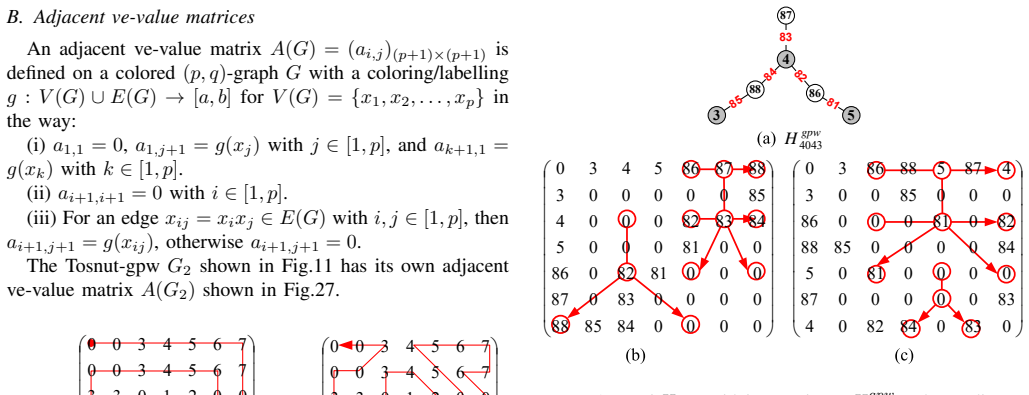
- [Figures] Several figures (e.g., Figs. 2, 19, and 27) are difficult to read or are not explicitly numbered in the text, which makes the examples harder to verify.
Circularity Check
No load-bearing circularity; Theorem 5 is a vacuous graphicability criterion, while the security claim rests on an unproved hardness premise rather than on a circular derivation.
-
self definitional
[Section II.A.3, Theorem 5 (graphicable criterion)]
"Theorem 5. A Topcode-matrix Tcode defined in Definition 4 is graphicable if and only if 2q =∑_{x∈X*} α(x) + ∑_{y∈Y*} α(y), where α(x) (resp. α(y)) is the number of x (resp. y) appeared in X (resp. Y)."
Because X and Y are each q-entry vectors, the right-hand side counts every entry of X and every entry of Y once, so it is identically 2q for every Topcode-matrix. The alleged characterization therefore imposes no restriction; 'graphicable iff true' is a tautology, and the paper immediately needs the Erdős–Gallai inequalities (Theorem 6) to have any real content. The theorem cannot filter graphicable Topcode-matrices or define a hard instance class; at most it restates the definition of a 3×q matrix with an evaluated e-vector.
full rationale
The central security claim ('our Topsnut-gpws are certainly computational security', Section II.C after Fig. 11) is not circular in the sense of a derived prediction; it is an unproved hardness assumption, since no reduction to a known hard problem, adversary game, or verifier predicate is given. This is an evidentiary and correctness gap, not a reduction of the conclusion to its inputs. The every-zero Topcode+-matrix and Topcode−-matrix groups, and the number-string groups, are constructed by the modular formulas (19)-(20) and (25)-(26); their group axioms hold by construction, and no external result is being renamed as a prediction. Theorem 11's equivalences are explicit affine relabelings (for example, x1_i = 2x_i and y1_i = 2y_i − 1), with proofs supplied in the text. Self-citations [11], [12], [14]-[17] introduce the Topsnut-gpw concept but are not load-bearing for the derivations here. The only circular or tautological item found is Theorem 5's vacuous graphicability criterion; it is not used in the security argument, so the paper's central claim has independent, though unsupported, content. Overall circularity is therefore low.
Assumptions & free parameters
free parameters (3)
- Modulus M in v-operations =
example: 6
- Constants k, d in (k,d)-Topcode matrices
- Magic constants k, k', k'' in edge-magic and ve-matching conditions
assumptions (4)
- standard math Erdos-Gallai degree sequence theorem
- domain assumption GB2312-80 provides a four-digit numeric code for Chinese characters
- ad hoc to paper Splitting a large union Topcode-matrix into its component Topsnut-gpws is computationally difficult
- ad hoc to paper Degree-sum condition is sufficient for a Topcode-matrix to be graphicable
Cite this review
Pith. "Pith review of Topological Coding and Topological Matrices Toward Network Overall Security." pith.science (2026). https://pith.science/paper/ZKYYSFAO
@misc{pith2026190901587,
  author       = {Pith},
  title        = {Pith review of: Topological Coding and Topological Matrices Toward Network Overall Security},
  year         = {2026},
  howpublished = {\url{https://pith.science/paper/ZKYYSFAO}},
  note         = {Machine review of arXiv:1909.01587}
}
abstract
A mathematical topology with matrix is a natural representation of a coding relational structure that is found in many fields of the world. Matrices are very important in computation of real applications, s ce matrices are easy saved in computer and run quickly, as well as matrices are convenient to deal with communities of current networks, such as Laplacian matrices, adjacent matrices in graph theory. Motivated from convenient, useful and powerful matrices used in computation and investigation of today's networks, we have introduced Topcode-matrices, which are matrices of order $3\times q$ and differ from popular matrices applied in linear algebra and computer science. Topcode-matrices can use numbers, letters, Chinese characters, sets, graphs, algebraic groups \emph{etc.} as their elements. One important thing is that Topcode-matrices of numbers can derive easily number strings, since number strings are text-based passwords used in information security. Topcode-matrices can be used to describe topological graphic passwords (Topsnut-gpws) used in information security and graph connected properties for solving some problems coming in the investigation of Graph Networks and Graph Neural Networks proposed by GoogleBrain and DeepMind. Our topics, in this article, are: Topsnut-matrices, Topcode-matrices, Hanzi-matrices, adjacency ve-value matrices and pan-Topcode-matrices, and some connections between these Topcode-matrices will be proven. We will discuss algebraic groups obtained from the above matrices, graph groups, graph networking groups and number string groups for encrypting different communities of dynamic networks. The operations and results on our matrices help us to set up our overall security mechanism to protect networks.
Figures


Figures from the paper (36 more)






Reference graph
Works this paper leans on
-
[1]
Four physical revolutions and the second quantum revolu- tion (talk)
Xiaogang Wen. Four physical revolutions and the second quantum revolu- tion (talk). The sixth issue of the high-level academic report of the Furan Forum, Sun Yat-sen University South Campus Auditorium, December 29, 2018
work page 2018
-
[2]
Graph Matching Networks for Learning the Similarity of Graph Struc- tured Objects
Yujia Li, Chenjie Gu, Thomas Dullien, Oriol Vinyals, Pushmeet Kohli. Graph Matching Networks for Learning the Similarity of Graph Struc- tured Objects. Proceedings of the 36 th International Conference on Machine Learning, Long Beach, USA, 2019. arXiv:1904.12787v1 [cs.LG] 29 Apr 2019
arXiv 2019
-
[3]
Peter W. Battaglia, Jessica B. Hamrick, Victor Bapst, Alvaro Sanchez- Gonzalez, Vinicius Zambaldi, Mateusz Malinowski, Andrea Tacchetti, David Raposo, Adam Santoro, Ryan Faulkner, Caglar Gulcehre, Francis Song, Andrew Ballard, Justin Gilmer, George Dahl, Ashish Vaswani, Kelsey Allen, Charles Nash4, Victoria Langston, Chris Dyer, Nicolas Heess, Daan Wierst...
work page 2018
-
[4]
F. Harary. Graph Theory. Addison-Wesley, 1969. 27
work page 1969
-
[5]
Digraphs Theory, Algorithms and Applications
Jorgen Bang-Jensen, Gregory Gutin. Digraphs Theory, Algorithms and Applications. Springer-Verlag, 2007
work page 2007
-
[6]
J. A. Bondy, U. S. R. Murty. Graph Theory. Springer London, 2008
2008
-
[7]
Joseph A. Gallian. A Dynamic Survey of Graph Labeling. The electronic journal of combinatorics , Twenty-first edition, December 21 (2018), # DS6. (502 pages, 2643 reference papers, over 200 graph labellings)
work page 2018
-
[8]
Xiaoyuan Suo, Ying Zhu, G. Scott. Owen. Graphical Password: A Survey. In: Proceedings of Annual Computer Security Applications Conference (ACSAC), Tucson, Arizona. IEEE (2005) 463-472. (10 pages, 38 refer- ence papers)
work page 2005
Show all 27 references
-
[9]
Biddle, S
R. Biddle, S. Chiasson, and P. C. van Oorschot. Graphical passwords: Learning from the First Twelve Years. ACM Computing Surveys, 44 (4), Article 19:1-41. Technical Report TR-09-09, School of Computer Science, Carleton University, Ottawa, Canada. 2009. (25 pages, 145 reference papers)
2009
-
[10]
A Survey on the Use of Graphical Passwords in Security
Haichang Gao, Wei Jia, Fei Ye and Licheng Ma. A Survey on the Use of Graphical Passwords in Security. Journal Of Software, V ol. 8 (7), July 2013, 1678-1698. (21 pages, 88 reference papers)
2013
-
[11]
Exploring New Cryptographical Con- struction Of Complex Network Data
Hongyu Wang, Jin Xu, Bing Yao. Exploring New Cryptographical Con- struction Of Complex Network Data. IEEE First International Conference on Data Science in Cyberspace. IEEE Computer Society, (2016):155-160
2016
-
[12]
Hongyu Wang, Jin Xu, Bing Yao. The Key-models And Their Lock- models For Designing New Labellings Of Networks.Proceedings of 2016 IEEE Advanced Information Management, Communicates, Electronic and Automation Control Conference (IMCEC 2016) 565-5568
2016
-
[13]
GB2312-80 Encoding of Chinese characters
“GB2312-80 Encoding of Chinese characters” cited from The Compila- tion Of National Standards For Character Sets And Information Coding, China Standard Press, 1998
1998
-
[14]
New Algebraic Groups Produced By Graphical Passwords Based On Colorings And Labellings
Hui Sun, Xiaohui Zhang, Meimei Zhao and Bing Yao. New Algebraic Groups Produced By Graphical Passwords Based On Colorings And Labellings. ICMITE 2017, MATEC Web of Conferences 139, 00152 (2017), DOI: 10. 1051/matecconf/201713900152
2017
-
[15]
On Color- ing/Labelling Graphical Groups For Creating New Graphical Passwords
Bing Yao, Hui Sun, Meimei Zhao, Jingwen Li, Guanghui Yan. On Color- ing/Labelling Graphical Groups For Creating New Graphical Passwords. (ITNEC 2017) 2017 IEEE 2nd Information Technology, Networking, Electronic and Automation Control Conference. (2017) 1371-1375
2017
-
[16]
Text-based Passwords Generated From Topological Graphic Pass- words
Bing Yao, Xiaohui Zhang, Hui Sun, Yarong Mu, Yirong Sun, Xiaomin Wang, Hongyu Wang, Fei Ma, Jing Su, Chao Yang, Sihua Yang, Mingjun Zhang. Text-based Passwords Generated From Topological Graphic Pass- words. arXiv: 1809. 04727v1 [cs.IT] 13 Sep 2018
2018
-
[17]
Using Chinese Characters To Generate Text-Based Passwords For Information Security
Bing Yao, Yarong Mu, Yirong Sun, Hui Sun, Xiaohui Zhang, Hongyu Wang, Jing Su, Mingjun Zhang, Sihua Yang, Meimei Zhao, Xiaomin Wang, Fei Ma, Ming Yao, Chao Yang, Jianming Xie. Using Chinese Characters To Generate Text-Based Passwords For Information Security. arXiv:1907.05406v...
1907 arXiv
-
[18]
Splitting Graceful And Pan-graceful Codes Towards Information Security
Bing Yao, Yarong Mu, Yirong Sun, Mingjun Zhang, Sihua Yang, Hongyu Wang, Xiaomin Wang, Jing Su, Fei Ma, Hui Sun. Splitting Graceful And Pan-graceful Codes Towards Information Security. submit- ted 2019
2019
-
[19]
Some results on spanning trees[J]
Bing Yao, Zhong-fu Zhang and Jian-fang Wang. Some results on spanning trees[J]. Acta Mathematicae Applicatae Sinica, English Series, 2010, 26(4).607-616. DOI: 10.1007/s10255-010-0011-4
2010 doi
-
[20]
Topological Graphic Passwords And Their Matchings Towards Cryptography
Bing Yao, Hui Sun, Xiaohui Zhang, Yarong Mu, Yirong Sun, Hongyu Wang, Jing Su, Mingjun Zhang, Sihua Yang, Chao Yang. Topological Graphic Passwords And Their Matchings Towards Cryptography. arXiv:
-
[21]
On theory of maximal planar graphs (first of two volumes)
Jin Xu. On theory of maximal planar graphs (first of two volumes). Science Press (Chinese), 2019, ISBN 978-7-03-060377-7
2019
-
[22]
A Note on Strongly Graceful Trees
Bing Yao, Hui Cheng, Ming Yao and Meimei Zhao. A Note on Strongly Graceful Trees. Ars Combinatoria 92 (2009), 155-169
2009
-
[23]
A proof to the odd-gracefulness of all lobsters
Xiangqian Zhou, Bing Yao, Xiang’en Chen and Haixia Tao. A proof to the odd-gracefulness of all lobsters. Ars Combinatoria 103 (2012), 13-18
2012
-
[24]
The structure and theoretical analysis of a topological graphic cipher
Hongyu Wang. The structure and theoretical analysis of a topological graphic cipher. Doctoral dissertation. Peking University, 2018.6
2018
-
[25]
Discrete Intelligent Computing Expert Committee Annual Meeting, 2019 China Artificial Intelligence Society, Lanzhou Jiaotong University, 2019.8.4-8.6
Bing Yao. Discrete Intelligent Computing Expert Committee Annual Meeting, 2019 China Artificial Intelligence Society, Lanzhou Jiaotong University, 2019.8.4-8.6
2019
-
[26]
Adjacent Strong Edge Coloring of Graphs
Zhang Zhong-fu, Liu Lin-zhong and Wang Jian-fang. Adjacent Strong Edge Coloring of Graphs. Applied Mathematics Letters. 15(5)(2002), 623-626. 28
2002
-
[1808]
03324v1 [cs.CR] 26 Jul 2018
2018
Reviewed August 14, 2026 · model on record in the stance chip above.
Discussion (0). Continue with ORCID to comment.