A Generative Model for Extremely Sparse Edge-Exchangeable Networks
Pith reviewed 2026-06-26 10:55 UTC · model grok-4.3
The pith
A novel completely random measure can be integrated into the edge-exchangeable framework to generate sequences of extremely sparse networks.
A machine-rendered reading of the paper's core claim, the machinery that carries it, and where it could break.
Core claim
The paper claims that the novel completely random measure can be integrated into the alternative edge-exchangeable framework to achieve extreme sparsity, where the number of edges scales near-linearly with the number of nodes, extending the measure's demonstrated performance from the vertex-exchangeable case.
What carries the argument
The novel completely random measure, integrated into the edge-exchangeable model to control sparsity while preserving exchangeability.
If this is right
- The model generates sequences of networks that are both edge-exchangeable and extremely sparse.
- Exchangeability is retained while matching the near-linear edge scaling seen in real networks.
- The sparsity-exchangeability trade-off is addressed for edge-exchangeable graphs.
- Sequences of such networks can be produced directly from the integrated measure.
Where Pith is reading between the lines
- The same measure might support inference algorithms that scale to large sparse networks.
- Comparisons could be made to see how the edge-exchangeable version differs in structure from its vertex-exchangeable counterpart.
- The approach could extend to other types of exchangeable point processes beyond networks.
Load-bearing premise
The properties of the novel completely random measure that produce extreme sparsity transfer or adapt to the edge-exchangeable framework without loss.
What would settle it
Generating networks from the proposed model and observing that the edge count grows faster than near-linearly with the node count would falsify the claim of achieving the extremely sparse regime.
Figures

read the original abstract
We propose a graph generative model for sequences of extremely sparse, edge-exchangeable networks. Models for sparse graphs often face a trade-off between desirable properties like exchangeability and the ability to capture the sparsity observed in real-world networks. While models based on vertex or edge exchangeability have successfully generated sparse graphs, achieving the "extremely sparse" regime, where the number of edges scales near-linearly with the number of nodes, has remained a challenge. Recently, a novel Completely Random Measure (CRM) was introduced, demonstrating that this rate could be achieved within the vertex-exchangeable framework of Caron and Fox. This paper extends this work by demonstrating that this new CRM can be integrated into the alternative edge-exchangeable framework to achieve extreme sparsity.
Editorial analysis
A structured set of objections, weighed in public.
Referee Report
Summary. The paper proposes a generative model for sequences of extremely sparse edge-exchangeable networks. It extends a recently introduced Completely Random Measure (CRM) that achieves |E| ~ |V| scaling in the Caron-Fox vertex-exchangeable framework by integrating the same CRM into an edge-exchangeable construction, thereby obtaining extreme sparsity while preserving edge exchangeability.
Significance. If the transfer of the CRM's sparsity properties holds, the result would provide the first edge-exchangeable model capable of the near-linear edge regime, addressing a known limitation in exchangeable graph models and enabling better fits to real networks with both exchangeability and extreme sparsity.
major comments (1)
- The central claim requires that the novel CRM's Lévy measure produces |E| ~ |V| scaling after re-expression as an edge-exchangeable point process. No explicit re-derivation of the edge-count asymptotics (or coupling argument) is supplied to confirm that the linear regime survives the change from the vertex-exchangeable representation to the symmetric measure on [0,1]^2; without this step the transfer is not automatic and the main result remains unverified.
Simulated Author's Rebuttal
We thank the referee for the careful reading and for identifying this key point regarding the transfer of sparsity properties. We address the comment below.
read point-by-point responses
-
Referee: The central claim requires that the novel CRM's Lévy measure produces |E| ~ |V| scaling after re-expression as an edge-exchangeable point process. No explicit re-derivation of the edge-count asymptotics (or coupling argument) is supplied to confirm that the linear regime survives the change from the vertex-exchangeable representation to the symmetric measure on [0,1]^2; without this step the transfer is not automatic and the main result remains unverified.
Authors: We agree that an explicit re-derivation is necessary to rigorously confirm the preservation of the |E| ~ |V| scaling. The manuscript integrates the CRM into the edge-exchangeable construction and claims the resulting extreme sparsity, but does not supply the full asymptotic analysis under the symmetric measure. In the revised manuscript we will add a dedicated derivation (or appendix) that re-expresses the Lévy measure as an edge-exchangeable point process on [0,1]^2 and establishes the edge-count asymptotics via direct calculation or an appropriate coupling argument. revision: yes
Circularity Check
No significant circularity; extension claim lacks exhibited reduction to inputs.
full rationale
The abstract references a prior novel CRM (likely self-cited) that achieved linear scaling in the vertex-exchangeable Caron-Fox model, then asserts integration into the edge-exchangeable framework yields the same extreme sparsity. No equations, Lévy measure re-derivations, or asymptotics are quoted that reduce the edge-count claim to the vertex-exchangeable case by construction. No fitted parameters are renamed as predictions, no uniqueness theorem is invoked via self-citation, and no ansatz is smuggled. The derivation chain is not shown to collapse; the extension step is presented as requiring separate demonstration. This is the normal non-finding for a high-level claim without load-bearing self-referential steps visible.
Axiom & Free-Parameter Ledger
Reference graph
Works this paper leans on
-
[1]
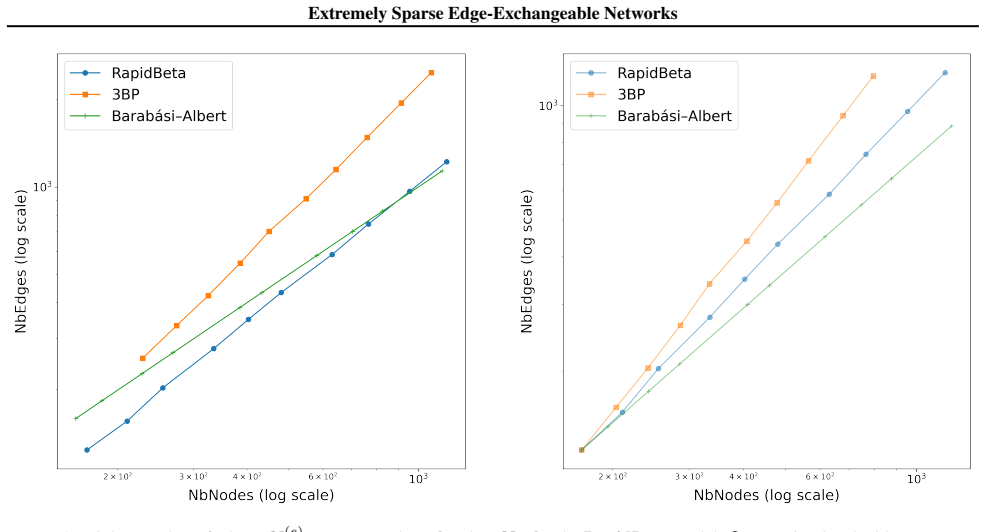
ISSN 0047-259X. doi: 10.1016/0047-259X(81)90099-3. 6 Extremely Sparse Edge-Exchangeable Networks Figure 4.(Right: number of edges ( N (e) t ) versus number of nodes (Nt) for theRapidBetamodel ( •) was simulated with parameters α= 1, τ= 0.95, ξ= 1.2 , and η= 15 . This is compared against thethree-parameter Beta processmodel ( ■) with parameters γ= 4, β= 4,...
-
[2]
Broderick, T. and Cai, D. Edge-exchangeable graphs and sparsity.arXiv:1603.06898, March
-
[3]
Cai, D., Campbell, T., and Broderick, T
ISSN 1936-0975, 1931-6690. Cai, D., Campbell, T., and Broderick, T. Edge-exchangeable graphs and sparsity. InAdvances in Neural Information Processing Systems, volume 29,
1936
-
[4]
Caron, F
ISSN 1935-7524, 1935-7524. Caron, F. and Fox, E. Sparse graphs using exchangeable random measures.Journal of the Royal Statistical Society. Series B (Statistical Methodology), 79:1295–1366,
1935
-
[5]
ISSN 0001-8678, 1475-6064. Crane, H. and Dempsey, W. A framework for statistical network modeling.arXiv:1509.08185, September
-
[6]
Crane, H. and Dempsey, W. Edge exchangeable models for network data.arXiv:1603.04571, October
-
[7]
Edge Exchangeable Graphs: Connectedness, Gaussianity and Completeness.arXiv:2501.09511, Jan- uary
Eriksson, E. Edge Exchangeable Graphs: Connectedness, Gaussianity and Completeness.arXiv:2501.09511, Jan- uary
-
[8]
Edge Exchangeable Graphs: Connectedness, Gaussianity and Completeness
doi: 10.48550/arXiv.2501.09511. Feller, W.An Introduction to Probability Theory and Its Applications, volume
work page internal anchor Pith review Pith/arXiv arXiv doi:10.48550/arxiv.2501.09511
-
[9]
ISSN 0091-1798, 2168-894X. doi: 10.1214/aop/ 1176996452. Gnedin, A., Hansen, B., and Pitman, J. Notes on the oc- cupancy problem with infinitely many boxes: General asymptotics and power laws.Probab. Surv, 4(146-171): 88,
-
[10]
On edge exchangeable random graphs.Journal of Statistical Physics, 173(3– 4):448–484, 2018
ISSN 1572-9613. doi: 10.1007/s10955-017-1832-9. Kallenberg, O.Probabilistic Symmetries and Invariance Principles. Springer Science & Business Media, Decem- ber
-
[11]
Kilian, V ., Guedj, B., and Caron, F
ISBN 978-0-387-28861-1. Kilian, V ., Guedj, B., and Caron, F. Rapidly Varying Completely Random Measures for Modeling Extremely Sparse Networks.arXiv:2505.13206, May
-
[12]
Lijoi, A
ISSN 1935- 7524, 1935-7524. Lijoi, A. and Pr¨unster, I. Models beyond the Dirichlet pro- cess. In Hjort, N. L., Holmes, C., M ¨uller, P., and Walker, S. G. (eds.),Bayesian Nonparametrics. Cambridge Uni- versity Press,
1935
-
[13]
Dynamic sparse graphs with overlapping communities.arXiv:2512.10717, April
Miscouridou, X., Panero, F., and Laos, A. Dynamic sparse graphs with overlapping communities.arXiv:2512.10717, April
-
[14]
ISSN 1935-7524, 1935-
1935
-
[15]
doi: 10.1109/TPAMI.2014.2334607
ISSN 0162-8828, 2160-9292. doi: 10.1109/TPAMI.2014.2334607. Todeschini, A., Miscouridou, X., and Caron, F. Exchange- able random measures for sparse and modular graphs with overlapping communities.Journal of the Royal Statistical Society: Series B (Statistical Methodology), 82(2):487– 520,
-
[16]
ISSN 1467-9868. doi: 10.1111/rssb.12363. Tropp, J. Freedman’s inequality for matrix martingales. Electronic Communications in Probability, 16(none), January
-
[17]
The Class of Random Graphs Arising from Exchangeable Random Measures
ISSN 1083-589X. doi: 10.1214/ECP. v16-1624. Veitch, V . and Roy, D. M. The Class of Random Graphs Arising from Exchangeable Random Measures. arXiv:1512.03099, December
work page internal anchor Pith review Pith/arXiv arXiv doi:10.1214/ecp
-
[18]
When f(x) and g(x) are random variables, the notation indicates that the relation holds almost surely
where a∈R∪ {−∞,+∞} . When f(x) and g(x) are random variables, the notation indicates that the relation holds almost surely. This usage of ∼ should not be confused with the standard distributional notation X∼ D , which indicates that the random variableXhas distributionD. B. Main lemma Lemma B.1.Let (Gt)t≥0 be the edge-exchangeable multigraph sequence cons...
2018
-
[19]
Therefore, ϕ has an asymptotic inverse ϕ−1 which is regularly varying with index 1, satisfyingϕ −1(ϕ(x))∼xasx→ ∞
According to Theorem G.6, any regularly varying function with index α >0 possesses an asymptotic inverse that is regularly varying with index 1/α. Therefore, ϕ has an asymptotic inverse ϕ−1 which is regularly varying with index 1, satisfyingϕ −1(ϕ(x))∼xasx→ ∞. We have proven Nt ∼cS ϕ(t)a.s. (80) Because ϕ−1 is regularly varying with index 1, it preserves ...
1993
-
[20]
Consequently, S is almost surely finite, and the partial sumsS n converge almost surely toS
=µ <∞,(123) the first Borel–Cantelli lemma implies that the events {Xk = 1} occur only finitely often almost surely. Consequently, S is almost surely finite, and the partial sumsS n converge almost surely toS. Fixϵ∈(0,1)and consider the events An ={|S n −µ n| ≥ϵµ}, A={|S−µ| ≥ϵµ}. For any sample path such thatS n(ω)→S(ω), if|S−µ| ≥ϵµ, then for all sufficie...
2005
discussion (0)
Sign in with ORCID, Apple, or X to comment. Anyone can read and Pith papers without signing in.