REVIEW 5 major objections 5 minor 6 cited by
EditP23: 3D Editing via Propagation of Image Prompts to Multi-View
T0 review · 5 major / 5 minor · reviewed 2026-08-06 · deepseek-v4-flash
Pith's one-line read A single 2D image edit propagates through a frozen multi-view diffusion model to produce a consistent 3D edit in seconds.
desk verdict EditP23 is a clean, useful transfer of DDS-style edit-aware denoising to multi-view grids, but the core edit-isolation claim is asserted rather than demonstrated, and the evaluation is too thin to fully support it. read the letter →
The pith
A machine-rendered reading of the paper's core claim, the machinery that carries it, and where it could break.
The reading
What carries the argument
The central mechanism is the edit-aware denoising step over a multi-view grid (mv-grid) in the latent space of Zero123++, a frozen image-conditioned multi-view diffusion model. Zero123++ processes the condition image in a reference pass, caching attention keys and values, and then synthesizes the six view tiles jointly in a grid pass whose self-attention is augmented by those cached features. EditP23 runs the model twice per denoising step: once on the noised source grid conditioned on the noised source image, and once on the currently edited grid conditioned on the noised target image. The two branches use the same Gaussian noise realizations for both the grids and the condition images, and the feedback update is the difference of their velocity predictions (Equation 1). This correlated-noise, dual-branch velocity subtraction is what isolates the edit while preserving shared structure.
What would settle it
Run the pipeline with $I_{\mathrm{tar}} = I_{\mathrm{src}}$ (no actual edit) and measure whether the object remains unchanged across all six views; if the velocity difference introduces any geometric drift, the subtraction is not cleanly canceling shared content. A sharper test uses a target view that differs from the source only by camera pose or lighting, with object content identical: if the edit direction still rearranges geometry, the method is amplifying condition-image bias rather than isolating the edit.
Extended reading notes
Core claim
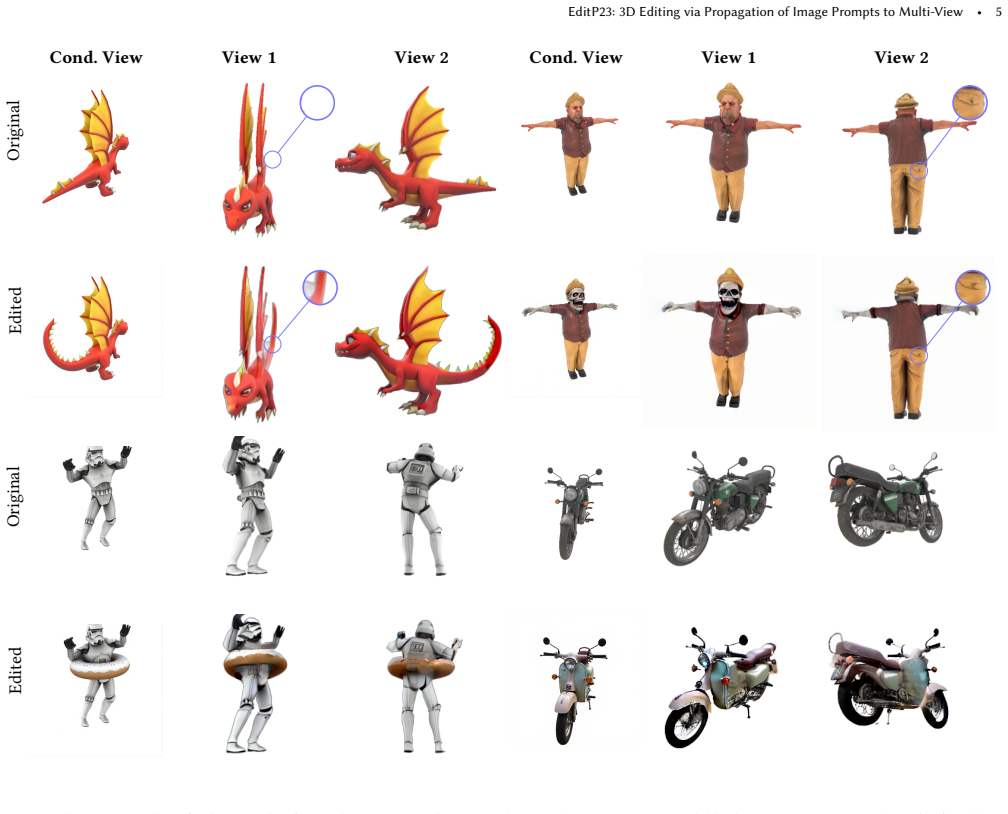
EditP23's central claim is that a single 2D image edit can be propagated to a full multi-view grid through an edit-aware denoising flow inside a pre-trained multi-view diffusion model. Given a source view $I_{\mathrm{src}}$ and its user-edited counterpart $I_{\mathrm{tar}}$, the method runs two denoising branches on noise-correlated inputs and, at each timestep, computes the velocity difference $\Delta v_{t_i}^\phi = v_\phi(Z_{t_i}^{\mathrm{edit}}, I_{\mathrm{tar}}) - v_\phi(Z_{t_i}^{\mathrm{src}}, I_{\mathrm{src}})$. This delta is the update applied to the edited grid, which starts as the noisy source grid and evolves toward the target. The subtraction is designed so that components common to both branches cancel, leaving only the edit signal; the target condition image anchors the orientation of the edit, while the source branch anchors the identity of the object. The paper demonstrates the approach on 24 objects with 54 edit prompts and shows that a reconstructed mesh from the edited grid preserves geometry, not just surface appearance.
Load-bearing premise
The load-bearing premise is that subtracting the frozen model's velocity prediction on the edited grid from its prediction on the source grid yields the user's edit direction, rather than noise or a distortion produced by the model's own view bias or by the different conditioning images.
Editorial extensions
If this is right
- Users can drive 3D edits with any 2D editing tool — manual painting, generative inpainting, or prompt-based editors — since the method needs only the edited image as a prompt.
- Because the backbone is frozen and no per-edit optimization is required, an edit completes in seconds on a single GPU, and the technique can be transplanted to improved multi-view backbones as they appear.
- The edited multi-view grid can be lifted to a textured mesh by a standard reconstruction module, and the untextured geometry confirms that the propagated change is a real shape modification, not just a surface effect.
- The method handles both local and global modifications in a unified framework, without the mask requirements or lengthy optimization that constrain prior 3D editors.
Reading between the lines
- A testable consequence of the delta-velocity design is that the frozen model's reference-pass attention must treat the source and target condition images as near-identical outside the edited region; if that fails, edits to occluded or aspect-dependent geometry should produce inconsistent views.
- The same delta-velocity update could be applied to video or scene editing, where a local modification must generalize coherently across time or space — a direction the paper mentions in its conclusion and that a natural follow-up could quantify.
- The reported metrics (CLIPSim and CLIPDir) capture semantic alignment but not multi-view geometric consistency; measuring per-view reconstruction error or cross-view feature agreement on the edited grid would strengthen the evidence for 3D consistency.
Editorial analysis
A structured set of objections, weighed in public.
Referee Report
Summary. The paper presents EditP23, a training-free, mask-free method for propagating a single 2D edit of a reference view to a six-view multi-view image grid using a frozen Zero123++ model. At each denoising step, the method computes a delta velocity by subtracting the model's velocity prediction on the source grid with the source condition image from its prediction on the current edited grid with the target condition image, using correlated noise on both grids and both condition images, and updates the edited grid with this delta. The method is evaluated on 24 Objaverse objects with 54 prompts against MVEdit and Vox-E, using CLIP metrics and a user study, plus ablations against SDEdit and FlowEdit variants. The central claim is that subtracting the source-conditioned velocity from the target-conditioned velocity isolates the user's edit while canceling shared content and common noise.
Significance. If the edit-isolation mechanism of Eq. (1) is reliable, EditP23 is a simple and practical contribution: it requires no masks, no optimization, no training, and runs in seconds on a frozen multi-view backbone. The paper also provides qualitative evidence across multi-view grids, reconstructed meshes, and untextured geometry, and it ablates against its own natural variants, which is good practice. However, the paper's core claim rests on an unproven cancellation argument, and the quantitative evidence is too weak to establish the method's advantage: CLIPDir values are near zero, the per-example best-of-four preset selection is post hoc, and no error bars are reported. The contribution is potentially publishable after the mechanism is better analyzed and the evaluation is substantially strengthened.
major comments (5)
- [Section 3.3, Eq. (1)]
- [Section 4.1 and Table 1]
- [Table 1, Section 4.2]
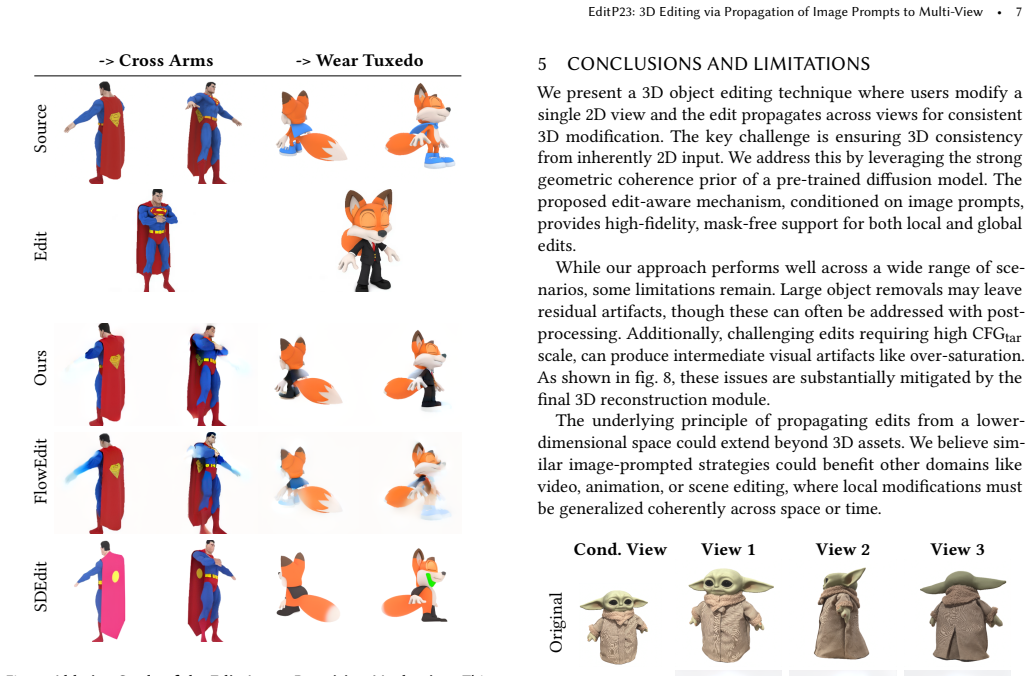
- [Section 4.2, Baseline Methods and Fig. 5]
- [Section 4.4, Fig. 7]
minor comments (5)
- [Section 3.3]
- [Algorithm 1]
- [Section 4.1]
- [Section 4.3 and Fig. 5]
- [Section 5]
Circularity Check
No significant circularity: EditP23's delta-velocity update is a self-contained ansatz on a frozen backbone; the only self-citations are inspirational and not load-bearing.
full rationale
The paper's central step, Eq. (1), is a proposed update rule, not a prediction fitted to its own outputs. v_phi is a frozen Zero123++ model; no parameters are trained to reproduce the edited grids. The claim that shared content and common noise 'ideally cancel out' is an unproven assumption about the model's behavior, but an unsupported or false assumption is a correctness risk, not circularity: the method's success or failure is settled by comparisons against external baselines (MVEdit, Vox-E) and a user study, not by construction. The DDS citation (Hertz et al. 2023) includes co-author Daniel Cohen-Or, but the paper only uses it as conceptual inspiration for taking a difference of predictions; it does not invoke DDS as a forced theorem, and the multi-view grid adaptation is independently implemented with a different conditioning mechanism (Zero123++ reference-pass attention). The FlowEdit ablation in Section 4.4 is an empirical sensitivity check, not a circularity. Per-example preset selection is hyperparameter tuning, not a fitted input called prediction. The user study does inherit the quality of the user-supplied edited view, but that is a benchmarking limitation, not a circular derivation. I find no step where an output is equivalent to an input by definition.
Assumptions & free parameters
free parameters (2)
- n_max (number of guided denoising steps) =
one of four presets, exact values not listed
- CFGtar (classifier-free guidance weight for target velocity) =
one of four presets, exact values not listed
assumptions (4)
- domain assumption Zero123++ is a frozen, reliable multi-view diffusion prior that maintains 3D consistency across six views when conditioned on an image.
- ad hoc to paper Subtracting the source-conditioned velocity from the target-conditioned velocity cancels shared content and common noise, isolating the edit.
- ad hoc to paper Correlated identical Gaussian noise applied to both grids and both condition images makes the subtraction well-posed.
- domain assumption A user-edited 2D view produced by an external tool (FlowEdit or FLUX inpainting) is a sufficient condition signal for the multi-view model.
Cite this review
Pith. "Pith review of EditP23: 3D Editing via Propagation of Image Prompts to Multi-View." pith.science (2026). https://pith.science/paper/ZMSALNIV
@misc{pith2026250620652,
  author       = {Pith},
  title        = {Pith review of: EditP23: 3D Editing via Propagation of Image Prompts to Multi-View},
  year         = {2026},
  howpublished = {\url{https://pith.science/paper/ZMSALNIV}},
  note         = {Machine review of arXiv:2506.20652}
}
read the original abstract
We present EditP23, a method for mask-free 3D editing that propagates 2D image edits to multi-view representations in a 3D-consistent manner. In contrast to traditional approaches that rely on text-based prompting or explicit spatial masks, EditP23 enables intuitive edits by conditioning on a pair of images: an original view and its user-edited counterpart. These image prompts are used to guide an edit-aware flow in the latent space of a pre-trained multi-view diffusion model, allowing the edit to be coherently propagated across views. Our method operates in a feed-forward manner, without optimization, and preserves the identity of the original object, in both structure and appearance. We demonstrate its effectiveness across a range of object categories and editing scenarios, achieving high fidelity to the source while requiring no manual masks.
Figures


Figures from the paper (9 more)




Forward citations
Cited by 6 Pith papers
-
VecSet-Edit: Unleashing Pre-trained LRM for Mesh Editing from Single Image
VecSet-Edit is the first method to perform high-fidelity mesh editing from a single image by analyzing and manipulating spatial token subsets in a pre-trained VecSet LRM.
-
EditFlow3D: Automated Local Editing of 3D Assets with Trajectory Preservation
Mask-guided differential flow with a soft preservation loss enables training-free local 3D editing that keeps unedited regions close to the source asset.
-
Hunyuan3D-Buffalo 1.0: A Unified Multimodal Model for Scalable 3D Generation, Understanding, and Editing
A unified 3D multimodal model combines understanding, text-to-3D generation, instruction-guided editing, and part generation in one architecture, trained on an 87M-sample corpus, with claimed state-of-the-art results.
-
TanGO: Training-Free 3D Editing via Tangent-Space Guidance and Optimization
Per-token tangent-space steering, with strength set by velocity-direction mismatch, improves localized training-free 3D editing over global-scaling baselines.
-
EditVerse3D: High-Quality 3D Object Editing with Region-Aware Learning
An end-to-end 3D editing framework achieves high-fidelity local edits from coarse bounding boxes and 2D image prompts using region-aware loss reweighting and a large-scale parts-derived training dataset.
-
SplatPainter: Interactive Authoring of 3D Gaussians from 2D Edits via Test-Time Training
A test-time-trained feedforward model that propagates 2D edits onto 3D Gaussian attributes at interactive speeds.
Reference graph
Works this paper leans on
-
[3]
In SIGGRAPH Asia 2024 Conference Papers (Tokyo, Japan) (SA ’24)
Consolidating Attention Features for Multi-view Image Editing. In SIGGRAPH Asia 2024 Conference Papers (Tokyo, Japan) (SA ’24). Association for Computing Machinery, New York, NY, USA, Article 40, 12 pages. https://doi.org/10.1145/ 3680528.3687611 Ben Poole, Ajay Jain, Jonathan T Barron, and Ben Mildenhall. 2023. DreamFusion: Text-to-3D using 2D Diffusion....
arXiv 2024
-
[2023]
In Proceedings of the IEEE/CVF International Conference on Computer Vision (ICCV)
SKED: Sketch-guided Text-based 3D Editing. In Proceedings of the IEEE/CVF International Conference on Computer Vision (ICCV) . 14607–14619. https://arxiv.org/ abs/2303.10735 Ben Mildenhall, Pratul P. Srinivasan, Matthew Tancik, Jonathan T. Barron, Ravi Ra- mamoorthi, and Ren Ng. 2020. NeRF: Representing Scenes as Neural Radiance Fields for View Synthesis....
arXiv 2020
-
[2024]
arXiv preprint arXiv:2412.08629 (2024)
FlowEdit: Inversion-Free Text-Based Editing Using Pre-Trained Flow Models. arXiv preprint arXiv:2412.08629 (2024). Black Forest Labs. 2024. FLUX. https://github.com/black-forest-labs/flux. Yuan Liu, Cheng Lin, Zijiao Zeng, Xiaoxiao Long, Lingjie Liu, Taku Komura, and Wenping Wang. 2024. Syncdreamer: Generating multiview-consistent images from a single-vie...
arXiv 2024
Reviewed August 6, 2026 · model on record in the stance chip above.
Discussion (0). Continue with ORCID to comment.