Kiselev black hole and the ultra-slow evaporating behavior
Pith reviewed 2026-06-26 20:24 UTC · model grok-4.3
The pith
Lowering the quintessence state parameter w_q reduces Kiselev black hole temperature and extends evaporation lifetime.
A machine-rendered reading of the paper's core claim, the machinery that carries it, and where it could break.
Core claim
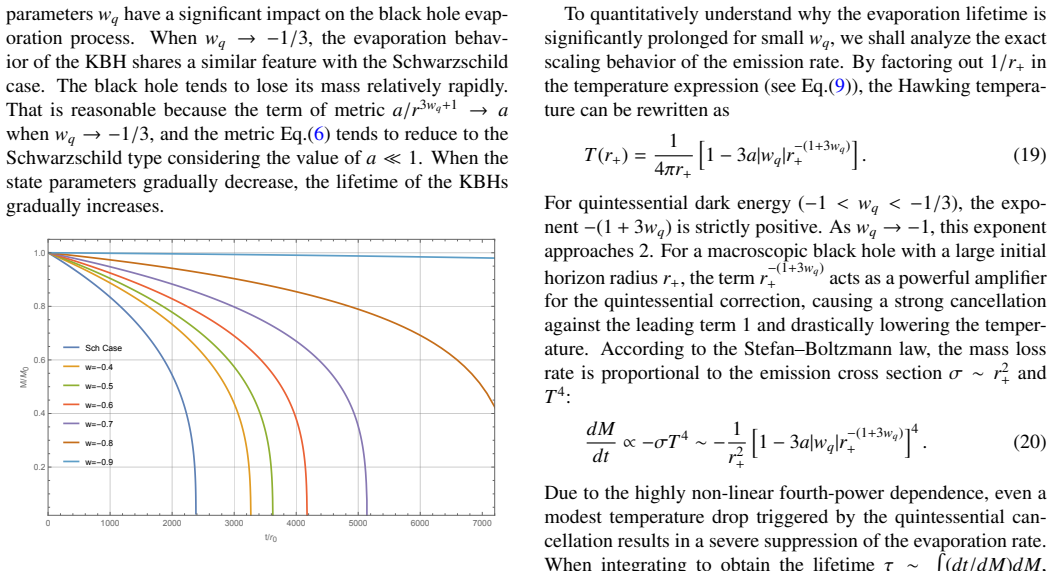
By introducing a dynamic state parameter w_q into the Kiselev solution, the authors find that decreasing w_q lowers the temperature in the non-final stages of evaporation and markedly prolongs the evaporation lifetime. This ultra-slow evaporation mechanism differs from those in PFDM black holes and Horndeski black holes that also have ultra-long lifetimes.
What carries the argument
The Kiselev metric with a dynamic quintessence state parameter w_q, which enters the spacetime geometry and thereby modifies the Hawking temperature used in the evaporation-rate calculation.
If this is right
- Smaller values of w_q produce longer evaporation lifetimes.
- The temperature evolution during evaporation changes in a manner distinct from PFDM and Horndeski cases.
- Black-hole evaporation offers a potential laboratory for constraining the value of w_q.
- The results may complement cosmological data such as DESI preferences for thawing dark energy and observations of exploding black holes.
Where Pith is reading between the lines
- If the mechanism holds, signatures of dark energy could appear in the statistics of primordial black holes that survive longer than expected.
- Detection of Hawking radiation from such objects might directly constrain w_q without relying solely on cosmological surveys.
- The distinction from other ultra-long-lifetime models could help classify which background produces which evaporation signature.
Load-bearing premise
The Kiselev solution with varying w_q continues to describe the geometry correctly throughout the mass-loss process, and standard semiclassical evaporation formulas apply without extra corrections from the changing background.
What would settle it
A calculation or observation of the temperature or lifetime that fails to show the predicted drop in temperature or increase in lifetime when w_q is lowered would falsify the central claim.
Figures

read the original abstract
Kiselev solution is a metric that describes black holes immersed in a quintessence-like dark energy background. By introducing a dynamic state parameter $w_q$, the Kiselev solution is supposed to help comprehend the effect of quintessential matter on black holes. In this work, we study the evaporation behaviors of Kiselev black holes. By varying the state parameter $w_q$, we find that the decreasing state parameter lowers the non-final stage temperature and markedly prolongs the evaporation lifetime. We also find that the ultra-slow evaporation mechanism of Kiselev black holes differs vastly from the perfect fluid dark matter (PFDM) black holes and Horndeski black holes, which share the analogous ultra-long lifetime. These results illuminate the effects of dynamic dark energy background on black hole evaporation, provide a potential laboratory to constrain the value of $w_q$, and may complement cosmological and astrophysical observations, e.g., the DESI's preference for thawing dark energy and the observation of exploding black holes based on ultra-slow evaporation.
Editorial analysis
A structured set of objections, weighed in public.
Referee Report
Summary. The manuscript examines the Hawking evaporation of Kiselev black holes immersed in quintessence with a time-dependent state parameter w_q. It reports that decreasing w_q lowers the temperature during non-final evaporation stages and substantially extends the lifetime, while asserting that this ultra-slow mechanism differs from the analogous long-lifetime behavior in perfect fluid dark matter (PFDM) and Horndeski black holes.
Significance. If the quasi-static approximation is valid, the results could illuminate dynamic dark energy effects on black hole evaporation and provide a potential laboratory for constraining w_q, complementing DESI observations of thawing dark energy and searches for exploding black holes.
major comments (2)
- [Metric derivation and evaporation law] The Kiselev line element is derived under the assumption of constant w_q to satisfy the Einstein equations with the anisotropic quintessence stress-energy. The manuscript provides no explicit demonstration that a time-dependent w_q(t) preserves the static geometry, the surface gravity κ, or the applicability of the standard semiclassical formulas T_H = κ/2π and dM/dt ∝ -T_H^4 without additional back-reaction or non-stationary corrections.
- [Comparison section] The claim that the ultra-slow evaporation 'differs vastly' from PFDM and Horndeski cases is not supported by a side-by-side calculation showing that the distinction originates from the dynamic w_q rather than from differences in the underlying metrics or parameter choices; the abstract-only comparison leaves the mechanism distinction unverified.
minor comments (1)
- [Abstract] The abstract refers to 'non-final stage temperature' without defining the evaporation stages or giving the explicit temperature expression employed in the lifetime integral.
Simulated Author's Rebuttal
We thank the referee for the careful reading and constructive comments on our manuscript. We address each major comment below and will incorporate revisions to strengthen the presentation.
read point-by-point responses
-
Referee: The Kiselev line element is derived under the assumption of constant w_q to satisfy the Einstein equations with the anisotropic quintessence stress-energy. The manuscript provides no explicit demonstration that a time-dependent w_q(t) preserves the static geometry, the surface gravity κ, or the applicability of the standard semiclassical formulas T_H = κ/2π and dM/dt ∝ -T_H^4 without additional back-reaction or non-stationary corrections.
Authors: We acknowledge that the Kiselev metric was originally derived for constant w_q. Our analysis relies on a quasi-static approximation in which w_q varies slowly, permitting the geometry to be treated as instantaneously static. While this is a standard approach in the literature on evolving backgrounds, we agree that an explicit discussion of its validity for surface gravity and the semiclassical evaporation law is missing. We will add a subsection clarifying the quasi-static limit, its applicability range, and the leading-order validity of T_H = κ/2π and the Stefan-Boltzmann law, while noting possible higher-order non-stationary corrections. revision: yes
-
Referee: The claim that the ultra-slow evaporation 'differs vastly' from PFDM and Horndeski cases is not supported by a side-by-side calculation showing that the distinction originates from the dynamic w_q rather than from differences in the underlying metrics or parameter choices; the abstract-only comparison leaves the mechanism distinction unverified.
Authors: We accept that the distinction is stated qualitatively and primarily in the abstract without quantitative side-by-side verification. The manuscript contains some discussion of the differences, but we agree this is insufficient. In the revision we will add an explicit comparison subsection (or table) that computes and contrasts the temperature evolution, mass-loss rates, and lifetimes for the dynamic-w_q Kiselev case against representative PFDM and Horndeski metrics under matched parameter regimes, thereby isolating the role of the time-dependent state parameter. revision: yes
Circularity Check
No significant circularity detected
full rationale
The paper extends the static Kiselev metric by treating w_q as a variable parameter and applies the standard semiclassical Hawking temperature T_H = κ/2π together with the Stefan-Boltzmann mass-loss law to compute lifetime as a function of w_q. These steps follow directly from the Einstein-equation solution and the usual surface-gravity formula without any self-referential definitions, without renaming fitted parameters as predictions, and without load-bearing self-citations that would force the central result. The comparative statement that the mechanism “differs vastly” from PFDM and Horndeski cases rests on parallel calculations rather than on any circular reduction to the paper’s own inputs. The derivation chain therefore remains self-contained.
Axiom & Free-Parameter Ledger
free parameters (1)
- w_q
Reference graph
Works this paper leans on
-
[1]
Perlmutter, et al., Measurements ofΩandΛfrom 42 High Redshift Supernovae, Astrophys
S. Perlmutter, et al., Measurements ofΩandΛfrom 42 High Redshift Supernovae, Astrophys. J. 517 (1999) 565–586.arXiv:astro-ph/9812133,doi:10.1086/ 307221
Pith/arXiv arXiv 1999
-
[2]
A. G. Riess, et al., Observational evidence from super- novae for an accelerating universe and a cosmological constant, Astron. J. 116 (1998) 1009–1038.arXiv: astro-ph/9805201,doi:10.1086/300499
work page internal anchor Pith review Pith/arXiv arXiv doi:10.1086/300499 1998
-
[3]
D. N. Spergel, et al., First year Wilkinson Microwave Anisotropy Probe (WMAP) observations: Determination of cosmological parameters, Astrophys. J. Suppl. 148 (2003) 175–194.arXiv:astro-ph/0302209,doi:10. 1086/377226
Pith/arXiv arXiv 2003
-
[4]
P. A. R. Ade, et al., Planck 2015 results. XIII. Cos- mological parameters, Astron. Astrophys. 594 (2016) A13.arXiv:1502.01589,doi:10.1051/0004-6361/ 201525830
work page internal anchor Pith review Pith/arXiv arXiv doi:10.1051/0004-6361/ 2015
-
[5]
Planck 2018 results. VI. Cosmological parameters
N. Aghanim, et al., Planck 2018 results. VI. Cosmological parameters, Astron. Astrophys. 641 (2020) A6, [Erratum: Astron.Astrophys. 652, C4 (2021)].arXiv:1807.06209, doi:10.1051/0004-6361/201833910
work page internal anchor Pith review Pith/arXiv arXiv doi:10.1051/0004-6361/201833910 2018
-
[6]
The Pantheon+ Analysis: Cosmological Constraints
D. Brout, et al., The Pantheon+Analysis: Cosmological Constraints, Astrophys. J. 938 (2) (2022) 110.arXiv: 2202.04077,doi:10.3847/1538-4357/ac8e04
work page internal anchor Pith review Pith/arXiv arXiv doi:10.3847/1538-4357/ac8e04 2022
-
[7]
T. M. C. Abbott, et al., The Dark Energy Survey: Cos- mology Results with∼1500 New High-redshift Type Ia Supernovae Using the Full 5 yr Data Set, Astrophys. J. Lett. 973 (1) (2024) L14.arXiv:2401.02929,doi: 10.3847/2041-8213/ad6f9f
work page internal anchor Pith review Pith/arXiv arXiv doi:10.3847/2041-8213/ad6f9f 2024
-
[8]
A. G. Adame, et al., DESI 2024 VI: cosmological con- straints from the measurements of baryon acoustic os- cillations, JCAP 02 (2025) 021.arXiv:2404.03002, doi:10.1088/1475-7516/2025/02/021
work page internal anchor Pith review Pith/arXiv arXiv doi:10.1088/1475-7516/2025/02/021 2024
-
[9]
E. J. Copeland, M. Sami, S. Tsujikawa, Dynam- ics of dark energy, Int. J. Mod. Phys. D 15 (2006) 1753–1936.arXiv:hep-th/0603057,doi:10.1142/ S021827180600942X
Pith/arXiv arXiv 2006
-
[10]
P. J. E. Peebles, B. Ratra, The Cosmological Con- stant and Dark Energy, Rev. Mod. Phys. 75 (2003) 559–606.arXiv:astro-ph/0207347,doi:10.1103/ RevModPhys.75.559
Pith/arXiv arXiv 2003
-
[11]
Weinberg, The Cosmological Constant Problem, Rev
S. Weinberg, The Cosmological Constant Problem, Rev. Mod. Phys. 61 (1989) 1–23.doi:10.1103/ RevModPhys.61.1
1989
-
[12]
Cosmological Constant - the Weight of the Vacuum
T. Padmanabhan, Cosmological constant: The Weight of the vacuum, Phys. Rept. 380 (2003) 235–320.arXiv:hep-th/0212290,doi: 10.1016/S0370-1573(03)00120-0
work page internal anchor Pith review Pith/arXiv arXiv doi:10.1016/s0370-1573(03)00120-0 2003
-
[13]
Challenges for $\Lambda$CDM: An update
L. Perivolaropoulos, F. Skara, Challenges forΛCDM: An update, New Astron. Rev. 95 (2022) 101659.arXiv: 2105.05208,doi:10.1016/j.newar.2022.101659
work page internal anchor Pith review Pith/arXiv arXiv doi:10.1016/j.newar.2022.101659 2022
-
[14]
R. R. Caldwell, R. Dave, P. J. Steinhardt, Cosmo- logical imprint of an energy component with general equation of state, Phys. Rev. Lett. 80 (1998) 1582– 1585.arXiv:astro-ph/9708069,doi:10.1103/ PhysRevLett.80.1582
Pith/arXiv arXiv 1998
-
[15]
V . V . Kiselev, Quintessence and black holes, Class. Quant. Grav. 20 (2003) 1187–1198.arXiv:gr-qc/0210040, doi:10.1088/0264-9381/20/6/310
work page internal anchor Pith review Pith/arXiv arXiv doi:10.1088/0264-9381/20/6/310 2003
-
[17]
Visser, The Kiselev black hole is neither perfect fluid, nor is it quintessence, Class
M. Visser, The Kiselev black hole is neither perfect fluid, nor is it quintessence, Class. Quant. Grav. 37 (4) (2020) 045001.arXiv:1908.11058,doi:10.1088/ 1361-6382/ab60b8
arXiv 2020
-
[18]
B. Toshmatov, Z. Stuchlík, B. Ahmedov, Rotating black hole solutions with quintessential energy, Eur. Phys. J. Plus 132 (2) (2017) 98.arXiv:1512.01498,doi:10. 1140/epjp/i2017-11373-4. 6
Pith/arXiv arXiv 2017
-
[20]
X.-X. Zeng, H.-Q. Zhang, Influence of quintessence dark energy on the shadow of black hole, Eur. Phys. J. C 80 (11) (2020) 1058.arXiv:2007.06333,doi:10. 1140/epjc/s10052-020-08656-7
arXiv 2020
-
[22]
Fernando, Schwarzschild black hole surrounded by quintessence: Null geodesics, Gen
S. Fernando, Schwarzschild black hole surrounded by quintessence: Null geodesics, Gen. Rel. Grav. 44 (2012) 1857–1879.arXiv:1202.1502,doi:10.1007/ s10714-012-1368-x
Pith/arXiv arXiv 2012
-
[23]
S.-b. Chen, J.-l. Jing, Quasinormal modes of a black hole surrounded by quintessence, Class. Quant. Grav. 22 (2005) 4651–4657.arXiv:gr-qc/0511085,doi:10. 1088/0264-9381/22/21/011
Pith/arXiv arXiv 2005
-
[24]
Z. Xu, J. Wang, Kerr-Newman-AdS Black Hole In Quintessential Dark Energy, Phys. Rev. D 95 (6) (2017) 064015.arXiv:1609.02045,doi:10.1103/ PhysRevD.95.064015
Pith/arXiv arXiv 2017
-
[25]
Wu, D.-C
C.-H. Wu, D.-C. Zou, Y . Wang, P-V Criticality of Born- Infeld AdS Black Holes Surrounded by Quintessence, Commun. Theor. Phys. 70 (4) (2018) 459.doi:10.1088/ 0253-6102/70/4/459
2018
-
[26]
Y . Wang, C.-H. Wu, R.-H. Yue, A new rotating black hole in quintessential dark energy and its thermodynamics, Sci. China Phys. Mech. Astron. 62 (11) (2019) 110411.doi: 10.1007/s11433-019-9382-0
-
[29]
V . Lungu, M.-A. Dariescu, C. Stelea, Charged particles orbiting a magnetized black hole immersed in quintessen- tial matter, Phys. Rev. D 111 (6) (2025) 064014.arXiv: 2405.14420,doi:10.1103/PhysRevD.111.064014
-
[30]
S. W. Hawking, Black hole explosions, Nature 248 (1974) 30–31.doi:10.1038/248030a0
-
[31]
S. W. Hawking, Particle Creation by Black Holes, Commun. Math. Phys. 43 (1975) 199–220, [Erratum: Commun.Math.Phys. 46, 206 (1976)].doi:10.1007/ BF02345020
1975
-
[32]
D. N. Page, Particle Emission Rates from a Black Hole: Massless Particles from an Uncharged, Nonrotating Hole, Phys. Rev. D 13 (1976) 198–206.doi:10.1103/ PhysRevD.13.198
1976
-
[33]
The entropy of Hawking radiation,
A. Almheiri, T. Hartman, J. Maldacena, E. Shaghoulian, A. Tajdini, The entropy of Hawking radiation, Rev. Mod. Phys. 93 (3) (2021) 035002.arXiv:2006.06872,doi: 10.1103/RevModPhys.93.035002
-
[34]
P. Chen, Y . C. Ong, D.-h. Yeom, Black Hole Remnants and the Information Loss Paradox, Phys. Rept. 603 (2015) 1–45.arXiv:1412.8366,doi:10.1016/j.physrep. 2015.10.007
work page internal anchor Pith review Pith/arXiv arXiv doi:10.1016/j.physrep 2015
-
[35]
D. N. Page, Particle Emission Rates from a Black Hole. 2. Massless Particles from a Rotating Hole, Phys. Rev. D 14 (1976) 3260–3273.doi:10.1103/PhysRevD.14.3260
-
[36]
W. A. Hiscock, L. D. Weems, Evolution of Charged Evap- orating Black Holes, Phys. Rev. D 41 (1990) 1142.doi: 10.1103/PhysRevD.41.1142
-
[37]
D. N. Page, Finite upper bound for the Hawking decay time of an arbitrarily large black hole in anti–de Sitter spacetime, Phys. Rev. D 97 (2) (2018) 024004.arXiv: 1507.02682,doi:10.1103/PhysRevD.97.024004
work page internal anchor Pith review Pith/arXiv arXiv doi:10.1103/physrevd.97.024004 2018
-
[38]
R. Gregory, I. G. Moss, N. Oshita, S. Patrick, Black hole evaporation in de Sitter space, Class. Quant. Grav. 38 (18) (2021) 185005.arXiv:2103.09862,doi:10. 1088/1361-6382/ac1a68
arXiv 2021
-
[39]
Y . C. Ong, An effective black hole remnant via infinite evaporation time due to generalized uncertainty princi- ple, JHEP 10 (2018) 195.arXiv:1806.03691,doi: 10.1007/JHEP10(2018)195
work page internal anchor Pith review Pith/arXiv arXiv doi:10.1007/jhep10(2018)195 2018
-
[40]
Black hole evaporation in Conformal (Weyl) gravity
H. Xu, M.-H. Yung, Black hole evaporation in Con- formal (Weyl) gravity, Phys. Lett. B 793 (2019) 97– 103.arXiv:1811.07309,doi:10.1016/j.physletb. 2019.04.036
work page internal anchor Pith review Pith/arXiv arXiv doi:10.1016/j.physletb 2019
-
[41]
Black hole evaporation in Lovelock gravity with diverse dimensions
H. Xu, M.-H. Yung, Black hole evaporation in Love- lock gravity with diverse dimensions, Phys. Lett. B 794 (2019) 77–82.arXiv:1904.06503,doi:10.1016/j. physletb.2019.05.031
work page internal anchor Pith review Pith/arXiv arXiv doi:10.1016/j 2019
-
[42]
H. Xu, Y . C. Ong, Black hole evaporation in Hoˇrava–Lifshitz gravity, Eur. Phys. J. C 80 (7) (2020) 679.arXiv:2005.02086,doi:10.1140/epjc/ s10052-020-8249-3
-
[43]
M.-S. Hou, H. Xu, Y . C. Ong, Hawking Evaporation of Black Holes in Massive Gravity, Eur. Phys. J. C 80 (11) (2020) 1090.arXiv:2008.10049,doi:10. 1140/epjc/s10052-020-08678-1. 7
arXiv 2020
-
[44]
C.-H. Wu, Y .-P. Hu, H. Xu, Hawking evaporation of Ein- stein–Gauss–Bonnet AdS black holes inD⩾4 dimen- sions, Eur. Phys. J. C 81 (4) (2021) 351.arXiv:2103. 00257,doi:10.1140/epjc/s10052-021-09140-6
-
[45]
X. Liang, Y .-P. Hu, C.-H. Wu, Y .-S. An, Thermo- dynamics and evaporation of perfect fluid dark mat- ter black hole in phantom background, Eur. Phys. J. C 83 (11) (2023) 1009.arXiv:2308.00308,doi:10. 1140/epjc/s10052-023-12200-8
arXiv 2023
-
[46]
An, Notes on thermodynamics of Schwarzschild- like bumblebee black hole, Phys
Y .-S. An, Notes on thermodynamics of Schwarzschild- like bumblebee black hole, Phys. Dark Univ. 45 (2024) 101520.arXiv:2401.15430,doi:10.1016/j.dark. 2024.101520
-
[47]
X. Liang, Y .-S. An, C.-H. Wu, Y .-P. Hu, Einstein- Horndeski gravity and the ultra slowly evaporating black hole, Phys. Lett. B 862 (2025) 139303.arXiv:2411. 03785,doi:10.1016/j.physletb.2025.139303
-
[48]
G. W. Gibbons, S. W. Hawking, Cosmological Event Horizons, Thermodynamics, and Particle Creation, Phys. Rev. D 15 (1977) 2738–2751.doi:10.1103/PhysRevD. 15.2738
-
[49]
Y . Qiu, J. Traschen, Black Hole and Cosmological Particle Production in Schwarzschild de Sitter, Class. Quant. Grav. 37 (13) (2020) 135012.arXiv:1908.02737,doi:10. 1088/1361-6382/ab8bba
arXiv 2020
-
[50]
H. Xu, Y . C. Ong, M.-H. Yung, Cosmic Censor- ship and the Evolution of d-Dimensional Charged Evaporating Black Holes, Phys. Rev. D 101 (6) (2020) 064015.arXiv:1911.11990,doi:10.1103/ PhysRevD.101.064015
arXiv 2020
-
[51]
M. J. Baker, J. Iguaz Juan, A. Symons, A. Thamm, Could We Observe an Exploding Black Hole in the Near Future?, Phys. Rev. Lett. 135 (11) (2025) 111002.arXiv:2503. 10755,doi:10.1103/nwgd-g3zl. 8
discussion (0)
Sign in with ORCID, Apple, or X to comment. Anyone can read and Pith papers without signing in.