REVIEW 3 major objections 4 minor 1 cited by
When Do LLMs Help With Node Classification? A Comprehensive Analysis
T0 review · 3 major / 4 minor · reviewed 2026-08-09 · deepseek-v4-flash
Pith's one-line read This paper claims that LLM-based node classification methods give large gains in semi-supervised settings but only marginal gains once supervision is abundant, and that stronger closed-source LLMs like GPT-4o still beat graph foundation…
desk verdict A solid, useful benchmark with one takeaway built on four tiny graphs and an abstract that outruns its own Table 13. read the letter →
The pith
A machine-rendered reading of the paper's core claim, the machinery that carries it, and where it could break.
The reading
What carries the argument
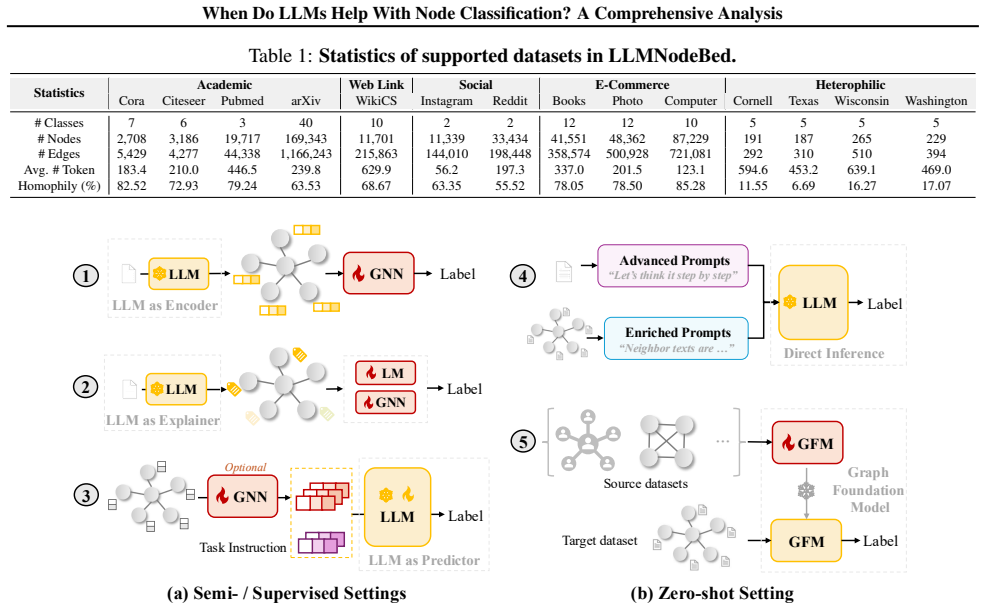
The load-bearing object is LLMNodeBed, a PyG-based codebase that standardizes dataloaders, backbones, and evaluation across algorithms, plus the mutual-information decomposition $I(G; Y_l) = I(E; Y_l) + I(X; Y_l|E)$ used to explain when LLM text features matter. The testbed organizes LLM methods into four roles — Encoder, Explainer, Predictor, and Direct Inference/GFM — and fixes GCN, RoBERTa-355M, and Mistral-7B as default components so performance differences are attributable to method design rather than architecture. The decomposition does the explanatory work: structure contributes more to labels under abundant supervision, narrowing the room for LLM text features.
What would settle it
Run the same encoder comparison (GCNLLMEmb with Mistral-7B versus RoBERTa-355M) on a heterophilic text-attributed graph with thousands of nodes; if the LLM encoder fails to beat the LM encoder by a large margin, the paper's claim that LLMs matter most in less informative graphs is falsified.
Extended reading notes
Core claim
The paper's central claim is that the value of LLMs in node classification is governed by how much information the graph structure and the supervision already carry. Using the decomposition $I(G; Y_l) = I(E; Y_l) + I(X; Y_l|E)$, the authors argue that when labels are scarce, structure carries less label information and the text-encoding power of LLMs contributes more; when supervision is abundant, structure dominates and LLM gains become marginal. Empirically, this yields the paper's eight takeaways, including the headline results that LLM-based methods significantly outperform traditional methods in semi-supervised settings but only marginally in supervised settings, and that graph foundation models beat open-source LLMs but fall short of GPT-4o in zero-shot classification. The paper frames these findings as design guidance for practitioners deciding whether to adopt LLM-based node classifiers.
Load-bearing premise
The load-bearing premise is that the 14 datasets, especially the four heterophilic graphs with only 191-265 nodes each, faithfully represent real-world text-attributed node classification; if those graphs are not representative, the guidance about less informative graphs does not transfer.
Editorial extensions
If this is right
- Practitioners with 10% or fewer labeled nodes should expect LLM-based encoders or explainers to outperform classic GNNs, and should budget for their extra compute.
- With 60% labeled nodes, classic methods like GCN with shallow embeddings or RoBERTa are competitive, so the extra cost of LLMs may not be justified.
- LLM-as-Predictor methods should be used mainly when labels are abundant; under scarce labels they produce biased and hallucinated outputs.
- In zero-shot settings, prompt a strong LLM with a summary of neighbor texts rather than relying on complex reasoning prompts or graph foundation models.
- On graphs with low homophily, replacing a language-model encoder with an LLM encoder gives larger gains than on homophilic graphs.
Reading between the lines
- The mutual-information explanation predicts that the advantage of LLM encoders should shrink continuously as label fraction increases; a direct sweep of label percentages on a fixed graph would test this more precisely than the two-point comparison in the paper.
- Because the heterophilic evidence comes from four graphs with 191-265 nodes, the 'less informative graphs' conclusion is the least robust part of the guidance; re-running the encoder comparison on larger heterophilic text-attributed graphs would show whether the reported 10-point gap persists.
- The ranking of open-source backbones (Mistral-7B over Qwen-7B and LLaMA-8B) is tied to current model generations and could shift as newer models appear, although the qualitative role-level findings are likely more stable.
- The neighbor-summary prompt finding suggests a testable recipe the paper does not directly evaluate: combine a graph foundation model's embeddings with a strong LLM's summarization in zero-shot settings.
Editorial analysis
A structured set of objections, weighed in public.
Referee Report
Summary. The paper introduces LLMNodeBed, a PyG-based testbed for node classification on text-attributed graphs, and reports a comparative study of 8 LLM-based methods, 8 classic baselines, 14 datasets, and three learning paradigms (semi-supervised, supervised, zero-shot), totaling over 2,700 trained or evaluated models. The central empirical findings are that LLM-based methods, especially LLM-as-Encoder and LLM-as-Explainer, give larger gains over classic methods in semi-supervised settings than in supervised settings; that zero-shot direct inference with structurally enriched prompts (w. Summary) performs best; that GFMs such as ZeroG beat LLaMA-8B but not GPT-4o; and that LLM encoders surpass LM encoders mainly on less informative graphs, with heterophilic graphs as the key evidence. The authors release code and processed datasets at the LLMNodeBed website.
Significance. The paper's main strength is as a benchmark artifact: it standardizes backbones, data loaders, and hyperparameter search, reports means and standard deviations across runs, and releases code and data, which should make future LLM-for-graph comparisons cheaper and more reproducible. The headline semi-supervised-versus-supervised finding is supported by nine larger homophilic datasets and is a practically useful guideline. The zero-shot prompt comparison is also valuable. However, the most generalizable-sounding claims, especially Takeaway 8 about less informative graphs and the abstract's statement about GFMs beating open-source LLMs, are not matched by the strength of the evidence. The paper is likely to be influential as a benchmark and should be published after the evidentiary claims are brought in line with the experiments.
major comments (3)
- [5.1 / Table 5 / Appendix C.1] Takeaway 8, which answers the title question for 'less informative graphs', is supported only by four tiny web-page graphs (Cornell 191, Texas 187, Wisconsin 265, Washington 229 nodes) from the same source and with the same five-class label schema. With 1:1:8 splits this provides only 19-26 labeled training nodes and test sets of roughly 150-210 nodes, and only four runs are reported, without significance tests, confidence intervals, or multiple-comparison corrections. Several entries in Table 5 are inconsistent with a clean LLM-over-LM conclusion, for example semi-supervised MLP on Cornell has Mistral-7B at 59.87±6.72 versus RoBERTa at 59.08±2.57, and H2GCN on Wisconsin has Qwen-3B at 84.53±0.70 versus Mistral-7B at 81.89±1.51. The paper itself concedes the scarcity of text-rich heterophilic datasets in the concluding section, but this caveat is not carried into the strength of Takeaway 8. I recommend either softening Takeaway 8 to a case-study finding or providing external validation, such as more heterophilic text-attributed graphs, paired bootstrap tests on the existing splits, or a homophily-perturbation experiment on larger graphs.
- [Abstract / §4.2 / Table 13] The claim that 'Graph Foundation Models can beat open-source LLMs' is contradicted by the paper's own zero-shot results. ZeroG reaches an average accuracy of 55.56, whereas DeepSeek-V3 with w. Summary reaches 65.02 and Mistral-7B with w. Summary reaches 59.15 (Table 13). The body text correctly limits the comparison to LLaMA-8B, but the abstract and Takeaway 6 overgeneralize it to open-source LLMs as a class. Please revise the wording to 'some open-source LLMs' or specify LLaMA-8B explicitly.
- [§4.1 / Tables 2 and 12] The phrase 'significantly outperform' in Takeaway 1 and Takeaway 2 is not backed by statistical inference. All comparisons are reported as mean ± standard deviation over four runs, with no paired significance tests, effect sizes, or confidence intervals. Some individual gaps are within the reported variation: for example, in semi-supervised Pubmed, GCNLLMEmb (78.71) does not beat GCNShallowEmb (78.94). If 'significantly' is meant statistically, the authors should report paired comparisons across the same data splits; if it is meant practically, they should use weaker wording such as 'on average'.
minor comments (4)
- [§4.1, Eq. (1)] The mutual-information explanation is presented as a formal argument, but the terms I(E; Y_l) and I(X; Y_l | E) are never estimated or shown to behave as claimed. I recommend labeling this passage as intuition and, if the formal framing is retained, defining the empirical estimators used.
- [Table 2, arXiv row] LLMIT on arXiv is a single run, and the table gives no uncertainty for the 76.08 value. The caption mentions this, but the main-text analysis of Takeaway 5 should also state that this particular result has no error bar.
- [Table 14 and Table 1] The homophily ratio for Reddit is reported as 55.52 in Table 1 and 55.22 in Table 14; please make the statistics consistent.
- [Appendix C.1] The statement that the four heterophilic datasets are the only available text-attributed options is an important limitation and should appear in Section 5.1 where Takeaway 8 is stated, rather than only in the concluding paragraph.
Circularity Check
No circularity: the paper is an empirical benchmark whose insights summarize direct measurements; the mutual-information identity is used as a post-hoc explanation, not as a fitted input or derivation.
full rationale
The paper's central claims are empirical summaries of a systematic benchmark: over 2,700 trained and evaluated models on 14 datasets (Section 3 and 4). No claim is derived by fitting a parameter and then renaming that fit a 'prediction'. The mutual-information decomposition in Equation (1) is a standard identity, I(G;Y_l)=I(E;Y_l)+I(X;Y_l|E), and the paper uses it only to interpret observed performance gaps, not to compute or force those gaps; the empirical tables are independent of the identity. Takeaway 8, about LLM-as-Encoder advantages in less informative graphs, is grounded in measured accuracy differences on heterophilic datasets (Table 5), with the 'less informative' characterization based on the datasets' homophily ratios, which are external dataset statistics rather than outputs of the tested models. Self-citations appear (e.g., Li et al. 2023b for a survey, Wu et al. 2024 in a related-work discussion), but none is load-bearing for the empirical conclusions, and no uniqueness theorem or ansatz is imported from prior work to make a choice forced. The absence of significance tests and the small size of the four heterophilic graphs are validity limitations, not circularity, and are explicitly flagged in the paper's conclusion as 'the scarcity of such text-rich datasets.' The derivation chain therefore does not reduce to its own inputs.
Assumptions & free parameters
assumptions (3)
- domain assumption The mutual information identity I(G; Yl) = I(E; Yl) + I(X; Yl|E) separates the contributions of graph structure and node features to label information.
- domain assumption The 14 datasets, including the 4 heterophilic graphs with 191-265 nodes, are representative of text-attributed node classification tasks.
- domain assumption Standardizing backbones (GCN, RoBERTa-355M, Mistral-7B) across methods yields a fair comparison.
Cite this review
Pith. "Pith review of When Do LLMs Help With Node Classification? A Comprehensive Analysis." pith.science (2026). https://pith.science/paper/ZPNLXJEB
@misc{pith2026250200829,
  author       = {Pith},
  title        = {Pith review of: When Do LLMs Help With Node Classification? A Comprehensive Analysis},
  year         = {2026},
  howpublished = {\url{https://pith.science/paper/ZPNLXJEB}},
  note         = {Machine review of arXiv:2502.00829}
}
read the original abstract
Node classification is a fundamental task in graph analysis, with broad applications across various fields. Recent breakthroughs in Large Language Models (LLMs) have enabled LLM-based approaches for this task. Although many studies demonstrate the impressive performance of LLM-based methods, the lack of clear design guidelines may hinder their practical application. In this work, we aim to establish such guidelines through a fair and systematic comparison of these algorithms. As a first step, we developed LLMNodeBed, a comprehensive codebase and testbed for node classification using LLMs. It includes 10 homophilic datasets, 4 heterophilic datasets, 8 LLM-based algorithms, 8 classic baselines, and 3 learning paradigms. Subsequently, we conducted extensive experiments, training and evaluating over 2,700 models, to determine the key settings (e.g., learning paradigms and homophily) and components (e.g., model size and prompt) that affect performance. Our findings uncover 8 insights, e.g., (1) LLM-based methods can significantly outperform traditional methods in a semi-supervised setting, while the advantage is marginal in a supervised setting; (2) Graph Foundation Models can beat open-source LLMs but still fall short of strong LLMs like GPT-4o in a zero-shot setting. We hope that the release of LLMNodeBed, along with our insights, will facilitate reproducible research and inspire future studies in this field. Codes and datasets are released at \href{https://llmnodebed.github.io/}{\texttt{https://llmnodebed.github.io/}}.
Figures

Figures from the paper (3 more)


Forward citations
Cited by 1 Pith paper
-
UNIT: Unleash Large Language Models Potential for Graph Continual Learning
UNIT reaches SOTA graph continual learning by one-shot LLM instruction tuning plus uncertainty-aware semantic and structural class anchors that jointly set classifier weights.
Reference graph
Works this paper leans on
-
[4]
The number of training epochs is set to 10 for semi-supervised settings and 4 for supervised settings. For Qwen2.5-series, we encounter over-fitting issues in the Photo, Computer, and Books datasets, leading us to adjust the learning rate to 5e − 5 and reduce the number of epochs to 2 under supervised settings. • For GraphGPT (Tang et al., 2023), it inclu...
work page 2023
-
[5]
Nt-llm: A novel node tokenizer for integrat- ing graph structure into large language models
Ji, Y ., Liu, C., Chen, X., Ding, Y ., Luo, D., Li, M., Lin, W., and Lu, H. Nt-llm: A novel node tokenizer for integrat- ing graph structure into large language models. ArXiv, abs/2410.10743,
-
[6]
Q., Sablayrolles, A., Mensch, A., Bamford, C., Chaplot, D
Jiang, A. Q., Sablayrolles, A., Mensch, A., Bamford, C., Chaplot, D. S., de Las Casas, D., Bressand, F., Lengyel, 10 When Do LLMs Help With Node Classification? A Comprehensive Analysis G., Lample, G., Saulnier, L., Lavaud, L. R., Lachaux, M.- A., Stock, P., Scao, T. L., Lavril, T., Wang, T., Lacroix, T., and Sayed, W. E. Mistral 7b. ArXiv, abs/2310.06825,
-
[7]
Large language models on graphs: A comprehensive survey
Jin, B., Liu, G., Han, C., Jiang, M., Ji, H., and Han, J. Large language models on graphs: A comprehensive survey. arXiv preprint arXiv:2312.02783, 2023a. Jin, B., Zhang, W., Zhang, Y ., Meng, Y ., Zhang, X., Zhu, Q., and Han, J. Patton: Language model pretraining on text-rich networks. In 61st Annual Meeting of the Association for Computational Linguisti...
arXiv 2023
-
[9]
Roberta: A robustly optimized bert pretraining approach
Liu, Y ., Ott, M., Goyal, N., Du, J., Joshi, M., Chen, D., Levy, O., Lewis, M., Zettlemoyer, L., and Stoyanov, V . Roberta: A robustly optimized bert pretraining approach. ArXiv, abs/1907.11692,
arXiv 1907
-
[10]
Mernyei, P. and Cangea, C. Wiki-cs: A wikipedia- based benchmark for graph neural networks. ArXiv, abs/2007.02901,
arXiv 2007
-
[11]
Reimers, N. and Gurevych, I. Sentence-bert: Sentence embeddings using siamese bert-networks. In Proceedings of the 2019 Conference on Empirical Methods in Natural Language Processing, 11
work page 2019
-
[13]
Text embeddings by weakly-supervised contrastive pre-training
Wang, L., Yang, N., Huang, X., Jiao, B., Yang, L., Jiang, D., Majumder, R., and Wei, F. Text embeddings by weakly-supervised contrastive pre-training. ArXiv, abs/2212.03533,
Show all 27 references
-
[14]
Learning on large-scale text-attributed graphs via variational inference
Zhao, J., Qu, M., Li, C., Yan, H., Liu, Q., Li, R., Xie, X., and Tang, J. Learning on large-scale text-attributed graphs via variational inference. In International Conference on Learning Representations, 2023a. Zhao, J., Zhuo, L., Shen, Y ., Qu, M., Liu, K., Bronstein, M. M.,...
-
[15]
Graphclip: Enhancing trans- ferability in graph foundation models for text-attributed graphs
Zhu, Y ., Shi, H., Wang, X., Liu, Y ., Wang, Y ., Peng, B., Hong, C., and Tang, S. Graphclip: Enhancing trans- ferability in graph foundation models for text-attributed graphs. Proceedings of the ACM on Web Conference 2025,
2025
-
[16]
Related Works and Discussion In this section, we present a comprehensive taxonomy of node classification methods, ranging from classic approaches to those leveraging LLMs
12 When Do LLMs Help With Node Classification? A Comprehensive Analysis A. Related Works and Discussion In this section, we present a comprehensive taxonomy of node classification methods, ranging from classic approaches to those leveraging LLMs. A.1. Classic Methods Early app...
2006
-
[18]
share similar frameworks with LLaGA but vary in integration approaches, training objectives, and tackled tasks. A.3. Zero-shot Learning with LLMs Supervised learning approaches, which rely on labeled data, often struggle to keep pace with the rapid evolution of real-world grap...
2022
-
[19]
deals with more complex graph computational problems, with the complexity of tasks ranging from polynomial to NP-Complete like the Traveling Salesman Problem. ProGraph (Li et al., 2024a) evaluates the scalability of LLMs by handling large graphs with up to 106 nodes, necessita...
2025
-
[20]
w. Neighbor
and LLaGA (Chen et al., 2024a), we utilize the prompt templates provided in their original papers for several datasets, including Cora and arXiv. For datasets not originally addressed, such as Photo, we adapt their prompt designs to create similarly formatted prompts. For LLM ...
2022
-
[21]
Photo”) and Ele-Computer (abbreviated as “Computer
datasets consist of nodes representing papers, with edges indicating citation relationships. The associated text attributes include each paper’s title and abstract, which we use the collected version as follows: Cora and Pubmed from He et al. (2024), Citeseer from Chen et al. ...
2024
-
[25]
In experiments involving GFMs, the intra-domain training mode utilizes the following source-target pairs: arXiv → Cora, arXiv → WikiCS, Reddit → Instagram, and Computer → Photo. C.3. Distinct Features A fair comparison necessitates a benchmark that evaluates all methods using ...
2017
-
[26]
These GNNs can be customized with various layers and embedding dimensions
and H2GCN (Zhu et al., 2020). These GNNs can be customized with various layers and embedding dimensions. – LMs and LLMs: Open-source models can be easily loaded via the Transformers library3. In our experiments, we primarily utilize SenBERT-66M (Reimers & Gurevych, 2019), RoBE...
2020
-
[27]
Additionally, LLMNodeBed allows users to specify and invoke any LM or LLM of their choice, providing flexibility for diverse research needs
and GPT-4o (OpenAI, 2024). Additionally, LLMNodeBed allows users to specify and invoke any LM or LLM of their choice, providing flexibility for diverse research needs. • Robust Evaluation Protocols: LLMNodeBed incorporates comprehensive hyperparameter tuning and design space e...
2024
-
[32]
Random Walk
Except for the Pubmed, arXiv, and Computer datasets, where the LM is trained first during the EM iteration, all remaining datasets train the GNN first. This choice is based on empirical findings that suggest better performance. • For ENGINE (Zhu et al., 2024), we refer to the ...
2024
-
[2006]
GraphLLM: Boosting graph reasoning ability of large language model
Chai, Z., Zhang, T., Wu, L., Han, K., Hu, X., Huang, X., and Yang, Y . GraphLLM: Boosting graph reasoning ability of large language model. arXiv preprint arXiv:2310.05845,
-
[2016]
techniques, generating a fixed 300- dimensional embedding for each node based on a walk length of 30 and a total of 10 walks. For the heterophilic GNN, H2GCN (Zhu et al., 2020), which we employed on heterophilic graphs in the fine-grained analysis of LLM-as-Encoder, we perform...
2020
-
[2020]
Can llms ef- fectively leverage graph structural information through prompts, and why? Trans
Huang, J., Zhang, X., Mei, Q., and Ma, J. Can llms ef- fectively leverage graph structural information through prompts, and why? Trans. Mach. Learn. Res. , 2024,
2024
-
[2021]
GraphGPT: Graph instruc- tion tuning for large language models
Tang, J., Yang, Y ., Wei, W., Shi, L., Su, L., Cheng, S., Yin, D., and Huang, C. GraphGPT: Graph instruc- tion tuning for large language models. arXiv preprint arXiv:2310.13023,
-
[2022]
allows these models to map textual information directly to node labels, leveraging their strong language understanding capabilities to predict labels. To harness the complementary strengths of GNNs and LMs, i.e., structural and textual information, hybrid LM+GNN architectures ...
2024
-
[2023]
Can gnn be good adapter for llms? Proceedings of the ACM on Web Conference 2024,
Huang, X., Han, K., Yang, Y ., Bao, D., Tao, Q., Chai, Z., and Zhu, Q. Can gnn be good adapter for llms? Proceedings of the ACM on Web Conference 2024,
2024
-
[2024]
Dubey, A., Jauhri, A., Pandey, A., Kadian, A., Al-Dahle, A., Letman, A., Mathur, A., Schelten, A., Yang, A., and et al, A. F. The llama 3 herd of models. ArXiv, abs/2407.21783,
-
[2025]
Can large language models analyze graphs like professionals? a benchmark, datasets and models, 2024a
Li, X., Chen, W., Chu, Q., Li, H., Sun, Z., Li, R., Qian, C., Wei, Y ., Liu, Z., Shi, C., Sun, M., and Yang, C. Can large language models analyze graphs like professionals? a benchmark, datasets and models, 2024a. Li, Y ., Ding, K., and Lee, K. Grenade: Graph-centric lan- guag...
Reviewed August 9, 2026 · model on record in the stance chip above.
Discussion (0). Continue with ORCID to comment.