Modeling and Mitigation of Equalization-Enhanced Phase Noise
Pith reviewed 2026-06-26 13:30 UTC · model grok-4.3
The pith
The temporal Gaussian noise model reproduces burst-like SNR degradation from equalization-enhanced phase noise.
A machine-rendered reading of the paper's core claim, the machinery that carries it, and where it could break.
Core claim
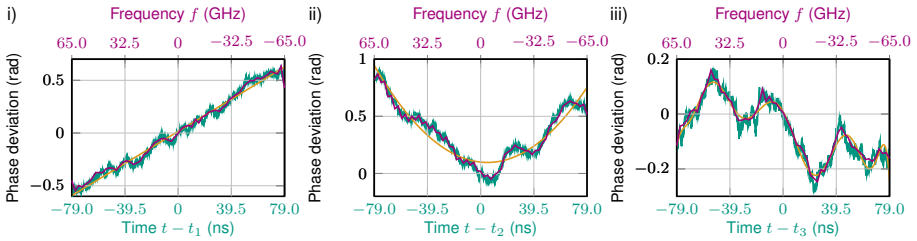
We highlight recent advances in modeling equalization-enhanced phase noise and show that the temporal Gaussian noise model reproduces the characteristic burst-like SNR degradation, enabling efficient system simulation.
What carries the argument
The temporal Gaussian noise model, which represents the statistical and temporal effects of phase noise enhanced by equalization in coherent receivers.
If this is right
- Simulations of high symbol-rate coherent systems become computationally feasible while preserving burst statistics.
- Mitigation techniques for EEPN can be tested and optimized through repeated simulation runs.
- Performance predictions for next-generation systems can incorporate EEPN effects without full waveform-level modeling.
Where Pith is reading between the lines
- The same modeling shortcut could extend to other equalization-enhanced impairments such as nonlinear phase noise.
- If the model holds across different hardware, it reduces reliance on custom simulators for network planning.
- Integration into standard link-budget tools would allow rapid assessment of EEPN impact at varying symbol rates.
Load-bearing premise
The temporal Gaussian noise model is adequate to capture the key statistical and temporal features of EEPN without needing additional parameters or validation against measured data.
What would settle it
Side-by-side comparison of time-series SNR traces from the model against experimental measurements in a high symbol-rate coherent system would confirm or refute whether the burst patterns match.
Figures


read the original abstract
Equalization-enhanced phase noise (EEPN) emerges as a key performance limitation in high symbol-rate coherent transmission systems. In this paper, we highlight recent advances in modeling EEPN and show that the temporal Gaussian noise model reproduces the characteristic burst-like SNR degradation, enabling efficient system simulation.
Editorial analysis
A structured set of objections, weighed in public.
Referee Report
Summary. The manuscript asserts that a temporal Gaussian noise model for equalization-enhanced phase noise (EEPN) reproduces the burst-like SNR degradation observed in high symbol-rate coherent transmission systems. This reproduction is said to enable efficient system simulations, and the paper highlights recent advances in EEPN modeling.
Significance. If the temporal Gaussian noise model is shown to accurately capture the key features of EEPN without additional parameters, it would provide a valuable tool for efficient simulation of system performance in optical communications, potentially aiding in the design of mitigation strategies for high-speed links.
major comments (1)
- [Abstract] Abstract: The assertion that the temporal Gaussian noise model reproduces the characteristic burst-like SNR degradation is made without any accompanying derivation, simulation setup, statistical metrics (such as burst rate, duration, or depth), or side-by-side comparisons to a full physical EEPN model or measured data. This lack of evidence makes it impossible to assess whether the Gaussian assumption is sufficient.
Simulated Author's Rebuttal
We thank the referee for the detailed review and constructive feedback on our manuscript. We address the major comment below.
read point-by-point responses
-
Referee: [Abstract] Abstract: The assertion that the temporal Gaussian noise model reproduces the characteristic burst-like SNR degradation is made without any accompanying derivation, simulation setup, statistical metrics (such as burst rate, duration, or depth), or side-by-side comparisons to a full physical EEPN model or measured data. This lack of evidence makes it impossible to assess whether the Gaussian assumption is sufficient.
Authors: The abstract is intended as a concise summary of the paper's main contribution. The full manuscript contains the requested details: the derivation of the temporal Gaussian noise model (Section 2), the simulation setup for high symbol-rate coherent systems (Section 3), quantitative statistical metrics on burst rate, duration, and depth (Section 4), and side-by-side comparisons to the full physical EEPN model via Monte Carlo simulations demonstrating reproduction of the burst-like SNR degradation. The work is simulation-based and does not include experimental measured data. To address the concern and improve accessibility, we will revise the abstract to briefly reference the simulation-based validation and key statistical findings. revision: yes
Circularity Check
No circularity: modeling claim stands on independent assertion
full rationale
The abstract states that the temporal Gaussian noise model reproduces burst-like SNR degradation but supplies no equations, fitted parameters, self-citations, or derivation steps. No load-bearing claim reduces to its own inputs by construction, self-definition, or renaming. The central modeling assertion is presented as a direct result without visible circular reduction in the given text.
Axiom & Free-Parameter Ledger
Reference graph
Works this paper leans on
-
[1]
Infinite Capacity Engine – Extensible (ICE-X) 800G ZR/ZR+ OSFP/QSFP-DD800
Nokia, “Infinite Capacity Engine – Extensible (ICE-X) 800G ZR/ZR+ OSFP/QSFP-DD800”, Nokia, Datasheet, 2025, Accessed: 2026-03-22. [Online]. Available:https: //www.nokia.com/asset/214587/
2025
-
[2]
Toward 1.6T low-power coherent DSP: Challenges, and lessons learned from preceding gener- ations
S. H. Fan, R. L. Nguyen, J. L. Correa Lust, H. Chien, and S.-C. Wang, “Toward 1.6T low-power coherent DSP: Challenges, and lessons learned from preceding gener- ations”, inProc. Optical Fiber Communications Confer- ence (OFC), San Diego, CA, USA, 2024, M2H.1.DOI: 10.1364/OFC.2024.M2H.1
-
[3]
Study of EEPN ef- fect in 800G QAM16 DSP for coherent pluggables
H. Xu, C. Chen, and S. -C. Wang, “Study of EEPN ef- fect in 800G QAM16 DSP for coherent pluggables”, in Proc. European Conference on Optical Communication (ECOC), Frankfurt, Germany, Sep. 2024, W4C.1
2024
-
[4]
System im- pact of laser phase noise on 400G and beyond coher- ent pluggables
H. Xu, M. O. Rebellato, and S. -C. Wang, “System im- pact of laser phase noise on 400G and beyond coher- ent pluggables”, inProc. Optical Fiber Communications Conference (OFC), San Diego, CA, USA, Mar. 2023, Th1E.1.DOI:10.1364/OFC.2023.Th1E.1
-
[5]
W. Shieh and K.-P . Ho, “Equalization-enhanced phase noise for coherent-detection systems using electronic digital signal processing”,Optics Express, vol. 16, no. 20, pp. 15 718–15 727, Sep. 2008.DOI: 10.1364/OE.16. 015718
-
[6]
CO2 Elim- ination in Hollow-Core Fibre via Post-Processing
B. Geiger, F . Buchali, V. Aref, and L. Schmalen, “A tem- poral gaussian noise model for equalization-enhanced phase noise”, inProc. European Conference on Opti- cal Communication (ECOC), Copenhagen, Denmark, Sep. 2025, Tu.01.05.3.DOI: 10.1109/ECOC66593.2025. 11263206
-
[7]
A novel phenomenological model of equalization-enhanced phase noise
B. Geiger, F . Buchali, V. Aref, and L. Schmalen, “A novel phenomenological model of equalization-enhanced phase noise”, inProc. Optical Fiber Communication Conference (OFC), San Francisco, CA, USA, Mar. 2025, M2E.6.DOI:10.1364/OFC.2025.M2E.6
-
[8]
Model- ing equalization-enhanced phase noise
B. Geiger, F . Buchali, V. Aref, and L. Schmalen, “Model- ing equalization-enhanced phase noise”, inProc. Opto- Electronics and Communications Conference (OECC), Busan, Republic of Korea, Jun. 2026
2026
-
[9]
W. Peng and K. Law,Dynamic channel characterization of equalization enhanced phase noise in coherent opti- cal receivers, Optica Open preprint, available at https: //doi.org/10.1364/opticaopen.30105046.v1 , Sep. 2025
-
[10]
Mitigation of equalization enhanced phase noise using feedforward timing error correction
M. Qiu, X. Tang, Y . Chen, J. He, and C. Li, “Mitigation of equalization enhanced phase noise using feedforward timing error correction”, inProc. European Conference on Optical Communication (ECOC), Frankfurt, Germany, Sep. 2024, W4C.2
2024
-
[11]
Mitigating equalization-enhanced phase noise using adaptive post equalization
S. Jung, T. Janz, and S. ten Brink, “Mitigating equalization-enhanced phase noise using adaptive post equalization”, inProc. European Conference on Opti- cal Communication (ECOC), Frankfurt, Germany, Sep. 2024, W2A.81
2024
-
[12]
Equalization-enhanced phase noise compen- sation in coherent fiber receivers
A. Abolfathimomtaz, M. Ardakani, H. Ebrahimzad, and Z. Zhang, “Equalization-enhanced phase noise compen- sation in coherent fiber receivers”,Journal of Lightwave Technology (JLT), vol. 42, no. 20, pp. 7155–7166, 2024. DOI:10.1109/JLT.2024.3416383
-
[13]
Receiver laser phase noise estimation with application to EEPN control
A. Abolfathimomtaz, M. Ardakani, H. Ebrahimzad, Z. Zhang, and C. Li, “Receiver laser phase noise estimation with application to EEPN control”,Journal of Lightwave Technology (JLT), vol. 43, no. 9, pp. 4106–4118, 2025. DOI:10.1109/JLT.2025.3535548
-
[14]
Y . Zhu, X. Fang, X. Cai, Y . Hu, W. Hu, and F . Zhang, “Overcoming EEPN in long-haul coherent transmission via transmitter and LO phase noise separation based on walk-off”, inProc. Optical Fiber Communications Con- ference (OFC), San Francisco, CA, USA, Mar. 2025, Th4B.6.DOI:10.1364/OFC.2025.Th4B.6
-
[15]
Frequency-band analysis of equal- ization enhanced phase noise jointly with DSP impact
C. S. Martins et al., “Frequency-band analysis of equal- ization enhanced phase noise jointly with DSP impact”, inProc. Optical Fiber Communications Conference (OFC), San Diego, CA, USA, Mar. 2024, Tu2H.5.DOI: 10.1364/OFC.2024.Tu2H.5
-
[16]
Modeling the impact of equalization-enhanced phase noise on DSP in optical coherent receivers
G. Balducci, C. Costantini, L. G. Razzetti, V. Aref, F . Buchali, and G. Gavioli, “Modeling the impact of equalization-enhanced phase noise on DSP in optical coherent receivers”,Journal of Lightwave Technology (JLT), vol. 43, no. 23, pp. 10 497–10 503, Dec. 2025.DOI: 10.1109/JLT.2025.3612988
-
[17]
S. Jung, T. Janz, V. Aref, and S. ten Brink, “Equalization- enhanced phase noise: Modeling and DSP-aware anal- ysis”,Journal of Lightwave Technology (JLT), vol. 43, no. 20, pp. 9551–9560, Oct. 2025.DOI: 10.1109/JLT. 2025.3601237
work page doi:10.1109/jlt 2025
-
[18]
Mitigat- ing EEPN-induced timing jitter in high baud rate optical systems: Experimental validation and DSP optimiza- tion
F . Buchali, V. Aref, G. Gavioli, and G. Balducci, “Mitigat- ing EEPN-induced timing jitter in high baud rate optical systems: Experimental validation and DSP optimiza- tion”, inProc. Optical Fiber Communications Conference (OFC), Los Angeles, CA, USA, Mar. 2026, W1C.4
2026
-
[19]
A. Arnould and A. Ghazisaeidi, “Equalization enhanced phase noise in coherent receivers: DSP-aware analysis and shaped constellations”,Journal of Lightwave Tech- nology (JLT), vol. 37, no. 20, pp. 5282–5290, Oct. 2019. DOI:10.1109/JLT.2019.2931841
-
[20]
Phenomenological characterization of the electronically enhanced phase noise in transmission experiments
X. Y e, A. Ghazisaeidi, S. Almonacil, H. Mardoyan, and J. Renaudier, “Phenomenological characterization of the electronically enhanced phase noise in transmission experiments”, inProc. European Conference on Optical Communication (ECOC), Basel, Switzerland, Sep. 2022, We3D.6
2022
-
[21]
State of the art real-time DSP for long-haul transmission systems
D. Lavery, “State of the art real-time DSP for long-haul transmission systems”, inProc. OptoElectronics and Communications Conference (OECC) and International Conference on Photonics in Switching and Computing (PSC), ISSN: 2166-8892, Sapporo, Japan, Jun. 2025. DOI:10.23919/OECC/PSC62146.2025.11109588
-
[22]
800G DSP ASIC design using probabilistic shaping and digital sub-carrier multiplexing
H. Sun et al., “800G DSP ASIC design using probabilistic shaping and digital sub-carrier multiplexing”,Journal of Lightwave Technology (JLT), vol. 38, no. 17, pp. 4744– 4756, Sep. 2020.DOI: 10 . 1109 / JLT . 2020 . 2996188 Accessed: Feb. 6, 2025
2020
-
[23]
Opportunities and Chal- lenges for Long-Distance Transmission in Hollow-Core Fibres
M. S. Neves, P . P . Monteiro, and F . P . Guiomar, “En- hanced phase estimation for long-haul multi-carrier systems using a dual-reference subcarrier approach”, Journal of Lightwave Technology (JLT), vol. 39, no. 9, pp. 2714–2724, May 2021.DOI: 10.1109/JLT.2021. 3057680
-
[24]
Dynamic EEPN impulse response mod- eling and DSP compensation for single-carrier coher- ent receivers
W.-R. Peng, “Dynamic EEPN impulse response mod- eling and DSP compensation for single-carrier coher- ent receivers”, inProc. Optical Fiber Communications Conference (OFC), Los Angeles, CA, USA, Mar. 2026, Th1B.1
2026
discussion (0)
Sign in with ORCID, Apple, or X to comment. Anyone can read and Pith papers without signing in.