REVIEW 3 major objections 5 minor 1 cited by
Vacuum-induced interference in light scattering by multilevel atomic chains
T0 review · 3 major / 5 minor · reviewed 2026-08-01 · deepseek-v4-flash
Pith's one-line read Vacuum coupling between two atomic transitions changes the cooperative decay and Lamb shift of an ordered chain, shifting the two resonances in opposite directions.
desk verdict A well-derived extension with a new analytic prediction, undermined by an unproven assumption that single-atom cross-damping vanishes by symmetry—worth refereeing but likely needs a major revision. read the letter →
The pith
A machine-rendered reading of the paper's core claim, the machinery that carries it, and where it could break.
The reading
What carries the argument
The model of coupled coherent dipoles (MCD): in the weak-saturation limit each optical transition is treated as a harmonic oscillator with a coherence amplitude b_i, and the vacuum-mediated coupling between any pair of transitions i,j at different sites enters through the Green's function G^{ij}_{αβ}. In the mean-field limit, the cross terms ⟨G^{RB}⟩⟨G^{BR}⟩ in the denominator of the coherence amplitudes produce the new linewidth and lineshift corrections.
What would settle it
A high-precision measurement of the total scattered-light spectrum from a pinned chain of 7Li atoms at period a=λ; if the two resonances do not shift in opposite directions with the magnitude difference between the full and cross-term-free predictions of Fig. 4, the cross-interference picture fails or the reduced level scheme is insufficient.
Extended reading notes
Core claim
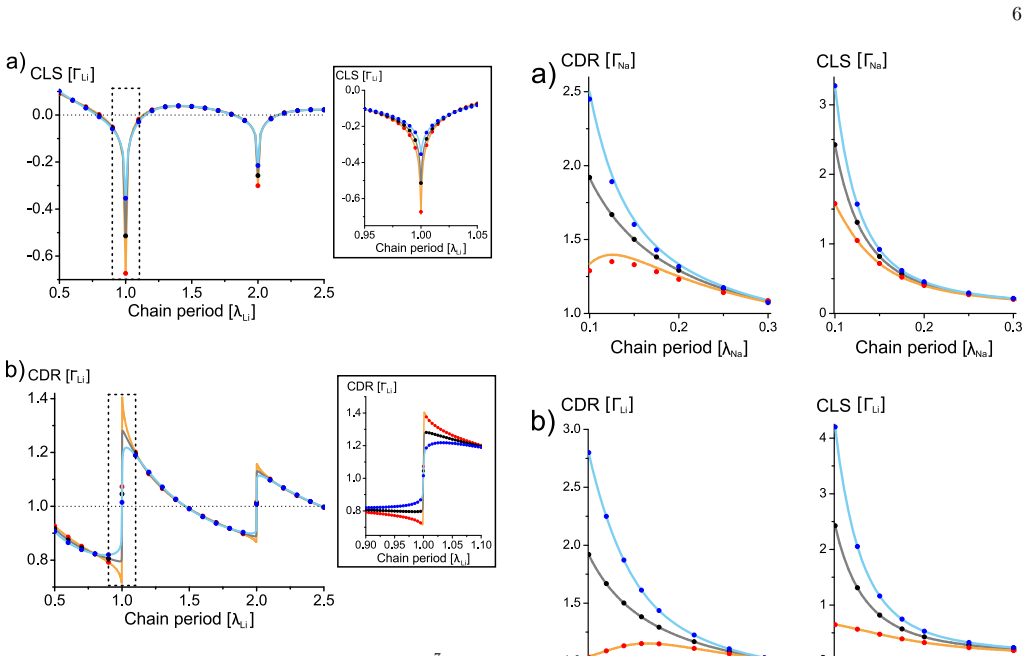
For a one-dimensional chain of atoms whose two relevant optical transitions have parallel dipole moments, the vacuum-induced cross-interference between the two transitions contributes a term i⟨G_RB⟩⟨G_BR⟩/δω to the cooperative linewidth (Eq. 13) and the analogous term to the collective Lamb shift (Eq. 14). Because this term is proportional to 1/δω and changes sign when going from the lower- to the higher-frequency resonance, it pushes the two resonances in opposite directions and narrows one while broadening the other. The paper shows that this correction is negligible for most lattice periods but becomes significant at period a=λ and for a≲0.15λ, and it is several times larger for lithium (
Load-bearing premise
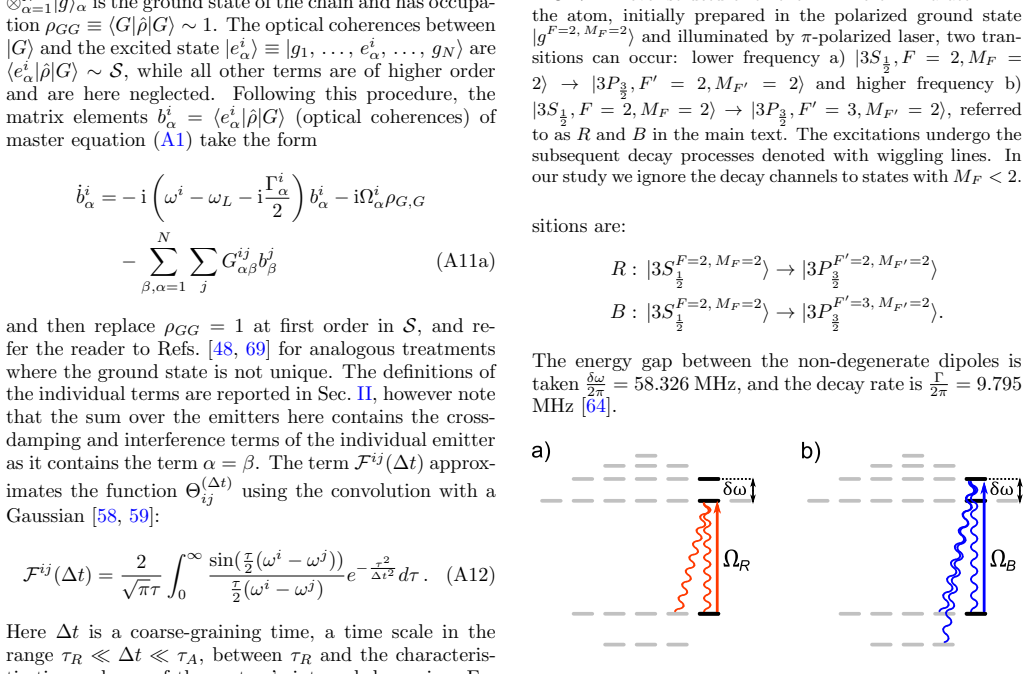
The quantitative predictions require that the real D2 line of sodium or lithium can be truncated to just two parallel transitions, with all other hyperfine levels and decay channels to lower magnetic sublevels ignored, and with the single-atom cross-damping exactly zero by spherical symmetry.
Editorial extensions
If this is right
- At chain periods equal to the transition wavelength, the cross-interference correction to the collective Lamb shift is comparable in size to the Lamb shift itself for lithium chains, so it cannot be ignored in high-precision scattering measurements.
- The sign reversal between the R and B resonances means the two peaks of the excitation spectrum shift asymmetrically, a signature that distinguishes vacuum-induced interference from ordinary two-level cooperative effects.
- Position fluctuations of the atoms suppress the cross-interference approximately as 1 − (kΔ)²/2, so the effect is best observed in tightly pinned lattices.
- The analytic mean-field expressions (Eqs. 13–14) give the linewidth and shift per resonance directly from the Green's function, providing a simple way to include multilevel interference in larger arrays.
Reading between the lines
- If the two-level approximation is dropped in dense optical lattices, similar cross terms may also affect subradiant modes and photon storage fidelities, since the corrections alter the collective decay matrix beyond just the two resonances.
- The scaling with 1/δω suggests that engineered near-degeneracy of two transitions (e.g., via magnetic fields or dc Stark shifts) could amplify vacuum-induced cross-talk to a level where it dominates the cooperative response.
- The same mean-field denominator structure appears in any system of coupled parallel dipoles (e.g., quantum dots or superconducting qubits), so the predicted asymmetric shifts may be a general signature of vacuum-mediated cross-damping.
Signed reviews
Editorial analysis
A structured set of objections, weighed in public.
Referee Report
Summary. The paper studies cooperative light scattering by a one-dimensional chain of N identical emitters, each modeled as a three-level system with a single ground state and two excited states R and B whose transition dipole moments are parallel. Starting from a coarse-grained master equation of Ref. [59], the authors derive a coupled-dipole model in the weak-saturation limit and focus on the role of vacuum-induced cross-interference between the two non-degenerate dipole transitions. They solve the model in a mean-field approximation, obtain first-order perturbative expressions in ε = Γ/δω for the cooperative decay rate and collective Lamb shift (Eqs. (13)–(14)), and compute excitation spectra numerically for parameters corresponding to the D2 lines of 23Na and 7Li. They also analyze the influence of atomic position fluctuations on the predicted line shifts. The central claim is that interatomic vacuum-induced interference between two parallel non-degenerate dipoles produces measurable modifications of the linewidth and shift of the R and B resonances at particular chain periodicities.
Significance. If the central claim is correct, the paper identifies a previously neglected mechanism in collective light scattering: multilevel vacuum-induced interference can modify cooperative decay and collective Lamb shifts in ordered atomic arrays, with observable consequences for chains of alkali atoms. The work combines a systematic derivation from a published master equation with explicit analytic mean-field expressions and numerical spectra, and it makes falsifiable predictions, e.g., asymmetric modifications of the two resonances and a characteristic dependence on chain period. The inclusion of interatomic cross-interference in a coupled-dipole framework goes beyond the standard two-level treatments of atomic chains and could be relevant for high-precision spectroscopy and quantum-optics experiments with dense atomic lattices. However, as detailed below, the validity of the central quantitative predictions depends on a model assumption about single-atom cross terms that is not adequately justified.
major comments (3)
- [Sec. II after Eq. (1); Appendix A, Eq. (A8)] The paper suppresses the single-atom cross-damping and cross-shift terms Γ^{i≠j} and Δ^{i≠j} on the grounds that spherical symmetry of the alkali atom leads to their vanishing. This is not derived and appears inconsistent with the master equation used. In Appendix A, Eq. (A8) gives Γ_{ij}^{αβ} ∝ D_i^{α*}·D_j^β for all α,β, including α=β. For the two stretched π transitions considered here, the dipole moments are parallel, so the scalar product is generally nonzero; the Wigner-Eckart factors do not automatically cancel it. If these single-atom cross terms are nonzero, they enter Eq. (1) at the same level as the interatomic G_{ij} terms and must be included in the perturbative solution of Sec. III. The central expressions (13)–(14) would then mix single-atom and interatomic interference, and the predicted magnitudes in Figs. 3–6 could change sign or size. The authors should either provide
- [Sec. IV, Fig. 2, Eq. (16)] For 7Li, ε = Γ/δω = 0.65, so the first-order expansion in ε used in Eqs. (8)–(18) is not a controlled approximation. Fig. 2(b) indeed shows a clear discrepancy between the exact numerical solution and the first-order perturbative spectrum. The text attributes this discrepancy entirely to cross-interference, but higher-order terms in ε also contribute. Without a second-order calculation or an estimate of the ε² corrections, the quantitative conclusions for lithium in Figs. 4–5, which are interpreted via Eqs. (13)–(14), are not fully supported. The numerical dots themselves are valid for the model, but the separation into 'cross-interference effects' versus 'higher-order corrections' is not cleanly established.
- [Sec. VI; Sec. II] The paper explicitly acknowledges that 'an accurate description of the spectroscopic signal shall include the full level structure of the D2 line' and that the reduced three-level model neglects decays to states with M_F<2. This is not merely a minor caveat: the claimed spherical-symmetry cancellation of single-atom cross terms in Sec. II depends on the full D2 manifold. If the omitted hyperfine levels contribute additional interfering channels, the two-transition model used for the sodium and lithium predictions may not describe the actual atoms. The authors should either demonstrate that the omitted channels do not affect the predicted effects, or clearly re-frame the results as a toy-model analysis rather than quantitative predictions for 23Na and 7Li chains.
minor comments (5)
- [Eq. (7)] The parentheses in Eqs. (7a)–(7b) are unbalanced, e.g., '(DR +⟨G RR)⟩' appears. Please fix the typography.
- [Fig. 5 caption] The caption says 'CLR' in the first line; this should presumably be 'CDR' (cooperative decay rate).
- [Sec. VI] Typo: 'alkaly-metal' should be 'alkali-metal'.
- [Eq. (19)] The Fano-like fitting function should specify the dimensions of the parameters a_i and b_i and clarify the meaning of the second term; as written, the two terms appear to have different units, and the numerator of the second term is not motivated.
- [Sec. III, Eq. (6)] The mean-field Green's function is defined as a double sum over all pairs. For an infinite or very long chain, the convergence of such sums near k a = 2π m should be discussed; the numerical calculations for N=1000 may be sensitive to boundary effects, and the comparison with mean-field should state how the edges are treated.
Circularity Check
No significant circularity: cross-interference CDR/CLS terms are derived algebraically from the model, not fitted; the main caveat is an unverified single-atom symmetry assumption, which is a correctness risk rather than a circular reduction.
full rationale
The prediction chain is not circular. Equation (1) is the weak-saturation MCD reduction of a published multilevel master equation (Appendix A, Ref. [59]); the mean-field solution (7) and the first-order expansion in epsilon = Gamma / delta_omega lead algebraically to the CDR/CLS formulas (13)-(14). The numerical spectra solve the same equations, and the Fano fit (19) only extracts linewidths and positions from those simulated spectra; it does not set model parameters. Atomic constants come from independent D-line data. The main load-bearing assumption is the Sec. II claim that single-atom cross-damping/cross-shift vanish by spherical symmetry (Gamma^{i!=j}=0, Delta^{i!=j}=0), which is neither derived nor fitted; if it fails, single-emitter vacuum interference contaminates the interatomic signal. That is an unproven physical premise and a correctness risk, not a circular reduction of the prediction to its input. Sec. VI itself flags the need for the full D2 structure. Self-citations (Refs. [58,59,67]) provide the starting master equation and analogous chain results, but the new cross-interference CDR/CLS terms are derived here rather than assumed from those references.
Assumptions & free parameters
free parameters (1)
- Fano spectral fit parameters (a_R,a_B,γ_R,γ_B,Λ_R,Λ_B) =
not reported individually; determined by least-squares fits to each numerical spectrum
assumptions (8)
- domain assumption The coarse-grained Born-Markov master equation of Ref. [59] (Eq. A1) correctly describes vacuum-mediated coupling between multilevel emitters, including cross-damping/cross-shifts.
- domain assumption Weak saturation: S=NΩ/|Δ_i−iΓ/2|≪1, so the ground-state population is ≈1 and each transition behaves as a harmonic oscillator.
- ad hoc to paper The emitter is a three-level system (ground + two excited states R,B) with parallel dipole moments; all other D2 hyperfine levels and decays to M_F<2 are neglected.
- domain assumption For alkali atoms, single-emitter cross-damping and cross-shift vanish (Γ_{i≠j}=Δ_{i≠j}=0) due to spherical symmetry, while interatomic cross terms remain finite.
- domain assumption The coarse-graining factor F^{ij}(Δt)≈1 in Eq. (2).
- domain assumption Mean-field approximation: each atom sees the same ensemble-averaged Green's function; edge effects are negligible for N=1000.
- ad hoc to paper First-order perturbation theory in ε=Γ/δω remains adequate for Li, where ε=0.65.
- domain assumption Atomic position fluctuations are independent Gaussians with width Δ, and the Green's function is rescaled by (1−(kΔ)^2/2).
Cite this review
Pith. "Pith review of Vacuum-induced interference in light scattering by multilevel atomic chains." pith.science (2026). https://pith.science/paper/ZSR6VX3G
@misc{pith2026260721073,
  author       = {Pith},
  title        = {Pith review of: Vacuum-induced interference in light scattering by multilevel atomic chains},
  year         = {2026},
  howpublished = {\url{https://pith.science/paper/ZSR6VX3G}},
  note         = {Machine review of arXiv:2607.21073}
}
read the original abstract
We investigate cooperative light scattering by an ordered chain of multilevel atoms, which possess two quasi-resonant transitions with parallel dipole moments. Interference between dipole transitions induced by coupling with the vacuum gives rise to so called cross-damping and cross-shifts, that modify the incoherent and coherent dynamics and can be manifest in the spectroscopic properties of the emitted light. We determine the excitation spectrum when the atomic chain is driven by an external laser in the limit in which the dipolar transitions can be described by harmonic oscillators and the scattering is coherent. We show that the interplay of multilevel interference and superradiance can give rise to measurable effects in chains of alkali-metal atoms.
Figures


Figures from the paper (3 more)


Forward citations
Cited by 1 Pith paper
-
Collective states of multi-level emitters: The role of multi-level interferences
Multi-level interference between near-resonant transitions suppresses superradiance in emitter arrays at separations below about 1% of the emission wavelength—a threshold absent for two-level emitters.
Reference graph
Works this paper leans on
-
[59]
Kiffner, M
M. Kiffner, M. Macovei, J. Evers, and C. Keitel, Chapter 3 - vacuum-induced processes in multilevel atoms (Else- vier, 2010) pp. 85–197
2010
-
[1]
Coherences For simplicity, we assume ΓR = ΓB = Γ. We set ˙bα i = 0 and introduce the variable ˜bi α =b i α exp(i⃗kL · ⃗Rα), which satisfies the coupled equation ˜bi α = Ωi iDi − 1 Di NX β(̸=α) X j=R,B e−i⃗kL· ⃗Rαβ Gij αβ ˜bj β,(4) whereD i = Γ/2−i∆ i. For sufficiently dilute atomic ensembles, we assume that each atom is equally affected by the entire ense...
-
[2]
Cross interference effects on the linewidth and frequency shift Let us now discuss the spectral properties of the co- herences (7), they can be extracted after inspecting the denominators. At first order inϵthe linewidth is given by ⟨ΓR CDR⟩= Γ + 2Re ⟨GRR⟩+ i ⟨GRB⟩⟨GBR⟩ δω ,(13) and contains the superradiant contribution of two-level emitters known as Coo...
-
[3]
From Eq.(3) we obtain: S(δL) = Γ X i=B,R |bi|2 + X i,j=B,R 2Re ⟨Gij⟩ bibj∗,(15) whereb i are given by Eqs
Excitation spectrum We now find an analytical form of the photon count signal for the mean field solution. From Eq.(3) we obtain: S(δL) = Γ X i=B,R |bi|2 + X i,j=B,R 2Re ⟨Gij⟩ bibj∗,(15) whereb i are given by Eqs. (7). Using Eq. (8), the exci- tation spectrum, up to the first order inϵ, is the sum of two terms (j=RorB): Sj(δL) =S (0) j (δL) +ϵS (1) j (δL)...
2020
-
[4]
1− ( ⃗Dα i · ⃗Rαβ)∗( ⃗D β j · ⃗Rαβ) Dα i Dβ j R2 αβ # − j1(kRαβ) kRαβ
Coarse-grained master equation We report here the coarse grained master equation of Ref. [59]. Letρbe the density operator for the internal states of the emitters, then its dynamics is governed by the Born-Markov master equation ∂t ˆρ= 1 iℏ [ ˆHA + ˆHS,ˆρ(t)] +LD ˆρ(t),(A1) where ˆHA is the Hamiltonian of the isolated emitters, in- cluding classical drive...
-
[5]
Derivation of the model for coupled coherent dipoles We now consider a chain composed byNidentical emitters uniformly driven by the laser. We now as- sume that the internal levels of the emitter consist of the ground state|g⟩and excited states|R⟩and|B⟩with parallel dipolar moments ⃗dR ≡ ⃗Di withi= (g, R) and 9 ⃗dB ≡ ⃗Dj withj= (g, B). Hamiltonian ˆHA = P ...
-
[6]
Reitz, C
M. Reitz, C. Sommer, and C. Genes, Cooperative quan- tum phenomena in light-matter platforms, PRX Quan- tum3, 010201 (2022)
2022
-
[7]
Hepp and E
K. Hepp and E. H. Lieb, On the superradiant phase tran- sition for molecules in a quantized radiation field: the dicke maser model, Annals of Physics76, 360 (1973)
1973
Show all 74 references
-
[8]
Gross and S
M. Gross and S. Haroche, Superradiance: An essay on the theory of collective spontaneous emission, Physics reports 93, 301 (1982)
1982
-
[9]
R. H. Dicke, Coherence in spontaneous radiation pro- cesses, Physical review93, 99 (1954)
1954
-
[10]
O’Dell, S
D. O’Dell, S. Giovanazzi, G. Kurizki, and V. M. Akulin, Bose-einstein condensates with 1/rinteratomic attrac- tion: Electromagnetically induced “gravity”, Physical Review Letters84, 5687–5690 (2000)
2000
-
[11]
Ritsch, P
H. Ritsch, P. Domokos, F. Brennecke, and T. Esslinger, Cold atoms in cavity-generated dynamical optical poten- tials, Rev. Mod. Phys.85, 553 (2013)
2013
-
[12]
Olmos, D
B. Olmos, D. Yu, Y. Singh, F. Schreck, K. Bongs, and I. Lesanovsky, Long-range interacting many-body sys- tems with alkaline-earth-metal atoms, Physical review letters110, 143602 (2013)
2013
-
[13]
Sch¨ utz and G
S. Sch¨ utz and G. Morigi, Prethermalization of atoms due to photon-mediated long-range interactions, Phys. Rev. Lett.113, 203002 (2014)
2014
-
[14]
J. S. Douglas, H. Habibian, C.-L. Hung, A. V. Gorshkov, H. J. Kimble, and D. E. Chang, Quantum many-body models with cold atoms coupled to photonic crystals, Na- ture Photonics9, 326–331 (2015)
2015
-
[15]
R. G. DeVoe and R. G. Brewer, Observation of superradi- ant and subradiant spontaneous emission of two trapped ions, Phys. Rev. Lett.76, 2049 (1996)
-
[16]
J. Rui, D. Wei, A. Rubio-Abadal, S. Hollerith, J. Zeiher, D. M. Stamper-Kurn, C. Gross, and I. Bloch, A subradi- ant optical mirror formed by a single structured atomic layer, Nature583, 369 (2020)
2020
-
[17]
Kr¨ amer, L
S. Kr¨ amer, L. Ostermann, and H. Ritsch, Optimized ge- ometries for future generation optical lattice clocks, EPL (Europhysics Letters)114, 14003 (2016)
2016
-
[18]
S. J. Masson, J. P. Covey, S. Will, and A. Asenjo- Garcia, Dicke superradiance in ordered arrays of mul- tilevel atoms, PRX Quantum5, 010344 (2024)
2024
-
[19]
Facchinetti, S
G. Facchinetti, S. D. Jenkins, and J. Ruostekoski, Stor- ing light with subradiant correlations in arrays of atoms, Physical review letters117, 243601 (2016)
2016
-
[20]
Jen, M.-S
H. Jen, M.-S. Chang, and Y.-C. Chen, Cooperative single-photon subradiant states, Physical Review A94, 013803 (2016)
2016
-
[21]
R. J. Bettles, S. A. Gardiner, and C. S. Adams, Coopera- tive eigenmodes and scattering in one-dimensional atomic arrays, Phys. Rev. A94, 043844 (2016)
2016
-
[22]
I. H. Deutsch, R. J. C. Spreeuw, S. L. Rolston, and W. D. Phillips, Photonic band gaps in optical lattices, Phys. Rev. A52, 1394 (1995)
1995
-
[23]
D. V. van Coevorden, R. Sprik, A. Tip, and A. Lagendijk, Photonic band structure of atomic lattices, Phys. Rev. Lett.77, 2412 (1996)
1996
-
[24]
Lambropoulos, G
P. Lambropoulos, G. M. Nikolopoulos, T. R. Nielsen, and S. Bay, Fundamental quantum optics in structured reser- voirs, Reports on Progress in Physics63, 455 (2000)
2000
-
[25]
S. Rist, P. Vignolo, and G. Morigi, Photonic spectrum of bichromatic optical lattices, Phys. Rev. A79, 053822 (2009)
2009
-
[26]
Fern´ andez-Vidal, S
S. Fern´ andez-Vidal, S. Zippilli, and G. Morigi, Nonlinear optics with two trapped atoms, Phys. Rev. A76, 053829 (2007)
2007
-
[27]
Habibian, S
H. Habibian, S. Zippilli, F. Illuminati, and G. Morigi, Stationary entanglement of photons and atoms in a high- finesse resonator, Phys. Rev. A89, 023832 (2014)
2014
-
[28]
Reimann, W
R. Reimann, W. Alt, T. Kampschulte, T. Macha, L. Ratschbacher, N. Thau, S. Yoon, and D. Meschede, Cavity-modified collective rayleigh scattering of two atoms, Phys. Rev. Lett.114, 023601 (2015)
2015
-
[29]
Neuzner, M
A. Neuzner, M. K¨ orber, O. Morin, S. Ritter, and G. Rempe, Interference and dynamics of light from a distance-controlled atom pair in an optical cavity, Na- ture Photonics10, 303–306 (2016)
2016
-
[30]
Bloch, J
I. Bloch, J. Dalibard, and W. Zwerger, Many-body physics with ultracold gases, Rev. Mod. Phys.80, 885 (2008)
2008
-
[31]
H. J. Manetsch, G. Nomura, E. Bataille, X. Lv, K. H. Leung, and M. Endres, A tweezer array with 6,100 highly coherent atomic qubits, Nature647, 60 (2025)
2025
-
[32]
Barredo, S
D. Barredo, S. De L´ es´ eleuc, V. Lienhard, T. Lahaye, and A. Browaeys, An atom-by-atom assembler of defect-free arbitrary two-dimensional atomic arrays, Science354, 1021 (2016)
2016
-
[33]
Endres, H
M. Endres, H. Bernien, A. Keesling, H. Levine, E. R. Anschuetz, A. Krajenbrink, C. Senko, V. Vuletic, M. Greiner, and M. D. Lukin, Atom-by-atom assembly of defect-free one-dimensional cold atom arrays, Science 354, 1024 (2016)
2016
-
[34]
Huang, W
X. Huang, W. Yuan, A. Holman, M. Kwon, S. J. Masson, R. Gutierrez-Jauregui, A. Asenjo-Garcia, S. Will, and N. Yu, Metasurface holographic optical traps for ultra- cold atoms, Progress in Quantum Electronics89, 100470 (2023)
2023
-
[35]
Zeiher, J.-y
J. Zeiher, J.-y. Choi, A. Rubio-Abadal, T. Pohl, R. van Bijnen, I. Bloch, and C. Gross, Coherent many-body spin dynamics in a long-range interacting ising chain, Phys. Rev. X7, 041063 (2017)
2017
-
[36]
Periwal, E
A. Periwal, E. S. Cooper, P. Kunkel, J. F. Wienand, E. J. Davis, and M. Schleier-Smith, Programmable in- teractions and emergent geometry in an array of atom clouds, Nature600, 630 (2021)
2021
-
[37]
E. Baum, A. Broman, T. Clarke, N. C. Costa, J. Mucciac- cio, A. Yue, Y. Zhang, V. Norman, J. Patton, M. Radu- laski, and R. T. Scalettar, Effect of emitters on quantum state transfer in coupled cavity arrays, Phys. Rev. B105, 195429 (2022)
2022
-
[38]
S. D. Jenkins, J. Ruostekoski, N. Papasimakis, S. Savo, and N. I. Zheludev, Many-body subradiant excitations in metamaterial arrays: Experiment and theory, Physical review letters119, 053901 (2017)
2017
-
[39]
se- lective radiance
A. Asenjo-Garcia, M. Moreno-Cardoner, A. Albrecht, H. Kimble, and D. E. Chang, Exponential improvement in photon storage fidelities using subradiance and “se- lective radiance” in atomic arrays, Physical Review X7, 031024 (2017)
2017
-
[40]
Shahmoon, D
E. Shahmoon, D. S. Wild, M. D. Lukin, and S. F. Yelin, Cooperative resonances in light scattering from 11 two-dimensional atomic arrays, Physical review letters 118, 113601 (2017)
2017
-
[41]
R. J. Bettles, S. A. Gardiner, and C. S. Adams, En- hanced optical cross section via collective coupling of atomic dipoles in a 2d array, Physical review letters116, 103602 (2016)
2016
-
[42]
J. S. Peter, S. Ostermann, and S. F. Yelin, Chirality- induced emergent spin-orbit coupling in topological atomic lattices, Physical Review A109, 043525 (2024)
2024
-
[43]
J. S. Peter, S. Ostermann, and S. F. Yelin, Chirality dependent photon transport and helical superradiance, Physical Review Research6, 023200 (2024)
2024
-
[44]
J. A. Needham, I. Lesanovsky, and B. Olmos, Subradiance-protected excitation transport, New Jour- nal of Physics21, 073061 (2019)
2019
-
[45]
S. D. Jenkins and J. Ruostekoski, Controlled manipu- lation of light by cooperative response of atoms in an optical lattice, Physical Review A—Atomic, Molecular, and Optical Physics86, 031602 (2012)
2012
-
[46]
M. Cech, I. Lesanovsky, and B. Olmos, Dispersionless subradiant photon storage in one-dimensional emitter chains, Physical Review A108, L051702 (2023)
2023
-
[47]
I. B. Mekhov and H. Ritsch, Quantum nondemolition measurements and state preparation in quantum gases by light detection, Phys. Rev. Lett.102, 020403 (2009)
2009
-
[48]
S. Rist, C. Menotti, and G. Morigi, Light scattering by ultracold atoms in an optical lattice, Phys. Rev. A81, 013404 (2010)
2010
-
[49]
Perczel, J
J. Perczel, J. Borregaard, D. E. Chang, H. Pichler, S. F. Yelin, P. Zoller, and M. D. Lukin, Topological quantum optics in two-dimensional atomic arrays, Physical review letters119, 023603 (2017)
2017
-
[50]
Ferioli, A
G. Ferioli, A. Glicenstein, L. Henriet, I. Ferrier-Barbut, and A. Browaeys, Storage and release of subradiant ex- citations in a dense atomic cloud, Physical Review X11, 021031 (2021)
2021
-
[51]
B. Zhu, J. Cooper, J. Ye, and A. M. Rey, Light scattering from dense cold atomic media, Physical Review A94, 023612 (2016)
2016
-
[52]
S. L. Bromley, B. Zhu, M. Bishof, X. Zhang, T. Both- well, J. Schachenmayer, T. L. Nicholson, R. Kaiser, S. F. Yelin, M. D. Lukin,et al., Collective atomic scattering and motional effects in a dense coherent medium, Nature communications7, 1 (2016)
2016
-
[53]
Jennewein, M
S. Jennewein, M. Besbes, N. Schilder, S. D. Jenkins, C. Sauvan, J. Ruostekoski, J.-J. Greffet, Y. R. Sortais, and A. Browaeys, Coherent scattering of near-resonant light by a dense microscopic cold atomic cloud, Physical review letters116, 233601 (2016)
2016
-
[54]
D. C. Yost, A. Matveev, E. Peters, A. Beyer, T. H¨ ansch, and T. Udem, Quantum interference in two-photon frequency-comb spectroscopy, Physical Review A90, 012512 (2014)
2014
-
[55]
T. Udem, L. Maisenbacher, A. Matveev, V. Andreev, A. Grinin, A. Beyer, N. Kolachevsky, R. Pohl, D. C. Yost, and T. W. H¨ ansch, Quantum interference line shifts of broad dipole-allowed transitions, Annalen der Physik 531, 1900044 (2019)
2019
-
[56]
Horbatsch and E
M. Horbatsch and E. Hessels, Shifts from a distant neigh- boring resonance, Physical Review A82, 052519 (2010)
2010
-
[57]
Horbatsch and E
M. Horbatsch and E. Hessels, Shifts from a distant neigh- boring resonance for a four-level atom, Physical Review A84, 032508 (2011)
2011
-
[58]
Ficek and S
Z. Ficek and S. Swain,Quantum interference and coher- ence: theory and experiments, Vol. 100 (Springer Science & Business Media, 2005)
2005
-
[60]
Milonni, Semiclassical and quantum-electrodynamical approaches in nonrelativistic radiation theory, Physics Reports25, 1 (1976)
P. Milonni, Semiclassical and quantum-electrodynamical approaches in nonrelativistic radiation theory, Physics Reports25, 1 (1976)
1976
-
[61]
D. A. Cardimona, M. G. Raymer, and C. R. S. Jr, Steady- state quantum interference in resonance fluorescence, Journal of Physics B: Atomic and Molecular Physics15, 55 (1982)
1982
-
[62]
D. A. Cardimona and C. R. Stroud, Spontaneous radia- tive coupling of atomic energy levels, Phys. Rev. A27, 2456 (1983)
1983
-
[63]
A. A. Buchheit and G. Morigi, Master equation for high- precision spectroscopy, Physical Review A94, 042111 (2016)
2016
-
[64]
Konovalov and G
A. Konovalov and G. Morigi, Master equation for mul- tilevel interference in a superradiant medium, Physical Review A102, 013724 (2020)
2020
-
[65]
Jennewein, L
S. Jennewein, L. Brossard, Y. R. Sortais, A. Browaeys, P. Cheinet, J. Robert, and P. Pillet, Coherent scattering of near-resonant light by a dense, microscopic cloud of cold two-level atoms: Experiment versus theory, Physical Review A97, 053816 (2018)
2018
-
[66]
Putnam, G.-D
G. Putnam, G.-D. Lin, and S. Yelin, Collective induced superradiant lineshifts, arXiv preprint arXiv:1612.04477 (2016)
2016 arXiv
-
[67]
R¨ ohlsberger, K
R. R¨ ohlsberger, K. Schlage, B. Sahoo, S. Couet, and R. R¨ uffer, Collective lamb shift in single-photon superra- diance, Science328, 1248 (2010)
2010
-
[68]
Glicenstein, G
A. Glicenstein, G. Ferioli, N. ˇSibali´ c, L. Brossard, I. Ferrier-Barbut, and A. Browaeys, Collective shift in resonant light scattering by a one-dimensional atomic chain, Physical Review Letters124, 253602 (2020)
2020
-
[69]
D. A. Steck, Sodium d line data (2001), URL http://steck. us/alkalidata/sodiumnumbers. pdf (2003)
2001
-
[70]
Zelener, S
B. Zelener, S. Saakyan, V. Sautenkov, A. Akulshin, E. Manykin, B. Zelener, and V. Fortov, Magneto-optical trap for preparation and study of rydberg matter, Co- herent Optical Phenomena2(2015)
2015
-
[71]
S. J. Masson, I. Ferrier-Barbut, L. A. Orozco, A. Browaeys, and A. Asenjo-Garcia, Many-body signa- tures of collective decay in atomic chains, Physical review letters125, 263601 (2020)
2020
-
[72]
Piovella, Cooperative decay of an ensemble of atoms in a one-dimensional chain with a single excitation, Atoms 12, 43 (2024)
N. Piovella, Cooperative decay of an ensemble of atoms in a one-dimensional chain with a single excitation, Atoms 12, 43 (2024)
2024
-
[73]
Nienhuis and F
G. Nienhuis and F. Schuller, Spontaneous emission and light scattering by atomic lattice models, Journal of Physics B: Atomic and Molecular Physics20, 23 (1987)
1987
-
[74]
Pellegrino, R
J. Pellegrino, R. Bourgain, S. Jennewein, Y. R. Sortais, A. Browaeys, S. Jenkins, and J. Ruostekoski, Observation of suppression of light scattering induced by dipole-dipole interactions in a cold-atom ensemble, Physical review let- ters113, 133602 (2014)
2014
Reviewed August 1, 2026 · model on record in the stance chip above.
Discussion (0). Continue with ORCID to comment.