CDiT: Conditional Diffusion Transformer for Geometry-Aware Terahertz Cross Far- and Near-Field Channel Generation
Pith reviewed 2026-05-20 03:24 UTC · model grok-4.3
The pith
Conditional diffusion transformer generates controllable high-fidelity Terahertz channels from position and geometry inputs.
A machine-rendered reading of the paper's core claim, the machinery that carries it, and where it could break.
Core claim
By combining diffusion models for distribution modeling with transformers for global dependencies inside a conditional architecture, the CDiT framework learns spatially dependent THz channel distributions from the hybrid planar-spherical wave model in the sparse beamspace domain and produces controllable high-fidelity realizations that outperform representative benchmarks on realistic datasets.
What carries the argument
Conditional Diffusion Transformer (CDiT) that embeds position information as conditioning signals into a diffusion process augmented by transformer layers to capture global spatial dependencies in beamspace.
If this is right
- Supplies diverse synthetic channel samples for training and testing UM-MIMO algorithms without repeated field measurements.
- Allows controllable generation conditioned on specific positions and geometries for scenario-specific evaluation.
- Offers a stable training procedure that converges on realistic THz channel datasets.
- Replaces rigid parametric assumptions with learned distributions that adapt to measured data statistics.
Where Pith is reading between the lines
- The same conditioning strategy could be tested on channel data from other millimeter-wave or sub-THz bands to check transferability.
- Generated channels could feed directly into end-to-end neural receivers for joint optimization of modulation and detection.
- The beamspace formulation may allow efficient extension to dynamic scenarios by adding velocity as an additional conditioning variable.
Load-bearing premise
The hybrid planar-spherical wave model supplies an accurate enough description of practical THz propagation across far- and near-field regimes.
What would settle it
Real-world THz measurements showing that the generated channels systematically mismatch observed spatial correlation functions or power delay profiles would falsify the high-fidelity claim.
Figures





read the original abstract
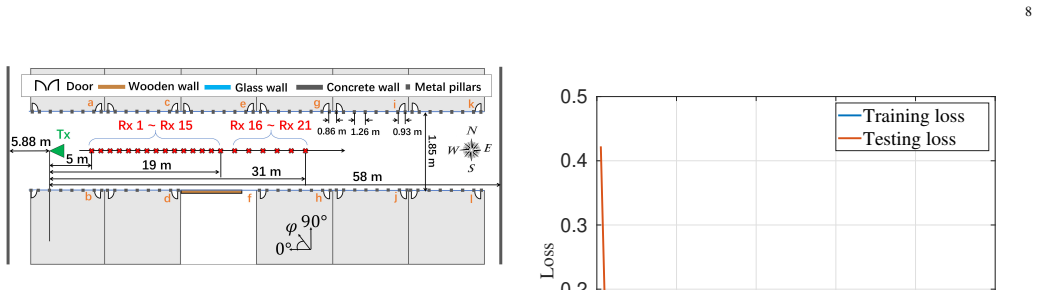
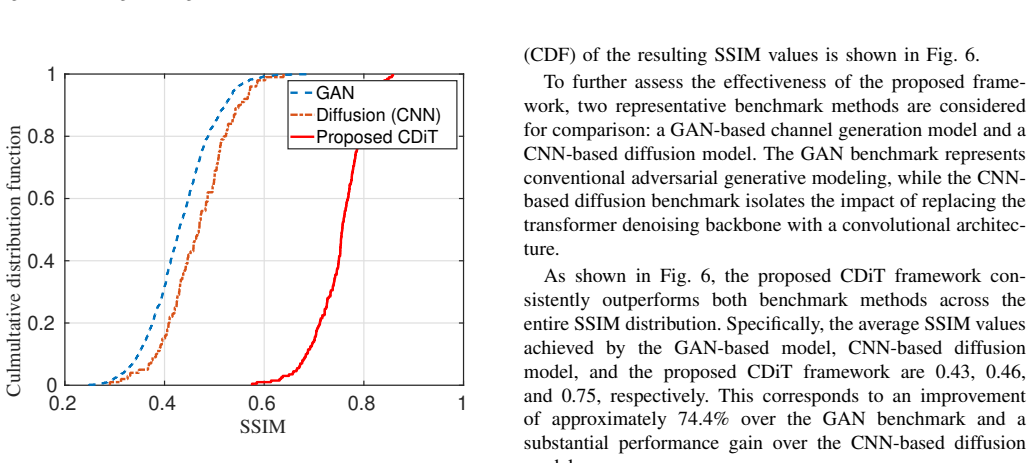
Accurate channel modeling is fundamental to design and evaluation of Terahertz (THz) ultra-massive multiple-input multiple-output (UM-MIMO) systems. However, existing model-based approaches typically rely on simplified assumptions, such as sparsity or predefined parametric structures, which are insufficient to capture the complex spatial variations and cross far-/near-field propagation characteristics of practical THz channels. In this paper, a conditional diffusion transformer (CDiT) framework is proposed for high-fidelity THz channel generation. By leveraging the state-of-the-art hybrid planar-spherical wave model (HPSM), THz channel modeling is formulated as a geometry-aware conditional generative learning problem in the sparse beamspace domain. Position information is incorporated as a conditioning signal within a diffusion-transformer architecture, enabling effective learning of the spatially dependent channel distribution. By combining the strong distribution modeling capability of diffusion models with the global dependency modeling strength of transformers, the proposed framework achieves controllable and high-fidelity THz channel synthesis. Extensive experiments on realistic THz channel datasets demonstrate that the proposed framework converges stably and significantly outperforms representative benchmark methods. The proposed framework provides a promising data-driven paradigm for THz channel modeling in next-generation wireless systems.
Editorial analysis
A structured set of objections, weighed in public.
Referee Report
Summary. The manuscript proposes the Conditional Diffusion Transformer (CDiT) for high-fidelity generation of Terahertz (THz) channels in ultra-massive MIMO systems. It leverages the hybrid planar-spherical wave model (HPSM) to cast the problem as a geometry-aware conditional generative learning task in the sparse beamspace domain, using position information as conditioning within a diffusion-transformer architecture. The framework is reported to achieve controllable synthesis and significantly outperform benchmark methods on realistic THz channel datasets.
Significance. Should the central claims hold upon verification, this contribution would be significant as it introduces a data-driven generative modeling approach that combines diffusion models' distribution learning with transformers' global dependency modeling for THz channel synthesis. This could address limitations of simplified model-based methods in capturing cross far- and near-field characteristics, providing a useful tool for system design in next-generation wireless communications. The use of position as conditioning for controllability is a notable aspect.
major comments (1)
- [§ II] The formulation relies on the hybrid planar-spherical wave model (HPSM) to supply geometry-aware conditioning for the generative model. The manuscript does not appear to validate the accuracy of HPSM against empirical measured data for key THz effects such as molecular absorption, scattering, and spherical wave curvature. This is a load-bearing issue for the claim of high-fidelity synthesis on 'realistic' channels, as the datasets may be simulated from HPSM, in which case the outperformance would demonstrate reproduction of the model rather than improved physical fidelity.
minor comments (2)
- [Abstract] The abstract states that the framework 'converges stably and significantly outperforms' benchmarks but does not include any quantitative metrics, which would help readers assess the practical impact immediately.
- Consider adding more details on the sparse beamspace domain transformation to improve accessibility for readers unfamiliar with THz channel representations.
Simulated Author's Rebuttal
We thank the referee for the positive assessment of our contribution and for the constructive major comment. We address it point by point below.
read point-by-point responses
-
Referee: [§ II] The formulation relies on the hybrid planar-spherical wave model (HPSM) to supply geometry-aware conditioning for the generative model. The manuscript does not appear to validate the accuracy of HPSM against empirical measured data for key THz effects such as molecular absorption, scattering, and spherical wave curvature. This is a load-bearing issue for the claim of high-fidelity synthesis on 'realistic' channels, as the datasets may be simulated from HPSM, in which case the outperformance would demonstrate reproduction of the model rather than improved physical fidelity.
Authors: We appreciate the referee's careful reading and agree that the source of the evaluation data merits explicit clarification. The HPSM is adopted because it is the most accurate analytical model currently available for capturing the hybrid far-/near-field geometry and key THz propagation phenomena (molecular absorption, spherical wavefront curvature) in UM-MIMO settings; the paper cites the relevant HPSM literature that has already performed limited comparisons with ray-tracing and early measurements. Because large-scale, publicly available measured THz UM-MIMO channel datasets do not yet exist, the realistic datasets used in the experiments are generated from the HPSM. Our central claim is therefore not that CDiT improves upon the physical fidelity of HPSM itself, but that, given channels drawn from this model, the conditional diffusion transformer learns their joint distribution more accurately than existing parametric or learning-based baselines. This is evidenced by the consistent gains in both statistical fidelity metrics and downstream beamforming performance. To remove any ambiguity, we have revised Section II to state explicitly that the datasets are synthesized from HPSM, added a dedicated paragraph on the model's assumptions and limitations, and clarified the scope of the 'high-fidelity' claim in the abstract and introduction. We believe these changes directly address the concern while preserving the paper's focus on the generative modeling contribution. revision: yes
Circularity Check
No significant circularity: empirical generative model trained on external datasets
full rationale
The paper formulates THz channel generation as a conditional generative task using HPSM for geometry-aware conditioning in sparse beamspace, then trains a diffusion-transformer architecture on realistic THz channel datasets. No mathematical derivations, equations, or fitted parameters are described that reduce to the inputs by construction. Performance claims rest on empirical outperformance over benchmarks rather than any self-referential loop or self-citation chain. The approach is self-contained against external data benchmarks, with no load-bearing self-citations or ansatzes imported from prior author work evident in the provided text.
Axiom & Free-Parameter Ledger
axioms (1)
- domain assumption Hybrid planar-spherical wave model (HPSM) accurately represents practical THz propagation including cross far-/near-field effects.
Lean theorems connected to this paper
-
IndisputableMonolith/Cost/FunctionalEquation.leanwashburn_uniqueness_aczel unclear?
unclearRelation between the paper passage and the cited Recognition theorem.
By leveraging the state-of-the-art hybrid planar-spherical wave model (HPSM), THz channel modeling is formulated as a geometry-aware conditional generative learning problem in the sparse beamspace domain. Position information is incorporated as a conditioning signal within a diffusion-transformer architecture...
-
IndisputableMonolith/Foundation/AlexanderDuality.leanalexander_duality_circle_linking unclear?
unclearRelation between the paper passage and the cited Recognition theorem.
the channel between the kt-th transmit subarray and the kr-th receive subarray can be expressed as HHPSM[kt, kr] = ... ak r(θkr,l, ϕkr,l) aH kt(θkt,l, ϕkt,l)
What do these tags mean?
- matches
- The paper's claim is directly supported by a theorem in the formal canon.
- supports
- The theorem supports part of the paper's argument, but the paper may add assumptions or extra steps.
- extends
- The paper goes beyond the formal theorem; the theorem is a base layer rather than the whole result.
- uses
- The paper appears to rely on the theorem as machinery.
- contradicts
- The paper's claim conflicts with a theorem or certificate in the canon.
- unclear
- Pith found a possible connection, but the passage is too broad, indirect, or ambiguous to say the theorem truly supports the claim.
Reference graph
Works this paper leans on
-
[1]
Combating the distance problem in the millimeter wave and terahertz frequency bands,
I. F. Akyildiz, C. Han, and S. Nie, “Combating the distance problem in the millimeter wave and terahertz frequency bands,”IEEE Communica- tions Magazine, vol. 56, no. 6, pp. 102–108, 2018
work page 2018
-
[2]
J. M. Jornet, V . Petrov, H. Wang, Z. Popovi ´c, D. Shakya, J. V . Siles, and T. S. Rappaport, “The evolution of applications, hardware design, and channel modeling for terahertz (thz) band communications and sensing: Ready for 6g?”Proceedings of the IEEE, vol. 113, no. 9, pp. 920–951, 2025
work page 2025
-
[3]
C. Han, M. Zhu, W. Zhao, Z. Yu, G. Huang, G. Wang, W. Tong, and W. Zhang, “When wires can’t keep up: Reconfigurable ai data centers empowered by terahertz wireless communications,” 2026. [Online]. Available: https://arxiv.org/abs/2512.24110 11
-
[4]
Use Cases for Terahertz Communications: An Industrial Perspective,
T. Zugnoet al., “Use Cases for Terahertz Communications: An Industrial Perspective,”IEEE Wireless Communications, vol. 32, no. 1, pp. 90–98, 2025
work page 2025
-
[5]
Thz isac: A physical- layer perspective of terahertz integrated sensing and communication,
C. Han, Y . Wu, Z. Chen, Y . Chen, and G. Wang, “Thz isac: A physical- layer perspective of terahertz integrated sensing and communication,” IEEE Communications Magazine, vol. 62, no. 2, pp. 102–108, 2024
work page 2024
-
[6]
Terahertz aerospace communications: enabling technologies and future directions,
W. Gao, C. Han, Y . Chen, Y . He, and W. Zhang, “Terahertz aerospace communications: enabling technologies and future directions,”Science China Information Sciences, vol. 68, no. 12, p. 220302, 2025
work page 2025
-
[7]
A. Liao, Z. Gao, D. Wang, H. Wang, H. Yin, D. W. K. Ng, and M.-S. Alouini, “Terahertz Ultra-Massive MIMO-Based Aeronautical Commu- nications in Space-Air-Ground Integrated Networks,”IEEE Journal on Selected Areas in Communications, vol. 39, no. 6, pp. 1741–1767, 2021
work page 2021
-
[8]
Terahertz wireless channels: A holistic survey on measurement, modeling, and analysis,
C. Han, Y . Wang, Y . Li, Y . Chen, N. A. Abbasi, T. K ¨urner, and A. F. Molisch, “Terahertz wireless channels: A holistic survey on measurement, modeling, and analysis,”IEEE Communications Surveys & Tutorials, vol. 24, no. 3, pp. 1670–1707, 2022
work page 2022
-
[9]
Y . Chen, R. Li, C. Han, S. Sun, and M. Tao, “Hybrid spherical- and planar-wave channel modeling and estimation for terahertz integrated um-mimo and irs systems,”IEEE Transactions on Wireless Communi- cations, vol. 22, no. 12, pp. 9746–9761, 2023
work page 2023
-
[10]
A non-stationary wideband channel model for massive mimo communication systems,
S. Wu, C.-X. Wang, H. Haas, e.-H. M. Aggoune, M. M. Alwakeel, and B. Ai, “A non-stationary wideband channel model for massive mimo communication systems,”IEEE Transactions on Wireless Communica- tions, vol. 14, no. 3, pp. 1434–1446, 2015
work page 2015
-
[11]
A 3d geometry-based thz channel model for 6g ultra massive mimo systems,
Y . Yuan, R. He, B. Ai, Z. Ma, Y . Miao, Y . Niu, J. Zhang, R. Chen, and Z. Zhong, “A 3d geometry-based thz channel model for 6g ultra massive mimo systems,”IEEE Transactions on Vehicular Technology, vol. 71, no. 3, pp. 2251–2266, 2022
work page 2022
-
[12]
J. Wang, C.-X. Wang, J. Huang, and H. Wang, “A novel 3d space- time-frequency non-stationary channel model for 6g thz indoor com- munication systems,” inProc. of IEEE Wireless Communications and Networking Conference (WCNC), 2020, pp. 1–7
work page 2020
-
[13]
S. Das, P. Zhang, and P. Ky ¨osti, “A near-field extension of the 3gpp geometry-based stochastic channel model for sub-thz communications,” IEEE Antennas and Wireless Propagation Letters, pp. 1–5, 2026
work page 2026
-
[14]
C. Han and I. F. Akyildiz, “Three-dimensional end-to-end modeling and analysis for graphene-enabled terahertz band communications,”IEEE Transactions on Vehicular Technology, vol. 66, no. 7, pp. 5626–5634, 2017
work page 2017
-
[15]
Site-specific ray-tracing and experimental validation for thz channel characterization,
Z. Yuan, G. Yu, Y . Lyu, J. Zhang, F. Zhang, and W. Fan, “Site-specific ray-tracing and experimental validation for thz channel characterization,” IEEE Transactions on Terahertz Science and Technology, vol. 15, no. 3, pp. 319–331, 2025
work page 2025
-
[16]
C. Zhang, C. Han, and I. F. Akyildiz, “Three dimensional end-to-end modeling and directivity analysis for graphene-based antennas in the terahertz band,” inProc. of IEEE Global Communications Conference, 2015, pp. 1–6
work page 2015
-
[17]
Ray tracing meets terahertz: Challenges and opportunities,
H. Yi, D. He, P. T. Mathiopoulos, B. Ai, J. M. Garc ´ıa-Loygorri, J. Dou, and Z. Zhong, “Ray tracing meets terahertz: Challenges and opportunities,”IEEE Communications Magazine, vol. 62, no. 2, pp. 40– 46, 2024
work page 2024
-
[18]
Deterministic ray tracing: A promising approach to thz channel modeling in 6g deployment scenarios,
J. Zhang, J. Lin, P. Tang, W. Fan, Z. Yuan, X. Liu, H. Xu, Y . Lyu, L. Tian, and P. Zhang, “Deterministic ray tracing: A promising approach to thz channel modeling in 6g deployment scenarios,”IEEE Communications Magazine, vol. 62, no. 2, pp. 48–54, 2024
work page 2024
-
[19]
Y . Chen, Y . Li, C. Han, Z. Yu, and G. Wang, “Channel measurement and ray-tracing-statistical hybrid modeling for low-terahertz indoor com- munications,”IEEE Transactions on Wireless Communications, vol. 20, no. 12, pp. 8163–8176, 2021
work page 2021
-
[20]
Deep learning-based CSI feedback approach for time-varying massive MIMO channels,
T. Wang, C.-K. Wen, S. Jin, and G. Y . Li, “Deep learning-based CSI feedback approach for time-varying massive MIMO channels,”IEEE Wireless Communications Letters, vol. 8, no. 2, pp. 416–419, 2019
work page 2019
-
[21]
T. J. O’Shea, T. Roy, and N. West, “Approximating the void: Learning stochastic channel models from observation with variational generative adversarial networks,” inProc. of International Conference on Comput- ing, Networking and Communications (ICNC), 2019, pp. 681–686
work page 2019
-
[22]
Generative- adversarial-network-based wireless channel modeling: Challenges and opportunities,
Y . Yang, Y . Li, W. Zhang, F. Qin, P. Zhu, and C.-X. Wang, “Generative- adversarial-network-based wireless channel modeling: Challenges and opportunities,”IEEE Communications Magazine, vol. 57, no. 3, pp. 22– 27, 2019
work page 2019
-
[23]
ChannelGan: Deep learning- based channel modeling and generating,
H. Xiao, W. Tian, W. Liu, and J. Shen, “ChannelGan: Deep learning- based channel modeling and generating,”IEEE Wireless Communica- tions Letters, vol. 11, no. 3, pp. 650–654, 2022
work page 2022
-
[24]
Y . Wei, M.-M. Zhao, and M.-J. Zhao, “Channel distribution learning: Model-driven gan-based channel modeling for irs-aided wireless com- munication,”IEEE Transactions on Communications, vol. 70, no. 7, pp. 4482–4497, 2022
work page 2022
-
[25]
A self-learning channel modeling approach based on explainable neural network,
P. Xue and Y . Zhao, “A self-learning channel modeling approach based on explainable neural network,”IEEE Wireless Communications Letters, vol. 12, no. 7, pp. 1289–1293, 2023
work page 2023
-
[26]
C. Huang, R. He, B. Ai, A. F. Molisch, B. K. Lau, K. Haneda, B. Liu, C.-X. Wang, M. Yang, C. Oestges, and Z. Zhong, “Artificial intelligence enabled radio propagation for communications—part ii: Scenario identification and channel modeling,”IEEE Transactions on Antennas and Propagation, vol. 70, no. 6, pp. 3955–3969, 2022
work page 2022
-
[27]
Digital twin online channel modeling: Challenges, principles, and applications,
J. Li, C.-X. Wang, C. Huang, T. Qi, and T. Wu, “Digital twin online channel modeling: Challenges, principles, and applications,”IEEE Ve- hicular Technology Magazine, vol. 20, no. 1, pp. 94–103, 2025
work page 2025
-
[28]
V oxelrf: V oxelized radiance field for fast wireless channel modeling,
Z. Zeng, S. Sun, M. Tao, Y . Xu, and X. Yu, “V oxelrf: V oxelized radiance field for fast wireless channel modeling,”IEEE Communications Letters, vol. 30, pp. 617–621, 2026
work page 2026
-
[29]
Generalizable neural ray tracing towards physics-informed intelligent channel modeling,
K. Bian, M. Tao, and S. Sun, “Generalizable neural ray tracing towards physics-informed intelligent channel modeling,” inProc. of 2025 IEEE/CIC International Conference on Communications in China (ICCC), 2025, pp. 1–6
work page 2025
-
[30]
Z. Huang, L. Bai, Z. Han, and X. Cheng, “Scatterer recognition for multi-modal intelligent vehicular channel modeling via synesthesia of machines,”IEEE Wireless Communications Letters, vol. 14, no. 7, pp. 1899–1903, 2025
work page 1903
-
[31]
Z. Hu, Y . Li, and C. Han, “Transfer learning enabled transformer-based generative adversarial networks for modeling and generating terahertz channels,”Communications Engineering, vol. 3, no. 153, 2024
work page 2024
-
[32]
Diffusion models beat gans on image synthesis,
P. Dhariwal and A. Nichol, “Diffusion models beat gans on image synthesis,” inProc. of Advances in Neural Information Processing Systems, ser. NIPS ’21. Red Hook, NY , USA: Curran Associates Inc., 2021
work page 2021
-
[33]
Diffusion models: A comprehensive survey of methods and applications,
L. Yang, Z. Zhang, Y . Song, S. Hong, R. Xu, Y . Zhao, W. Zhang, B. Cui, and M.-H. Yang, “Diffusion models: A comprehensive survey of methods and applications,”ACM Computing Surveys, vol. 56, no. 4, Nov. 2023. [Online]. Available: https://doi.org/10.1145/3626235
-
[34]
Score-based generative modeling through stochastic differential equations,
Y . Song, J. Sohl-Dickstein, D. P. Kingma, A. Kumar, S. Ermon, and B. Poole, “Score-based generative modeling through stochastic differential equations,” inProc. of International Conference on Learning Representations, 2021. [Online]. Available: https://openreview.net/forum?id=PxTIG12RRHS
work page 2021
-
[35]
Generative modeling by estimating gradients of the data distribution,
Y . Song and S. Ermon, “Generative modeling by estimating gradients of the data distribution,” inProc. of Advances in Neural Information Processing Systems, 2019, pp. 11 895–11 907
work page 2019
-
[36]
Maximum likelihood training of score-based diffusion models,
Y . Song, C. Durkan, I. Murray, and S. Ermon, “Maximum likelihood training of score-based diffusion models,” inProc. of Thirty-Fifth Conference on Neural Information Processing Systems, 2021
work page 2021
-
[37]
Generating high dimen- sional user-specific wireless channels using diffusion models,
T. Lee, J. Park, H. Kim, and J. G. Andrews, “Generating high dimen- sional user-specific wireless channels using diffusion models,”IEEE Transactions on Wireless Communications, vol. 25, pp. 2907–2921, 2026
work page 2026
-
[38]
T. Wu, C.-X. Wang, J. Li, X. Chen, C. Huang, M. Yao, and E.-H. M. Aggoune, “High-accuracy predictive channel modeling for 6g wireless communications with an improved diffusion-driven learning framework,” IEEE Transactions on Communications, vol. 74, pp. 4014–4029, 2026
work page 2026
-
[39]
M. Cui, Z. Wu, Y . Lu, X. Wei, and L. Dai, “Near-field mimo communica- tions for 6g: Fundamentals, challenges, potentials, and future directions,” IEEE Communications Magazine, vol. 61, no. 1, pp. 40–46, 2023
work page 2023
-
[40]
On spherical vs. plane wave modeling of line-of-sight mimo channels,
F. Bohagen, P. Orten, and G. E. Oien, “On spherical vs. plane wave modeling of line-of-sight mimo channels,”IEEE Transactions on Com- munications, vol. 57, no. 3, pp. 841–849, 2009
work page 2009
-
[41]
Quadriga: A 3-d multi-cell channel model with time evolution for enabling virtual field trials,
S. Jaeckel, L. Raschkowski, K. B ¨orner, and L. Thiele, “Quadriga: A 3-d multi-cell channel model with time evolution for enabling virtual field trials,”IEEE Transactions on Antennas and Propagation, vol. 62, no. 6, pp. 3242–3256, 2014
work page 2014
-
[42]
Channel measurement and analysis in an indoor corridor scenario at 300 ghz,
Y . Li, Y . Wang, Y . Chen, Z. Yu, and C. Han, “Channel measurement and analysis in an indoor corridor scenario at 300 ghz,” inProc. of IEEE International Conference on Communications, 2022, pp. 2888–2893
work page 2022
-
[43]
Information content weighting for perceptual image quality assessment,
Z. Wang and Q. Li, “Information content weighting for perceptual image quality assessment,”IEEE Transactions on Image Processing, vol. 20, no. 5, pp. 1185–1198, 2011
work page 2011
discussion (0)
Sign in with ORCID, Apple, or X to comment. Anyone can read and Pith papers without signing in.