Emissivity of oxidizing titanium in simulated atmospheric entry flows
Pith reviewed 2026-06-26 21:47 UTC · model grok-4.3
The pith
Emissivity of oxidizing titanium evolves dynamically in entry conditions with a drop tied to a temperature jump not seen in prior data.
A machine-rendered reading of the paper's core claim, the machinery that carries it, and where it could break.
Core claim
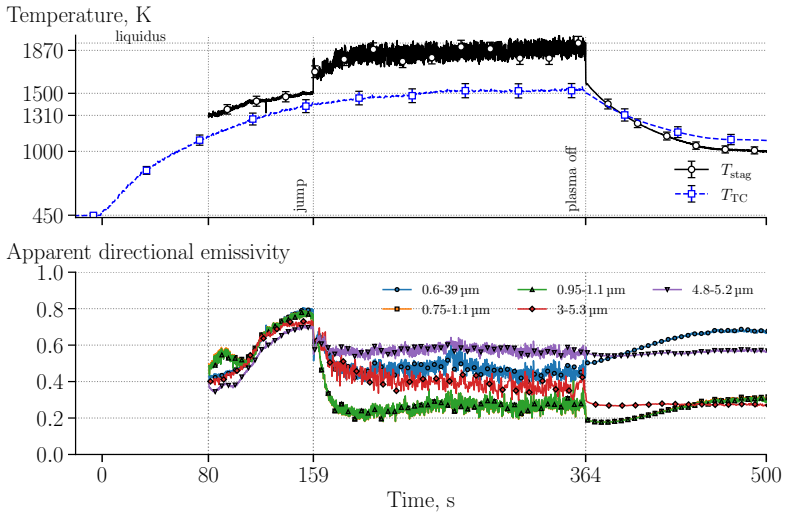
The emissivity of titanium changes continuously during oxidation in dissociated oxygen flows, including a pronounced drop linked to a characteristic surface temperature jump, while electron microscopy shows varied microscale oxide layer morphology; this coupling between oxidation and radiative behavior cannot be resolved by conventional pre-test and post-test emissivity values alone.
What carries the argument
Time-resolved infrared emissivity measurements across five wavelength bands performed on titanium samples during plasma wind tunnel exposure.
If this is right
- Pre-test and post-test emissivity data miss the real-time changes driven by ongoing oxidation.
- Surface thermal balance calculations for titanium must incorporate the observed dynamic emissivity evolution.
- Oxide layer morphology at the microscale contributes to the measured radiative properties.
- Models of titanium space debris demise require in-situ emissivity tracking rather than fixed values.
Where Pith is reading between the lines
- Re-entry trajectory predictions for titanium components could shift if dynamic emissivity is included in thermal models.
- Similar time-resolved measurements on other spacecraft metals might reveal comparable oxidation-radiation couplings.
- The temperature jump may mark a threshold in oxide growth that could be tested by varying exposure duration.
Load-bearing premise
The plasma wind tunnel reproduces the oxidation and heat transfer processes that control emissivity evolution during actual atmospheric entry.
What would settle it
Absence of the emissivity drop and associated temperature jump when titanium is tested in a facility that includes additional flight effects such as particle impacts or different pressure histories would indicate the observed behavior is not general.
Figures






read the original abstract
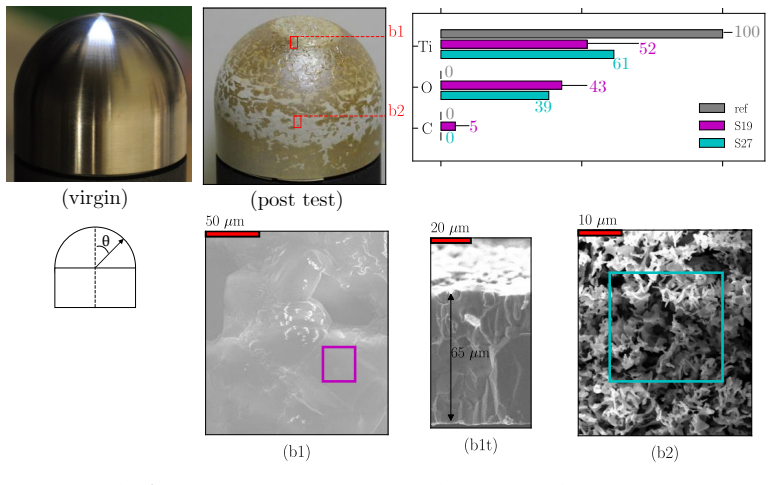
The aerothermal demise of titanium components plays a critical role in the uncontrolled re-entry of space debris from low-Earth orbit. Exposure to high temperatures and dissociated oxygen environments promotes rapid oxidation, significantly influencing the material degradation and surface thermal balance. This study presents time-resolved infrared emissivity measurements of both Grade 2 and Grade 5 titanium samples across five wavelength bands during exposure to entry-relevant conditions simulated in the Plasmatron facility at the von Karman Institute for Fluid Dynamics. The results reveal a dynamic evolution of emissivity throughout the test, including a pronounced drop associated with a characteristic surface temperature jump that is not captured in existing literature data. Post-test electron microscopy highlights a diverse oxide layer morphology at the microscale. Although plasma wind tunnel experiments reproduce only a subset of flight-relevant phenomena to space-debris entry, these findings demonstrate that the complex coupling between oxidation and surface radiative behavior is not adequately captured by conventional pre- and post-test analyses, highlighting their limitations in resolving in-situ emissivity evolution.
Editorial analysis
A structured set of objections, weighed in public.
Referee Report
Summary. The manuscript reports time-resolved infrared emissivity measurements across five wavelength bands for Grade 2 and Grade 5 titanium samples during exposure to simulated atmospheric entry conditions in the Plasmatron plasma wind tunnel. It claims a dynamic evolution of emissivity, including a pronounced drop associated with a surface temperature jump not captured in existing literature, and concludes that this oxidation-radiative coupling is inadequately resolved by conventional pre- and post-test analyses.
Significance. If the time-resolved observations can be substantiated with quantitative data, the work would highlight an important gap in aerothermal demise modeling for titanium space debris, where in-situ emissivity changes during oxidation affect surface thermal balance. The multi-band approach and post-test microscopy provide a foundation for linking microscale oxide morphology to radiative properties, though the acknowledged limitation that the facility reproduces only a subset of flight phenomena tempers broader applicability.
major comments (3)
- [Abstract] Abstract and results sections: The central claim of a 'pronounced drop' in emissivity linked to a temperature jump is presented without any reported numerical values, uncertainties, sample sizes, or detailed measurement protocols, rendering the magnitude, repeatability, and statistical significance of the effect impossible to assess from the text.
- [Abstract] Abstract and discussion: The assertion that conventional pre- and post-test analyses fail to capture the coupling lacks supporting quantitative comparisons (e.g., differences in emissivity values or temperature predictions) between the in-situ data and static literature values.
- [Abstract] Abstract: The generalization that these findings demonstrate limitations 'in resolving in-situ emissivity evolution' for actual re-entry is weakened by the explicit statement that plasma wind tunnel tests reproduce only a subset of flight-relevant phenomena; no analysis is provided of how omitted factors (full-spectrum radiation, atomic oxygen fluxes) could alter the observed emissivity-temperature coupling.
minor comments (1)
- [Abstract] The abstract could more precisely qualify the temperature jump as 'observed in the facility' rather than implying direct flight relevance.
Simulated Author's Rebuttal
We thank the referee for the detailed and constructive report. We address each major comment point by point below. Revisions will be incorporated where they strengthen the quantitative presentation of the results without altering the core findings.
read point-by-point responses
-
Referee: [Abstract] Abstract and results sections: The central claim of a 'pronounced drop' in emissivity linked to a temperature jump is presented without any reported numerical values, uncertainties, sample sizes, or detailed measurement protocols, rendering the magnitude, repeatability, and statistical significance of the effect impossible to assess from the text.
Authors: The results section presents the time-resolved emissivity data through figures that illustrate the drop associated with the temperature jump, along with the multi-band measurements and post-test microscopy. However, we agree that the abstract and results would benefit from explicit numerical reporting. In the revised manuscript we will add the magnitude of the emissivity drop (with uncertainties), the number of samples tested per grade, and a concise description of the measurement protocols and repeatability to allow direct assessment of statistical significance. revision: yes
-
Referee: [Abstract] Abstract and discussion: The assertion that conventional pre- and post-test analyses fail to capture the coupling lacks supporting quantitative comparisons (e.g., differences in emissivity values or temperature predictions) between the in-situ data and static literature values.
Authors: The manuscript contrasts the observed dynamic evolution against static literature values for titanium emissivity, but we acknowledge that more explicit quantitative side-by-side comparisons would strengthen the claim. The revised discussion will include direct numerical differences between the in-situ emissivity during the temperature jump and representative static values from the literature, together with an estimate of the resulting discrepancy in surface temperature predictions under the same heat flux. revision: yes
-
Referee: [Abstract] Abstract: The generalization that these findings demonstrate limitations 'in resolving in-situ emissivity evolution' for actual re-entry is weakened by the explicit statement that plasma wind tunnel tests reproduce only a subset of flight-relevant phenomena; no analysis is provided of how omitted factors (full-spectrum radiation, atomic oxygen fluxes) could alter the observed emissivity-temperature coupling.
Authors: The abstract already qualifies the applicability by noting that the facility reproduces only a subset of flight phenomena. We agree that the generalization should be further tempered. In revision we will expand the discussion to reference how factors such as full-spectrum radiation and atomic oxygen fluxes, as discussed in the aerothermal literature, could modulate the oxidation-radiative coupling, while preserving the central point that even within the tested conditions the in-situ evolution is not captured by conventional pre- and post-test methods. revision: partial
Circularity Check
No circularity: purely experimental study with no derivations or models
full rationale
The paper consists entirely of experimental measurements of time-resolved emissivity on titanium samples in a plasma wind tunnel, supplemented by post-test microscopy. No equations, derivations, fitted parameters, predictions, or models are presented that could reduce to their own inputs. The abstract and described content confirm the work is observational, with claims resting on direct data rather than any self-referential chain. This is a standard case of an experimental paper where circularity analysis does not apply.
Axiom & Free-Parameter Ledger
axioms (1)
- domain assumption Plasma wind tunnel experiments reproduce a sufficient subset of flight-relevant phenomena to reveal in-situ emissivity evolution during titanium oxidation
Reference graph
Works this paper leans on
-
[1]
H. Klinkrad, Space Debris: Models and Risk Analysis, Springer Nature - Praxis Publishing Ltd, Chichester, UK, 2006. doi:10.1007/3-540-37674-7
-
[2]
ESA Space Debris Office, ESA’S Annual Space Environment Report, Tech- nical Report, ESA ESOC, 2025
2025
-
[3]
ESA Space Debris Mitigation Working Group, ESA Space Debris Mitigation Requirements, Technical Report, European Space Agency, 2023
2023
-
[5]
Lemmens, Q
S. Lemmens, Q. Funke, H. Krag, On-ground casualty risk reduction by structural design for demise, Advances in Space Research 55 (2015) 2592–
2015
-
[6]
doi:10.1016/j.asr.2015.02.017
-
[7]
URL: https://reentry.esoc.esa.int/home/recovereddebris
European Space Agency, Table of recovered Space Debris, 2026-05. URL: https://reentry.esoc.esa.int/home/recovereddebris
2026
-
[8]
T. Lips, B. Fritsche, R. Kanzler, T. Schleutker, A. Gülhan, B. Bonvoisin, T. Soares, G. Sinnema, About the demisability of propellant tanks during atmosphericre-entryfromLEO, JournalofSpaceSafetyEngineering4(2017) 99–104. doi:10.1016/j.jsse.2017.07.004
-
[9]
Y. Prévereaud, J.-L. Vérant, M. Balat-Pichelin, J.-M. Moschetta, Numerical and experimental study of the thermal degradation process during the atmo- spheric re-entry of a Ti6Al4V tank, Acta Astronautica 122 (2016) 258–286. doi:10.1016/j.actaastro.2016.02.009
-
[10]
thesis, Université Per- pignan Via Domitia, 2018
Barka, Lucile, Etude de la survivabilité des débris spatiaux en phase de ren- trée atmosphérique (oxydation et émissivité), Ph.D. thesis, Université Per- pignan Via Domitia, 2018
2018
-
[11]
URL:https://doi.org/10.1007/ s11665-020-04984-7
M.Balat-Pichelin, B.Lucile, BehaviorofTA6VAlloyatHighTemperaturein Air Plasma Conditions: Part 1—Oxidation, Journal of Materials Engineering and Performance 29 (2020) 4597–4605. URL:https://doi.org/10.1007/ s11665-020-04984-7. doi:10.1007/s11665-020-04984-7
-
[12]
M. Balat-Pichelin, J. Annaloro, L. Barka, J. L. Sans, Behavior of TA6V Alloy at High Temperature in Air Plasma Conditions: Part 2—Thermal Diffusivity 28 and Emissivity, Journal of Materials Engineering and Performance 29 (2020) 4606–4616. doi:10.1007/s11665-020-04985-6
-
[13]
B. Bonvoisin, M. Meisnar, J. Merrifield, J. Beck, T. Lips, A. Guelhan, T. Schleutker, G. Herdrich, A. Pagan, E. Kaschnitz, V. Liedtke, B. Hel- ber, S. Lopes, J. B. Gouriet, O. Chazot, T. Ghidini, Demisability as- sessment of space materials, CEAS Space Journal 15 (2023) 213–235. doi:10.1007/s12567-022-00429-0
-
[14]
A. S. Pagan, B. Massuti-Ballester, G. Hendrich, Total and Spectral Emissivi- ties of Demising Aerospace Materials, Frontier of Applied Plasma Technology 9 (2016)
2016
-
[15]
A. Fagnani, B. Helber, D. Le Quang, A. Turchi, J. L. Freitas Monteiro, A. Hubin, O. Chazot, Characterization of the VKI Plasmatron subsonic ICP jet combining optical emission spectroscopy, intrusive measurements, and CFD simulations, International Journal of Heat and Mass Transfer 256 (2026) 128102. doi:10.1016/j.ijheatmasstransfer.2025.128102
-
[17]
A. Fagnani, B. Helber, A. Hubin, O. Chazot, 3D infrared tempera- ture maps measurements of ablative materials during plasma wind tun- nel experiments, Measurement Science and Technology 34 (2023) 075401. doi:10.1088/1361-6501/acc67c
-
[18]
E. György, A. Pérez Del Pino, G. Sauthier, A. Figueras, F. Alsina, J. Pascual, Structural, morphological and local electric properties of TiO2 thin films grown by pulsed laser deposition, Journal of Physics D: Applied Physics 40 (2007) 5246–5251. doi:10.1088/0022-3727/40/17/035
-
[19]
Y. Shida, H. Anada, The effect of various ternary additives on the oxidation behavior of TiAl in high-temperature air, Oxidation of Metals 45 (1996) 197–219. doi:10.1007/BF01046826
-
[20]
H. Guleryuz, H. Cimenoglu, Oxidation of Ti-6Al-4V alloy, Journal of Alloys and Compounds 472 (2009) 241–246. doi:10.1016/j.jallcom.2008.04.024
-
[21]
H. Garbacz, M. Lewandowska, Microstructural changes during oxidation of titanium alloys, Materials Chemistry and Physics 81 (2003) 542–547. doi:10.1016/S0254-0584(03)00070-1. 29
-
[22]
A. Rajabi, A. Mashreghi, S. Hasani, Non-isothermal kinetic analysis of high temperature oxidation of Ti–6Al–4V alloy, Journal of Alloys and Compounds 815 (2020) 151948. doi:10.1016/j.jallcom.2019.151948
-
[23]
J. L. Buckner, Investigation Of TI-6AL-4V Alloy Response To Atmospheric Re-Entry Exposure, Ph.D. thesis, University of Texas at El Paso, 2016
2016
-
[24]
N. U. Ochoa, A. Smith, D. Cone, S. Stafford, J. Olivas, Investigation of material response to atmospheric re-entry exposure of sub-structural Ti-6Al- 4V components recovered from Space Shuttle Columbia, Journal of Space Safety Engineering 8 (2021) 113–120. doi:10.1016/j.jsse.2020.12.003
-
[25]
Brault, S
A. Brault, S. Jouen, D. Gibouin, P. Boubert, Oxidation of Ti–6Al–4V titanium alloy in air plasma, CEAS Space Journal (2025). doi:10.1007/ s12567-025-00611-0
2025
-
[26]
A. Brault, A. Favre, L. Gosse, M. Hoblos, D. Gibouin, S. Jouen, H.-L. Bi- longo Moussol, A. Bultel, P. Boubert, J. Annaloro, Quantitative analysis of TiO 2 formation on TA6V terrestrial atmospheric re-entries: Cross compar- ison of SEM-EDS, XRD, Raman spectroscopy and CF-LIBS measurements, Acta Astronautica 240 (2026) 830–839. doi:10.1016/j.actaastro.2025.12. 045
-
[27]
Neuer, F
G. Neuer, F. Güntert, Insitu measurements of layer thickness during oxi- dation of titanium, Thermochimica Acta 133 (1988) 299–304. doi:10.1016/ 0040-6031(88)87173-9
1988
-
[28]
A. El Bakali, R. Gilblas, T. Pottier, A. Lieurey, Y. Le Maoult, Effect of oxidation on spectral and integrated emissivity of Ti-6Al-4V alloy at high temperatures, Journal of Alloys and Compounds 889 (2021) 161545. doi:10. 1016/j.jallcom.2021.161545
-
[30]
F. Zhang, K. Yu, K. Zhang, Y. Liu, Y. Zhao, Y. Liu, Infrared Spectral Emis- sivity Property of Pure Titanium in the 473–1035 K Temperature Range, Ap- plied Spectroscopy 70 (2016) 1717–1725. doi:10.1177/0003702816644757
-
[31]
A. Cezairliyan, J. L. McClure, R. Taylor, Thermophysical measurements on 90Ti-6al-4V alloy above 1450 K using a transient (subsecond) technique, 30 Journal of Research of the National Bureau of Standards Section A: Physics and Chemistry 81A (1977) 251. doi:10.6028/jres.081A.014
-
[32]
Omaly, C
P. Omaly, C. MagninVella, S. Galera, DEBRISK, CNES Tool For Re-Entry Survivability Prediction: Validation and Sensitivity Analysis, in: 6th IAASS Conference, Montreal, Canada, 2013
2013
-
[33]
Bottin, O
B. Bottin, O. Chazot, M. Carbonaro, V. Van Der Haegen, S. Paris, The VKI Plasmatron Characteristics and Performance, Technical Report September 2014, 2000
2014
-
[34]
A. Fagnani, B. Helber, O. Chazot, Evaluation of Probe-Material Thermal Interaction in Plasma Wind Tunnel Tests by Means of IR Thermography and ThermalInverseModelling, in: 8thEuropeanConferenceforAeronauticsand Space Sciences, 2019. doi:10.13009/EUCASS2019-413
-
[35]
A. Turchi, J. J. Matesanz Saiz, T. E. Magin, O. Chazot, Duplication of hypersonic stagnation-region aerothermochemistry and gas-surface interac- tion in high-enthalpy ground testing, Experiments in Fluids 62 (2021) 238. doi:10.1007/s00348-021-03320-6
-
[36]
A. Kolesnikov, The concept of local simulation for stagnation point heat transfer in hypersonic flows - Applications and validation, in: 21st AIAA Aerodynamic Measurement Technology and Ground Testing Conference,
-
[37]
doi:10.2514/6.2000-2515
-
[38]
A. Fagnani, B. Helber, A. Hubin, O. Chazot, Line-of-sight gas radia- tion effects on near-infrared two-color ratio pyrometry measurements dur- ing plasma wind tunnel experiments, Measurement 227 (2024) 114175. doi:10.1016/j.measurement.2024.114175
-
[39]
Bradski, The OpenCV Library, Dr
G. Bradski, The OpenCV Library, Dr. Dobb’s Journal of Software Tools (2000)
2000
-
[40]
D. B. Wei, P. Z. Zhang, Z. J. Yao, J. T. Zhou, X. F. Wei, P. Zhou, Cyclic oxidation behavior of plasma surface chromising coating on titanium alloy Ti-6Al-4V, Applied Surface Science 261 (2012) 800–806. doi:10.1016/j. apsusc.2012.08.102. 31
work page doi:10.1016/j 2012
discussion (0)
Sign in with ORCID, Apple, or X to comment. Anyone can read and Pith papers without signing in.