Phase diagram of magnetic S³ Skyrmions on three-dimensional lattices and the toroidal antiSkyrmion
Pith reviewed 2026-06-27 20:58 UTC · model grok-4.3
The pith
Magnetic S^3 Skyrmions on lattices include a toroidal antiSkyrmion of unit charge.
A machine-rendered reading of the paper's core claim, the machinery that carries it, and where it could break.
Core claim
The authors derive a lattice regularization of the S^3 sigma model stabilized by the alpha-term and beta-term generalized DMIs, perform Monte Carlo sampling, and establish the existence of a stable toroidal antiSkyrmion carrying unit S^3 topological charge together with the surrounding phase diagram that contains spin-spiral, magnetic-string-lattice, Skyrmion-lattice, and antiSkyrmion-lattice regions as well as a mixed-topology regime with fractional charges localized at string bends.
What carries the argument
The toroidal antiSkyrmion, a closed-loop unit-charge soliton configuration stabilized by the beta-term generalized DMI on the cubic lattice.
If this is right
- The phase diagram contains distinct spin-spiral, magnetic-string-lattice, Skyrmion-lattice, and antiSkyrmion-lattice regions.
- A mixed-topology regime exists in which fractional S^3 charges appear at bends of magnetic strings.
- The beta-term produces anti-confinement in which an axially symmetric Skyrmion splits into two half-Skyrmions joined by a negative-tension string.
- The lattice model reproduces both continuum limits at long wavelengths.
- The toroidal antiSkyrmion is the first reported unit-charge toroidal soliton in this class of models.
Where Pith is reading between the lines
- The same discretization approach could be used to study higher-charge or multi-soliton configurations on larger lattices.
- Systems whose order-parameter manifold is S^3 may host analogous toroidal textures even when the microscopic interaction is not exactly the beta term.
- The anti-confinement string mechanism might be testable by varying temperature or anisotropy in candidate materials.
- Fractional charges at string bends suggest possible braiding statistics or fusion rules that remain to be classified.
Load-bearing premise
The chosen cubic-lattice discretization reproduces the long-wavelength physics of both the alpha-term hedgehog and beta-term axially symmetric continuum theories.
What would settle it
Monte Carlo runs on the same lattice with the beta-term that never produce a stable closed toroidal configuration with integer topological charge equal to one would falsify the claim.
Figures




read the original abstract
Magnetic Skyrmions are planar solitons stabilized by the Dzyaloshinskii-Moriya interaction (DMI) and realized in chiral magnets. We study their natural three-dimensional generalization: a sigma model from $\mathbb{R}^3$ to $S^3$ with a four-component magnetization vector, stabilized by a one-derivative term which is a generalized DMI. We utilize two SO(3)-invariant generalized DMIs discovered recently: an "$\alpha$-term" supporting a spherically symmetric hedgehog Skyrmion and a "$\beta$-term" supporting an axially symmetric Skyrmion that splits into two half-Skyrmions connected by a magnetic string of negative tension, a phenomenon we call "anti-confinement". We derive a cubic-lattice discretization that reproduces both continuum theories at long wavelengths and use Monte Carlo simulations to map the finite-temperature phase diagram. We identify spin-spiral, magnetic-string-lattice, Skyrmion-lattice, and antiSkyrmion-lattice phases, as well as a mixed-topology regime with fractional $S^3$ charges localized at string bends. We find, for the first time in the literature to the best of our knowledge, a toroidal (anti-)soliton of unit charge. Our results establish a theoretical and computational framework for three-dimensional topological magnetic textures in systems whose order-parameter manifold is $S^3$.
Editorial analysis
A structured set of objections, weighed in public.
Referee Report
Summary. The paper studies the 3D generalization of magnetic Skyrmions via an S^3 sigma model stabilized by two SO(3)-invariant generalized DMI terms (alpha-term for hedgehog solitons and beta-term for axially symmetric configurations with anti-confinement). It derives a cubic-lattice discretization claimed to reproduce the continuum theories at long wavelengths, performs Monte Carlo simulations to map the finite-temperature phase diagram (identifying spin-spiral, string-lattice, Skyrmion-lattice, antiSkyrmion-lattice, and mixed-topology phases), and reports the discovery of a toroidal unit-charge anti-Skyrmion.
Significance. If the lattice discretization is validated and the Monte Carlo results are robust, the work provides a new framework for three-dimensional topological magnetic textures with S^3 order-parameter manifold and identifies a novel toroidal anti-Skyrmion, extending beyond planar Skyrmions in chiral magnets.
major comments (2)
- [Lattice discretization derivation] The section deriving the cubic-lattice discretization: the assertion that this discretization reproduces both the alpha-term hedgehog and beta-term axially symmetric continuum theories at long wavelengths is made without reported quantitative benchmarks (e.g., continuum-limit extrapolation of hedgehog energy or beta-term string tension). This validation is load-bearing for the phase diagram and the toroidal anti-Skyrmion claim, as lattice artifacts could alter the negative-tension anti-confinement or topological charge distributions.
- [Monte Carlo results and phase diagram] Results sections presenting the Monte Carlo phase diagram and toroidal soliton: no details are provided on simulation parameters (e.g., system sizes, equilibration times, or update algorithms), error bars on order parameters or phase boundaries, or finite-size scaling analysis. Without these, it is not possible to assess whether the reported phases and the unit-charge toroidal anti-Skyrmion are free of finite-size or sampling artifacts.
Simulated Author's Rebuttal
We thank the referee for their careful reading of our manuscript and for highlighting the importance of validating the lattice discretization and providing full details on the Monte Carlo simulations. We address each major comment below and will revise the manuscript to strengthen these aspects.
read point-by-point responses
-
Referee: [Lattice discretization derivation] The section deriving the cubic-lattice discretization: the assertion that this discretization reproduces both the alpha-term hedgehog and beta-term axially symmetric continuum theories at long wavelengths is made without reported quantitative benchmarks (e.g., continuum-limit extrapolation of hedgehog energy or beta-term string tension). This validation is load-bearing for the phase diagram and the toroidal anti-Skyrmion claim, as lattice artifacts could alter the negative-tension anti-confinement or topological charge distributions.
Authors: We agree that quantitative benchmarks would provide stronger evidence. Although our discretization was constructed via a systematic long-wavelength expansion to reproduce the continuum alpha- and beta-terms by design, we will add explicit numerical validations in the revised manuscript, including continuum-limit extrapolations of the hedgehog energy (alpha-term) and string tension (beta-term). revision: yes
-
Referee: [Monte Carlo results and phase diagram] Results sections presenting the Monte Carlo phase diagram and toroidal soliton: no details are provided on simulation parameters (e.g., system sizes, equilibration times, or update algorithms), error bars on order parameters or phase boundaries, or finite-size scaling analysis. Without these, it is not possible to assess whether the reported phases and the unit-charge toroidal anti-Skyrmion are free of finite-size or sampling artifacts.
Authors: We acknowledge that the manuscript would benefit from additional methodological details. In the revision we will include a dedicated methods section or appendix specifying system sizes, equilibration and sampling times, update algorithms, error bars on all order parameters and phase boundaries, and finite-size scaling results to demonstrate that the reported phases, including the toroidal unit-charge anti-Skyrmion, are robust. revision: yes
Circularity Check
No significant circularity; Monte Carlo results are independent of inputs
full rationale
The derivation chain consists of (i) adopting the alpha- and beta-term continuum models (cited as recently discovered), (ii) deriving a cubic-lattice discretization stated to match them at long wavelengths, and (iii) running Monte Carlo on that lattice to extract finite-temperature phases and a new toroidal soliton. None of these steps reduces by construction to a fitted parameter renamed as a prediction, a self-definition, or a load-bearing self-citation chain; the Monte Carlo sampling produces statistically independent configurations whose topological features are measured directly. The discretization step is presented as a derivation rather than an ansatz smuggled via citation, and no equation equates a reported phase or soliton to an input fit. The work is therefore self-contained against external benchmarks.
Axiom & Free-Parameter Ledger
free parameters (2)
- alpha-term coefficient
- beta-term coefficient
axioms (2)
- domain assumption The four-component magnetization vector lives on S^3 and the sigma-model energy functional with one-derivative generalized DMI terms is the correct effective description.
- domain assumption Monte Carlo sampling on the discretized lattice captures the finite-temperature equilibrium phases of the continuum theory.
Reference graph
Works this paper leans on
-
[1]
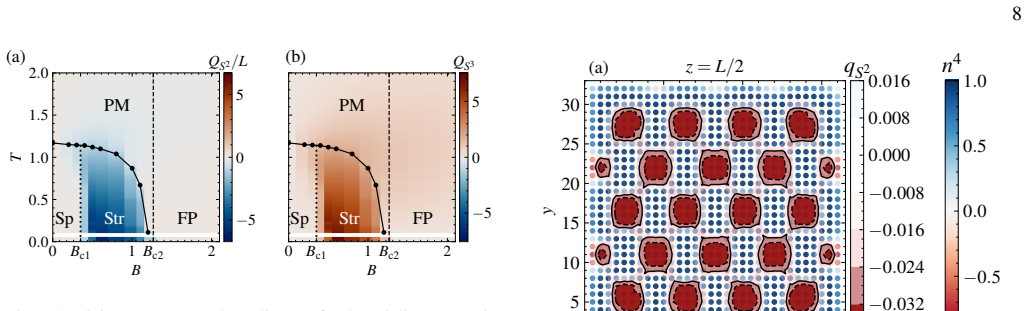
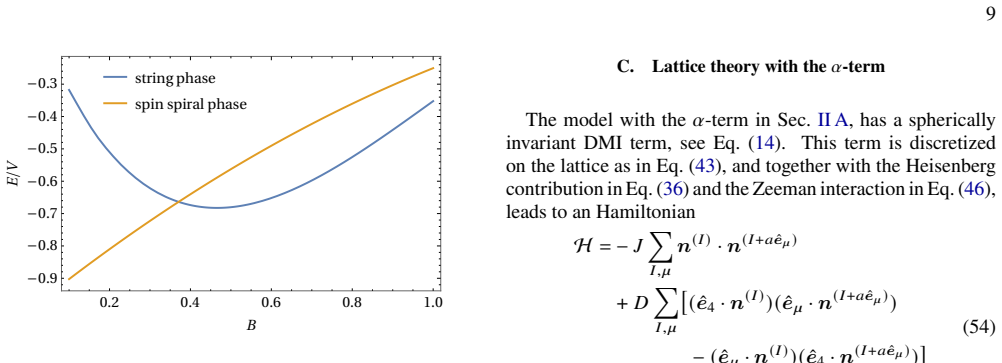
In theB=0 case and with periodic boundary conditions, this choice of values yields a spin-spiral ground state with known wavevectorK, as de- scribed in App. A 2. Different from the axial case, here we considered periodic boundary conditions. The finite temperature phase diagram together with the zero- temperature minimization results are shown in Fig. 5. ...
-
[2]
5(b), with𝐵 c3 ≈1.5
3D spherical Skyrmion lattice As the field decreases from large values, the system enters a Skyrmion lattice phase, highlighted by the positive-charge region around𝐵 c3 ≲𝐵≲𝐵 c4 in Fig. 5(b), with𝐵 c3 ≈1.5. This phase consists of an emergent lattice formed by spher- ical Skyrmions, as shown in Fig. 6(a). The Skyrmions ar- range themselves in a body-centere...
-
[3]
The phase diagram in Fig
String lattice If the field decreases below a certain threshold𝐵 c3, the Skyrmion lattice disappears. The phase diagram in Fig. 5(a)- (b) shows a region of vanishing𝜋 3 (𝑆 3)topological charge in the range 1.1≲𝐵≲1.5, with a simultaneous finite𝜋 2(𝑆 2) topological charge. Inspection of the low-temperature spin configurations reveals a string lattice phase....
-
[4]
5(b) in the range𝐵 c1 ≲𝐵≲𝐵 c2
AntiSkyrmion lattice Before reaching the spin-spiral phase at low fields, the sys- tem enters a different regime, characterized by negative𝜋3(𝑆 3) and𝜋 2 (𝑆 2)charges, see Fig. 5(b) in the range𝐵 c1 ≲𝐵≲𝐵 c2. 6 On the lattice, the angle is around 116◦. 12 (a) (b) (c) (d) Figure 9. Two types of string lattice obtained for𝐿=24 and (a)- (b)𝐵=1.2, (c)-(d)𝐵=1.1...
-
[5]
SFT 2024 - Lectures on Statistical Field Theories
direction. Only one plane is shown; however, the string lattice features stacked planes with the same features as the ones shown here. The strings oscillate around the average propagation direction. (d) The regions of direction-change are associated with a fractional 𝜋3 (𝑆 3)topological charge. Since the angle of the string knees is around 2𝜋/3, the expec...
2024
-
[6]
vortices
A. N. Bogdanov and D. A. Yablonskii, Thermodynamically sta- ble “vortices” in magnetically ordered crystals. The mixed state of magnets, Soviet Journal of Experimental and Theoretical Physics68, 101 (1989)
1989
-
[7]
Bogdanov, New localized solutions of the nonlinear field equations, Soviet Journal of Experimental and Theoretical Physics Letters62, 247 (1995)
A. Bogdanov, New localized solutions of the nonlinear field equations, Soviet Journal of Experimental and Theoretical Physics Letters62, 247 (1995)
1995
-
[8]
Nagaosa and Y
N. Nagaosa and Y. Tokura, Topological properties and dynamics of magnetic skyrmions, Nat. Nanotechnol.8, 899 (2013)
2013
-
[9]
M¨ uhlbauer, B
S. M¨ uhlbauer, B. Binz, F. Jonietz, C. Pfleiderer, A. Rosch, A. Neubauer, R. Georgii, and P. B ¨oni, Skyrmion lattice in a chiral magnet, Science323, 915 (2009)
2009
-
[10]
X. Z. Yu, Y. Onose, N. Kanazawa, J. H. Park, J. H. Han, Y. Mat- sui, N. Nagaosa, and Y. Tokura, Real-space observation of a two-dimensional skyrmion crystal, Nature465, 901 (2010)
2010
-
[11]
A. Fert, N. Reyren, and V. Cros, Magnetic skyrmions: advances in physics and potential applications, Nature Reviews Materials 2, 17031 (2017)
2017
-
[12]
Everschor-Sitte, J
K. Everschor-Sitte, J. Masell, R. M. Reeve, and M. Kl ¨aui, Per- spective: Magnetic skyrmions—Overview of recent progress in an active research field, Journal of Applied Physics124, 240901 (2018)
2018
-
[13]
Luo and L
S. Luo and L. You, Skyrmion devices for memory and logic applications, APL Materials9, 050901 (2021)
2021
-
[14]
Psaroudaki, E
C. Psaroudaki, E. Peraticos, and C. Panagopoulos, Skyrmion qubits: Challenges for future quantum computing applications, Applied Physics Letters123, 260501 (2023)
2023
-
[15]
T. H. R. Skyrme, A non-linear field theory, Proceedings of the Royal Society of London. Series A. Mathematical and Physical Sciences260, 127 (1961)
1961
-
[16]
T. H. R. Skyrme, A unified field theory of mesons and baryons, Nuclear Physics31, 556 (1962)
1962
-
[17]
U. K. R ¨oßler, A. N. Bogdanov, and C. Pfleiderer, Spontaneous skyrmion ground states in magnetic metals, Nature442, 797 (2006)
2006
-
[18]
Chiral Skyrmionic matter in non-centrosymmetric magnets
U. Rossler, A. A. Leonov, and A. N. Bogdanov, Chiral Skyrmionic matter in non-centrosymmetric magnets, J. Phys. Conf. Ser.303, 012105 (2011), arXiv:1009.4849 [cond-mat.str- el]
work page internal anchor Pith review Pith/arXiv arXiv 2011
-
[19]
Compact Skyrmions, Merons and Bimerons in Thin Chiral Magnetic Films
M. Ezawa, Compact Skyrmions, Merons and Bimerons in Thin Chiral Magnetic Films, Phys. Rev. B83, 100408 (2011), arXiv:1010.4119 [cond-mat.str-el]
work page internal anchor Pith review Pith/arXiv arXiv 2011
-
[20]
Enhanced Stability of Skyrmions in Two-Dimensional Chiral Magnets with Rashba Spin-Orbit Coupling
S. Banerjee, J. Rowland, O. Erten, and M. Randeria, Skyrmions in two-dimensional chiral magnets, Phys. Rev. X4, 031045 (2014), arXiv:1402.7082 [cond-mat.str-el]
work page internal anchor Pith review Pith/arXiv arXiv 2014
-
[21]
Melcher, Chiral skyrmions in the plane, Proceedings of the Royal Society A: Mathematical, Physical and Engineering Sci- ences470, 20140394 (2014)
C. Melcher, Chiral skyrmions in the plane, Proceedings of the Royal Society A: Mathematical, Physical and Engineering Sci- ences470, 20140394 (2014)
2014
-
[22]
F. N. Rybakov and N. S. Kiselev, Chiral magnetic skyrmions with arbitrary topological charge, Phys. Rev. B99, 064437 (2019), arXiv:1806.00782 [cond-mat.str-el]
work page internal anchor Pith review Pith/arXiv arXiv 2019
- [23]
-
[24]
B. Barton-Singer, C. Ross, and B. J. Schroers, Magnetic Skyrmions at Critical Coupling, Commun. Math. Phys.375, 2259 (2020), arXiv:1812.07268 [cond-mat.str-el]
- [25]
- [26]
-
[27]
D. Hill, V. Slastikov, and O. Tchernyshyov, Chiral magnetism: a geometric perspective, SciPost Phys.10, 078 (2021)
2021
-
[28]
B. Schroers, Solvable Models of Magnetic Skyrmions, in11th International Symposium on Quantum Theory and Symmetries (2019) arXiv:1910.13907 [cond-mat.mes-hall]
- [29]
-
[30]
F. Hanada and N. Sawado, A baby Skyrme model with anisotropic DM interaction: Compact skyrmions revisited, Nucl. Phys. B996, 116377 (2023), arXiv:2303.15751 [hep-th]
-
[31]
S. Bolognesi, S. B. Gudnason, and R. Menta, Magnetic skyrmions: From lumps to supercompactons, Phys. Rev. Res.6, 043162 (2024), arXiv:2406.03941 [cond-mat.mes-hall]
-
[32]
Barton-Singer, S
B. Barton-Singer, S. Bolognesi, S. B. Gudnason, and R. Menta, Moduli spaces and breather dynamics of analytic solutions in heisenberg exchange-free chiral magnets, Journal of Mathemat- ical Physics67, 021901 (2026)
2026
-
[33]
Zheng, Q
Y. Zheng, Q. Hu, X. Yu, H. Ji, I. Timoshuk, J. Garaud, H. Xu, Y. Li, Y. Gao, X. Lu, V. Grinenko, E. Babaev, N. F. Q. Yuan, R. Wu, B. Lv, C.-M. Yim, and H. Ding, Observation of quan- tum vortex core fractionalization and skyrmion formation in a superconductor, Science0, eads0189
-
[34]
Dzyaloshinsky, A thermodynamic theory of “weak” ferromag- netism of antiferromagnetics, Journal of Physics and Chemistry of Solids4, 241 (1958)
I. Dzyaloshinsky, A thermodynamic theory of “weak” ferromag- netism of antiferromagnetics, Journal of Physics and Chemistry of Solids4, 241 (1958)
1958
-
[35]
Moriya, Anisotropic superexchange interaction and weak fer- romagnetism, Phys
T. Moriya, Anisotropic superexchange interaction and weak fer- romagnetism, Phys. Rev.120, 91 (1960)
1960
-
[36]
Moriya, New mechanism of anisotropic superexchange inter- action, Phys
T. Moriya, New mechanism of anisotropic superexchange inter- action, Phys. Rev. Lett.4, 228 (1960)
1960
-
[37]
G. H. Derrick, Comments on nonlinear wave equations as mod- els for elementary particles, J. Math. Phys.5, 1252 (1964). 15
1964
-
[38]
G. E. Volovik and V. P. Mineev, Particle-like solitons in super- fluid 3he phases, Soviet Journal of Experimental and Theoretical Physics46, 401 (1977)
1977
-
[39]
G. E. Volovik,The Universe in a Helium Droplet(Oxford Uni- versity Press, 2009)
2009
-
[40]
D. M. Stamper-Kurn and M. Ueda, Spinor bose gases: Symme- tries, magnetism, and quantum dynamics, Rev. Mod. Phys.85, 1191 (2013)
2013
-
[41]
S. B. Gudnason, S. Bolognesi, and R. Menta, Higher- dimensional magnetic skyrmions, Journal of High Energy Physics2025, 16 (2025)
2025
-
[42]
Menta, Magnetic skyrmions and possible extensions, ETD (Master Thesis) University of Pisa (2023)
R. Menta, Magnetic skyrmions and possible extensions, ETD (Master Thesis) University of Pisa (2023)
2023
-
[43]
Metropolis, A
N. Metropolis, A. W. Rosenbluth, M. N. Rosen- bluth, A. H. Teller, and E. Teller, Equation of state calculations by fast computing machines, J. Chem. Phys.21, 1087 (1953), https://pubs.aip.org/aip/jcp/article- pdf/21/6/1087/18802390/1087 1 online.pdf
1953
-
[44]
Creutz, Overrelaxation and monte carlo simulation, Phys
M. Creutz, Overrelaxation and monte carlo simulation, Phys. Rev. D36, 515 (1987)
1987
-
[45]
Marinari and G
E. Marinari and G. Parisi, Simulated tempering: A new monte carlo scheme, Europhys. Lett.19, 451 (1992)
1992
-
[46]
K. Hukushima and K. Nemoto, Exchange monte carlo method and application to spin glass simulations, J. Phys. Soc. Jpn.65, 1604 (1996), https://doi.org/10.1143/JPSJ.65.1604
-
[47]
Hukushima, Domain-wall free energy of spin-glass models: Numerical method and boundary conditions, Phys
K. Hukushima, Domain-wall free energy of spin-glass models: Numerical method and boundary conditions, Phys. Rev. E60, 3606 (1999)
1999
-
[48]
Janssen, E
L. Janssen, E. C. Andrade, and M. Vojta, Honeycomb-lattice heisenberg-kitaev model in a magnetic field: Spin canting, meta- magnetism, and vortex crystals, Phys. Rev. Lett.117, 277202 (2016)
2016
-
[49]
http://www.nhr-verein.de/en/our-partners
- [50]
-
[51]
S. B. Gudnason and M. Nitta, Baryonic torii: Toroidal baryons in a generalized skyrme model, Phys. Rev. D91, 045027 (2015)
2015
-
[52]
Manton and P
N. Manton and P. Sutcliffe,Topological Solitons, Cambridge Monographs on Mathematical Physics (Cambridge University Press, 2004)
2004
-
[53]
J. M. Luttinger and L. Tisza, Theory of dipole interaction in crystals, Phys. Rev.70, 954 (1946)
1946
-
[54]
D. H. Lyons and T. A. Kaplan, Method for determining ground- state spin configurations, Phys. Rev.120, 1580 (1960)
1960
-
[55]
Litvin, The luttinger-tisza method, Physica77, 205 (1974)
D. Litvin, The luttinger-tisza method, Physica77, 205 (1974)
1974
-
[56]
J. H. Han,Skyrmions in condensed matter, Vol. 278 (Springer, 2017). Appendix A: Luttinger-Tisza method The Luttinger-Tisza method is a powerful tool for studying the ground-state configurations of classical bilinear spin sys- tems with periodic boundary conditions [48–50]. Consider a generic bilinear Hamiltonian H= 1 2 ∑︁ 𝑖, 𝑗 ∑︁ 𝜇,𝜈 n𝑖, 𝜇J𝑖, 𝜇, 𝑗,𝜈 n 𝑗,𝜈...
2017
-
[57]
(51) of Sec
Application to the axial case with the𝛽-term The Hamiltonian in Eq. (51) of Sec. III B, reduces to a bilinear Hamiltonian of the kind as in Eq. (A1) if the Zeeman field is zero. The cubic lattice is a three-dimensional Bravais lattice, so𝑑=3 and𝑝=1, and we can drop the sublattice indices. The interaction matrix in momentum space is given by Λ 𝛼𝛽 (k)=−2𝐽𝛿 ...
-
[58]
(54) reduces to a bilinear model as in Eq
Application to the spherical case with the𝛼-term The Hamiltonian in Eq. (54) reduces to a bilinear model as in Eq. (A1) if the Zeeman term vanishes. In the numerical calculations, we considered a three-dimensional cubic lattice, so𝑑=3 and𝑝=1, and we can drop the sublattice index also in this case. The 4×4 interaction matrix reads Λ 𝛼𝛽 (k)=−2𝐽𝛿 𝛼𝛽 3∑︁ 𝑎=1 ...
-
[59]
Solving Eq
Application to the axial case with the𝛽-term The model with the𝛽-term has a DM energy density E1 =𝐷𝑎 −2 ∑︁ 𝛼𝛽 𝜎𝜌 𝜖 𝛼𝛽 𝜎𝜌 Γ𝛼𝑛𝛽 𝜕𝜎𝑛𝜌 ,(B9) where we considered the vectorN=(0,0,0,1)and𝚪= (0,0,1,0). Solving Eq. (B8) and minimizing with respect to the wavevectorKleads to n0 = 𝐵 𝜅𝐷 N,𝚿= 1 2 √︄ 1− 𝐵 𝜅𝐷 2 © « −𝑖sin𝜃 𝑖cos𝜃 0 1 ª®®® ¬ , K=𝜅 © « cos𝜃 sin𝜃 0 ª® ¬...
-
[60]
Application to the spherical case with the𝛼-term In the𝛼-term model, the DM contribution reads E1 =𝐷𝑎 −2 ∑︁ 𝜇 𝑛4𝜕𝜇𝑛𝜇 −𝑛 𝜇𝜕𝜇𝑛4 .(B12) 18 The solution of Eq. (B8) together with the minimization with respect to the wavevectorKresults in a spin spiral n0 = 𝐵 𝜅𝐷 N,𝚿= 1 2 √︄ 1− 𝐵 𝜅𝐷 2 © « 𝑖sin𝜃cos𝜙 𝑖sin𝜃sin𝜙 𝑖cos𝜃 1 ª®®® ¬ , K=𝜅 © « sin𝜃cos𝜙 sin𝜃sin𝜙 cos𝜃 ª...
discussion (0)
Sign in with ORCID, Apple, or X to comment. Anyone can read and Pith papers without signing in.