REVIEW 2 major objections 2 minor 36 references
A Reproducible and Physically Feasible Dynamic Parameter Identification Framework for a Low-Cost Robot Arm
T0 review · 2 major / 2 minor · reviewed 2026-06-30 · grok-4.3
Pith's one-line read A staged pipeline of least-squares estimation, semidefinite projection, and closed-loop refinement yields physically feasible dynamic parameters for low-cost robot arms.
desk verdict This assembles a workable OLS-SDP-CLIE pipeline with symmetry reduction and inertia audit for the CRANE-X7, but the 65-to-39 parameter cut lacks a direct accuracy comparison. read the letter →
The pith
A machine-rendered reading of the paper's core claim, the machinery that carries it, and where it could break.
The reading
What carries the argument
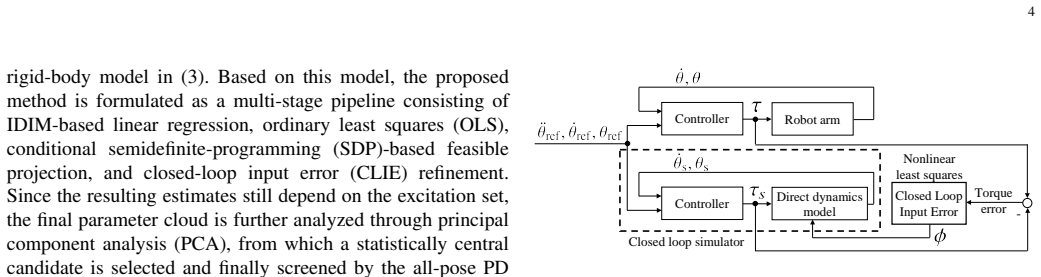
The staged identification pipeline of ordinary least squares regression, conditional semidefinite programming projection for feasibility recovery, closed-loop input error refinement, principal component analysis centrality selection, and all-pose inertia-matrix positive-definiteness audit.
What would settle it
If the final selected model produces large torque prediction errors on new validation trajectories or yields a non-positive-definite inertia matrix in any reachable pose, the claim that the pipeline delivers feasible and accurate parameters would be falsified.
Extended reading notes
Core claim
The central claim is that ordinary least squares estimates can be projected onto the physically feasible set by conditional semidefinite programming, refined by closed-loop input error minimization, and then selected via principal component centrality plus inertia-matrix auditing to produce a statistically representative and physically acceptable dynamic model that retains high predictive accuracy on held-out validation motions.
Load-bearing premise
Approximate symmetry of the robot links is sufficient to remove products of inertia without materially harming identifiability or predictive power.
Editorial extensions
If this is right
- Parameter estimates become progressively more concentrated after the semidefinite programming and closed-loop input error steps.
- The final accepted model maintains high predictive accuracy on held-out validation motions.
- The symmetry reduction to 39 base parameters preserves practical identifiability.
- Physical acceptability can be enforced by the inertia-matrix audit and, when needed, a localized post-refinement semidefinite programming rescue.
Reading between the lines
- The same sequence of symmetry reduction, structured motions, and staged projection could be applied to other modular-actuator manipulators.
- The method may lower the barrier to reliable dynamic models in settings without access to high-precision calibration rigs.
- Extending the principal component selection criterion to incorporate prediction uncertainty on validation data could further stabilize the final choice.
- Testing the accepted model inside closed-loop torque control would reveal whether feasibility translates into improved tracking performance.
Signed reviews
Editorial analysis
A structured set of objections, weighed in public.
Referee Report
Summary. The paper claims to present a reproducible framework for dynamic parameter identification on the low-cost CRANE-X7 arm. It reduces the rigid-body model from 65 to 39 base parameters by removing products of inertia under an approximate link-symmetry assumption, then applies OLS regression on hand-designed trajectories, SDP projection for physical feasibility, CLIE refinement, PCA-based selection of a statistically central candidate from 40 trajectories, and a final positive-definiteness audit with optional post-CLIE SDP rescue. Experiments are said to show progressive concentration of the parameter cloud across pipeline stages while the final model retains high predictive accuracy on held-out validation motions.
Significance. If the symmetry reduction and feasibility steps preserve predictive power without introducing bias, the work supplies a practical, end-to-end pipeline that combines statistical centrality, physical feasibility constraints, and reproducibility for low-cost manipulators. The explicit use of multiple structured trajectories, PCA visualization, and SDP rescue steps are concrete strengths that could be adopted by others working on similar platforms.
major comments (2)
- [Abstract / model reduction] Abstract and model-reduction paragraph: the claim that removing products of inertia via approximate link symmetry improves practical identifiability is load-bearing for the central result, yet no quantitative comparison (validation RMSE, condition number of the regressor, or parameter covariance) is supplied between the 39-parameter model and either the unreduced 65-parameter model or a version retaining selected products of inertia. Without this, it is impossible to verify that the reduction does not materially degrade held-out torque prediction or bias the subsequent OLS-SDP-CLIE pipeline.
- [Abstract / experimental results] Abstract and experimental-results paragraph: the statement that the final accepted model 'preserves high predictive accuracy on held-out validation motions' is not accompanied by explicit checks that the SDP projection or post-CLIE rescue steps do not increase validation error relative to the pre-correction OLS solution, nor by error bars or statistical tests on the reported accuracy. This directly affects the claim that the pipeline yields both feasible and accurate models.
minor comments (2)
- [Model section] Notation for the 39 base parameters after symmetry reduction should be defined explicitly (e.g., which products of inertia are set to zero and the resulting base-parameter vector) rather than left implicit.
- [Identification motions] The description of the 40 structured trajectories and the PCA space used for centrality selection would benefit from a table or figure caption that lists the exact motion primitives and the retained principal components.
Simulated Author's Rebuttal
We thank the referee for the constructive comments, which highlight areas where additional evidence would strengthen the manuscript. We address each major comment below and commit to revisions that directly respond to the concerns raised.
read point-by-point responses
-
Referee: [Abstract / model reduction] Abstract and model-reduction paragraph: the claim that removing products of inertia via approximate link symmetry improves practical identifiability is load-bearing for the central result, yet no quantitative comparison (validation RMSE, condition number of the regressor, or parameter covariance) is supplied between the 39-parameter model and either the unreduced 65-parameter model or a version retaining selected products of inertia. Without this, it is impossible to verify that the reduction does not materially degrade held-out torque prediction or bias the subsequent OLS-SDP-CLIE pipeline.
Authors: We agree that the absence of a direct quantitative comparison between the 39-parameter reduced model and the full 65-parameter model (or variants retaining selected products of inertia) leaves the identifiability improvement claim insufficiently supported. In the revised manuscript we will add side-by-side results on held-out validation motions, including validation RMSE, condition numbers of the regressor matrices, and parameter covariance estimates for both the reduced and unreduced models. These additions will allow readers to verify that the symmetry reduction does not materially degrade torque prediction accuracy. revision: yes
-
Referee: [Abstract / experimental results] Abstract and experimental-results paragraph: the statement that the final accepted model 'preserves high predictive accuracy on held-out validation motions' is not accompanied by explicit checks that the SDP projection or post-CLIE rescue steps do not increase validation error relative to the pre-correction OLS solution, nor by error bars or statistical tests on the reported accuracy. This directly affects the claim that the pipeline yields both feasible and accurate models.
Authors: We acknowledge that the manuscript does not currently provide explicit before-and-after comparisons of validation error for the SDP projection and post-CLIE rescue steps, nor does it include error bars or statistical tests. In revision we will insert these checks: validation RMSE values computed on the same held-out motions before and after each feasibility step, together with standard-error bars across the 40 trajectories and paired statistical tests (e.g., Wilcoxon signed-rank) to confirm that the corrections do not significantly increase prediction error. revision: yes
Circularity Check
No significant circularity; validation on held-out motions is independent
full rationale
The paper's pipeline fits parameters via OLS on identification trajectories, applies SDP projection and CLIE refinement, selects a central model from the resulting cloud, and reports predictive accuracy on separate held-out validation motions. The symmetry-based reduction (65 to 39 parameters) is an explicit modeling assumption stated upfront to improve identifiability, not derived from or equivalent to the fitted outputs. No self-citations, self-definitional equations, or fitted quantities renamed as independent predictions appear in the load-bearing claims. The held-out validation supplies an external benchmark, rendering the derivation self-contained against the reported metrics.
Assumptions & free parameters
free parameters (1)
- 39 base inertial parameters
assumptions (2)
- domain assumption Approximate link symmetry allows removal of products of inertia
- domain assumption Structured single-joint and adjacent-joint motions under joint-range limits are sufficiently exciting
Cite this review
Pith. "Pith review of A Reproducible and Physically Feasible Dynamic Parameter Identification Framework for a Low-Cost Robot Arm." pith.science (2026). https://pith.science/paper/ZVU2AEDI
@misc{pith2026260515949,
  author       = {Pith},
  title        = {Pith review of: A Reproducible and Physically Feasible Dynamic Parameter Identification Framework for a Low-Cost Robot Arm},
  year         = {2026},
  howpublished = {\url{https://pith.science/paper/ZVU2AEDI}},
  note         = {Machine review of arXiv:2605.15949}
}
read the original abstract
This paper presents a reproducible and physically feasible dynamic parameter identification framework for CRANE-X7, a low-cost robot arm driven by modular smart actuators. To improve practical identifiability, products of inertia are removed according to approximate link symmetry, reducing the rigid-body model from 65 to 39 base parameters. Identification motions are hand-designed from structured single-joint and adjacent-joint primitives under practical joint-range limits. The proposed pipeline combines preprocessing, inverse-dynamics-regressor-based ordinary least squares (OLS), conditional semidefinite-programming (SDP) projection for feasibility recovery, and closed-loop input error (CLIE) refinement. Candidate solutions from 40 structured trajectories are analyzed in a common principal component analysis (PCA) space to select a statistically central representative model. Because statistical centrality alone does not ensure physical acceptability, the selected model is finally screened by an all-pose positive-definiteness audit of the inertia matrix and, when necessary, corrected by a localized post-CLIE SDP rescue step. Experiments show that the parameter cloud becomes progressively more concentrated from OLS to SDP and CLIE, while the final accepted model preserves high predictive accuracy on held-out validation motions. These results demonstrate a practical route to statistically coherent and physically feasible dynamic models for low-cost robot platforms.
Figures


Figures from the paper (4 more)


Reference graph
Works this paper leans on
-
[1]
Learning fine-grained bimanual manipulation with low-cost hardware,
T. Z. Zhao, V . Kumar, S. Levine, and C. Finn, “Learning fine-grained bimanual manipulation with low-cost hardware,” inRobotics: Science and Systems, Daegu, Korea, Jul. 2023
work page 2023
-
[2]
Aloha 2: An enhanced low-cost hardware for bimanual teleoperation
ALOHA 2 Team, J. Aldaco, T. Armstrong, R. Baruch, J. Bingham, S. Chan, K. Draper, D. Dwibedi, C. Finn, P. Florence, S. Goodrich, W. Gramlich, T. Haarnoja, A. Herzog, J. Hoech, T. Nguyen, I. Pierson, T. Wahrburg, L. Wang, S. Young, Y . Lu, and S. Levine, “Aloha 2: An enhanced low-cost hardware for bimanual teleoperation,”arXiv preprint, arXiv:2405.02292 [c...
- [3]
-
[4]
ROBOTIS, “DYNAMIXEL X-Series e-Manual,” Online, 2026, avail- able: ROBOTIS e-Manual
work page 2026
-
[5]
K. Yamane, Y . Saigusa, S. Sakaino, and T. Tsuji, “Soft and rigid object grasping with cross-structure hand using bilateral control-based imitation learning,”IEEE Robotics and Automation Letters, vol. 9, no. 2, pp. 1198–1205, Feb. 2024
work page 2024
-
[6]
Motion retouch: Motion modifi- cation using four-channel bilateral control,
K. Inami, S. Sakaino, and T. Tsuji, “Motion retouch: Motion modifi- cation using four-channel bilateral control,” inProceedings of the 2025 IEEE International Conference on Mechatronics, Wollongong, Australia, Feb. 2025, pp. 1–6
work page 2025
-
[7]
K. Yamane, Y . Li, M. Konosu, K. Inami, J. Oaki, S. Sakaino, and T. Tsuji, “Design and experimental validation of sensorless 4-channel bilateral teleoperation for low-cost manipulators,”arXiv preprint, arXiv:2507.06174 [cs.RO], Jul. 2025
-
[8]
A new identification method for serial manipulator arms,
H. Mayeda, K. Osuka, and A. Kangawa, “A new identification method for serial manipulator arms,” inIFAC Proceedings Volumes, vol. 17, no. 2, Jul. 1984, pp. 2429–2434
work page 1984
Show all 36 references
-
[9]
Base parameters of manipulator dynamic models,
H. Mayeda, K. Yoshida, and K. Osuka, “Base parameters of manipulator dynamic models,”IEEE Transactions on Robotics and Automation, vol. 6, no. 3, pp. 312–321, Jun. 1990
1990
-
[10]
Direct calculation of minimum set of inertial parameters of serial robots,
M. Gautier and W. Khalil, “Direct calculation of minimum set of inertial parameters of serial robots,”IEEE Transactions on Robotics and Automation, vol. 6, no. 3, pp. 368–373, Jun. 1990
1990
-
[11]
Verification of the positive definiteness of the inertial matrix of manipulators using base inertial parameters,
K. Yoshida and W. Khalil, “Verification of the positive definiteness of the inertial matrix of manipulators using base inertial parameters,”The International Journal of Robotics Research, vol. 19, no. 5, pp. 498–510, May 2000
2000
-
[12]
Physical feasibility of robot base inertial parameter identification: A linear matrix inequality approach,
C. D. Sousa and R. Cortes ˜ao, “Physical feasibility of robot base inertial parameter identification: A linear matrix inequality approach,”The International Journal of Robotics Research, vol. 33, no. 6, pp. 931– 944, Feb. 2014
2014
-
[13]
Linear matrix inequalities for physically consistent inertial parameter identification: A statistical perspective on the mass distribution,
P. M. Wensing, S. Kim, and J.-J. E. Slotine, “Linear matrix inequalities for physically consistent inertial parameter identification: A statistical perspective on the mass distribution,”IEEE Robotics and Automation Letters, vol. 3, no. 1, pp. 60–67, Jan. 2018
2018
-
[14]
A new closed-loop output error method for parameter identification of robot dynamics,
M. Gautier, A. Janot, and P.-O. Vandanjon, “A new closed-loop output error method for parameter identification of robot dynamics,”IEEE Transactions on Control Systems Technology, vol. 21, no. 2, pp. 428– 444, Mar. 2013
2013
-
[15]
Stable robot manipulator pa- rameter identification: A closed-loop input error approach,
A. Perrusqu ´ıa, R. Garrido, and W. Yu, “Stable robot manipulator pa- rameter identification: A closed-loop input error approach,”Automatica, vol. 141, 110294, Jul. 2022
2022
-
[16]
Inertial parameter identification in robotics: A survey,
Q. Leboutet, J. Roux, A. Janot, J. R. Guadarrama-Olvera, and G. Cheng, “Inertial parameter identification in robotics: A survey,”Applied Sci- ences, vol. 11, no. 9, 4303, May 2021
2021
-
[17]
Opensymoro: An open-source software package for symbolic modelling of robots,
W. Khalil, A. Vijayalingam, B. Khomutenko, I. Mukhanov, P. Lemoine, and G. Ecorchard, “Opensymoro: An open-source software package for symbolic modelling of robots,” inProceedings of the 2014 IEEE/ASME International Conference on Advanced Intelligent Mechatronics, Besan- con, ...
2014
-
[18]
Khalil and E
W. Khalil and E. Dombre,Modeling, Identification and Control of Robots. London, UK: Hermes Penton Science, 2002
2002
-
[19]
Estimation of inertial parameters of manipulator loads and links,
C. G. Atkeson, C. H. An, and J. M. Hollerbach, “Estimation of inertial parameters of manipulator loads and links,”The International Journal of Robotics Research, vol. 5, no. 3, pp. 101–119, Sep. 1986
1986
-
[20]
Ex- perimental robot identification using optimised periodic trajectories,
J. Swevers, C. Ganseman, J. De Schutter, and H. Van Brussel, “Ex- perimental robot identification using optimised periodic trajectories,” Mechanical Systems and Signal Processing, vol. 10, no. 5, pp. 561– 577, Sep. 1996. 12
1996
-
[21]
Optimal robot excitation and identification,
J. Swevers, C. Ganseman, D. B. Tukel, J. De Schutter, and H. Van Brus- sel, “Optimal robot excitation and identification,”IEEE Transactions on Robotics and Automation, vol. 13, no. 5, pp. 730–740, Oct. 1997
1997
-
[22]
New criteria of exciting trajectories for robot identification,
C. Presse and M. Gautier, “New criteria of exciting trajectories for robot identification,” inProceedings of the 1993 IEEE International Conference on Robotics and Automation, Atlanta, Georgia, May 1993, pp. 907–912
1993
-
[23]
Fourier-based optimal excitation trajectories for the dynamic identification of robots,
K.-J. Park, “Fourier-based optimal excitation trajectories for the dynamic identification of robots,”Robotica, vol. 24, no. 5, pp. 625–633, Mar. 2006
2006
-
[24]
An overview of dynamic parameter iden- tification of robots,
J. Wu, J. Wang, and Z. You, “An overview of dynamic parameter iden- tification of robots,”Robotics and Computer-Integrated Manufacturing, vol. 26, no. 5, pp. 414–419, Oct. 2010
2010
-
[25]
Dynamic parameter identification in industrial robots considering physical feasibility,
V . Mata, F. Benimeli, N. Farhat, and A. Valera, “Dynamic parameter identification in industrial robots considering physical feasibility,”Ad- vanced Robotics, vol. 19, no. 1, pp. 101–119, Apr. 2005
2005
-
[26]
Parameter identification for industrial robots with a fast and robust trajectory design approach,
J. Jin and N. Gans, “Parameter identification for industrial robots with a fast and robust trajectory design approach,”Robotics and Computer- Integrated Manufacturing, vol. 31, pp. 21–29, Feb. 2015
2015
-
[27]
Inertia tensor properties in robot dy- namics identification: A linear matrix inequality approach,
C. D. Sousa and R. Cortes ˜ao, “Inertia tensor properties in robot dy- namics identification: A linear matrix inequality approach,”IEEE/ASME Transactions on Mechatronics, vol. 24, no. 1, pp. 406–411, Feb. 2019
2019
-
[28]
A lie-theory-based dynamic parameter identification methodology for serial manipulators,
Z. Fu, J. Pan, E. Spyrakos-Papastavridis, Y .-H. Lin, X. Zhou, X. Chen, and J. S. Dai, “A lie-theory-based dynamic parameter identification methodology for serial manipulators,”IEEE/ASME Transactions on Mechatronics, vol. 26, no. 5, pp. 2688–2699, Oct. 2021
2021
-
[29]
An optimal information method for mobile manipulator dynamic parameter identification,
V . A. Sujan and S. Dubowsky, “An optimal information method for mobile manipulator dynamic parameter identification,”IEEE/ASME Transactions on Mechatronics, vol. 8, no. 2, pp. 215–225, Jun. 2003
2003
-
[30]
Model-based control of a 3-dof parallel robot based on identified relevant parameters,
M. D ´ıaz-Rodr´ıguez, ´A. Valera, V . Mata, and M. Vall ´es, “Model-based control of a 3-dof parallel robot based on identified relevant parameters,” IEEE/ASME Transactions on Mechatronics, vol. 18, no. 6, pp. 1737– 1744, Dec. 2013
2013
-
[31]
Dynamic model identifi- cation for industrial robots,
J. Swevers, W. Verdonck, and J. De Schutter, “Dynamic model identifi- cation for industrial robots,”IEEE Control Systems Magazine, vol. 27, no. 5, pp. 58–71, Oct. 2007
2007
-
[32]
Sequential semidefinite optimization for physically and statistically consistent robot identification,
A. Janot and P. M. Wensing, “Sequential semidefinite optimization for physically and statistically consistent robot identification,”Control Engineering Practice, vol. 107, 104699, Feb. 2021
2021
-
[33]
Dynamic identification of the franka emika panda robot with retrieval of feasible parameters using penalty-based optimization,
C. Gaz, M. Cognetti, A. Oliva, P. R. Giordano, and A. D. Luca, “Dynamic identification of the franka emika panda robot with retrieval of feasible parameters using penalty-based optimization,”IEEE Robotics and Automation Letters, vol. 4, no. 4, pp. 4147–4154, Oct. 2019
2019
-
[34]
Dynamic identification of the kuka lbr iiwa robot with retrieval of physical parameters using global optimization,
T. Xu, J. Fan, Y . Chen, X. Ng, J. Marcelo H. Ang, Q. Fang, Y . Zhu, and J. Zhao, “Dynamic identification of the kuka lbr iiwa robot with retrieval of physical parameters using global optimization,”IEEE Access, vol. 8, pp. 108 018 – 108 031, Jun. 2020
2020
-
[35]
Dynamic parameter identifi- cation of serial robots using a hybrid approach,
Y . Huang, J. Ke, X. Zhang, and J. Ota, “Dynamic parameter identifi- cation of serial robots using a hybrid approach,”IEEE Transactions on Robotics, vol. 39, no. 2, pp. 1607–1621, Apr. 2023
2023
-
[36]
A convex optimization-based dynamic model identification package for the da vinci research kit,
Y . Wang, R. Gondokaryono, A. Munawar, and G. S. Fischer, “A convex optimization-based dynamic model identification package for the da vinci research kit,”IEEE Robotics and Automation Letters, vol. 4, no. 4, pp. 3657–3664, Oct. 2019
2019
Reviewed June 30, 2026 · model on record in the stance chip above.
Discussion (0). Continue with ORCID to comment.