Quantum Gravity Cutoff from Axions: A Type IIB Landscape Study
Pith reviewed 2026-06-26 13:21 UTC · model grok-4.3
The pith
Type IIB Calabi-Yau compactifications satisfy the axion bound on the quantum gravity cutoff even near Kähler moduli space boundaries.
A machine-rendered reading of the paper's core claim, the machinery that carries it, and where it could break.
Core claim
In Calabi-Yau compactifications of Type IIB string theory the bound Λ_QG ≲ 2π √S f holds for both C2 and C4 axions throughout the Kähler moduli space, including near boundaries where the co-scaling relationship for axion strings fails, as demonstrated by a combination of analytic arguments and numerical landscape scans.
What carries the argument
The inequality Λ_QG ≲ 2π √S f that relates the quantum gravity cutoff to an axion's decay constant f and its instanton action S.
If this is right
- The bound applies equally to C2 and C4 axions in these compactifications.
- The inequality remains valid near Kähler moduli space boundaries where co-scaling fails.
- The result supplies quantitative support for earlier naturalness and unitarity arguments that the bound is general.
- The same identification of the cutoff with the string scale is consistent across the scanned landscape.
Where Pith is reading between the lines
- Similar scans in other string theories or with different axion species could reveal whether the bound persists outside Type IIB.
- If the bound is universal it would restrict the allowed range of axion decay constants in any effective description of quantum gravity.
- Strongly coupled regimes or non-Calabi-Yau compactifications remain untested by the present methods and could furnish counter-examples.
Load-bearing premise
The quantum gravity cutoff can be identified with the string scale in the weakly coupled regime of Type IIB string theory.
What would settle it
A single point in the Kähler moduli space of any Calabi-Yau threefold where, for a C2 or C4 axion, the string scale exceeds 2π √S f.
Figures

read the original abstract
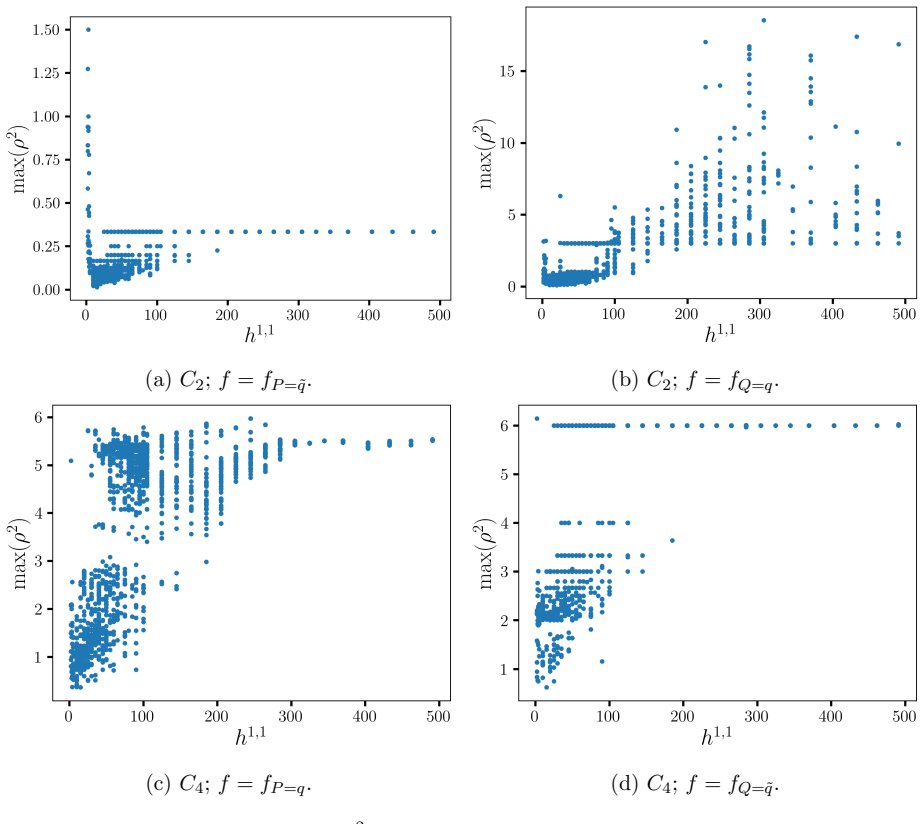
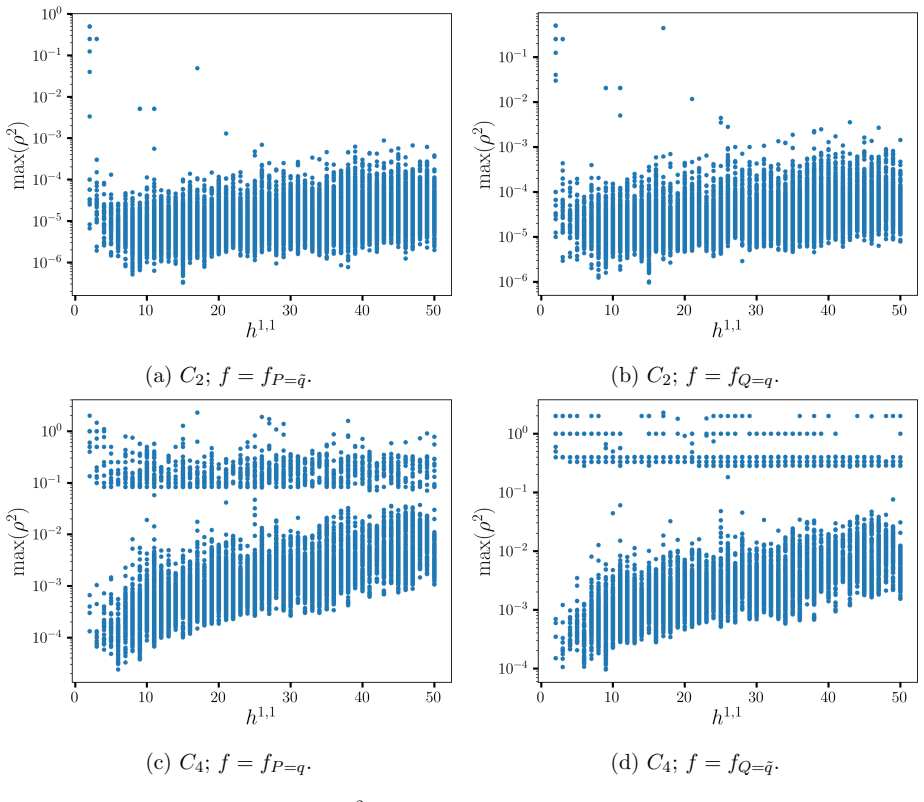
Extra-dimensional axions have coupling strength related to fundamental, ultraviolet physics. It has been proposed that the properties of such axions imply a bound on the quantum gravity cutoff: $\Lambda_\mathrm{QG} \lesssim 2\pi \sqrt{S} f$, where $f$ is the axion decay constant and $S$ is the instanton action. In the context of weakly-coupled string theory, we identify $\Lambda_\mathrm{QG}$ with the string scale $M_s$. In this paper, we carry out a quantitative study of this bound on the string scale in the context of Calabi-Yau compactifications of Type IIB string theory, considering both $C_2$ and $C_4$ axions. We show, both analytically and numerically, that the bound holds even near boundaries of the K\"ahler moduli space, including those where the co-scaling relationship for axion strings fails. This evidence bolsters previous arguments, based on naturalness and on unitarity, that the bound is a general feature of extra-dimensional axions in quantum gravity.
Editorial analysis
A structured set of objections, weighed in public.
Referee Report
Summary. The paper claims that in Type IIB Calabi-Yau compactifications, the bound Λ_QG ≲ 2π √S f on the quantum gravity cutoff (identified with the string scale M_s) holds for C2 and C4 axions. This is supported by analytic arguments and numerical scans over the Kähler moduli space, including near boundaries where the co-scaling relation for axion strings fails.
Significance. If the central identification and numerical evidence hold, the work supplies quantitative string-theory support for a proposed general bound on extra-dimensional axions, strengthening prior naturalness and unitarity arguments with landscape data.
major comments (1)
- [Abstract (and associated numerical sections)] The identification of Λ_QG with M_s is stated to apply in the weakly-coupled regime, yet the numerical scans (mentioned in the abstract) include points approaching Kähler boundaries where volumes are not parametrically large and α' corrections become O(1). This risks invalidating the cutoff identification via unaccounted KK modes or higher-derivative terms, so the evidence does not fully test the bound at those points.
minor comments (2)
- Clarify the precise range of Kähler volumes and string coupling values used in the scans to ensure they remain within the regime where the tree-level M_s identification is reliable.
- Add explicit statements on how the analytic arguments handle the transition to boundary regimes without relying on the co-scaling relation.
Simulated Author's Rebuttal
We thank the referee for their careful reading of the manuscript and for this constructive comment on the regime of validity of our results. We address the point below.
read point-by-point responses
-
Referee: [Abstract (and associated numerical sections)] The identification of Λ_QG with M_s is stated to apply in the weakly-coupled regime, yet the numerical scans (mentioned in the abstract) include points approaching Kähler boundaries where volumes are not parametrically large and α' corrections become O(1). This risks invalidating the cutoff identification via unaccounted KK modes or higher-derivative terms, so the evidence does not fully test the bound at those points.
Authors: We agree with the referee that the identification of the quantum gravity cutoff with the string scale is valid in the weakly-coupled regime where volumes are parametrically large. Our numerical scans are restricted to regions of the Kähler moduli space where the total volume satisfies Vol ≫ 1 (specifically, we impose Vol > 50), ensuring that α' corrections remain small even near the boundaries where some individual moduli approach zero. The string coupling is also fixed to be small. We will update the abstract and the relevant numerical sections to explicitly mention this volume cut and to discuss the suppression of KK modes and higher-derivative corrections. This revision will clarify that the evidence tests the bound in the controlled regime. revision: yes
Circularity Check
No significant circularity; verification is independent of the bound
full rationale
The paper states the identification of Λ_QG with M_s as an explicit modeling assumption in the weakly-coupled regime, then carries out separate analytic arguments and numerical scans over the Kähler moduli space of Calabi-Yau compactifications to test whether M_s ≲ 2π √S f continues to hold. These checks compare the string-scale cutoff against axion decay constants and instanton actions computed from the same geometry; the inequality is not imposed by construction, nor is any parameter fitted to the target bound and then relabeled a prediction. Self-citations appear only for motivational context and are not required to close the verification loop. The central result is therefore a genuine consistency test against the moduli-space geometry rather than a tautological reduction.
Axiom & Free-Parameter Ledger
axioms (1)
- domain assumption Identification of Λ_QG with the string scale M_s in weakly-coupled string theory
Reference graph
Works this paper leans on
-
[1]
Constraints Imposed by CP Conservation in the Presence of Instantons,
R. D. Peccei and H. R. Quinn, “Constraints Imposed by CP Conservation in the Presence of Instantons,”Phys. Rev.D16(1977) 1791–1797. 1
1977
-
[2]
CP Conservation in the Presence of Instantons,
R. D. Peccei and H. R. Quinn, “CP Conservation in the Presence of Instantons,” Phys. Rev. Lett.38(1977) 1440–1443. 1
1977
-
[3]
A New Light Boson?,
S. Weinberg, “A New Light Boson?,”Phys. Rev. Lett.40(1978) 223–226. 1
1978
-
[4]
Problem of Strong P and T Invariance in the Presence of Instantons,
F. Wilczek, “Problem of Strong P and T Invariance in the Presence of Instantons,” Phys. Rev. Lett.40(1978) 279–282. 1
1978
-
[5]
Cosmology of the Invisible Axion,
J. Preskill, M. B. Wise, and F. Wilczek, “Cosmology of the Invisible Axion,”Phys. Lett.120B(1983) 127–132. 1
1983
-
[6]
The Not So Harmless Axion,
M. Dine and W. Fischler, “The Not So Harmless Axion,”Phys. Lett.120B(1983) 137–141. 1
1983
-
[7]
A Cosmological Bound on the Invisible Axion,
L. F. Abbott and P. Sikivie, “A Cosmological Bound on the Invisible Axion,”Phys. Lett.120B(1983) 133–136. 1
1983
-
[8]
Some Properties of O(32) Superstrings,
E. Witten, “Some Properties of O(32) Superstrings,”Phys. Lett.149B(1984) 351–356. 1
1984
-
[9]
Harmful Axions in Superstring Models,
K. Choi and J. E. Kim, “Harmful Axions in Superstring Models,”Phys. Lett.154B (1985) 393. [Erratum: Phys. Lett.156B,452(1985)]. 1
1985
-
[10]
Harmless Axions in Superstring Theories,
S. M. Barr, “Harmless Axions in Superstring Theories,”Phys. Lett.158B(1985) 397–400. 1
1985
-
[11]
String Theory and the Strong CP Problem,
M. Dine and N. Seiberg, “String Theory and the Strong CP Problem,”Nucl. Phys. B 273(1986) 109–124. 1
1986
-
[12]
The Cosmology of string theoretic axions,
T. Banks and M. Dine, “The Cosmology of string theoretic axions,”Nucl. Phys. B 505(1997) 445–460,arXiv:hep-th/9608197. 1
Pith/arXiv arXiv 1997
-
[13]
A QCD axion from higher dimensional gauge field,
K.-w. Choi, “A QCD axion from higher dimensional gauge field,”Phys. Rev. Lett.92 (2004) 101602,arXiv:hep-ph/0308024. 1
Pith/arXiv arXiv 2004
-
[14]
The QCD axion and moduli stabilisation,
J. P. Conlon, “The QCD axion and moduli stabilisation,”JHEP05(2006) 078, arXiv:hep-th/0602233 [hep-th]. 1, 21 24
Pith/arXiv arXiv 2006
-
[15]
P. Svrcek and E. Witten, “Axions In String Theory,”JHEP06(2006) 051, arXiv:hep-th/0605206 [hep-th]. 1
Pith/arXiv arXiv 2006
-
[16]
A. Arvanitaki, S. Dimopoulos, S. Dubovsky, N. Kaloper, and J. March-Russell, “String Axiverse,”Phys. Rev. D81(2010) 123530,arXiv:0905.4720 [hep-th]. 1
Pith/arXiv arXiv 2010
-
[17]
An M Theory Solution to the Strong CP Problem and Constraints on the Axiverse,
B. S. Acharya, K. Bobkov, and P. Kumar, “An M Theory Solution to the Strong CP Problem and Constraints on the Axiverse,”JHEP11(2010) 105,arXiv:1004.5138 [hep-th]. 1
Pith/arXiv arXiv 2010
-
[18]
The type IIB string axiverse and its low-energy phenomenology,
M. Cicoli, M. Goodsell, and A. Ringwald, “The type IIB string axiverse and its low-energy phenomenology,”JHEP10(2012) 146,arXiv:1206.0819 [hep-th]. 1
Pith/arXiv arXiv 2012
-
[19]
M. Demirtas, C. Long, L. McAllister, and M. Stillman, “The Kreuzer-Skarke Axiverse,”JHEP04(2020) 138,arXiv:1808.01282 [hep-th]. 1, 3, 5, 8, 21
Pith/arXiv arXiv 2020
-
[20]
M. Demirtas, N. Gendler, C. Long, L. McAllister, and J. Moritz, “PQ axiverse,” JHEP06(2023) 092,arXiv:2112.04503 [hep-th]. 1, 5, 21
arXiv 2023
-
[21]
N. Gendler, D. J. E. Marsh, L. McAllister, and J. Moritz, “Glimmers from the axiverse,”JCAP09(2024) 071,arXiv:2309.13145 [hep-th]. 1, 5, 21
arXiv 2024
-
[22]
S. V. P. Fallon, J. Halverson, L. McAllister, and Y. Zhu, “F-theory Axiverse,” arXiv:2511.20458 [hep-th]. 1, 21
-
[23]
TASI Lectures: (No) Global Symmetries to Axion Physics,
M. Reece, “TASI Lectures: (No) Global Symmetries to Axion Physics,”PoS TASI2022(2024) 008,arXiv:2304.08512 [hep-ph]. 1
arXiv 2024
-
[24]
High-quality axions from higher-form symmetries in extra dimensions,
N. Craig and M. Kongsore, “High-quality axions from higher-form symmetries in extra dimensions,”Phys. Rev. D111no. 1, (2025) 015047,arXiv:2408.10295 [hep-ph]. 1
arXiv 2025
-
[25]
Extra-dimensional axion expectations,
M. Reece, “Extra-dimensional axion expectations,”JHEP07(2025) 130, arXiv:2406.08543 [hep-ph]. 1, 2, 3, 21
arXiv 2025
-
[26]
Axion-gauge coupling quantization with a twist,
M. Reece, “Axion-gauge coupling quantization with a twist,”JHEP10(2023) 116, arXiv:2309.03939 [hep-ph]. 1
arXiv 2023
-
[27]
Quantization of Axion-Gauge Couplings and Noninvertible Higher Symmetries,
Y. Choi, M. Forslund, H. T. Lam, and S.-H. Shao, “Quantization of Axion-Gauge Couplings and Noninvertible Higher Symmetries,”Phys. Rev. Lett.132no. 12, (2024) 121601,arXiv:2309.03937 [hep-ph]. 1
arXiv 2024
-
[28]
Axion domain walls, small instantons, and non-invertible symmetry breaking,
C. Cordova, S. Hong, and L.-T. Wang, “Axion domain walls, small instantons, and non-invertible symmetry breaking,”JHEP05(2024) 325,arXiv:2309.05636 [hep-ph]. 1
arXiv 2024
-
[29]
Opening the Axion Window,
D. B. Kaplan, “Opening the Axion Window,”Nucl. Phys. B260(1985) 215–226. 1 25
1985
-
[30]
Axion Couplings to Matter. 1. CP Conserving Parts,
M. Srednicki, “Axion Couplings to Matter. 1. CP Conserving Parts,”Nucl. Phys. B 260(1985) 689–700. 1
1985
-
[31]
Manifesting the Invisible Axion at Low-energies,
H. Georgi, D. B. Kaplan, and L. Randall, “Manifesting the Invisible Axion at Low-energies,”Phys. Lett. B169(1986) 73–78. 1
1986
-
[32]
G. Grilli di Cortona, E. Hardy, J. Pardo Vega, and G. Villadoro, “The QCD axion, precisely,”JHEP01(2016) 034,arXiv:1511.02867 [hep-ph]. 2
Pith/arXiv arXiv 2016
-
[33]
QCDθ-vacuum energy and axion properties,
Z.-Y. Lu, M.-L. Du, F.-K. Guo, U.-G. Meißner, and T. Vonk, “QCDθ-vacuum energy and axion properties,”JHEP05(2020) 001,arXiv:2003.01625 [hep-ph]. 2
arXiv 2020
-
[34]
R. Gao, Z.-H. Guo, J. A. Oller, and H.-Q. Zhou, “Axion-meson mixing in light of recent latticeη–η’ simulations and their two-photon couplings within U(3) chiral theory,”JHEP04(2023) 022,arXiv:2211.02867 [hep-ph]. 2
arXiv 2023
-
[35]
E. Meggiolaro and M. Tamburini, “New study of the interactions of the axion with mesons and photons using a chiral effective Lagrangian model,”Phys. Rev. D111 no. 9, (2025) 095024,arXiv:2502.13615 [hep-ph]. 2
arXiv 2025
-
[36]
The axion-photon coupling from lattice Quantum Chromodynamics,
B. B. Brandt, G. Endr˝ odi, J. J. Hern´ andez Hern´ andez, G. Mark´ o, and L. Pannullo, “The axion-photon coupling from lattice Quantum Chromodynamics,” arXiv:2603.29153 [hep-lat]. 2
-
[37]
Unitarity constraints on ALP interactions,
I. Brivio, O. J. P. ´Eboli, and M. C. Gonzalez-Garcia, “Unitarity constraints on ALP interactions,”Phys. Rev. D104no. 3, (2021) 035027,arXiv:2106.05977 [hep-ph]. 2
arXiv 2021
-
[38]
Photon Masses in the Landscape and the Swampland,
M. Reece, “Photon Masses in the Landscape and the Swampland,”JHEP07(2019) 181,arXiv:1808.09966 [hep-th]. 2
arXiv 2019
-
[39]
String theory and grand unification suggest a submicroelectronvolt QCD axion,
J. N. Benabou, K. Fraser, M. Reig, and B. R. Safdi, “String theory and grand unification suggest a submicroelectronvolt QCD axion,”Phys. Rev. D112no. 6, (2025) 066003,arXiv:2505.15884 [hep-ph]. 2, 3, 4, 5
arXiv 2025
-
[40]
Co-scaling and alignment of electric and magnetic towers,
M. Reece, T. Rudelius, and C. Tudball, “Co-scaling and alignment of electric and magnetic towers,”JHEP09(2025) 146,arXiv:2505.22713 [hep-th]. 2, 3, 4, 13, 16, 22
arXiv 2025
-
[41]
Large N bounds on, and compositeness limit of, gauge and gravitational interactions,
G. Veneziano, “Large N bounds on, and compositeness limit of, gauge and gravitational interactions,”JHEP06(2002) 051,arXiv:hep-th/0110129. 2
Pith/arXiv arXiv 2002
-
[42]
Axion species scale and axion weak gravity conjecture-like bound,
M.-S. Seo, “Axion species scale and axion weak gravity conjecture-like bound,”JHEP 11(2024) 082,arXiv:2407.16156 [hep-th]. 3
arXiv 2024
-
[43]
Wormholes in the axiverse, and the species scale,
L. Martucci, N. Risso, A. Valenti, and L. Vecchi, “Wormholes in the axiverse, and the species scale,”JHEP07(2024) 240,arXiv:2404.14489 [hep-th]. 3 26
arXiv 2024
-
[44]
Swampland Conjectures for Strings and Membranes,
S. Lanza, F. Marchesano, L. Martucci, and I. Valenzuela, “Swampland Conjectures for Strings and Membranes,”JHEP02(2021) 006,arXiv:2006.15154 [hep-th]. 3
arXiv 2021
-
[45]
Large Field Distances from EFT strings,
S. Lanza, F. Marchesano, L. Martucci, and I. Valenzuela, “Large Field Distances from EFT strings,”PoSCORFU2021(2022) 169,arXiv:2205.04532 [hep-th]. 3
arXiv 2022
-
[46]
Systematics of Axion Inflation in Calabi-Yau Hypersurfaces,
C. Long, L. McAllister, and J. Stout, “Systematics of Axion Inflation in Calabi-Yau Hypersurfaces,”JHEP02(2017) 014,arXiv:1603.01259 [hep-th]. 3, 8
Pith/arXiv arXiv 2017
-
[47]
Heterotic String Theory Suggests a QCD Axion Near 0.5 neV,
J. N. Benabou, G. A. Dainelli, M. Reig, and B. R. Safdi, “Heterotic String Theory Suggests a QCD Axion Near 0.5 neV,”arXiv:2605.04142 [hep-th]. 3
-
[48]
CYTools: A Software Package for Analyzing Calabi-Yau Manifolds,
M. Demirtas, A. Rios-Tascon, and L. McAllister, “CYTools: A Software Package for Analyzing Calabi-Yau Manifolds,”arXiv:2211.03823 [hep-th]. 3, 8
-
[49]
J. Cheng and N. Gendler, “Universality in the axiverse,”JHEP11(2025) 012, arXiv:2507.12516 [hep-th]. 3, 21
arXiv 2025
-
[50]
Chiral Dynamics in the Large n Limit,
P. Di Vecchia and G. Veneziano, “Chiral Dynamics in the Large n Limit,”Nucl. Phys. B171(1980) 253–272. 5
1980
-
[51]
Axion reheating in the string landscape,
J. Halverson, C. Long, B. Nelson, and G. Salinas, “Axion reheating in the string landscape,”Phys. Rev. D99no. 8, (2019) 086014,arXiv:1903.04495 [hep-th]. 5
Pith/arXiv arXiv 2019
-
[52]
Superradiance in string theory,
V. M. Mehta, M. Demirtas, C. Long, D. J. E. Marsh, L. McAllister, and M. J. Stott, “Superradiance in string theory,”JCAP07(2021) 033,arXiv:2103.06812 [hep-th]. 5, 21
arXiv 2021
-
[53]
On systems of linear indeterminate equations and congruences,
H. J. S. Smith, “On systems of linear indeterminate equations and congruences,” Proceedings of the Royal Society of Londonno. 11, (1862) 86–89. 5
-
[54]
Axion Periodicity and Coupling Quantization in the Presence of Mixing,
K. Fraser and M. Reece, “Axion Periodicity and Coupling Quantization in the Presence of Mixing,”JHEP05(2020) 066,arXiv:1910.11349 [hep-ph]. 5
arXiv 2020
-
[55]
Recent Progress in the Physics of Axions and Axion-Like Particles,
K. Choi, S. H. Im, and C. Sub Shin, “Recent Progress in the Physics of Axions and Axion-Like Particles,”Ann. Rev. Nucl. Part. Sci.71(2021) 225–252, arXiv:2012.05029 [hep-ph]. 5
arXiv 2021
-
[56]
Axion minima in string theory,
N. Gendler, O. Janssen, M. Kleban, J. La Madrid, and V. M. Mehta, “Axion minima in string theory,”JHEP02(2025) 134,arXiv:2309.01831 [hep-th]. 5
arXiv 2025
-
[57]
Towards string theory expectations for photon couplings to axionlike particles,
J. Halverson, C. Long, B. Nelson, and G. Salinas, “Towards string theory expectations for photon couplings to axionlike particles,”Phys. Rev. D100no. 10, (2019) 106010, arXiv:1909.05257 [hep-th]. 5, 21 27
arXiv 2019
-
[58]
C. Benoit, “Note sur une m´ ethode de r´ esolution des ´ equations normales provenant de l’application de la m´ ethode des moindres carr´ es ` a un syst` eme d’´ equations lin´ eaires en nombre inf´ erieur ` a celui des inconnues (Proc´ ed´ e du Commandant Cholesky),”Bulletin g´ eod´ esique2no. 1, (1924) 67–77. 6
1924
-
[59]
D. S. Watkins,Fundamentals of Matrix Computations. John Wiley & Sons, 2004. 6
2004
-
[60]
The String landscape, black holes and gravity as the weakest force,
N. Arkani-Hamed, L. Motl, A. Nicolis, and C. Vafa, “The String landscape, black holes and gravity as the weakest force,”JHEP0706(2007) 060, arXiv:hep-th/0601001 [hep-th]. 8, 14, 21
Pith/arXiv arXiv 2007
-
[61]
Constraints on Axion Inflation from the Weak Gravity Conjecture,
T. Rudelius, “Constraints on Axion Inflation from the Weak Gravity Conjecture,” JCAP09(2015) 020,arXiv:1503.00795 [hep-th]. 8
Pith/arXiv arXiv 2015
-
[62]
Fencing in the Swampland: Quantum Gravity Constraints on Large Field Inflation,
J. Brown, W. Cottrell, G. Shiu, and P. Soler, “Fencing in the Swampland: Quantum Gravity Constraints on Large Field Inflation,”JHEP10(2015) 023, arXiv:1503.04783 [hep-th]. 8, 20
Pith/arXiv arXiv 2015
-
[63]
D. Harlow, B. Heidenreich, M. Reece, and T. Rudelius, “Weak gravity conjecture,” Rev. Mod. Phys.95no. 3, (2023) 035003,arXiv:2201.08380 [hep-th]. 8
arXiv 2023
-
[64]
Positivity of the gravitational path integral implies the axionic weak gravity conjecture,
G. Di Ubaldo, L. V. Iliesiu, H. W. Lin, and C. Yan, “Positivity of the gravitational path integral implies the axionic weak gravity conjecture,”arXiv:2605.05305 [hep-th]. 8, 21
-
[65]
Wormholes and the imaginary distance bound,
J. Maldacena, A. Maloney, and B. McPeak, “Wormholes and the imaginary distance bound,”arXiv:2605.05336 [hep-th]. 8, 21
-
[66]
Sharpening the Supersymmetric Axion Weak Gravity Conjecture,
M. Etheredge, M. Reece, T. Rudelius, and C. Tudball, “Sharpening the Supersymmetric Axion Weak Gravity Conjecture,”arXiv:2605.22912 [hep-th]. 8
-
[67]
Axion inflation in type II string theory,
T. W. Grimm, “Axion inflation in type II string theory,”Phys. Rev. D77(2008) 126007,arXiv:0710.3883 [hep-th]. 8, 9, 10
Pith/arXiv arXiv 2008
-
[68]
Phase transitions in M theory and F theory,
E. Witten, “Phase transitions in M theory and F theory,”Nucl. Phys.B471(1996) 195–216,arXiv:hep-th/9603150 [hep-th]. 11
Pith/arXiv arXiv 1996
-
[69]
Emergent strings from infinite distance limits,
S.-J. Lee, W. Lerche, and T. Weigand, “Emergent strings from infinite distance limits,”JHEP02(2022) 190,arXiv:1910.01135 [hep-th]. 11, 14, 16
arXiv 2022
-
[70]
The Weak Gravity Conjecture and BPS Particles,
M. Alim, B. Heidenreich, and T. Rudelius, “The Weak Gravity Conjecture and BPS Particles,”Fortsch. Phys.69no. 11-12, (2021) 2100125,arXiv:2108.08309 [hep-th]. 11 28
arXiv 2021
-
[71]
Swampland conjectures and infinite flop chains,
C. R. Brodie, A. Constantin, A. Lukas, and F. Ruehle, “Swampland conjectures and infinite flop chains,”Phys. Rev. D104no. 4, (2021) 046008,arXiv:2104.03325 [hep-th]. 11
arXiv 2021
-
[72]
Moduli space reconstruction and Weak Gravity,
N. Gendler, B. Heidenreich, L. McAllister, J. Moritz, and T. Rudelius, “Moduli space reconstruction and Weak Gravity,”JHEP12(2023) 134,arXiv:2212.10573 [hep-th]. 11
arXiv 2023
-
[73]
The Weak Gravity Conjecture and BPS Strings,
B. Heidenreich, N. Pittman, and T. Rudelius, “The Weak Gravity Conjecture and BPS Strings,” 2026. to appear. 11, 14
2026
-
[74]
Swampland and the Geometry of Marked Moduli Spaces,
S. Raman and C. Vafa, “Swampland and the Geometry of Marked Moduli Spaces,” arXiv:2405.11611 [hep-th]. 12
-
[75]
Curvature divergences in 5dN= 1 supergravity,
A. Blanco, F. Marchesano, and L. Melotti, “Curvature divergences in 5dN= 1 supergravity,”JHEP11(2025) 026,arXiv:2505.05558 [hep-th]. 13
arXiv 2025
-
[76]
On the moduli space curvature at infinity,
F. Marchesano, L. Melotti, and L. Paoloni, “On the moduli space curvature at infinity,”JHEP02(2024) 103,arXiv:2311.07979 [hep-th]. 13
arXiv 2024
-
[77]
Asymptotic curvature divergences and non-gravitational theories,
F. Marchesano, L. Melotti, and M. Wiesner, “Asymptotic curvature divergences and non-gravitational theories,”JHEP02(2025) 151,arXiv:2409.02991 [hep-th]. 13
arXiv 2025
-
[78]
The Moduli Space Curvature and the Weak Gravity Conjecture,
A. Castellano, F. Marchesano, L. Melotti, and L. Paoloni, “The Moduli Space Curvature and the Weak Gravity Conjecture,”arXiv:2410.10966 [hep-th]. 13
-
[79]
Compactifications of moduli spaces inspired by mirror symmetry,
D. R. Morrison, “Compactifications of moduli spaces inspired by mirror symmetry,” in Journ´ ees de g´ eom´ etrie alg´ ebrique d’Orsay - Juillet 1992, no. 218 in Ast´ erisque. Soci´ et´ e math´ ematique de France, 1993.arXiv:alg-geom/9304007 [alg-geom]. http://www.numdam.org/item/AST_1993__218__243_0/. 14
Pith/arXiv arXiv 1992
-
[80]
D. R. Morrison, “Beyond the K¨ ahler Cone,” inProceedings of the Hirzebruch 65 Conference on Algebraic Geometry (Ramat Gan, 1993), pp. 361–376. 1994. arXiv:alg-geom/9407007 [alg-geom]. 14
Pith/arXiv arXiv 1993
discussion (0)
Sign in with ORCID, Apple, or X to comment. Anyone can read and Pith papers without signing in.