REVIEW 3 major objections 4 minor 72 references
A multi-technique detection of an eccentric giant planet around accelerating star HD 57625
T0 review · 3 major / 4 minor · reviewed 2026-08-11 · deepseek-v4-flash
Pith's one-line read Archival radial velocities and Hipparcos-Gaia proper motion data jointly reveal a giant planet, HD 57625 b, with a true mass of 8.4 Jupiter masses on a 5.7 AU eccentric orbit.
desk verdict A genuine multi-technique detection of a wide-orbit giant planet, whose true mass is conditional on a single-companion attribution of the proper-motion anomaly. read the letter →
The pith
A machine-rendered reading of the paper's core claim, the machinery that carries it, and where it could break.
The reading
What carries the argument
The proper motion anomaly (PMa) - the statistically significant difference between a star's long-term proper motion, measured by comparing Hipparcos and Gaia, and its short-term proper motion - is the astrometric signal that reveals the star is accelerating. The paper's central mechanism is a joint Markov-chain Monte Carlo fit that models the radial velocities and the PMa with the same single Keplerian orbit, producing orbital elements and a true mass rather than a minimum mass. The imaging contrast curves contribute a second, independent constraint by showing that no stellar or high-mass brown-dwarf companion could have escaped detection, leaving only the substellar-mass interpretation.
What would settle it
Measure one full radial-velocity orbit (the fitted period is roughly 4,850 days while the available data span 4,708 days) and obtain an independent astrometric orbit from future Gaia data. The single-Keplerian model predicts a specific position-angle track on the sky and a 43.8-degree inclination; if the new data require a different period, a second companion, or a different inclination, the claimed true mass of 8.4 Jupiter masses is wrong.
Extended reading notes
Core claim
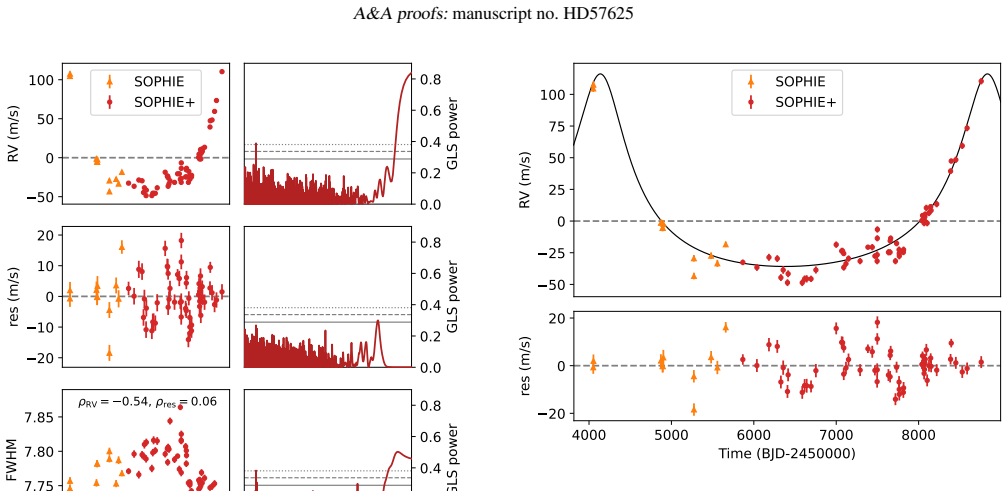
The paper's central claim is that the accelerating star HD 57625 hosts a genuine planetary-mass companion, HD 57625 b, with a dynamical mass of $8.43^{+1.10}_{-0.91}$ $M_{\rm Jup}$, a semimajor axis of $5.70^{+0.14}_{-0.13}$ au, and an eccentricity of $0.52^{+0.04}_{-0.03}$. The companion is responsible for both the long-term Keplerian trend visible in the archival radial velocities and the significant proper motion anomaly between Hipparcos and Gaia. Jointly fitting the two datasets yields an orbital inclination of $43.8^{+14.3}_{-7.2}$ degrees, which converts the radial-velocity minimum mass into a true mass and places the object firmly below the roughly 13 $M_{\rm Jup}$ deuterium-burning limit. The imaging non-detection sets contrast limits that exclude stellar and massive brown-dwarf companions, so the substellar interpretation is confirmed by three independent datasets.
Load-bearing premise
The detection assumes that the measured wobble in the star's radial velocity and the change in its motion across the sky are produced by one and the same unseen planet, and not by a second companion or by systematic errors in the merged star catalogs.
Editorial extensions
If this is right
- HD 57625 b becomes one of the few dozen outer giant planets with a true dynamical mass, so population studies can use it without the sin i degeneracy.
- Because the imaging observations rule out stellar and brown-dwarf companions at separations beyond about 5 au, the planetary interpretation of the RV and PMa signals is independently supported.
- The multi-technique completeness maps show that additional inner low-mass planets and wide-orbit giant planets could still be present, defining the discovery space for future observations.
- The estimated Kozai timescale, between about 2 and 39 million years, is much shorter than the star's 4.8-billion-year age, so the distant stellar companion is a plausible driver of the planet's high eccentricity if the mutual inclination exceeds about 39 degrees.
Reading between the lines
- If the same joint RV-plus-PMa analysis is applied to other accelerating stars with archival RV trends, the sample of outer giant planets with true masses could grow substantially without waiting for full-orbit RV coverage.
- The published relative astrometric orbit predicts where HD 57625 b should appear on the sky; an imaging observation with a smaller inner working angle, timed near the predicted position, could test the orbital solution directly.
- The moderately eccentric orbit and the presence of a wide stellar companion suggest that similar systems with PMa-detected giants may preferentially show Kozai-excited eccentricities; this is a testable prediction for the survey sample.
Editorial analysis
A structured set of objections, weighed in public.
Referee Report
Summary. The paper reports the first result of an ongoing SHARK-NIR high-contrast imaging survey of stars with significant proper-motion anomalies. For the F8 star HD 57625, the authors combine SHARK-NIR H-band and LBTI/LMIRCam L'-band imaging non-detections with archival SOPHIE radial velocities and the Hipparcos-Gaia proper-motion anomaly, modeled jointly with the orvara MCMC code. They report the detection of HD 57625 b, a giant planet with true mass 8.43(+1.10,-0.91) M_Jup, semi-major axis 5.70(+0.14,-0.13) au, and eccentricity 0.52(+0.04,-0.03). The imaging non-detection is used to exclude stellar and massive brown-dwarf companions, and a multi-technique injection-recovery completeness analysis is presented. The paper explicitly acknowledges the limited RV phase coverage and the resulting uncertainties in the RV-only orbital solution.
Significance. If the inferred parameters are correct, HD 57625 b is a useful addition to the small sample of wide-orbit giant planets with true masses determined by combining radial velocities and astrometry, and it demonstrates the scientific return of the SHARK-NIR survey. The paper's strengths are its explicit use of public datasets (SOPHIE, Hipparcos, Gaia), its quantitative MCMC treatment with orvara, and its injection-recovery completeness maps that combine imaging, RV, and astrometric data. The main weakness is that the true-mass and inclination claims rest on the untested assumption that the full proper-motion anomaly is produced by the single Keplerian companion detected in the RVs; the paper does not present a two-companion or extra-acceleration alternative model.
major comments (3)
- [Section 5, Table 4] The conversion of the RV-only minimum mass (5.79 M_Jup, Table 3) into the true mass (8.43 M_Jup) and inclination (43.8 deg) is entirely driven by the assumption in the joint orvara fit that the Hipparcos-Gaia proper-motion anomaly is produced by the same single Keplerian companion seen in the SOPHIE RVs. This assumption is not tested. The astrometric constraint is only an epoch-difference proper motion (Fig. 6), not a resolved orbit, so it cannot by itself distinguish one companion from two or from catalog systematics. Given that the RV baseline (4708 d) is shorter than the fitted period (~4843 d), that the RV-only K upper uncertainty is about 25%, and that the residual periodogram shows a 1300 d peak at 6% FAP (Section 4), a second companion or an additional acceleration contributing to the PMa is not excluded. Please add an explicit two-companion or extra-acceleration model comparison, or at least a quantitative bound on a possible second contribution, and state how the quoted M_b and i_b would change under such a model.
- [Section 5 and Table 1] The astrometric input used in the joint fit is not stated precisely enough. The paper initially quotes the Kervella et al. (2022) PMa with SNR 11.04 and uses that catalog for the sensitivity curve in Fig. 5, but it then says that orvara is designed to use the PMa from the Hipparcos-Gaia Catalog of Accelerations (HGCA, Brandt 2018, 2021). These catalogs have different cross-calibration treatments, and the adopted PMa values, uncertainties, and covariances directly affect the fitted inclination and true mass. Please state explicitly which PMa dataset was input to orvara and confirm that the Table 4 results are unchanged when the other catalog is used.
- [Section 4, Table 3] The RV-only posterior for the orbital period may be weakly constrained by the prior choice U(2000, 10000) d because the baseline is only 4708 d, close to the fitted period. The paper acknowledges the incomplete phase coverage, but it should also show that the quoted period uncertainty is not prior-dominated, for example by reporting the prior and posterior probability density functions for P_b or by testing a wider period prior. This is important because the joint solution's period and semi-major axis inherit the RV period information.
minor comments (4)
- [Figure 7 caption] The caption labels the green circles as the reference epochs for Hipparcos and Gaia DR3 (1991 and 2024), but the Gaia DR3 reference epoch is approximately 2016, while 2024 is the epoch of the imaging observation. Please correct this labeling.
- [Table 4] The prior line for inclination reads 'cos i, U(0, 180)', which is ambiguous. Please clarify whether the prior is uniform in cos i over [-1, 1] or uniform in i over [0, 180] degrees.
- [Section 5] In the discussion of the distant stellar companion, the statement that a 0.2 M_sun companion would produce the reported acceleration only at ~70 au appears to assume a circular orbit; please state this assumption explicitly.
- [Section 4] The residual periodogram peak at ~1300 d with FAP = 6% is described as non-significant, but given the paper's reliance on a single-Keplerian model, a sentence explaining why this peak cannot be due to a second companion would be helpful.
Circularity Check
No significant circularity: the true-mass result is a joint fit to independent external RV and astrometric datasets, not a quantity defined by its own inputs.
full rationale
The central claim, a true mass of 8.43 MJup for HD 57625 b, is obtained by fitting public SOPHIE radial velocities and the Hipparcos-Gaia proper motion anomaly with the orvara code (Brandt et al. 2021). The RV-only analysis independently yields a Keplerian with P = 4851 d, K = 78.94 m/s, e = 0.52, and a minimum mass of 5.79 MJup, and the joint RV+PMa fit adds the inclination and true mass. The PMa data are taken from external catalogs (Kervella et al. 2022; HGCA), not from an assumed value of the planet's mass, and the RV period and semi-amplitude are not constructed from the PMa. The imaging non-detection is used only to place upper limits and to support a substellar interpretation; it does not define the planet parameters. Self-citations in the paper concern instrument early-science results and a detection-completeness code used for the completeness maps, and they are not load-bearing for the detection or mass determination. The single-companion attribution of the PMa is a modeling premise, not a circular reduction: the paper contains no equation in which the predicted mass is an input to the same prediction, and no fitted parameter is renamed as a prediction. A second companion or catalog systematic could bias the derived inclination and true mass, but that is an ordinary assumption/risk and does not make the derivation circular. Therefore no circular steps are identified.
Assumptions & free parameters
free parameters (8)
- Orbital period P_b =
4843 +306/-167 d (joint fit)
- Planet mass M_b =
8.43 +1.10/-0.91 MJup
- Orbital eccentricity e_b =
0.52 +0.04/-0.03
- Orbital inclination i_b =
43.82 +14.30/-7.22 deg
- RV semi-amplitude K_b =
78.94 +19.87/-5.85 m/s (RV-only)
- Stellar mass M_star =
1.040 +0.078/-0.080 Msun
- Stellar age =
4.8 +3.7/-2.9 Ga
- RV zero-points and jitters (gamma, j for SOPHIE and SOPHIE+) =
gamma about 14.4 and 22.6 m/s; j about 9.5 and 6.9 m/s
assumptions (6)
- domain assumption A single Keplerian companion produces both the radial velocity variation and the Hipparcos-Gaia proper motion anomaly.
- domain assumption The Hipparcos-Gaia proper motion anomaly reported by Kervella et al. (2022) is an accurate measure of the star's astrometric acceleration.
- domain assumption The RV variations are not driven by stellar activity; the moderate correlations with FWHM and S_MW are unrelated periodicities.
- domain assumption MIST stellar evolution models and AMES-COND atmospheric models provide valid conversions from photometry, isochrones, and contrasts to stellar and companion masses.
- domain assumption The wide, roughly 0.2 Msun stellar companion at about 440 au does not contribute significantly to the observed RV or PMa signals.
- standard math Keplerian two-body orbital mechanics is the correct dynamical model for the RV and PMa fit.
Cite this review
Pith. "Pith review of A multi-technique detection of an eccentric giant planet around accelerating star HD 57625." pith.science (2026). https://pith.science/paper/ZWQXMKVU
@misc{pith2026241206404,
  author       = {Pith},
  title        = {Pith review of: A multi-technique detection of an eccentric giant planet around accelerating star HD 57625},
  year         = {2026},
  howpublished = {\url{https://pith.science/paper/ZWQXMKVU}},
  note         = {Machine review of arXiv:2412.06404}
}
abstract
The synergy between different detection methods is a key asset in exoplanetology, allowing for both precise characterization of detected exoplanets and robust constraints even in the case of non-detection. Recently, the interplay between imaging, radial velocities and astrometry has produced significant advancements in exoplanetary science. We report a first result of an ongoing survey performed with SHARK-NIR, the new high-contrast near-infrared imaging camera at the Large Binocular Telescope, in parallel with LBTI/LMIRCam in order to detect planetary companions around stars with significant proper motion anomaly. In this work we focus on HD 57625, a F8 star for which we determine a $4.8^{+3.7}_{-2.9}$Ga age, exhibiting significant astrometric acceleration and for which archival radial velocities hint at the presence of a previously undetected massive long-period companion. We analyse the imaging data we collected with SHARK-NIR and LMIRCam in synergy with the available public SOPHIE radial velocity time series and Hipparcos-Gaia proper motion anomaly. With this joint multi-technique analysis, we aim at characterizing the companion responsible for the astrometric and radial velocity signals. The imaging observations result in a non-detection, indicating the companion to be in the substellar regime. This is confirmed by the synergic analysis of archival radial velocity and astrometric measurements resulting in the detection of HD 57625 b, a ${8.43}_{-0.91}^{+1.10}$M$_{\rm Jup}$ planetary companion with an orbital separation of ${5.70}_{-0.13}^{+0.14}$au and ${0.52}_{-0.03}^{+0.04}$ eccentricity. HD 57625 b joins the small but growing population of giant planets in outer orbits with true mass determination provided by the synergic usage of multiple detection methods, proving once again the importance of multi-technique analysis in providing robust characterization of planetary companions.
Figures


Figures from the paper (5 more)


Reference graph
Works this paper leans on
-
[1]
Allard, F., Guillot, T., Ludwig, H.-G., et al. 2003, in IAU Symposium, V ol. 211, Brown Dwarfs, ed. E. Martín, 325
work page 2003
-
[2]
& Quanz, S
Amara, A. & Quanz, S. P. 2012, MNRAS, 427, 948
2012
-
[3]
2024, in Ground-based and Air- borne Instrumentation for Astronomy X, ed
Barbato, D., Farinato, J., Baru ffolo, A., et al. 2024, in Ground-based and Air- borne Instrumentation for Astronomy X, ed. J. J. Bryant, K. Motohara, & J. R. D. Vernet, V ol. 13096, International Society for Optics and Photonics (SPIE), 130961W
work page 2024
-
[4]
2023, A&A, 674, A114
Barbato, D., Ségransan, D., Udry, S., et al. 2023, A&A, 674, A114
2023
-
[5]
Barbato, D., Sozzetti, A., Biazzo, K., et al. 2019, A&A, 621, A110
work page 2019
-
[6]
2018, A&A, 615, A175
Barbato, D., Sozzetti, A., Desidera, S., et al. 2018, A&A, 615, A175
2018
-
[7]
Bonavita, M., Fontanive, C., Gratton, R., et al. 2022, MNRAS, 513, 5588
work page 2022
-
[8]
Bouchy, F., Díaz, R. F., Hébrard, G., et al. 2013, A&A, 549, A49
work page 2013
Show all 72 references
-
[9]
Brandt, T. D. 2018, ApJS, 239, 31
2018
-
[10]
Brandt, T. D. 2021, ApJS, 254, 42
2021
-
[11]
D., Dupuy, T
Brandt, T. D., Dupuy, T. J., Li, Y ., et al. 2021, AJ, 162, 186
2021
-
[12]
L., Knutson, H
Bryan, M. L., Knutson, H. A., Lee, E. J., et al. 2019, AJ, 157, 52
2019
-
[13]
& Janson, M
Calissendorff, P. & Janson, M. 2018, A&A, 615, A149
2018
-
[14]
Cannon, A. J. & Pickering, E. C. 1993, VizieR Online Data Catalog: Henry Draper Catalogue and Extension (Cannon + 1918-1924; ADC 1989), VizieR On-line Data Catalog: III/135A. Originally published in: Harv. Ann. 91-100 (1918-1924)
1993
-
[15]
2018, in Society of Photo-Optical In- strumentation Engineers (SPIE) Conference Series, V ol
Carolo, E., Vassallo, D., Farinato, J., et al. 2018, in Society of Photo-Optical In- strumentation Engineers (SPIE) Conference Series, V ol. 10701, Optical and Infrared Interferometry and Imaging VI, ed. M. J. Creech-Eakman, P. G. Tuthill, & A. Mérand, 107012B
2018
-
[16]
E., Wetherill, G
Chambers, J. E., Wetherill, G. W., & Boss, A. P. 1996, Icarus, 119, 261
1996
-
[17]
2016, ApJ, 823, 102
Choi, J., Dotter, A., Conroy, C., et al. 2016, ApJ, 823, 102
2016
-
[18]
D., Kuzuhara, M., et al
Currie, T., Brandt, T. D., Kuzuhara, M., et al. 2020, ApJ, 904, L25
2020
-
[19]
M., Skrutskie, M
Cutri, R. M., Skrutskie, M. F., van Dyk, S., et al. 2003, VizieR Online Data Catalog: 2MASS All-Sky Catalog of Point Sources (Cutri + 2003), VizieR On-line Data Catalog: II/246. Originally published in: 2003yCat.2246....0C
2003
-
[20]
M., Wright, E
Cutri, R. M., Wright, E. L., Conrow, T., et al. 2021, VizieR Online Data Catalog, II/328 De Rosa, R. J., Nielsen, E. L., Wahhaj, Z., et al. 2023, A&A, 672, A94
2021
-
[21]
S., Snik, F., Por, E
Doelman, D. S., Snik, F., Por, E. H., et al. 2021, Appl. Opt., 60, D52
2021
-
[22]
D., Rodriguez, J
Eastman, J. D., Rodriguez, J. E., Agol, E., et al. 2019, arXiv e-prints, arXiv:1907.09480
2019 arXiv
-
[23]
2022, in Society of Photo-Optical Instrumentation Engineers (SPIE) Conference Series, V ol
Farinato, J., Baruffolo, A., Bergomi, M., et al. 2022, in Society of Photo-Optical Instrumentation Engineers (SPIE) Conference Series, V ol. 12185, Adaptive Optics Systems VIII, ed. L. Schreiber, D. Schmidt, & E. Vernet, 1218522
2022
-
[24]
2023, in Adaptive Optics for Extremely Large Telescopes (AO4ELT7), 68
Farinato, J., Di Filippo, S., Baru ffolo, A., et al. 2023, in Adaptive Optics for Extremely Large Telescopes (AO4ELT7), 68
2023
-
[25]
B., Kozinsky, B., & Rasio, F
Ford, E. B., Kozinsky, B., & Rasio, F. A. 2000, ApJ, 535, 385
2000
-
[26]
W., Lang, D., & Goodman, J
Foreman-Mackey, D., Hogg, D. W., Lang, D., & Goodman, J. 2013, PASP, 125, 306
2013
-
[27]
P., Zhou, Y ., et al
Franson, K., Bowler, B. P., Zhou, Y ., et al. 2023, ApJ, 950, L19 Gaia Collaboration, Brown, A. G. A., Vallenari, A., et al. 2018, A&A, 616, A1 Gaia Collaboration, Prusti, T., de Bruijne, J. H. J., et al. 2016, A&A, 595, A1 Gaia Collaboration, Smart, R. L., Sarro, L. M., et al...
2023
-
[28]
2016, A&A, 594, A63 Głe ¸bocki, R
Galicher, R., Marois, C., Macintosh, B., et al. 2016, A&A, 594, A63 Głe ¸bocki, R. & Gnaci´nski, P. 2005, in ESA Special Publication, V ol. 560, 13th Cambridge Workshop on Cool Stars, Stellar Systems and the Sun, ed. F. Fa- vata, G. A. J. Hussain, & B. Battrick, 571 Gomes da S...
2016
-
[29]
2024, A&A, 685, A119
Gratton, R., Bonavita, M., Mesa, D., et al. 2024, A&A, 685, A119
2024
-
[30]
Y ., Bohn, A
Haffert, S. Y ., Bohn, A. J., de Boer, J., et al. 2019, Nature Astronomy, 3, 749
2019
-
[31]
D., et al
Hinkley, S., Lacour, S., Marleau, G. D., et al. 2023, A&A, 671, L5 Høg, E., Fabricius, C., Makarov, V . V ., et al. 2000, A&A, 355, L27
2023
-
[32]
A., Zheng, J
Innanen, K. A., Zheng, J. Q., Mikkola, S., & Valtonen, M. J. 1997, AJ, 113, 1915
1997
-
[33]
2018, A&A, 617, A44
Keppler, M., Benisty, M., Müller, A., et al. 2018, A&A, 617, A44
2018
-
[34]
2022, A&A, 657, A7
Kervella, P., Arenou, F., & Thévenin, F. 2022, A&A, 657, A7
2022
-
[35]
2013, ApJ, 774, 11
Kuzuhara, M., Tamura, M., Kudo, T., et al. 2013, ApJ, 774, 11
2013
-
[36]
M., Skrutskie, M
Leisenring, J. M., Skrutskie, M. F., Hinz, P. M., et al. 2012, in Ground-based and Airborne Instrumentation for Astronomy IV , ed. I. S. McLean, S. K. Ram- say, & H. Takami, V ol. 8446, International Society for Optics and Photonics (SPIE), 84464F
2012
-
[37]
& Ezzeddine, R
Li, Y . & Ezzeddine, R. 2023, AJ, 165, 145
2023
-
[38]
R., Barman, T., et al
Macintosh, B., Graham, J. R., Barman, T., et al. 2015, Science, 350, 64
2015
-
[39]
W., Louden, T., et al
Malavolta, L., Mayo, A. W., Louden, T., et al. 2018, AJ, 155, 107
2018
-
[40]
2016, A&A, 588, A118
Malavolta, L., Nascimbeni, V ., Piotto, G., et al. 2016, A&A, 588, A118
2016
-
[41]
Mamajek, E. E. & Hillenbrand, L. A. 2008, ApJ, 687, 1264
2008
-
[42]
2022, in Society of Photo-Optical Instrumentation Engineers (SPIE) Conference Series, V ol
Marafatto, L., Carolo, E., Umbriaco, G., et al. 2022, in Society of Photo-Optical Instrumentation Engineers (SPIE) Conference Series, V ol. 12184, Ground- based and Airborne Instrumentation for Astronomy IX, ed. C. J. Evans, J. J. Bryant, & K. Motohara, 121843V
2022
-
[43]
2006, ApJ, 641, 556
Marois, C., Lafrenière, D., Doyon, R., Macintosh, B., & Nadeau, D. 2006, ApJ, 641, 556
2006
-
[44]
2008, Science, 322, 1348
Marois, C., Macintosh, B., Barman, T., et al. 2008, Science, 322, 1348
2008
-
[45]
M., Macintosh, B., & Barman, T
Marois, C., Zuckerman, B., Konopacky, Q. M., Macintosh, B., & Barman, T. 2010, Nature, 468, 1080
2010
-
[46]
C., Bonnefoy, M., Xie, C., et al
Matthews, E. C., Bonnefoy, M., Xie, C., et al. 2023, A&A, 679, A58
2023
-
[47]
C., Carter, A
Matthews, E. C., Carter, A. L., Pathak, P., et al. 2024, Nature, 633, 789
2024
-
[48]
2022, A&A, 665, A73
Mesa, D., Bonavita, M., Benatti, S., et al. 2022, A&A, 665, A73
2022
-
[49]
2024, arXiv e-prints, arXiv:2412.04171
Mesa, D., Gratton, R., D’Orazi, V ., et al. 2024, arXiv e-prints, arXiv:2412.04171
2024 arXiv
-
[50]
2023, A&A, 672, A93
Mesa, D., Gratton, R., Kervella, P., et al. 2023, A&A, 672, A93
2023
-
[51]
R., Amara, A., Reggiani, M., & Quanz, S
Meyer, M. R., Amara, A., Reggiani, M., & Quanz, S. P. 2018, A&A, 612, L3
2018
-
[52]
A., Prugniel, P., & Soubiran, C
Moultaka, J., Ilovaisky, S. A., Prugniel, P., & Soubiran, C. 2004, PASP, 116, 693 Müller, A., Keppler, M., Henning, T., et al. 2018, A&A, 617, L2
2004
-
[53]
L., De Rosa, R
Nielsen, E. L., De Rosa, R. J., Macintosh, B., et al. 2019, AJ, 158, 13
2019
-
[54]
M., et al
Nowak, M., Lacour, S., Lagrange, A. M., et al. 2020, A&A, 642, L2
2020
-
[55]
W., Hartmann, L
Noyes, R. W., Hartmann, L. W., Baliunas, S. L., Duncan, D. K., & Vaughan, A. H. 1984, ApJ, 279, 763
1984
-
[56]
Pecaut, M. J. & Mamajek, E. E. 2013, ApJS, 208, 9
2013
-
[57]
2022, in Adaptive Optics Systems VIII, ed
Pedichini, F., Piazzesi, R., Viavattene, G., et al. 2022, in Adaptive Optics Systems VIII, ed. L. Schreiber, D. Schmidt, & E. Vernet, V ol. 12185, International Society for Optics and Photonics (SPIE), 121856Q
2022
-
[58]
2008, in Society of Photo-Optical In- strumentation Engineers (SPIE) Conference Series, V ol
Perruchot, S., Kohler, D., Bouchy, F., et al. 2008, in Society of Photo-Optical In- strumentation Engineers (SPIE) Conference Series, V ol. 7014, Ground-based and Airborne Instrumentation for Astronomy II, ed. I. S. McLean & M. M. Casali, 70140J
2008
-
[59]
2016, in Adaptive Optics Systems V , ed
Pinna, E., Esposito, S., Hinz, P., et al. 2016, in Adaptive Optics Systems V , ed. E. Marchetti, L. M. Close, & J.-P. Véran, V ol. 9909, International Society for Optics and Photonics (SPIE), 99093V
2016
-
[60]
2023, in Adaptive Optics for Extremely Large Telescopes (AO4ELT7), 80
Pinna, E., Rossi, F., Agapito, G., et al. 2023, in Adaptive Optics for Extremely Large Telescopes (AO4ELT7), 80
2023
-
[61]
N., Barnes, R., Veras, D., et al
Raymond, S. N., Barnes, R., Veras, D., et al. 2009, ApJ, 696, L98
2009
-
[62]
J., Knutson, H
Rosenthal, L. J., Knutson, H. A., Chachan, Y ., et al. 2022, ApJS, 262, 1
2022
-
[63]
F., Jones, T., Hinz, P., et al
Skrutskie, M. F., Jones, T., Hinz, P., et al. 2010, in Ground-based and Air- borne Instrumentation for Astronomy III, ed. I. S. McLean, S. K. Ramsay, & H. Takami, V ol. 7735, International Society for Optics and Photonics (SPIE), 77353H
2010
-
[64]
2018, A&A, 616, A7
Soubiran, C., Jasniewicz, G., Chemin, L., et al. 2018, A&A, 616, A7
2018
-
[65]
2012, ApJ, 755, L28
Soummer, R., Pueyo, L., & Larkin, J. 2012, ApJ, 755, L28
2012
-
[66]
& Price, K
Storn, R. & Price, K. 1997, Journal of Global Optimization, 11, 341
1997
-
[67]
& Rasio, F
Takeda, G. & Rasio, F. A. 2005, ApJ, 627, 1001
2005
-
[68]
1999, PASP, 111, 169 van Leeuwen, F
Torres, G. 1999, PASP, 111, 169 van Leeuwen, F. 2007, A&A, 474, 653
1999
-
[69]
2021, A&A, 651, A72 V oges, W., Aschenbach, B., Boller, T., et al
Vigan, A., Fontanive, C., Meyer, M., et al. 2021, A&A, 651, A72 V oges, W., Aschenbach, B., Boller, T., et al. 1999, A&A, 349, 389 V oges, W., Aschenbach, B., Boller, T., et al. 2000, IAU Circ., 7432, 3
2021
-
[70]
Weidenschilling, S. J. & Marzari, F. 1996, Nature, 384, 619
1996
-
[71]
& Murray, N
Wu, Y . & Murray, N. 2003, ApJ, 589, 605
2003
-
[72]
T., Girard, T
Zacharias, N., Finch, C. T., Girard, T. M., et al. 2012, VizieR Online Data Cata- log, I/322A Article number, page 12 of 12
2012
Reviewed August 11, 2026 · model on record in the stance chip above.
Discussion (0). Continue with ORCID to comment.