REVIEW 2 major objections 4 minor 1 cited by
Fully nonequilibrium Hall response from Berry curvature
T0 review · 2 major / 4 minor · reviewed 2026-08-12 · deepseek-v4-flash
Pith's one-line read For inversion-broken semimetals with microscopic time-reversal symmetry, the spontaneous Hall current crosses over from quadratic to quasi-linear scaling in a fully nonequilibrium regime, and a once-per-cycle response appears without…
desk verdict The DC and even-harmonic non-perturbative Hall result is solid and worth engaging; the 1ω claim is built on an assumed relaxation-time asymmetry and should be read as a proposal, not a derivation. read the letter →
The pith
A machine-rendered reading of the paper's core claim, the machinery that carries it, and where it could break.
The reading
What carries the argument
The central object is the fully nonequilibrium (FNE) regime signalled by the ratio $\epsilon = k_E/k_{BC}$, where $k_E=eE\tau_0/\hbar$ is the momentum shift an electric field imparts over one relaxation time and $k_{BC}$ is the shortest distance, along the field, between the extrema of the Berry curvature density and the Fermi surface. The argument is carried by the Boltzmann equation in the relaxation-time approximation, solved directly in $E$ rather than expanded perturbatively, together with a self-consistent collision integral that makes the relaxation time depend on momentum and field. The odd-harmonic response is generated by the minimal asymmetric form $1/\tau(k)=1/\tau_0+\alpha(E)\,\mathrm{sign}(\hat{E}\cdot k)$, with $\alpha(E)=\alpha_0(E\cos\omega t)^2$ used for the explicit calculations; this form is motivated in the paper by self-consistent solutions of two 1D ansatz relaxation-time models.
What would settle it
Solve the coupled Boltzmann and collision-integral equations numerically for the 2D model of Eq. (8) with a finite-range impurity potential and check whether $\gamma(k,E)=1/\tau(k,E)$ satisfies $\gamma(k,E)\neq\gamma(-k,E)$. In parallel, measure the DC and $1\omega$ spontaneous Hall current in a candidate TRS-preserving inversion-broken semimetal: the central claim predicts $J_y/E$ flattening for $k_E\gtrsim k_{BC}$ and a nonzero $1\omega$ channel growing as $E^5$ at weak fields for $\alpha\propto E^2$. If no odd harmonic appears, or if the DC response keeps its weak-field scaling beyond $k_E\sim k_{BC}$, the fully nonequilibrium mechanism is ruled out.
Extended reading notes
Core claim
The central claim is that the spontaneous Hall response in time-reversal-symmetric, inversion-broken semimetals has a fully nonequilibrium regime in which the reference electronic state is itself out of equilibrium and the Hall current is no longer controlled by the Berry curvature dipole. In this regime the occupation of states carrying large Berry curvature density is substantially reorganized by the field, all moments of the Berry curvature contribute comparably, and the DC Hall current scales quasi-linearly with $E$ over an extended range of moderately strong fields. For AC driving, the even harmonics ($0\omega$ and $2\omega$) show the same crossover, while the field-induced momentum-space asymmetry of the relaxation time makes odd harmonics, in particular $1\omega$, nonzero even with microscopic TRS; for the minimal form $\alpha(E)=\alpha_0(E\cos\omega t)^2$, the weak-field $1\omega$ current scales as $E^5$. The authors argue that this universality extends to systems where higher Berry multipoles dominate the weak-field response, such as a $C_4T$-symmetric metal whose Berry quadrupole gives $E^3$ at weak fields, and that the mechanism is realized in three-dimensional non-centrosymmetric Weyl semimetals viewed as stacks of 2D planes.
Load-bearing premise
The argument stands on the assumption that a strong electric field makes the impurity-scattering relaxation time momentum-asymmetric in the two-sided form $1/\tau(k)=1/\tau_0+\alpha(E)\,\mathrm{sign}(\hat{E}\cdot k)$; this asymmetry is illustrated with 1D toy models and ansatz forms but is not derived from the microscopic collision integral in the actual 2D models, so if the true asymmetry is weaker or has a different momentum dependence, the odd-harmonic prediction changes or disappears.
Editorial extensions
If this is right
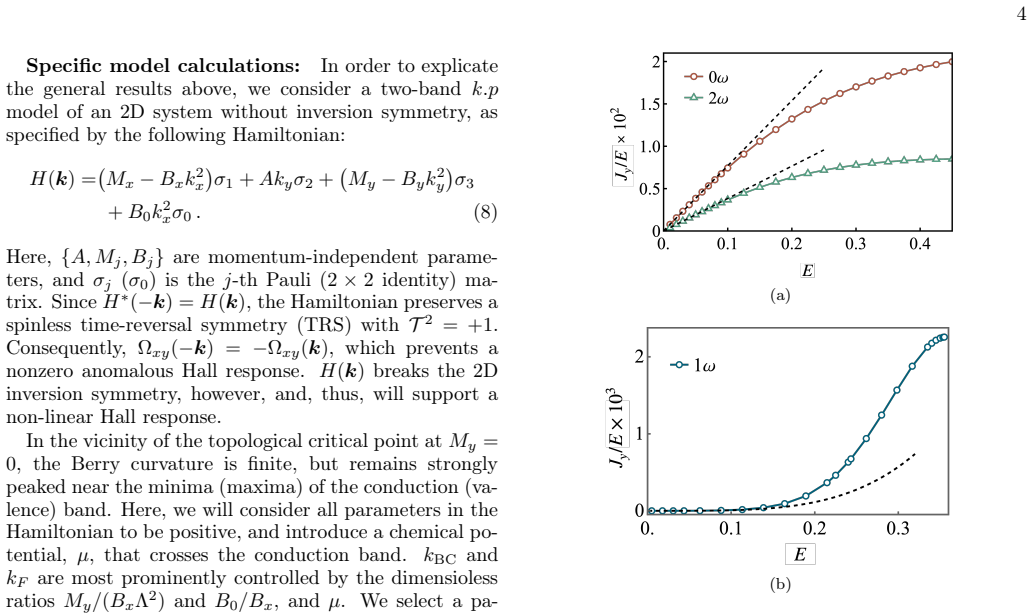
- If the central claim is right, the spontaneous DC Hall conductivity $J_y/E$ of a TRS-preserving, inversion-broken semimetal will be proportional to $E$ only at weak fields; for $k_E\gtrsim k_{BC}$ it becomes nearly $E$-independent, mimicking an anomalous Hall effect without magnetic order.
- The $0\omega$ and $2\omega$ AC Hall channels inherit the same crossover, so multi-harmonic transport measurements can locate the FNE regime by the field strength at which the quadratic scaling saturates.
- A nonzero $1\omega$ spontaneous Hall response is predicted to appear without broken TRS once the field-driven relaxation-time asymmetry is present, and its weak-field exponent carries information about how $\alpha(E)$ depends on $E$.
- The same breakdown of the multipole expansion applies regardless of which Berry-multipole moment dominates at weak fields, so the quasi-linear strong-field response is a generic signature of non-centrosymmetric semimetals.
- The results connect directly to the observed large spontaneous Hall and $1\omega$ signals in Weyl-Kondo semimetals and provide a target for strongly correlated topological semimetals.
Reading between the lines
- Inference: the prediction that the odd-harmonic Hall response is proportional to a positive power of $|\alpha(E)|$ suggests a new diagnostic, namely that measuring the field and frequency dependence of the $1\omega$ channel can map the microscopic field-induced anisotropy of impurity scattering.
- Inference: because the crossover scale $k_{BC}$ is set by how close the Berry curvature extrema sit to the Fermi surface, chemical-potential tuning should move the crossover field $E^*$; comparing the measured $E^*$ with the band-structure-derived $k_{BC}$ would test the mechanism.
- Inference: in moir\'e materials, whose small Brillouin zones lower the momentum scale $\Lambda$, modest electric fields may reach $k_E\sim k_{BC}$, making them candidate platforms for observing quasi-linear nonlinear Hall and odd harmonics at accessible voltages.
Editorial analysis
A structured set of objections, weighed in public.
Referee Report
Summary. The manuscript develops a Boltzmann-equation approach to the spontaneous Hall effect in time-reversal-symmetric, inversion-broken semimetals driven by a strong electric field. The authors solve the DC Boltzmann equation non-perturbatively (with τ = τ0) and find that the Hall current crosses over from the weak-field Berry-curvature-dipole scaling to a quasi-linear E scaling when the field-induced momentum scale kE exceeds the scale kBC set by the Berry curvature distribution. They extend the solution to AC fields and obtain even-harmonic responses; they then introduce a field-induced momentum-space asymmetry in the relaxation time, Eq. (7), which produces a nonzero 1ω Hall response despite microscopic TRS. The results are illustrated with a two-band k.p model and a C4T-symmetric model, and are motivated by experiments on Weyl-Kondo semimetals.
Significance. If correct, the DC and even-harmonic AC results constitute an important advance: they go beyond the weak-field nonlinear Hall paradigm of Sodemann and Fu, provide a concrete breakdown criterion kE ~ kBC, and are supported by an exact solution of the Boltzmann equation (Eq. B3) and a perturbative breakdown analysis (Appendix B). The odd-harmonic mechanism is potentially significant for understanding the 1ω response in Ce3Bi4Pd3, but it is not established at the same level because it relies on an assumed form of the relaxation-time asymmetry; the paper is transparent about the dependence of the E^5 scaling on this choice. The manuscript's strengths include closed-form zero-temperature distribution functions, explicit numerical demonstrations in two models, and a clear separation of the weak-field and FNE regimes.
major comments (2)
- [Eq. (7) and Appendix C] The 1ω Hall response is a headline result (Abstract, Introduction, Conclusion), yet it rests entirely on the assumed relaxation-time asymmetry 1/τ(k) = 1/τ0 + α(E) sign(Ê·k) with α(E) = α0(E cosωt)^2, Eq. (7). The derivation in Appendix A is performed only for a 1D parabolic band, and the self-consistent fits in Eq. (A23) yield γ1(E) = Σ_{j=1}^4 b_j E^j, which includes a linear-in-E term b1E; the main text sets b1 = 0 and all a_{j≥1} = 0 without showing that the 2D k.p model of Eq. (8)/(D3) produces the same sign(k_x) structure with leading E^2 weight. As shown in Appendix C, the 1ω current comes from the odd-in-k parts of ar{g}_0 and ar{g}_2, so any different momentum dependence of γ—e.g., a smooth function instead of sign(Ê·k), or a nonzero b1—changes both the amplitude and the weak-field scaling of ar{J}_y^{(1)}. The E^5 scaling displayed in Fig. 3(b) is therefore a consequence of the chosen ansatz rather than a derived prediction, a point the authors concede in the sentence 'the precise weak-field scaling of ar{J}_y^{(1)} with E is determined by the form of non-uniformity present in the relaxation time.' To support the abstract's claim that the relaxation time 'generates an 1ω response, even in the presence of microscopic TRS,' the manuscript should either compute τ(k,E) self-consistently for the actual 2D models (numerically, along the lines of Appendix A) or explicitly reframe the odd-ω result as a scenario contingent on a microscopic input that remains to be supplied.
- [Eq. (6) and Sec. 'Odd-ω vs. even-ω response'] Equation (6) solves the Boltzmann equation as a differential equation in f(k0,t) with a relaxation time written as τ(t), but the relaxation time in Eq. (7) depends on k through sign(Ê·k). As printed, Eq. (6) and the definition A_s(t) = exp{s ∫ dt'/τ(t')} treat τ as independent of k0, in which case the k-asymmetry that generates the odd harmonics would not enter the solution at all. The authors should state explicitly that τ(t) in Eq. (6) denotes τ(k0,t) and specify whether sign(Ê·k) is evaluated at the initial momentum k0 or at the time-dependent momentum k(t) = k0 − x̂(kE/τ0ω) sinωt. This is necessary to reproduce the numerical results in Fig. 3(b).
minor comments (4)
- [Eq. (3b)] The collision integral in Eq. (3b) appears to have the factor [f(k,t) − f0(k)] in the numerator, which would make 1/τ vanish at equilibrium. The expression used in the self-consistent derivation, Eq. (A8), has γ(k,E) g(k,E) = (2π/ħ)∫dk′ δ(...)|U|^2 [g(k)−g(k′)]. Please check the typesetting of Eq. (3b) and ensure it matches Eq. (A8).
- [Abstract and text] There are several typographical errors: 'spontaneoous' in the abstract and 'dimensioless' near Fig. 1 should be 'spontaneous' and 'dimensionless', respectively; in the Introduction the phrase 'not odd ink' should be 'not odd in k'.
- [Fig. 3(b) caption] The caption states '¯Jy/E ∼ E^4 (dashed curve), which depends on our choice of α(E) = α0E^2 [cf. Eq. (7)].' This is helpful, but the main text should also make clear that this scaling is not a robust prediction of the formalism but a property of the chosen ansatz, as is done in the sentence preceding Fig. 3(b).
- [Appendix A, Fig. S1 caption] The caption notes that γ± should be expressed as γ±(kx, E, T, µ), but the ansatz in Eq. (A15) depends on kx only through sign(kx); the notation could be simplified or clarified to avoid implying a continuous kx dependence.
Circularity Check
Quantitative 1ω Hall scaling is fixed by an explicitly chosen α(E)∝E^2 ansatz, not by the 2D model; the qualitative odd-ω response and the DC/even-AC FNE results are self-contained.
-
other
[Main text 'Odd-ω vs. even-ω response', Eq. (7); 'Specific model calculations', Fig. 3(b); Appendix C.2, Eq. (C11)]
"Based on the explicit solution of the 1D case, we choose α(E) = α0(E cos ωt)^2 with α0 > 0 being a model-dependent constant. ... For the form of non-uniform τ considered in the main text, all a_{j≥1}=0 but b_j's are finite. Therefore, only the third terms in the expressions of ¯g0 and ¯g2 contribute to the Hall current through the ¯γ2 dependence. Since this term ∼ E^4, the 1ω component of the Hall current will scale as E^5."
The E^5 scaling is not derived for the 2D k.p model; it is produced by choosing α(E)=α0(E cosωt)^2 in Eq. (7) and setting a_{j≥1}=0 and b1=0. Appendix A's own 1D fit (A23) gives γ1(E)=Σ_{j=1}^4 b_jE^j, with a generically nonzero b1, so dropping the linear term is a choice, not a derivation. Odd harmonics come only from odd-in-k parts of ¯g0 and ¯g2 (Appendix C), so any other power of E in the sign-asymmetric τ changes the scaling; the paper concedes 'the precise weak-field scaling of J̄_y^(1) ... is determined by the form of non-uniformity present in the relaxation time.' Hence J̄_y^(1)∼E^5 is equivalent by construction to the assumed ansatz, not an independent prediction. The qualitative odd-ω claim is broader and not circular.
full rationale
The central DC quasi-linear Hall response and the even-ω AC channels are obtained by direct solution of the Boltzmann equation with stated τ=τ0 and by numerical evaluation of the 2D k.p model; they reproduce known perturbative limits (E^2 dipole scaling, E^3 quadrupole scaling) and therefore are not circular. The qualitative odd-ω result also follows from the stated input that an E-field induces an odd-in-k component of 1/τ, and Appendix A gives a self-consistent 1D demonstration (within two explicit ansätze) that such asymmetry arises. The circularity is confined to the specific quantitative claim J̄_y^(1)∼E^5: this scaling is imposed by choosing α(E)=α0(E cosωt)^2 and setting b1=0, even though the 1D fit in Eq. (A23) contains a linear term. The paper itself flags that the scaling is set by the form of the non-uniformity, so this is not a hidden circularity, but it is a case where a 'prediction' reduces by construction to an assumed ansatz. This does not undermine the DC, even-AC, or qualitative odd-ω claims.
Assumptions & free parameters
free parameters (4)
- α0 in Eq. (7): 1/τ(k)=1/τ0+α(E) sign(Ê·k) =
unspecified positive constant
- Polynomial fit coefficients a_j, b_j for γ0(E), γ1(E) =
obtained by numerical fit (Figs. S1, S2)
- Two-band k.p model parameters (δ, Δ, a, b, w, µ, B0/Bx, k_F) =
chosen; e.g., k_F=0.1Λ, k_BC/k_F=0.12 or 0.76
- C4T-symmetric model parameters =
Δ=1.98, t1/t3=0.05, t2/t3=0.5, t0/t3=0.1, µ=0.055
assumptions (6)
- domain assumption Bloch electrons obey the semiclassical Boltzmann equation with the field entering as -eE/ħ · ∇_k f and the Berry curvature contributing to the transverse current.
- domain assumption The collision integral is dominated by elastic impurity scattering and can be treated in a relaxation-time approximation with a single field-dependent τ.
- domain assumption The partially filled band is well isolated and the band gap is the largest energy scale.
- ad hoc to paper The field-induced relaxation-time asymmetry has the form 1/τ(k)=1/τ0+α(E) sign(Ê·k) with α(E)=α0(E cosωt)^2.
- domain assumption A time-periodic steady state exists after t0/τ0 >> 1.
- standard math TRS with T^2=+1 and inversion breaking gives odd Berry curvature Ω_xy(-k) = -Ω_xy(k).
Cite this review
Pith. "Pith review of Fully nonequilibrium Hall response from Berry curvature." pith.science (2026). https://pith.science/paper/ZXHKACUT
@misc{pith2026241116675,
  author       = {Pith},
  title        = {Pith review of: Fully nonequilibrium Hall response from Berry curvature},
  year         = {2026},
  howpublished = {\url{https://pith.science/paper/ZXHKACUT}},
  note         = {Machine review of arXiv:2411.16675}
}
read the original abstract
In topological materials, Berry curvature leads to intrinsic Hall responses. Focusing on time-reversal symmetric systems with broken inversion symmetry, a spontaneoous (zero magnetic field) Hall effect is expected to develop under an applied electric field. Motivated by recent developments in Weyl-Kondo semimetals, here we advance a fully nonequilibrium (FNE) Hall response due to the Berry curvature. In particular, we show that, while the spontaneous Hall current is quadratic in the previously described regime of weak electric field, due to the contribution from the dipole moment of the Berry curvature, the FNE Hall response for non-perturbative electric fields is not controlled by the Berry curvature dipole. Remarkably, the FNE Hall response resembles what happens in systems that break the microscopic time-reversal symmetry. We illustrate the universality of these results by comparing them with their counterparts in systems with any higher-multipole of the Berry curvature. The implications of our results for the understanding of strongly correlated topological semimetals are discussed.
Figures


Forward citations
Cited by 1 Pith paper
-
Disorder-driven Weyl-Kondo Semimetal Phase in WTe$_2$
Disordered WTe2 shows Kondo-like resistivity upturns and a disorder-enhanced zero-field Hall voltage, interpreted as a Weyl-Kondo semimetal phase.
Reference graph
Works this paper leans on
- [1]
-
[2]
W. Witczak-Krempa, G. Chen, Y. B. Kim, and L. Ba- lents, Annu. Rev. Condens. Matter Phys.5, 57 (2014)
work page 2014
-
[3]
H.-H. Lai, S. E. Grefe, S. Paschen, and Q. Si, Proceed- ings of the National Academy of Sciences115, 93 (2018), https://www.pnas.org/doi/pdf/10.1073/pnas.1715851115
-
[4]
L. Chen, C. Setty, H. Hu, M. G. Vergniory, S. E. Grefe, L. Fischer, X. Yan, G. Eguchi, A. Prokofiev, S. Paschen, J. Cano, and Q. Si, Nature Physics18, 1341 (2022)
work page 2022
-
[5]
S. Dzsaber, L. Prochaska, A. Sidorenko, G. Eguchi, R. Svagera, M. Waas, A. Prokofiev, Q. Si, and S. Paschen, Phys. Rev. Lett.118, 246601 (2017)
work page 2017
-
[6]
S. Dzsaber, X. Yan, M. Taupin, G. Eguchi, A. Prokofiev, T. Shiroka, P. Blaha, O. Rubel, S. E. Grefe, H.-H. Lai, Q. Si, and S. Paschen, Proceedings of the Na- tional Academy of Sciences 118, e2013386118 (2021), https://www.pnas.org/doi/pdf/10.1073/pnas.2013386118
-
[7]
S. E. Grefe, H.-H. Lai, S. Paschen, and Q. Si, Phys. Rev. B 101, 075138 (2020)
work page 2020
-
[8]
T. Jungwirth, Q. Niu, and A. MacDonald, Physical re- view letters88, 207208 (2002)
work page 2002
Show all 44 references
-
[9]
Z. Fang, N. Nagaosa, K. S. Takahashi, A. Asamitsu, R. Mathieu, T. Ogasawara, H. Yamada, M. Kawasaki, Y. Tokura, and K. Terakura, Science302, 92 (2003)
2003
-
[10]
Y. Yao, L. Kleinman, A. MacDonald, J. Sinova, T. Jung- wirth, D.-s. Wang, E. Wang, and Q. Niu, Physical review letters 92, 037204 (2004)
2004
-
[11]
Thonhauser, D
T. Thonhauser, D. Ceresoli, D. Vanderbilt, and R. Resta, Physical review letters95, 137205 (2005). 6
2005
-
[12]
D. Xiao, Y. Yao, Z. Fang, and Q. Niu, Physical review letters 97, 026603 (2006)
2006
-
[13]
D. Xiao, M. C. Chang, and Q. Niu, Rev. Mod. Phys.82, 1959 (2010)
2010
-
[14]
Nagaosa, J
N. Nagaosa, J. Sinova, S. Onoda, A. H. MacDonald, and N. P. Ong, Reviews of modern physics82, 1539 (2010)
2010
- [15]
-
[16]
Sodemann and L
I. Sodemann and L. Fu, Physical review letters 115, 216806 (2015)
2015
-
[17]
T. Low, Y. Jiang, and F. Guinea, Physical Review B92, 235447 (2015)
2015
-
[18]
Zhang, X.-J
C.-P. Zhang, X.-J. Gao, Y.-M. Xie, H. C. Po, and K. T. Law, Physical Review B107, 115142 (2023)
2023
-
[19]
Nakai and N
R. Nakai and N. Nagaosa, Physical Review B99, 115201 (2019)
2019
-
[20]
C. Zeng, S. Nandy, A. Taraphder, and S. Tewari, Physi- cal Review B100, 245102 (2019)
2019
-
[21]
C. Zeng, S. Nandy, and S. Tewari, Physical Review Re- search 2, 032066 (2020)
2020
-
[22]
Yu, Z.-G
X.-Q. Yu, Z.-G. Zhu, J.-S. You, T. Low, and G. Su, Physical Review B99, 201410 (2019)
2019
-
[23]
Ma, S.-Y
Q. Ma, S.-Y. Xu, H. Shen, D. MacNeill, V. Fatemi, T.-R. Chang, A. M. Mier Valdivia, S. Wu, Z. Du, C.-H. Hsu, et al., Nature565, 337 (2019)
2019
-
[24]
K. Kang, T. Li, E. Sohn, J. Shan, and K. F. Mak, Nature materials 18, 324 (2019)
2019
-
[25]
Qin et al., Chin
M.-S. Qin et al., Chin. Phys. Lett.38, 017301 (2021)
2021
-
[26]
Tiwariet al., Nat
A. Tiwariet al., Nat. Commun.12, 2049 (2021)
2021
- [27]
-
[28]
Kiswandhi and T
A. Kiswandhi and T. Osada, Journal of Physics: Con- densed Matter34, 105602 (2021)
2021
-
[29]
P. He, H. Isobe, D. Zhu, C.-H. Hsu, L. Fu, and H. Yang, Nature Communications12, 698 (2021)
2021
-
[30]
Kumar et al., Nat
D. Kumar et al., Nat. Nanotechnol.16, 421 (2021)
2021
-
[31]
Ho et al., Nat
S.-C. Ho et al., Nat. Electron.4, 116 (2021)
2021
-
[32]
See the ‘Supplemental Materials’ for more details on (i) the non-uniformity of relaxation time; (ii) spontaneous DC and AC Hall responses; (iii) the Hamiltonians used to produce the results
-
[33]
Thus, the contribution ofJy(t) to ¯J (2n+1) y is exponentially suppressed att ≫ τ∗ ∼ τ0
In the limit where the relaxation time is a constant, τ (t) = τ∗, we observe that Jy(t + π/ω) = Jy(t) + e−t/τ∗ I(t). Thus, the contribution ofJy(t) to ¯J (2n+1) y is exponentially suppressed att ≫ τ∗ ∼ τ0. Therefore, for a spatiotemporally uniform relaxation time only even har...
-
[34]
Morimoto and N
T. Morimoto and N. Nagaosa, Scientific reports8, 2973 (2018)
2018
-
[35]
V. T. Phong and E. Mele, Physical Review Letters130, 266601 (2023)
2023
-
[36]
De Beule, S
C. De Beule, S. Gassner, S. Talkington, and E. Mele, Physical Review B109, 235421 (2024)
2024
-
[37]
Classical and Quantum Hall Ef- fects
S. M. Blinder, “Classical and Quantum Hall Ef- fects”, https://demonstrations.wolfram.com/ ClassicalAndQuantumHallEffects, Wolfram Demon- strations Project
-
[38]
This limiting case also captures the essential aspects of higherdimensionalmetalsbecausethecomponentsofmo- mentum perpendicular to the applied field act like a label in the Boltzmann equation
-
[39]
1 − g(˜k′ x, E) g(˜kx, E) # (A11) = Λ 2¯hεΛ|˜kx|
Both Mx and My could be madekz-dependent, but such a model would be unitarily equivalent to the one we write here. 7 Appendix A: Non-uniformity of relaxation time due to an applied field In this section, through a self-consistent solution of the electron distribution function ...
-
[40]
Breakdown of perturbative expansion in the DC limit In this section we demonstrate the breakdown of the perturbative expansion inkE of the anomalous Hall current in the DC limit. For the leading order non-vanishing term in the expansion (say, at ordern = n0) to be a good appro...
-
[41]
¯γ1¯g0 + ¯γ0¯g1 + 1 2 X n=1 (¯γn+1¯gn + ¯γn¯gn+1) # = γE 2 2∂˜kx f0 + 2∂˜kx ¯g0 + ∂˜kx ¯g2 e2iωt : 2 iω¯g2 +
Zero-temperature limit of DC response We begin by noting that in the finite-T expression of g in the main text the∂˜qf0 term in the integrand is a result of the fact that we expressedf = f0 + g. Its presence only represents this mathematically convenient decomposition of f, si...
-
[42]
Further, we need to set¯γ0 = 1/τ0
Uniform relaxation time approximation The conventional perturbative results for up to2ω AC Hall response [16] can be obtained by setting all¯gn≥3 = 0, and ¯γn≥1 = 0 with the assumption that these produce higher-orderE dependence. Further, we need to set¯γ0 = 1/τ0. Thus from th...
-
[43]
To obtain the expression ofγ in the AC limit we generalizeE → E cos (ωt)
Non-uniform relaxation time Motivated by the results in Section A, we employ a relaxation time whose inverse is of the form 1 τ (k, E) = γ(k, E) = NX j=0 ajEj +sign( ˆE · k) NX j=1 bjEj, (C9) where E = E ˆE and a0 = 1/τ0. To obtain the expression ofγ in the AC limit we general...
-
[44]
correlation length
Non-perturbative solution in E The above process fails beyond the asymptotically weak-E limit, even if we set γ(t, ˜k, E) = 1 /τ0, due to the coupling among all nω harmonics of g [this can be readily deduced by attempting to solve for ¯gn’s via Eq. C6]. Thus, a general solutio...
Reviewed August 12, 2026 · model on record in the stance chip above.
Discussion (0). Continue with ORCID to comment.